lock BMW Z8 2000 Owner's Manual
[x] Cancel search | Manufacturer: BMW, Model Year: 2000, Model line: Z8, Model: BMW Z8 2000Pages: 172, PDF Size: 1.9 MB
Page 42 of 172
41n
IndexDataTechnologyRepairsCar careControlsOverview
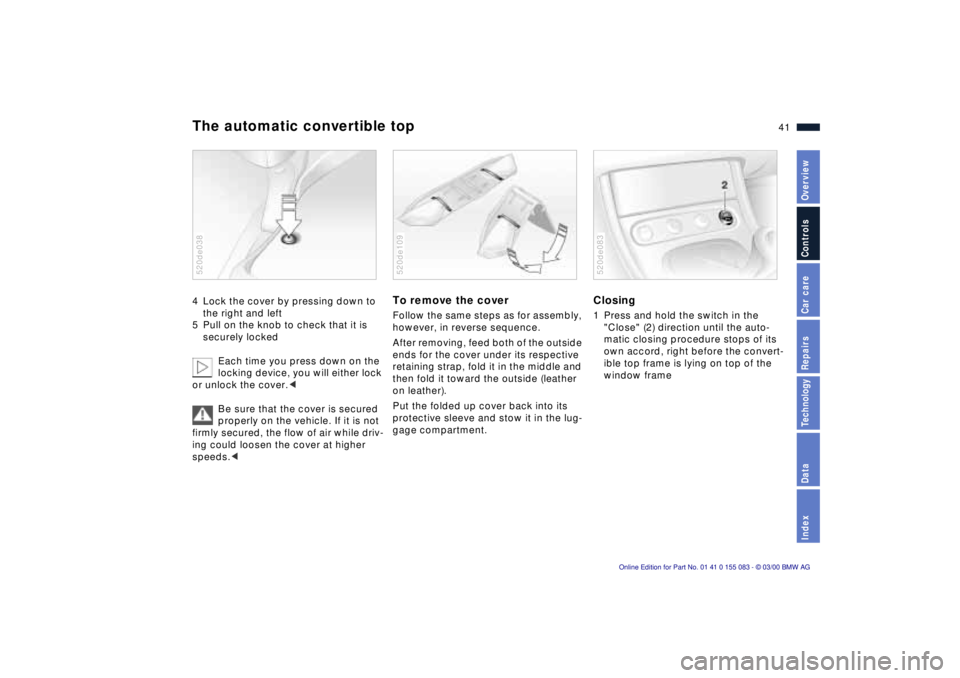
The automatic convertible top4 Lock the cover by pressing down to
the right and left
5 Pull on the knob to check that it is
securely locked
Each time you press down on the
locking device, you will either lock
or unlock the cover.<
Be sure that the cover is secured
properly on the vehicle. If it is not
firmly secured, the flow of air while driv-
ing could loosen the cover at higher
speeds.<520de038
To remove the cover Follow the same steps as for assembly,
however, in reverse sequence.
After removing, feed both of the outside
ends for the cover under its respective
retaining strap, fold it in the middle and
then fold it toward the outside (leather
on leather).
Put the folded up cover back into its
protective sleeve and stow it in the lug-
gage compartment.520de109
Closing1 Press and hold the switch in the
"Close" (2) direction until the auto-
matic closing procedure stops of its
own accord, right before the convert-
ible top frame is lying on top of the
window frame520de083
Page 43 of 172
42n
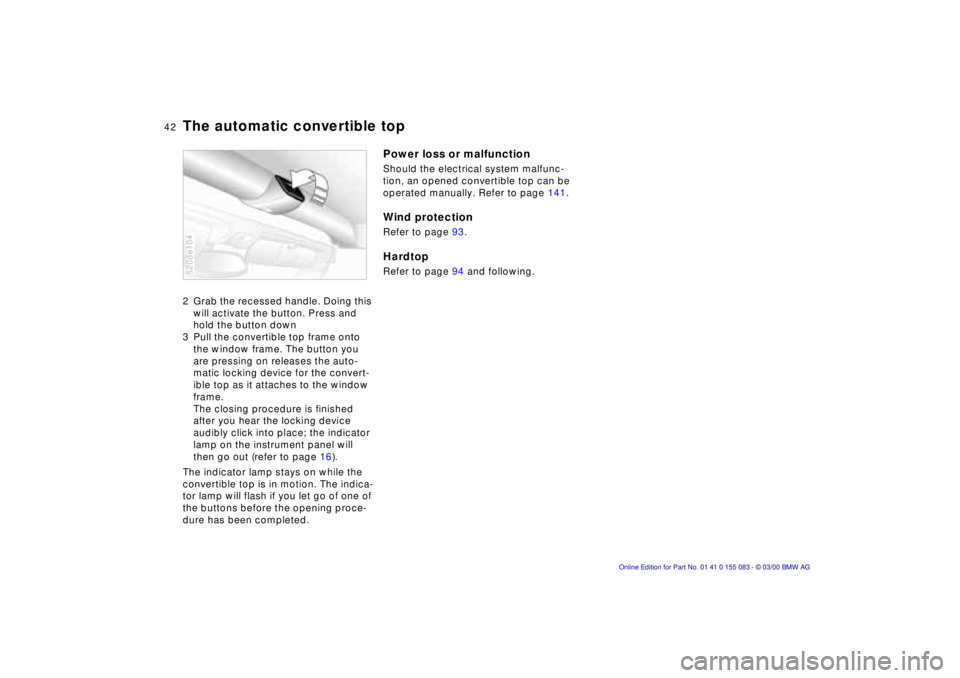
The automatic convertible top2 Grab the recessed handle. Doing this
will activate the button. Press and
hold the button down
3 Pull the convertible top frame onto
the window frame. The button you
are pressing on releases the auto-
matic locking device for the convert-
ible top as it attaches to the window
frame.
The closing procedure is finished
after you hear the locking device
audibly click into place; the indicator
lamp on the instrument panel will
then go out (refer to page 16).
The indicator lamp stays on while the
convertible top is in motion. The indica-
tor lamp will flash if you let go of one of
the buttons before the opening proce-
dure has been completed.520de104
Power loss or malfunctionShould the electrical system malfunc-
tion, an opened convertible top can be
operated manually. Refer to page 141.Wind protectionRefer to page 93.HardtopRefer to page 94 and following.
Page 44 of 172
43n
IndexDataTechnologyRepairsCar careControlsOverview
For maximum safety when adjusting the
seating position, please observe the
following:
Never try to adjust your seat while
driving the vehicle. The seat could
respond with an unexpected move-
ment, and the ensuing loss of vehicle
control could lead to an accident.
Be sure that the safety belt remains
firmly against your body at all times. In
the event of a frontal impact, a loose lap
belt could slide over the hips, leading to
abdominal injury. In addition, the safety
belt's restraint effectiveness is reduced
if the belt is worn loosely.
Never ride with the backrest reclined to
an extreme angle (especially important
for the passenger to remember). If you
do so, there is a risk that you will slide
under the safety belt in an accident,
thus reducing the protection provided
by the safety belt.<
Correct sitting postureTo reduce strain on the spinal column,
sit all the way back in the seat and rest
your back fully against the backrest.
The ideal sitting posture is achieved
with your head extending from your
spine in a straight line.
For long-distance driving, you may wish
to increase the backrest tilt-angle
slightly to reduce muscular tension.
You should be able to grasp the steer-
ing wheel at its highest point with your
arms slightly bent.
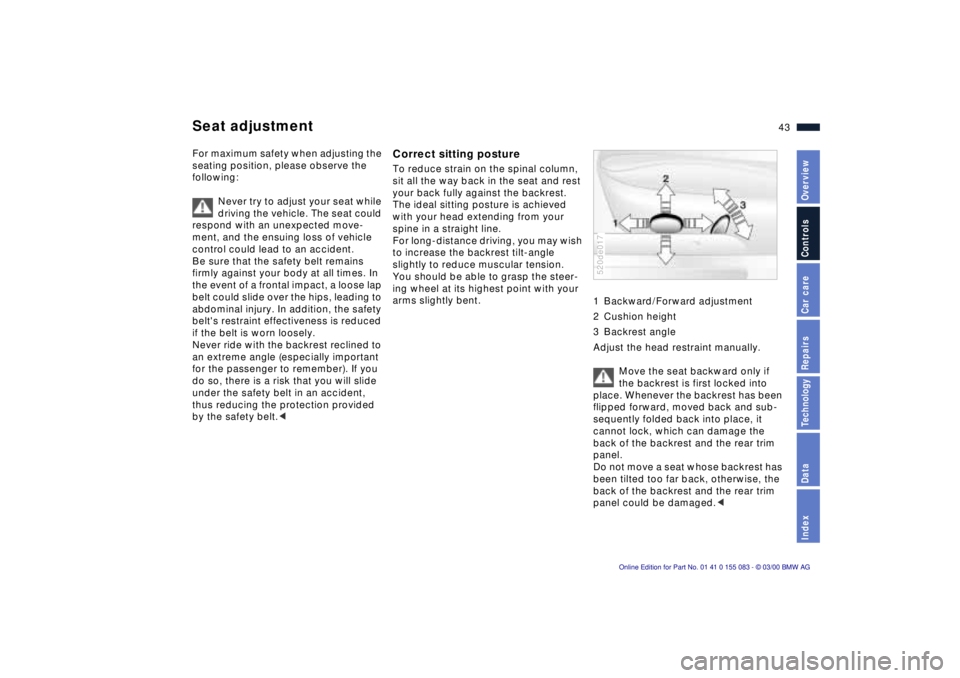
1 Backward/Forward adjustment
2 Cushion height
3 Backrest angle
Adjust the head restraint manually.
Move the seat backward only if
the backrest is first locked into
place. Whenever the backrest has been
flipped forward, moved back and sub-
sequently folded back into place, it
cannot lock, which can damage the
back of the backrest and the rear trim
panel.
Do not move a seat whose backrest has
been tilted too far back, otherwise, the
back of the backrest and the rear trim
panel could be damaged.<
520de017
Seat adjustment
Page 45 of 172
44n
Head restraints Seat backrest Belt guideAdjustments Upward: by pulling.
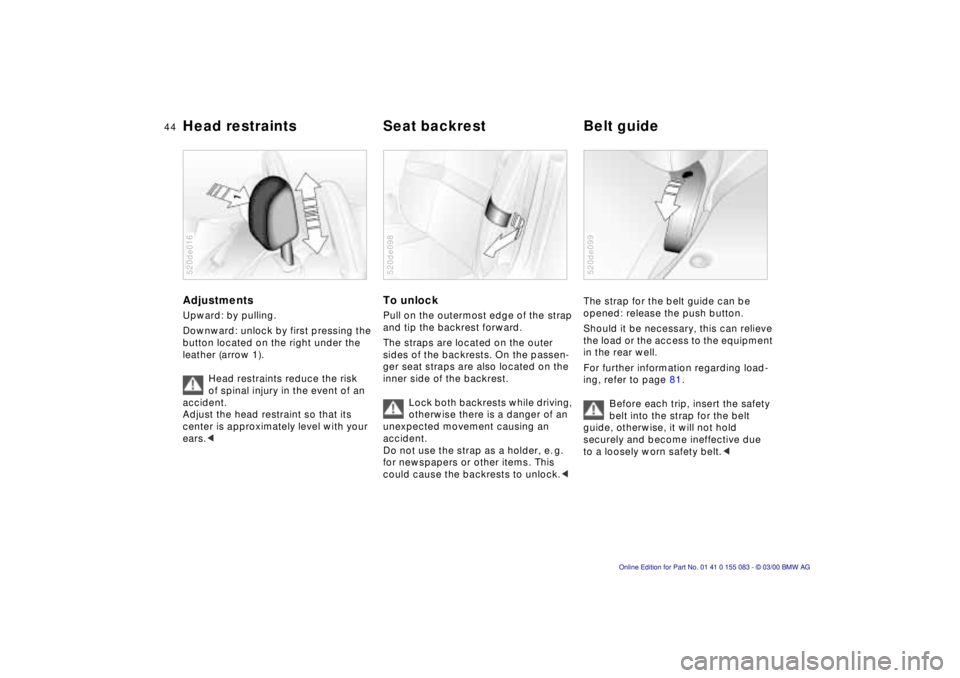
Downward: unlock by first pressing the
button located on the right under the
leather (arrow 1).
Head restraints reduce the risk
of spinal injury in the event of an
accident.
Adjust the head restraint so that its
center is approximately level with your
ears.<520de016
To unlockPull on the outermost edge of the strap
and tip the backrest forward.
The straps are located on the outer
sides of the backrests. On the passen-
ger seat straps are also located on the
inner side of the backrest.
Lock both backrests while driving,
otherwise there is a danger of an
unexpected movement causing an
accident.
Do not use the strap as a holder, e. g.
for newspapers or other items. This
could cause the backrests to unlock.<520de098
The strap for the belt guide can be
opened: release the push button.
Should it be necessary, this can relieve
the load or the access to the equipment
in the rear well.
For further information regarding load-
ing, refer to page 81.
Before each trip, insert the safety
belt into the strap for the belt
guide, otherwise, it will not hold
securely and become ineffective due
to a loosely worn safety belt.<520de099
Page 47 of 172
46n
Mirrors Car Memory, Key MemoryInterior rearview mirror with
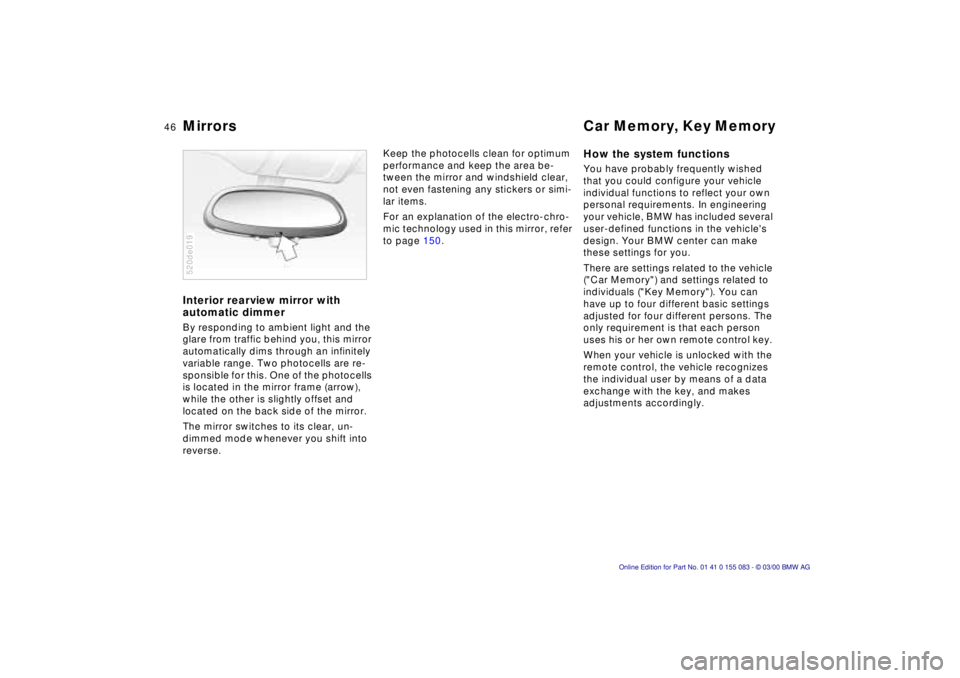
automatic dimmer By responding to ambient light and the
glare from traffic behind you, this mirror
automatically dims through an infinitely
variable range. Two photocells are re-
sponsible for this. One of the photocells
is located in the mirror frame (arrow),
while the other is slightly offset and
located on the back side of the mirror.
The mirror switches to its clear, un-
dimmed mode whenever you shift into
reverse. 520de019
Keep the photocells clean for optimum
performance and keep the area be-
tween the mirror and windshield clear,
not even fastening any stickers or simi-
lar items.
For an explanation of the electro-chro-
mic technology used in this mirror, refer
to page 150.
How the system functions You have probably frequently wished
that you could configure your vehicle
individual functions to reflect your own
personal requirements. In engineering
your vehicle, BMW has included several
user-defined functions in the vehicle's
design. Your BMW center can make
these settings for you.
There are settings related to the vehicle
("Car Memory") and settings related to
individuals ("Key Memory"). You can
have up to four different basic settings
adjusted for four different persons. The
only requirement is that each person
uses his or her own remote control key.
When your vehicle is unlocked with the
remote control, the vehicle recognizes
the individual user by means of a data
exchange with the key, and makes
adjustments accordingly.
Page 48 of 172

47n
IndexDataTechnologyRepairsCar careControlsOverview
Car Memory, Key MemoryWhat the system can doYour BMW center can provide you with
details on the capabilities of the Car
Memory and Key Memory systems.
Below are a few examples:
Examples for Car Memory:
>Various signals you can use as ac-
knowledgement for locking and un-
locking your vehicle
>Deactivating/activating the "follow-
me-home" lamps function
Example for Key Memory:
>Locking your vehicle after starting to
drive
You will see this symbol through-
out the Owner's Manual. It is to
remind you at appropriate places of the
settings that are available to you.<
Page 49 of 172
48n
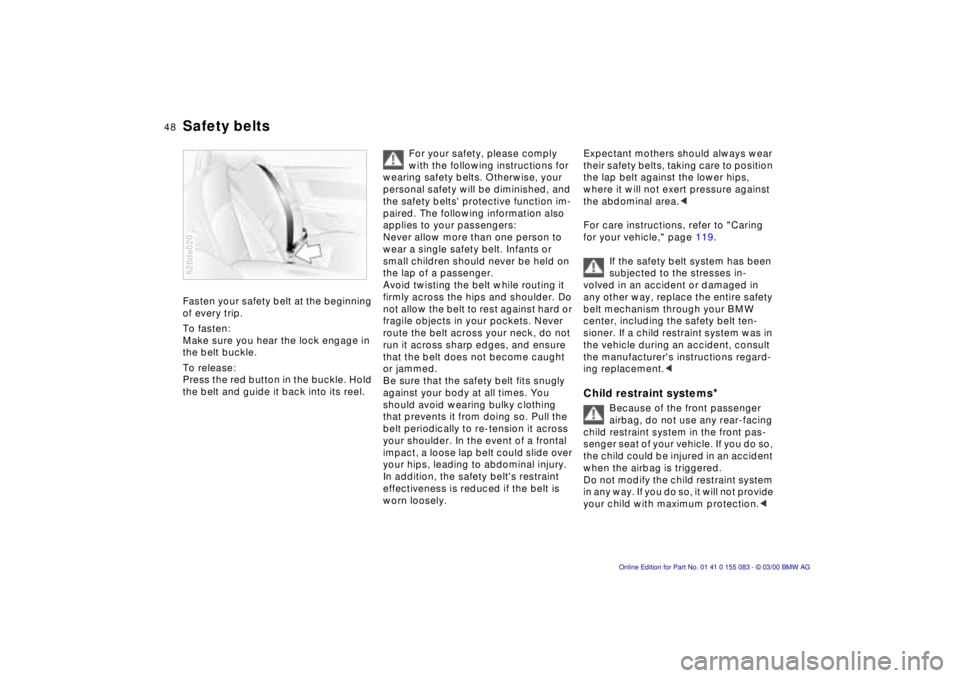
Fasten your safety belt at the beginning
of every trip.
To fasten:
Make sure you hear the lock engage in
the belt buckle.
To release:
Press the red button in the buckle. Hold
the belt and guide it back into its reel.
520de020
For your safety, please comply
with the following instructions for
wearing safety belts. Otherwise, your
personal safety will be diminished, and
the safety belts' protective function im-
paired. The following information also
applies to your passengers:
Never allow more than one person to
wear a single safety belt. Infants or
small children should never be held on
the lap of a passenger.
Avoid twisting the belt while routing it
firmly across the hips and shoulder. Do
not allow the belt to rest against hard or
fragile objects in your pockets. Never
route the belt across your neck, do not
run it across sharp edges, and ensure
that the belt does not become caught
or jammed.
Be sure that the safety belt fits snugly
against your body at all times. You
should avoid wearing bulky clothing
that prevents it from doing so. Pull the
belt periodically to re-tension it across
your shoulder. In the event of a frontal
impact, a loose lap belt could slide over
your hips, leading to abdominal injury.
In addition, the safety belt's restraint
effectiveness is reduced if the belt is
worn loosely.
Expectant mothers should always wear
their safety belts, taking care to position
the lap belt against the lower hips,
where it will not exert pressure against
the abdominal area.<
For care instructions, refer to "Caring
for your vehicle," page 119.
If the safety belt system has been
subjected to the stresses in-
volved in an accident or damaged in
any other way, replace the entire safety
belt mechanism through your BMW
center, including the safety belt ten-
sioner. If a child restraint system was in
the vehicle during an accident, consult
the manufacturer's instructions regard-
ing replacement.
Because of the front passenger
airbag, do not use any rear-facing
child restraint system in the front pas-
senger seat of your vehicle. If you do so,
the child could be injured in an accident
when the airbag is triggered.
Do not modify the child restraint system
in any way. If you do so, it will not provide
your child with maximum protection.<
Safety belts
Page 51 of 172
50n
AirbagsSitting correctly with airbags
Comply with the following instruc-
tions for the airbags, otherwise,
the airbags may not be able to provide
their maximum protection, with result-
ing risks to personal safety. All passen-
gers in the vehicle should be aware of
and comply with this information:
The airbags are supplemental restraint
devices designed to provide extra pro-
tection; they are not a substitute for
safety belts. Wear your safety belt at all
times. The airbags will not be triggered
in the event of a minor accident, a vehi-
cle roll-over, or collisions from the rear.
In these instances, the safety belt pro-
vides optimal protection.
Airbags are located under cover panels
in the steering wheel, in the instrument
panel and in the door side trim panels.
Assume a seating position that is com-
fortable and provides the greatest-pos-
sible distance between you and the air-
bags in your seating area. Always hold
the steering wheel by the rim Ð hands in
the "9 o'clock" and "3 o'clock" posi-
tions Ð otherwise, your hands or arms
could be injured if the airbag is trig-
gered.
Do not allow any objects to obstruct the
area between the airbag and the driver/
passenger.
Do not use the cover panel above the
front passenger airbag as a storage
area.
Do not apply adhesive materials to the
cover panels of the airbags, or cover or
modify them in any other way.
Do not use a rear-facing child seat in the
front passenger seat. If you use a child
restraint system, read carefully and
comply with the instructions on page 51.
Be sure that child seats are installed
correctly and with the greatest possible
distance between them and the side air-
bag. Do not allow children to lean out of
the child's seat in the direction of the
side trim panels. If they do so, serious
injuries can occur if the airbag is trig-
gered.<
Even when all these guidelines are ob-
served, there is still a small residual risk
of injury to the face, hands and arms
occurring from airbag deployment in
isolated instances.
The ignition and inflation noise may
cause a mild temporary hearing loss in
extremely sensitive individuals.
For additional information concerning
the airbag system, refer to pages 121
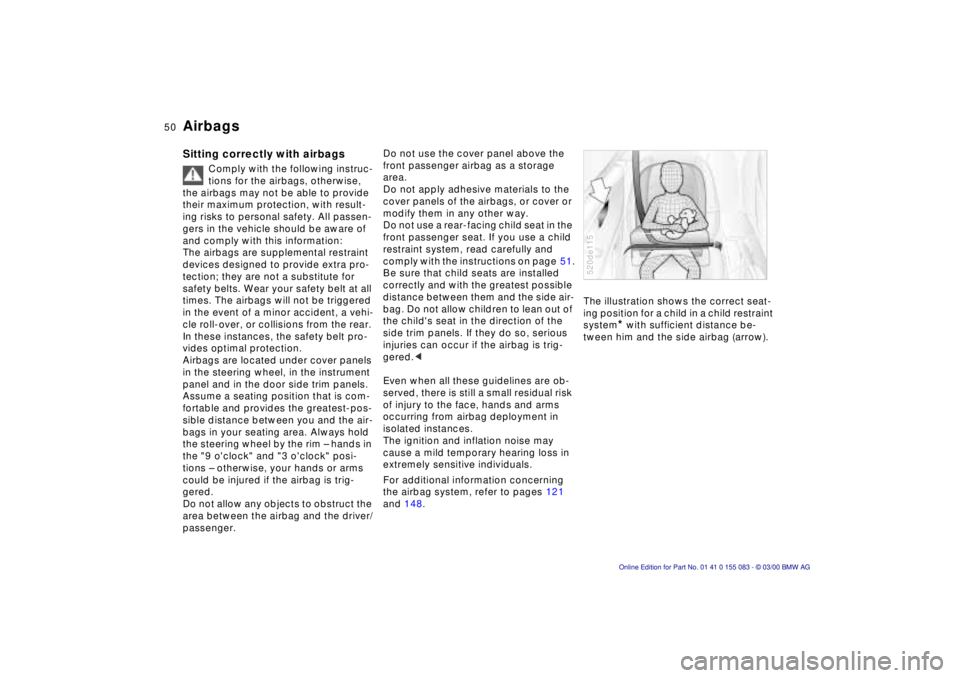
and 148.The illustration shows the correct seat-
ing position for a child in a child restraint
system
* with sufficient distance be-
tween him and the side airbag (arrow).
520de115
Page 53 of 172
52n
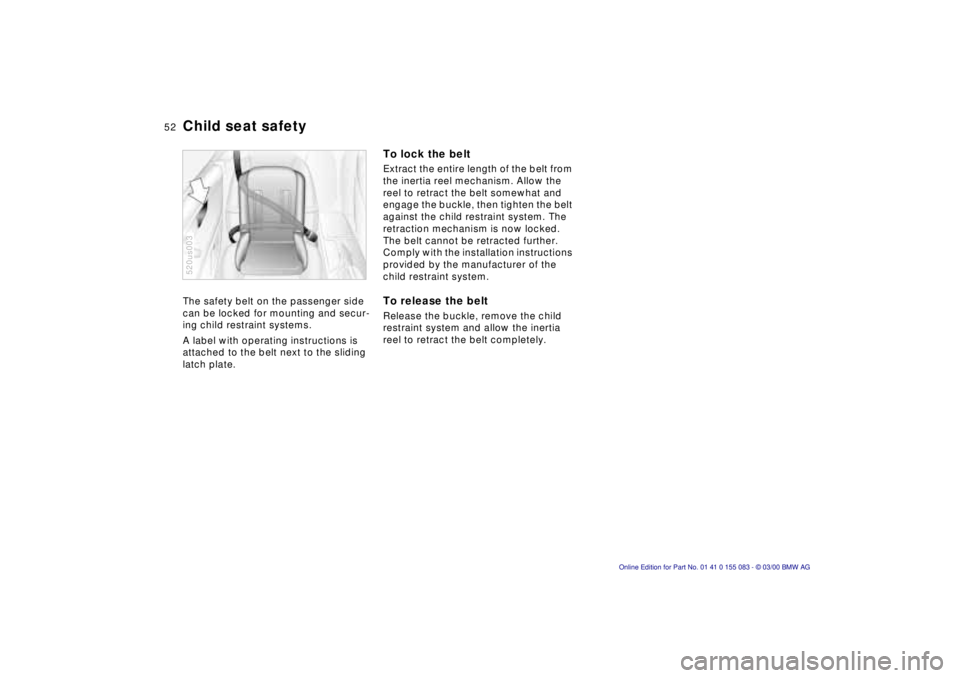
Child seat safetyThe safety belt on the passenger side
can be locked for mounting and secur-
ing child restraint systems.
A label with operating instructions is
attached to the belt next to the sliding
latch plate.520us003
To lock the beltExtract the entire length of the belt from
the inertia reel mechanism. Allow the
reel to retract the belt somewhat and
engage the buckle, then tighten the belt
against the child restraint system. The
retraction mechanism is now locked.
The belt cannot be retracted further.
Comply with the installation instructions
provided by the manufacturer of the
child restraint system.To release the beltRelease the buckle, remove the child
restraint system and allow the inertia
reel to retract the belt completely.
Page 54 of 172
53n
IndexDataTechnologyRepairsCar careControlsOverview
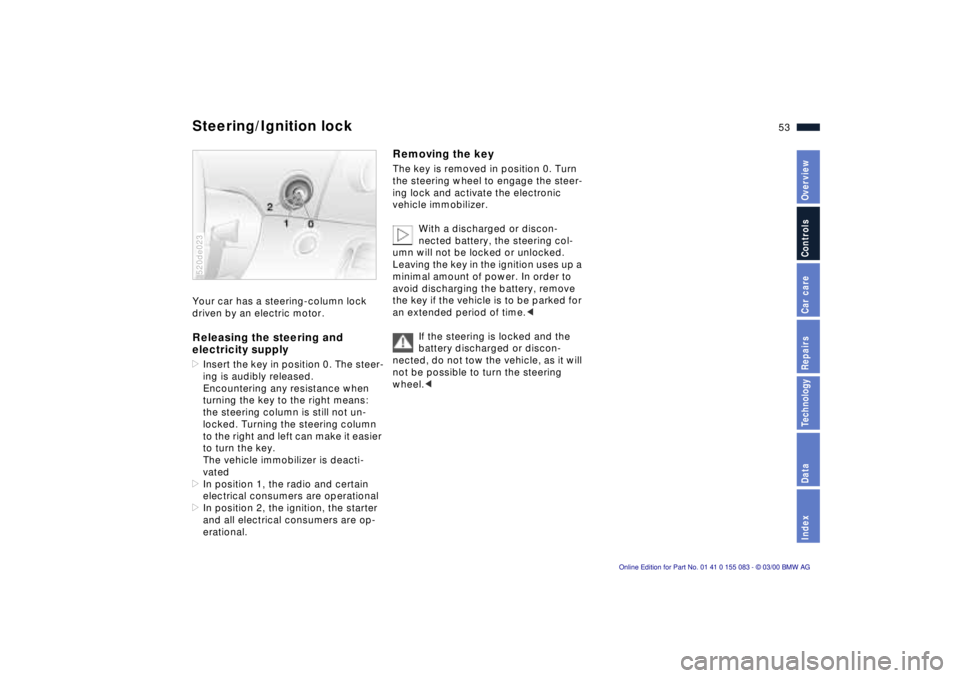
Your car has a steering-column lock
driven by an electric motor.Releasing the steering and
electricity supply>Insert the key in position 0. The steer-
ing is audibly released.
Encountering any resistance when
turning the key to the right means:
the steering column is still not un-
locked. Turning the steering column
to the right and left can make it easier
to turn the key.
The vehicle immobilizer is deacti-
vated
>In position 1, the radio and certain
electrical consumers are operational
>In position 2, the ignition, the starter
and all electrical consumers are op-
erational.520de023
Removing the keyThe key is removed in position 0. Turn
the steering wheel to engage the steer-
ing lock and activate the electronic
vehicle immobilizer.
With a discharged or discon-
nected battery, the steering col-
umn will not be locked or unlocked.
Leaving the key in the ignition uses up a
minimal amount of power. In order to
avoid discharging the battery, remove
the key if the vehicle is to be parked for
an extended period of time.<
If the steering is locked and the
battery discharged or discon-
nected, do not tow the vehicle, as it will
not be possible to turn the steering
wheel.<
Steering/Ignition lock