low oil pressure BUICK LACROSSE 2005 Owner's Manual
[x] Cancel search | Manufacturer: BUICK, Model Year: 2005, Model line: LACROSSE, Model: BUICK LACROSSE 2005Pages: 410, PDF Size: 2.59 MB
Page 81 of 410
If you enter the vehicle after a remote start, and the
engine is still running, insert the key into the ignition lock
cylinder and turn it to the RUN position to drive the
vehicle.
Your vehicle’s engine can be started two times using
the transmitter’s remote start feature.
If only one remote start procedure has been done, since
last driving the vehicle or resetting the remote start
system, the engine may be started again remotely
following the remote start procedure a second time.
If the remote start procedure is used again before the
rst ten minute time frame has ended, 10 minutes will be
added to the remaining minutes. The added
10 minutes are considered a second remote start.
The remote vehicle start feature will not operate if:
The remote start system is disabled.
The vehicle’s key is in the ignition.
A door is open or the vehicle’s hood is not closed.
The hazard warning ashers are on.
There is an emission control system malfunction.
The engine coolant temperature is too high.
The oil pressure is low.
Two remote vehicle starts have already been
provided. The maximum number of remote starts or
remote start attempts between ignition cycles
with the key is two.
If a remote start is attempted and is unsuccessful, the
Driver Information Center (DIC) will display REMOTE
START DISABLED.
Vehicles equipped with the remote vehicle start feature
are shipped from the factory with the remote vehicle
start system enabled. The system may be disabled
through the DIC. See “REMOTE START” under
DIC Vehicle Personalization on page 3-71for additional
information.
2-9
Page 116 of 410
Engine Coolant Temperature Gage..................3-38
Low Coolant Warning Light............................3-39
Malfunction Indicator Lamp.............................3-39
Oil Pressure Light.........................................3-42
Change Engine Oil Light................................3-43
Security Light...............................................3-43
Cruise Control Light......................................3-43
Reduced Engine Power Light.........................3-44
Highbeam On Light.......................................3-44
Headlamps Suggested Light...........................3-44
Low Washer Fluid Warning Light.....................3-45
Door Ajar Light.............................................3-45
Trunk Ajar Light............................................3-45
Service Vehicle Soon Light............................3-45
Fuel Gage...................................................3-46
Low Fuel Warning Light.................................3-46
Check Gas Cap Light....................................3-46Driver Information Center (DIC).......................3-47
DIC Operation and Displays...........................3-47
DIC Warnings and Messages.........................3-53
DIC Vehicle Personalization............................3-71
Audio System(s).............................................3-79
Setting the Time...........................................3-79
Radio with CD (Base)...................................3-79
Radio with CD (UpLevel)...............................3-84
Radio with CD (MP3)....................................3-92
Radio with Six-Disc CD................................3-105
Theft-Deterrent Feature................................3-117
Audio Steering Wheel Controls......................3-118
Radio Reception.........................................3-119
Care of Your CDs.......................................3-119
Care of Your CD Player...............................3-119
Backglass Antenna......................................3-120
Chime Level Adjustment...............................3-120
Section 3 Instrument Panel
3-2
Page 156 of 410
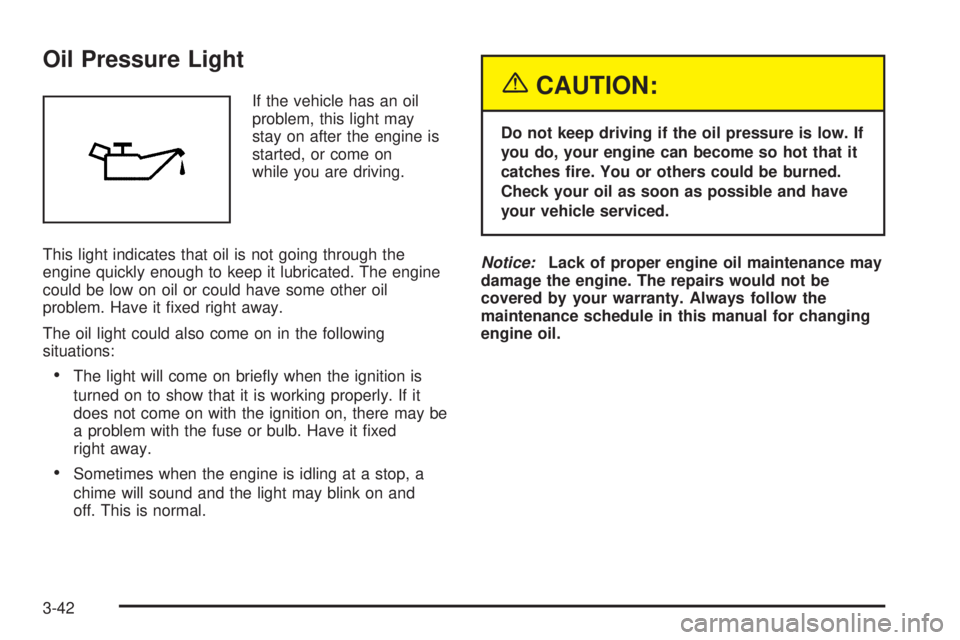
Oil Pressure Light
If the vehicle has an oil
problem, this light may
stay on after the engine is
started, or come on
while you are driving.
This light indicates that oil is not going through the
engine quickly enough to keep it lubricated. The engine
could be low on oil or could have some other oil
problem. Have it xed right away.
The oil light could also come on in the following
situations:
The light will come on briey when the ignition is
turned on to show that it is working properly. If it
does not come on with the ignition on, there may be
a problem with the fuse or bulb. Have it xed
right away.
Sometimes when the engine is idling at a stop, a
chime will sound and the light may blink on and
off. This is normal.
{CAUTION:
Do not keep driving if the oil pressure is low. If
you do, your engine can become so hot that it
catches re. You or others could be burned.
Check your oil as soon as possible and have
your vehicle serviced.
Notice:Lack of proper engine oil maintenance may
damage the engine. The repairs would not be
covered by your warranty. Always follow the
maintenance schedule in this manual for changing
engine oil.
3-42
Page 175 of 410
LOW OIL PRESSURE
Notice:If the LOW OIL PRESSURE warning
message appears on the DIC display, stop the
vehicle immediately. Do not drive the vehicle until
the cause of the low oil pressure is corrected.
Severe engine damage can result from driving a
vehicle with low oil pressure. SeeEngine Oil
on page 5-15for more information.
This message will display when the vehicle’s engine oil
pressure is low. The oil pressure light will also appear
on the instrument panel cluster. SeeOil Pressure Light
on page 3-42.
Stop the vehicle immediately, as engine damage can
result from driving a vehicle with low oil pressure. Have
the vehicle serviced by your GM dealer as soon as
possible when this message is displayed.
This message will display only when the ignition is in
RUN. A chime will sound continuously when this
message is displayed.
This message cannot be acknowledged and cleared
from the screen. This message will re-display for a few
seconds if the condition still exists when the engine
is turned off.
If the condition still exists, the message will re-appear
when the engine is turned on.
LOW WASHER FLUID
This message will display when the windshield washer
uid is low. Fill the windshield washer reservoir as
soon as possible. SeeEngine Compartment Overview
on page 5-12for the location of the windshield
washer reservoir. Also, seeWindshield Washer Fluid on
page 5-34for more information.
This message will display and a chime will sound only
when the ignition is in RUN. Press any of the DIC
buttons to acknowledge this message and to clear it
from the screen.
This message will continue to display for two seconds if
it has not been acknowledged when the engine is
turned off. It will also re-display for two seconds if the
message has been acknowledged, but the condition still
exists when the engine is turned off.
If the condition still exists, the message will re-appear
when the engine is turned on.
3-61
Page 178 of 410
REDUCED POWER STOP WHEN SAFE
This message will display when your vehicle is in an
overheated engine operating mode. This operating mode
allows your vehicle to be driven to a safe place in an
emergency. In this mode, you will notice a signicant
loss in power and engine performance. SeeOverheated
Engine Protection Operating Mode on page 5-26for
more information. Anytime this message is on, the
vehicle should be taken to your GM dealer for service
as soon as possible.
This message will display and a chime will sound only
when the ignition is in RUN. Press any of the DIC
buttons to acknowledge this message and to clear it
from the screen.
This message will continue to display for two seconds if
it has not been acknowledged when the engine is
turned off. It will also re-display for two seconds if the
message has been acknowledged, but the condition still
exists when the engine is turned off.
If the condition still exists, the message will re-appear
when the engine is turned on.
REMOTE START DISABLED
This warning message will come on if a remote start
attempt is unsuccessful. This may be caused if any of
the following conditions are true when a remote
start attempt is made:
The remote start system is disabled through
the DIC.
The key is in the ignition.
The hood or the doors are not closed.
There is an emission control system malfunction.
The engine coolant temperature is too high.
The oil pressure is low.
The hazard warning ashers are turned on.
The maximum number of remote starts or
remote start attempts between ignition cycles
has been reached.
The content theft-deterrent alarm is on while
attempting to remote start the vehicle.
See “REMOTE START” underDIC Vehicle
Personalization on page 3-71and “Remote Vehicle
Start” underRemote Keyless Entry System Operation
on page 2-4for more information.
3-64
Page 289 of 410
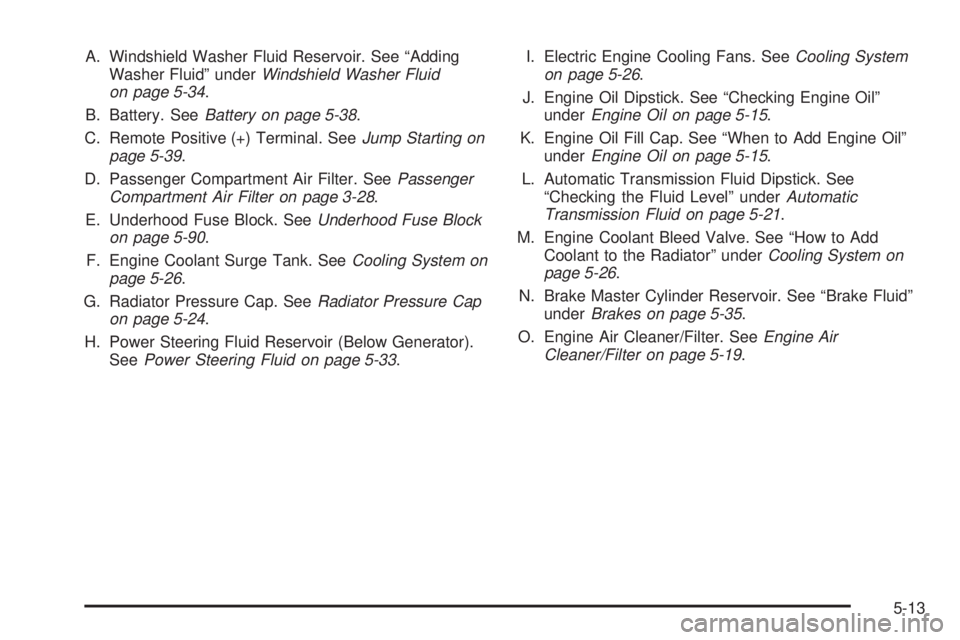
A. Windshield Washer Fluid Reservoir. See “Adding
Washer Fluid” underWindshield Washer Fluid
on page 5-34.
B. Battery. SeeBattery on page 5-38.
C. Remote Positive (+) Terminal. SeeJump Starting on
page 5-39.
D. Passenger Compartment Air Filter. SeePassenger
Compartment Air Filter on page 3-28.
E. Underhood Fuse Block. SeeUnderhood Fuse Block
on page 5-90.
F. Engine Coolant Surge Tank. SeeCooling System on
page 5-26.
G. Radiator Pressure Cap. SeeRadiator Pressure Cap
on page 5-24.
H. Power Steering Fluid Reservoir (Below Generator).
SeePower Steering Fluid on page 5-33.I. Electric Engine Cooling Fans. SeeCooling System
on page 5-26.
J. Engine Oil Dipstick. See “Checking Engine Oil”
underEngine Oil on page 5-15.
K. Engine Oil Fill Cap. See “When to Add Engine Oil”
underEngine Oil on page 5-15.
L. Automatic Transmission Fluid Dipstick. See
“Checking the Fluid Level” underAutomatic
Transmission Fluid on page 5-21.
M. Engine Coolant Bleed Valve. See “How to Add
Coolant to the Radiator” underCooling System on
page 5-26.
N. Brake Master Cylinder Reservoir. See “Brake Fluid”
underBrakes on page 5-35.
O. Engine Air Cleaner/Filter. SeeEngine Air
Cleaner/Filter on page 5-19.
5-13
Page 291 of 410
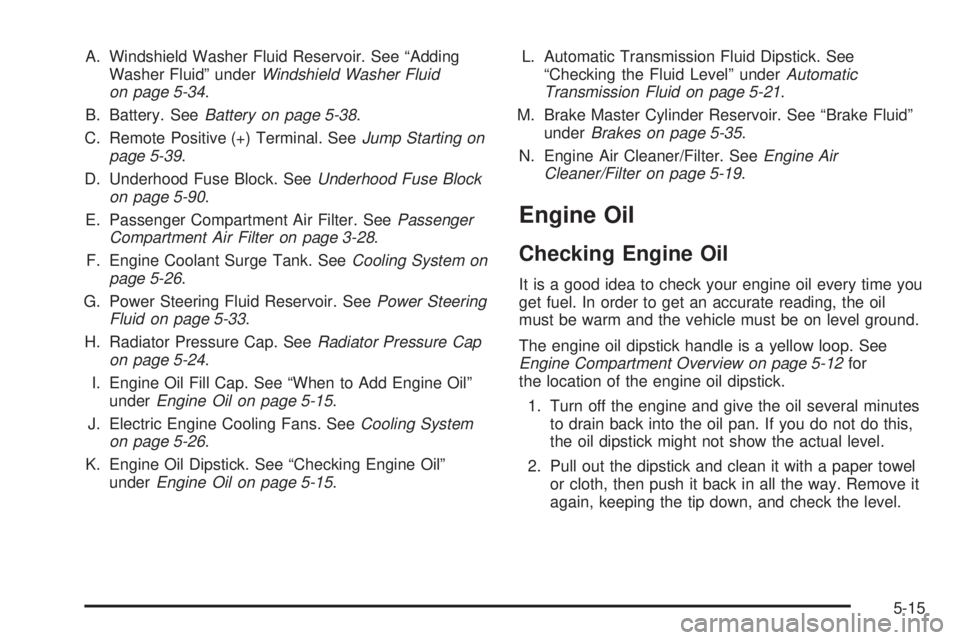
A. Windshield Washer Fluid Reservoir. See “Adding
Washer Fluid” underWindshield Washer Fluid
on page 5-34.
B. Battery. SeeBattery on page 5-38.
C. Remote Positive (+) Terminal. SeeJump Starting on
page 5-39.
D. Underhood Fuse Block. SeeUnderhood Fuse Block
on page 5-90.
E. Passenger Compartment Air Filter. SeePassenger
Compartment Air Filter on page 3-28.
F. Engine Coolant Surge Tank. SeeCooling System on
page 5-26.
G. Power Steering Fluid Reservoir. SeePower Steering
Fluid on page 5-33.
H. Radiator Pressure Cap. SeeRadiator Pressure Cap
on page 5-24.
I. Engine Oil Fill Cap. See “When to Add Engine Oil”
underEngine Oil on page 5-15.
J. Electric Engine Cooling Fans. SeeCooling System
on page 5-26.
K. Engine Oil Dipstick. See “Checking Engine Oil”
underEngine Oil on page 5-15.L. Automatic Transmission Fluid Dipstick. See
“Checking the Fluid Level” underAutomatic
Transmission Fluid on page 5-21.
M. Brake Master Cylinder Reservoir. See “Brake Fluid”
underBrakes on page 5-35.
N. Engine Air Cleaner/Filter. SeeEngine Air
Cleaner/Filter on page 5-19.
Engine Oil
Checking Engine Oil
It is a good idea to check your engine oil every time you
get fuel. In order to get an accurate reading, the oil
must be warm and the vehicle must be on level ground.
The engine oil dipstick handle is a yellow loop. See
Engine Compartment Overview on page 5-12for
the location of the engine oil dipstick.
1. Turn off the engine and give the oil several minutes
to drain back into the oil pan. If you do not do this,
the oil dipstick might not show the actual level.
2. Pull out the dipstick and clean it with a paper towel
or cloth, then push it back in all the way. Remove it
again, keeping the tip down, and check the level.
5-15
Page 302 of 410
Overheated Engine Protection
Operating Mode
This emergency operating mode allows your vehicle to
be driven to a safe place in an emergency situation. If an
overheated engine condition exists, an overheat
protection mode which alternates ring groups of
cylinders helps prevent engine damage. In this mode, you
will notice a signicant loss in power and engine
performance. The REDUCED POWER STOP WHEN
SAFE message will come on in the Driver Information
Center (DIC), along with the engine coolant temperature
warning light on the instrument panel, to indicate the
vehicle has entered overheated engine protection
operating mode. The temperature gage will also indicate
an overheat condition exists. Driving extended miles (km)
and/or towing a trailer in the overheat protection mode
should be avoided.
Notice:After driving in the overheated engine
protection operating mode, to avoid engine damage,
allow the engine to cool before attempting any repair.
The engine oil will be severely degraded. Repair the
cause of coolant loss, change the oil and reset the oil
life system. SeeEngine Oil on page 5-15.
Cooling System
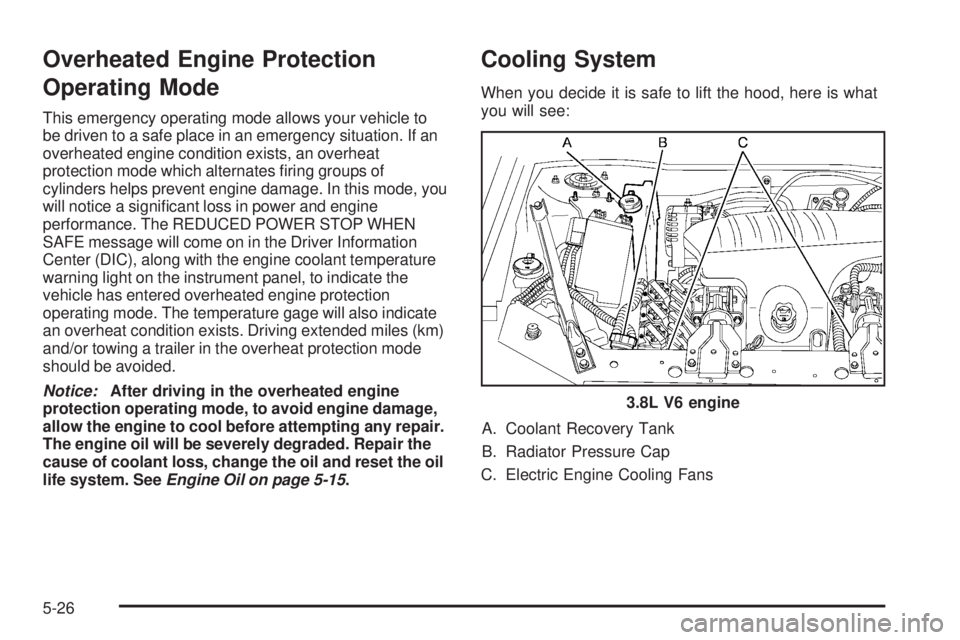
When you decide it is safe to lift the hood, here is what
you will see:
A. Coolant Recovery Tank
B. Radiator Pressure Cap
C. Electric Engine Cooling Fans3.8L V6 engine
5-26
Page 403 of 410
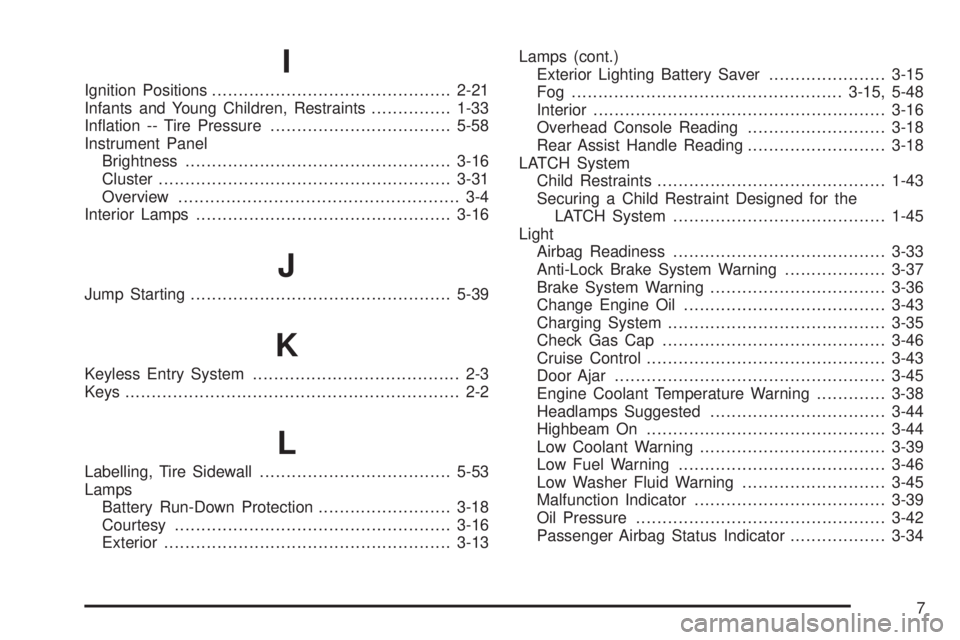
I
Ignition Positions.............................................2-21
Infants and Young Children, Restraints...............1-33
Ination -- Tire Pressure..................................5-58
Instrument Panel
Brightness..................................................3-16
Cluster.......................................................3-31
Overview..................................................... 3-4
Interior Lamps................................................3-16
J
Jump Starting.................................................5-39
K
Keyless Entry System....................................... 2-3
Keys............................................................... 2-2
L
Labelling, Tire Sidewall....................................5-53
Lamps
Battery Run-Down Protection.........................3-18
Courtesy....................................................3-16
Exterior......................................................3-13Lamps (cont.)
Exterior Lighting Battery Saver......................3-15
Fog ...................................................3-15, 5-48
Interior.......................................................3-16
Overhead Console Reading..........................3-18
Rear Assist Handle Reading..........................3-18
LATCH System
Child Restraints...........................................1-43
Securing a Child Restraint Designed for the
LATCH System........................................1-45
Light
Airbag Readiness........................................3-33
Anti-Lock Brake System Warning...................3-37
Brake System Warning.................................3-36
Change Engine Oil......................................3-43
Charging System.........................................3-35
Check Gas Cap..........................................3-46
Cruise Control.............................................3-43
Door Ajar...................................................3-45
Engine Coolant Temperature Warning.............3-38
Headlamps Suggested.................................3-44
Highbeam On.............................................3-44
Low Coolant Warning...................................3-39
Low Fuel Warning.......................................3-46
Low Washer Fluid Warning...........................3-45
Malfunction Indicator....................................3-39
Oil Pressure...............................................3-42
Passenger Airbag Status Indicator..................3-34
7