change time BUICK LESABRE 1993 User Guide
[x] Cancel search | Manufacturer: BUICK, Model Year: 1993, Model line: LESABRE, Model: BUICK LESABRE 1993Pages: 324, PDF Size: 17.02 MB
Page 170 of 324
0 Try not to pass more than one vehicle at a time on
two-lane roads. Reconsider before passing the
next
vehicle.
Don’t overtake a slowly moving vehicle too rapidly.
Even though
the brake lights are not flashing, it may
be slowing down or starting to turn.
following driver to get ahead of you. Perhaps
you
can ease a little to the right.
If you’re being passed, make it easy for the
Loss of Control
Let’s review what driving experts say about what
happens when the three control systems (brakes, steering
and acceleration) don’t have enough friction where the
tires meet the road
to do what the driver has asked.
In
any emergency, don’t give up. Keep trying to steer and
constantly seek an escape route or area of less danger.
Skidding
In a skid, a driver can lose control of the vehicle.
Defensive drivers avoid most skids by taking reasonable
care suited to existing conditions, and by
not “over-
driving” those conditions. But skids are always possible. The
three types of skids correspond
to your Buick‘s
three control systems. In
the braking skid your wheels
aren’t rolling. In
the steering or cornering skid, too
much speed or steering in a curve causes tires to slip and
lose cornering force. And in the acceleration skid too
much throttle causes the driving wheels
to spin.
A cornering skid and an acceleration skid are best
handled by easing your
foot off the accelerator pedal.
If your vehicle starts to slide (as when
you turn a comer
on a wet, snow-or icexovered road), ease your foot off
the accelerator pedal as soon as your feel the vehicle start
to slide. Quickly steer the way
you want the vehicle to
go. If you start steering quickly enough, your vehicle will
straighten
out. As it does, straighten the front wheels.
Of course, traction is reduced when water, snow, ice,
gravel, or other material is
on the road. For safety, you’ll
want
to slow down and adjust your driving to these
conditions. It is important to slow down
on slippery
surfaces because stopping distance will be longer and
vehicle control more limited.
While driving
on a surface with reduced traction, try
your best
to avoid sudden steering, acceleration, or
braking (including engine braking by shifting
to a lower
gear). Any sudden changes could cause tires to slide.
You may
not realize the surface is slippery until your
168
Page 180 of 324
Driving a Long Distance
Although most long trips today are made on freeways,
there are still many made on regular highways. Long-distance driving on freeways and regular
highways is the same in some ways. The trip has to be
planned and the vehicle prepared, you drive at
higher-than-city speeds, and there are longer turns
behind the wheel. You’ll enjoy your trip more if you and
your vehicle are in good shape. Here are some tips for a
successful long trip.
Before Leaving on a Long Trip
Make sure you’re ready. Try to be well rested. If you
must start when you’re not fresh
-- such as after a day’s
work
-- don’t plan to make too many miles that first part
of the journey. Wear comfortable clothing and shoes you
can easily drive
in.
Is your vehicle ready for a long trip? If you keep it
serviced and maintained,
it’s ready to go. If it needs
service, have it done before starting out. Of course,
you’!! find experienced and able service experts in
Buick dealerships all across North America. They’ll be
ready and willing to help
if you need it.
Here are some things you can check before a trip:
0
e
e
0
e
0
0
Windshield Washer Fluid: Is the reservoir full? Are
all windows clean inside and outside?
Wiper Blades: Are they in good shape?
Fuel, Engine Oil. Other Fluids: Have
you checked
all levels?
Lights: Are they all working? Are the lenses clean?
- Tires: They are vitally important to a safe,
trouble-free trip.
Is the tread good enough for
long-distance driving? Are the tires all inflated to the
recommended pressure?
Weather Forecasts: What’s the weather outlook
along your route? Should you delay your trip
a short
time to avoid a major storm system?
Maps:
Do you have up-to-date maps?
On the Road
Unless you are the only driver, it is good to share the
driving task with others. Limit turns behind the wheel to
about
100 miles (160 km) or two hours at a sitting.
Then, either change drivers or stop for some refreshment
like coffee, tea
or soft drinks and some limbering up.
But do stop and move around. Eat lightly along the way.
Heavier meals tend to make some people sleepy.
Page 191 of 324
from the cold. But do it as little as possible. Preserve the
fuel
as long as you can. To help keep warm, you can get
out of the vehicle and do some fairly vigorous exercises
every half hour or
so until help comes.
If You’re Stuck in Deep Snow
This manual explains how to get the vehicle out of deep
snow without damaging it. See “Rocking Your Vehicle”
in the Index.
Towing a Trailer
I- I
A CAUTION:
If you don’t use‘the correct equipment and drive
properly, you can lose control when you pull a
trailer. For example, if the trailer Is too heavy, the
brakes may not work well - or even at all. You
and your passengers could be seriously iniured.
Pull a trailer only if you have followed all tt
steps in this section.
I
vehicle and result in costly repairs not covered
by your warranty. To pull a traAer correctly,
follow I
the advice in this section.
Your car can tow a trailer. To identify what the vehicle
trailering capacity is for your vehicle, you should read
the information
in “Weight of the Trailer” that appears
later in this section. But trailering
is different than just
driving your vehicle by itself. Trailering means changes
in handling, durability, and fuel economy. Successful,
safe trailering takes correct equipment, and it has to be
used properly.
That’s the reason for this section. In it are many
time-tested, important trailering tips and safety rules. Many
of these are important for your safety and that of
your passengers. So please read this section carefully
before you pull a trailer.
Load-pulling components such as the engine, transaxle,
wheel assemblies, and tires are forced to work harder
against the drag
of the added weight. The engine is
required to operate at relatively higher speeds and under greater loads, generating extra heat. What’s more, the
189
Page 225 of 324
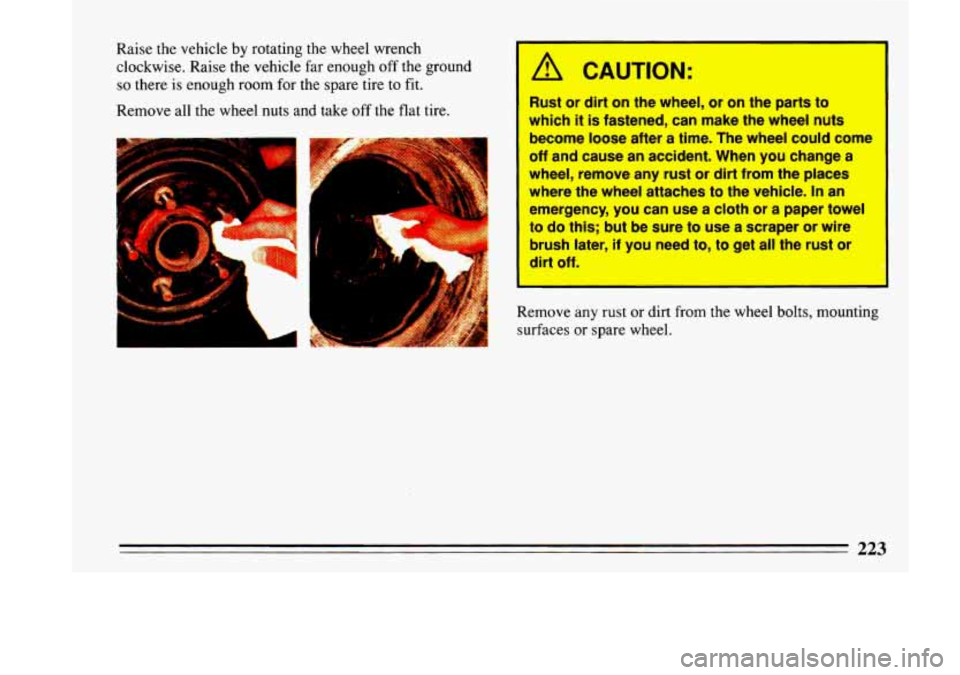
Raise the vehicle by rotating the wheel wrench
clockwise. Raise
the vehicle far enough off the ground
so there is enough room for the spare tire to fit.
Remove all the wheel nuts and take off the flat tire.
pll
f
CAUTION:
Rust or dirt on the wheel, or on the parts to
which it is fastened, can make the wheel nuts
become loose after a time. The wheel could come
riff and cause an accident. When you change a
eel, remove any rust or dirt from the places
where the wheel attaches to the vehicle. In
an
erngrgeocy, you can use a cloth or a paper towel
to do this; but be sure to use a scraper or wire
dirt Offa "
brush later, if you need to, to get all the rust or
I
Remove any rust or dirt from the wheel bolts, mounting
surfaces or spare wheel.
223
Page 241 of 324
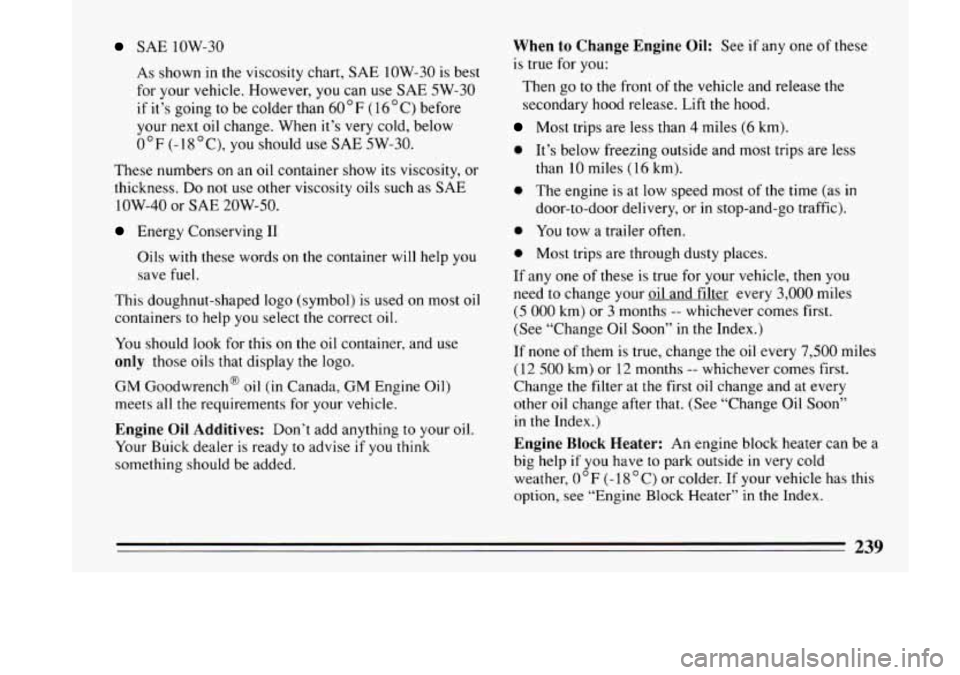
SAE low-30
As shown in the viscosity chart, SAE low-30 is best
for your vehicle. However, you can use SAE 5W-30
if
it’s going to be colder than 60 F ( 16 C) before
your next oil change. When it’s very cold, below
0 F (- 1 8 C), you should use SAE 5W-30.
These numbers on an oil container show its viscosity, or
thickness,
Do not use other viscosity oils such as SAE
1OW-40 or SAE 20W-50.
Energy Conserving I1
Oils with these words on the container will help
you
save fuel.
This doughnut-shaped logo (symbol) is used on most oil
containers to help
you select the correct oil.
You should look for this on the oil container, and use
only those oils that display the logo.
GM Goodwrench@
oil (in Canada, GM Engine Oil)
meets all the requirements for your vehicle.
Engine Oil Additives: Don’t add anything to your oil.
Your Buick dealer is ready to advise if you think
something should be added.
When to Change Engine Oil: See if any one of these
is true for you:
Then go
to the front of the vehicle and release the
secondary hood release. Lift the hood.
Most trips are less than 4 miles (6 km).
0 It’s below freezing outside and most trips are less
than
10 miles ( 16 km).
0 The engine is at low speed most of the time (as in
0 You tow a trailer often.
0 Most trips are through dusty places.
If any one of these is true for your vehicle, then you
need to change your oil and filter every 3,000 miles
(5 000 km) or 3 months -- whichever comes first.
(See “Change Oil Soon” in the Index.)
If none of them is true, change the oil every
7,500 miles
(12 500 km) or 12 months -- whichever comes first.
Change the filter at the first oil change and at every
other oil change after that. (See “Change Oil Soon”
in the Index.)
Engine Block Heater: An engine block heater can be a
big help if you have to park outside in very cold
weather,
0 F (- 18 C) or colder. If your vehicle has this
option,
see “Engine Block Heater” in the Index.
door-to-door delivery, or
in stop-and-go traffic).
239
Page 243 of 324
Refer to the Maintenance Schedule to determine when
to replace the air filter.
See “Scheduled Maintenance Services” in the Index.
A CAUTION:
Operating the engine with the air cleaner off can
cause you or others
to be burned. The air cleaner
not only cleans the air, it stops flame if the
engine backfires.
If it isn’t there, and the engine
backfires, you could be burned. Don’t drive with
it off, and be careful working on the engine with
the
air cleaner off.
I
NOTICE:
If the air cleaner is off, a backfire can cause a
damaging engine fire. And, dirt can easily gel
into your engine, which wiil damage
it. Always
have the air cleaner
in place when you’re driving.
Automatic Transaxle Fluid
When to Check and Change:
A good time to check your automatic transaxle fluid
level
is when the engine oil is changed. Refer to the
Maintenance Schedule to determine when to change
your fluid. See “Scheduled Maintenance Services”
in
the Index.
How to Check:
Because this operation can be a little difficult, you may
choose to have this done at a Buick dealership Service
Department.
If you do it yourself, be sure to follow all the
instructions here,
or you could get a false reading on the
dipstick.
241
Page 251 of 324
What to Add:
When you do need brake fluid, use only DOT-3 brake
fluid
-- such as Delco Supreme 11 @ (GM Part
No. 1052535). Use new brake fluid from a sealed
container only.
DOT-5 silic
your vehicle. Don’t use it.
0 Don’t let someone put in the wrong kind o
fluid. For example, just a few drops of
mineral-based oil, such as engine
oil, in
your brake system can damage brake
system parts
so badly that they’ll have to
Brake fluid can damage paint,
so be caref
Replacing Brake System Parts
The braking system on a modern vehicle is complex. Its
many parts have to be of top quality and work well
together if the vehicle is to have really good braking. Vehicles
we design and test have top-quality GM brake
parts in them, as your Buick does when it is new. When
you replace parts of your braking system -- for example,
when your brake linings wear down and you have to
have new ones put in
-- be sure you get new genuine
GM replacement parts.
If you don’t, your brakes may no
longer work properly. For example, if someone puts in
brake linings that are wrong for your vehicle, the
balance between your front and rear brakes can change,
for the worse. The braking performance you’ve come to
expect can change in many other ways if someone puts
in the wrong replacement brake parts.
Battery
Every new Buick has a Delco Freedoms battery. You
never have to add water to one of these. When it’s time
for a new battery, we recommend a Delco Freedoms
battery. Get one that has the catalog number shown
on
the original battery’s label.
Vehicle Storage
If you’re not going to drive your vehicle for 25 days or
more, take
off the black, negative (-) cable from the
battery. This will help keep your battery from running
down.
249
Page 259 of 324
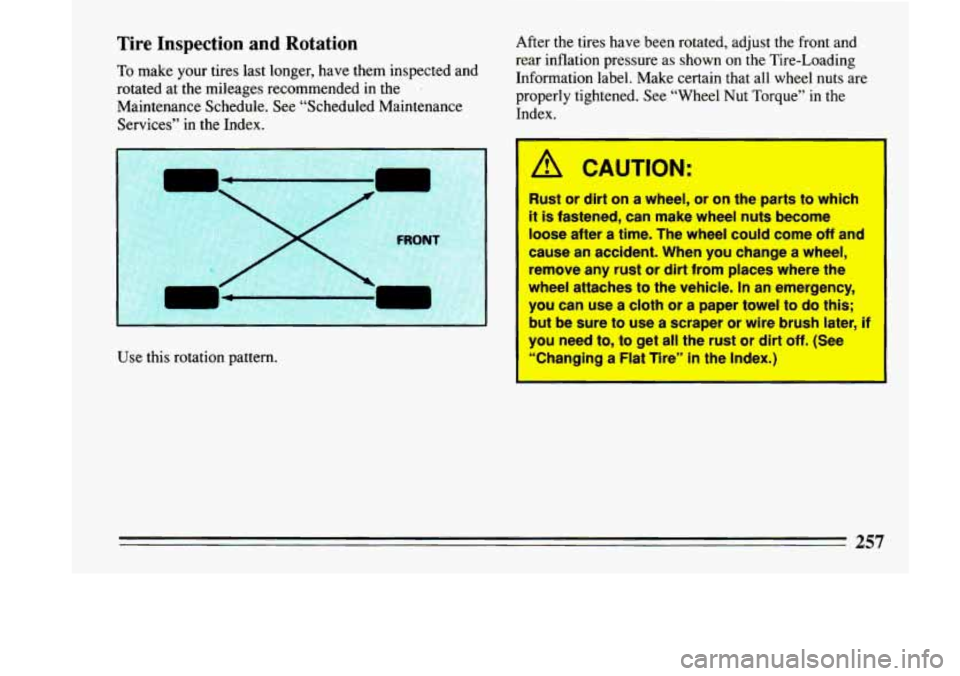
Tire Inspection and Rotation
To make your tires last longer, have them inspected and
rotated at the mileages recommended in the
.
Maintenance Schedule. See “Scheduled Maintenance
Services’’ in the Index.
Use this rotation pattern. After
the tires have been rotated, adjust the front and
rear inflation pressure as shown on the Tire-Loading
Information label. Make certain that all wheel nuts are
properly tightened. See “Wheel Nut Torque” in the
Index.
I
A CAUTION:
Rust or dlrt on a wheel, or on the parts to which
it is fastetfed, can make wheel nuts become
loose after a time. The wheel could come off and
cause
an accident. When you change a wheel,
remove any rust or dirt from places where the
wheel attaches
to the vehicle. In an emergency,
you can use a cloth or a paper towel to do this;
but be
sure to use a scraper or wire brush later, if
you need to, to get all the rust or dirt off. (See
“Changing a FI; Tire’* On the Index.)
Page 280 of 324
I IMPORTANT:
KEEP ENGINE OIL AT THE PROPER
LEVELANDCHANGEAS RECOMMENDED
1
Protection I
Plan I
Have you purchased the GM Protection Plan? The
Plan supplements your new vehicle warranties. See
your Buick dealer for details.
Introduction
A Word About Maintenance
We at General Motors want to help you keep your
vehicle in good working condition. But we don’t know
exactly
how you’ll drive it. You may drive very short
distances
only a few times a week. Or you may drive
long distances all the time in very hot, dusty weather.
You may use your vehicle in making deliveries. Or you
may drive it to work, to do errands or in many other
ways.
Because of all the different ways people
use their GM
vehicles, maintenance needs vary. You may even need
more frequent checks and replacements than you will
find in the schedules in this part.
So please read this part
and note how
you drive. If you have any questions on
how to keep your vehicle in good condition,
see your
Buick dealer, the place many GM owners choose to
have their maintenance work done. Your dealer can be
relied upon to
use proper parts and practices.
278
Page 312 of 324
Label. Service Parts Identification .................. 269
Lane Change Indicator
............................. 85
LapBelt
........................................ 38
Lap-Shoulder Belt. Usage by Children
................ 53
Leaving Your Vehicle .............................. 79
Light. Safety Belt
................................. 24
Light.
Turn Signal Indicator ......................... 85
Lighter. Cigarette ................................ 103
Lights
.......................................... 95
Lights
Daytime Running
.............................. 98
Panel
........................................ 96
Time Out Feature
.............................. 96
Traffic
...................................... 152
“On” Warning
................................. 96
Operation
.................................... 86
Lights and Gages. Warning Indicators ................ 106
Loading Your Vehicle
............................ 253
Locks. Door
..................................... 59
Locks. Rear Door Security
.......................... 65
Long Distance Driving ............................ 178
Loss of Control
................................. 168
Low Oil Pressure Warning Light
.................... 112
Maintenance Schedule
.......................... 277
Maintenance Inspections
.................................. 292
Record
...................................... 295
Schedule
.................................... 280
Underbody
.................................. 267
Malfunction Indicator Light
........................ 11 1
Manualseat ..................................... 14 Markings. Pavement
............................. 153
Master Cylinder. Brake ........................... 248
Methanol
in Gasoline ............................. 231
Mirrors Convex Outside
.............................. 100
Heated Outside Rearview
....................... 100
Inside
....................................... 99
Outside
...................................... 99
Visor Vanity
................................. 102
Mist. Driving
in ................................. 173
Mobile Telephone. Adding a
....................... 128
Mountain Driving
................................ 180
MTBE in Gasoline
............................... 231
N (Neutral) Gear Position ......................... 74
Net. Convenience
................................ 101
New Vehicle “Break-In”
........................... 68
NightDriving
................................... 169
Night Vision .................................... 170
Notices About Damage
............................ 11
Octane Required for Your Car
..................... 231
Odometer
...................................... 105
Odometer. Trip
.................................. 105
Off (Ignition Key Position)
......................... 69
Off Road Recovery
.............................. 166
Oil. Engine
..................................... 236
Oil Pressure Warning Light
........................ 112
Operation
in Foreign Countries ..................... 232
Operation of Lights
............................... 86
Oil. Change Your Engine
...................... 239. 277
310 __ .. ~