lights BUICK LESABRE 1993 User Guide
[x] Cancel search | Manufacturer: BUICK, Model Year: 1993, Model line: LESABRE, Model: BUICK LESABRE 1993Pages: 324, PDF Size: 17.02 MB
Page 104 of 324
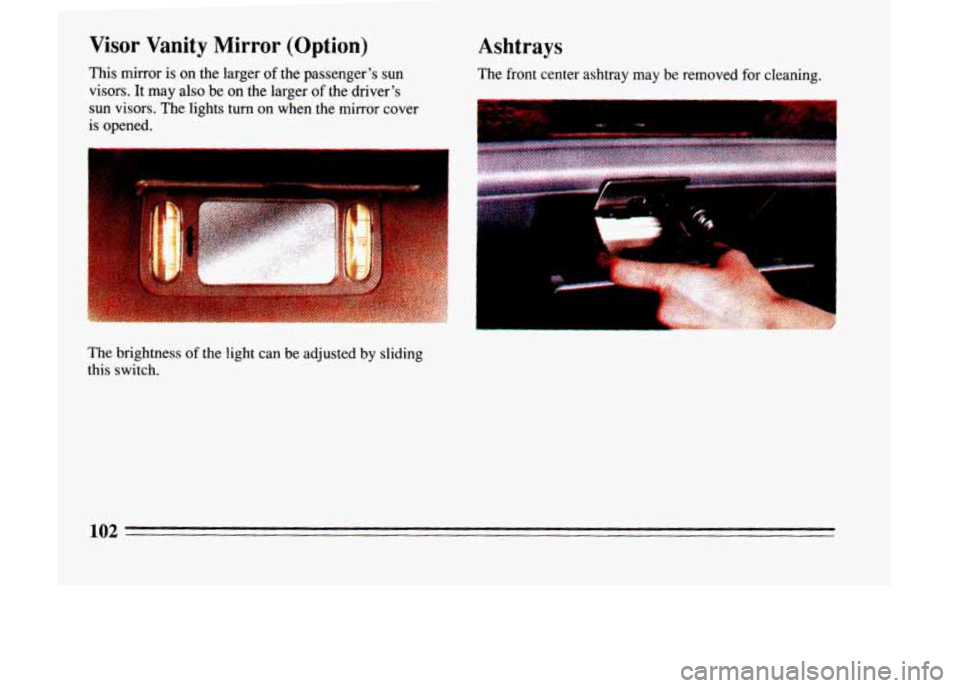
Visor Vanity Mirror (Option)
This mirror is on the larger of the passenger's sun
visors.
It may also be on the larger of the driver's
sun visors. The lights
turn on when the mirror cover
is opened.
The brightness
of the light can be adjusted by sliding
this switch.
102
Page 108 of 324
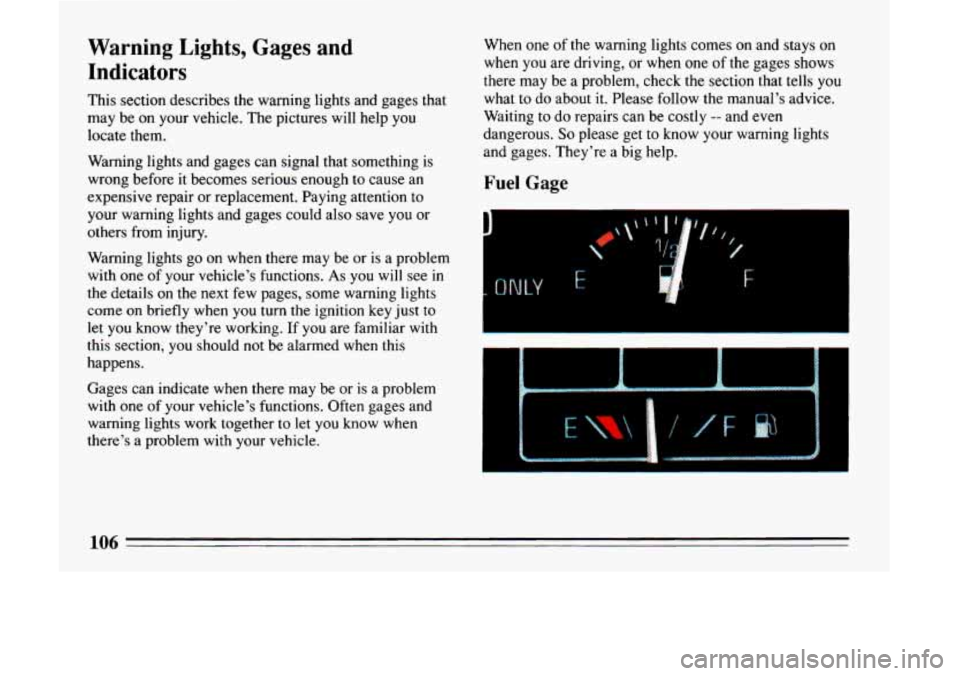
Warning Lights, Gages and
Indicators
This section describes the warning lights and gages that
may be on your vehicle. The pictures will help you
locate them.
Warning lights and gages can signal that something is
wrong before it becomes serious enough to cause an
expensive repair or replacement. Paying attention to
your warning lights and gages could also save
you or
others from injury.
Warning lights go on when there may be or
is a problem
with
one of your vehicle’s functions. As you will see in
the details
on the next few pages, some warning lights
come on briefly when
you turn the ignition key just to
let you know they’re working. If you are familiar with
this section, you should not be alarmed when this
happens.
Gages can indicate when there may be or is a problem
with one of your vehicle’s functions. Often gages and
warning lights work together to
let you how when
there’s a problem with your vehicle. When
one
of the warning lights comes on and stays on
when you are driving,
or when one of the gages shows
there may be
a problem, check the section that tells you
what to do about it. Please follow the manual’s advice.
Waiting to do repairs can be costly
-- and even
dangerous.
So please get to know your warning lights
and gages. They’re a big help.
Fuel Gage
r
F
”
I//,
0
ONLY E F F
106
Page 154 of 324
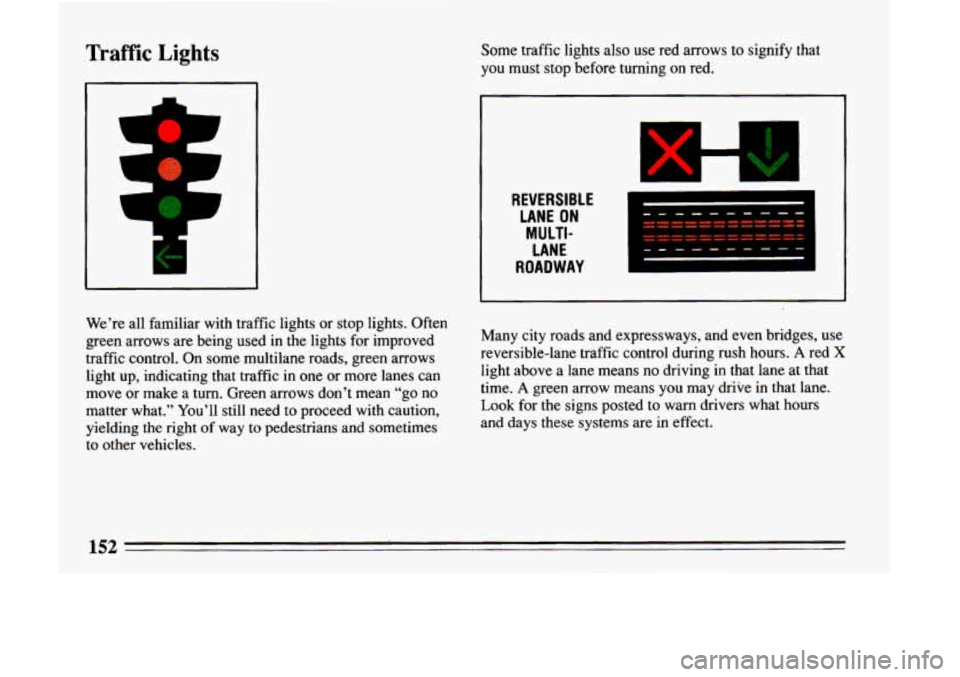
Traffic Lights Some traffic lights also use red arrows to signify that
you must stop before turning on red.
REVERSIBLE
LANE ON
LANE
ROADWAY MULTI-
x
-.
-.
We’re
all familiar with traffic lights or stop lights. Often
green arrows are being used in the lights for improved
traffic control. On some multilane roads, green arrows
light up, indicating that traffic in one or more lanes can
move or make
a turn. Green arrows don’t mean “go no
matter what.” You’ll still need
to proceed with caution,
yielding
the right of way to pedestrians and sometimes
to other vehicles. Many city
roads and expressways, and even bridges, use
reversible-lane traffic control during rush hours.
A red X
light above a lane means no driving in that lane at that
time.
A green arrow means you may dfive in that lane.
Look for the signs posted to warn drivers what hours
and days these systems are
in effect.
152
-
Page 155 of 324
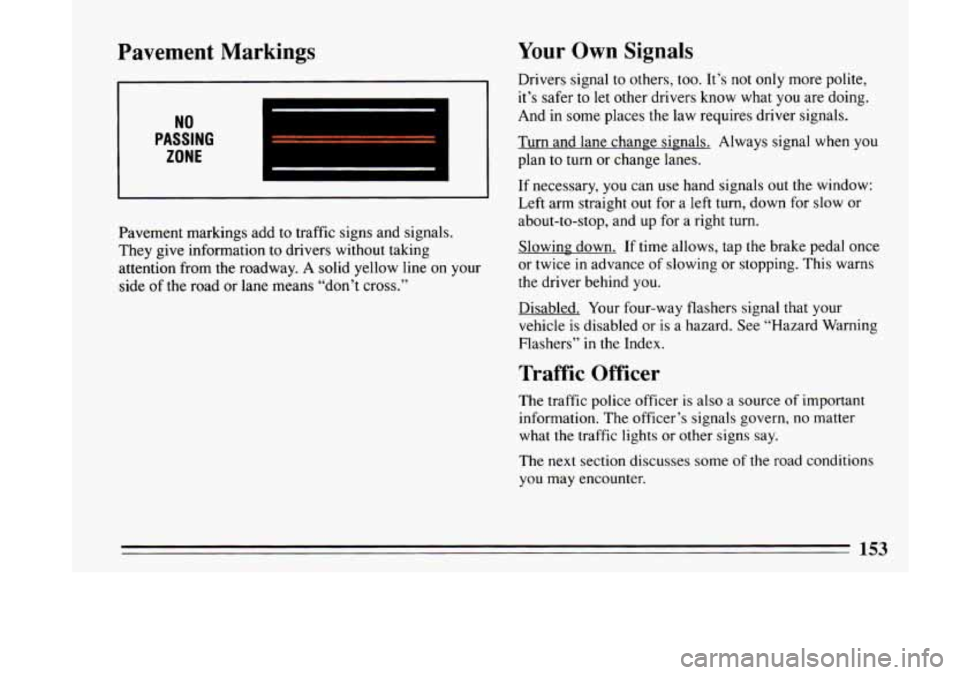
Pavement Markings
NO
PASSING
ZONE
Pavement markings add to traffic signs and signals.
They give information to drivers without taking
attention from the roadway. A solid yellow line on your
side
of the road or lane means “don’t cross.’’
Your Own Signals
Drivers signal to others, too. It’s not only more polite,
it’s safer to let other drivers know what
you are doing.
And in some places the law requires driver signals.
Turn and
lane change signals. Always signal when you
plan to turn or change lanes.
If necessary, you can use hand signals
out the window:
Left arm straight out for a left turn, down for slow or
about-to-stop, and
up for a right turn.
Slowinn down. If time allows, tap the brake pedal once
or twice in advance of slowing or stopping. This warns
the driver behind
you.
Disabled. Your four-way flashers signal that your
vehicle is disabled
or is a hazard. See “Hazard Warning
Flashers” in the Index.
Traffic Officer
The traffic police officer is also a source of important
information. The officer’s signals govern, no matter
what the traffic lights or other signs say.
The next section discusses some
of the road conditions
you may encounter.
153
Page 166 of 324
the front wheels. If there’s no traction, inertia will keep
the vehicle going in the same direction. If you’ve ever
tried to steer
a vehicle on wet ice, you’ll understand this.
The traction you can get in a curve depends on the
condition of your tires and the road surface, the angle at
which the curve is banked, and y.our speed. While
you’re in a curve, speed is the one factor you can
control.
Suppose you’re steering through a sharp curve. Then
you suddenly accelerate.
Those two control systems
-- steering and acceleration --
can overwhelm those places where the tires meet the
road and make you lose control.
What should you do
if this ever happens? Let up on the
accelerator pedal, steer the vehicle the way you want it
to go, and slow down.
Speed limit signs near curves warn that you should
adjust your speed. Of course, the posted speeds are
based on good weather and road conditions. Under less
favorable conditions you’ll want to go slower.
If you need to reduce your speed as you approach
a
curve, do it before you enter the curve, while your front
wheels are straight ahead. Try to adjust your speed
so you can
“drive” through the
curve. Maintain a reasonable, steady speed. Wait to
accelerate until you are out of the curve, and then
accelerate gently into the straightaway.
When you drive into a curve at night, it’s harder to see
the road ahead of you because it bends away from the
straight beams of your lights. This is one good reason to
drive slower.
Steering in Emergencies
There are times when steering can be more effective
than braking. For example, you come over a hill and
find a truck stopped
in your lane, or a car suddenly pulls
out from nowhere, or a child darts out from between
parked cars and stops right in front of you. You can
avoid these problems
by braking -- if you can stop in
time. But sometimes you can’t; there isn’t room. That’s\
the time for evasive action
-- steering around the
problem.
Your Buick can perform very well
in emergencies like
these. First apply your brakes.
It is better to remove as
much speed as you can from a possible collision. Then
steer around
the problem, to the left or right depending
on the space available,
An emergency like this requires close attention and a
quick decision. If you are holding the steering wheel at
164
Page 170 of 324
0 Try not to pass more than one vehicle at a time on
two-lane roads. Reconsider before passing the
next
vehicle.
Don’t overtake a slowly moving vehicle too rapidly.
Even though
the brake lights are not flashing, it may
be slowing down or starting to turn.
following driver to get ahead of you. Perhaps
you
can ease a little to the right.
If you’re being passed, make it easy for the
Loss of Control
Let’s review what driving experts say about what
happens when the three control systems (brakes, steering
and acceleration) don’t have enough friction where the
tires meet the road
to do what the driver has asked.
In
any emergency, don’t give up. Keep trying to steer and
constantly seek an escape route or area of less danger.
Skidding
In a skid, a driver can lose control of the vehicle.
Defensive drivers avoid most skids by taking reasonable
care suited to existing conditions, and by
not “over-
driving” those conditions. But skids are always possible. The
three types of skids correspond
to your Buick‘s
three control systems. In
the braking skid your wheels
aren’t rolling. In
the steering or cornering skid, too
much speed or steering in a curve causes tires to slip and
lose cornering force. And in the acceleration skid too
much throttle causes the driving wheels
to spin.
A cornering skid and an acceleration skid are best
handled by easing your
foot off the accelerator pedal.
If your vehicle starts to slide (as when
you turn a comer
on a wet, snow-or icexovered road), ease your foot off
the accelerator pedal as soon as your feel the vehicle start
to slide. Quickly steer the way
you want the vehicle to
go. If you start steering quickly enough, your vehicle will
straighten
out. As it does, straighten the front wheels.
Of course, traction is reduced when water, snow, ice,
gravel, or other material is
on the road. For safety, you’ll
want
to slow down and adjust your driving to these
conditions. It is important to slow down
on slippery
surfaces because stopping distance will be longer and
vehicle control more limited.
While driving
on a surface with reduced traction, try
your best
to avoid sudden steering, acceleration, or
braking (including engine braking by shifting
to a lower
gear). Any sudden changes could cause tires to slide.
You may
not realize the surface is slippery until your
168
Page 171 of 324
vehicle is skidding. Learn to recognize warning clues -
such as enough water, ice or packed snow on the road to
make a “mirrored surface”
- and slow down when you
have any doubt.
Remember: Any anti-lock braking system (ABS) helps
avoid only the braking skid. Steer the way
you want to go.
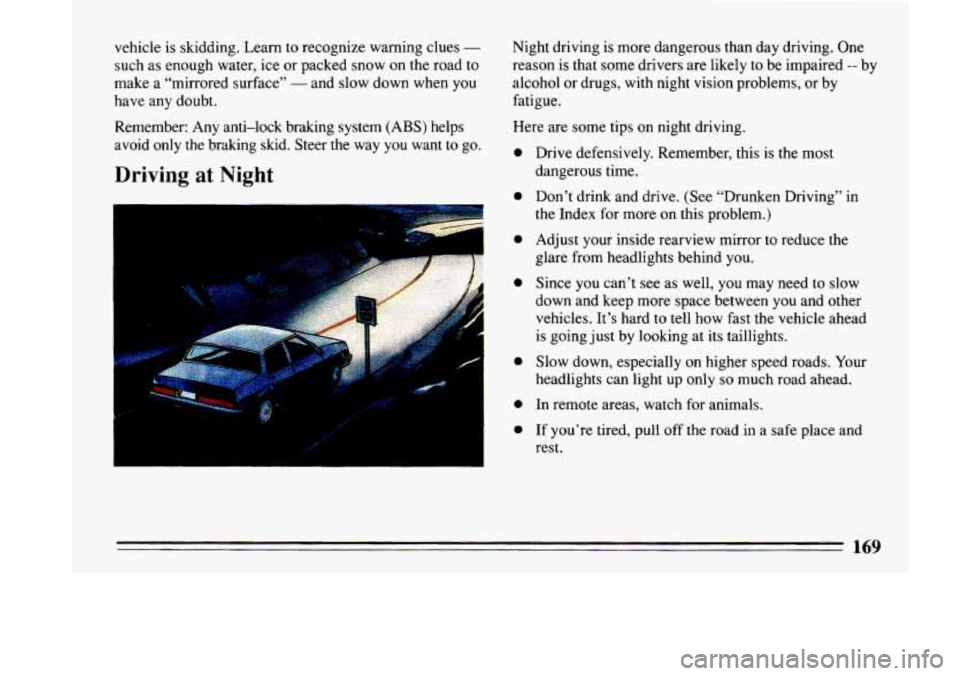
Driving at Night
Night driving is more dangerous than day driving. One
reason is that some drivers are likely
to be impaired -- by
alcohol or drugs, with night vision problems, or by
fatigue.
Here are some tips on night driving.
0
0
0
0
0
0
0
Drive defensively. Remember, this is the most
dangerous time.
Don’t drink and drive, (See “Drunken Driving’’ in
the Index for more
on this problem.)
Adjust your inside rearview mirror to reduce the
glare from headlights behind you.
Since you can’t see as well,
you may need to slow
down and keep more space between you and other
vehicles. It’s hard to tell
how fast the vehicle ahead
is going just by looking at its taillights.
Slow down, especially on higher speed roads. Your
headlights can light up only
so much road ahead.
In remote areas, watch for animals.
If you’re tired, pull off the road in a safe place and
rest.
169
Page 172 of 324
Night Vision
No one can see as well at night as in the daytime. But as
we get older these differences increase.
A SO-year-old
driver may require at least twice as much light to see the
same thing at night as a 20-year-old.
What you do in the daytime can also affect your night
vision. For example, if you spend the day
in bright
sunshine you are wise to wear sunglasses. Your eyes will
have less trouble adjusting to night.
But if you’re driving, don’t wear sunglasses at night.
They may cut down on glare from headlights, but
they
also make a lot of things invisible that should remain
visible
- such as parked cars, obstacles, pedestrians, or
even trains blocking railway crossings. You may want to
put on your sunglasses after you have pulled into
a
brightly-lighted service or refreshment area. Eyes shielded from that glare may adjust more quickly to
darkness back on the road. But be sure to remove your sunglasses before you leave the service area.
You can be temporarily blinded by approaching lights. It
can take a second
or two, or even several seconds, for
your eyes to readjust to the dark. When you are faced
with severe glare (as from
a driver who doesn’t lower
the high beams, or a vehicle with misaimed headlights), slow down
a little. Avoid staring directly into the
approaching lights. If there is a line of opposing traffic,
make occasional glances over the line of headlights to
make certain that one of the vehicles isn’t starting to
move into your lane. Once you are past the bright lights,
give your eyes time to readjust before resuming speed.
High Beams
If the vehicle approaching you has its high beams on,
signal by flicking yours to high and then back
to low
beam. This is the usual signal to lower the headlight
beams. If the other driver still doesn’t lower the beams,
resist the temptation to put your high beams on. This only makes two half-blinded drivers.
On a freeway, use your high beams only in remote areas
where you won’t impair approaching drivers. In some
places, like cities, using high beams is illegal.
When you follow another vehicle on a freeway or
highway, use low beams. True, most vehicles now have day-night mirrors that enable the driver to reduce glare. But outside mirrors are not of this type and high beams
from behind can bother the driver ahead.
170
-
Page 173 of 324
A Few More Night Driving Suggestions
Keep your windshield and all the glass on your vehicle
clean
-- inside and out. Glare at night is made much
worse by dirt on the glass. Even the inside
of the glass
can build up a film caused by dust. Tobacco smoke also
makes inside glass surfaces very filmy and can be a
vision hazard if it’s left there.
Dirty glass makes lights dazzle and flash more than
clean glass would, making the pupils
of your eyes
contract repeatedly. You might even want
to keep a cloth
and some glass cleaner in your vehicle if
you need to
clean your glass frequently.
Remember that your headlights light up far less
of a
roadway when you are in a turn
or curve.
Keep your eyes moving; that way, it’s easier to pick out
dimly lighted objects.
Just
as your headlights should be checked regularly for
proper aim,
so should your eyes be examined regularly.
Some drivers suffer from night blindness
-- the inability
to see in dim light -- and aren’t even aware of it.
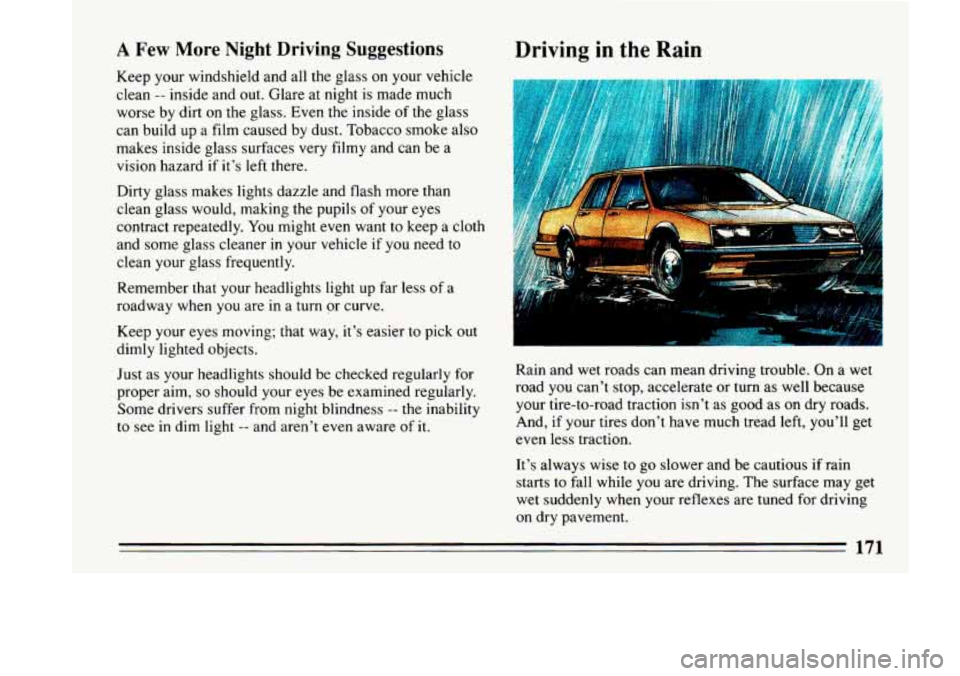
Driving in the Rain
/’ ..
Rain and wet roads can mean driving trouble. On a wet
road you can’t stop, accelerate or turn as well because
your tire-to-road traction isn’t as good
as on dry roads.
And, if your tires don’t have much tread left, you’ll get
even less traction.
It’s always wise to go slower and be cautious if rain
starts to fall while you are driving. The surface may get
wet suddenly when your reflexes are tuned for driving
on dry pavement.
171
Page 175 of 324
to pass -- or if you get hit by a gust of wind. You could
suddenly find yourself out of control.
Hydroplaning doesn’t happen often. But it can
ir your
tires haven’t much tread or if the pressure in one or
more is low.
It can happen if a lot of water is standing
on the road. If you can see reflections from trees,
telephone poles, or other vehicles, and raindrops
“dimple” the water’s surface, there could be
hydroplaning.
Hydroplaning usually happens at higher speeds. There
just isn’t a hard and fast rule about hydroplaning. The
best advice is to slow down.when it is raining, and be
careful.
Some Other Rainy Weather Tips
0 Turn on your headlights -- not just your parking
lights
-- to help make you more visible to others.
0 Look for hard-to-see vehicles coming from behind.
You may want to use your headlights even
in
daytime if it’s raining hard.
0 Besides slowing down, allow some extra following
distance. And be especially careful when you pass
another vehicle. Allow yourself more clear room
ahead, and be prepared to have your view restricted
bv road spray. If the road spray is so heavy you are actually blinded,
drop back. Don’t pass until
conditions improve. Going more slowly is better
than having an accident.
0 Use your defogger if it helps.
0 Have good tires with proper tread depth. (See
“Tires” in the Index.)
Driving in Fog, Mist and Haze