engine BUICK LESABRE 1993 Manual PDF
[x] Cancel search | Manufacturer: BUICK, Model Year: 1993, Model line: LESABRE, Model: BUICK LESABRE 1993Pages: 324, PDF Size: 17.02 MB
Page 248 of 324
Thermostat
Engine coolant temperature is controlled by a thermostat
in the engine coolant system. The thermostat stops the
flow of coolant through the radiator until the coolant
reaches a preset temperature.
When
you replace your thermostat, an ACS thermostat
is recommended.
Power Steering Fluid
:i
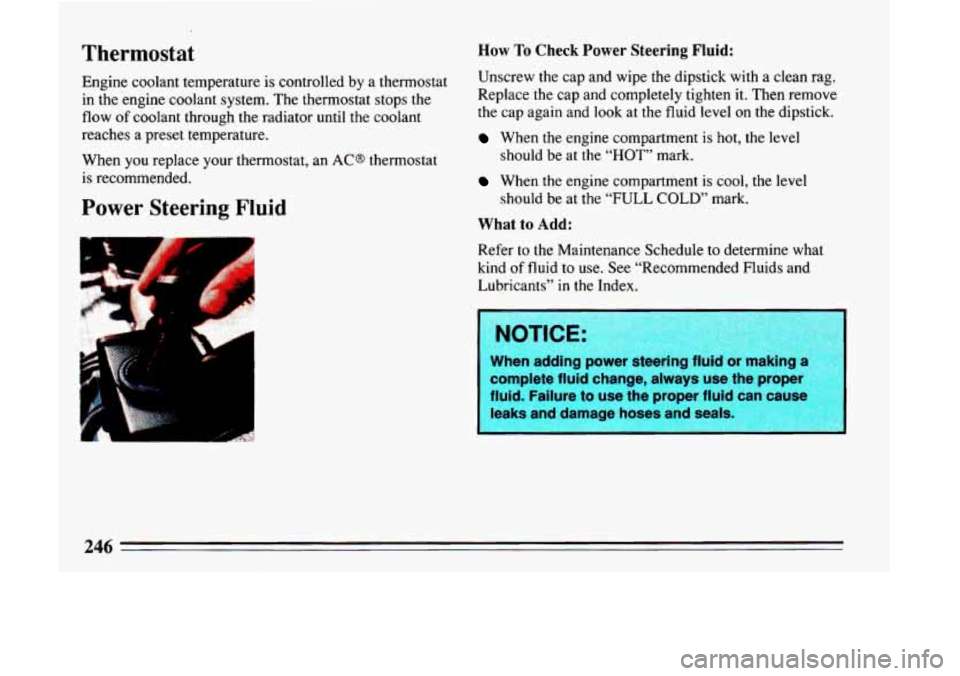
How To Check Power Steering Fluid:
Unscrew the cap and wipe the dipstick with a clean rag.
Replace the cap and completely tighten it. Then remove
the cap again and look at the fluid level on the dipstick.
When the engine compartment is hot, the level
When the engine compartment is cool, the level
What to Add:
Refer to the Maintenance Schedule to determine what
kind
of fluid to use. See “Recommended Fluids and
Lubricants” in the Index.
should be
at the
“HOT” mark.
should be at the
“FULL COLD” mark.
When adding power steering fli or making a
complete fluid change, always use the proper
fluid. Failure
to use the proper fluid can cause
leaks and damage hoses and seals.
Page 250 of 324
Brake Master Cylinder
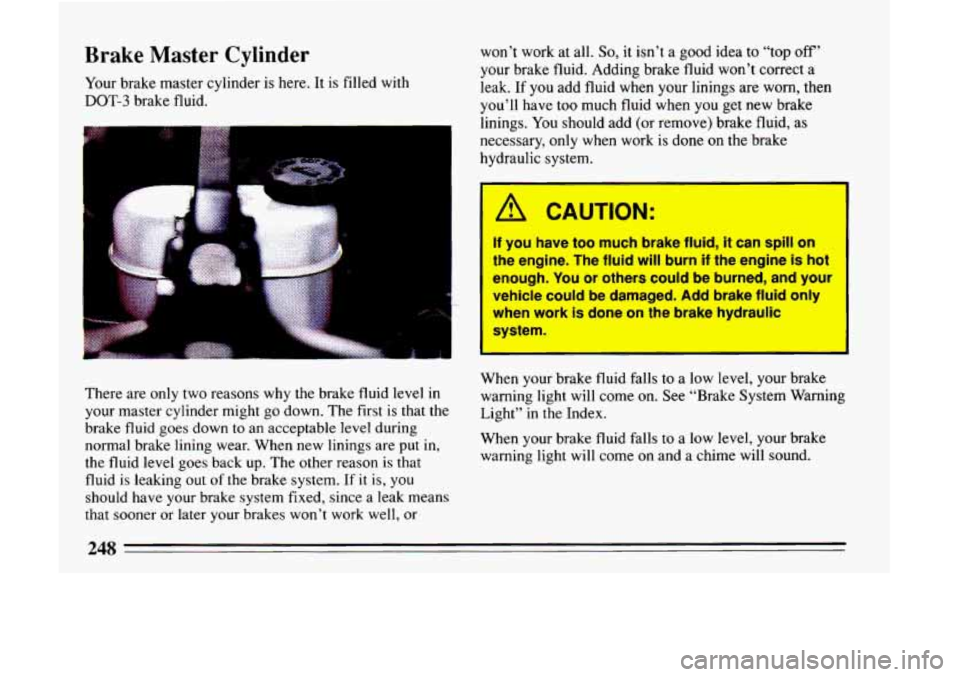
Your brake master cylinder is here. It is filled with
DOT-3 brake fluid. won’t
work at all.
So, it isn’t a good idea to “top off’
your brake fluid. Adding brake fluid won’t correct a
leak.
If you add fluid when your linings are worn, then
you’ll have too much fluid when you get new brake
linings. You should add (or remove) brake fluid, as
necessary, only when work
is done on the brake
hydraulic system.
A CAUTION:
If you have too much brake fluid, it can spill on
the engine. The fluid will burn if the engine is hat
,..ough. You or others could be burned, and you1
vehicle could be damaged. Add brake fluid only
when work is done on the brake hydraulic
system.
There are only two reasons why the brake fluid level in
your master cylinder might
go down. The first is that the
brake fluid goes down to an acceptable level during
normal brake lining wear. When new linings are put in,
the fluid level goes back up.
The other reason is that
fluid
is leaking out of the brake system. If it is, you
should have your brake system fixed, since a leak means
that sooner
or later your brakes won’t work well, or When your brake
fluid falls to a low level, your brake
warning light will come on. See “Brake System Warning
Light” in the Index.
When your brake fluid falls to a low
level, your brake
warning light will come
on and a chime will sound.
248
Page 251 of 324
What to Add:
When you do need brake fluid, use only DOT-3 brake
fluid
-- such as Delco Supreme 11 @ (GM Part
No. 1052535). Use new brake fluid from a sealed
container only.
DOT-5 silic
your vehicle. Don’t use it.
0 Don’t let someone put in the wrong kind o
fluid. For example, just a few drops of
mineral-based oil, such as engine
oil, in
your brake system can damage brake
system parts
so badly that they’ll have to
Brake fluid can damage paint,
so be caref
Replacing Brake System Parts
The braking system on a modern vehicle is complex. Its
many parts have to be of top quality and work well
together if the vehicle is to have really good braking. Vehicles
we design and test have top-quality GM brake
parts in them, as your Buick does when it is new. When
you replace parts of your braking system -- for example,
when your brake linings wear down and you have to
have new ones put in
-- be sure you get new genuine
GM replacement parts.
If you don’t, your brakes may no
longer work properly. For example, if someone puts in
brake linings that are wrong for your vehicle, the
balance between your front and rear brakes can change,
for the worse. The braking performance you’ve come to
expect can change in many other ways if someone puts
in the wrong replacement brake parts.
Battery
Every new Buick has a Delco Freedoms battery. You
never have to add water to one of these. When it’s time
for a new battery, we recommend a Delco Freedoms
battery. Get one that has the catalog number shown
on
the original battery’s label.
Vehicle Storage
If you’re not going to drive your vehicle for 25 days or
more, take
off the black, negative (-) cable from the
battery. This will help keep your battery from running
down.
249
Page 271 of 324
Vehicle Identification Number (VIN)
ENGINE A3 f ASSEMBLY
~ CODE MODEL YEAR PLANT
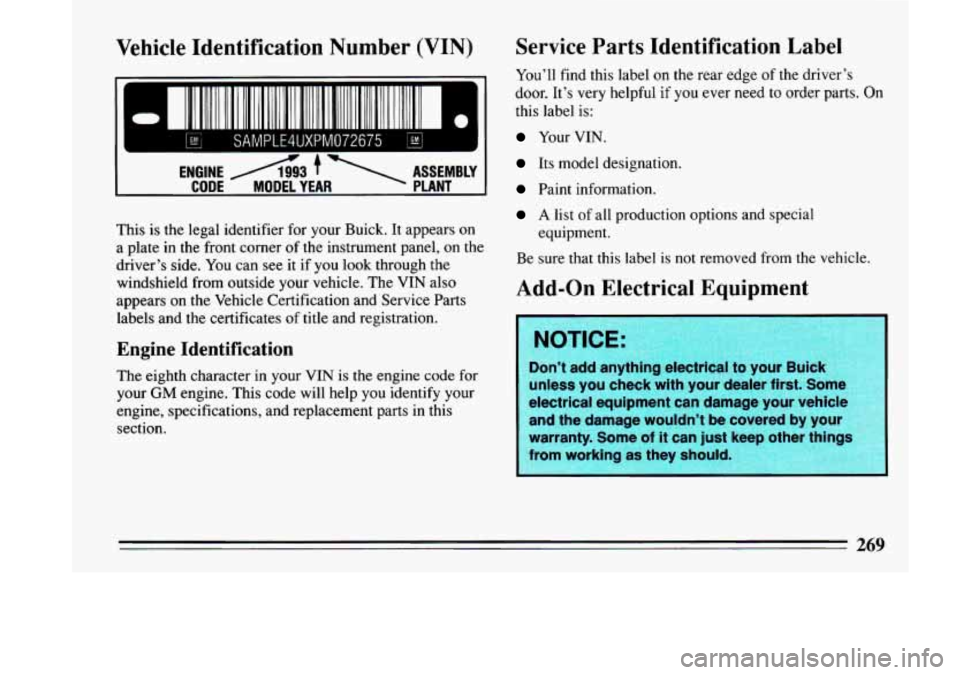
This is the legal identifier for your Buick. It appears on
a plate in the front corner
of the instrument panel, on the
driver’s side. You can see it if you look through the
windshield from outside your vehicle.
The VIN also
appears on the Vehicle Certification and Service Parts
labels and the certificates
of title and registration.
Engine Identification
The eighth character in your VIN is the engine code for
your
GM engine. This code will help you identify your
engine, specifications, and replacement parts in this
section.
Service Parts Identification Label
You’ll find this label on the rear edge of the driver’s
door.
It’s very helpful if you ever need to order parts. On
this label is:
Your VIN.
Its model designation.
Paint information.
A list of all production options and special
Be sure that this label is
not removed from the vehicle.
equipment.
Add-on
Electrical Equipment
unless you check with your dealer first. Some
electrical equipment can damage your vehicle
and the damage wouldn’t be covered by your
warranty. Some
of it can just kee
from working as they should.
Page 276 of 324
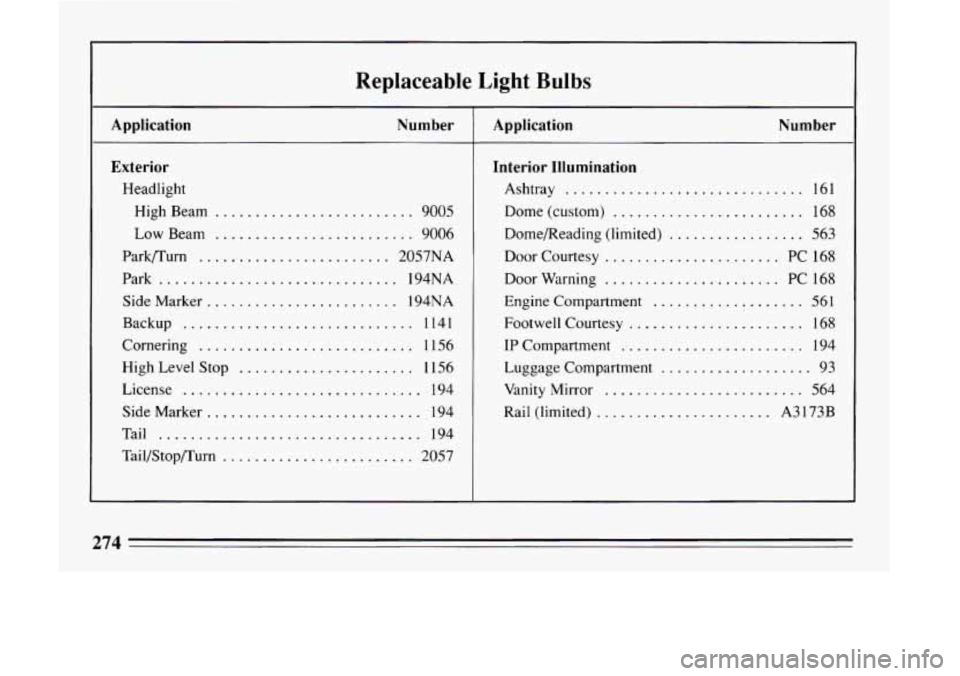
Replaceable Light Bulbs
Application Number
Exterior
Headlight High Beam
......................... 9005
Low Beam
......................... 9006
Parknurn
........................ 2057NA
Park
.............................. 194NA
Side Marker
........................ 194NA
Backup
............................. 1141
Cornering
........................... 1156
High Level Stop
...................... 1156
License
.............................. 194
Side Marker
........................... 194
Tail ................................. 194
Tail/Stop/Turn
........................ 2057
Application Number
Interior Illumination
Ashtray .............................. 161
Dome (custom)
........................ 168
Domemeading (limited)
................. 563
Door Courtesy ...................... PC 168
Door Warning
...................... PC 168
Engine Compartment
................... 561
Footwell Courtesy ...................... 168
IP Compartment ....................... 194
Luggage Compartment
................... 93
Vanity Mirror
......................... 564
Rail (limited) ...................... A3173B
274
Page 277 of 324
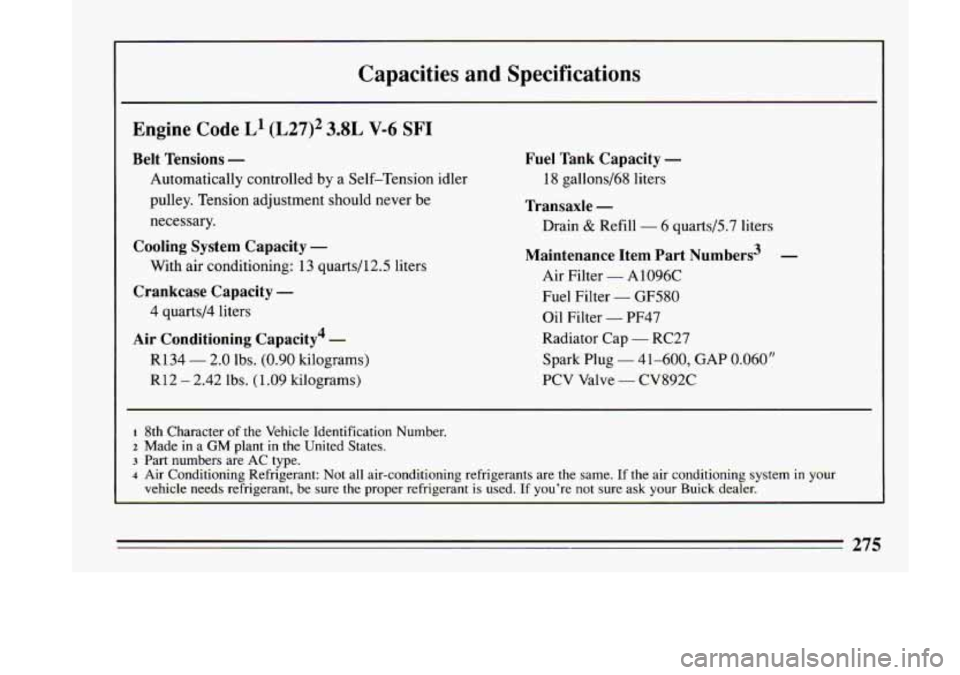
Capacities and Specifications
Engine Code L1 (L27)2 3.8L V-6 SF1
Belt Tensions -
Automatically controlled by a Self-Tension idler
pulley. Tension adjustment should never
be
necessary.
Cooling System Capacity -
Crankcase Capacity -
Air Conditioning Capacity4 -
With air conditioning: 13 quarts/l2.5 liters
4 quarts/4 liters
R134
- 2.0 lbs. (0.90 kilograms)
R12 - 2.42 lbs. ( 1.09 kilograms)
Fuel Tank Capacity -
18 gallons/68 liters
Transaxle -
Drain & Refill - 6 quarts/5.7 liters
Maintenance Item Part Numbers3 -
Air Filter - A1096C
Fuel Filter
- GF580
Oil Filter
- PF47
Radiator Cap - RC27
Spark Plug
- 41-600, GAP 0.060”
PCV Valve
- CV892C
1 8th Character of the Vehicle Identification Number.
2 Made in a GM plant in the United States.
3 Part numbers are AC type.
4 Air Conditioning Refrigerant: Not all air-conditioning refrigerants are the same. If the air conditioning system in your
vehicle needs refrigerant, be sure the proper refrigerant
is used. If you’re not sure ask your Buick dealer.
Page 280 of 324
I IMPORTANT:
KEEP ENGINE OIL AT THE PROPER
LEVELANDCHANGEAS RECOMMENDED
1
Protection I
Plan I
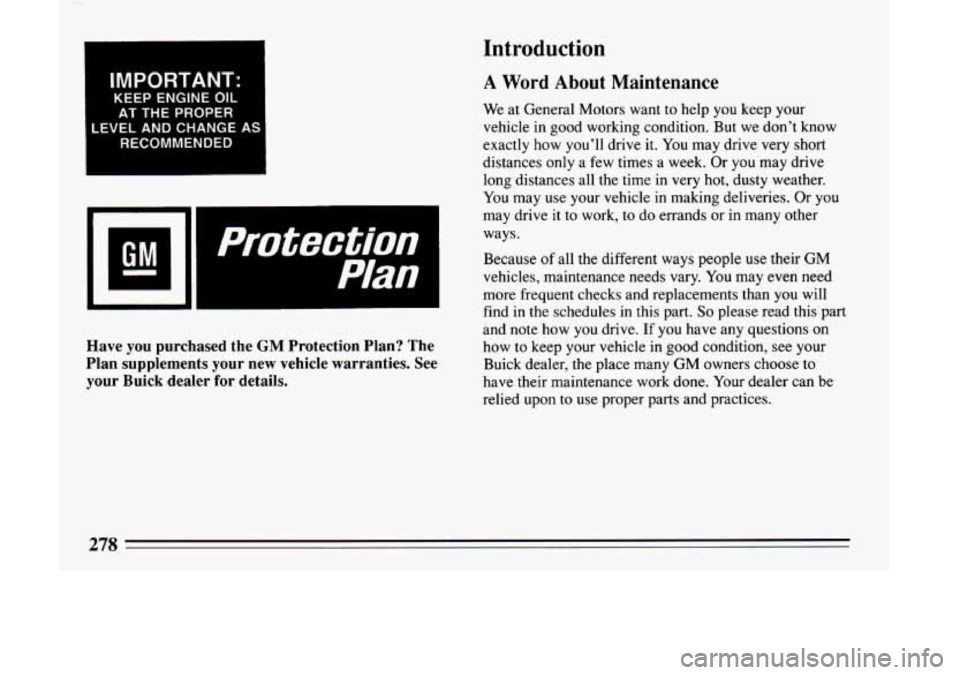
Have you purchased the GM Protection Plan? The
Plan supplements your new vehicle warranties. See
your Buick dealer for details.
Introduction
A Word About Maintenance
We at General Motors want to help you keep your
vehicle in good working condition. But we don’t know
exactly
how you’ll drive it. You may drive very short
distances
only a few times a week. Or you may drive
long distances all the time in very hot, dusty weather.
You may use your vehicle in making deliveries. Or you
may drive it to work, to do errands or in many other
ways.
Because of all the different ways people
use their GM
vehicles, maintenance needs vary. You may even need
more frequent checks and replacements than you will
find in the schedules in this part.
So please read this part
and note how
you drive. If you have any questions on
how to keep your vehicle in good condition,
see your
Buick dealer, the place many GM owners choose to
have their maintenance work done. Your dealer can be
relied upon to
use proper parts and practices.
278
Page 283 of 324
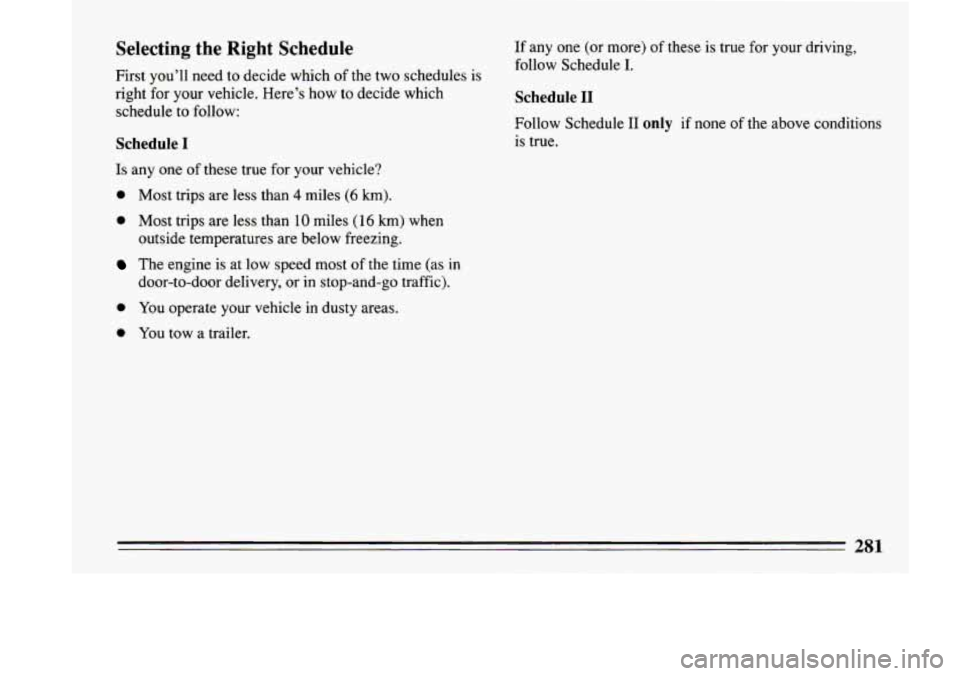
Selecting the Right Schedule
First you’ll need to decide which of the two schedules is
right for your vehicle. Here’s how to decide which
schedule to follow:
Schedule I
Is any one of these true for your vehicle?
0 Most trips are less than 4 miles (6 km).
0 Most trips are less than 10 miles ( 16 km) when
outside temperatures are below freezing.
The engine is at low speed most of the time (as in
door-to-door delivery, or in stop-and-go traffic).
0 You operate your vehicle in dusty areas.
0 You tow a trailer. If any
one
(or more) of these is true for your driving,
follow Schedule I.
Schedule I1
Follow Schedule I1 only if none of the above conditions
is true.
281
~ __.- ..
Page 284 of 324
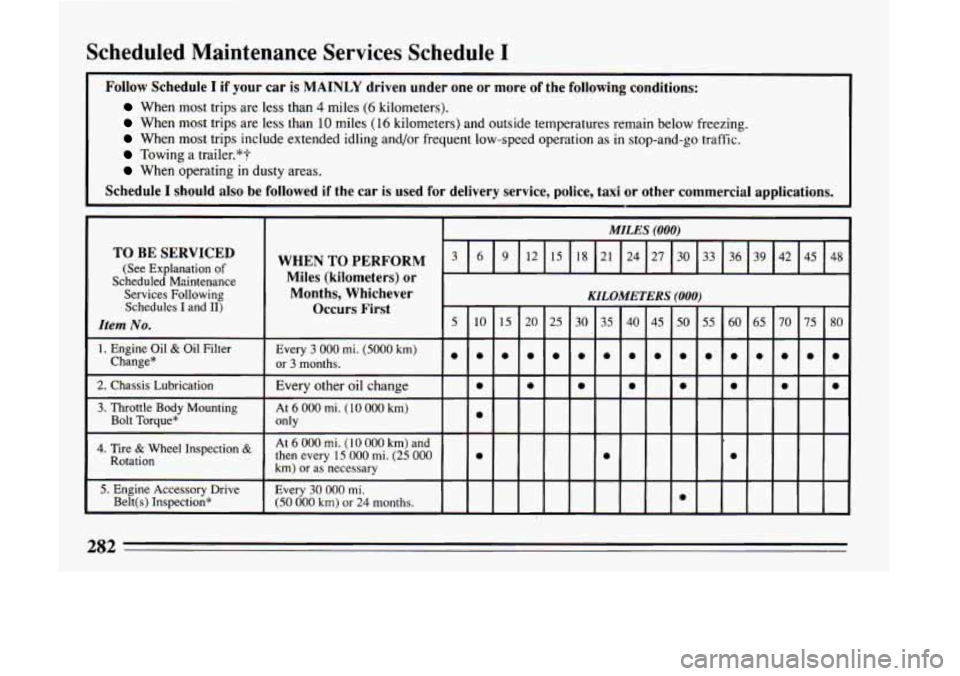
Scheduled Maintenance Services Schedule I
Follow Schedule I if your car is MAINLY driven under one .or more of the following conditions:
When most trips are less than 4 miles (6 kilometers).
When most trips are less than 10 miles (16 kilometers) and outside temperatures remain below freezing.
When most trips include extended idling and/or frequent low-speed operation as in stop-and-go traffic.
Towing a trailer.*?
When operating in dusty areas.
Schedule I should also be followed if the car is used for delivery service, police, taxi or other commercial applications.
I I MILES (000) ~ ~ ~~
TO BE SERVICED
Miles (kilometers) or
Scheduled Mzintenance
48 45 42 39
36
33 30 27
24 21 18 15 12 9 6 3 WHEN TO PERFORM (See Explanation of
~ ~~ ~~
Services Following
Schedules I and
11)
Months, Whichever
Occurs First
Item No.
1. Engine Oil & Oil Filter Every 3 000 mi. (5000 km)
Change* or
3 months.
2. Chassis Lubrication Every
other oil change
3. Throttle Body Mounting At 6 000 mi. (10 000 km)
~~
Bolt Torque*
only
4* Tire & Inspection & then every 15 000 mi. (25 000 At 6 000 mi. ( 10 000 km) and
km)
or as necessary
Rotation
5. Engine
Accessory Drive
Every 30 000 mi.
Belt(s) Inspection* (50 000 km) or 24 months.
5 10
e.
e
e
e
20 25
e.
e
KILOMETERS (000)
30 35
me
e
e
40 45
em
e
50 55
me
e
e
282
Page 286 of 324
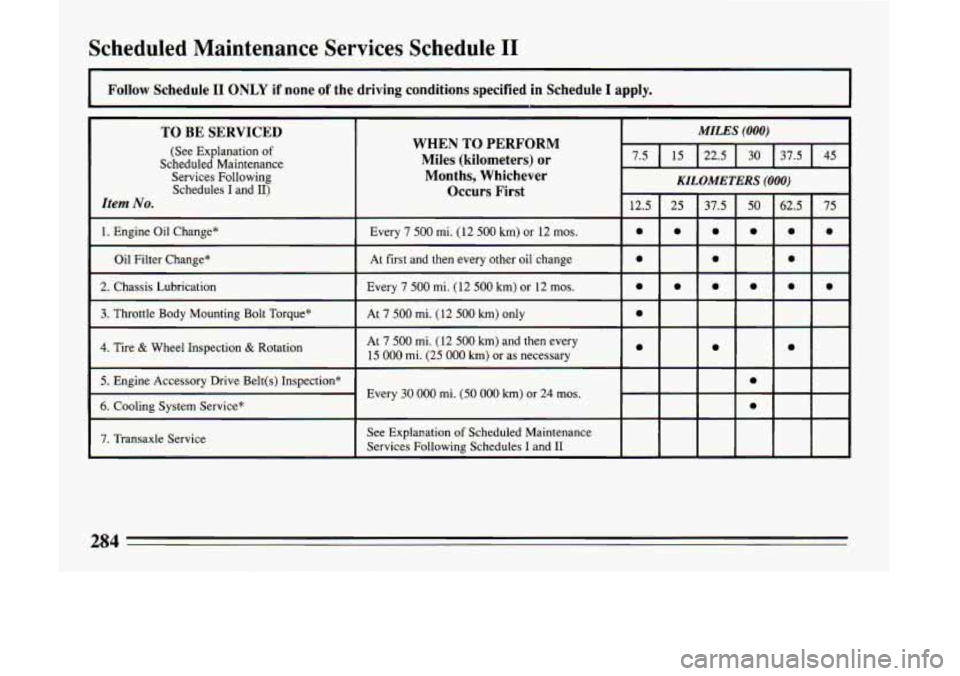
Scheduled Maintenance Services Schedule I1
Follow Schedule I1 ONLY if none of the driving conditions specified in Schedule I apply.
TO BE SERVICED
(See Explanation of
Scheduled Maintenance
Services Following Schedules
I and 11)
Item No.
1. Engine Oil Change"
Oil Filter Change"
2. Chassis Lubrication
3. Throttle Body Mounting Bolt Torque*
4. Tire & Wheel Inspection & Rotation
5. Engine Accessory Drive Belt(s) Inspection"
6. Cooling System Service*
7. Transaxle Service
WHEN TO PERFORM
Miles (kilometers) or
Months, Whichever
Occurs
First
MILES (000)
KILOMETERS (000)
I' I 12.5 I 25
Every
7 500 mi. (12 500 km) or 12 mos. 1.1.
At first and then every other oil change 1.1 ~~ ~
Every 7 500 mi. (12 500 km) or 12 mos.
I I
At 7 500 mi. (12 500 km) only 1.1
At 7 500 mi. (12 500 km) and then every
15
000 mi. (25 000 km) or as necessary
Every
30 000 mi. (50 000 km) or 24 mos.
H-
See Explanation of Scheduled Maintenance
Services Following Schedules
I and I1 I
284