brake fluid BUICK LESABRE 1993 Owners Manual
[x] Cancel search | Manufacturer: BUICK, Model Year: 1993, Model line: LESABRE, Model: BUICK LESABRE 1993Pages: 324, PDF Size: 17.02 MB
Page 91 of 324
NOTICE:
When using concentrated washer fluid
iollow the manufacturer instructions for
~ Idding water.
I 0 Don’t mix water with ready to use washe
fluid
. Water can cause the solution to
freeze and damage your washer fluid tank
and other parts of
t
water doesn’t clean as well as washer
0 Fill your washer fluid tank only 3/4 full
when it’s very cold. This
allows for
expansion, which c
it is completely full.
0 Don’t use radiator a
windshield washer. It c
paint.
I
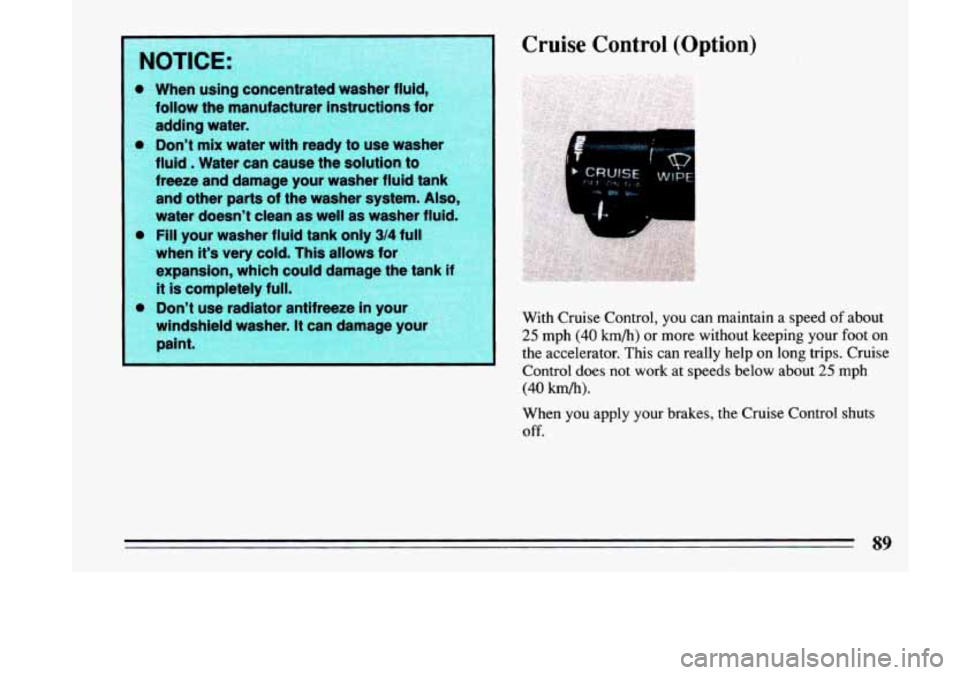
Cruise Control (Option)
With Cruise Control, you can maintain a speed of about
25 mph (40 km/h) or more without keeping your foot on
~ the accelerator. This can really help on long trips. Cruise
Control
does not work at speeds below about 25 mph
(40 km/h).
When you apply your brakes, the Cruise Control shuts
off.
Page 182 of 324
Hill and Mountain Roads
-.
Driving on steep hills or mountains is different from
driving in flat or rolling terrain.
If you drive regularly in steep country, or if you're
planning to visit there, here are
some tips that can make
your trips safer and
more enjoyable.
0 Keep your vehicle in good shape. Check all fluid
levels and also the brakes, tires, cooling system and
transaxle. These parts can work hard
on mountain
roads.
Know how to go down hills. The most important
thing
to know is this: let your engine do some of the
slowing down. Don't make your brakes do it all.
Shift
to a lower gear when you go down a steep or
long hill. That way, you will slow down without
excessive use of your brakes.
A CAUTION:
If you don't shift down, your brakes could get so
hot that they wouldn't work well. You would then
have poor braking
or even none going down a
hill. You could crash. Shift down to let your
engine assist your brakes on
a steep downhill
slope.
180
Page 196 of 324
Parking on Hills
You really should not park your vehicle, with a trailer
attached, on a hill. If something goes wrong, your rig
could start to move. People can be injured, and both
your vehicle and the trailer can be damaged.
But if you
ever have to park your rig on a hill, here’s
how to do it:
1. Apply your regular brakes, but don’t shift into “P7’
(Park) yet.
2. Have someone place chocks under the trailer wheels.
3. When the wheel chocks are in place, release the
regular brakes until the chocks absorb the load.
4. Reapply the regular brakes. Then apply your parking
brake, and then shift to
“P” (Park).
5. Release the regular brakes.
When You Are Ready to Leave After
Parking
on a Hill
1. Apply your regular brakes and hold the pedal down
while you:
Start your engine;
Shift into a gear; and
0 Release the parking brake.
2. Let up on the brake pedal.
3. Drive slowly until the trailer is clear of the chocks.
4. Stop and have someone pick up and store the chocks.
Maintenance When Trailer Towing
Your vehicle will need service more often when you’re
pulling a trailer. See the Maintenance Schedule for more
on this. Things that are especially important in trailer
operation are automatic transaxle fluid (don’t overfill),
engine oil, belts, cooling system, and brake adjustment.
Each of these is covered
in this manual, and the Index
will help you find them quickly. If you’re trailering, it’s
a good idea to review these sections before you
start
your trip.
Check periodically to see that all hitch nuts and bolts are
tight.
194
Page 231 of 324
@ Part 6 Service & Appearance Lare
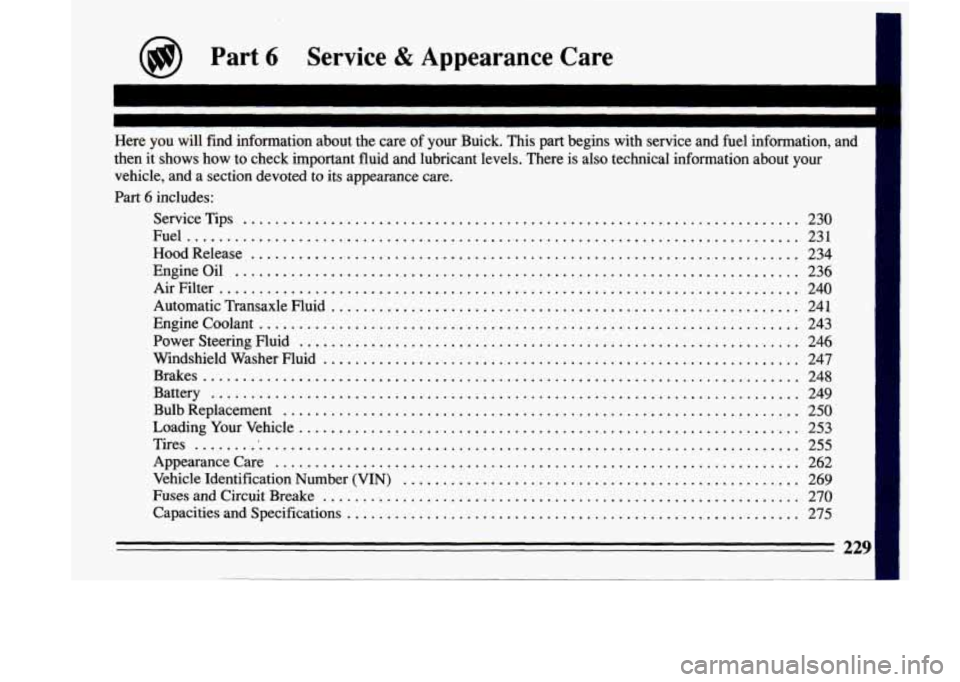
Here you will find information about the care of your Buick . This part begins with service and fuel information. and
then it shows how to check important fluid and lubricant level\
s
. There is also technical information about your
vehicle. and a section devoted to its appearance care .
Part 6 includes:
ServiceTips
......................................................................
Fuel ........................................................................\
.....
HoodRelease .....................................................................
Engineoil ....................................................................... \
AirFilter ........................................................................\
.
Automatic Transaxle Fluid ............................................................
Enginecoolant ....................................................................
Power Steering Fluid ...............................................................
Windshield Washer Fluid ............................................................
Brakes ........................................................................\
...
Battery ........................................................................\
..
BulbReplacement .................................................................
Tires ........................................................................\
.....
Appearancecare ..................................................................
Vehicle Identification Number (VIN) ..................................................
FusesandCircuitBreake ............................................................
Capacities and Specifications .........................................................
LoadingYourVehicle ...............................................................
230
231
234
236
240
241
243
246 247
248
249
250
253
255
262
269
270
275
229
Page 238 of 324
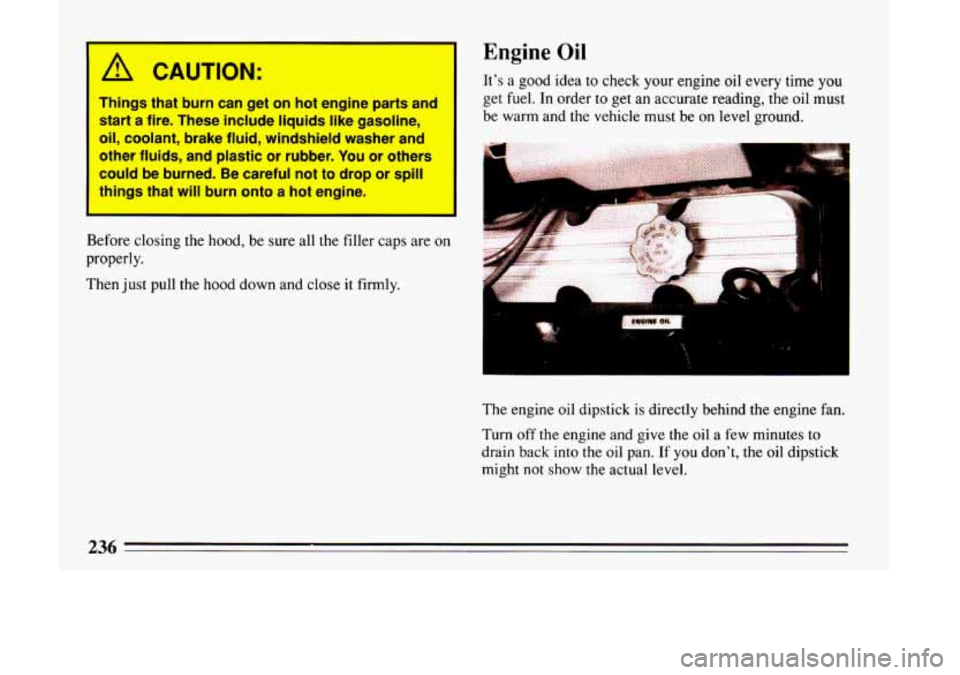
A CAUTION:
Things that burn can get on hot engine parts and
start a fire. These include liquids like gasoline,
oil, coolant, brake fluid, windshield washer and
other fluids, and plastic
or rubber. You or others
could
be burned. Be careful not to drop or spill
things that
will burn onto a hot engine.
I
Before closing the hood, be sure all the filler caps are on
properly.
Then just pull the hood down and close it firmly.
Engine Oil
It’s a good idea to check your engine oil every time you
get fuel. In order to get an accurate reading, the oil must
be warm and the vehicle
must be on level ground.
The engine oil dipstick is directly behind the engine fan.
Turn
off the engine and give the oil a few minutes to
drain back into the oil pan. If you don’t, the oil dipstick
might not show the actual level.
236
Page 244 of 324
Wait at least 30 minutes before checking the transaxle
fluid level if
you have been driving:
0 When outside temperatures are above 90 " F (32 " C).
0 At high speed for quite a while.
0 In heavy traffic -- especially in hot weather.
While pulling a trailer.
To get the right reading, the fluid should be at normal
operating temperature, which is
180 F to 200 " F (82 " C
to 93 "C).
Get the vehicle warmed up by driving about 15 miles
(24 km) when outside temperatures are above 50 " F
(10' C). If it's colder than 50 " F (1 0 ' C), you may have
to drive longer.
To check the fluid level:
Park your vehicle on a level place.
Place the shift lever in 7'" (Park) with the parking
With your foot on the brake pedal, move the shift
brake
applied.
lever through each gear range, pausing for about
three seconds in each range.
Then, position the shift
lever in "P" (Park).
Let the engine run at idle for three to five minutes. Then, without
shutting off the engine, follow these
steps:
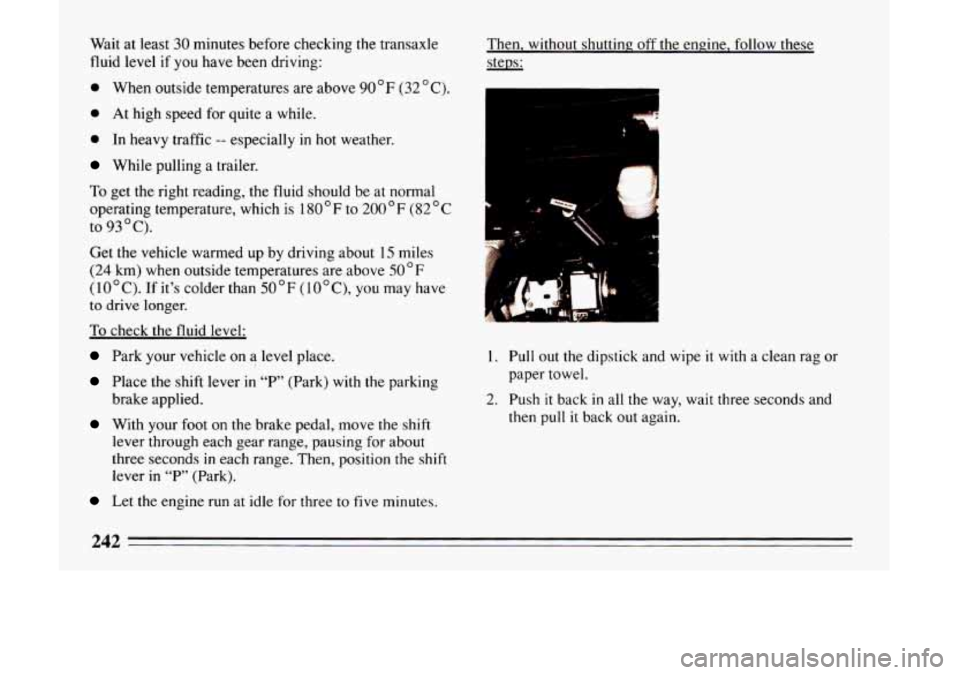
1. Pull out the dipstick and wipe it with a clean rag or
paper towel.
2. Push it back in all the way, wait three seconds and
then pull it back out again.
242
Page 250 of 324
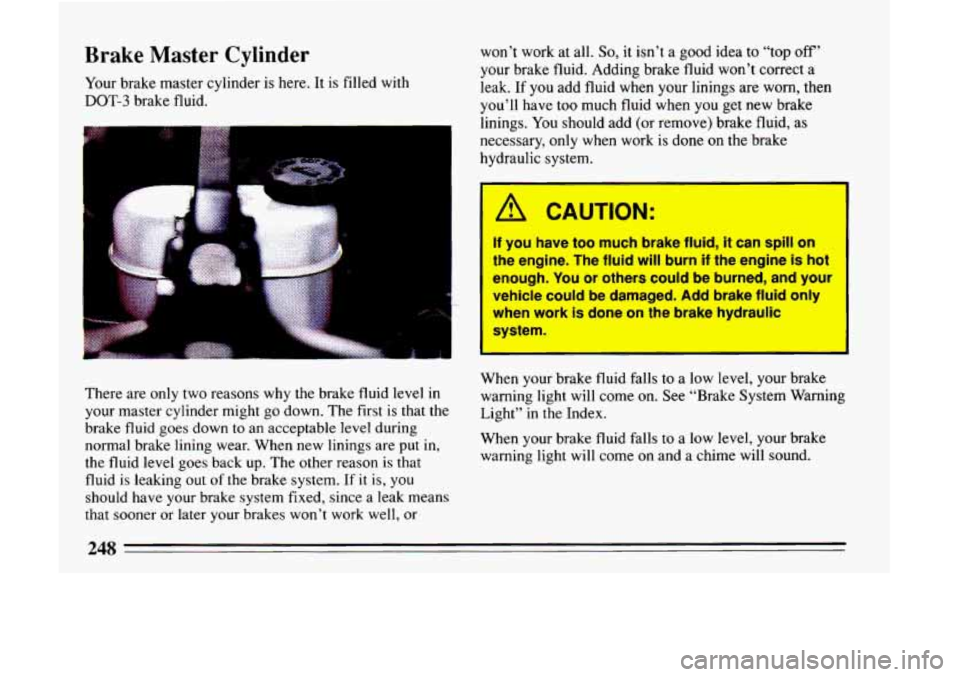
Brake Master Cylinder
Your brake master cylinder is here. It is filled with
DOT-3 brake fluid. won’t
work at all.
So, it isn’t a good idea to “top off’
your brake fluid. Adding brake fluid won’t correct a
leak.
If you add fluid when your linings are worn, then
you’ll have too much fluid when you get new brake
linings. You should add (or remove) brake fluid, as
necessary, only when work
is done on the brake
hydraulic system.
A CAUTION:
If you have too much brake fluid, it can spill on
the engine. The fluid will burn if the engine is hat
,..ough. You or others could be burned, and you1
vehicle could be damaged. Add brake fluid only
when work is done on the brake hydraulic
system.
There are only two reasons why the brake fluid level in
your master cylinder might
go down. The first is that the
brake fluid goes down to an acceptable level during
normal brake lining wear. When new linings are put in,
the fluid level goes back up.
The other reason is that
fluid
is leaking out of the brake system. If it is, you
should have your brake system fixed, since a leak means
that sooner
or later your brakes won’t work well, or When your brake
fluid falls to a low level, your brake
warning light will come on. See “Brake System Warning
Light” in the Index.
When your brake fluid falls to a low
level, your brake
warning light will come
on and a chime will sound.
248
Page 251 of 324
What to Add:
When you do need brake fluid, use only DOT-3 brake
fluid
-- such as Delco Supreme 11 @ (GM Part
No. 1052535). Use new brake fluid from a sealed
container only.
DOT-5 silic
your vehicle. Don’t use it.
0 Don’t let someone put in the wrong kind o
fluid. For example, just a few drops of
mineral-based oil, such as engine
oil, in
your brake system can damage brake
system parts
so badly that they’ll have to
Brake fluid can damage paint,
so be caref
Replacing Brake System Parts
The braking system on a modern vehicle is complex. Its
many parts have to be of top quality and work well
together if the vehicle is to have really good braking. Vehicles
we design and test have top-quality GM brake
parts in them, as your Buick does when it is new. When
you replace parts of your braking system -- for example,
when your brake linings wear down and you have to
have new ones put in
-- be sure you get new genuine
GM replacement parts.
If you don’t, your brakes may no
longer work properly. For example, if someone puts in
brake linings that are wrong for your vehicle, the
balance between your front and rear brakes can change,
for the worse. The braking performance you’ve come to
expect can change in many other ways if someone puts
in the wrong replacement brake parts.
Battery
Every new Buick has a Delco Freedoms battery. You
never have to add water to one of these. When it’s time
for a new battery, we recommend a Delco Freedoms
battery. Get one that has the catalog number shown
on
the original battery’s label.
Vehicle Storage
If you’re not going to drive your vehicle for 25 days or
more, take
off the black, negative (-) cable from the
battery. This will help keep your battery from running
down.
249
Page 288 of 324
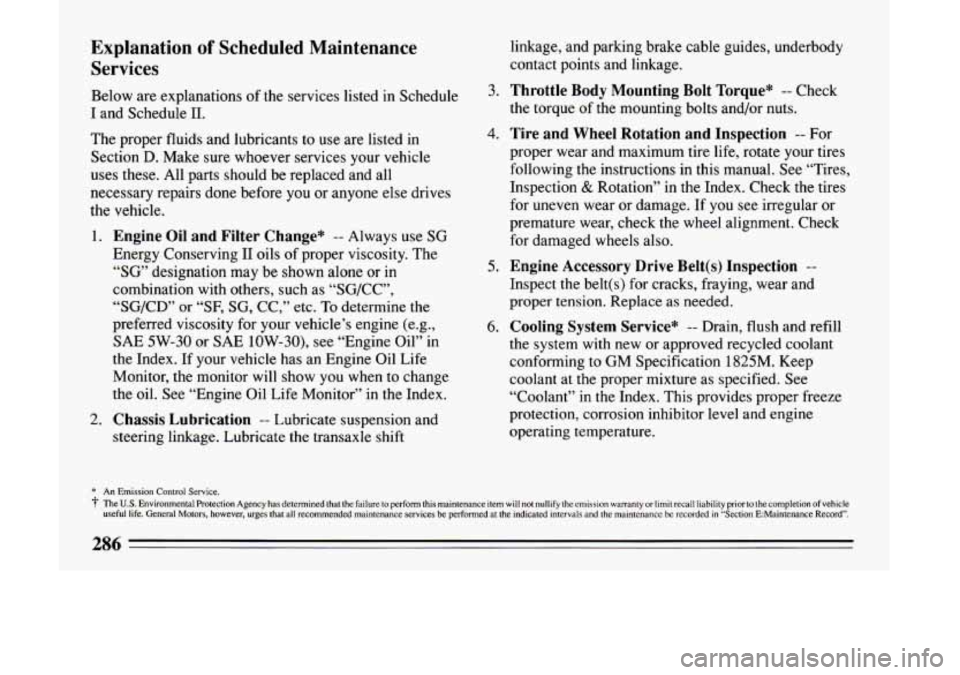
Explanation of Scheduled Maintenance
Services
Below are explanations of the services listed in Schedule
I and Schedule 11.
The proper fluids and lubricants to use are listed in
Section
D. Make sure whoever services your vehicle
uses these. All parts should be replaced and all
necessary repairs done before
you or anyone else drives
the vehicle.
1. Engine Oil and Filter Change* -- Always use SG
Energy Conserving I1 oils of proper viscosity. The
“SG” designation may be shown alone or in
combination with others, such as “SG/CC”,
“SG/CD” or “SF, SG, CC,” etc. To determine the
preferred viscosity for your vehicle’s engine (e.g.,
SAE
5W-30 or SAE 10W-30), see “Engine Oil” in
the Index. If your vehicle has an Engine Oil Life
Monitor, the monitor will show
you when to change
the oil. See “Engine Oil Life Monitor” in the Index.
2. Chassis Lubrication -- Lubricate suspension and
steering linkage. Lubricate the transaxle shift linkage, and parking brake
cable guides, underbody
contact points and linkage.
3. Throttle Body Mounting Bolt Torque* -- Check
the torque of the mounting bolts and/or nuts.
4. Tire and Wheel Rotation and Inspection -- For
proper wear and maximum tire life, rotate your tires
following
the instructions in this manual. See “Tires,
Inspection
& Rotation” in the Index. Check the tires
for uneven wear or damage. If you see irregular or
premature wear, check the wheel alignment. Check
for damaged wheels also.
5. Engine Accessory Drive Belt(s) Inspection --
Inspect the belt(s) for cracks, fraying, wear and
proper tension. Replace as needed.
6. Cooling System Service” -- Drain, flush and refill
the system with new or approved recycled coolant
conforming to GM Specification 1825M. Keep
coolant at the proper mixture as specified. See
“Coolant” in
the Index. This provides proper freeze
protection, corrosion inhibitor level
and engine
operating temperature.
* An Emission Control Service.
3‘ The U.S. Environmental Protection Agency has determined that the failure to perfonn this maintenance item will not nullify the emission warranty or limit recall liability prior to thecompletion of vehicle
useful life. General Motors, however, urges that all recommended maintenance services be performed at the indicated intervals and the maintenance be recorded in “Section E:Maintenance Record”.
286
Page 295 of 324
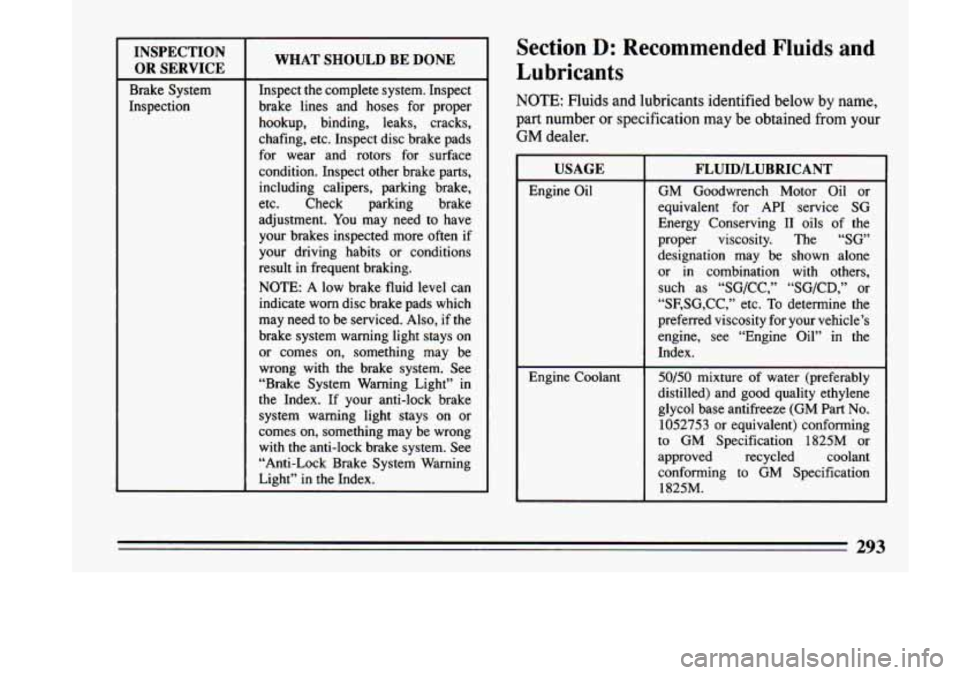
INSPECTION OR SERVICE
Brake System
Inspection
WHAT SHOULD BE DONE
Inspect the complete system. Inspect
brake lines and hoses for proper hookup, binding, leaks, cracks,
chafing, etc. Inspect disc brake pads
for wear and rotors for surface
condition. Inspect other brake parts, including calipers, parking brake,
etc. Check parking brake
adjustment.
You may need to have
your brakes inspected more often
if
your driving habits or conditions
result in frequent braking.
NOTE:
A low brake fluid level can
indicate worn disc brake pads which
may need to be serviced. Also,
if the
brake system warning light stays on
or comes on, something may be
wrong with the brake system. See
“Brake System Warning Light” in
the Index. If your anti-lock brake
system warning light stays
on or
comes on, something may be wrong
with the anti-lock brake system. See
“Anti-Lock Brake System Warning
Light” in the Index.
Section D: Recommended Fluids and
Lubricants
NOTE: Fluids and lubricants identified below by name,
part number
or specification may be obtained from your
GM dealer.
FLUID/LUBRICANT
GM Goodwrench Motor Oil or
equivalent for API service SG
Energy Conserving I1 oils of the
proper viscosity. The
“SG’
designation may be shown alone
or
in combination with others,
such as “SG/CC,” “SG/CD,” or
“SF,SG,CC,” etc.
To determine the
preferred viscosity for your vehicle’s
engine, see “Engine Oil’’ in the
Index.
50/50 mixture of water (preferably
distilled) and good quality ethylene
glycol base antifreeze (GM Part
No.
1052753 or equivalent) conforming
to GM Specification 1825M or
approved recycled coolant
conforming to GM Specification
1825M.
293
-