tow BUICK REGAL 1993 Service Manual
[x] Cancel search | Manufacturer: BUICK, Model Year: 1993, Model line: REGAL, Model: BUICK REGAL 1993Pages: 308, PDF Size: 16.35 MB
Page 226 of 308
When to Change Engine Oil: See if any one of these
is true for you:
Most trips are less than 4 miles (6 km).
9 It’s below freezing outside and most trips are less
9 The engi.ne is at low speed most of the time (as in
door-to-door delivery, or in stop-and-go traffic).
You tow a trailer often. .-
9 Most trips are through dusty places.
If
any one of thes,e is true for your vehicle, then you
need to change your oil and filter every
3,000 miles (5
000 km) or 3 months -- whichever comes first.
If none of them is true, change the oil every 7,500 miles
(12
500 km) or 12 months -- whichever comes first.
Change the filter at the first
oil change and at every
other
oil change after that.
Engine Block Heater: An engine block heater can be a
big help if you have to park outside in very cold
than
10 miles (16 km).
weather,
-20 F (-29 C)
or colder. If your vehicle has
this option, see ”Engine
Block Heater” in the Index.
What to Do with Used Oil:
Used engine oil contains things that ha\, zaused
skin cancer in laboratory animals. Don’t let use6 oil stay on your skin for very long. Clean your
skin and nails with soap and water, or a good
hand cleaner. Wash
or properly throw away
4othing or rags containing used engine oil
Used oil can be a real threat to the environment. If you
change your own oil, be sure
to drain all free-flowing oil
from the filter before disposal. Don’t ever dispose of oil
by pouring
it on the ground, into sewers, or into streams
or bodies of water. Instead, recycle
it by taking it to a
place that collects used oil.
If you have a problem
224
ProCarManuals.com
Page 229 of 308
Then, without shutting off the engine, follow these
steps:
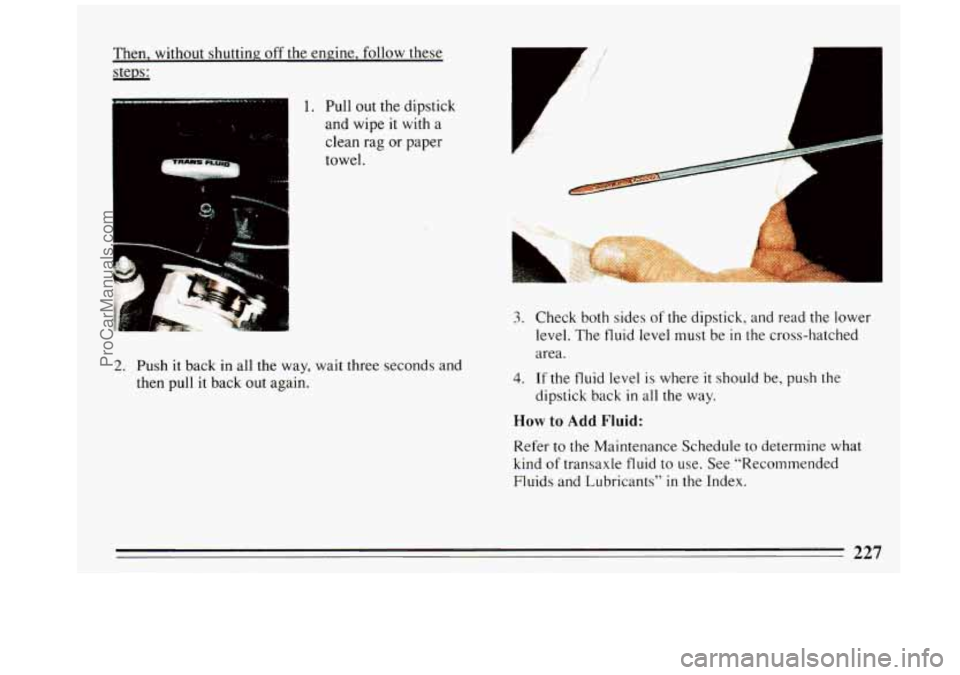
1. Pull out the dipstick
and wipe it with
a
clean rag or paper
towel.
‘i
2. Push it back in all the way, wait three seconds and
then pull it back out again.
A
3. Check both sides of the dipstick, and read the lower
level. The fluid level must be
in the cross-hatched
area.
4. If the fluid level is where it should be, push the
dipstick back
in all the way.
How to Add Fluid:
Refer to the Maintenance Schedule to determine what
kind
of transaxle fluid to use. See “Recommended
Fluids and Lubricants’’
in the Index.
ProCarManuals.com
Page 238 of 308
Headlight bulbs can be changed as described by the
following procedure.
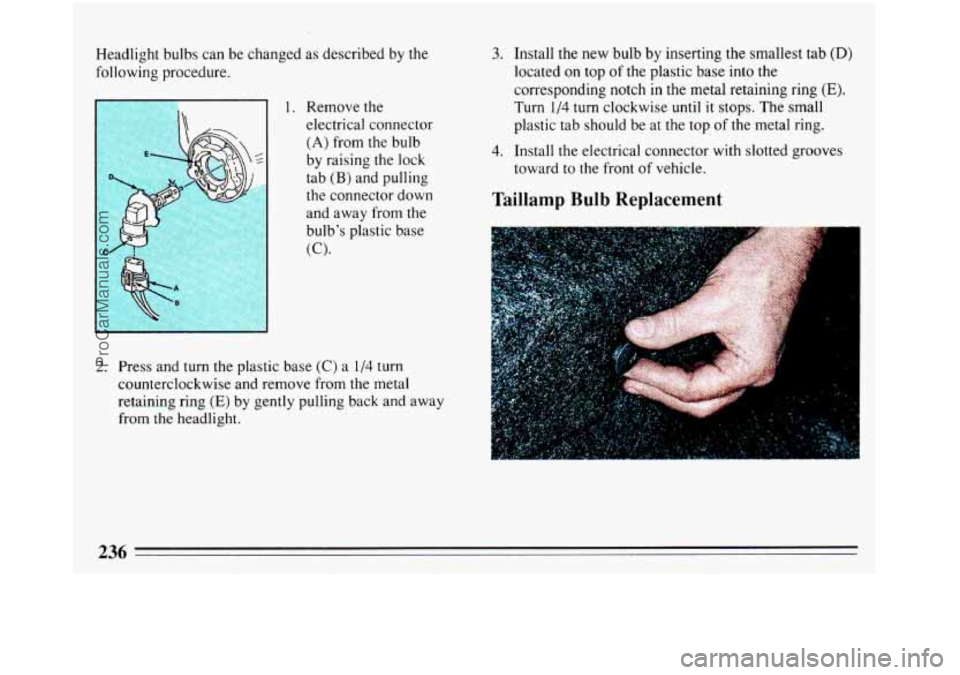
1. Remove the
electrical connector
(A) from the bulb
by raising the lock tab
(B) and pulling
the connector down
and away from the
bulb’s plastic base
(C).
2. Press and turn the plastic base (C) a 1/4 turn
counterclockwise and remove from the metal
retaining ring
(E) by gently pulling back and away
from
the headlight.
3. Install the new bulb by inserting the smallest tab (D)
located on top of the plastic base into the
corresponding
notch in the metal retaining ring (E).
Turn 1/4 turn clockwise until it stops. The small
plastic tab should be at the top
of the metal ring.
4. Install the electrical connector with slotted grooves
toward
to the front of vehicle.
Taillamp Bulb Replacement
ProCarManuals.com
Page 245 of 308
A CAW’ON
Rust or dirt on a wheel, or on the parts to which
it is fastened, can make wheel nuts become
loose after a time. The wheel could come off
a-”
cause an accident. When you change a wheel,
remove any rust or dirt from places where the
wheel attaches to the vehicle.
In an emergency,
you can use a cloth
or a paper towel to do this;
but be sure to use a scraper or wire brush later, if
you need to, to get all the rust or dirt off. (See
“nhanging a Flat
in the Index.)
I
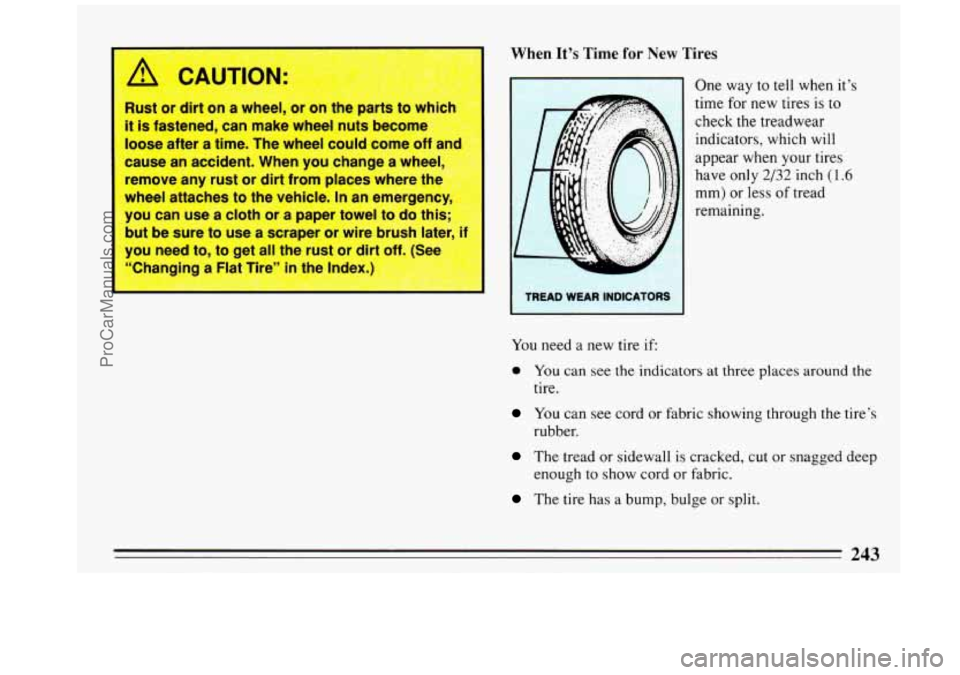
When It’s Time for New Tires
b One wav to tell when it’s r’
time for new tires is to
check
the treadwear
indicators, which will
appear when your tires
have only
2/32 inch (1.6
mm) or less of tread
remaining.
I TREAD WEAR INDICATORS I
You need a new tire if
0 You can see the indicators at three places around the
tire.
You can see cord or fabric showing through the tire‘s
rubber.
The tread or sidewall is cracked, cut or snagged deep
enough to show cord or fabric.
The tire has a bump, bulge or split.
243
ProCarManuals.com
Page 251 of 308
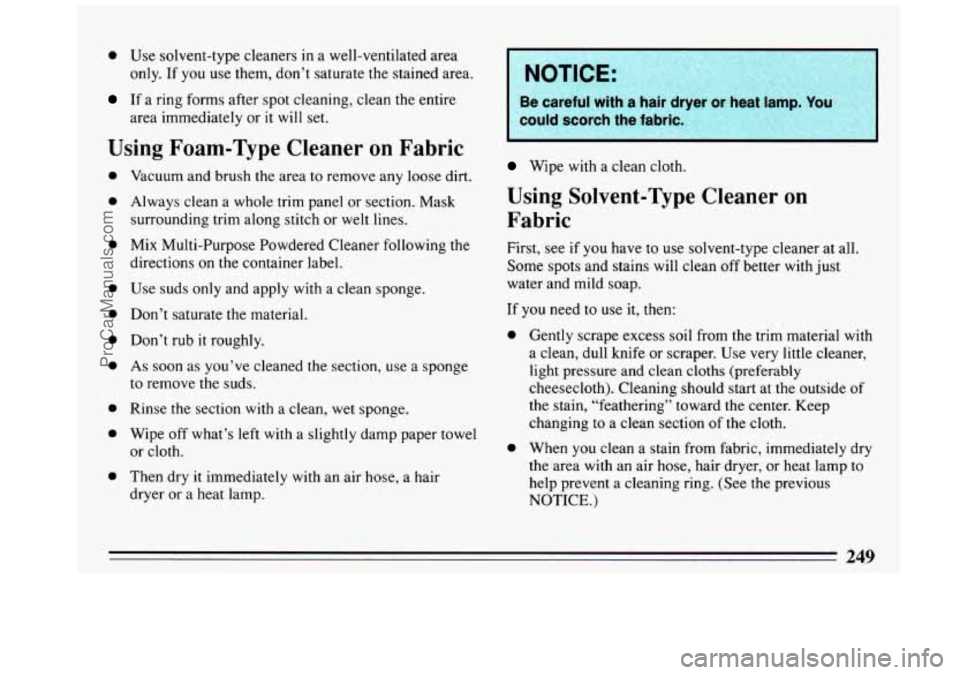
0 Use solvent-type cleaners In a well-ventilated area
only. If you use them, don’t saturate the stained area.
If a ring forms after spot cleaning, clean the entire
area immediately or it will set.
Using Foam-Type Cleaner on Fabric
0
0
0
0
0
0
0
0
0
0
Vacuum and brush the area to remove any loose dirt.
Always clean a
whole trim panel or section. Mask
surrounding trim along stitch or welt lines.
Mix Multi-Purpose Powdered Cleaner following the
directions
on the container label.
Use suds only and apply with a clean sponge.
Don’t saturate the material.
Don’t rub
it roughly.
As soon
as you’ve cleaned the section, use a sponge
to remove
the suds.
Rinse the section with a clean, wet sponge.
Wipe off what’s left with a slightly damp paper towel
or cloth.
Then dry it immediately with an air hose, a hair
dryer
or a heat lamp.
I NOTICE:
I
Be careful with a hair dryer or heat lamp. You
could scorch the fabric.
I
Wipe with a clean cloth.
Using Solvent-Type Cleaner on
Fabric
First, see if you have to use solvent-type cleaner at all.
Some spots and stains will clean off better with just
water and mild soap.
If you need to use it, then:
0 Gently scrape excess soil from the trim material with
a clean, dull knife or scraper. Use very little cleaner,
light pressure and clean cloths (preferably
cheesecloth). Cleaning should start at the outside
of
the stain, “feathering” toward the center. Keep
changing
to a clean section of the cloth.
the area with an air hose, hair dryer, or heat lamp to
help prevent a cleaning ring. (See the previous
NOTICE.)
0 When you clean a stain from fabric, immediately dry
249
ProCarManuals.com
Page 254 of 308
Don’t wash your vehicle in the direct rays of the sun.
Don’t
use strong soaps or chemical detergents. Use
liquid hand, dish or car washing (non-detergent) soaps.
Don’t use cleaning agents that contain acid or abrasives.
All cleaning agents should be flushed promptly and not
allowed
to dry on the surface, or they could stain. Dry
the finish with a soft, clean chamois or a
100% cotton
towel to avoid surface scratches and water spotting.
High pressure vehicle washes may cause water
to enter
your vehicle.
Finish Care
Occasional waxing or mild polishing of your Buick may
be necessary to remove residue from the paint finish.
You can get
GM approved cleaning products from your
dealer. (See “Appearance Care and Materials” in the
Index.)
Your Buick has a “basecoat/clearcoat” paint finish. The
clearcoat gives more depth and gloss to
the colored
basecoat.
I NOTICE: I
Machine compounding or aggressive polishing
on a basecoatlclearcoat pa
finish or leave swirl marks.
Aluminum Wheels (If So Equipped)
Your aluminum wheels have a protective coating similar
to the painted surface of your vehicle. Don’t use strong
soaps, chemicals, chrome polish, or other abrasive
cleaners
on them because you could damage this
coating. After rinsing thoroughly, a wax may be applied.
r
-
NOTICE:
6.
If you have aluminum wheels, don’t use an
j automatic vehicle wash that has hard silicon
’: carbide cleaning brushes. These brushes can
take
off the protective coating
252
ProCarManuals.com
Page 271 of 308
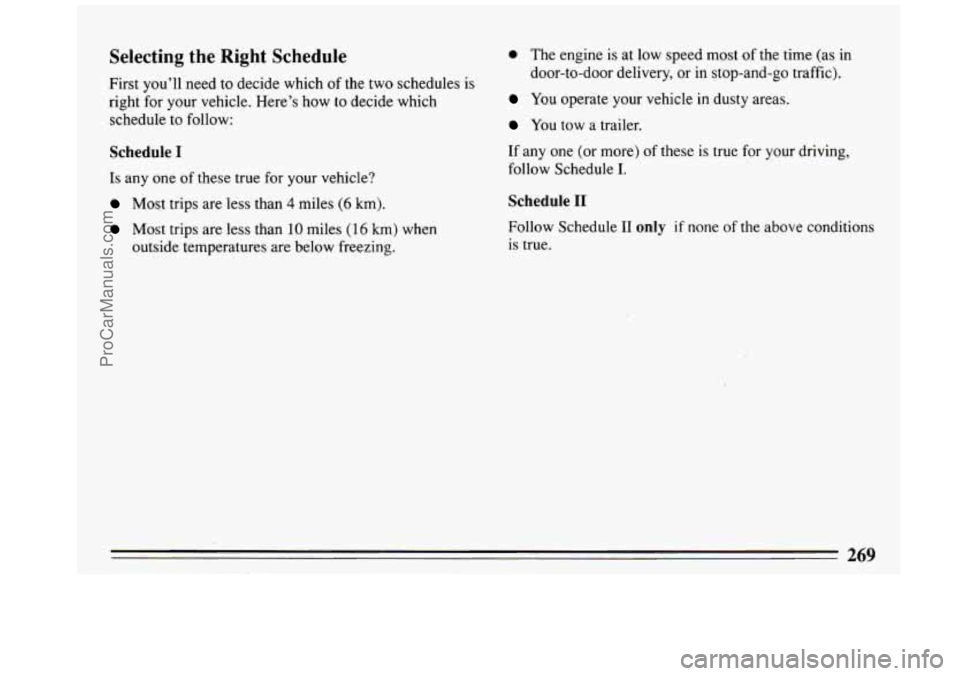
Selecting the Right Schedule
First you’ll need to decide which of the two schedules is
right for your vehicle. Here’s how to decide which
schedule
to follow:
Schedule I
Is any one of these true for your vehicle?
Most trips are less than 4 miles (6 km).
Most trips are less than 10 miles (16 km) when
outside temperatures are below freezing.
0 The engine is at low speed most of the time (as in
door-to-door delivery, or in stop-and-go traffic).
You operate your vehicle in dusty areas.
You tow a trailer.
If any one (or more) of these is true for your driving,
follow Schedule
I.
Schedule I1
Follow Schedule I1 only if none of the above conditions
is true.
269
ProCarManuals.com
Page 272 of 308
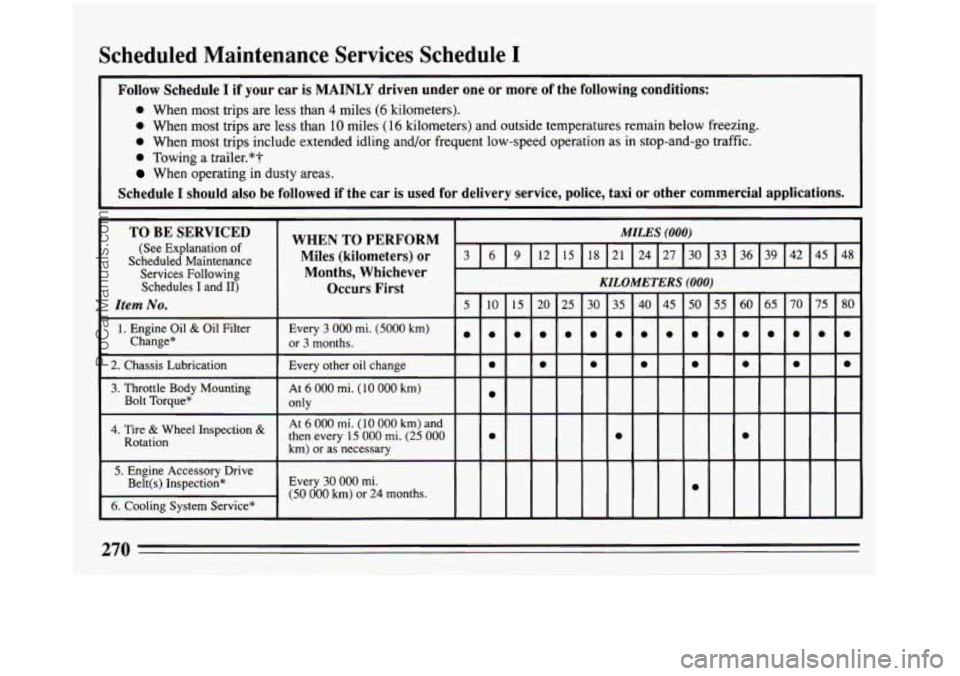
Scheduled Maintenance Services Schedule I
Follow Schedule I if your car is MAINLY driven under one or more of the following conditions: I
0 When most trips are less than 4 miles (6 kilometers).
0 When most trips are less than 10 miles (16 kilometers) and outside temperatures remain below freezing.
0 When most trips include extended idling and/or frequent low-speed operation as in stop-and-go traffic.
0 Towing a trailer.*?
When operating in dusty areas.
Schedule I should also be followed if the car is used for delivery service, police, taxi or other commercial applications.
TO BE SERVICED
(See Explanation of
Scheduled Maintenance
Services Following Schedules
I and 11)
Item No.
1. Engine Oil & Oil Filter
Change*
2. Chassis Lubrication
3. Throttle Body Mounting Bolt Torque*
4. Tire & Wheel Inspection &
Rotation
5. Engine Accessory Drive
' Belt(s) Inspection*
6. Cooling System Service*
65 70 75 80
0.00
0 0
270
ProCarManuals.com
Page 277 of 308
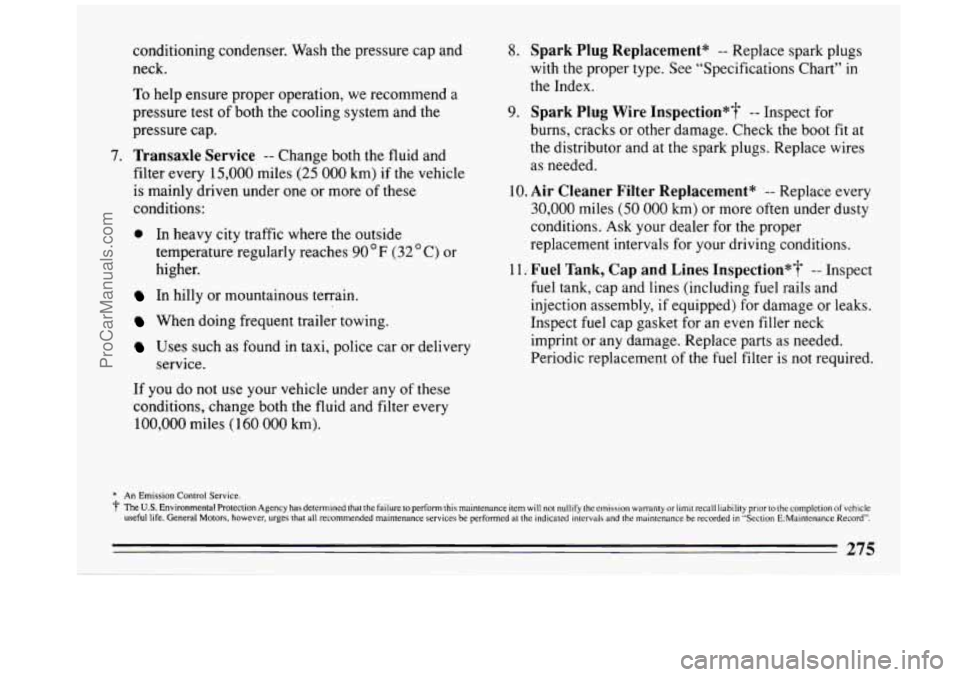
conditioning condenser. Wash the pressure cap and
neck.
To help ensure proper operation, we recommend a
pressure test of both the cooling system and the
pressure cap.
7. Transaxle Service -- Change both the fluid and
filter every
15,000 miles (25 000 km) if the vehicle
is mainly driven under one or more of these
conditions:
0 In heavy city traffic where the outside
temperature regularly reaches
90 F (32 C) or
higher.
In hilly or mountainous terrain.
When doing frequent trailer towing.
Uses such as found in taxi, police car or delivery
If you do not use your vehicle under any of these
conditions, change both the fluid and filter every
100,000 miles ( 160 000 km).
service.
8. Spark Plug Replacement* -- Replace
spark plugs
with the proper type. See “Specifications Chart” in
the Index.
9. Spark Plug Wire Inspection”? -- Inspect for
burns, cracks or other damage. Check the boot fit at
the distributor and at the spark plugs. Replace wires
as needed.
10.
Air Cleaner Filter Replacement* -- Replace every
30,000 miles (50 000 km) or more often under dusty
conditions. Ask your dealer for the proper
replacement intervals for your driving conditions.
11
.. Fuel Tank, Cap and Lines Inspection”? -- Inspect
fuel tank, cap and lines (including fuel rails and
injection assembly, if equipped) for damage or leaks.
Inspect fuel cap gasket for an even filler neck
imprint or any damage. Replace parts as needed.
Periodic replacement of the fuel filter is not required.
275
ProCarManuals.com
Page 296 of 308
......................
?.'rrrrir.rr.*..s ..r.. *rrrlr)ry)r* 14p A ..
..... * ......... L . li e 0 $ 1 .... . i., . 5 ; ....... ?. . * .
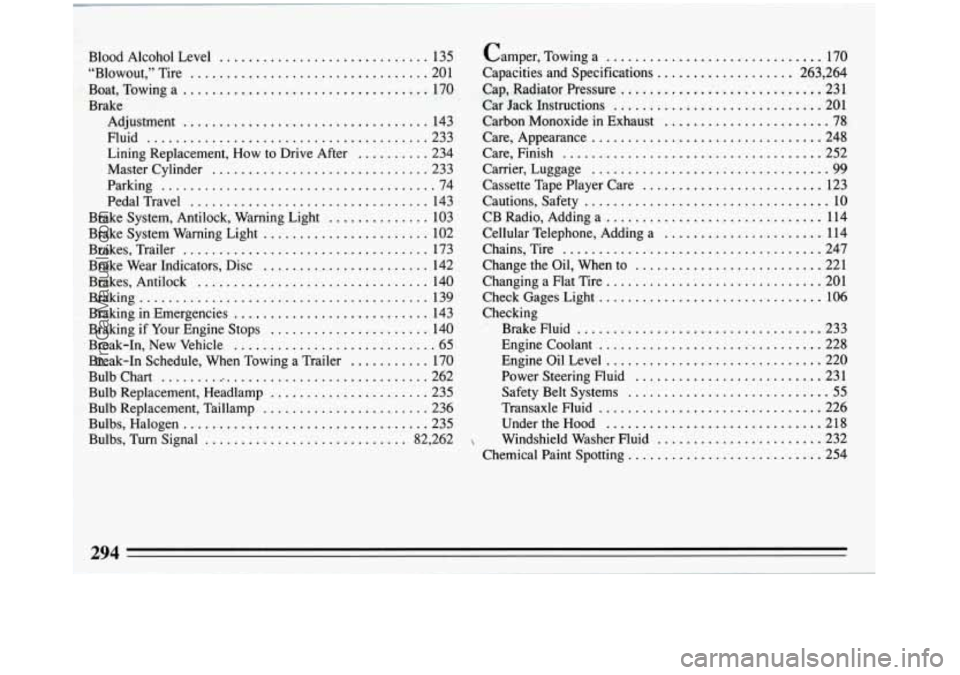
Camper. Towing a .............................. 170
Capacities and Specifications ................... 263. 264
Car Jack Instructions ............................. 201
Carbon Monoxide in Exhaust ....................... 78
Care. Appearance ................................ 248
Care. Finish .................................... 252
Carrier. Luggage ................................. 99
Cassette Tape Player Care ......................... 123
Cautions. Safety .................................. 10
Cellular Telephone. Adding a ...................... 114
Chains. Tire .................................... 247
Changing a Flat Tire ............................... 201
Checking Cap. Radiator Pressure
............................ 231
CB Radio. Adding a .............................. 114
Change the Oil. When to .......................... 221
Check Gages Light ............................... 106
Brake Fluid .................................. 233
Engine Coolant ............................... 228
Engine Oil Level .............................. 220
Power Steering Fluid .......................... 231
Safety Belt Systems ............................ 55
Transaxle Fluid ............................... 226
Under the Hood ............................... 218
Windshield Washer Fluid ....................... 232
Chemical Paint Spotting ........................... 254
.
ProCarManuals.com