traction control BUICK REGAL 1997 Owners Manual
[x] Cancel search | Manufacturer: BUICK, Model Year: 1997, Model line: REGAL, Model: BUICK REGAL 1997Pages: 422, PDF Size: 21.34 MB
Page 17 of 422
6-Way Power Seat (If Equipped) Heated Seat (If Equipped)
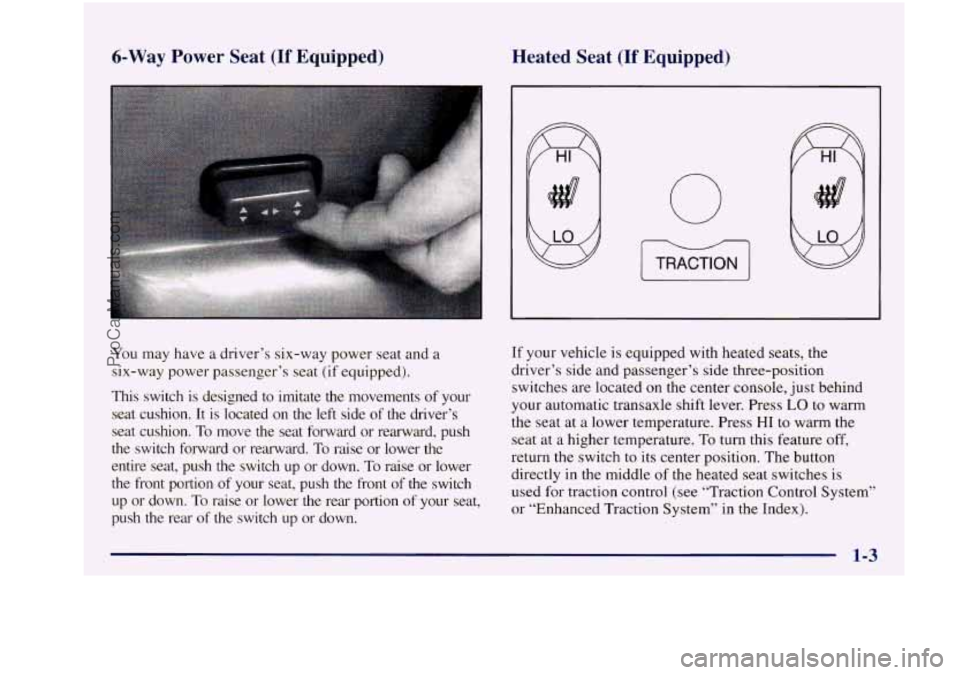
You may have a driver’s six-way power seat and a
six-way power passenger’s seat (if equipped).
This switch is designed to imitate the movements
of your
seat cushion. It is located on the left side of the driver’s
seat cushion.
To move the seat forward or rearward, push
the switch folward or rearward.
To raise or lower the
entire seat, push the switch up or down. To raise
or lower
the front portion of your seat, push
the front of the switch
up or down.
To raise or lower the rear portion of your seat,
push the rear of the switch up or down.
0
If your vehicle is equipped with heated seats, the
driver’s side and passenger’s side three-position
switches are located
on the center console, just behind
your automatic transaxle shift lever. Press
LO to warm
the seat at a lower temperature. Press HI to warm the
seat at a higher temperature.
To turn this feature off,
return the switch to its center position. The button
directly in the middle of the heated seat switches is
used for traction control (see “Traction Control System”
or “Enhanced Traction System” in the Index).
1-3
ProCarManuals.com
Page 115 of 422
Setting Cruise Control
0 Cruise control can be dangerous where you
can’t drive safely at a steady speed.
So,
don’t use your cruise control on winding
roads
or in heavy traffic.
slippery roads. On such roads, fast changes
in tire traction can cause needless wheel
spinning, and you could lose control. Don’t
Cruise control can be dangerous on
If you leave your cruise control switch on when
you’re not using cruise,
you might hit a button
and go into cruise when you don’t want to. You
could be startled and even lose control. Keep the
cruise control switch off until you want to use it.
use cruise control on slippery roads.
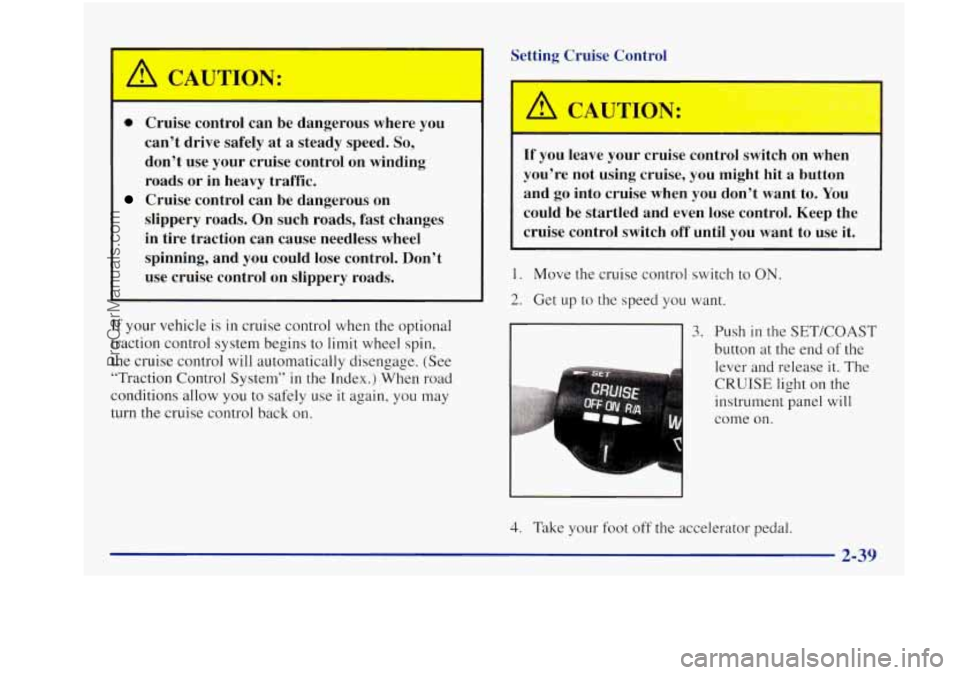
1. Move the cruise control switch to ON.
2. Get up to the speed you want.
If your vehicle is in cruise control when the optional
traction control system begins to
limit wheel spin,
the cruise control will automatically disengage. (See
“Traction Control System’’
in the Index.) When road
conditions allow you to safely
use it again, you may
turn
the cruise control back on.
&I button at the end of the
lever and release it. The
CRUISE light on the
instrument panel will
come on.
3. Push in the SETKOAST
4. Take your foot off the accelerator pedal.
2-39
ProCarManuals.com
Page 140 of 422
0 If the Enhanced Traction System warning light
comes on and stays on for an extended period of
time when the system is turned on your vehicle
needs service. Adjust your driving accordingly.
If the traction control system is affected by an
engine-related problem, the system will turn off and
the warning light will come on. When this warning
light
is on, the system will not limit wheel spin.
Adjust your driving accordingly.
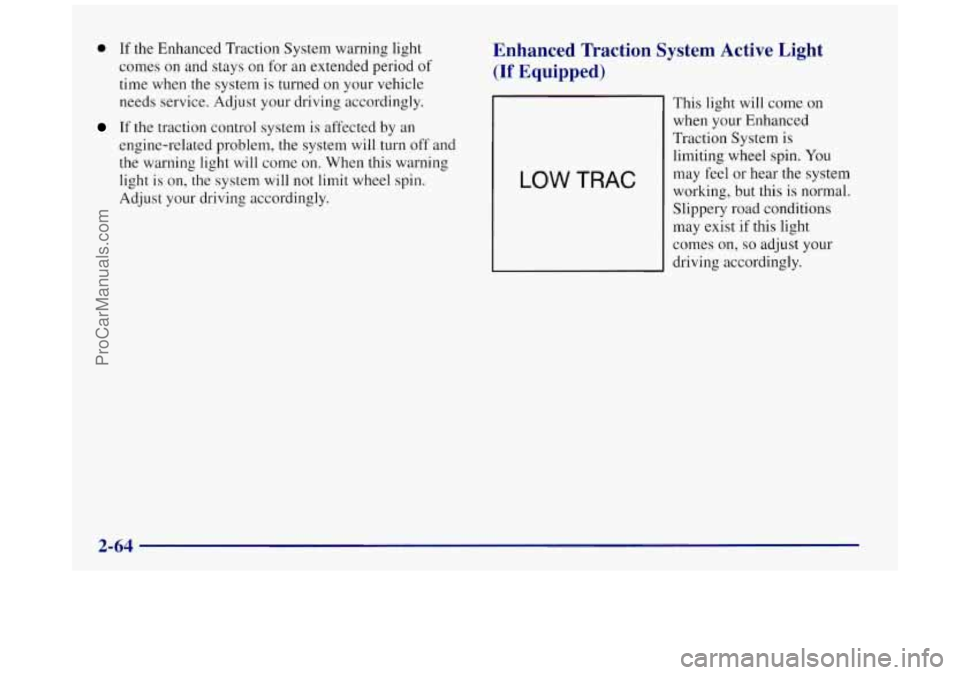
Enhanced Traction System Active Light
(If Equipped)
LOW TRAC
This light will come on
when your Enhanced
Traction System is
limiting wheel spin. You
may feel
or hear the system
working, but this is normal.
Slippery road conditions
may exist if this light
comes on,
so adjust your
driving accordingly.
2-64
ProCarManuals.com
Page 141 of 422
Traction Control System Warning Light
(If Equipped: 3800 Supercharged
Engine Only)
TRAC
OFF
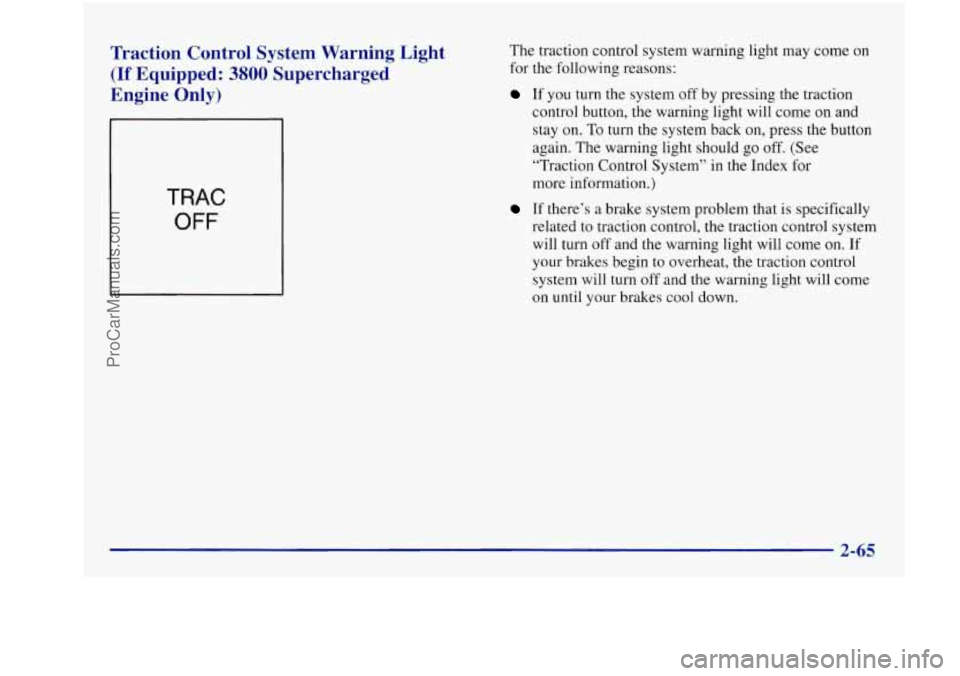
The traction control system warning light may come on
for the following reasons:
If you turn the system off by pressing the traction
control button, the warning light will come on and
stay on.
To turn the system back on, press the button
again. The warning light should go off. (See
“Traction Control System” in the Index for
more information.)
If there’s a brake system problem that is specifically
related to traction control, the traction control system
will turn
off and the warning light will come on. If
your brakes begin to overheat, the traction control
system will turn off and the warning light will come
on until your brakes cool down.
ProCarManuals.com
Page 142 of 422
Traction Control System Active Light
(If Equipped: 3800 Supercharged
Engine Only)
LOW TRAC
When your traction control
system
is limiting wheel
spin, this light will come on.
Slippery road conditions
may exist if the traction
control system active light
comes on,
so adjust your
driving accordingly.
Low Traction Light
LOW TRAC
When your anti-lock system
is adjusting brake pressure to
help avoid a braking skid,
this light will come on.
(Also see “Anti-Lock Brake
System Active Light” earlier
in this section.)
If
you have the Enhanced Traction System or the Traction
Control System, this light will also come on when the
system is limiting wheel spin. See “Enhanced Traction
System” or “Traction Control System” in the Index.
Slippery road conditions may exist if the low traction
light comes on,
so adjust your driving accordingly. The
light will stay on for a few seconds after the anti-lock
system stops adjusting brake pressure or the Enhanced
Traction System stops limiting wheel spin.
The LOW TRAC light also comes on briefly when
you
turn the ignition key to RUN. If the light doesn’t come
on then, have
it fixed so it will be there to tell you when
the anti-lock brake system or Enhanced Traction System
is active.
ProCarManuals.com
Page 205 of 422
Remember: Anti-lock doesn’t change the time you need
to get your foot up
to the brake pedal or always decrease
stopping distance. If you get too close to the vehicle in
front
of you, you won’t have time to apply your brakes
if that vehicle suddenly slows or stops. Always leave
enough room up ahead
to stop, even though you have
anti-lock brakes.
-‘sing Anti-Lock
uon’t pump the brakes. Just hold the brake pedal
down and let anti-lock work for you. You may feel the
system working, or you may notice some noise, but this
is normal.
LOW TRAC
When your anti-lock system
is adjusting brake pressure
to help avoid
a braking skid,
this light will come on. See
“Anti-Lock Brake System
Active Light” in the Index.
Traction Control System
(With
3800 Supercharged Engine)
Your vehicle has a traction control system that limits wheel
spin. This is especially useful
in slippery road conditions.
The system operates only if it senses that one or both
of
the front wheels are spinning or beginning to lose traction.
When this happens,
the system works the front brakes and
reduces engine power to limit wheel spin.
LOW TRAC
This light will come on
when your traction control
system is limiting wheel
spin. See “Traction Control
System Active Light” in
the Index.
You may feel or hear the system working, but this is normal.
If your vehicle is in cruise control when the traction
control system begins to limit wheel spin, the cruise
control will automatically disengage. When road
conditions allow you to safely use it again, you may
reengage the cruise control. (See “Cruise Control”
in the Index.)
ProCarManuals.com
Page 206 of 422
When the system is on, this
warning light will come on
to let you know if there’s a
problem with your traction
TRAC
OFF
0
To turn the system off,
press the TRACTION
button
on the black panel
located directly behind
your automatic transaxle
shift lever.
See “Traction Control System Warning Light” in the
Index. When this warning light is on, the system will not
limit wheel spin. Adjust your driving accordingly.
The traction control system automatically comes on
whenever you start your vehicle. To limit wheel spin,
especially in slippery road conditions, you should
always leave the system on. But you can turn the
traction control system off
if you ever need to. (You
should turn the system off if your vehicle ever gets stuck
in sand, mud, ice or snow.
See “Rocking Your Vehicle”
in the Index.) The
traction control system warning light will come on
and stay
on. If the system is limiting wheel spin when you
press the button, the warning light will come on -- but the
system won’t
turn off right away. It will wait until there’s
no longer a current need to limit wheel spin.
You can turn the system back on at any
time by pressing
the button again. The traction control system warning
light should go off.
4-10
ProCarManuals.com
Page 208 of 422
0
To turn the system on or
off, press the
TRACTION
button on the black panel
located directly behind
your automatic transaxle
shift lever.
When you turn the system off, the Enhanced Traction
System warning light will come on and stay on.
If the
Enhanced Traction System is limiting wheel spin when
you press the button to turn the system off, the warning
light will come on
-- but the system won’t turn off right
away. It will wait until there’s no longer a current need
to limit wheel spin.
You can turn the system back on at any time by pressing
the button again. The Enhanced Traction System
warning light should go off.
Braking in Emergencies
With anti-lock, you can steer and brake at the same
time. In many emergencies, steering can help you more
than even the very best braking.
Steering
Power Steering
If you lose power steering assist because the engine
stops or the system is not functioning,
you can steer but
it will take much more effort.
Magnasteer TM
This steering system provides lighter steering effort for
parking and when driving at low speeds. Steering effort
will increase at higher speeds for improved road feel.
Steering Tips
Driving on Curves
It’s important to take curves at a reasonable speed.
A lot of the “driver lost control” accidents mentioned on
the news happen on curves. Here’s why:
Experienced driver or beginner, each of us is subject to
the same laws of physics when driving on curves. The
traction
of the tires against the road surface makes it
possible for the vehicle
to change its path when you turn
the front wheels. If there’s no traction, inertia will keep
the vehicle going in
the same direction. If you’ve ever
tried
to steer a vehicle on wet ice, you’ll understand this.
ProCarManuals.com
Page 209 of 422
The traction you can get in a curve depends on the
condition
of your tires and the road surface, the angle at
which the curve is banked, and your speed. While you’re
in
a curve, speed is the one factor you can control.
Suppose you’re steering through a sharp curve. Then you
suddenly accelerate. Both control systems
-- steering and
acceleration
-- have to do their work where the tires meet
the road. Adding
the sudden acceleration can demand too
much of those places. You can lose control.
What should
you do if this ever happens? Ease up on the
accelerator pedal, steer the vehicle the way you want
it
to go, and slow down.
Speed limit signs near curves warn that you should
adjust your speed. Of course, the posted speeds are
based on good weather and road conditions. Under less
favorable conditions you’ll want to go slower.
If you need to reduce your speed as you approach a
curve, do it before
you enter the curve, while your front
wheels are straight ahead.
Try
to adjust your speed so you can “drive” through the
curve. Maintain a reasonable, steady speed. Wait to
accelerate until you are out
of the curve, and then
accelerate gently into the straightaway.
Steering in Emergencies
There are times when steering can be more effective
than braking. For example,
you come over a hill and
find a truck stopped in your lane, or a car suddenly pulls
out from nowhere, or a child darts out from between
parked cars and stops right
in front of you. You can
avoid these problems by braking
-- if you can stop in
time. But sometimes you can’t; there isn’t room.
That’s the time for evasive action
-- steering around
the problem.
Your Buick can perform very well in emergencies like
these. First apply your brakes. (See “Braking in
Emergencies” earlier in this section.) It
is better to
remove as much speed as you can from a possible
collision. Then steer around the problem, to the left or
right depending on the space available.
ProCarManuals.com
Page 213 of 422
If your vehicle starts to slide, ease your foot off the
accelerator pedal and quickly steer the way you want the
vehicle to go.
If you start steering quickly enough, your
vehicle may straighten
out. Always be ready for a
second skid
if it occurs.
Of course, traction is reduced when water, snow, ice,
gravel or other material is
on the road. For safety, you’ll
want to slow down and adjust your driving to these
conditions. It is important to slow down on slippery
surfaces because stopping distance will be longer and
vehicle control more limited.
While driving on a surface with reduced traction, try
your best
to avoid sudden steering, acceleration or
braking (including engine braking by shifting to a lower
gear). Any sudden changes could cause the tires to
slide. You may not realize the surface
is slippery until
your vehicle is skidding. Learn
to recognize warning
clues
-- such as enough water, ice or packed snow on
the road to make a “mirrored surface’’
-- and slow
down when you have any doubt.
Remember: Any anti-lock brake system (ABS) helps
avoid only the braking skid.
Driving at Night
/’ ,//
..... ....A
A
A
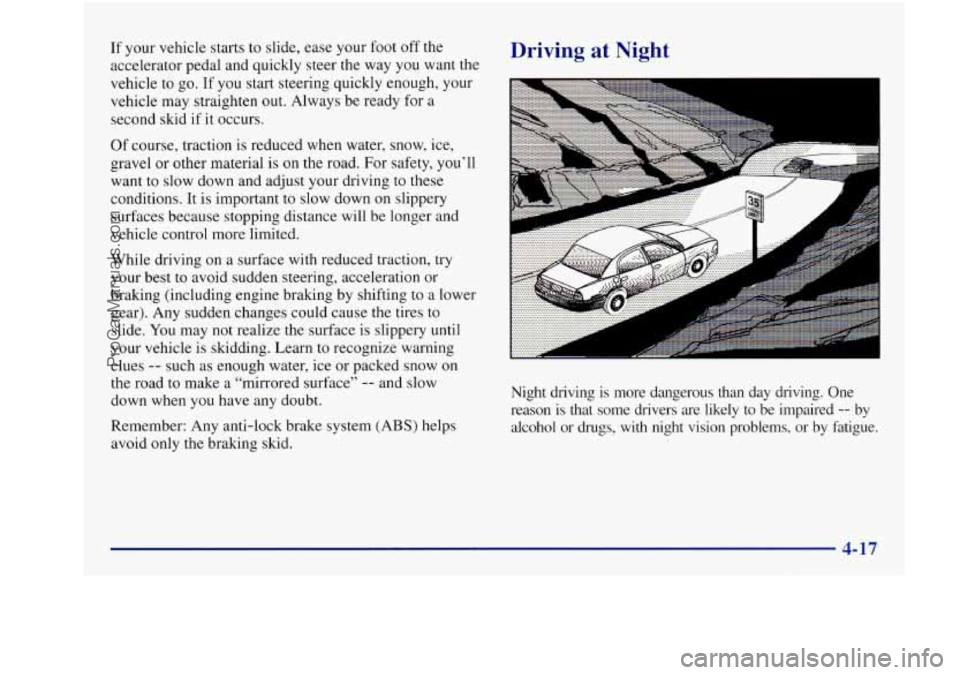
Night driving is more dangerous than day driving. One
reason is that
some drivers are likely to be impaired -- by
alcohol or drugs, with night vision problems, or by fatigue.
ProCarManuals.com