belt BUICK ROADMASTER 1993 Owner's Guide
[x] Cancel search | Manufacturer: BUICK, Model Year: 1993, Model line: ROADMASTER, Model: BUICK ROADMASTER 1993Pages: 340, PDF Size: 18.34 MB
Page 57 of 340
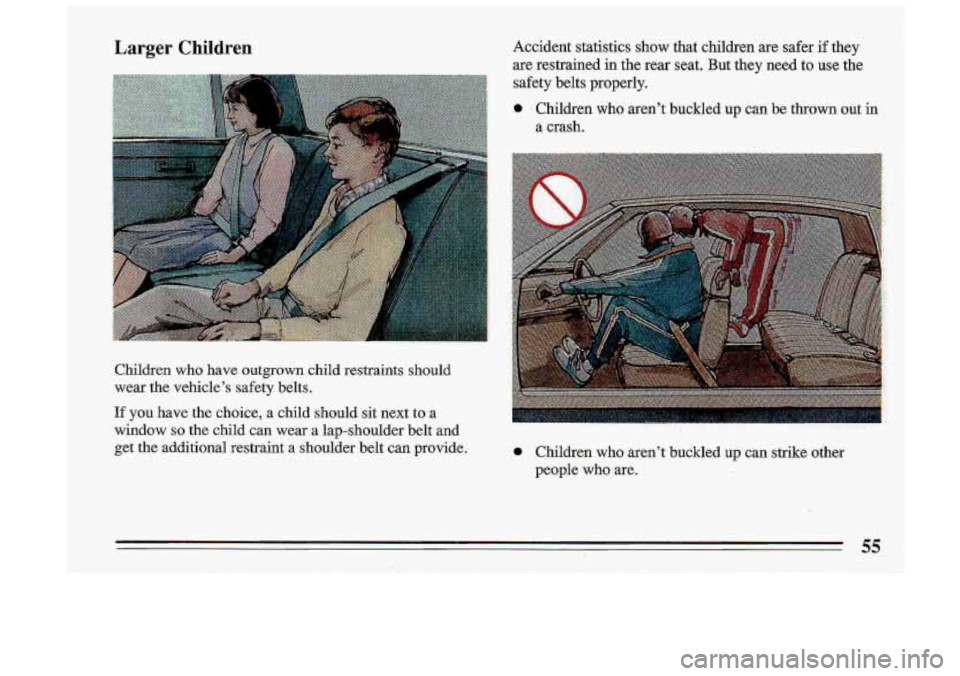
Larger Children Accident statistics show that children are safer if they
are restrained in
the rear seat. But they need to use the
safety belts. properly.
0 Children who aren’t buckled up can be thrown out in
a crash.
Children
who have outgrown child restraints should
wear the vehicle’s safety belts..
If you have the choice, a child should sit next to a
window so the child can wear -a lap-shoulder belt and
get the additional restraint a shoulder belt can provide. 0 Children who aren’t buckled up can strike ather
people who are.
55
Page 58 of 340
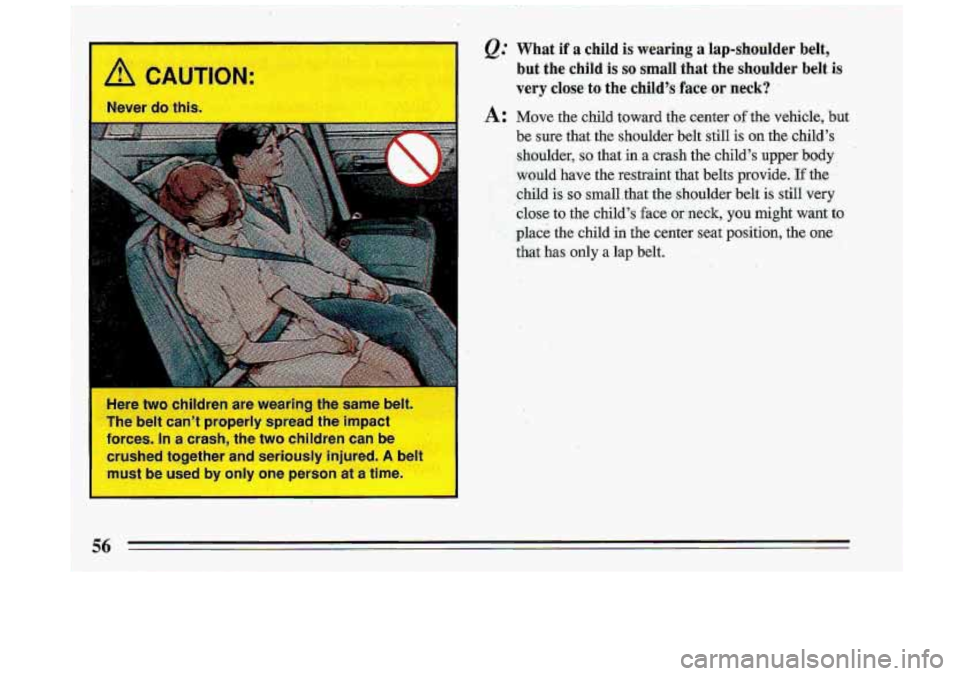
Here two children are wearing the same bell
The belt can’t properly spread the impact
forces. In a crash, the two children can be
crushed together and seriously injured.
A belt
must be used
by only one person at a time.
Page 59 of 340
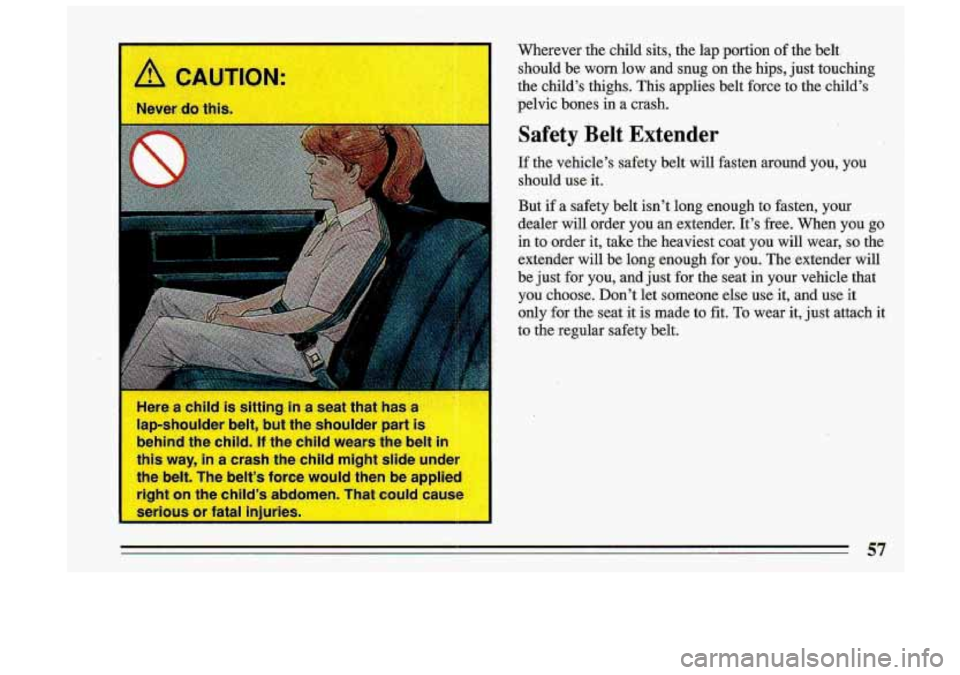
Here a child is sitting in a seat that has - I
lap-shoulder belt, but the shoulder pari
behind the child.
If the child wears the belt in
this way, in a crash the child might slide under
the belt. The belt's force
WOU'~ then be applied
right
on the child's abdom- hat crtlld ca1-c
Wherever the child sits, the lap portion of the belt
should be
worn low and snug on the hips, just touching
the child's thighs. This applies belt force to the child's
pelvic bones in
a crash.
Safety Belt Extender
If the vehicle's safety belt will fasten around you, you
should use it.
But if a safety belt isn't long enough to fasten, your
dealer will order you an extender.
It's free. When you go
in to order it, take the heaviest coat you will wear, so the
extender will be long enough for you. The extender will
be just for you, and just for the seat in your vehicle that
you choose. Don't let someone else use it, and use it
only for the seat it is made to fit. To wear it, just attach it
to the regular safety belt.
57
Page 60 of 340
Checking Your Restraint Systems
Now and then, make sure all your belts, buckles, latch
plates, retractors, anchorages and reminder systems are
working properly.
Look for any loose parts or damage.
If you sei anything that might keep a restraint system
from doing its
job, have it repaired.
Replacing Safety Belts After a Crash
If you've had a crash, do you need new belts?
After
a very minor collision,'nothing may be necessary.
But if the belts were stretched, as they would be if worn
during
a more severe crash, then you need new belts.
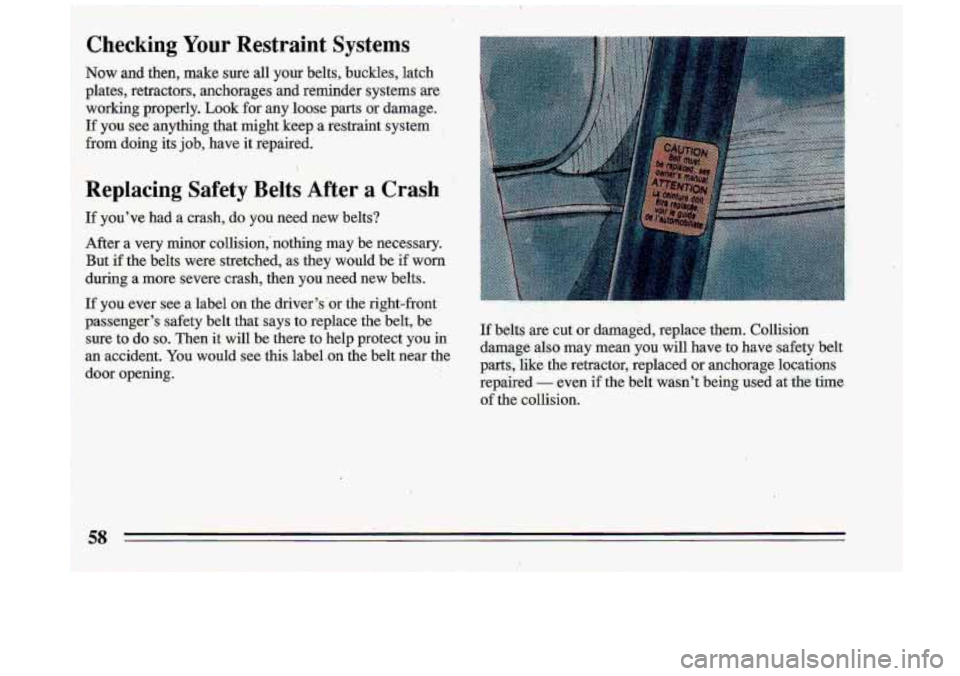
If you ever see a label on the driver's -or the right-front
passenger's safety belt that says to replace the belt, be
sure to do
so. Then it will be there to help protect you in
an accident. You would see this 1abel.on the belt near the
door opening. If belts are cut. or damaged, replace them. Collision
damage'also may mean' you.wil1 have to have safety belt
parts, like the retractor, -replaced or anchorage, 1ocatia-s
repaired
- even if the belt wasn't being used at the time
of the collision.
58
Page 61 of 340
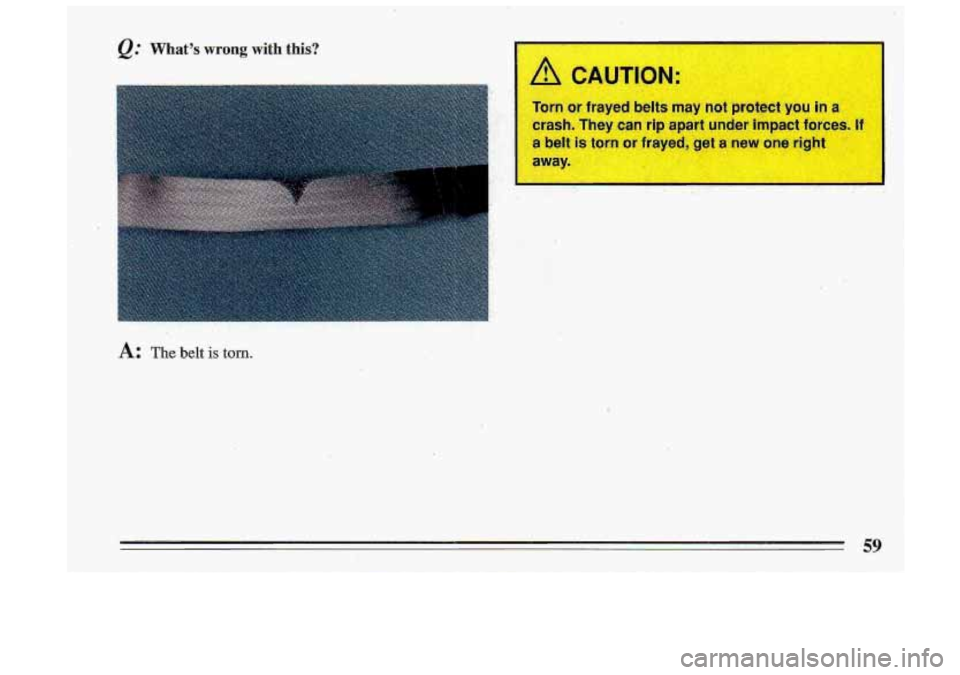
@ What's wrong with this?
A: The belt is torn.
A LAUTION
Torn or frayed belts miry not protect you in a
crash. They can rip apart under impact forc@sJRgd Lrn. ,
a belt is torn or '-dyed, get a new one right
59
Page 65 of 340
When a new Roadmaster is delivered, the dealer
removes
the plugs from the keys, and gives them to the
first owner.
Each plug
has a code on it that tells your dealer or a
qualified locksmith how to make exBa keys. Keep ‘the
plugs in a
safe place. If y.ou lose your keys, you’ll be
able to have new ones made easily using these plugs.
Door Locks
I
A CAUTION:
Unlocked doors can be dangerou,.
P.assengers
- especially children - can easily
open the doors and fall out. When a.door is
locked, the inside handle won’t open
it. , .,
Outsiders can easily enter through an uniockc
door when you
slow down or stop your vehicle.
?his may not be
so obvious: You increase the
chance of being thrown out of the vehicle
in a
crash if the doors aren’t locked. Wear safetl
belts properly, lock your doors, and you wi’ll be
far better off whenever you drive your vehicle.
,
Page 161 of 340
Your Own Signals Defensive Driving
Drivers signal
to others, too. It’s not only more polite,
it’s safer ‘to let other drivers know what you are doing.
And in some places the law requires driver signals.
Turn and lane change signals. Always signal when you
plan to turn or change lanes.
If necessary, you can
use hand signals out the window:
Left arm straight out for
a left turn, down- for slow or
about-to-stop, and up for a right turn.
Slowing. down. If time allows, tap the brake pedal once
or twice
in advance of slowing or stopping. This warns
the driver behind you.
Disabled. Your -four-way flashers signal that your
vehicle is disabled or is a hazard. See “Hazard Warning
Flasher” in the Index.
Traffic Officer
The traffic police officer is also a source of important
information.
The officer’s signals govern, no matter
what the traffic lights or other signs say.
The next section discusses some of the road conditions
you
may encounter. The
best advice anyone can give about driving is: Drive
i
defensively. !
Please start with a very important safety device in your
Buick: Buckle up. (See “Safety Belts” in the Index.) i
Defensive driving really means “be ready for anything.”
On city streets, rural roads, or freeways, it means
“always expect the unexpected.”
Assume that pedestrians or other drivers are going to be
careless and make mistakes. Anticipate what they might
do. Be ready for their mistakes.
Expect children to dash out from behind parked cas,
often-followed by other children. Expect occupants
in
parked cars to open doors into traffic., Watch for
movement
in parked cars - someone may be about to
open a door.
Expect other drivers to run stop signs when. you are on a
through street. Be ready to brake if necessary
as you go
through intersections. You may not have
to use the
brake, but if you do, you will be ready.
If you’re driving through a shopping center parking lot
where there are well-marked lanes, directional arrows,
and designated parking areas, expect.some drivers to
159
__
Page 173 of 340
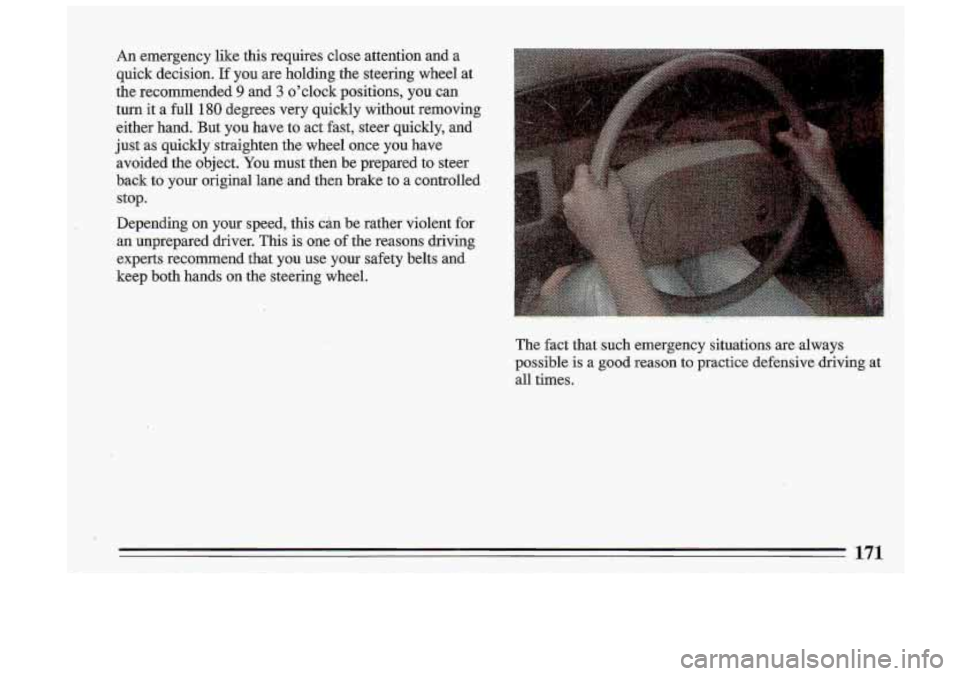
An emergency like this requires close attention and a
quick decision.
If you are holding the steering wheel at
the recommended
9 and 3 o'clock positions, you can
turn it a full 180 degrees very quickly without removing
either hand. But you have to act fast, steer quickly, and
just as quickly straighten the wheel once you have
avoided the object.
You must then be prepared to steer
back to y.our original lane and then brake
to a controlled
stop.
Depending on your speed, this can be rather violent
for
an unprepared driver. This is one of the reasons driving
experts recommend that you use your safety belts and
keep both hands on the steering wheel.
The fact that such emergency situations are .always
possible is a good reason to practice defensive driving at
all times.
171
Page 277 of 340
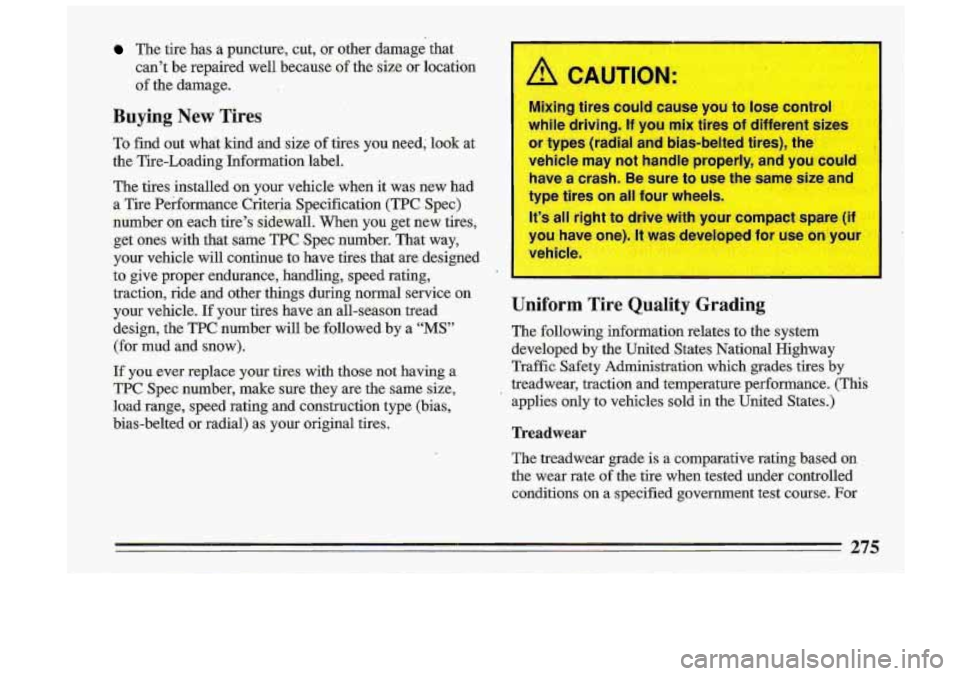
The tire has a puncture, cut, or other damage that
can’t be repaired well because of the size or location
of the damage.
Buying New Tires
.To find out what kind and size of tires you need; look at
the Tire-Loading Information label.
The tires installed on your vehicle when it was new had
a Tire Performance Criteria Specification
(TPC Spec)
-number on each tire’s sidewall. When you get new tires, get ones with that same TPC Spec number.
That way,
your vehicle will continue
to have tires that are designed
to give proper endurance, handling, speed rating,
traction, ride and other things during normal service on
your vehicle.
If your tires have an all-season tread
design, the
TPC nu-mber will be followed. by a “MS”
(for mad and snow).
If you ever replace your tires with those not having a
TPC Spec number, make sure .they are the same size,
load range, speed rating and construction type (bias,
bias-belted or radial) as your original tires.
‘t
A CAUTION:
Mixing tires could cause you to lose control
while driving. If you mix tires of different siz
or types (radial and bias-belted tires), the
vehicle may not handle properly, and you
cows
have a crash. Be sure to use the same size and
type tires
on all four wheels.
It’s all right to drive with your compact spare (if
you have one). It
was developed for use on your
I
I
‘ :le.
Uniform Tire Quality Grading
The following information relates to the system
developed by the United States National Highway
Traffic Safety Administration which grades tires
by
treadwear, traction and temperature performance. (This
applies only to vehicles sold
in the United States.)
Treadwear
The treadwear grade is a comparative rating based on
the wear rate of the tire when tested under controlled
conditions
on a specified govement test course. For
I
Page 284 of 340
Finally, if needed, clean lightly with solvent-type Care of Safety Belts
cleaner.
Combination Stains: Like candy, ice cream,
mayonnaise, chili sauce and unknown stains.
@ Carefully scrape off excess stain, then clean with
If a stain remains, clean it with solvent-type cleaner.
cool water and allow to dry.
Cleaning Vinyl .or Leather
Just use warm water and a clean cloth.
Rub with a clean, damp cloth to remove dirt. You
may have to do it more than once.
Things
like tar, asphalt and shoe polish will stain if
you don’t get them off quickly. Use a clean.-clQth -and.
solvent-type vinylfleather cleaner.
Cleaning the Top of the Instrument
Panel
Use only mild soap and water to clean the top surtaces
,of the instrument panel. Sprays containing silicones or
.
waxes may cause annoying reflections in the windshield
and even make
it difficult to see through the windshield
under certain conditions.
-
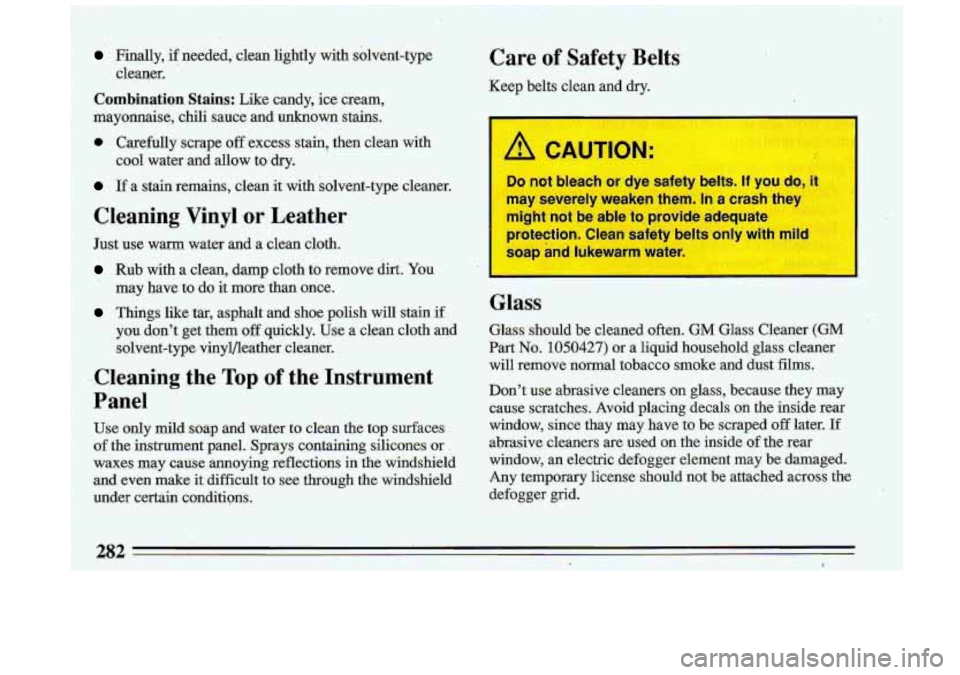
Keep belts clean and dry.
/L CAUTIOC
Do not bleach or dye satety belts. IT you UO, I
may severely weaken them. In a crash they
might not
be able to provide adequate
protection. Clean safety belts only with
mi
soap and lukewarm water.
I
Glass
Glass should be cleaned often. GM Glass Cleaner (GM
Part No. 1050427) or a liquid household! glass cleaner
will remove normal tobacco smoke and dust films.
Don’t use abrasive cleaners on glass, because they may
cause scratches. Avoid placing decals
OR the inside rear
window, since thay may have to be scraped
off later. If
abrasive cleaners are used on the inside of the rear
window, an electric defogger element may be damaged.
Any temporary license should not be attached across the defogger grid.