brake CADILLAC DEVILLE 1994 7.G User Guide
[x] Cancel search | Manufacturer: CADILLAC, Model Year: 1994, Model line: DEVILLE, Model: CADILLAC DEVILLE 1994 7.GPages: 399, PDF Size: 20.97 MB
Page 111 of 399

Downloaded from www.Manualslib.com manuals search engine Leaving Your ‘vehicle With the Engine Running
L
’ CAUTION:
It can be dangerous to leave your vehicle .with the engine I-
running. Your vehicle could move suddenly if.the shift lever is
noi Eully in “P” (Park) with the parking brake firmly set. And, if
I- you leave the vehicle with the engine running, it could overhe\
at
and even catch fire.
You or others could be injured. Don’t leave
your vehicle with the engine running unless you have to.
If you have to leave your vehicle with the engine running, be sure your
vehicle is in “P” (Park) and your parking brake is firmly set before you
leave it. After you’ve moved the shift lever into the “P” (Park) position,
hold the regular brake pedal down. Then, see
if you can move the shift
lever away from “P” (Park) without first pulling it toward you. If you can,
it means that the shift lever wasn’t fully locked into “P” (Park).
SHIFTING OUT OF “P9’ (PARK)
Your Cadillac has a brake-transaxle shift interlock. You have to fully
apply your regular brake before you can shift from “P” (Park) when the
ignition is in the “Run” position. See “Automatic Transaxle”
in the Index.
If you cannot shift out
of “P” (Park), ease pressure on the shift lever --
push the shift lever all the way into “P” (Park) you maintain brake
application. Then move the shift lever into the gear you want.
If you ever
hold the brake pedal down but still can’t shift out of “P” (Park), try this:
1. Turn the key to “Off.” Open and close the driver’s door to turn off the
Retained Accessory Power feature.
2. Apply and hold the brake until the end of Step 4.
3. Shift to “N” (Neutral).
4. Start the vehicle and then shift to the drive gear you want.
5. Have the vehicle fixed as soon as you can.
r
r
L
98
Page 112 of 399

Downloaded from www.Manualslib.com manuals search engine Torque Lock
If you are parking on a hill and you don’t shift your transaxle into “P”
(Park) properly, the weight
of the vehicle may put too much force on the
parking pawl in the transaxle. You may find it difficult to pull the shift
lever out
of “P” (Park). This is called “torque lock.” To prevent torque
lock, set the parking brake and then shift into “P” (Park) properly before
in the Index.
__*
-. you leave the driver’s seat. To find out how, see “Shifting Into ‘P’ (Park)”
If “torque lock” does occur, you may need to have another vehicle push
yours a little uphill to take some
of the pressure from the transaxle, so
you can pull the shift lever out of “P” (Park).
_-
P-NG OWR THINGS TiHATBURN
99
Page 114 of 399

Downloaded from www.Manualslib.com manuals search engine - RUNNING YOUR ENGINE WHILE YOU’RE
PARK%D
- It’s better not to park with the engine running. But if you ever have to,
here are some things to know.
/i CAUTION:
Idling the engine with the air system control off could allow
dangerous exhaust into. your vehicle. (See the earlier caution
under “Engine Exhaust”.)
Also, idling in a closed-in place can let deadly carbon monoxide
(CO) into your vehicle even if the fan switch is at the highest
setting. One place this can happen is a garage. Exhaust
-- with
CO -- can come in easily. NEVER park in a garage with the
engine running.
Another closed-in place can be
a blizzard. (See “Blizzard” in the
Index.)
A CAUTION:
It can be dangerous to get out of your vehicle if the shift lever is
not fully in
“P” (Park) with the parking brake firmly set. Your
vehicle can roll. Don’t leave your vehicle when the engine is
running
unless you have to. If you’ve left the engine running,
the vehicle
can move suddenty. You or others could be injured.
To be sure your vehicle won’t move, even when you’re on fairly
level ground, always set your parking brake after you move the
shift lever to
“P” (Park).
101
Page 122 of 399
Downloaded from www.Manualslib.com manuals search engine r C.
NOTICE:
0
0
I
0
0
-
!
r
n
r I
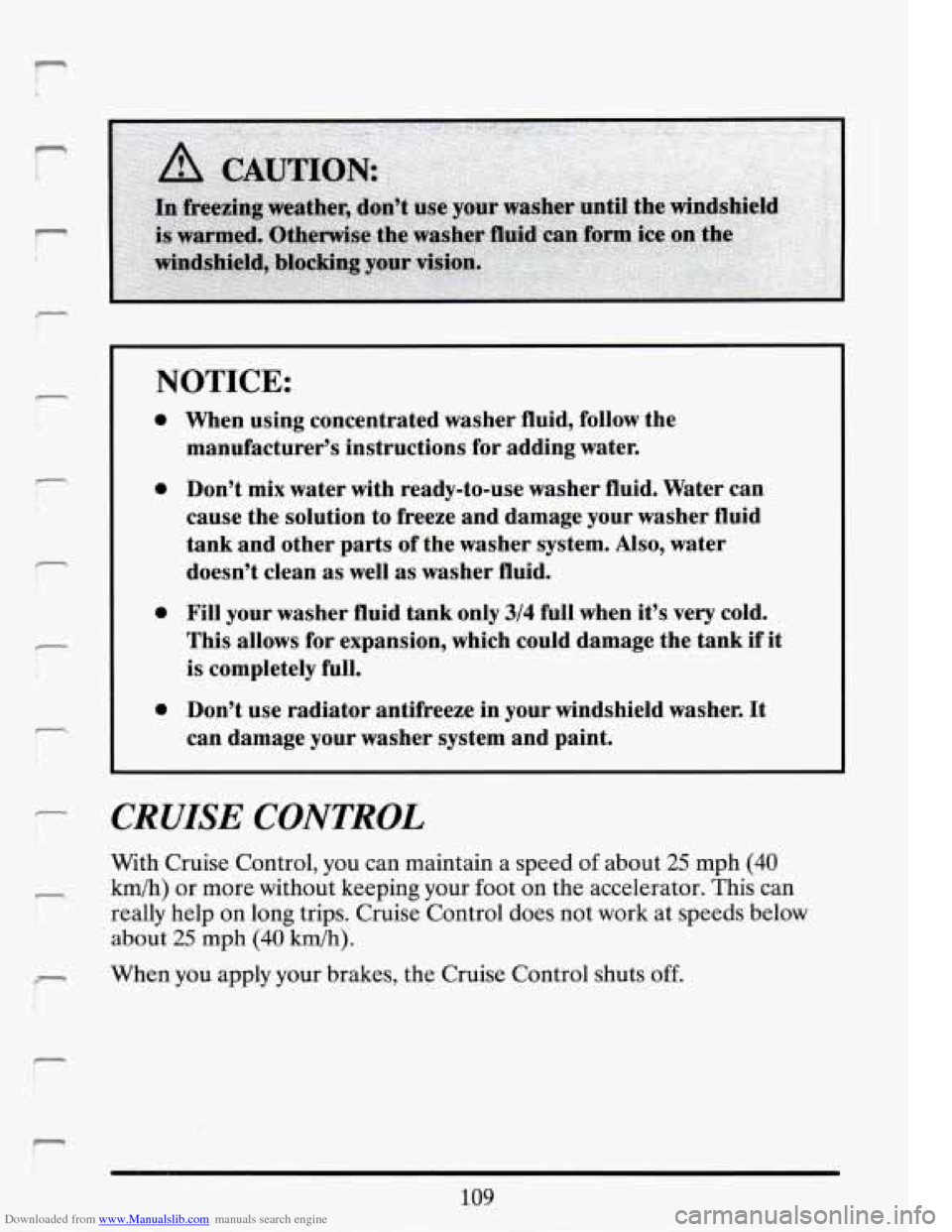
When using concentrated washer fluid, follow the
manufacturer’s instructions for adding water.
Don’t mix water with ready-to-use washer fluid. Water can
cause the solution to freeze and damage your washer fluid
tank and other parts of the washer system.
Also, water
doesn’t clean as well as washer fluid.
Fill your washer fluid tank only
3/4 full when it’s very cold.
This allows for expansion, which could damage the tank
if it
is completely full.
Don’t use radiator antifreeze in your windshield washer.
It
can damage your washer system and paint.
CRUISE CONTROL
With Cruise Control, you can maintain a speed of about 25 mph (40
km/h) or more without keeping your foot on the accelerator. This can
really help on long trips. Cruise Control does not work at speeds below
about
25 mph (40 km/h).
When you apply your brakes, the Cruise Control shuts off.
109
Page 124 of 399
Downloaded from www.Manualslib.com manuals search engine r
7 2. Get up to the speed you want.
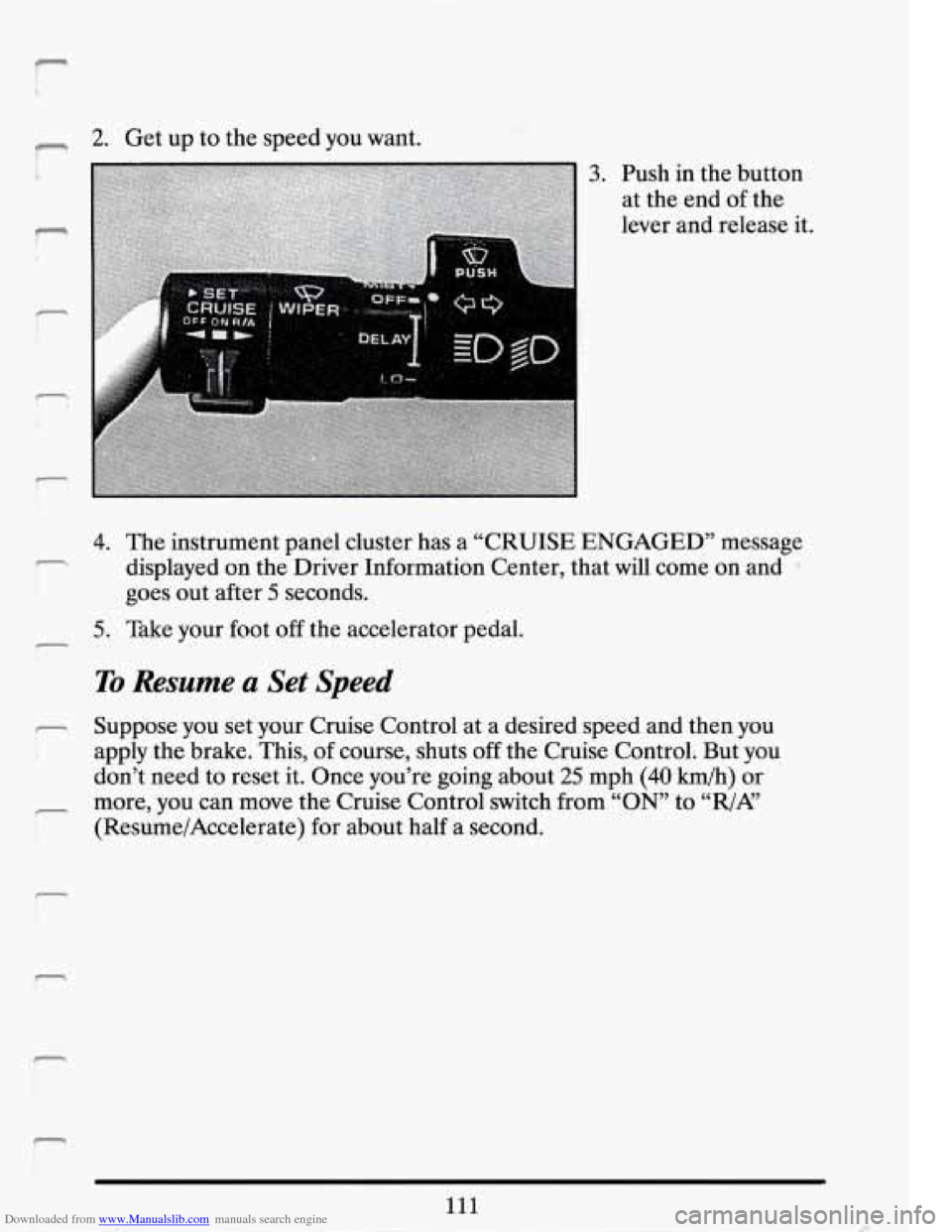
3. Push in the button
at the end of.the
lever and release it.
4. The instrument panel cluster has a “CRUISE ENGAGED” message
displayed on the Driver Information-Center, that will come on and
goes out after
5 seconds.
r
5. Take your foot off the accelerator pedal. c
To Resume a Set Speed
- Suppose you set your Cruise Control at a desired speed and then you
apply the brake. This, of course, shuts off the Cruise Control. But you
don’t need to reset it. Once you’re going about
25 mph (40 h/h) or
(Resume/Accelerate) for about half a second.
r more, you can move the Cruise Control switch from “ON” to “R/A’
111
F
Page 125 of 399
Downloaded from www.Manualslib.com manuals search engine _c--
-
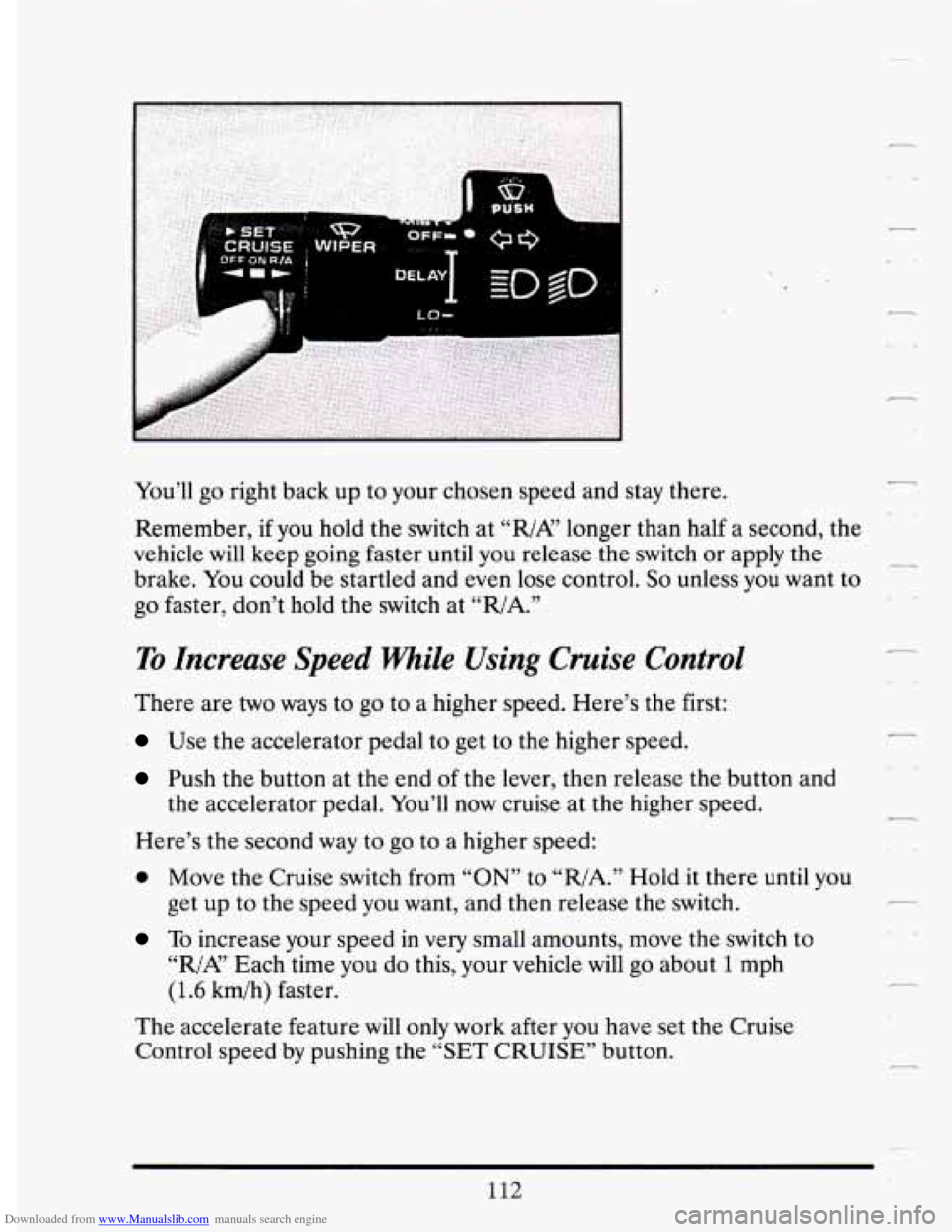
You’ll go right back up to your chosen speed and stay there.
Remember, if
you hold the switch at ‘‘,/A?’ longer than half a second, the
vehicle will keep going faster until you release the switch or apply the
brake.
You could be startled and even lose control. So unless you want to
go faster, don’t hold the switch at “R/A.”
To Increase Speed While Using Cruise Control
There are two ways to go to a higher speed. Here’s the first:
Use the accelerator pedal to get to the higher speed.
Push the button at the end of the lever, then release the button and
the accelerator pedal. You’ll now cruise at the higher speed.
Here’s the second way to go
to a higher speed:
0 Move the Cruise switch from “ON” to “R/A.” Hold it there until you
get up to the speed you want, and then release the switch.
To increase your speed in very small amounts, move the switch to
“R/A” Each time you do this, your vehicle
will go about 1 mph
(1.6 km/h) faster.
The accelerate feature
will only work after you have set the Cruise
Control speed by pushing the “SET CRUISE” button.
112
Page 126 of 399
Downloaded from www.Manualslib.com manuals search engine - To Reduce Speed mile Using Cruise Control
There are two ways to reduce your speed while using cruise control:
Push in the button at the end of the lever until you reach the lower - speed you want, then release it.
c-
To slow down in very small amounts, push the button for less than half
a second. Each time you do this, you’ll go
1 mph (1.6 km/h) slower.
Passing Another Khicle While Using Cruise Control
~ Use the accelerator pedal to increase your speed. When you take your
foot off the pedal, your vehicle will slow down to the Cruise Control
speed you set earlier.
Using Cruise Control on Hills
How well your Cruise Control will work on hills depends upon your
- speed, load, and the steepness of the hills. When going up steep hills, you
may have to step on the accelerator pedal to maintain your speed. When
going downhill, you may have to brake or shift to a lower gear to keep
Control. Many drivers find
this to be too much trouble and don’t use
Cruise Control on steep hills.
__ your speed down. Of course, applying the brake takes you out of Cruise
113
Page 127 of 399
Downloaded from www.Manualslib.com manuals search engine To Get Out of Cruise Control
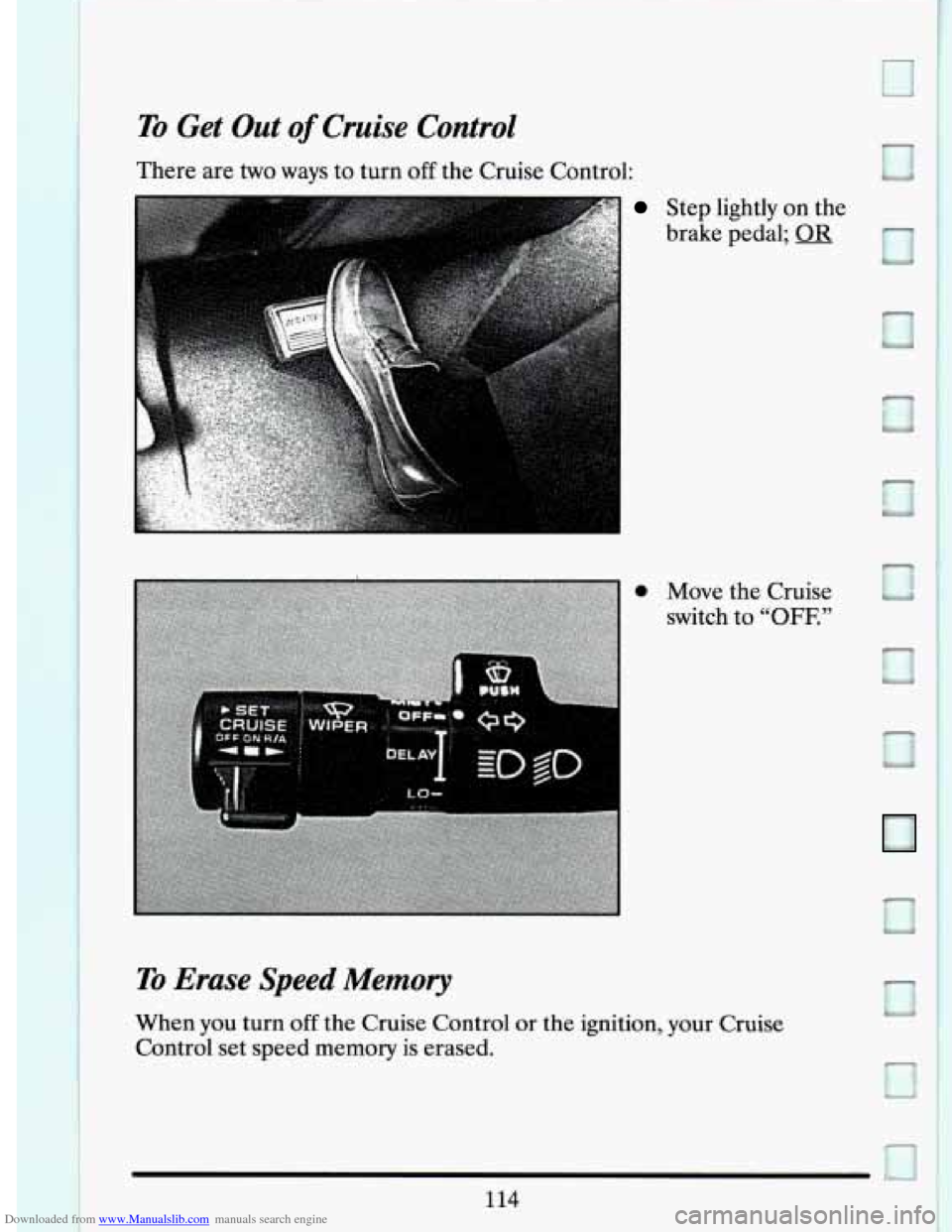
There are two ways to turn off the Cruise Control:
Step lightly on the
brake pedal;
OR
0 Move the Cruise
switch
to "OFF"
To Erase Speed Memory
When you turn off the Cruise Control or the ignition, your Cruise
Control set speed memory is erased.
114
!
Page 133 of 399

Downloaded from www.Manualslib.com manuals search engine Rear Taillamp Monitor
The rear taillamp monitor is located at the top center over the back glass.
You
will see it as you are looking through your inside rearview mirror.
Two red indicators will illuminate to show that your taillights and brake
lights are working.
Page 145 of 399
Downloaded from www.Manualslib.com manuals search engine Odometer
You may wonder what happens if a car has to have a new odometer
installed. The new one will read the correct mileage. This is because the
computer stores the mileage in memory.
WMING LIGHTS
This section describes the warning lights that are on your vehicle. The
pictures will help you locate them.
Warning lights can signal that something is wrong before it becomes
serious enough to cause an expensive repair or replacement. Paying
attention to your warning lights could also save you or others from injury.
Warning lights
go on when there may be or is a problem with one of your
vehicle’s functions.
As you will see in the details on the next few pages,
some warning lights come on briefly when you turn the ignition key just to
let you know they’re working. If you are familiar with this section, you
should not be alarmed when this happens.
When one
of the warning lights comes on and stays on when you are
driving, check the section that tells you what to do about it. Please follow
the manual’s advice. Waiting to do repairs can be costly
-- and even
dangerous.
So please get to know your warning lights. They’re a big help.
Your vehicle may also have a driver information system that works along
with the warning lights. See “Driver Information System” in the Index.
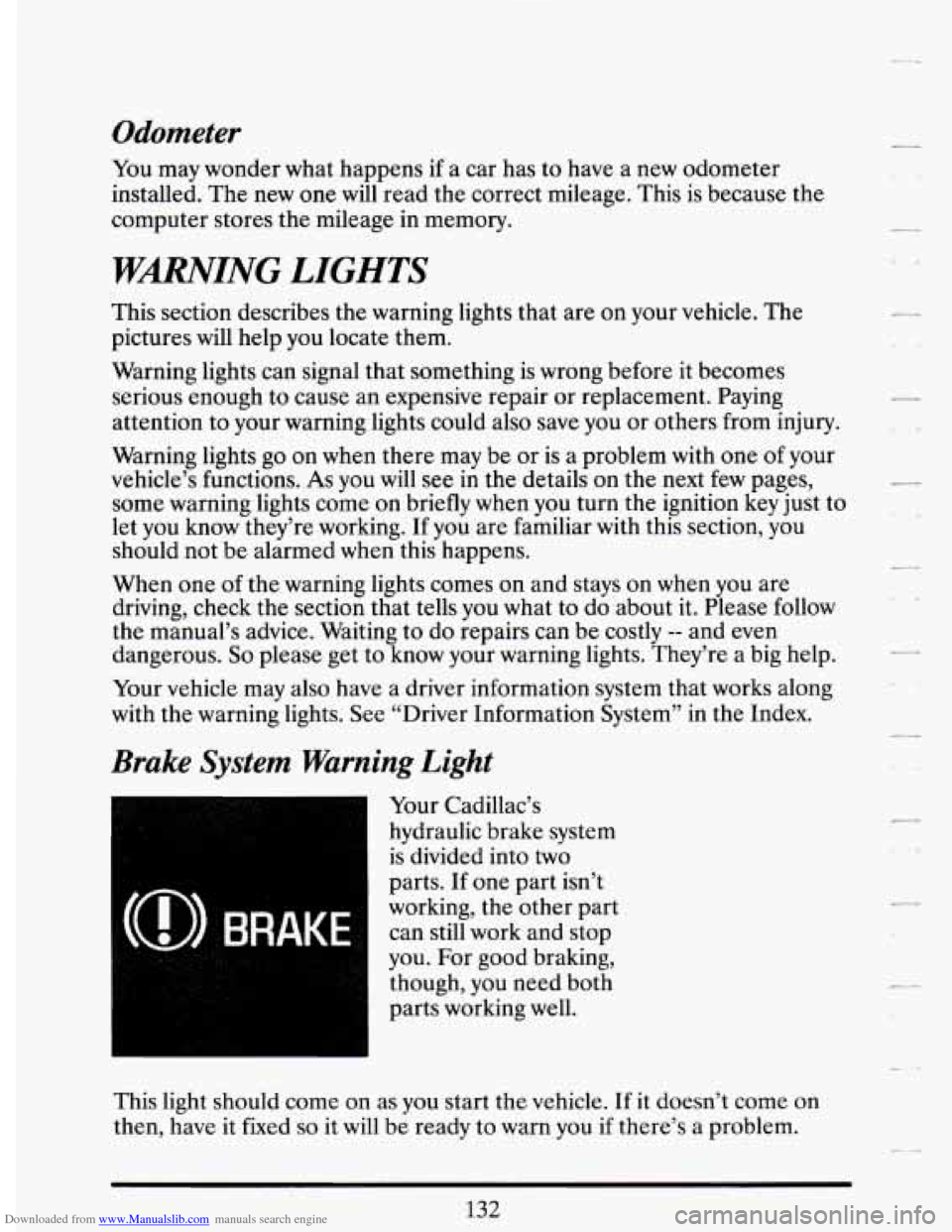
Brake System Warning Light
Your Cadillac’s
hydraulic brake system
is divided into
two
parts. If one part isn’t
working, the other part
can still work and stop
you. For good braking,
though, you need both
parts working
well.
r
L-l
This light should come on as you start the vehicle. If it doesn’t come on
then, have it fixed so it will be ready to warn you if there’s a problem.