steering CADILLAC DEVILLE 2003 8.G Workshop Manual
[x] Cancel search | Manufacturer: CADILLAC, Model Year: 2003, Model line: DEVILLE, Model: CADILLAC DEVILLE 2003 8.GPages: 423, PDF Size: 2.91 MB
Page 263 of 423
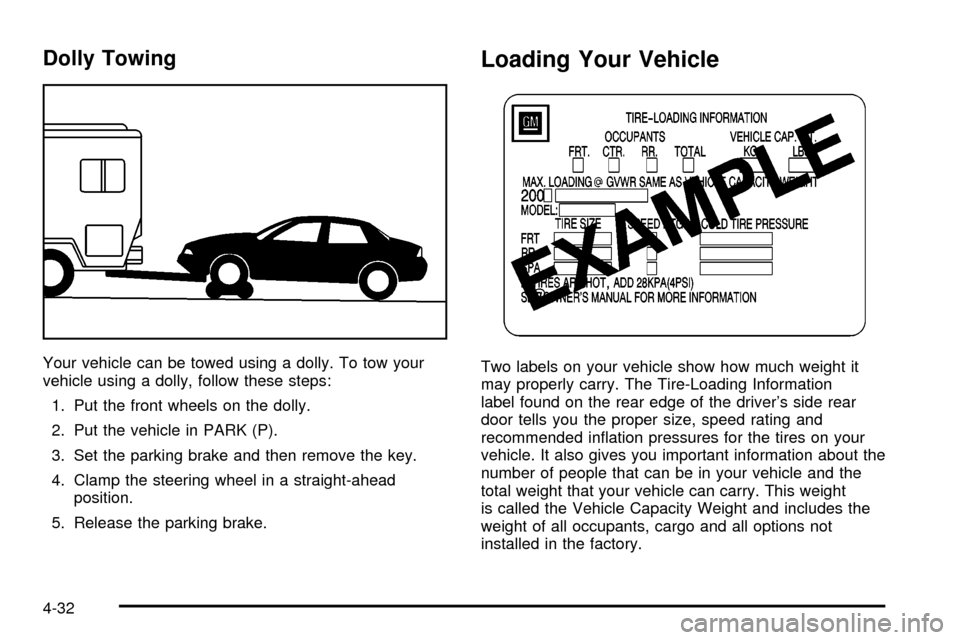
Dolly Towing
Your vehicle can be towed using a dolly. To tow your
vehicle using a dolly, follow these steps:
1. Put the front wheels on the dolly.
2. Put the vehicle in PARK (P).
3. Set the parking brake and then remove the key.
4. Clamp the steering wheel in a straight-ahead
position.
5. Release the parking brake.
Loading Your Vehicle
Two labels on your vehicle show how much weight it
may properly carry. The Tire-Loading Information
label found on the rear edge of the driver's side rear
door tells you the proper size, speed rating and
recommended in¯ation pressures for the tires on your
vehicle. It also gives you important information about the
number of people that can be in your vehicle and the
total weight that your vehicle can carry. This weight
is called the Vehicle Capacity Weight and includes the
weight of all occupants, cargo and all options not
installed in the factory.
4-32
Page 269 of 423

Trailer Brakes
Because you have anti-lock brakes, don't try to tap into
your vehicle's hydraulic brake system. If you do,
both brake systems won't work well, or at all. If you tow
more than 1,000 lbs. (450 kg), use trailer brakes.
Be sure to follow the instructions that come with the
trailer or from the brake manufacturer.
Be sure to read and follow the instructions for the trailer
brakes so you'll be able to maintain them properly.
Driving with a Trailer
Towing a trailer requires a certain amount of experience.
Before setting out for the open road, you'll want to get
to know your rig. Acquaint yourself with the feel of
handling and braking with the added weight of the trailer.
And always keep in mind that the vehicle you are
driving is now a good deal longer and not nearly as
responsive as your vehicle is by itself.
Before you start, check the trailer hitch and platform
(and attachments), safety chains, electrical connector,
lamps, tires and mirror adjustment. If the trailer has
electric brakes, start your vehicle and trailer moving and
then apply the trailer brake controller by hand to be
sure the brakes are working. This lets you check your
electrical connection at the same time.
During your trip, check occasionally to be sure that the
load is secure, and that the lamps and any trailer
brakes are still working.
Following Distance
Stay at least twice as far behind the vehicle ahead as
you would when driving your vehicle without a trailer.
This can help you avoid situations that require
heavy braking and sudden turns.
Passing
You'll need more passing distance up ahead when
you're towing a trailer. And, because you're a good deal
longer, you'll need to go much farther beyond the
passed vehicle before you can return to your lane.
Backing Up
Hold the bottom of the steering wheel with one hand.
Then, to move the trailer to the left, just move that hand
to the left. To move the trailer to the right, move your
hand to the right. Always back up slowly and, if possible,
have someone guide you.
Making Turns
Notice:Making very sharp turns while trailering
could cause the trailer to come in contact with the
vehicle. Your vehicle could be damaged. Avoid
making very sharp turns while trailering.
When you're turning with a trailer, make wider turns than
normal. Do this so your trailer won't strike soft shoulders,
curbs, road signs, trees or other objects. Avoid jerky or
sudden maneuvers. Signal well in advance.
4-38
Page 272 of 423
Service............................................................5-3
Doing Your Own Service Work.........................5-3
Adding Equipment to the Outside of Your
Vehicle......................................................5-4
Fuel................................................................5-4
Gasoline Octane............................................5-4
Gasoline Speci®cations....................................5-5
California Fuel...............................................5-5
Additives.......................................................5-6
Fuels in Foreign Countries...............................5-6
Filling Your Tank............................................5-7
Filling a Portable Fuel Container.......................5-9
Checking Things Under
the Hood....................................................5-10
Hood Release..............................................5-11
Engine Compartment Overview.......................5-12
Engine Oil...................................................5-13
Engine Air Cleaner/Filter................................5-19
Automatic Transaxle Fluid..............................5-21
Engine Coolant.............................................5-24
Coolant Surge Tank Pressure Cap..................5-27
Engine Overheating.......................................5-27
Cooling System............................................5-30Power Steering Fluid.....................................5-36
Windshield Washer Fluid................................5-37
Brakes........................................................5-38
Battery........................................................5-41
Jump Starting...............................................5-43
Headlamp Aiming...........................................5-49
Headlamp Horizontal Aiming...........................5-50
Headlamp Vertical Aiming..............................5-50
Bulb Replacement..........................................5-53
Halogen Bulbs..............................................5-53
Headlamps..................................................5-53
Front Turn Signal, Sidemarker, Parking and
Cornering Lamps.......................................5-57
Center High-Mounted Stoplamp (CHMSL).........5-58
Taillamps, Turn Signal, and Stoplamps............5-58
Replacement Bulbs.......................................5-58
Windshield Wiper Blade Replacement..............5-59
Tires..............................................................5-60
In¯ation Ð Tire Pressure...............................5-61
Tire Pressure Monitor System.........................5-62
Tire Inspection and Rotation...........................5-64
When It Is Time for New Tires.......................5-65
Buying New Tires.........................................5-66
Section 5 Service and Appearance Care
5-1
Page 278 of 423

Filling Your Tank
{CAUTION:
Fuel vapor is highly ¯ammable. It burns
violently, and that can cause very bad injuries.
Don't smoke if you're near fuel or refueling
your vehicle. Keep sparks, ¯ames and smoking
materials away from fuel.The fuel cap is located behind a hinged door on driver's
side of your vehicle.
The fuel door release
button is located to the left
of the steering wheel
next to the exterior lamp
control.
The button only works when the vehicle is in PARK (P)
or NEUTRAL (N), when the key is in the ignition and
the VALET lockout button is in OFF.
5-7
Page 284 of 423
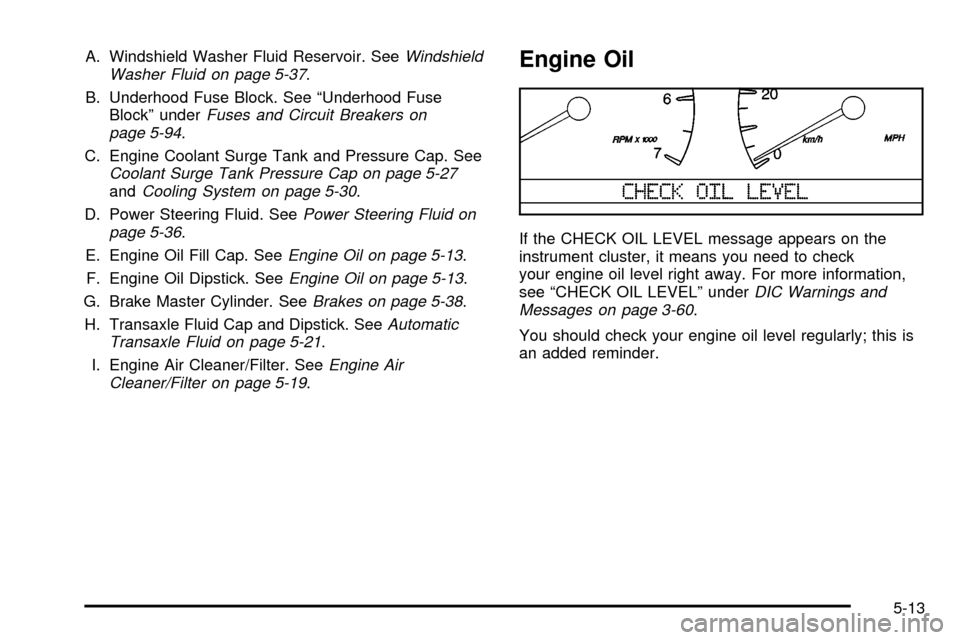
A. Windshield Washer Fluid Reservoir. SeeWindshield
Washer Fluid on page 5-37.
B. Underhood Fuse Block. See ªUnderhood Fuse
Blockº under
Fuses and Circuit Breakers on
page 5-94.
C. Engine Coolant Surge Tank and Pressure Cap. See
Coolant Surge Tank Pressure Cap on page 5-27andCooling System on page 5-30.
D. Power Steering Fluid. See
Power Steering Fluid on
page 5-36.
E. Engine Oil Fill Cap. See
Engine Oil on page 5-13.
F. Engine Oil Dipstick. See
Engine Oil on page 5-13.
G. Brake Master Cylinder. See
Brakes on page 5-38.
H. Transaxle Fluid Cap and Dipstick. See
Automatic
Transaxle Fluid on page 5-21.
I. Engine Air Cleaner/Filter. See
Engine Air
Cleaner/Filter on page 5-19.
Engine Oil
If the CHECK OIL LEVEL message appears on the
instrument cluster, it means you need to check
your engine oil level right away. For more information,
see ªCHECK OIL LEVELº under
DIC Warnings and
Messages on page 3-60.
You should check your engine oil level regularly; this is
an added reminder.
5-13
Page 307 of 423

Power Steering Fluid
The power steering ¯uid reservoir is located next to the
underhood fuse block on the passenger's side of the
vehicle. See
Engine Compartment Overview on
page 5-12for more information on location.
When to Check Power Steering Fluid
It is not necessary to regularly check power steering ¯uid
unless you suspect there is a leak in the system or
you hear an unusual noise. A ¯uid loss in this system
could indicate a problem. Have the system inspected
and repaired.
How to Check Power Steering Fluid
Turn the key off, let the engine compartment cool down,
wipe the cap and the top of the reservoir clean, then
unscrew the cap and wipe the dipstick with a clean rag.
Replace the cap and completely tighten it. Then
remove the cap again and look at the ¯uid level on the
dipstick.
The level should be at the FULL COLD mark. If
necessary, add only enough ¯uid to bring the level up to
the mark.
What to Use
To determine what kind of ¯uid to use, seePart D:
Recommended Fluids and Lubricants on page 6-15.
Always use the proper ¯uid. Failure to use the proper
¯uid can cause leaks and damage hoses and seals.
5-36
Page 315 of 423

Notice:If you leave your radio on, it could be badly
damaged. The repairs wouldn't be covered by
your warranty.
3. Turn off the ignition on both vehicles. Unplug
unnecessary accessories plugged into the cigarette
lighter or in the accessory power outlets. Turn off
the radio and all lamps that aren't needed. This will
avoid sparks and help save both batteries. And it
could save your radio!
4. Open the hoods and locate the positive (+) and
negative (-) terminal locations on the other
vehicle. Your vehicle has a remote positive (+) jump
starting terminal and a remote negative (-) jump
starting terminal.
The remote positive (+)
terminal is located in the
engine compartment
on the passenger's side of
the vehicle. A second
remote positive (+) terminal
is located on the rear
underseat fuse block. Lift
the red plastic cap to
access the terminal.The remote negative (-) terminal is located near
the power steering ¯uid reservoir. It is marked
ªGND (-).º See
Engine Compartment Overview on
page 5-12for more information on location.
You will not see the battery of your vehicle under
the hood. It is located under the rear passenger's
seat. You will not need to access the battery
for jump starting. The remote positive (+) terminal is
for that purpose.
{CAUTION:
An electric fan can start up even when the
engine is not running and can injure you. Keep
hands, clothing and tools away from any
underhood electric fan.
5-44
Page 342 of 423
Notice:If your vehicle has a tire size other than
P235/55R17 size tires, use tire chains only where
legal and only when you must. Use only SAE Class
ªSº type chains that are the proper size for your
tires. Install them on the front tires and tighten them
as tightly as possible with the ends securely
fastened. Drive slowly and follow the chain
manufacturer's instructions. If you can hear the
chains contacting your vehicle, stop and retighten
them. If the contact continues, slow down until
it stops. Driving too fast or spinning the wheels with
chains on will damage your vehicle.
If a Tire Goes Flat
It's unusual for a tire to ªblowoutº while you're driving,
especially if you maintain your tires properly. If air goes
out of a tire, it's much more likely to leak out slowly.
But if you should ever have a ªblowout,º here are a few
tips about what to expect and what to do:
If a front tire fails, the ¯at tire will create a drag that
pulls the vehicle toward that side. Take your foot off the
accelerator pedal and grip the steering wheel ®rmly.
Steer to maintain lane position, and then gently brake to
a stop well out of the traffic lane.A rear blowout, particularly on a curve, acts much like a
skid and may require the same correction you'd use
in a skid. In any rear blowout, remove your foot from the
accelerator pedal. Get the vehicle under control by
steering the way you want the vehicle to go. It may be
very bumpy and noisy, but you can still steer. Gently
brake to a stop, well off the road if possible.
{CAUTION:
Lifting a vehicle and getting under it to do
maintenance or repairs is dangerous without
the appropriate safety equipment and training.
The jack provided with your vehicle is
designed only for changing a ¯at tire. If it is
used for anything else, you or others could be
badly injured or killed if the vehicle slips off
the jack. Use the jack provided with your
vehicle only for changing a ¯at tire.
If a tire goes ¯at, the next part shows how to use your
jacking equipment to change a ¯at tire safely.
5-71
Page 369 of 423
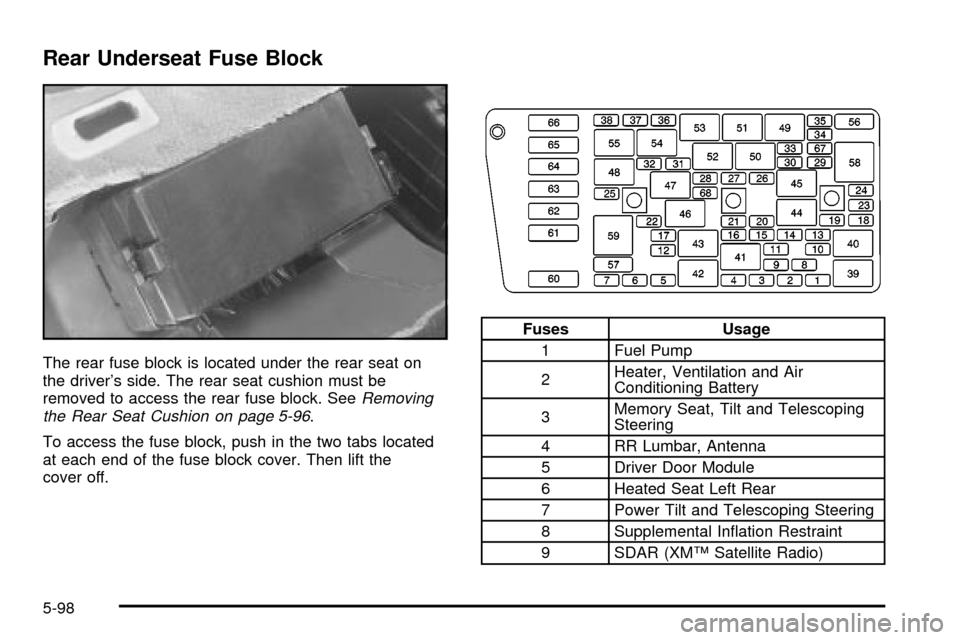
Rear Underseat Fuse Block
The rear fuse block is located under the rear seat on
the driver's side. The rear seat cushion must be
removed to access the rear fuse block. See
Removing
the Rear Seat Cushion on page 5-96.
To access the fuse block, push in the two tabs located
at each end of the fuse block cover. Then lift the
cover off.
Fuses Usage
1 Fuel Pump
2Heater, Ventilation and Air
Conditioning Battery
3Memory Seat, Tilt and Telescoping
Steering
4 RR Lumbar, Antenna
5 Driver Door Module
6 Heated Seat Left Rear
7 Power Tilt and Telescoping Steering
8 Supplemental In¯ation Restraint
9 SDAR (XMŸ Satellite Radio)
5-98
Page 376 of 423
Maintenance Schedule......................................6-2
Introduction...................................................6-2
Your Vehicle and the Environment....................6-2
Maintenance Requirements..............................6-2
How This Section is Organized.........................6-3
Part A: Scheduled Maintenance Services...........6-4
Using Your Maintenance Schedule....................6-4
Scheduled Maintenance...................................6-4
Part B: Owner Checks and Services.................6-9
At Each Fuel Fill............................................6-9
At Least Once a Month...................................6-9
At Least Twice a Year...................................6-10At Least Once a Year...................................6-10
Part C: Periodic MaintenanceInspections.........6-13
Steering, Suspension and Front Drive Axle
Boot and Seal Inspection............................6-13
Exhaust System Inspection............................6-13
Fuel System Inspection..................................6-13
Engine Cooling System Inspection...................6-14
Throttle System Inspection.............................6-14
Brake System Inspection................................6-14
Part D: Recommended Fluids and Lubricants. . . .6-15
Part E: Maintenance Record...........................6-16
Section 6 Maintenance Schedule
6-1