lock CADILLAC ELDORADO 1998 10.G Owners Manual
[x] Cancel search | Manufacturer: CADILLAC, Model Year: 1998, Model line: ELDORADO, Model: CADILLAC ELDORADO 1998 10.GPages: 380, PDF Size: 21.39 MB
Page 15 of 380
Downloaded from www.Manualslib.com manuals search engine For the 1948 model. Cadillac introduced the legendary
tail fin
which once more set the trend in automotive
styling
for nearly two decades. This was closely
followed with the two door hardtop Coupe DeVille and
the industry’s first modem overhead valve, high
compression
V8 engine on the 1949 model.
Engineering innovations. conveniences and styling
dominated
the ’50s and ‘60s. Cruise control, automatic
climate control.
tilt and telescoping steering wheels,
twilight sentinel and four door hard tops
all debuted in
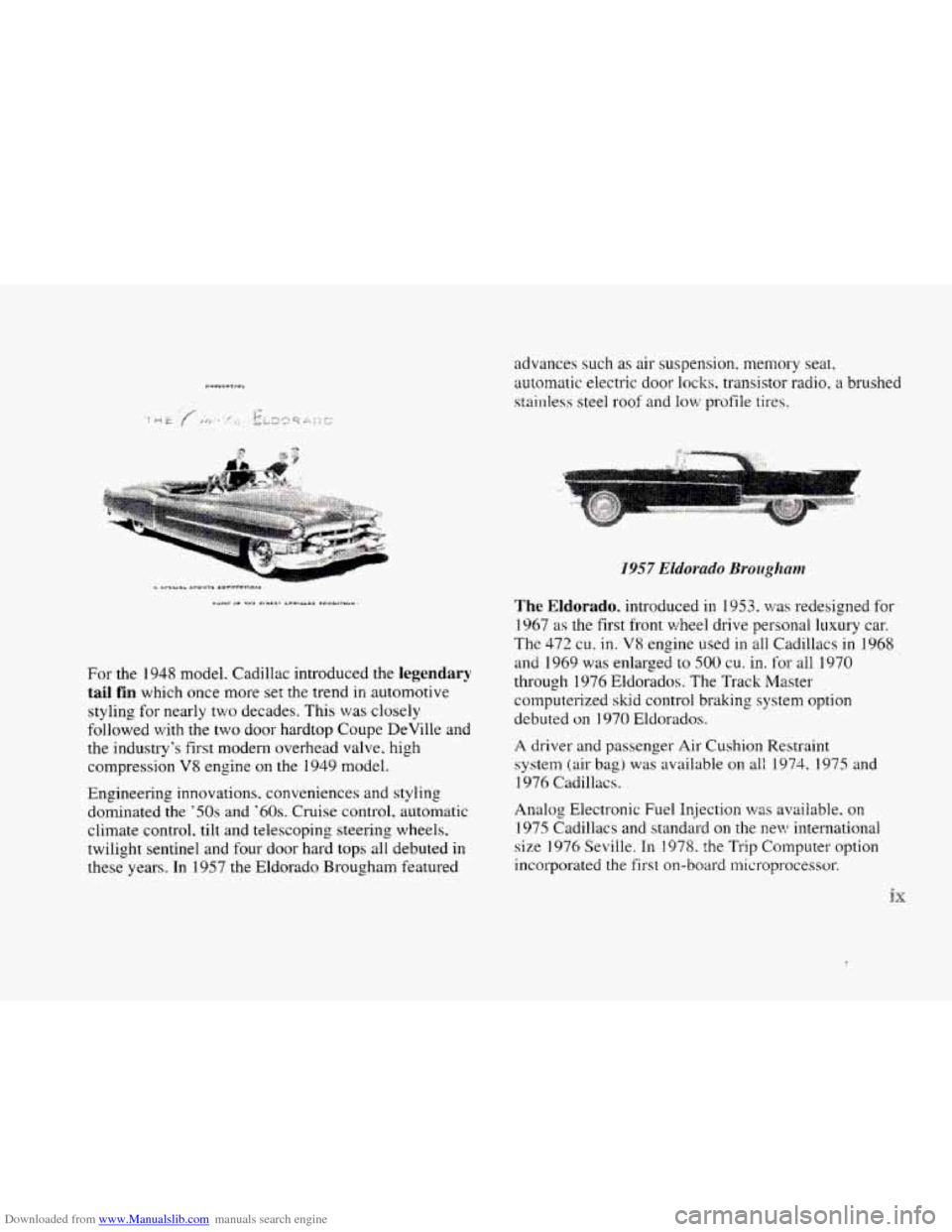
these years. In 1957 the Eldorado Brougham featured advances
such as air suspension. memory seat,
automatic electric
door locks, transistor radio. a brushed
stainless steel roof and
low profile tires.
The Eldorado. introduced in 1953, wziS redesigned for
1967 as the first front wheel drive personal luxury car.
The
472 cu. in. V8.engine used in all Cadiilacs in 1968
and 1969 was enlarged to SO0 cu. in. for all 1970
through 1976 Eldorados. The
Track Master
computerized
skid control braking system option
debuted on
1970 Eldorados.
A driver and passenger Air Cushion Restraint
system (air bag) was available on
ali 1974. 1975 and
1976 Cadillacs.
Analog Electronic Fuel Injection
was available. on
1975 Cadillacs and standard on the new international
size 1976 Seville. In
1978. the Trip Computet. option
incorporated the first on-board microprocessor.
Page 16 of 380
Downloaded from www.Manualslib.com manuals search engine The electronics and computerization which were
pioneered by Cadillac in the
’70s came of age in the
’80s with Digital Fuel Injection and On-Board
Diagnostics
in 1980. four wheel Anti-lock Brakes on
1986 models and Traction Control in the fdl of 1989.
The 1992 Seville STS was the first car ever to win all
three major automotive awards: Car
of the Year, Motor
Trend; Ten Best List, Car
& Driver; Car of the Year.
Automobile Magazine.
The year
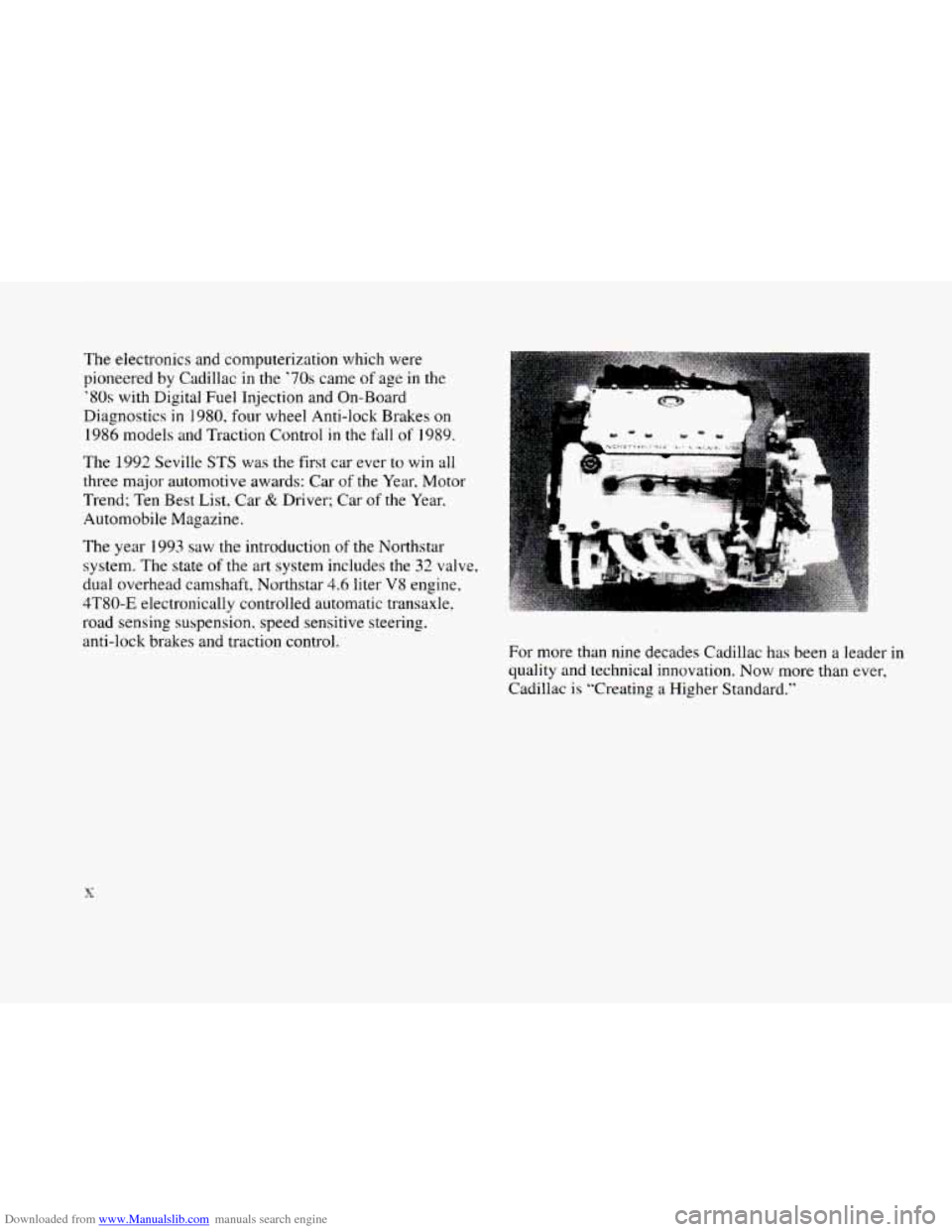
1993 saw the introduction of the Northstar
system. The state
of the art system includes the 32 valve,
dual overhead camshaft, Northstar 4.6 liter V8 engine,
4T80-E electronically controlled automatic transaxle,
road sensing suspension, speed sensitive steering.
anti-lock brakes and traction control.
For more than nine decades Cadillac has been
a leader in
quality and technical innovation. Now more than ever,
Cadillac
is “Creating a Higher Standard.”
Page 19 of 380
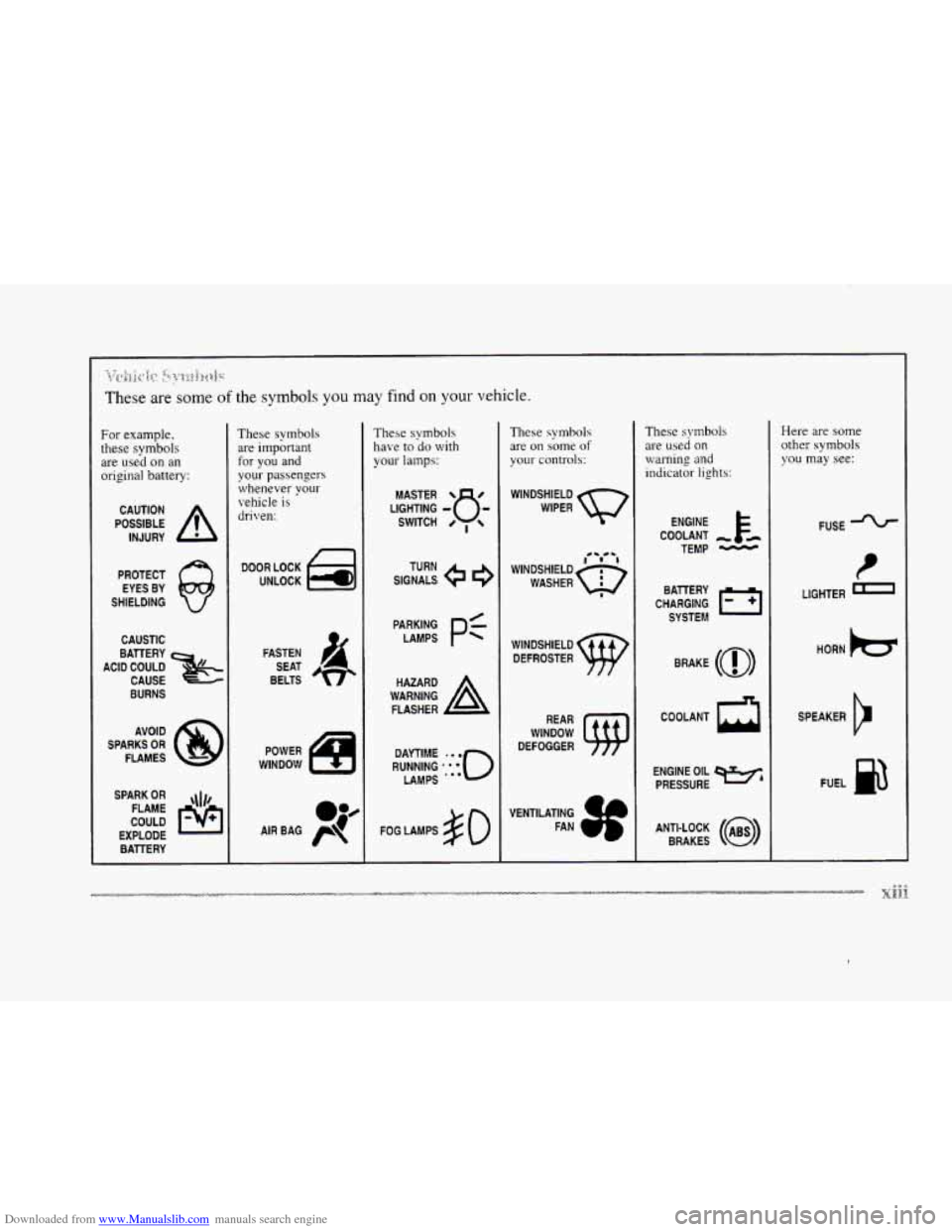
Downloaded from www.Manualslib.com manuals search engine For example, these
symbols
are used on an
original battery:
POSSIBLE A
CAUTION
INJURY
PROTECT EYES BY
SHIELDING
CAUSTIC
ACID COULD
BAlTERY
CAUSE
BURNS
SPARK
OR ,\I/,
COULD FLAME
EXPLODE BAllERY
These symbols
are important
for you and
your passengers
whenever your
vehicle
is
driven:
DOOR LOCK
UNLOCK
FASTEN SEAT
BELTS
These symbols
have
to do with
your lamps:
SIGNALS e
TURN
FOG LAMPS
# 0
These symbols
are
on some of
your controls:
WINDSHIELD
WIPER
WINDSHIELD DEFROSTER
WINDOW
DEFOGGER
These symbols
are used on
warning and
indicator lights:
COOLANT -
TEMP -
CHARGING I-1
BAlTERY
SYSTEM
BRAKE
(0)
COOLANT a
ENGINE OIL e,
PRESSURE
ANTI-LOCK
(@)
BRAKES
Here are some
other symbols
you may see:
FUSE
t
LIGHTER
HORN tcr
SPEAKER
cr
FUEL p3
Page 23 of 380
Downloaded from www.Manualslib.com manuals search engine Power Lumbar Control (If Equipped)
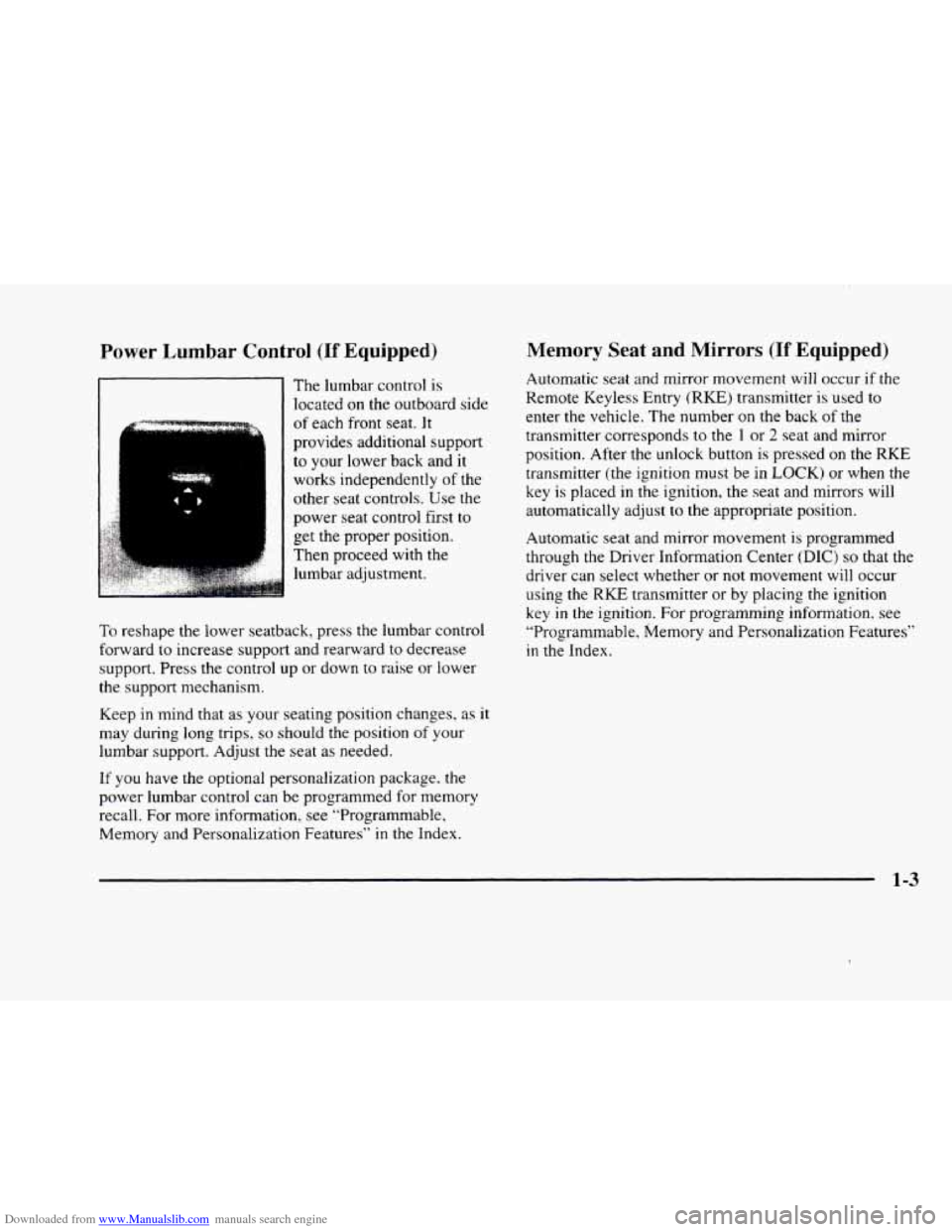
The lumbar control is
located
on the outboard side
I I
of each front seat. It
provides additional support
to your lower back and it
works independently
of the
other seat controls. Use the
power seat control first
to
get the proper position.
Then proceed with the
lumbar adjustment.
To reshape the lower seatback, press the lumbar control
forward to increase support and rearward to decrease
support. Press the control up or down
to raise or lower
the support mechanism.
Keep in mind that as your seating position changes,
as it
may during long trips,
so should the position of your
lumbar support. Adjust
the seat as needed.
If you have the optional personalization package, the
power lumbar control can be programmed for memory
recall. For more information. see “Programmable,
Memory and Personalization Features”
in the Index.
Memory Seat and Mirrors (If Equipped)
Automatic seat and mirror movement will occur if the
Remote Keyless Entry
(RKE) transmitter is used to
enter the vehicle. The number
on the back of the
transmitter corresponds to the
1 or 2 seat and mirror
position. After the unlock button is pressed on the
RKE
transmitter (the ignition must be in LOCK) or when the
key is placed in the ignition, the seat and mirrors will
automatically adjust
to the appropriate position.
Automatic seat and mirror movement
is programmed
through the Driver Information Center
(DIC) so that the
driver can select whether or not movement will occur
using the
RKE transmitter or by placing the ignition
key in the ignition. For programming information, see
“Pragrammable, Memory and Personalization Features”
in the Index.
1-3
Page 26 of 380
Downloaded from www.Manualslib.com manuals search engine Seatback Latches
I A CAUTION:
If the seatback isn’t locked, it could move
forward in a sudden stop or crash. That could
cause injury to the person sitting there. Always
press rearward on the seatback to be sure it
is locked.
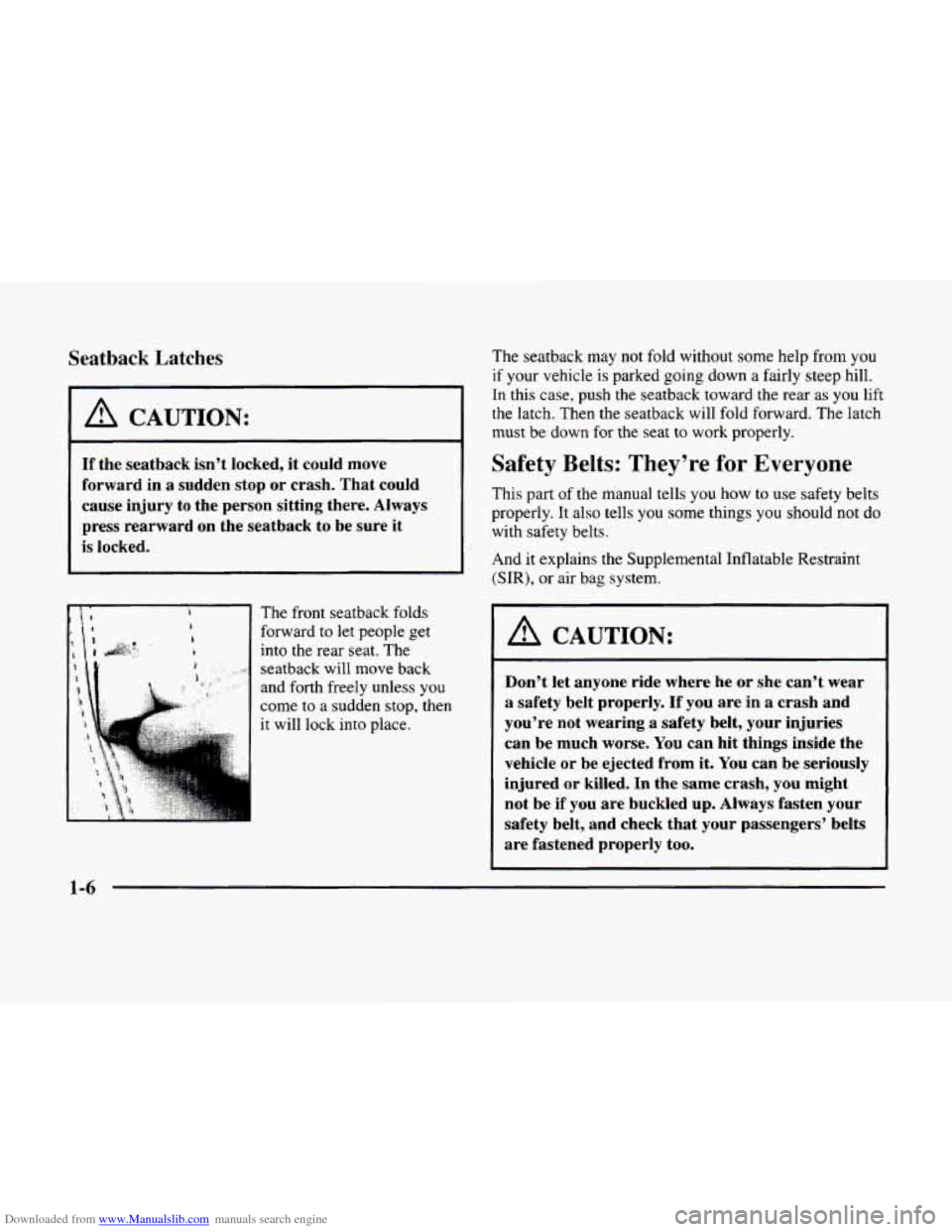
The front seatback folds
forward to
let people get
into the rear seat. The
seatback will move back
and forth freely unless you
come to a sudden stop, then
it will lock into place. The
seatback may not fold without some help from
you
if your vehicle is parked going down a fairly steep hill.
In this case, push the seatback toward the rear as you lift
the latch. Then the seatback will fold forward. The latch
must be
down for the seat to work properly.
Safety Belts: They’re for Everyone
This part of the manual tells you how to use safety belts
properly. It also tells you some things
you should not do
with safety belts.
And it explains the Supplemental Inflatable Restraint
(SIR), or air bag system.
A CAUTION:
Don’t let anyone ride where he or she can’t wear
a safety belt properly.
If you are in a crash and
you’re not wearing a safety belt, your injuries
can be much worse.
You can hit things inside the
vehicle
or be ejected from it. You can be seriously
injured
or killed. In the same crash, you might
not be
if you are buckled up. Always fasten your
safety belt, and check that your passengers’ belts
are fastened properly too.
1-6
Page 32 of 380
Downloaded from www.Manualslib.com manuals search engine How to Wear Safety Belts Properly
Adults
This part is only for people of adult size.
Be aware that there are special things to know about
safety belts and children. And there are different
rules for smaller children and babies. If
a child will be
riding in your vehicle,
see the part of this manual
called “Children.”
Follow those rules for
everyone’s protection.
First, you’ll want to
know which restraint systems your
vehicle has.
We’ll start with the driver position.
Driver Position
This part describes the driver’s restraint system.
Lap-Shoulder Belt
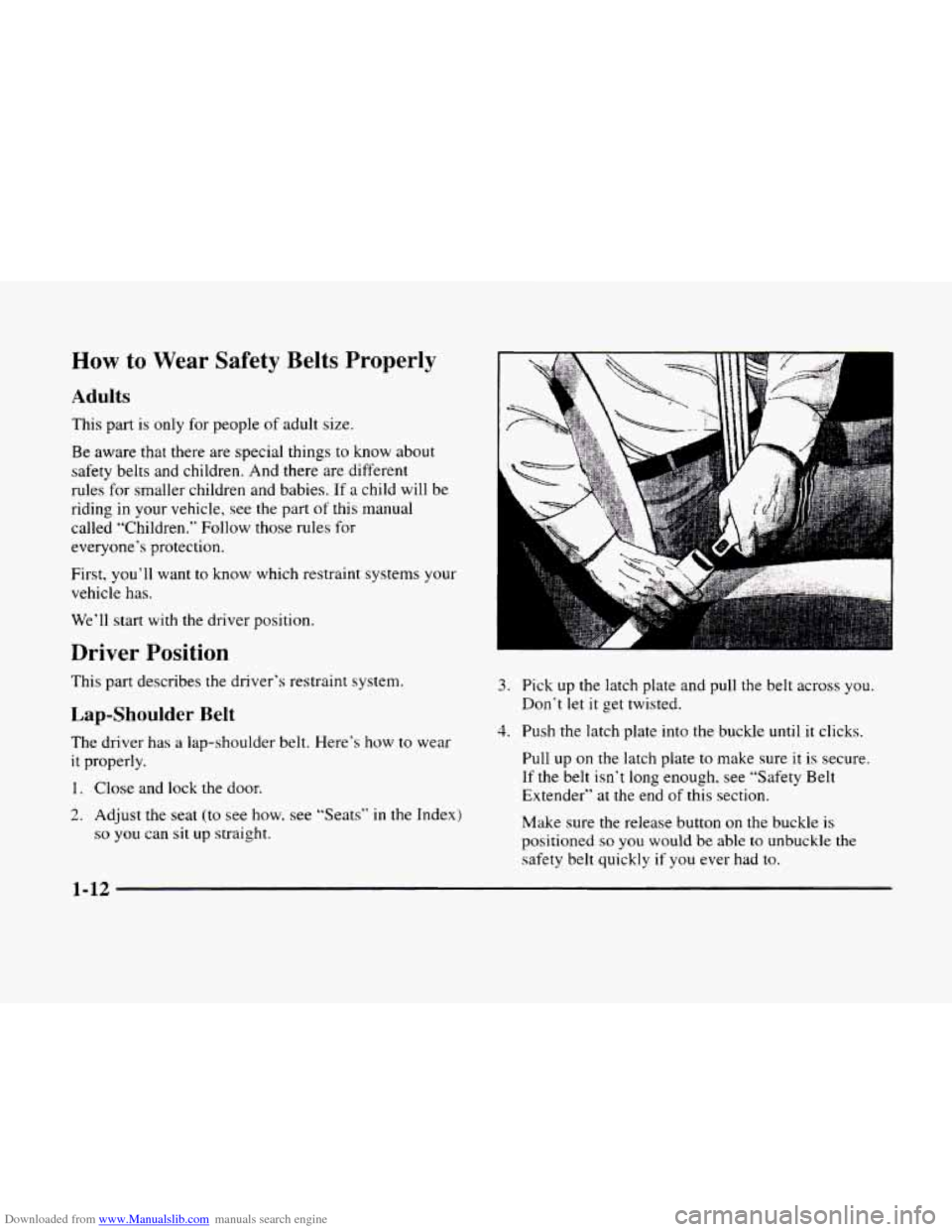
The driver has a lap-shoulder belt. Here’s how to wear
it properly.
1. Close and lock the door.
2. Adjust the seat (to see how. see “Seats” in the Index)
so you can sit up straight.
3. Pick up the latch plate and pull the belt across you.
Don’t let
it get twisted.
4. Push the latch plate into the buckle until it clicks.
Pull up on
the latch plate to make sure it is secure.
If the belt isn’t long enough. see “Safety Belt
Extender” at the end of this section.
Make sure the release button
on the buckle is
positioned
so you would be able to unbuckle the
safety belt quickly if you ever had to.
1-12
Page 33 of 380
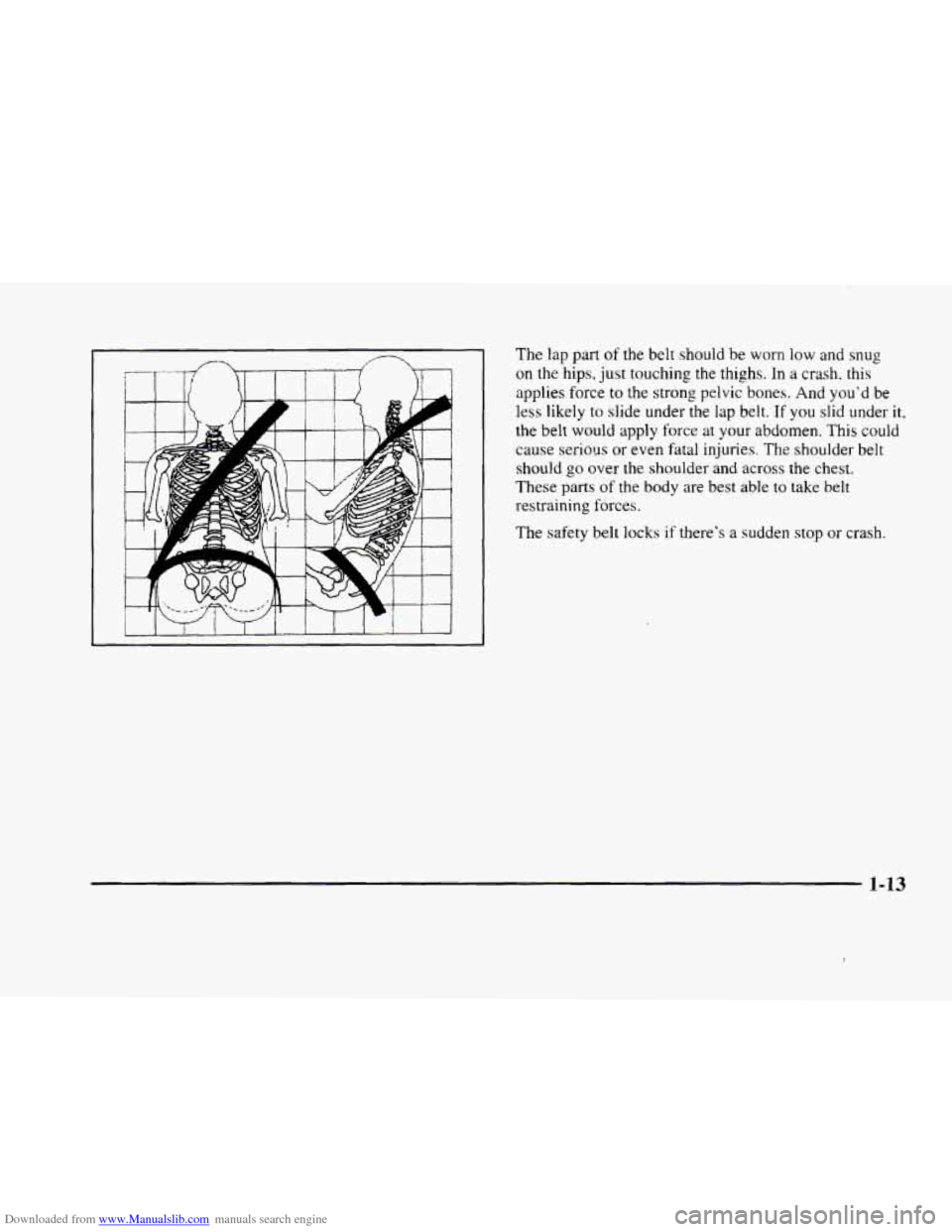
Downloaded from www.Manualslib.com manuals search engine The lap part of the belt should be worn low and snug
on the hips, just touching the thighs. In a crash, this
applies force to the strong pelvic bones. And you’d be
less likely to slide under the
lap belt. If you slid under it,
the belt would apply force at your abdomen. This could
cause serious
or even fatal injuries. The shoulder belt
should
go over the shoulder and across the chest.
These parts
of the body are best able to take belt
restraining forces.
The safety belt
locks if there’s a sudden stop or crash.
1-13
Page 40 of 380
Downloaded from www.Manualslib.com manuals search engine The best way to protect the fetus is to protect the
mother. When a safety belt is worn properly, it’s more
likely that the
fetus won’t be hurt in a crash. For
pregnant women, as
for anyone, the key to making
safety belts effective is wearing them properly.
Right Front Passenger Position
To learn how to wear the right front passenger’s
safety belt properly,
see “Driver Position” earlier in
this section.
The right front passenger’s safety belt works the same
way as the driver’s safety belt
-- except for one thing.
If you ever pull the lap portion of the belt
out all the
way,
you will engage the child restraint locking feature.
If this happens, just let the belt go back all the way and
start again.
Supplemental Inflatable Restraint
(SIR) System
This part explains the Supplemental Inflatable Restraint
(SIR) system or air bag system.
Your vehicle has two air bags
-- one air bag for the
driver and another air bag for
the right front passenger. Here
are the most important
things to know about the air
bag system:
A CAUTION:
You can be severely injured or killed in a crash if
you aren’t wearing your safety belt -- even if you
have
air bags. Wearing your safety belt during a
crash helps reduce your chance
of hitting things
inside the vehicle or being ejected
from it. Air
bags are “supplemental restraints” to the safety
belts.
All air bags are designed to work with
safety belts, but don’t replace them. Air bags are
designed
to work only in moderate to severe
crashes where the front of your vehicle hits
something. They aren’t designed to inflate at all
in rollover, rear, side or low-speed frontal
crashes. Everyone in your vehicle should wear a
safety belt properly
-- whether or not there’s an
air bag for that person.
1-20
Page 44 of 380
Downloaded from www.Manualslib.com manuals search engine How does an air bag restrain?
In moderate to severe frontal or near-frontal cobsions,
even belted occupants can contact the steering wheel or the
instrument panel.
Air bags supplement the protection
provided by safety belts. Air bags distribute the force
of
the impact more evenly over the occupant’s upper body,
stopping the occupant more gradually. But air bags
would
not help you in many types of collisions, including
rollovers, rear impacts and side impacts,
primarily because
an occupant’s motion is not toward those air bags. Air
bags should never be regarded as anything more than a
supplement to safety belts, and then
only in moderate to
severe frontal or near-frontal collisions.
What will you see after an air bag inflates?
After an air bag inflates, it quickly deflates, so quickly that
some people may not even realize the
air bag inflated.
Some components
of the air bag module -- the steering
wheel hub for the driver’s
air bag, or the instrument panel
for the right front passenger’s bag
-- will be hot for a short
time. The parts
of the bag that come into contact with you
may be warm, but not too
hot to touch. There will be
some smoke and dust coming from vents in the deflated
air bags. Air bag inflation doesn’t prevent the driver from
seeing
or from being able to steer the vehicle, nor does it
stop people from leaving the vehicle.
A CAUTION:
When an air bag inflates, there is dust in the air.
This dust could cause breathing problems
for
people with a history of asthma or other
breathing trouble. To avoid this, everyone in the
vehicle should get out as soon as it
is safe to do so.
If you have breathing problems but can’t get out
of the vehicle after an air bag inflates, then get
fresh air by opening a window or door.
Your vehicle has a feapre that will automatically unlock
the doors and turn the interior lamps on when the air
bags inflate (if battery power is available). You can lock
the doors again and turn the interior lamps off by using
the door lock and interior lamp controls.
In many crashes severe enough to inflate an air bag,
windshields are broken by vehicle deformation.
Additional windshield breakage may also occur from
the
right front passenger air bag.
1-24
Page 48 of 380
Downloaded from www.Manualslib.com manuals search engine /-- /- -l
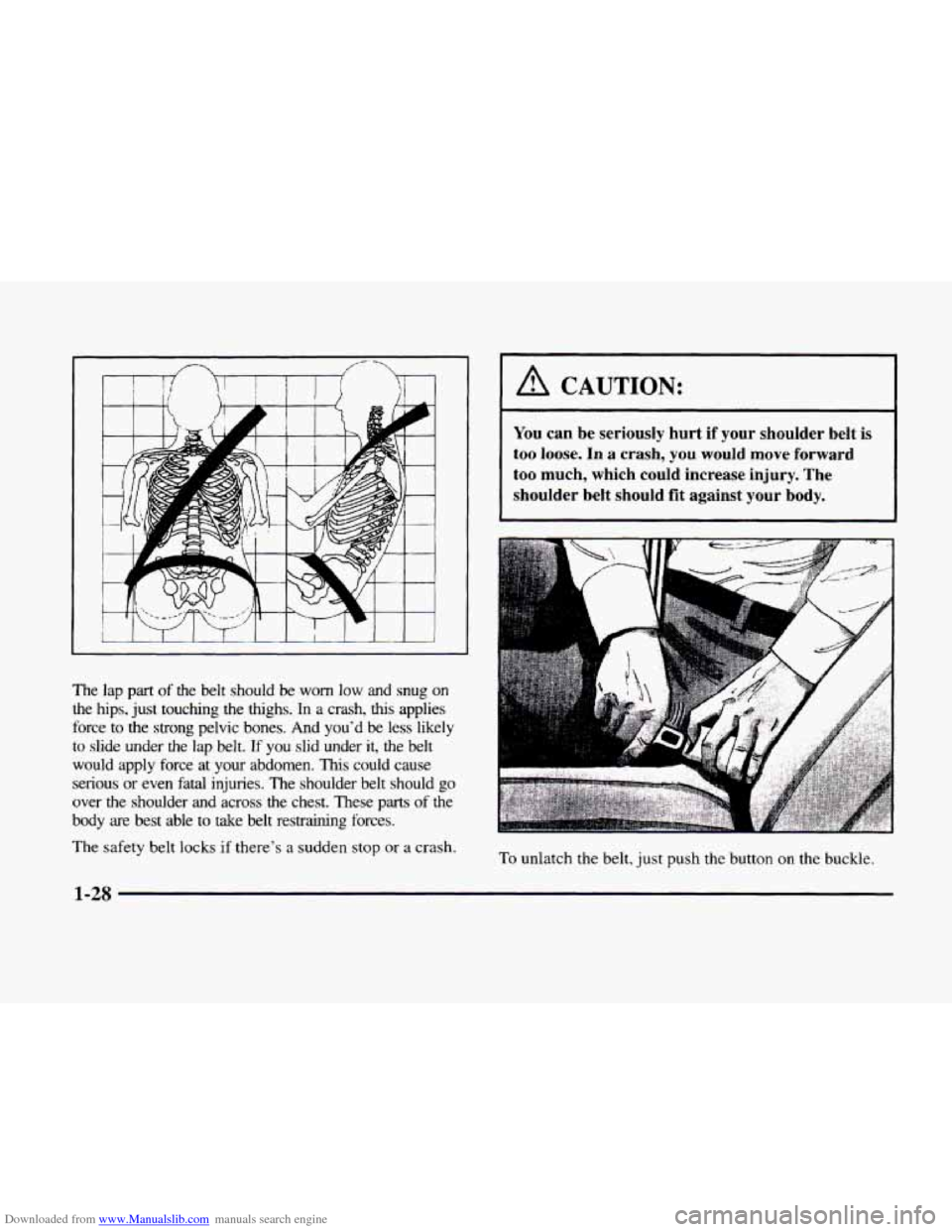
The lap part of the belt should be worn low and snug on
the hips, just touching the thighs. Ln a crash, this applies
force to the strong pelvic bones. And you’d be less likely
to slide under the lap belt. If you slid under it, the belt
would apply force at your abdomen.
This could cause
serious or even fatal injuries. The shoulder belt should
go
over the shoulder and across the chest. These parts of the
body are best able to take belt restraining forces.
The safety belt locks if there’s a sudden stop or a crash.
I A CAUTION:
I I
You can be seriously hurt if your shoulder belt is
too loose. In a crash, you would move forward
too
much, which could increase injury. The
shoulder belt should
fit against your body.
t
To unlatch the belt, just push the button on the buckle.