key CHEVROLET ASTRO 2003 User Guide
[x] Cancel search | Manufacturer: CHEVROLET, Model Year: 2003, Model line: ASTRO, Model: CHEVROLET ASTRO 2003Pages: 386, PDF Size: 17.31 MB
Page 86 of 386
Doors and Locks
Door 'lock--
Unlocked doors can be dangerous.
Passengers - especially children - can
easily open
the doors and fall out of a
moving vehicle. When a door
is locked,
the handle won't open
it. You increase the
chance of being thrown out of the vehicle in a crash if the doors aren't locked.
So,
wear safety belts properly and lock the
doors whenever you drive.
vehicles may be unable to get out. A child
can be overcome by extreme heat and can
suffer permanent injuries or even death
from heat stroke. Always lock your vehicle
whenever you leave
it.
unlocked door when you slow down or
stop your vehicle. Locking your doors can
help prevent this from happening.
Young children who get into unlocked
Outsiders can easily enter through an There
are several ways to lock and unlock your vehicle.
To unlock your door from the outside, use your key
or remote keyless entry transmitter,
if equipped.
For more information, see
Remote Keyless Entry
System
on page 2-4.
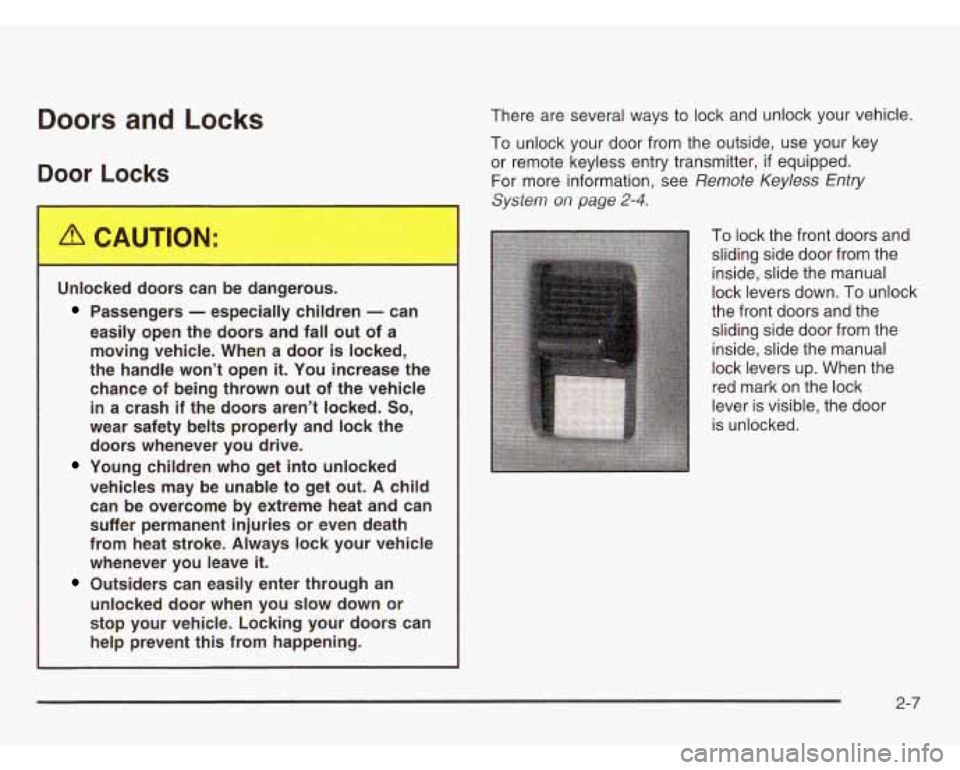
To lock the front doors and
sliding side door from the
inside, slide the manual
lock levers down. To unlock
the front doors and the
sliding side door from the
inside, slide the manual
lock levers
up. When the
red mark on the lock
lever
is visible, the door
is unlocked.
2-7
Page 88 of 386
If the sliding door is open and you press the power door
lock switch, the sliding door will not lock immediately.
After you close the door, the system comes on and locks
the sliding door in about five seconds.
When the key is in the ignition and the
power door lock
switch is pressed with a door open, all doors are
locked while the driver’s side door remains unlocked.
Programmable Automatic
Door Locks
Your vehicle is equipped with an auto IocWunlock
feature which enables you
to program your power
door locks.
Your vehicle left the factory programmed to have all the
doors lock automatically when the shift lever is moved out
of PARK (P).
All of the doors will unlock when the shift
lever is moved back into PARK (P). The following
instructions detail how to program your door locks. To
enter the program mode you need to do the following:
1. Begin with the ignition in OFF. Then, pull back on the
turn signaVmultifunction lever all the way toward you
and hold
it while you perform the next step.
2. Turn your key to RUN and
OFF twice. Then, with
the key in
OFF, release the turn signaVmultifunction
lever. Once you do this, you will hear the lock
switch lock and unlock.
You are now ready to program the automatic door
locks. Select one
of the following four programming
options and follow the instructions. You
will have thirty
seconds to begin programming.
If you exceed the
thirty second limit, the locks will automatically lock and
unlock to indicate that you have left the program mode.
If this occurs, repeat the procedure beginning with
Step
1. You can exit the program mode any time by
turning the ignition to RUN. The locks will automatically
lock and unlock
to indicate that you are leaving the
program mode. If the IocWunlock switches are not
pressed while in the programming mode, the auto
IocWunlock setting will not be modified.
2-9
Page 89 of 386
The following is a list of the available programming
oDtions: Sliding Side Door
0 All doors lock/Only the driver’s door unlocks:
Press the lock side of the power lock switch on
the door panel once and then the unlock side once.
All doors lock/All doors unlock: Press the
lock side
of the power lock switch on the door panel
once, and then the unlock side twice.
All doors lock/None of the doors unlock: Press
the lock side of the power lock switch on the door
panel once, and then the unlock side three times.
0 No doors lock/None of the doors unlock: Press
the lock side of the power lock switch on the door
panel twice. This turns
off the automatic lock feature.
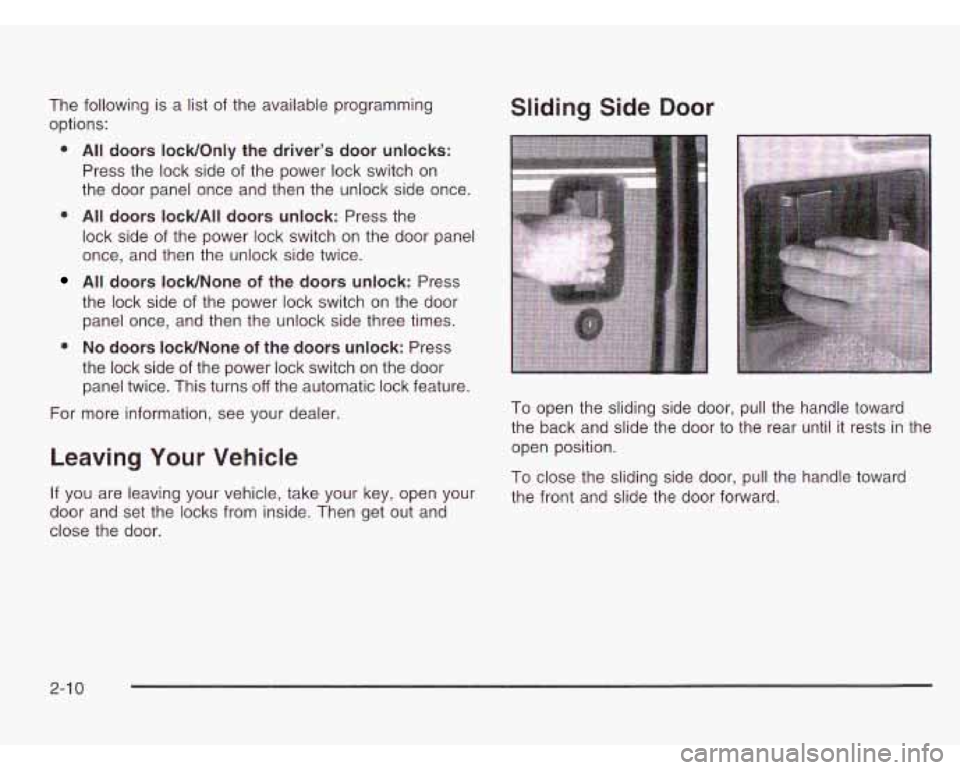
For more information, see your dealer. To open the sliding
side door, pull the handle toward
the back and slide the door to the rear until it rests in the
Leaving Your Vehicle open position.
To close the sliding side door, pull the handle toward
If you are leaving your vehicle, take your key, open your the front and slide the door forward.
door and set the locks from inside. Then get out and
close the door.
2-1 0
Page 94 of 386
Hatch Release
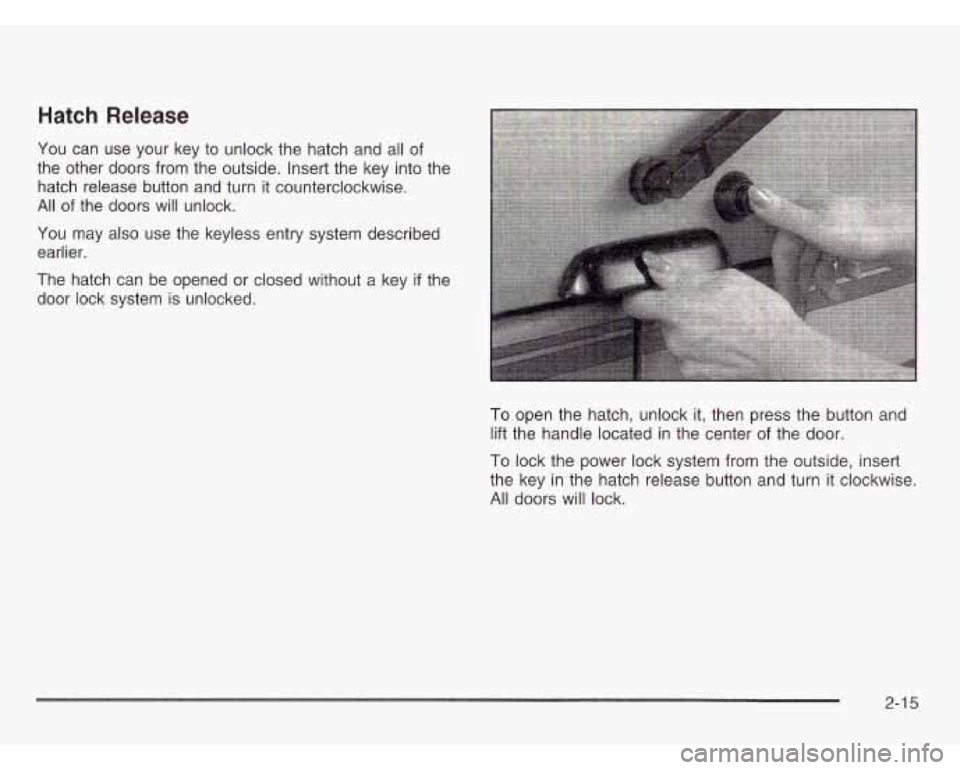
You can use your key to unlock the hatch and all of
the other doors from the outside. Insert the key into the
hatch release button and turn it counterclockwise.
All of the doors will unlock.
You may also use the keyless entry system described
earlier.
The hatch can be opened
or closed without a key if the
door lock system is unlocked.
To open the hatch, unlock it, then press the button and
lift the handle located in the center
of the door.
To lock the power lock system from the outside, insert
the key in the hatch release button and turn it clockwise.
All doors will lock.
2-1 5
Page 97 of 386
Theft-Deterrent Systems
Vehicle theft is a big business, especially in some cities.
Although your vehicle has a number of theft-deterrent
features, we know that nothing we put on it can make
it impossible to steal. However, there are ways you
can help.
Passlock@
Your vehicle is equipped with the Passlock@
theft-deterrent system.
Passlock@ is a passive theft-deterrent system. Passlock@
enables fuel
if the ignition lock cylinder is turned with
a valid key.
If a correct key is not used or the ignition
lock cylinder is tampered with, fuel is disabled. During normal operation,
the SECURITY light will
go off
approximately five seconds after the key is turned
to RUN.
If the engine stalls and the SECURITY light flashes, wait
until the light stops flashing before trying to restart the
engine. Remember to release the key from START as
soon as the engine starts.
If the engine is running and the SECURITY light comes
on, you will be able to restart the engine
if you turn
the engine
off. However, your Passlock@ system is
not working properly and must be serviced by your
dealer. Your vehicle is not protected by Passlock@ at this
time. You may also want to check the fuse.
See
Fuses and Circuit Breakers on page 5-93.
See your dealer for service.
2-1 8
Page 98 of 386
Starting and Operating
Your Vehicle
New Vehicle Break-in
Nofice: Your vehicle doesn’t need an elaborate
“break-in.” But
it will perform better in the long run
if you follow these guidelines:
e
e
Keep your speed at 55 mph (88 km/h) or less
for
the first 500 miles (805 km).
Don’t drive at any one speed
- fast or
slow
- for the first 500 miles (805 km).
Don’t make full-throttle starts.
Avoid making hard stops for the first
200 miles
(322 km) or so. During this time your new
brake linings aren’t yet broken in. Hard stops
with new linings can mean premature wear and
earlier replacement. Follow this breaking-in guideline every time you get new brake linings.
Don’t tow a trailer during break-in. See “Towing
a Trailer” in the Index for more information.
Ignition Positions
With the key in the ignition, you can turn it to five
different positions.
C
A
A (ACCESSORY): This position lets you use things like
the radio, power windows and windshield wipers when
the engine is off.
To get into ACCESSORY, push in the
key and turn it toward you. Your steering wheel will
remain locked, just as it was before you inserted the key.
2-1 9
Page 99 of 386
Notice: Don’t operate accessories in the
ACCESSORY position for long periods of time.
Prolonged operation of accessories in the
ACCESSORY position could drain your battery
and prevent you from starting your vehicle.
B (LOCK): This position locks your ignition, steering
wheel and transmission. It’s a theft-deterrent feature.
You will only be able to remove your key when the
ignition is turned to LOCK.
Notice: If your key seems stuck in LOCK and you
can’t turn
it, be sure you are using the correct key;
if
so, is it all the way in? If it is, then turn the
steering wheel left and right while you turn the key hard. Turn the key only with your hand. Using a
tool to force
it could break the key or the ignition
switch. If none of this works, then your vehicle needs service.
C (OFF): This position lets you turn off the engine but
still turn the steering wheel. Use
OFF if you must
have your vehicle in motion while the engine is
off
(for example, if your vehicle is being towed).
D (RUN): This is the position for driving.
E (START): This position starts your engine.
Retained Accessory Power (RAP)
Your vehicle is equipped with a Retained Accessory
Power (RAP) feature which will allow certain features
on your vehicle to continue to work up to
20 minutes
after the ignition key is turned
to OFF.
Your radio, power windows and overhead console will
work when the ignition key is in RUN or ACCESSORY
Once the key is turned from RUN to
OFF, these
features will continue to work for up to
20 minutes or
until a door is opened.
2-20
Page 100 of 386
Starting Your Engine
Move your shift lever to PARK (P) or NEUTRAL (N).
Your engine won’t start in any other position
- that’s a
safety feature.
To restart when you’re already moving,
use NEUTRAL (N) only.
Notice: Don’t try to shift to PARK
(P) if your
vehicle
is moving. If you do, you could damage the
transmission. Shift to PARK (P) only when your
vehicle
is stopped.
1. With your foot off the accelerator pedal, turn the
ignition key to START. When the engine starts,
let go of the key. The idle speed will go down as
your engine gets warm.
Notice: Holding your key
in START for longer than
15 seconds at a time will cause your battery to
be drained much sooner. And the excessive heat
can damage your starter motor. Wait about
15 seconds between each try to help avoid draining
your battery or damaging your starter.
2. If it doesn’t start within 10 seconds, push the
accelerator pedal all the way to the floor, while you
hold the ignition key in START. When the engine
starts, let go of the key and let up on the accelerator
pedal. Wait about
15 seconds between each try. When
starting your engine in very cold weather
(below
0°F or -18°C)’ do this:
1. With your foot off the accelerator pedal, turn the
ignition key
to START and hold it there up to
15 seconds. When the engine starts, !et go of
the key.
2.
If your engine still won’t start (or starts but then
stops), it could be flooded with too much gasoline.
Try pushing your accelerator pedal all the way to the
floor and holding
it there as you hold the key in
START for about three seconds. When the engine
starts, let go of the key and accelerator.
If the
vehicle starts briefly but then stops again, do the
same thing, but this time keep the pedal down
for five or six seconds. This clears the extra
gasoline from the engine.
Notice: Your engine
is designed to work with the
electronics in your vehicle.
If you add electrical
parts or accessories, you could change the way the
engine operates. Before adding electrical equipment,
check with your dealer. If you don’t, your engine might not perform properly.
Fuel Regulator
You have a fuel regulator that shuts the fuel off when
the engine reaches
5,600 rpm.
2-2
1
Page 102 of 386
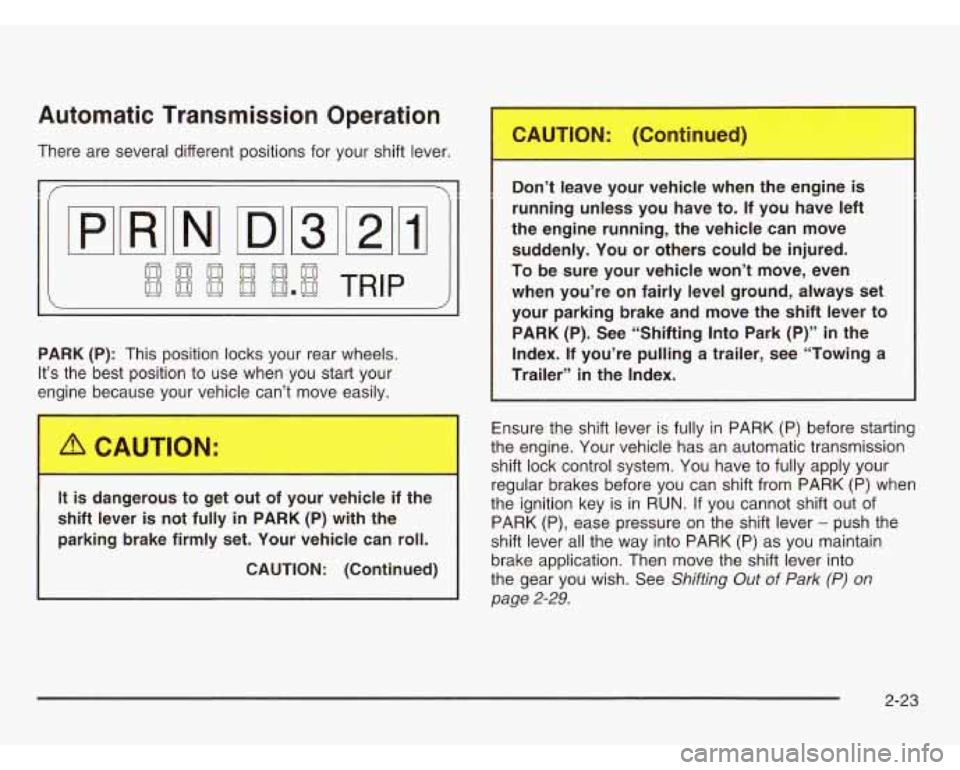
Automatic Transmission Operation
There are several different positions for your shift lever.
PARK (P): This position locks your rear wheels.
It’s the best position to use when you start your
engine because your vehicle can’t move easily.
It is dangerous to get out of your vehicle if the
shift lever is not fully in PARK (P) with the
parking brake firmly set. Your vehicle can roll.
CAUTION: (Continued) Don’t leave your vehicle when
the enL le
is
running unless you have to. If you have left
the engine running, the vehicle can move
suddenly. You or others could be injured.
To be sure your vehicle won’t move, even
when you’re on fairly level ground, always set
your parking brake and move the shift lever to
PARK (P). See “Shifting Into Park (P)” in the
Index. If you’re pulling
a trailer, see “Towing a
Trailer” in the Index.
Ensure the shift lever is fully in PARK (P) before starting
the engine. Your vehicle has an automatic transmission
shift lock control system. You have to fully apply your
regular brakes before you can shift from PARK (P) when
the ignition key is in
RUN. If you cannot shift out of
PARK (P), ease pressure on the shift lever
- push the
shift lever all the way into PARK (P) as you maintain
brake application. Then move the shift lever into
the gear you wish. See
Shifting Out of Park (P) on
page
2-29.
2-23
Page 107 of 386
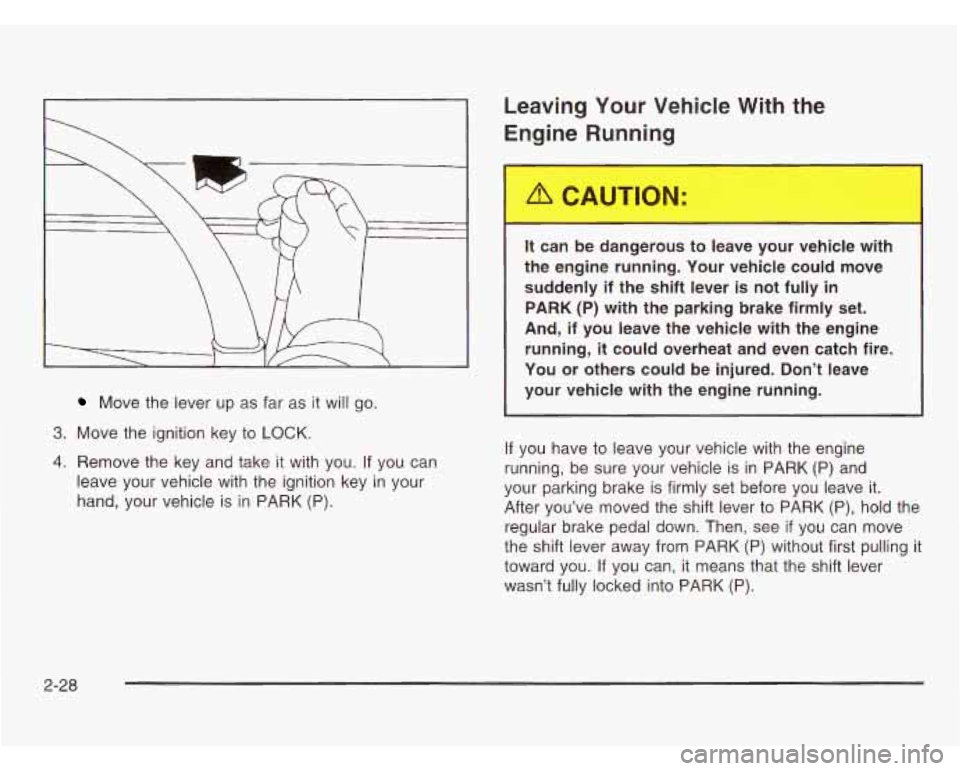
Move the lever up as far as it will go.
3. Move the ignition key to LOCK.
4. Remove the key and take it with you. If you can
leave your vehicle with the ignition key in your
hand, your vehicle is
in PARK (P).
Leaving Your Vehicle With the
Engine
F nning
It can be dangerous to leave your vehicle with
the engine running. Your vehicle could move suddenly if the shift lever is not fully in
PARK (P) with the parking brake firmly set.
And, if you leave the vehicle with the engine
running,
it could overheat and even catch fire.
You
or others could be injured. Don’t leave
your vehicle with the engine running.
If you have to leave your vehicle with the engine
running, be sure your vehicle is in PARK (P) and
your parking brake is firmly set before you leave it.
After you’ve moved the shift lever to PARK (P), hold the
regular brake pedal down. Then, see
if you can move
the shift lever away from PARK (P) without first pulling it
toward you.
If you can, it means that the shift lever
wasn’t fully locked into PARK (P).
2-28