clock CHEVROLET AVALANCHE 2007 2.G Owner's Manual
[x] Cancel search | Manufacturer: CHEVROLET, Model Year: 2007, Model line: AVALANCHE, Model: CHEVROLET AVALANCHE 2007 2.GPages: 618, PDF Size: 3.25 MB
Page 364 of 618
Try to adjust your speed so you can “drive”
through the curve. Maintain a reasonable, steady
speed. Wait to accelerate until you are out of
the curve, and then accelerate gently into
the straightaway.
Adding non-GM accessories can affect your
vehicle’s performance. SeeAccessories and
Modications on page 433.
Steering in Emergencies
There are times when steering can be more
effective than braking. For example, you come
over a hill and nd a truck stopped in your lane,
or a car suddenly pulls out from nowhere, or
a child darts out from between parked cars and
stops right in front of you. You can avoid these
problems by braking — if you can stop in time.
But sometimes you cannot; there is not room.
That is the time for evasive action — steering
around the problem.
Your vehicle can perform very well in emergencies
like these. First, apply the brakes. SeeBraking
on page 356. It is better to remove as much speed
as you can from a possible collision. Then steer
around the problem, to the left or right depending
on the space available.An emergency like this requires close attention
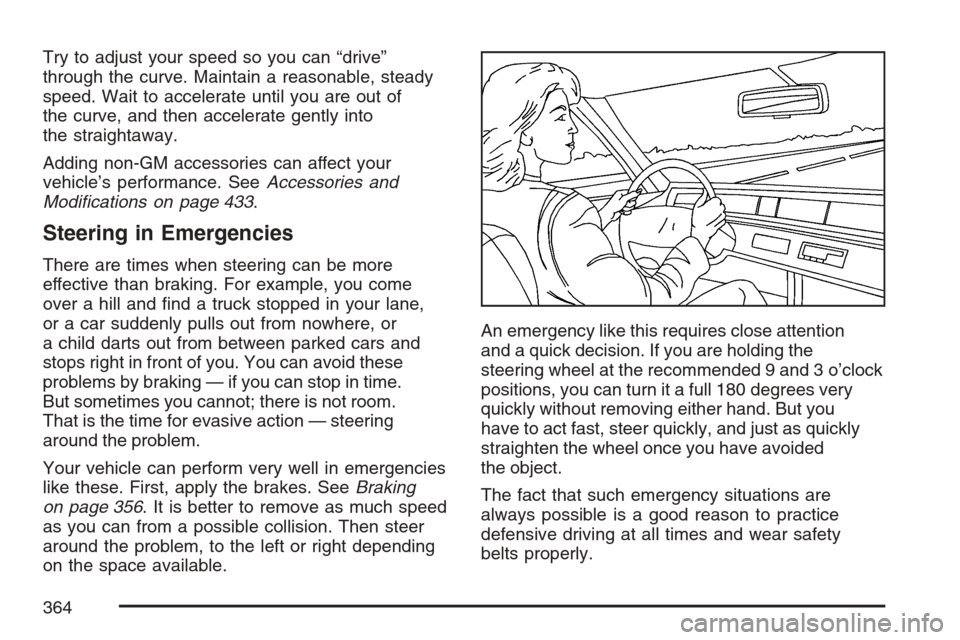
and a quick decision. If you are holding the
steering wheel at the recommended 9 and 3 o’clock
positions, you can turn it a full 180 degrees very
quickly without removing either hand. But you
have to act fast, steer quickly, and just as quickly
straighten the wheel once you have avoided
the object.
The fact that such emergency situations are
always possible is a good reason to practice
defensive driving at all times and wear safety
belts properly.
364
Page 377 of 618
Q:What should I do if my vehicle stalls, or
is about to stall, and I cannot make it up
the hill?
A:If this happens, there are some things you
should do, and there are some things you
must not do. First, here is what youshoulddo:
Push the brake pedal to stop the vehicle
and keep it from rolling backwards. Also, apply
the parking brake.
If the engine is still running, shift the
transmission to REVERSE (R), release the
parking brake, and slowly back down the hill
in REVERSE (R).
If the engine has stopped running, you will
need to restart it. With the brake pedal pressed
and the parking brake still applied, shift the
transmission to PARK (P) and restart the
engine. Then, shift to REVERSE (R), release
the parking brake, and slowly back down the
hill as straight as possible in REVERSE (R).
As you are backing down the hill, put your left
hand on the steering wheel at the 12 o’clock
position. This way, you will be able to tell if thewheels are straight and maneuver as you back
down. It is best that you back down the hill with
the wheels straight rather than in the left or right
direction. Turning the wheel too far to the left or
right will increase the possibility of a rollover.
Here are some things youmust notdo if you stall,
or are about to stall, when going up a hill.
Never attempt to prevent a stall by shifting
into NEUTRAL (N) to rev-up the engine
and regain forward momentum. This will
not work. Your vehicle will roll backwards
very quickly and you could go out of control.
Instead, apply the regular brake to stop
the vehicle. Then apply the parking brake.
Shift to REVERSE (R), release the parking
brake, and slowly back straight down.
Never attempt to turn around if you are about
to stall when going up a hill. If the hill is steep
enough to stall your vehicle, it is steep
enough to cause you to roll over if you turn
around. If you cannot make it up the hill, you
must back straight down the hill.
377
Page 440 of 618
Filling the Tank
{CAUTION:
Fuel vapor burns violently and a fuel re
can cause bad injuries. To help avoid
injuries to you and others, read and follow
all the instructions on the pump island.
Turn off your engine when you are
refueling. Do not smoke if you are near
fuel or refueling your vehicle. Do not use
cellular phones. Keep sparks, ames,
and smoking materials away from fuel.
Do not leave the fuel pump unattended
when refueling your vehicle. This is
against the law in some places. Do not
re-enter vehicle while pumping fuel.
Keep children away from the fuel pump;
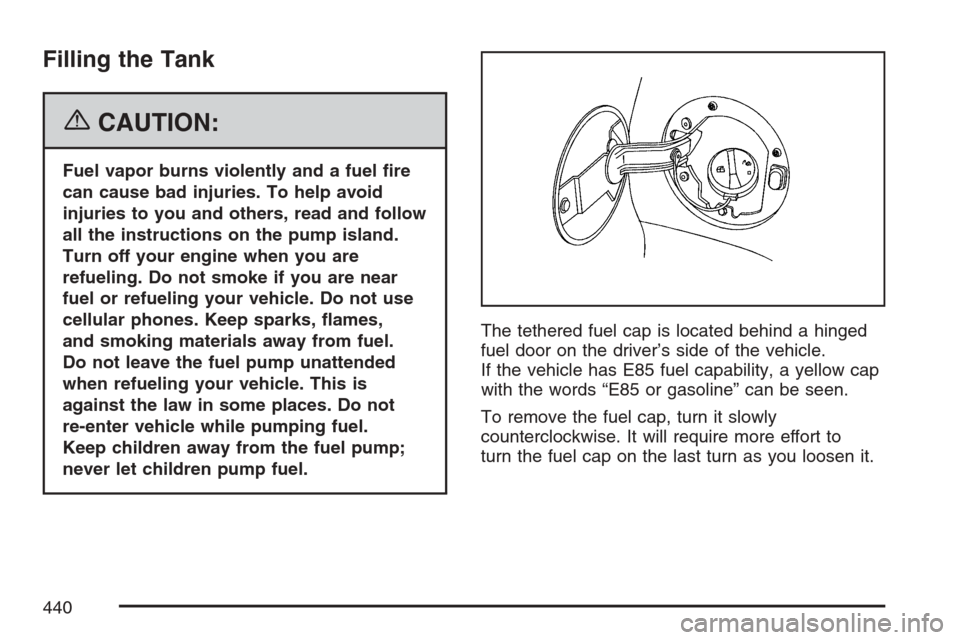
never let children pump fuel.The tethered fuel cap is located behind a hinged
fuel door on the driver’s side of the vehicle.
If the vehicle has E85 fuel capability, a yellow cap
with the words “E85 or gasoline” can be seen.
To remove the fuel cap, turn it slowly
counterclockwise. It will require more effort to
turn the fuel cap on the last turn as you loosen it.
440
Page 441 of 618
{CAUTION:
If you spill fuel and then something
ignites it, you could be badly burned.
Fuel can spray out on you if you open
the fuel cap too quickly. This spray can
happen if your tank is nearly full, and is
more likely in hot weather. Open the fuel
cap slowly and wait for any hiss noise to
stop. Then unscrew the cap all the way.
Be careful not to spill fuel. Do not top off or overll
the tank and wait a few seconds after you have
nished pumping before removing the nozzle.
Clean fuel from painted surfaces as soon as
possible. SeeWashing Your Vehicle on page 541.
When replacing the fuel cap, turn it clockwise
until it clicks. It will require more effort to turn
the fuel cap on the last turn as you tighten it.
Make sure the cap is fully installed. The diagnostic
system can determine if the fuel cap has been
left off or improperly installed. This would allow
fuel to evaporate into the atmosphere. See
Malfunction Indicator Lamp on page 250.The TIGHTEN GAS CAP message will be
displayed on the Driver Information Center (DIC)
if the fuel cap is not properly installed. See
DIC Warnings and Messages on page 267for
more information.
{CAUTION:
If a re starts while you are refueling,
do not remove the nozzle. Shut off the
ow of fuel by shutting off the pump
or by notifying the station attendant.
Leave the area immediately.
Notice:If you need a new fuel cap, be sure
to get the right type. Your dealer can get
one for you. If you get the wrong type,
it may not t properly. This may cause your
malfunction indicator lamp to light and
may damage your fuel tank and emissions
system. SeeMalfunction Indicator Lamp
on page 250.
441
Page 467 of 618
{CAUTION:
Adding only plain water to your cooling
system can be dangerous. Plain water, or
some other liquid such as alcohol, can
boil before the proper coolant mixture will.
Your vehicle’s coolant warning system is
set for the proper coolant mixture. With
plain water or the wrong mixture, your
engine could get too hot but you would
not get the overheat warning. Your engine
could catch re and you or others could
be burned. Use a 50/50 mixture of clean,
drinkable water and DEX-COOL
®coolant.
Notice:In cold weather, water can freeze and
crack the engine, radiator, heater core and
other parts. Use the recommended coolant
and the proper coolant mixture.
{CAUTION:
You can be burned if you spill coolant
on hot engine parts. Coolant contains
ethylene glycol and it will burn if the
engine parts are hot enough. Do not spill
coolant on a hot engine.
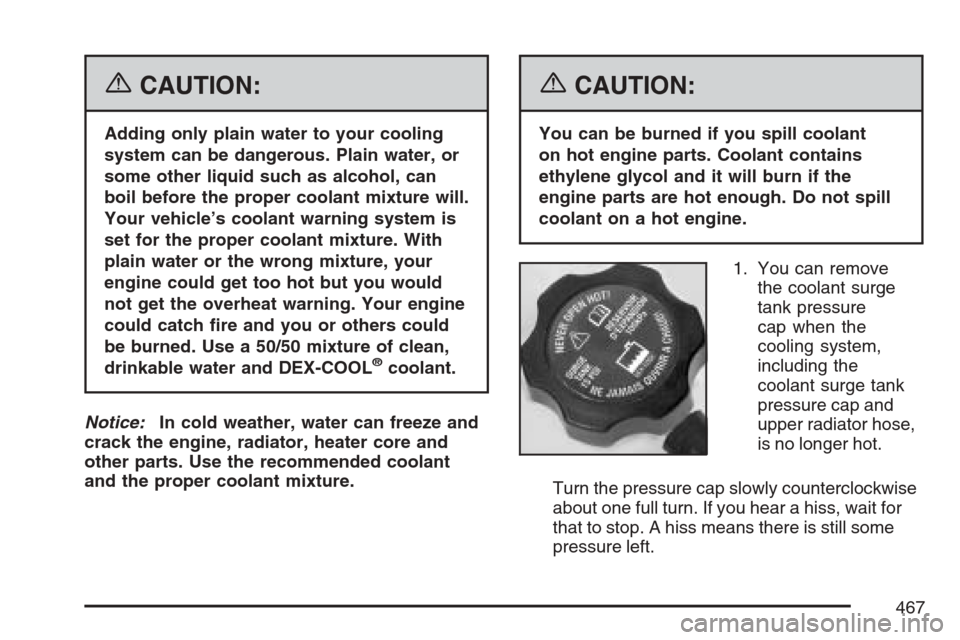
1. You can remove
the coolant surge
tank pressure
cap when the
cooling system,
including the
coolant surge tank
pressure cap and
upper radiator hose,
is no longer hot.
Turn the pressure cap slowly counterclockwise
about one full turn. If you hear a hiss, wait for
that to stop. A hiss means there is still some
pressure left.
467
Page 487 of 618
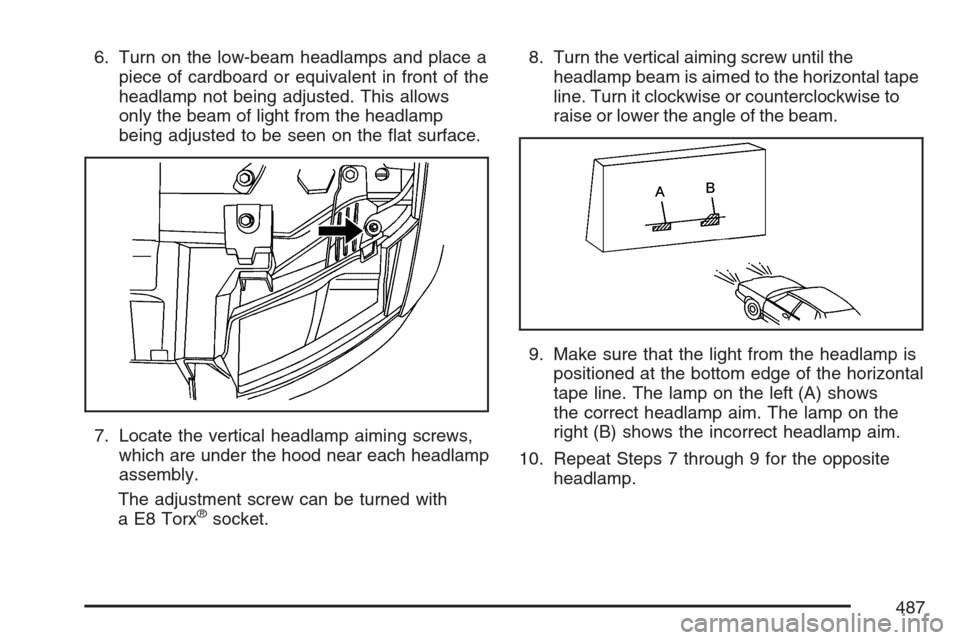
6. Turn on the low-beam headlamps and place a
piece of cardboard or equivalent in front of the
headlamp not being adjusted. This allows
only the beam of light from the headlamp
being adjusted to be seen on the at surface.
7. Locate the vertical headlamp aiming screws,
which are under the hood near each headlamp
assembly.
The adjustment screw can be turned with
a E8 Torx
®socket.8. Turn the vertical aiming screw until the
headlamp beam is aimed to the horizontal tape
line. Turn it clockwise or counterclockwise to
raise or lower the angle of the beam.
9. Make sure that the light from the headlamp is
positioned at the bottom edge of the horizontal
tape line. The lamp on the left (A) shows
the correct headlamp aim. The lamp on the
right (B) shows the incorrect headlamp aim.
10. Repeat Steps 7 through 9 for the opposite
headlamp.
487
Page 489 of 618
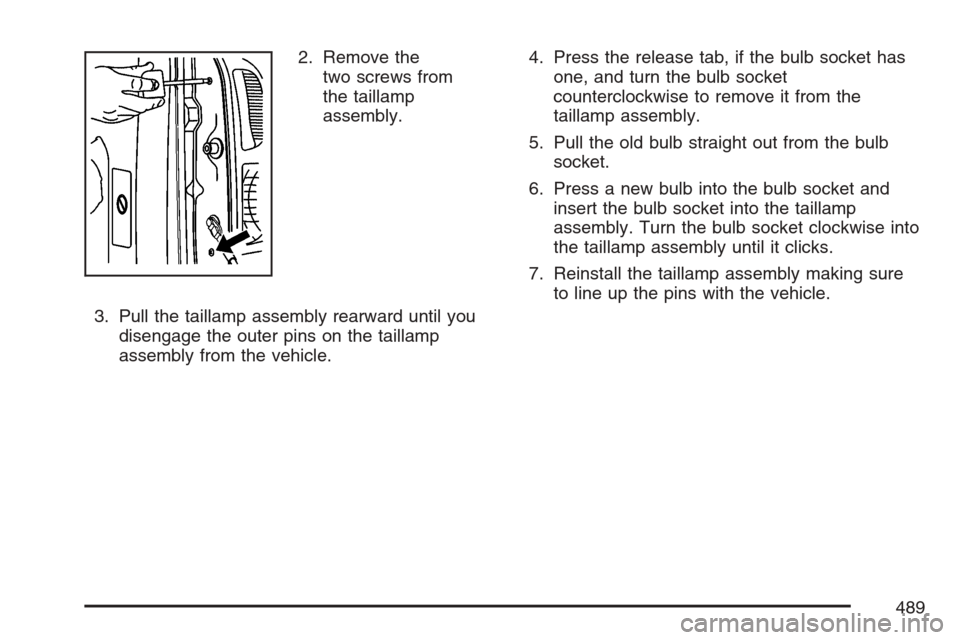
2. Remove the
two screws from
the taillamp
assembly.
3. Pull the taillamp assembly rearward until you
disengage the outer pins on the taillamp
assembly from the vehicle.4. Press the release tab, if the bulb socket has
one, and turn the bulb socket
counterclockwise to remove it from the
taillamp assembly.
5. Pull the old bulb straight out from the bulb
socket.
6. Press a new bulb into the bulb socket and
insert the bulb socket into the taillamp
assembly. Turn the bulb socket clockwise into
the taillamp assembly until it clicks.
7. Reinstall the taillamp assembly making sure
to line up the pins with the vehicle.
489
Page 490 of 618
License Plate Lamp
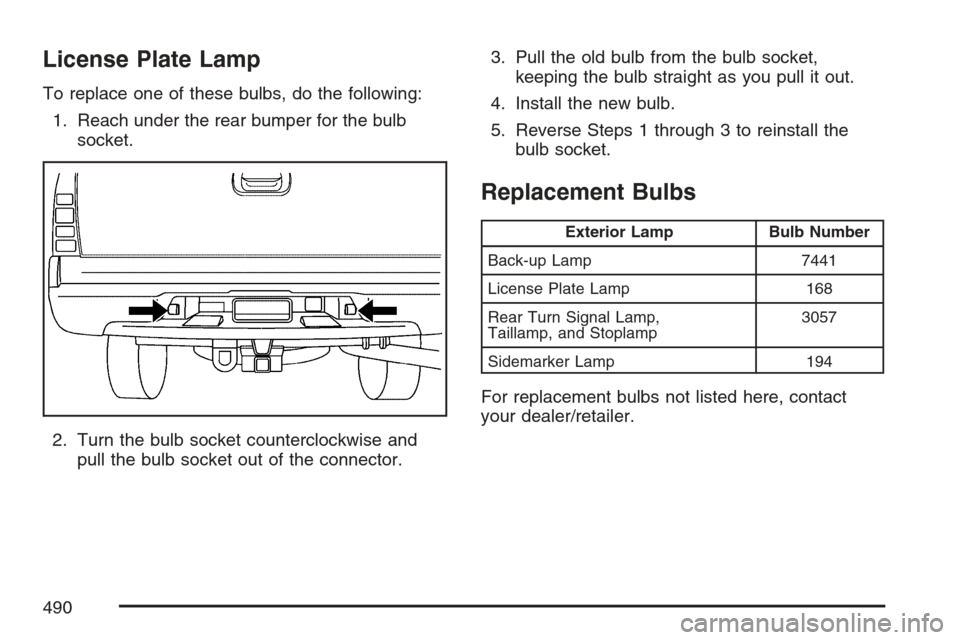
To replace one of these bulbs, do the following:
1. Reach under the rear bumper for the bulb
socket.
2. Turn the bulb socket counterclockwise and
pull the bulb socket out of the connector.3. Pull the old bulb from the bulb socket,
keeping the bulb straight as you pull it out.
4. Install the new bulb.
5. Reverse Steps 1 through 3 to reinstall the
bulb socket.
Replacement Bulbs
Exterior Lamp Bulb Number
Back-up Lamp 7441
License Plate Lamp 168
Rear Turn Signal Lamp,
Taillamp, and Stoplamp3057
Sidemarker Lamp 194
For replacement bulbs not listed here, contact
your dealer/retailer.
490
Page 518 of 618
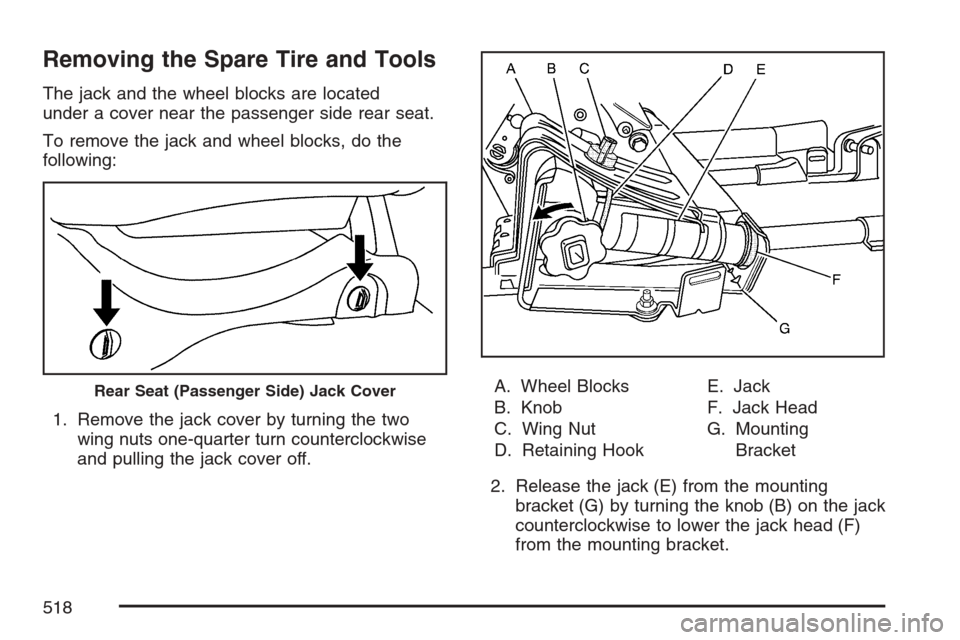
Removing the Spare Tire and Tools
The jack and the wheel blocks are located
under a cover near the passenger side rear seat.
To remove the jack and wheel blocks, do the
following:
1. Remove the jack cover by turning the two
wing nuts one-quarter turn counterclockwise
and pulling the jack cover off.A. Wheel Blocks
B. Knob
C. Wing Nut
D. Retaining HookE. Jack
F. Jack Head
G. Mounting
Bracket
2. Release the jack (E) from the mounting
bracket (G) by turning the knob (B) on the jack
counterclockwise to lower the jack head (F)
from the mounting bracket.
Rear Seat (Passenger Side) Jack Cover
518
Page 519 of 618
3. Remove the wheel blocks (A) attached to
the jack (E) by turning the wing nut (C)
counterclockwise. Place the wheel blocks
where needed as indicated in previously in
this section.
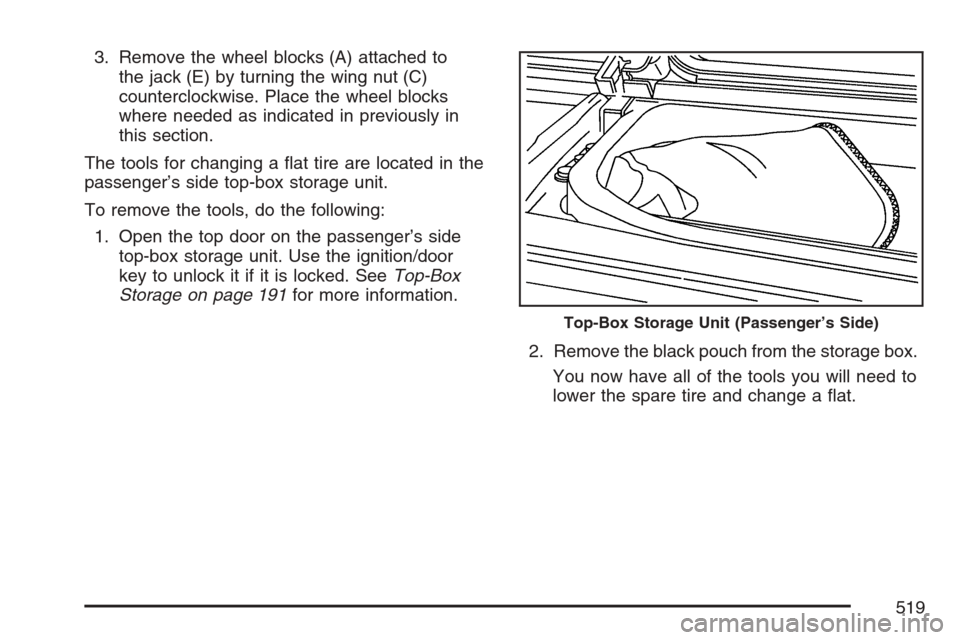
The tools for changing a at tire are located in the
passenger’s side top-box storage unit.
To remove the tools, do the following:
1. Open the top door on the passenger’s side
top-box storage unit. Use the ignition/door
key to unlock it if it is locked. SeeTop-Box
Storage on page 191for more information.
2. Remove the black pouch from the storage box.
You now have all of the tools you will need to
lower the spare tire and change a at.
Top-Box Storage Unit (Passenger’s Side)
519