washer fluid CHEVROLET BLAZER 1996 2.G Owners Manual
[x] Cancel search | Manufacturer: CHEVROLET, Model Year: 1996, Model line: BLAZER, Model: CHEVROLET BLAZER 1996 2.GPages: 392, PDF Size: 20.35 MB
Page 96 of 392
Downloaded from www.Manualslib.com manuals search engine Windshield Wipers
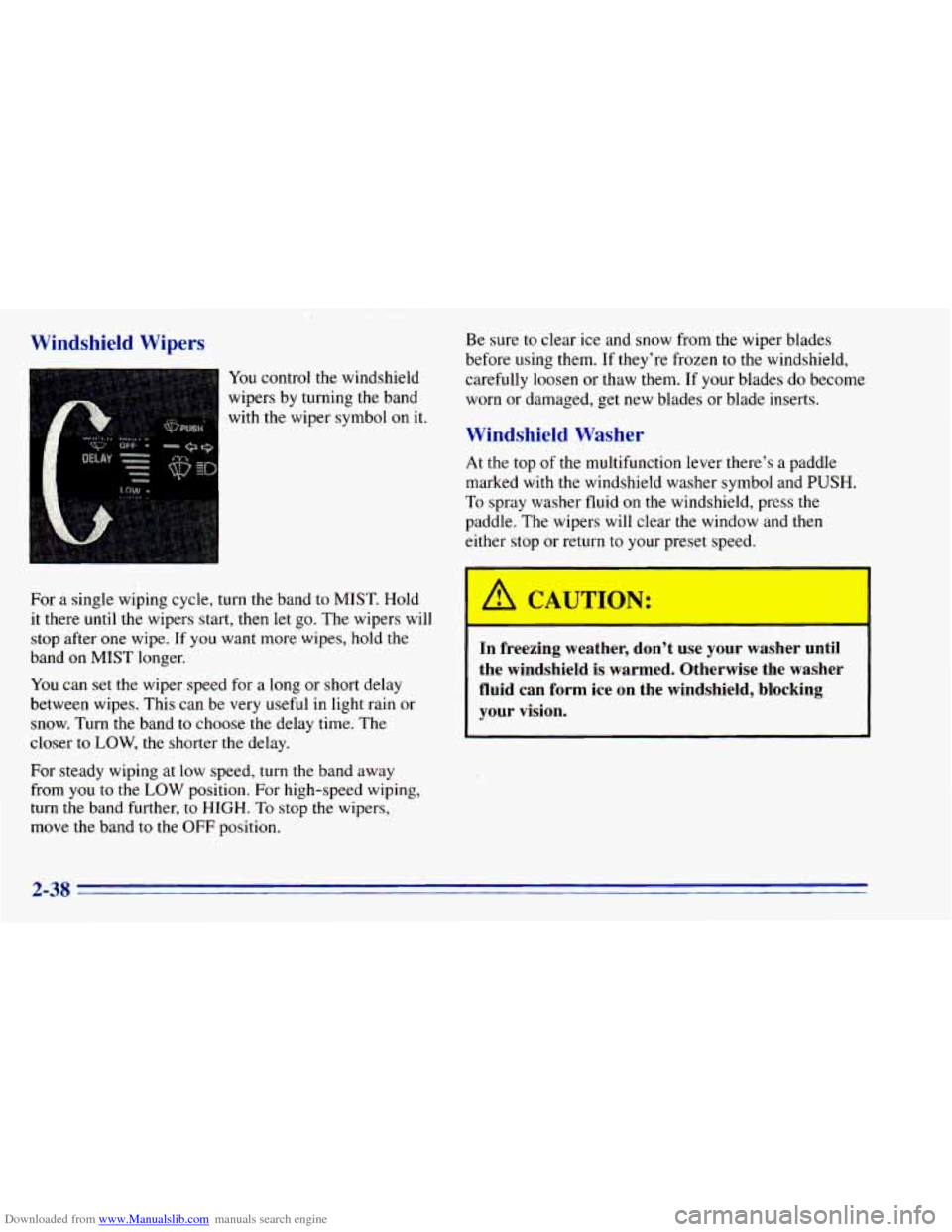
You control the windshield
wipers by turning the band
with the wiper symbol
on it.
For a single wiping cycle, turn the band to MIST. Hold
it there until the wipers start, then let
go. The wipers will
stop after one wipe. If you want more wipes, hold the
band on MIST longer.
You can set the wiper speed for a long or short delay
between wipes. This can be very useful in light rain or
snow. Turn
the band to choose the delay time. The
closer to
LOW, the shorter the delay.
For steady wiping at low speed, turn the band away
from
you to the L,OW position. For high-speed wiping,
turn the band further, to HIGH.
To stop the wipers,
move the band to the
OFF position. Be sure
to clear
ice and snow from the wiper blades
before using
them. If they’re frozen to the windshield,
carefully loosen
or thaw them. If your blades do become
worn or damaged, get new blades or blade inserts.
Windshield Washer
At the top of the multifunction lever there’s a paddle
marked
with the windshield washer symbol and PUSH.
To spray washer fluid on the windshield, press the
paddle. The wipers will clear the window and then
either stop or return
to your preset speed.
In freezing weather, don’t use your washer until
the windshield
is warmed. Otherwise the washer
fluid can form ice on the windshield, blocking
your vision.
2-38
Page 97 of 392
Downloaded from www.Manualslib.com manuals search engine Rear Window WasherNViper
WASH
REAR WIPER
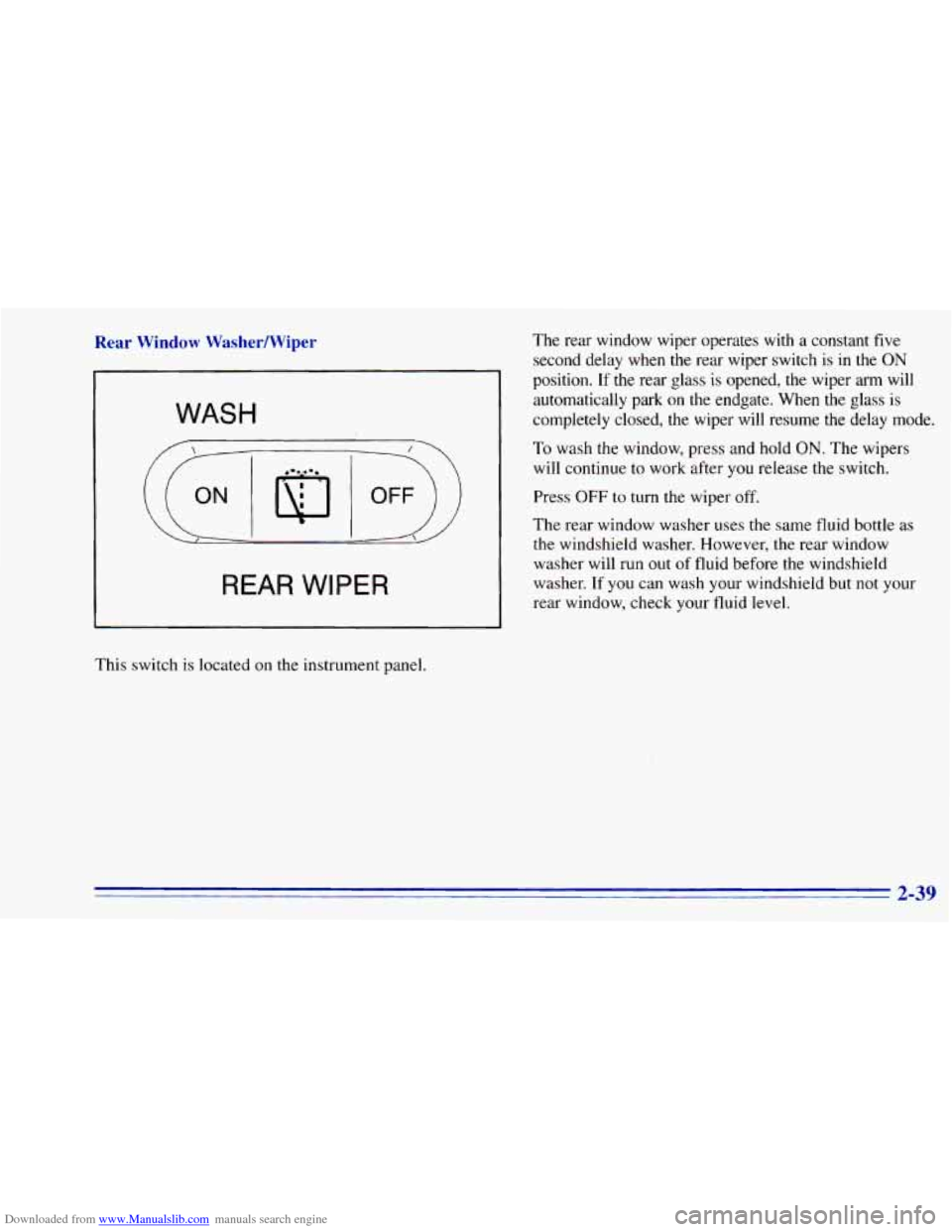
This switch is located on the instrument panel. The
rear window wiper operates with
a constant five
second delay when the rear wiper switch
is in the ON
position. If the rear glass is opened, the wiper arm will
automatically park
on the endgate. When the glass is
completely closed, the wiper will resume the delay mode.
10 wash the window, press and hold ON. The wipers
will continue to work after
you release the switch.
Press
OFF to turn the wiper off.
The rear window washer uses the same fluid bottle as
the windshield washer. However, the rear window
washer will run
out of fluid before the windshield
washer.
If you can wash your windshield but not your
rear window, check your fluid level.
2-39
Page 191 of 392
Downloaded from www.Manualslib.com manuals search engine Here are some things you can check before a trip:
0
a
0
0
0
0
0
Windshield Washer Fluid: Is the reservoir full?
Are all windows clean inside and outside?
Wiper Blades: Are they in good shape?
Fuel, Engine Oil, Other Fluids: Have you checked
all levels?
Lamps: Are they all working? Are the lenses clean?
Tires: They are vitally important to a safe,
trouble-free trip.
Is the tread good enough for
long-distance driving? Are the tires all inflated to the
recommended pressure?
Weather Forecasts: What’s the weather outlook
along your route? Should you delay your trip a short
time
to avoid a major storm system?
Maps: Do you have up-to-date maps?
Highway Hypnosis
Is there actually such a condition as “highway hypnosis”?
Or is
it just plain falling asleep at the wheel? Call it
highway hypnosis, lack of awareness,
or whatever.
There is something about an easy stretch
of road with the
same scenery, along with the hum of the tires on the road,
the drone
of the engine, and the rush of the wind against
the vehicle that can make
you sleepy. Don’t let it happen
to you!
If it does, your vehicle can leave the road in less
than n second, and you could crash and be injured.
What can
you do about highway hypnosis‘? First, be
aware that it can happen.
Then here are some tips:
0
0
0
Make sure your vehicle is well ventilated, with a
comfortably cool interior.
Keep your eyes moving. Scan the road ahead and
to
the sides. Check your mirrors and your instruments
frequently.
If
you get sleepy, pull off the road into a rest, service
or parking area and take a nap, get some exercise, or
both. For safety, treat drowsiness on the highway
as
an emergency.
4-37
Page 194 of 392
Downloaded from www.Manualslib.com manuals search engine Include an ice scraper, a small brush or broom, a supply
of windshield washer fluid, a rag, some winter outer
clothing, a
small shovel, a flashlight, a red cloth and a
couple
of reflective warning triangles. And, if you will
be driving under severe conditions, include a small bag
of sand,
a piece of old carpet or a couple of burlap bags
to help provide traction. Be sure
you properly secure
these items in your vehicle.
Driving on Snow or Ice
Most of the time, those places where your tires meet the
road probably have good traction.
However, if there is snow or ice between your tires and the
road,
you can have a very slippery situation. You’ll have a
lot less traction or “grip” and will need to be very careful.
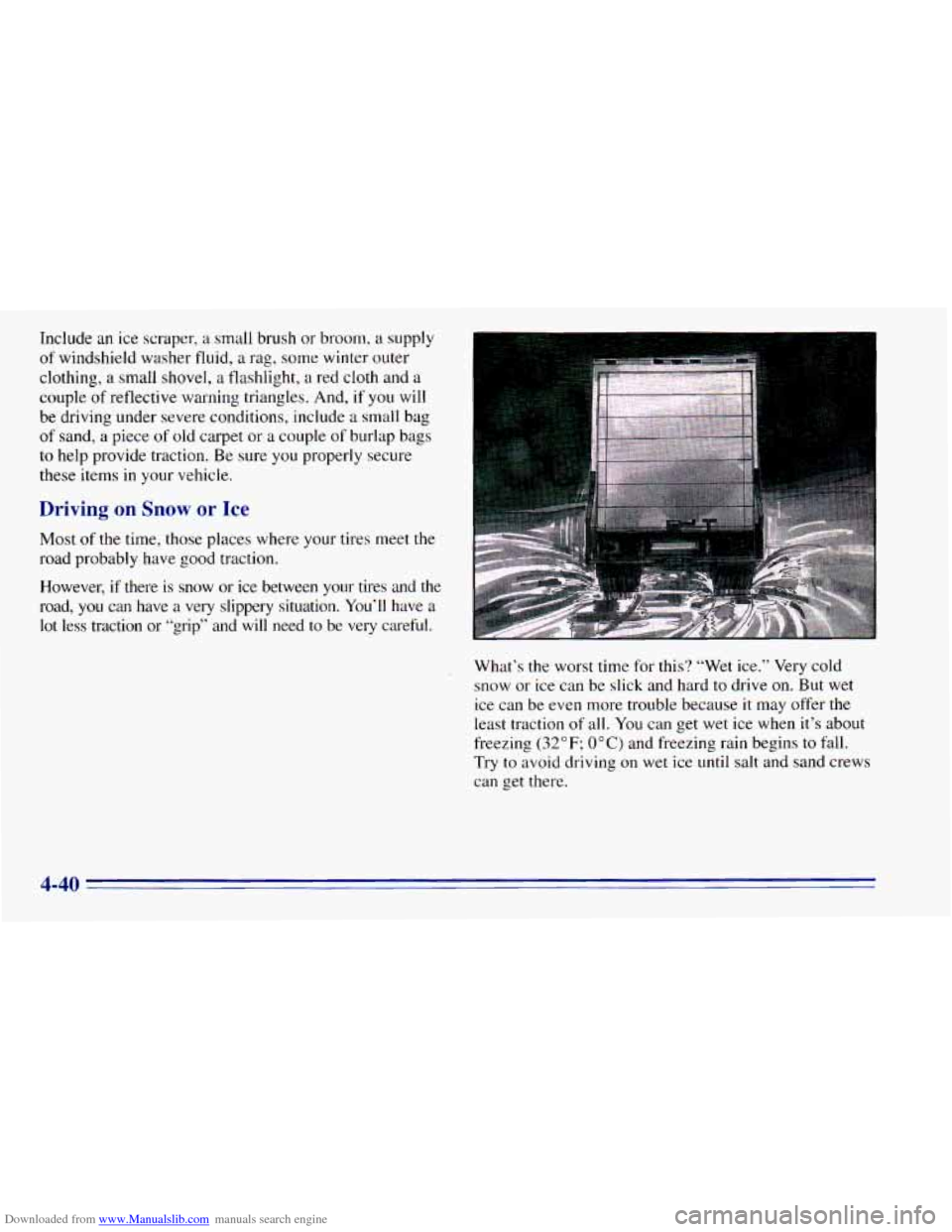
What’s the worst
time for this? “Wet ice.” Very cold
snow or ice can be slick and hard to drive on. But wet
ice can be even more trouble because
it may offer the
least traction of all. You can get wet ice when it’s about
freezing
(32°F; OOC) and freezing rain begins to fall.
Try
to avoid driving on wet ice until salt and sand crews
can get there.
4-40
Page 255 of 392
Downloaded from www.Manualslib.com manuals search engine Checking Things Under the Hood
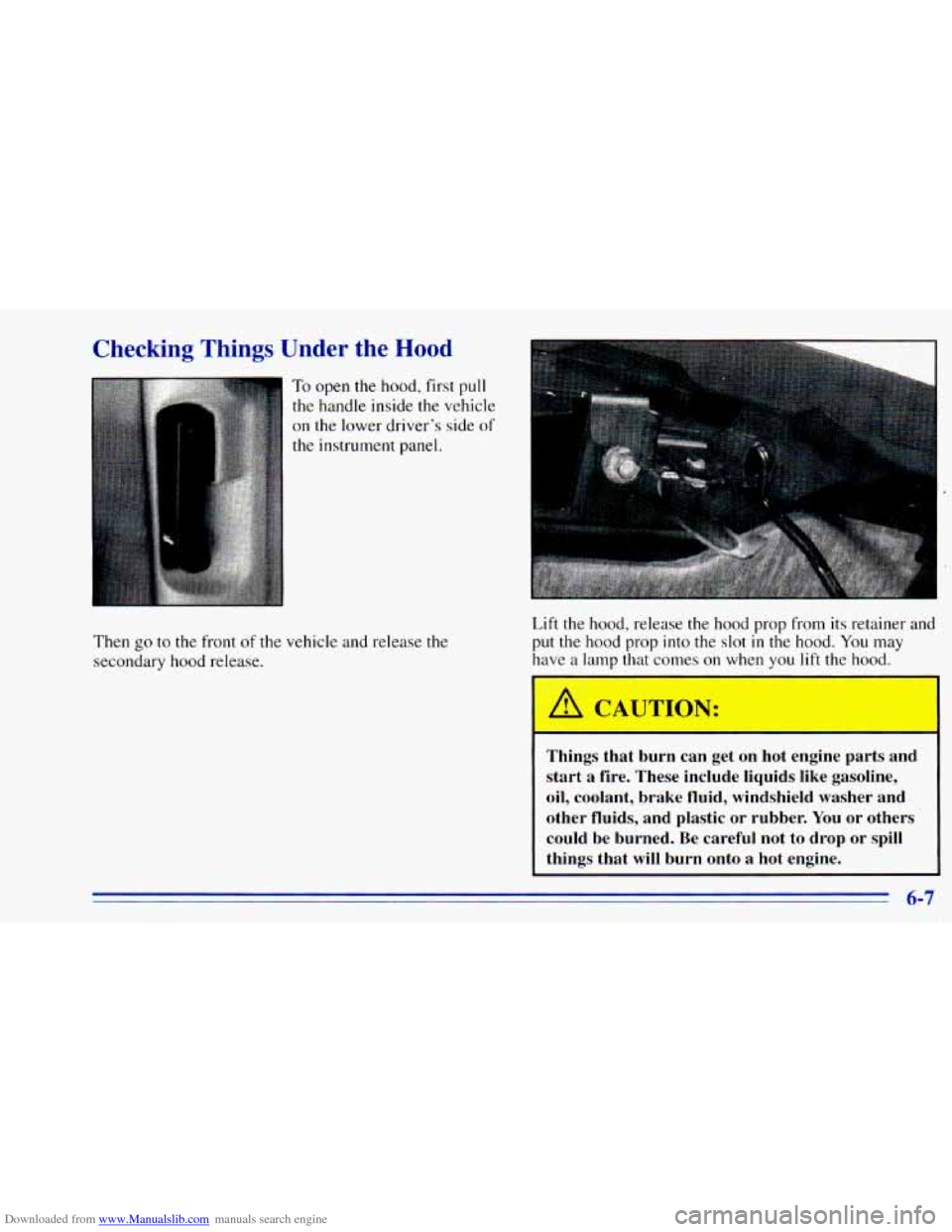
To open the hood, first pull
the handle inside the vehicle
on the lower driver's side of
the instrument panel.
Then go to the front of the vehicle and release the
secondary hood release. Lift the hood, release
the hood
prop from its retainer and
put the hood prop into the slot
in the hood. You may
have a
lnnl~ that cn'qes *n when you lift the hood.
.. .: '_* , . . .I.
Things that burn can get on hot engine parts and
start a fire. These include liquids like gasoline,
oil, coolant, brake fluid, windshield washer and
other fluids, and plastic or rubber. You
or others
could be burned. Be careful not to drop or spill
things that
will burn onto a hot engine.
6-7
Page 256 of 392
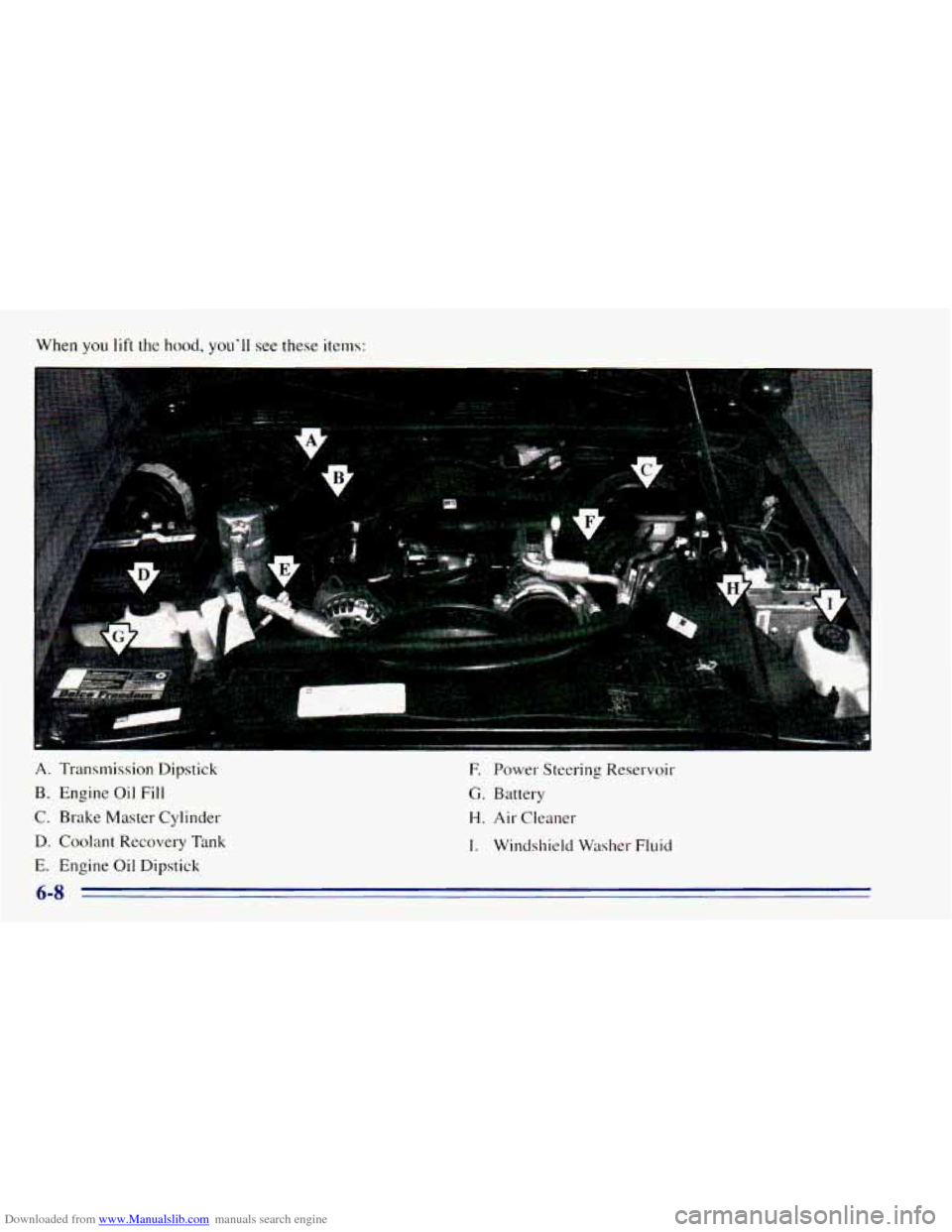
Downloaded from www.Manualslib.com manuals search engine When you lift the hood, you'll see these items:
A. Transmission Dipstick
B. Engine Oil Fill
C. Brake Master Cylinder
D. Coolant Recovery Tank
E. Engine Oil Dipstick F.
Power Steering Reservoir
G. Battery
H. Air Cleaner
I. Windshield Washer Fluid
6-8
Page 274 of 392
Downloaded from www.Manualslib.com manuals search engine Power Steering Fluid
When to Check Power Steering Fluid
It is not necessary to regularly check power steering
fluid unless you suspect there
is a leak in the system or
you hear an unusual noise.
A fluid loss in this system
could indicate a problem. Have the system inspected
and repaired.
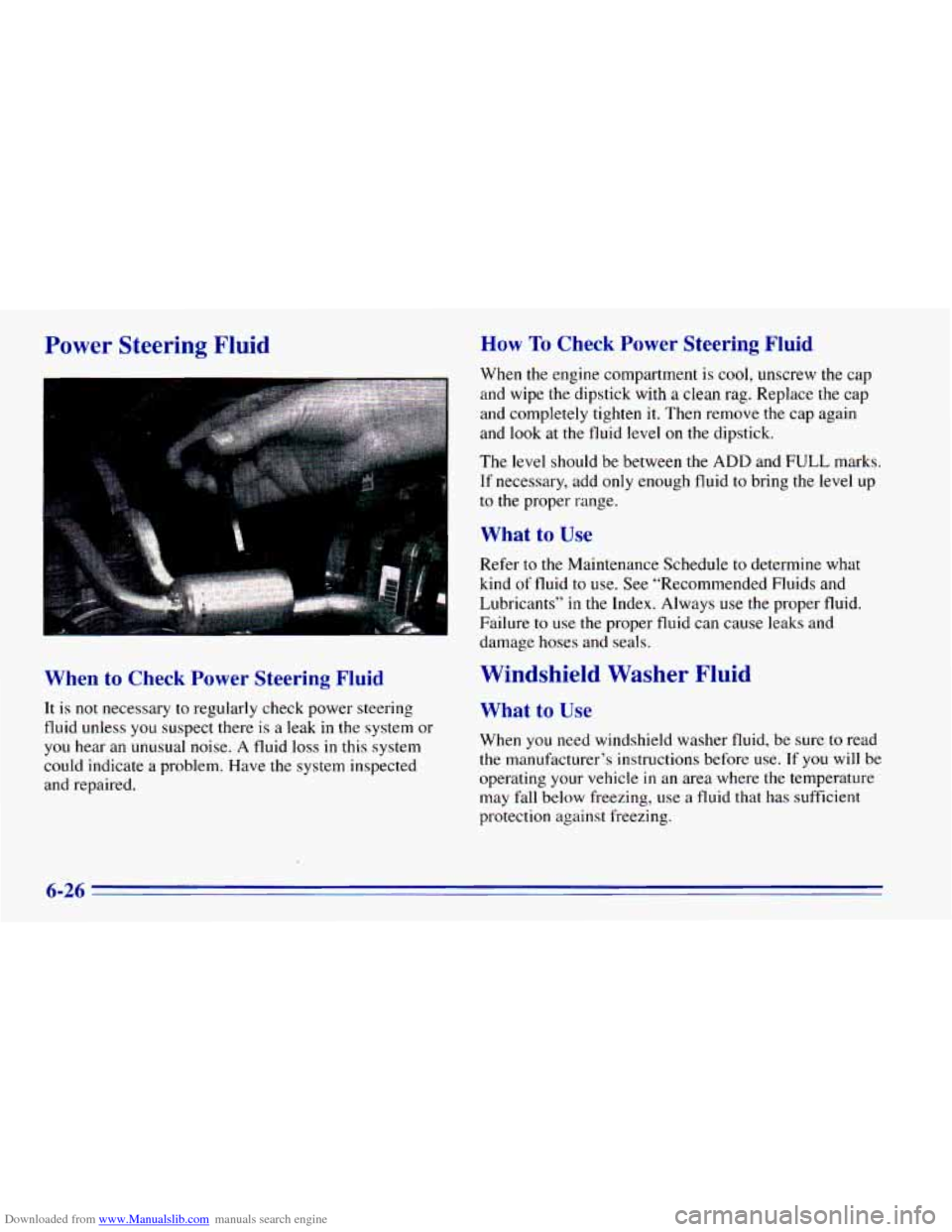
How To Check Power Steering Fluid
When the engine compartment is cool, unscrew the cap
and wipe the dipstick
with a clean rag. Replace the cap
and completely tighten it. Then remove the cap again
and look at the fluid level on the dipstick.
The level should be between the
ADD and FULL marks.
If necessary, add
only enough fluid to bring the level up
to the proper range.
What to Use
Refer to the Maintenance Schedule to determine what
kind
of fluid to use. See “Recommended Fluids and
Lubricants”
in the Index. Always use the proper fluid.
Failure to use the proper fluid can cause leaks and
damage hoses and seals.
Windshield Washer Fluid
What to Use
When you need windshield washer fluid, be sure to read
the manufacturer’s instructions before use. If you will be
operating your vehicle
in an area where the temperature
may fall below freezing, use a fluid that
has sufficient
protection against freezing.
6-26
Page 275 of 392
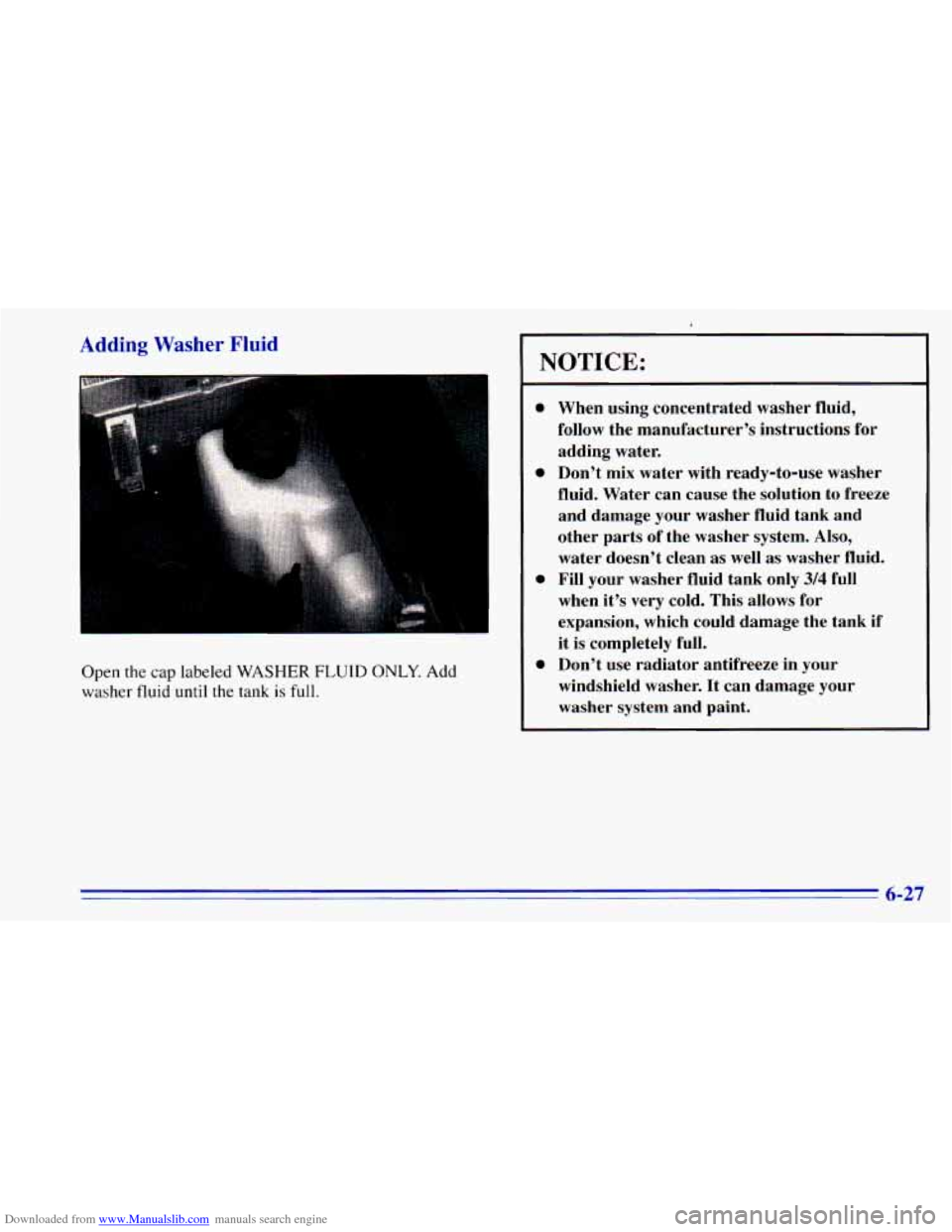
Downloaded from www.Manualslib.com manuals search engine Adding Washer Fluid
Open the cap labeled WASHER FLUID ONLY. Add
washer fluid until the tank
is full.
NOTICE:
0
e
0
0
When using concentrated washer fluid,
follow the manufacturer’s instructions for
adding water.
Don’t mix water with ready-to-use washer
fluid. Water can cause the solution to freeze and damage your washer fluid tank and
other parts of the washer system. Also,
water doesn’t clean as well
as washer fluid.
Fill your washer fluid tank only
3/4 full
when it’s very cold. This allows for
expansion, which could damage the tank if
it is completely full.
Don’t use radiator antifreeze in your
windshield washer.
It can damage your
washer system and paint.
6-27
Page 300 of 392
Downloaded from www.Manualslib.com manuals search engine Care of Safety Belts
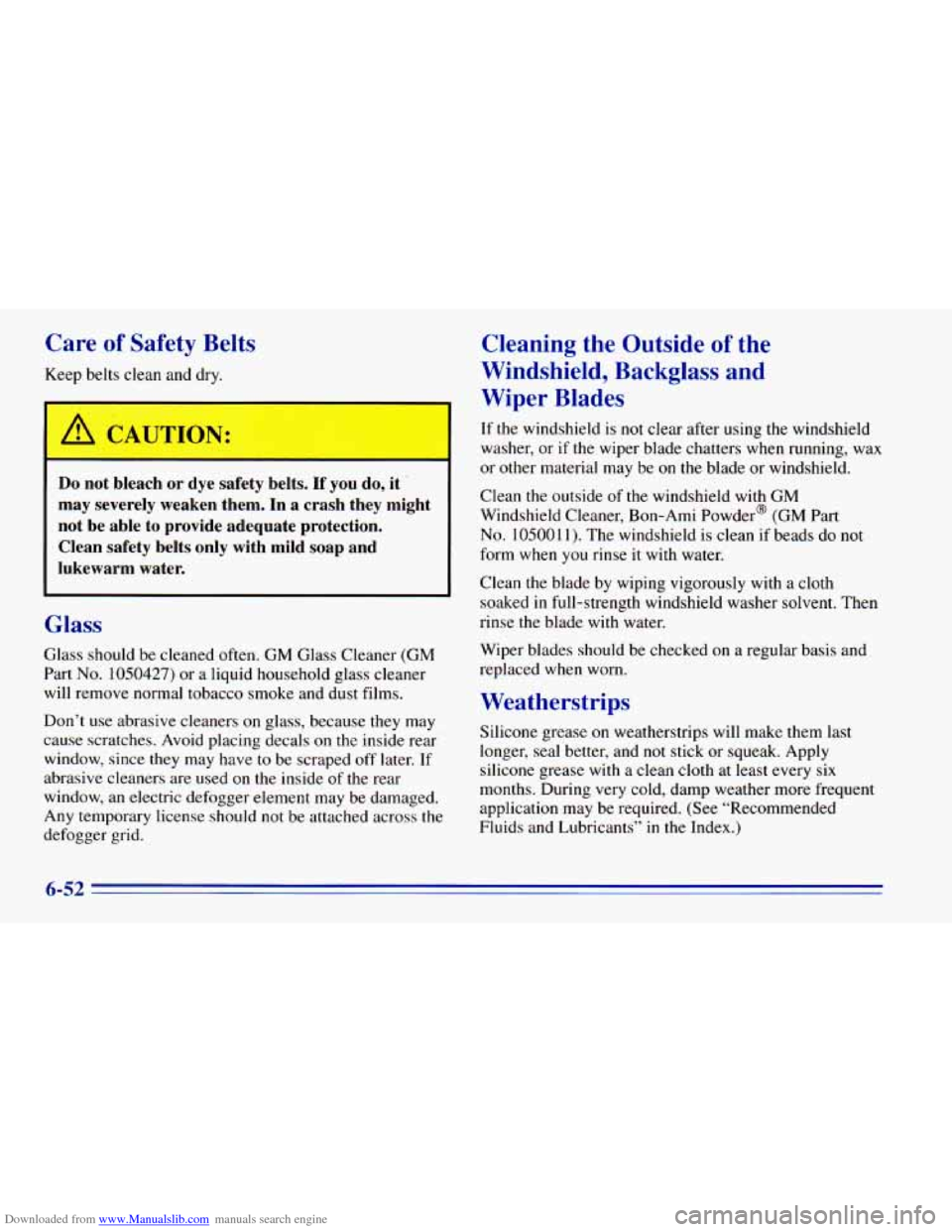
Keep. belts clean and dry.
I
Do not bleach or dye safety belts. If you do, it
may severely weaken them. In a crash they might
not be able to provide adequate protection.
Clean safety belts only with mild soap and
lukewarm water.
Glass
Glass should be cleaned often. GM Glass Cleaner (GM
Part
No. 1050427) or a liquid household glass cleaner
will remove normal tobacco smoke and dust films.
Don’t
use abrasive cleaners on glass, because they may
cause scratches. Avoid placing decals
on the inside rear’
window, since they may have to be scraped
off later. If
abrasive cleaners are used on the inside of
the rear
window, an electric defogger element may be damaged.
Any temporary license should not be attached across the
defogger grid.
Cleaning the Outside of the
Windshield, Backglass and
Wip
- Blades
If the windshield is not clear after using the windshield
washer, or if the wiper blade chatters when running, wax
or other material may be
on the blade or windshield.
Clean the outside of the windshield with GM
Windshield Cleaner, Bon-Ami Powder@
(GM Part
No. 105001 1). The windshield is clean if beads do not
form when
you rinse it with water.
Clean the blade by wiping vigorously with a cloth
soaked in full-strength windshield washer solvent. Then
rinse the blade with water.
Wiper blades should be checked on a regular basis and
replaced when worn.
Weatherstrips
Silicone grease on weatherstrips will make them last
longer, seal better, and not stick or squeak. Apply
silicone grease with a clean
cloth at least every six
months. During very cold, damp weather more frequent
application may be required. (See “Recommended
Fluids and Lubricants” in the Index.)
6-52
Page 304 of 392
Downloaded from www.Manualslib.com manuals search engine Appearance Care Materials Chart
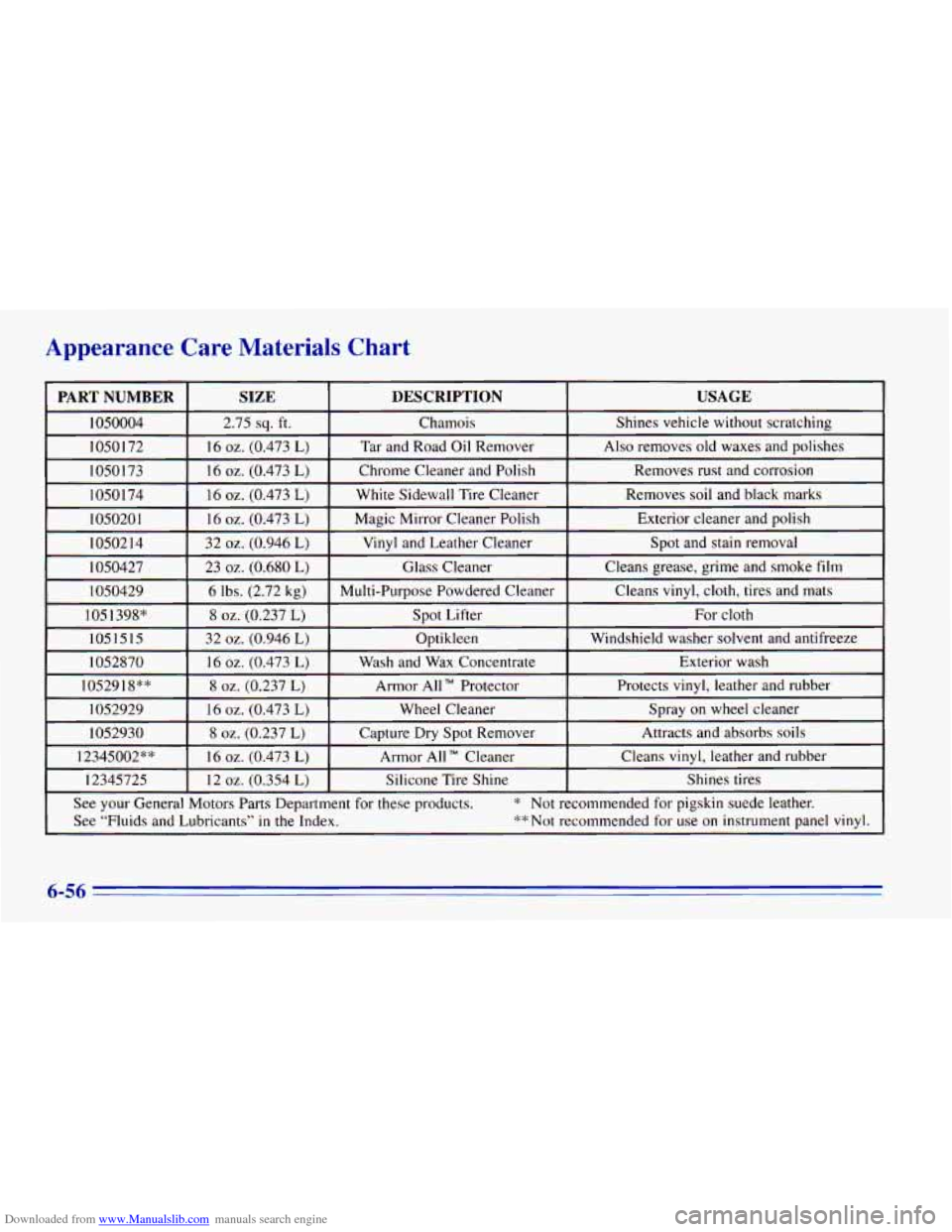
I PARTNUMBER I SIZE I DESCRIPTION I USAGE I
1050004 16 oz. (0.473 L)
1050 I72 Shines vehicle without scratching
Chamois
2.75
sq. ft.
Cleans
vinvl, cloth, tires and mats
Multi-Purpose Powdered Cleaner 6 Ibs. (2.72 kg) 1050429 Cleans grease, grime and
smoke film
Glass Cleaner
23
oz. (0.680 L) 1050427 Spot and stain removal
Vinyl and Leather Cleaner
32 oz. (0.946 L)
10502 14 Exterior cleaner and polish
Magic Mirror Cleaner Polish
16
oz. (0.473 L) 1 05020 1
Removes soil and black marks White Sidewall Tire Cleaner
16 oz. (0.473 L) 1050 174 Removes rust and corrosion
Chrome Cleaner and Polish 16
oz. (0.473 L)
1050173
Also removes old waxes and polishes
Tar and Road Oil Remover
I
I -. I I 4
105 1398“ I 8 oz. (0.237
L) I Spot Lifter I For cloth I
1051515 32 oz. (0.946 L) Optikleen Windshield washer solvent and antifreeze
1052870 16 oz. (0.473 L) Wash and Wax
Concentrate Exterior wash
1052918””
8 oz. (0.237 L) Armor All TM Protector Protects vinyl, leather and rubber
I 1052929 I 16 oz. (0.473 L) I Wheel Cleaner I Spray on wheel cleaner I Ir
1052930
12345002** 16
oz. (0.473 L) Armor All TM Cleaner Cleans vinyl, leather and rubber
Attracts and absorbs
soils Capture Dry Spot Remover 8 oz. (0.237 L)
I I I
I 12345725 I 12
oz. (0.354 L) I Silicone Tire Shine I Shines tires I I I I
See your General Motors Parts Department for these products. * Not recommended for pigskin suede leather.
See “Fluids and Lubricants’’
in the Index. **Not
recommended for use on instrument panel vinyl.
6-56