belt CHEVROLET CAMARO 1971 2.G Owners Manual
[x] Cancel search | Manufacturer: CHEVROLET, Model Year: 1971, Model line: CAMARO, Model: CHEVROLET CAMARO 1971 2.GPages: 88, PDF Size: 34.8 MB
Page 8 of 88
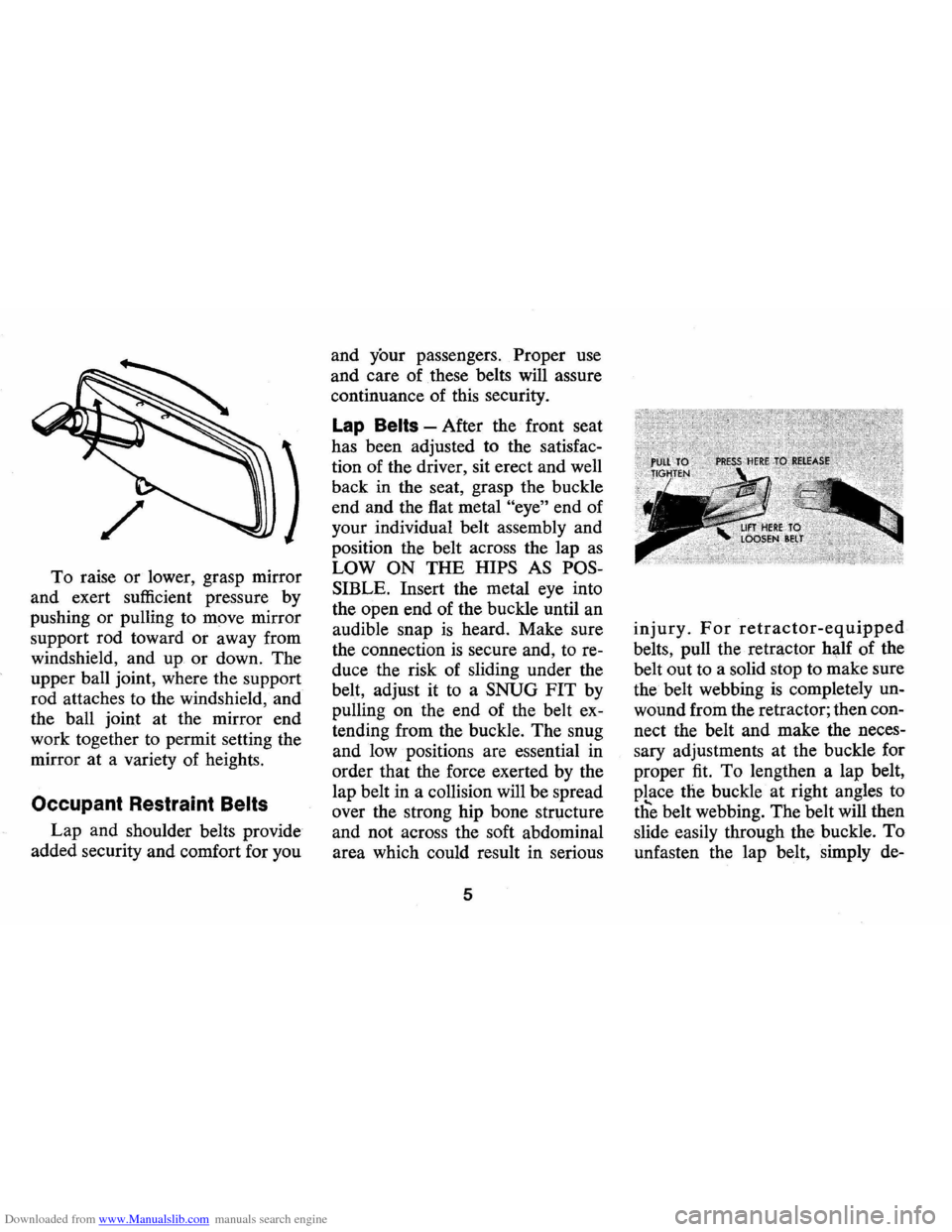
Downloaded from www.Manualslib.com manuals search engine To raise or lower, grasp mirror
and exert sufficient pressure by
pushing or pulling to move mirror
support rod toward
or away from
windshield, and up
or down. The
upper ball joint, where the support
rod attaches to the windshield, and
the ball joint at the mirror end
work together to permit setting the
mirror at a variety of heights.
Occupant Restraint Belts
Lap and shoulder belts provide
added security and comfort for you and
your passengers. Proper use
and care of these belts will assure
continuance of this security.
Lap Belts -After the front seat
has been adjusted to the satisfac
tion of the driver, sit erect and well
back in the seat, grasp the buckle
end and the flat metal
"eye" end of
your individual belt assembly and
position the belt across the lap
as
LOW ON THE HIPS AS POS
SIBLE. Insert the metal eye into
the open end of the buckle until an
audible snap
is heard. Make sure
the connection
is secure and, to re
duce the risk of sliding under the
belt, adjust it to a SNUG
FIT by
pulling on the end of the belt ex
tending from the buckle. The snug
and low positions are essential in
order that the force exerted by the
lap belt in a collision will be spread
over the strong hip bone structure
and not across the soft abdominal
area which could result in serious
5
injury. For retractor-equipped
belts, pull the retractor hl;tlf of the
belt out to a solid stop to make sure
the belt webbing
is completely un
wound from the retractor; then con
nect the belt and make the neces
sary adjustments at the buckle for
proper
fit. To lengthen a lap belt,
pLace the buckle at right angles to
the belt webbing. The belt will then
slide easily through the buckle.
To
unfasten the lap belt, simply de-
Page 9 of 88
Downloaded from www.Manualslib.com manuals search engine press the push button located in the
center of the buckle.
Automatic-locking lap belt re
tractors are provided for the added
convenience of the driver and out
board front seat passenger on all
Camaro cars
as an extra cost op
tion. The automatic-locking re
tractors adjust and lock the lap
belts into position automatically
after fastening.
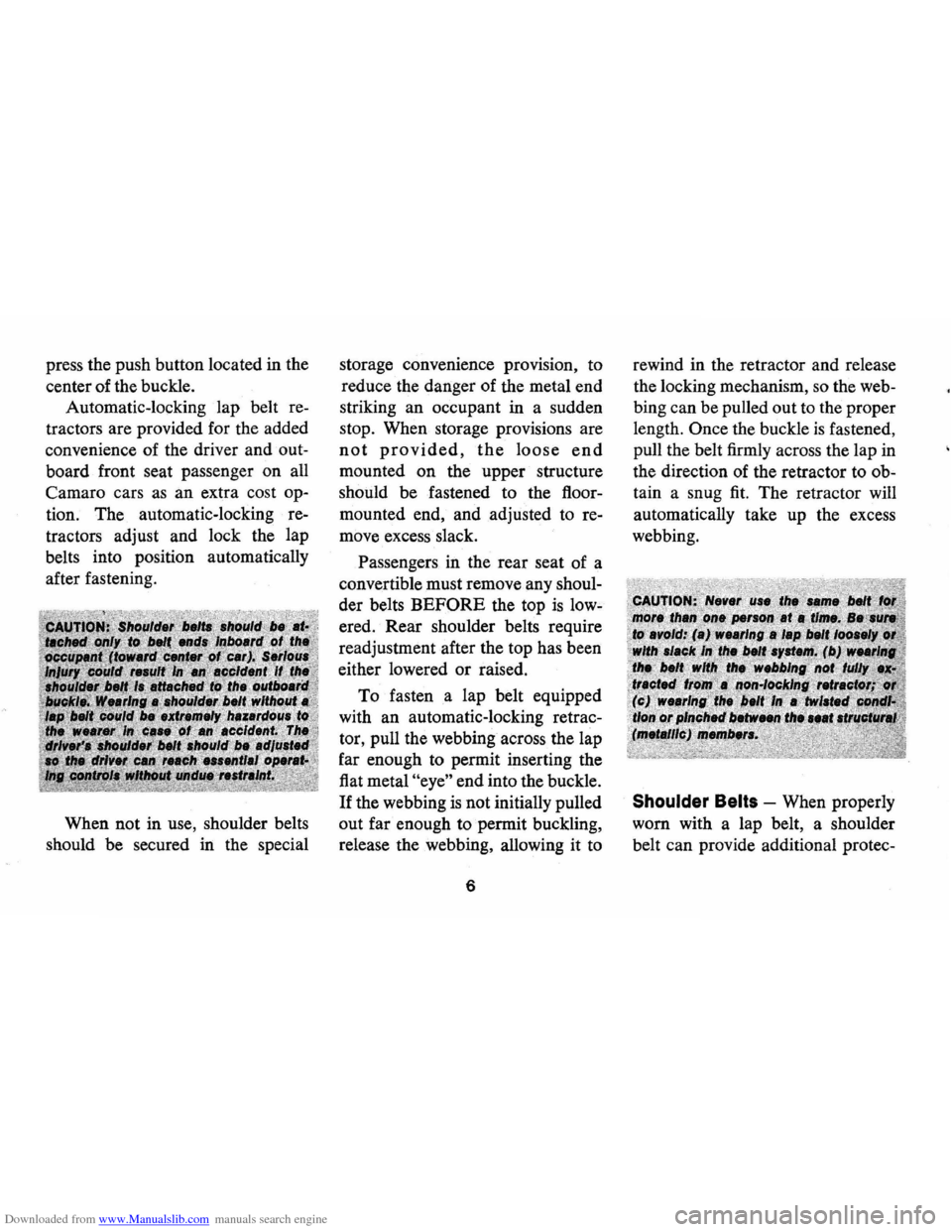
When not in use, shoulder belts
should be secured in the special storage
convenience provision, to
reduce the danger of the metal end
striking an occupant
in a sudden
stop. When storage provisions are
not provided, the loose end
mounted on the upper structure
should be .fastened to the fioor
mounted end, and adjusted to re
move excess · slack.
Passengers in the rear seat of a
convertible must remove any shoul
der belts BEFORE the top
is low
ered. Rear shoulder belts require
readjustment after the top has been
either lowered or raised.
To fasten
a lap belt equipped
with an automatic-locking retrac
tor, pull the webbing across the lap
far enough to permit inserting the
fiat metal "eye" end into the buckle.
If the webbing is not initially pulled
out far enough to permit buckling,
release the webbing, allowing it to
6
rewind in the retractor and release
the locking mechanism,
so the web
bing can be pulled out to the proper
length.
Once the buckle is fastened,
pull the belt firmly across the lap in
the direction of the retractor to
ob.;.
tain a snug fit. The retractor will
automatically take up the excess
webbing.
Shoulder Belts -When properly
worn with a lap belt, a shoulder
belt can provide additional protec-
Page 10 of 88
Downloaded from www.Manualslib.com manuals search engine tion against impact with the car in
terior
by restraining forward mo
tion of the upper torso in a colli
sion. This
is primarily true in case
of frontal impacts, which are the
most frequent type of accident. Shoulder
belts are fastened and
unfastened in the same manner
as
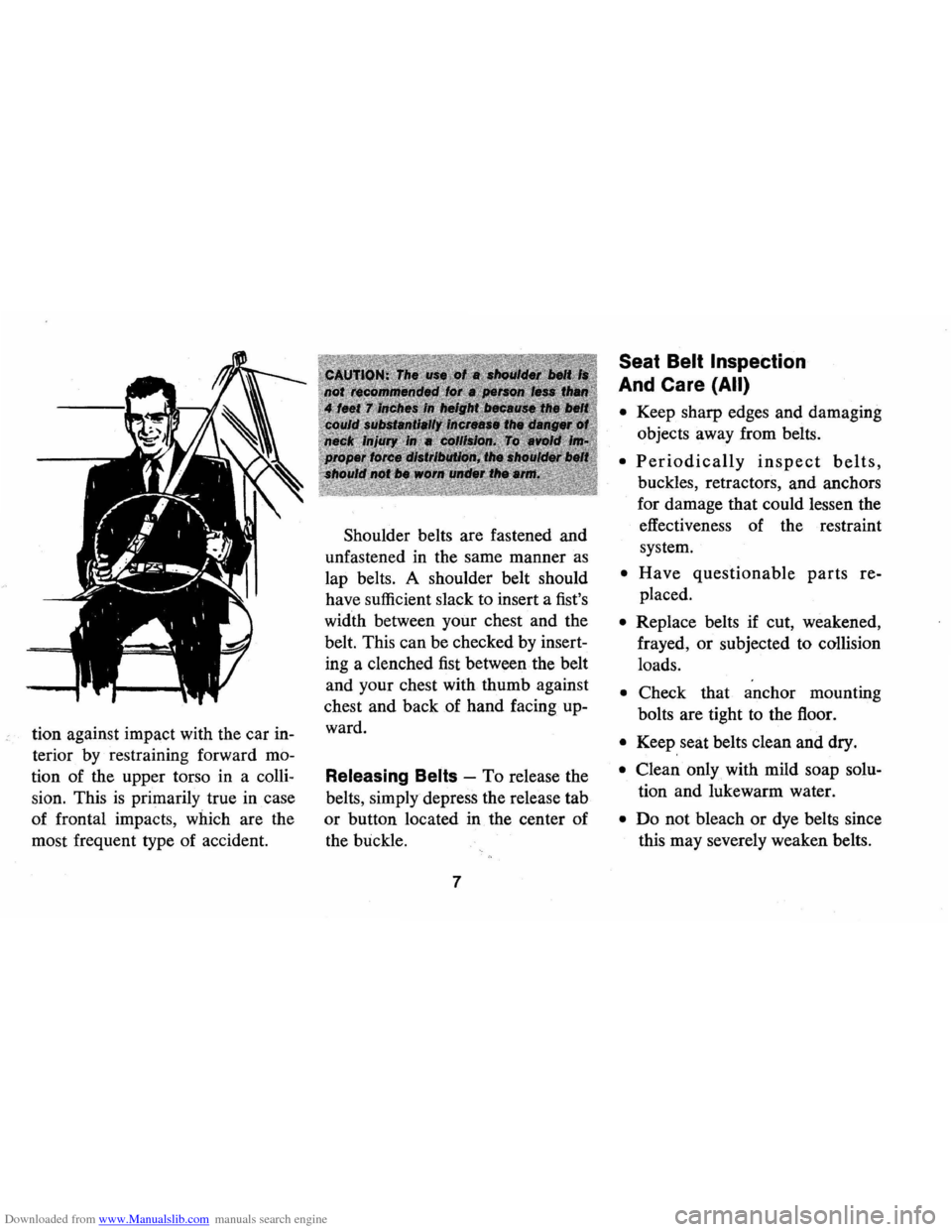
lap belts. A shoulder belt should
have sufficient slack to insert a fist's
width between your chest and the
belt. This can be checked by insert
ing a clenched
fist between the belt
and your chest with thumb against
chest and back of hand facing up
ward.
Releasing Belts -To release the
belts, simply depress the release tab
or button located
in the center of
the buckle.
7
Seat Belt Inspection
And Care (All)
• Keep sharp edges and damaging
objects away from belts.
• Periodically inspect belts,
buckles, retractors, and anchors
for damage that could lessen the
effectiveness of the restraint
system.
• Have questionable parts re
placed.
• Replace belts if cut, weakened,
frayed,
or subjected to collision
loads.
• Check that anchor mounting
bolts are tight to the floor.
• Keep seat belts clean and dry.
• Clean only with mild soap solu
tion and lukewarm water.
• Do not bleach or dye belts since
this may severely weaken belts.
Page 11 of 88
Downloaded from www.Manualslib.com manuals search engine Child Restraint
Children in automobiles should
be restrained to lessen the risk of
injury in accidents, sudden
s~ops or
other driving conditions . General
Motors has designed an
"INFANT
SAFETY CARRIER" specifically
for infants and a
"CHILD SAFETY
SEAT"
specifically for small chil
dren which are available from your
Che~rolet dealer. The Carrier and
Child
Seat are designed to utilize
lap belts in your 1971 Camaro.
The General Motors Infant
Safety
Carrier and the Child Safety Seat
must be used only in passenger ve
hicle seats equipped with lap belts.
They
must be used only on front or
rear seats which do not fold or on
folding seats equipped with a latch
to hold the seat back upright
(Stan
dard on 1967 and later model GM
passenger vehicles) .
In using either
Carrier or Child
Seat, read and
comply with all installation and usage
instructions.
Do ?ot place
more than one child at a tIme In the
Carrier or Child
Seat. · The Carrier
is designed for use only with infants
weighing up to
20 pounds. The
Child
Seat is designed for use only
by children weighing up to 30
pounds and who are able to sit up
by themselves. All unused seat belts
near the Carrier or Child Seat
should be stowed properly to help
prevent them from striking the
child in the event of a sudden stop
or collision. Shoulder belts should
be stowed in any special storage
convenience provision provided.
Lap belts and shoulder belts
with
out storage provisions should have
buckles latched and belts adjusted
to remove slack.
Cars Not Equipped With
Special Child Restraints
If a child is traveling in a vehicle
not equipped with a General
8
Motors Infant Safety Carrier or
Child Safety Seat, the following
precautions should be taken:
1. Children should be placed in
the rear seat. Never allow a
child to stand
or kneel on any
seat.
2. Infants . unable to sit up by
themselves should be restrained
by placing them in a covered,
padded bassinet
whi~h is pl~ced
crossways in the vehlcle (wldth
wise) on the rear seat. The bas
sinet should be securely re
strained with the regular ve
hicle seat belts. An alternate
method
is to position the bas
sinet so that it rests against the
back of the front seat, again
crossways in the vehicle.
3. When a child
is old enough to
sit up by himself in a
~ar, he
should sit on a firm cushion and
use the conventional lap belt to
restrain him at the hips. The
Page 12 of 88
Downloaded from www.Manualslib.com manuals search engine cushion should be as firm as
practical and just high enough
to enable the child to look
hori
zontally out of the car windows.
4. The use of the cushion should
be discontinued
as soon as the
child
is old enough to see out of
the car windows without it.
Trailer Hauling
Since passenger cars are designed
and intended to
be used primarily
as passenger conveyances, towing
a trailer will affect handling,
dura
bility and economy. Maximum
safety and· satisfaction depends
upon proper use of correct equip
ment and avoiding overloads and
other abusive operation .
The maximum loaded trailer
weight which you can pull with 5
. Do not
use shoulder belts on
children shorter than approxi
mately 4 feet 7 inches
in height.
6. General Motors recommends
that children be restrained when
riding. However, if conditions
require that a child must stand,
he should stand on the floor di-
your Camaro depends on what
special equipment has been in
stalled on your car. We do not rec
ommend pulling any trailer unless
the car
is properly equipped. In
formation on trailer hauling capa
bilities, special equipment required,
and optional equipment offered by
Chevrolet
is available from your
Chevrolet Dealer or by writing
Chevrolet Motor Division, Detroit,
9
rectly behind the front seat.
This
will minimize the possi
bility of his being thrown from
the rear
compartment during a.
sudden stop. This method
should be used only if more
complete restraint cannot be
used.
Michigan 48202.
Usage of bumper hitches
is not
recommended; however, rental
in
stallations may be made if in accord
with proper installation and usage
instructions of a reputable trailer
rental agency. Axle mounted
hitches should not be used.
To assist in attaining good
han
dling of the car-trailer combina
tion, it
is important that the trailer
Page 20 of 88
Downloaded from www.Manualslib.com manuals search engine motorists and pedestrians. The ig
nition switch must be in the "ON"
position in order for the turn sig
nals to be operational. This feature
prevents battery drain if the lever
is left in an "ON" position when
your car
is not in use.
In a normal turning situation
such
as turning a corner, the turn
signal is cancelled automatically
after the turn
is completed. How
ever, in some driving maneuvers
such
as changing lanes on an ex
pressway, the steering wheel
is not
turned back sufficiently after com
pleting the turn to automatically
cancel the turn signal. For con
venience in such maneuvers, the
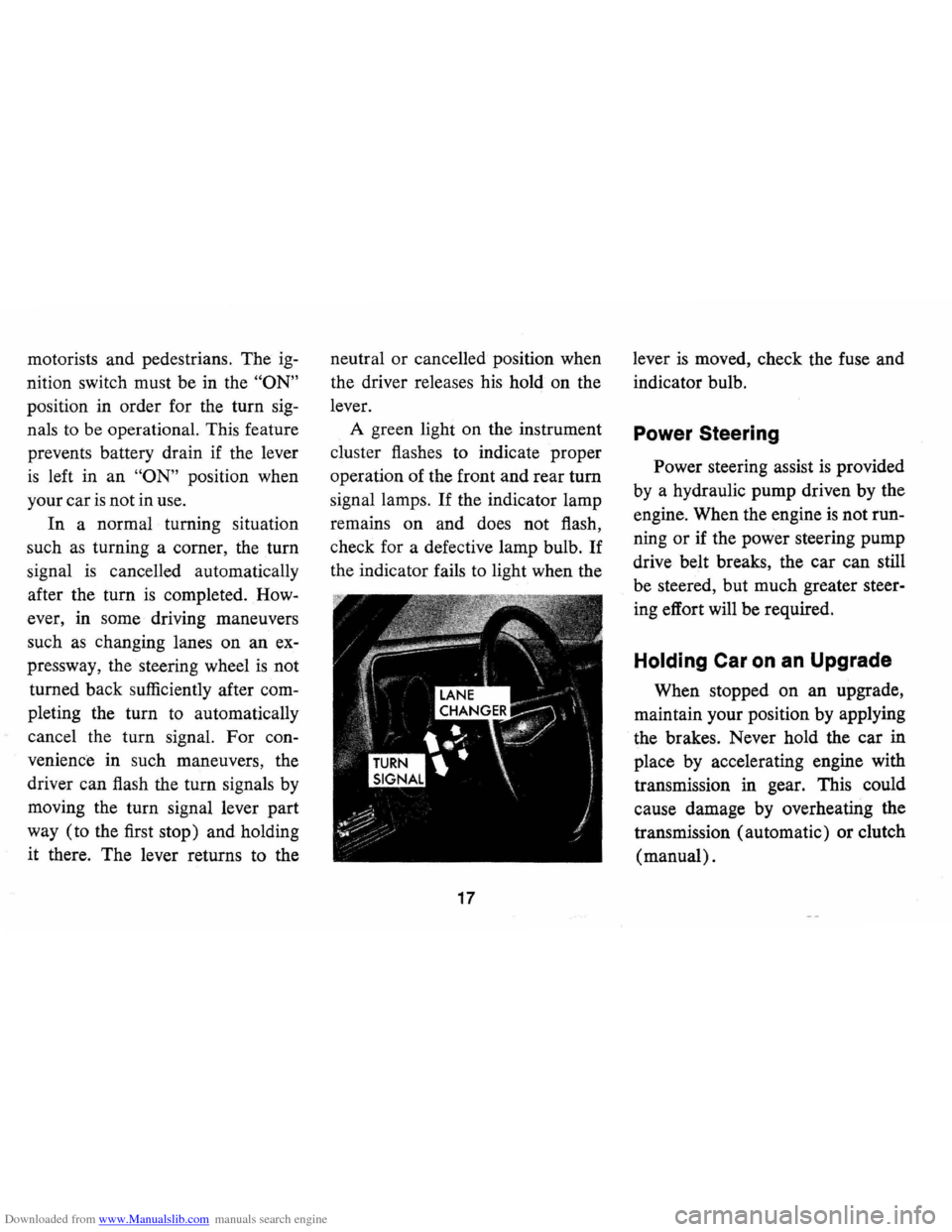
driver can flash the turn signals by
moving the turn signal lever part
way (to the first stop) and holding
it there. The lever returns to the neutral
or cancelled position when
the driver releases his hold on the
lever.
A green light on the instrument
cluster flashes to indicate proper
operation of the front and rear
tum
signal lamps. If the indicator lamp
remains on and does not flash,
check for a defective lamp bulb.
If
the indicator fails to light when the
17
lever is moved, check the fuse and
indicator bulb.
Power Steering
Power steering assist is provided
by a hydraulic pump driven by the
engine. When the engine
is not run
ning
or if the power steering pump
drive belt breaks, the car can still
be steered, but much greater steer
ing effort will be required.
Holding Car on an Upgrade
When stopped on an upgrade,
maintain your position by applying
the brakes. Never hold the car in
place by accelerating engine with
transmission in gear. This could
cause damage by overheating the
transmission (automatic) or clutch
(manual).
Page 36 of 88
Downloaded from www.Manualslib.com manuals search engine SAFETY CHECKS
Your Camaro not only conforms to all U.S. Fed
eral Motor Vehicle
Safety Standards applicable at
time of manufacture, but also incorporates other im
portant General Motors safety features. Even with
these safety features, however, continued safe and
dependable operation depends greatly upon regular
vehicle maintenance.
This section discusses the various components and
systems of your vehicle that should be checked regu-
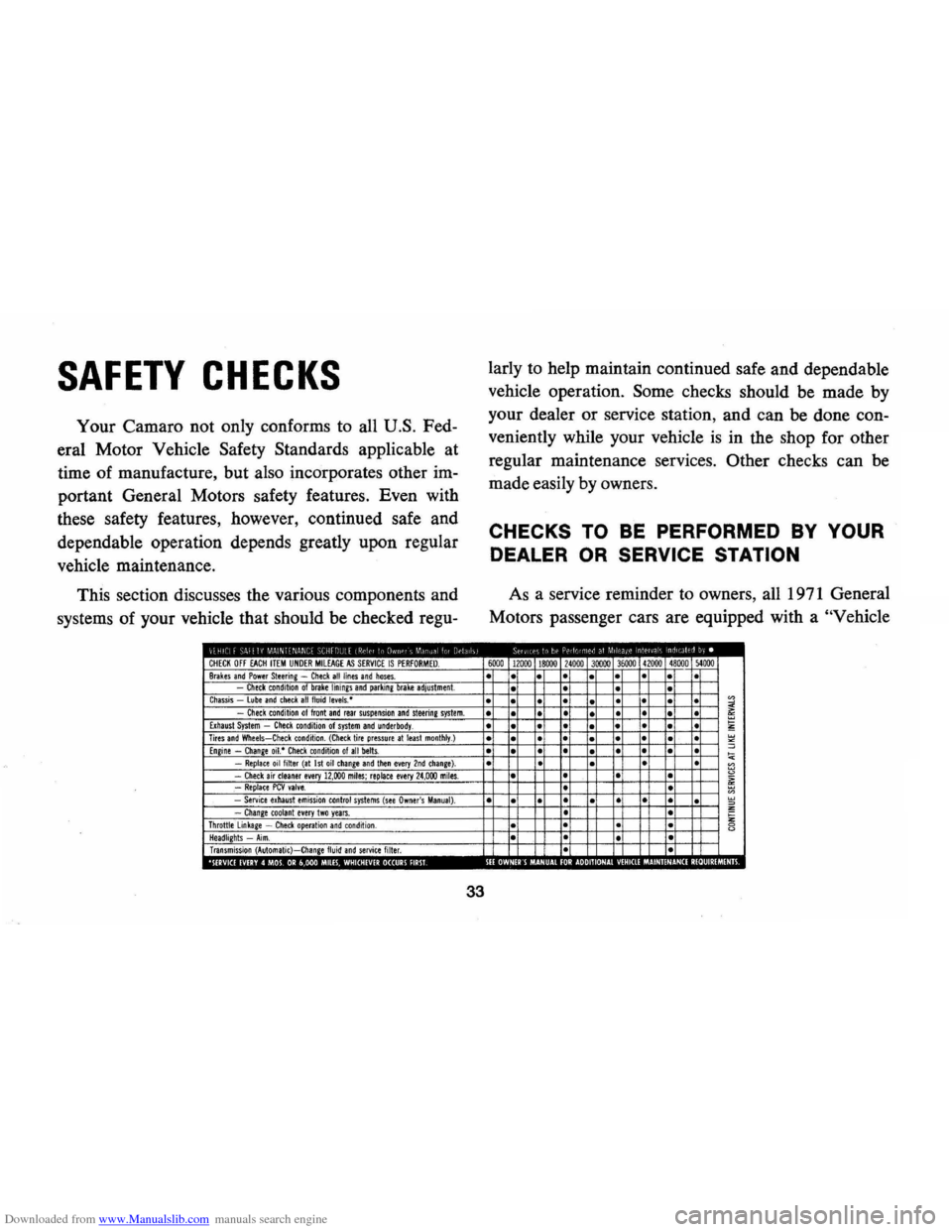
CHECK OFF EACH ITEM UNDER MIlEAGE AS SERVICE IS PERFORMED. Brakes and Power Steering -Check all lines and hoses. Check condition of brake linings and parking brake adjustment. Chassis lube and check all fluid levels,· Check condition of front and rear suspension and steerine system. Exhaust System -Check condition of system and underbody. Tires and Wheels-Check condition. (Check tire pressure at least monthly.) Engine -Change oil.· Check condition 01 all belts. -Replace oil filter (at 1st oil change and tllen every 2nd chanie). -Check air cleaner every 12,000 miles; replace every 24,000 miles. .-Replace PCV valve. -Service exhaust emission control systems (see Owner's Manual). -Change toolanl every Iwo years. Throttle linkage -Check operation and condition . Headlights -Aim. Transmission (Automatic)-Change fluid and service filter. 0 ,', III · 0
33
larly to help maintain continued safe and dependable
vehicle operation.
Some checks should be made by
your dealer or service station, and can be done con
veniently while your vehicle
is in the shop for other
regular maintenance services.
Other checks can be
made easily by owners.
CHECKS TO BE PERFORMED BY YOUR
DEALER OR SERVICE STATION
As a service reminder to owners, all 1971 General
Motors passenger cars are equipped with a
"Vehicle
6000 12000 18000 24000 30000 36000 41000 48000 )4000
• •
• •
• • • •
• • •
• •
• • • • • • •
• • • • • • • • • • •
• • • •
• • •
• •
• • • •
• • • • • • •
• • • • •
• •
• •
• • •
• •
• • • • •
• • • • • •
•
• • •
· • · •
• • • • •
• 0 o· 00 0 ·
0
Page 38 of 88
Downloaded from www.Manualslib.com manuals search engine TREAD STILL GOOD
-
TREAD
WORN OUT
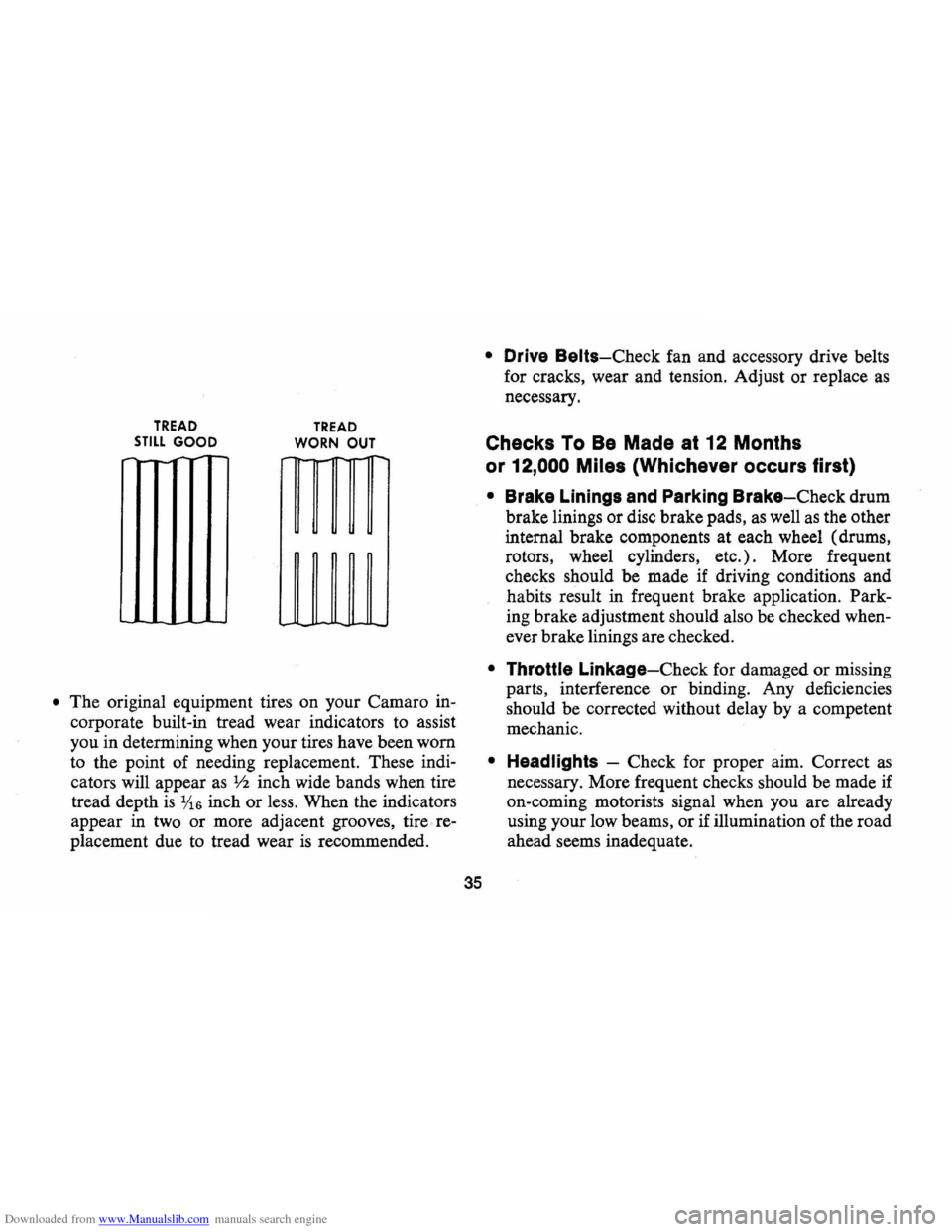
• The original equipment tires on your Camaro in
corporate built-in tread wear indicators to assist
you in detennining when your tires have been worn
to the point of needing replacement. These indi
cators will appear
as V2 inch wide bands when tire
tread depth
is 1;16 inch or less. When the indicators
appear in two or more adjacent grooves, tire re
placement due to tread wear
is recommended.
35
• Drive Belts-Check fan and accessory drive belts
for cracks, wear and tension. Adjust or replace
as
necessary.
Checks To Be Made at 12 Months
or
12,000 Miles (Whichever occurs first)
• Brake Linings and Parking Brake-Check drum
brake linings or disc brake pads,
as well as the other
internal brake components at each wheel (drums,
rotors, wheel cylinders, etc.) . More frequent
checks should be made if driving conditions and
habits result in frequent brake application. Park
ing brake adjustment should also be checked when
ever brake linings are checked.
• Throttle Linkage-Check for damaged or missing
parts, interference or binding. Any deficiencies
should be corrected without delay by a competent
mechanic.
• Headlights -Check for proper aim. Correct as
necessary. More frequent checks should be made if
on-coming motorists signal when you are already
using your low beams, or if illumination of the road
ahead seems inadequate.
Page 39 of 88
Downloaded from www.Manualslib.com manuals search engine For further details on the engine and transmission
items listed on the
"Vehicle Safety Maintenance
Schedule," and for other recommended maintenance,
refer
to the "Service and Maintenance" and "Air
Pollution. Control" Sections of this manual.
CHECKS lOBE PERFORMED
BY OWNER
Listed below are the safety checks that should be
made by the owner . These checks should be made at
least every 4 months or
6,000 miles, whichever occurs
first , or more often when so indicated . Any
deficien
cies should be brought to the attention of your dealer
or service station, so the advice of a qualified mech
anic is available regarding the need for repairs or
replacements.
• Anti-Theft Lock-Check for proper operation by
attempting to turn key to
LOCK position in the
various transmission gears with
car stationary. Key
should
tum to LOCK position only when trans
mission control is in PARK on automatic trans
mission models or in REVERSE on manual trans
mission models.
• Seat Belts-Check lap and shoulder belts as well
as buckles, retractors and anchors for loose con-
36
nections, damage and positive latching action.
• Windshield Wipers and Washers-Check con
dition and alignment of wiper blades. Check
amount and direction of fluid sprayed by washers
during use.
• Defrosters-Check performance by turning con
trols to "de-ice" and "Hi" fan speed and noting
amount of air directed against the windshield.
• Wheel Alignment and Balance-In addition to
abnormal tire wear the need for wheel alignment
service may be indicated by a pull to the right or
left when driving on a straight level road. The need
for wheel balancing may be indicated by a
vibra
tion at the steering wheel while driving.
• Parking Brake and "Park" Mechanism-Check
parking brake holding ability by parking on a fairly
steep hill and restraining the vehicle with the
parking brake only.
On cars with automatic trans
missions, check the holding ability of the "Park"
mechanism by releasing all brakes after the trans
mission selector lever has been placed in the "P"
position.
• Lights -Check license plate lights, side marker
lights , headlamps, parking lamps, tail lamps , brake
Page 48 of 88
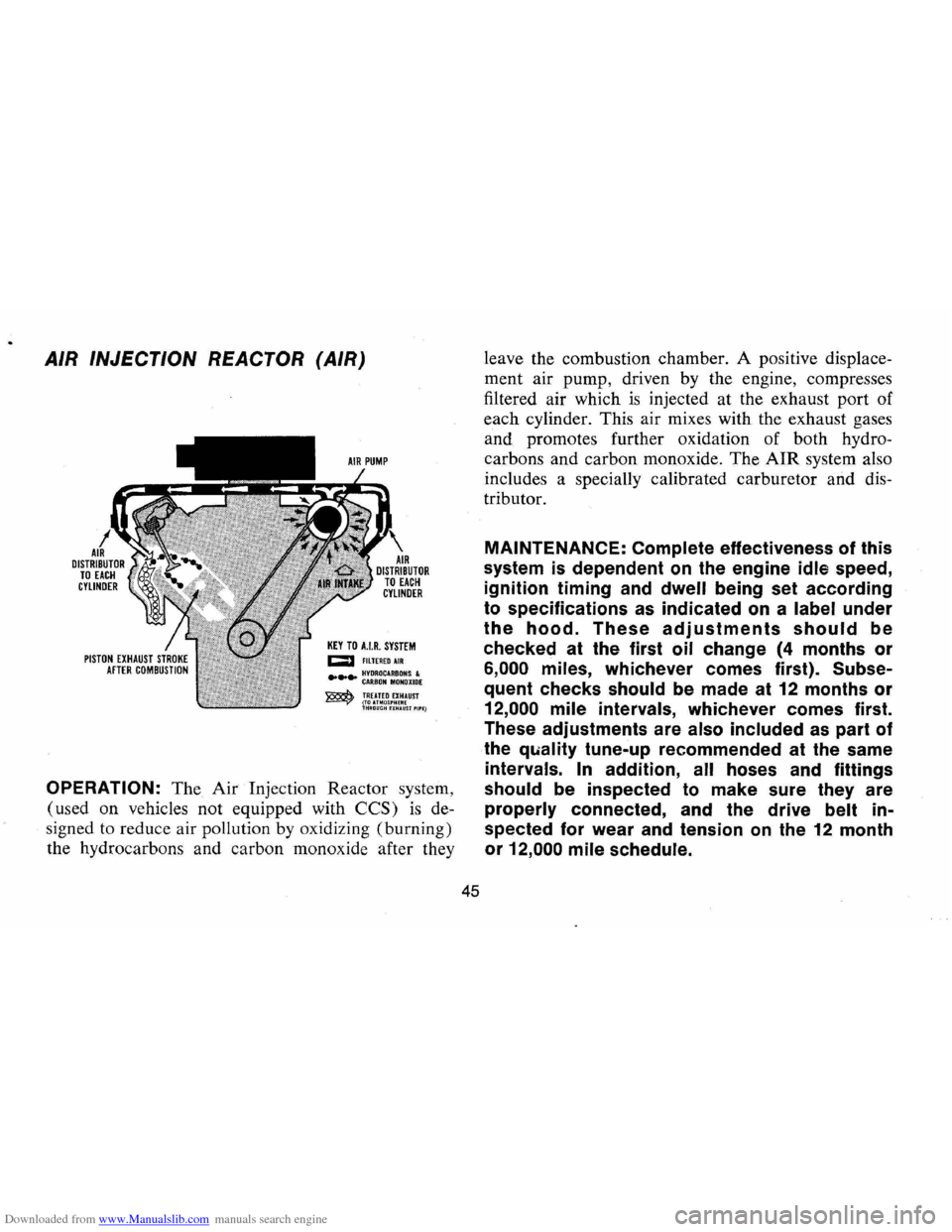
Downloaded from www.Manualslib.com manuals search engine AIR INJECTION REACTOR (AIR)
KEY TO HR. SYSTEM CJ F1LTEREDAIR
.... ~!~:~~A:~~~~I:E ~ TREATED EXHAUST ~(TOUMOS'HERE THMOUGHHHAlIST'II'E)
OPERATION: The Air Injection Reactor system,
(used on vehicles not equipped with
CCS) is de
signed to reduce air pollution by oxidizing (burning)
the hydrocarbons and carbon monoxide after they
45
leave the combustion chamber. A positive displace
ment air pump, driven by the engine, compresses
filtered air which
is injected at the exhaust port of
each cylinder. This air mixes with the exhaust gases
and promotes further oxidation of both hydro
carbons and carbon monoxide. The
AIR system also
includes a specially calibrated carburetor and dis
tributor.
MAINTENANCE: Complete effectiveness of this
system
is dependent on the engine idle speed,
ignition timing and
dwell being set according
to specifications as indicated on a label under
the hood. These adjustments should be
checked at the first oil change (4 months or
6,000 miles, whichever comes first). Subse
quent checks should be made at 12 months or
12,000 mile intervals, whichever comes first.
These adjustments are
also included as part of
the
quality tune-up recommended at the same
intervals. In addition, all hoses and fittings
should be inspected to make sure they are
properly connected, and the drive belt in
spected for wear
and tension on the 12 month
or
12,000 mile schedule.