stop start CHEVROLET CAMARO 1982 Repair Guide
[x] Cancel search | Manufacturer: CHEVROLET, Model Year: 1982, Model line: CAMARO, Model: CHEVROLET CAMARO 1982Pages: 875, PDF Size: 88.64 MB
Page 51 of 875

GM – CAMARO 1982-1992 – Repair Guide (Checked by WxMax) 51
shoes to rotate very slightly with the
drum, rocking an adjusting lever, thereby
causing rotation of the adjusting scr ew. Some drum brake systems are
designed to self-adjust duri ng application whenever the br akes are applied. This
on-board adjustment system reduces the need for maintenance adjustments
and keeps both the brake function and pedal feel satisfactory.
POWER BOOSTERS
Virtually all modern vehicles use a va cuum assisted power brake system to
multiply the braking force and reduce pedal effort. Since vacuum is always
available when the en gine is operating, the system is simple and efficient. A
vacuum diaphragm is located on the front of the master cylinder and assists the
driver in applying the brakes, reducing both the effort and travel he must put into
moving the brake pedal.
The vacuum diaphragm housing is normally connected to the intake manifold by
a vacuum hose. A check valve is placed at the point where the hose enters the
diaphragm housing, so that during periods of low manifold vacuum brakes
assist will not be lost.
Depressing the brake pedal closes o ff the vacuum source and allows
atmospheric pressure to enter on one side of the diaphragm. This causes the
master cylinder pistons to move and app ly the brakes. When the brake pedal is
released, vacuum is applied to both si des of the diaphragm and springs return
the diaphragm and master cylinder pist ons to the released position.
If the vacuum supply fails, the brake pedal rod will contact the end of the master
cylinder actuator rod and the system will apply the br akes without any power
assistance. The driver will notice that much higher pedal effort is needed to stop
the car and that the pedal f eels harder than usual.
VACUUM LEAK TEST
1. Operate the engine at idle without t ouching the brake pedal for at least one
minute.
2. Turn off the engine and wait one minute.
3. Test for the presence of assist va cuum by depressing the brake pedal and
releasing it several times. If vac uum is present in the system, light
application will produce less and less pedal travel. If there is no vacuum, air
is leaking into the system.
SYSTEM OPERATION TEST
1. With the engine OFF, pump the brake p edal until the supply vacuum is
entirely gone.
2. Put light, steady pressu re on the brake pedal.
3. Start the engine and let it idle. If the system is operating correctly, the brake
pedal should fall toward the floor if t he constant pressure is maintained.
Page 113 of 875

GM – CAMARO 1982-1992 – Repair Guide (Checked by WxMax) 113
1. Remove 2/3 of the brake fluid from the ma
ster cylinder. Raise the car.
Remove the wheel. Reinstall a wheel nut, with the flat side toward the rotor,
to hold the rotor in place.
2. Loosen the parking brake cable at the equalizer. At the caliper, remove the
parking brake cable, damper and spring from the lever.
3. Hold the parking brake lever and re move the lock nut. Remove the lever,
seal and anti-friction washer.
4. Position a C-clamp ov er the caliper and force the piston into its bore.
Remove the C-clamp. Rein stall the lever, seal and nut to the caliper.
5. Loosen the brake tube nut and disc onnect the brake tube from the caliper.
Plug the tube to prevent t he loss of brake fluid.
At the right rear wheel, it may be necessary to remove the rear bolt from the
lower control arm to allow the lower caliper mounting bolt to be removed.
6. Remove the mounting bolts using a
3/8 in. Allen head socket. Remove the
caliper and inspect the mounting bolts for corrosion. If necessary, replace
the mounting bolts.
To install:
7. Place the caliper onto the rotor and install the m ounting bolts. Torque the
mounting bolts to 30-45 ft . lbs. (40.7-61 Nm).
8. Install a new anti-friction washer and lubricate the lever with silicone brake
lube. Install the lever on the actuator with the lever pointing down. Rotate the
lever toward the front of the car and hol d while installing the nut. Torque the
nut to 30-40 ft. lbs. (40.7-54.2 Nm), then rotate the lever back against the
stop on the caliper.
9. Install damper and spring. Connect the parking brake cable. Tighten the
cable at the equalizer until the lever starts to move off the stop on the
caliper, then loosen the adjustment unt il the lever moves back against the
stop.
10. Remove the nut holding the rotor in place and install the wheel. Lower the
car and fill the master cylin der with brake fluid.
1989-92 MODELS
1. Raise and safely support the vehicle.
2. Loosen the parking brake cable at the equalizer.
3. Remove the wheel and tire assembly. Inst all 2 wheel nuts to retain the rotor.
4. Remove the bolt, inlet fitting and was hers from the caliper housing. Plug the
holes in the caliper housing and inlet fitting.
5. Remove the caliper lever return spri ng only if it is defective. Discard the
spring if the coils are opened.
6. Disconnect the parking brake cable from the caliper lever and caliper
bracket.
7. Remove the 2 caliper guide pin holes.
8. Remove the caliper housing from the rotor and mounting bracket.
To install:
Page 223 of 875

GM – CAMARO 1982-1992 – Repair Guide (Checked by WxMax) 223
FUSIBLE LINKS
In addition to circuit breakers and fuses,
the wiring harness incorporates fusible
links to protect the wiring. Links are used rather than a fuse, in wiring circuits
that are not normally fused, such as th e ignition circuit. The fusible links are
color coded red in the charging and load circuits to match the color coding of
the circuits they protect. Each link is four gauges smaller than the cable it
protects, and is marked on the insulation with the gauge size because the
insulation makes it appear heavier than it really is. The engine compartment
wiring harness has several fusible links. The same size wire with a special
Hypalon insulation must be used w hen replacing a fusible link.
For more details, see the information on fusible links at the beginning of this
section.
The links are located in the following areas:
1. A molded splice at the starter solenoid Bat terminal, a 14 gauge red wire.
2. A 16 gauge red fusible link at the j unction block to protect the unfused
wiring of 12 gauge or larger wire. This link stops at the bulkhead
connector.
3. The alternator warning light and fiel d circuitry is protected by a 20 gauge
red wire fusible link used in the batte ry feed-to-voltage regulator number
3 terminal. The link is installed as a molded splice in the circuit at the
junction block.
4. The ammeter circuit is protected by two 20 gauge fusible links installed
as molded splices in the circuit at t he junction block and battery to starter
circuit.
REPLACEMENT 1. Determine the circuit that is damaged.
2. Disconnect the negative battery terminal.
3. Cut the damaged fuse link from the harness and discard it.
4. Identify and procure the proper fuse link and butt connectors.
5. Strip the wire about
1/2 in. (13mm) on each end.
6. Connect the fusible link and crimp the butt connectors making sure that the wires are secure.
7. Solder each connection with resin core solder, and wrap the connections
with plastic electrical tape.
8. Reinstall the wir e in the harness.
9. Connect the negative battery terminal and test the system for proper
operation.
CIRCUIT BREAKERS
Various circuit breakers are located under the instrument panel. In order to gain
access to these components, it may be ne cessary to first remove the under
dash padding. Most of the circuit breakers are located in the convenience
center or the fuse panel.
Page 626 of 875

GM – CAMARO 1982-1992 – Repair Guide (Checked by WxMax) 626
ENGINE PERFORMANCE AND TUNE-UP
TUNE-UP PROCEDURES
In order to extract the full measure of performance and economy from your
engine it is essential that it is properly tuned at regul ar intervals. A regular tune-
up will keep your Camaro's engine running smoothly and will prevent the
annoying breakdowns and poor perform ance associated with an untuned
engine.
A complete tune-up should be performed every 30,000 miles (48,000 km). This
interval should be halved if the car is operated under severe conditions such as
trailer towing, prolonged idling, start-and- stop driving, or if starting or running
problems are noticed. It is assumed that the routine maintenance described in
General Information & Maintenance has been kept up, as this will have a
decided effect on the result s of a tune-up. All of the applicable steps of a tune-
up should be followed in order, as the result is a cumulative one.
If the specifications on the underhoo d tune-up sticker in the engine
compartment of your car disagree with th e "Tune-Up Specifications" chart in this
Section, the figures on the sticker must be used. The sticker often reflects
changes made during t he production run.
SPARK PLUGS
A typical spark plug consists of a metal shell surrounding a ceramic insulator. A
metal electrode extends downward through the center of the insulator and
protrudes a small distance. Located at the end of the plug and attached to the
side of the outer metal shell is the side el ectrode. The side electrode bends in at
a 90 angle so that its tip is just pas t and parallel to the tip of the center
electrode. The distance between these two electrodes (measured in
thousandths of an inch or hundredths of a millimeter) is called the spark plug
gap.
The spark plug does not pr oduce a spark, but instead provides a gap across
which the current can arc. The coil produces anywhere from 20,000 to 50,000
volts (depending on the type and application) which travels through the wires to
the spark plugs. The current passes along the center electrode and jumps the
gap to the side electrode, and in doing so, ignites the air/fuel mixture in the
combustion chamber.
Page 698 of 875

GM – CAMARO 1982-1992 – Repair Guide (Checked by WxMax) 698
5. Disconnect and plug hose to canister purge port.
6. Disconnect and plug hose to idle load compensator.
7. Back out idle stop screw
on carburetor 3 turns.
8. Turn air conditioning OFF.
9. Block drive wheels, set parki ng brake, place transmission in P, start and
warm engine to normal operating temperature. Make certain choke is
OPEN .
10. With engine RUNNING place transmission in D and idle load
compensator fully extended (no vacuum applied). Using tool J-29607, or
equivalent, adjust plunger to obtain 650-750 rpm. Locknut on plunger
must be held with a wrench to prevent damage to guide tabs.
11. Measure distance from the locknut to tip of the plunger. This distance
must not exceed 1 in. (25mm). If it does check for low idle condition.
12. Reconnect vacuum hose to idle load compensator and observe idle
speed.
13. Idle speed should be between 425-475 rpm in D.
14. If idle speed is correct no further adjustment is necessary, proceed to the
next step. If idle speed is still incorrect continue as follows:
It may be necessary to remove the idle load compensator from the engine
unless a hex key wrench is m odified to clear obstructions.
a. Stop engine, remove rubber cap from the center outlet tube.
b. Using a 0.90 in. (23mm) hex wrench, insert through open center tube to
engage idle speed adjusting screw.
c. If idle speed was low, turn t he adjusting screw counterclockwise
approximately 1 turn for every 85 rpm low. If idle speed was high turn
screw 1 turn for every 85 rpm high.
15. Disconnect and plug vacuum hose to the idle load compensator.
16. Using a hand pump, apply vacuum to the idle load compensator until fully
retracted.
17. Adjust the idle stop screw on carburetor float bowl to obtain 450 rpm in
D .
18. Place transmission in P and stop engine.
19. Reconnect the idle load compensator.
20. Reconnect all vacuum hoses.
21. Install air cleaner and gasket. Remove wheel blocks.
Page 719 of 875

GM – CAMARO 1982-1992 – Repair Guide (Checked by WxMax) 719
11. Lubricate the new large O-ring with cl
ean engine oil and install it directly
over the backup washer. Be sure t he O-ring is seated properly and is
flush with the top of the fuel meter body surface.
12. Lubricate the new small O-ring with clean engine oil and install it on the
nozzle end of the injector. Push t he O-ring on far enough to contact the
filter.
WARNING - Do not attempt to reverse this procedure and install the backup
washer and O-ring after the injector is located in the cavity. To do so will
prevent proper seating of the O-ring in th e cavity recess which could result in a
fuel leak and possible fire.
13. Install the injector by aligning the raised lug on the injector base with the
notch cast into the fuel meter body . Push down on the injector making
sure it is fully seated in the cavity. In jector installation is correct when the
lug is seated in the notch and the electrical terminals are parallel to the
throttle shaft.
14. Using new gaskets on the fuel mete r cover and a new dust seal, install
the cover to the fuel meter body. Use an appropriate thread locking
compound on the cover attaching screws.
15. Connect the injector electrical c onnector by pushing straight down until
seated firmly in place.
16. Connect the negative battery cable.
17. With the engine OFF and the igniti on ON, check for fuel leaks.
18. Install the air cleaner.
ADJUSTMENTS
MINIMUM IDLE SPEED
Minimum idle speed should only be adjus ted when installing a replacement
throttle body. The idle stop screw is used to regulate the minimum idle speed of
the engine. The throttle body is adjusted at the factory, then covered with a cap
or plug to discourage unnecessary readjustment.
2.5L ENGINES 1. Remove the air cleaner and pl ug the THERMAC vacuum port.
2. Disconnect the TV cable from the th rottle control bracket to allow access
to the idle adjustment screw.
3. Remove the throttle stop screw plug or cap.
4. Connect a tachometer to the engine.
5. Disconnect the Idle Air Control (IAC) valve connector.
6. Start the engine with the transmi ssion in PARK (auto transmission) or
NEUTRAL (manual transmission) and allow the engine speed to
stabilize. All accessories (A/C, rear defogger, etc.) should be OFF.
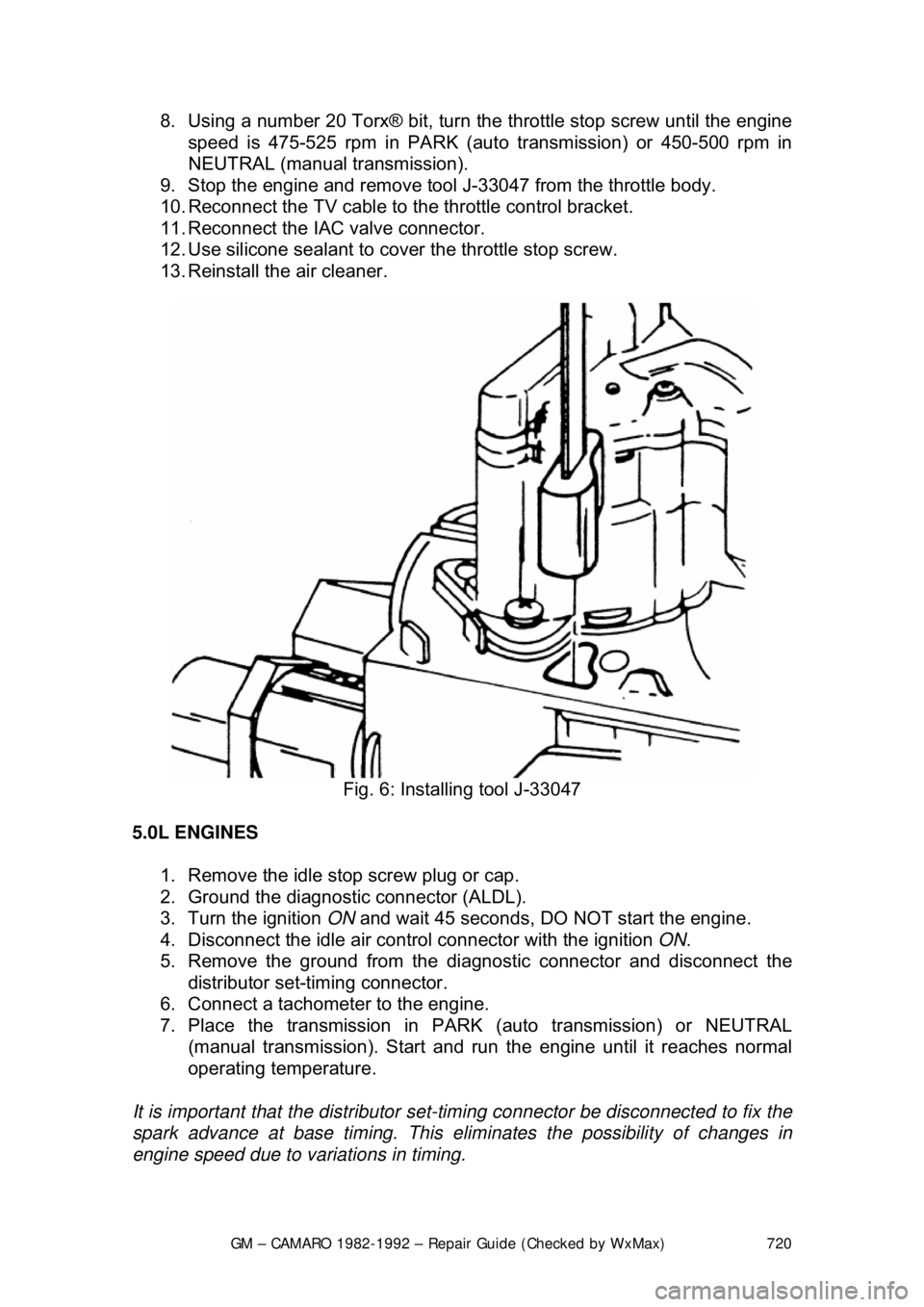
7. Install tool J-33047 in t he idle air passage of the throttle body. Be certain
that the tool seats fully in t he passage and no air leaks exist.
Page 720 of 875
GM – CAMARO 1982-1992 – Repair Guide (Checked by WxMax) 720
8. Using a number 20 Torx® bit, turn
the throttle stop screw until the engine
speed is 475-525 rpm in PARK (aut o transmission) or 450-500 rpm in
NEUTRAL (manual transmission).
9. Stop the engine and remove tool J-33047 from the throttle body.
10. Reconnect the TV cable to the throttle control bracket.
11. Reconnect the IAC valve connector.
12. Use silicone sealant to co ver the throttle stop screw.
13. Reinstall the air cleaner.
Fig. 6: Installing tool J-33047
5.0L ENGINES 1. Remove the idle stop screw plug or cap.
2. Ground the diagnostic connector (ALDL).
3. Turn the ignition ON and wait 45 seconds, DO NOT start the engine.
4. Disconnect the idle air control connector with the ignition ON.
5. Remove the ground from the di agnostic connector and disconnect the
distributor set-timing connector.
6. Connect a tachometer to the engine.
7. Place the transmission in PARK (auto transmission) or NEUTRAL
(manual transmission). Start and run the engine until it reaches normal
operating temperature.
It is important that the distributor set- timing connector be disconnected to fix the
spark advance at base timing. This elim inates the possibility of changes in
engine speed due to variations in timing.
Page 721 of 875
GM – CAMARO 1982-1992 – Repair Guide (Checked by WxMax) 721
8. The idle speed should be 450-500 rpm, adjust as necessary.
WARNING - Correct minimum idle speed adj ustment is critical to vehicle
performance and component durability. Incorrect minimum idle speed
adjustment (too high) will caus e the IAC valve pintle to constantly bottom in it's
seat and result in early valve failure. If minimum idle speed is adjusted too low,
the vehicle may not start in cold weather or may stall during warm-up.
Turn the ignition OFF and reconnect the IAC motor connector.
9. Reconnect the distributor set-timing connector.
10. Use silicone sealant to co ver the throttle stop screw.
THROTTLE POSITION SENSOR (TPS)
1982-1983 2.5L TBI engines ar e equipped with an adjustable throttle position
sensor. This procedure should only be performed after replacing the TPS or
diagnosis leads to incorrect TPS adjustment.
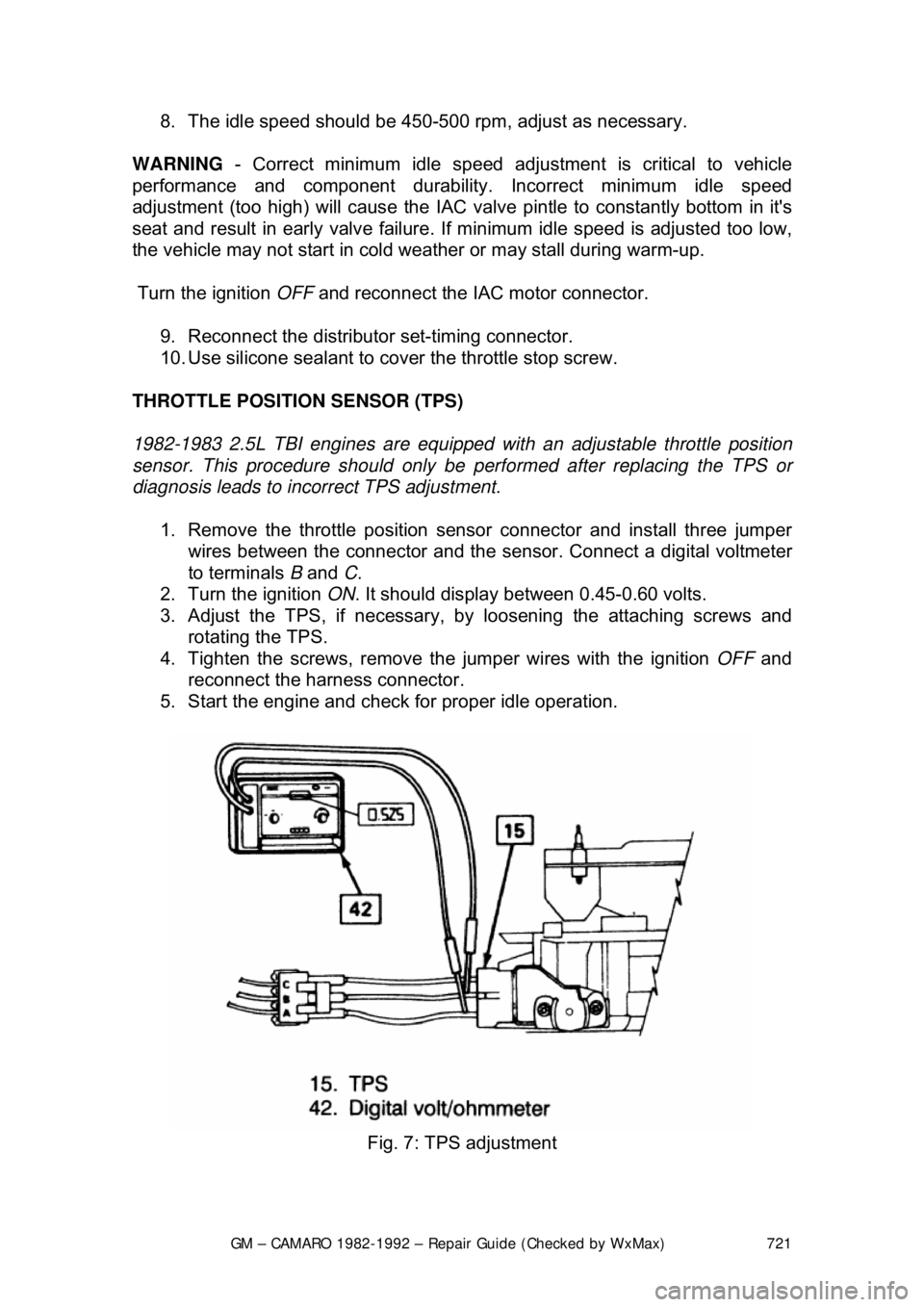
1. Remove the throttle position sensor connector and install three jumper wires between the connector and the s ensor. Connect a digital voltmeter
to terminals B and C.
2. Turn the ignition ON. It should display bet ween 0.45-0.60 volts.
3. Adjust the TPS, if necessary, by loosening the attaching screws and
rotating the TPS.
4. Tighten the screws, remove the jumper wires with the ignition OFF and
reconnect the harness connector.
5. Start the engine and check fo r proper idle operation.
Fig. 7: TPS adjustment
Page 726 of 875

GM – CAMARO 1982-1992 – Repair Guide (Checked by WxMax) 726
RELIEVING FUEL SYSTEM PRESSURE
1. Remove the fuse marked "Fuel Pu mp" from the fuse block in the
passenger compartment.
2. Crank the engine. Th e engine will start and run until the fuel supply
remaining in the lines is exhauste d. When the engines stops, engage the
starter again for three seconds to a ssure dissipation of any remaining
pressure.
3. With the ignition OFF, disconnect the negative battery cable to prevent
fuel discharge if the key is accidentally turned to the ON position.
Replace the fuse with the ignition OFF.
When disconnecting fuel lines, there ma y still be a small amount of fuel
released. Cover the fuel line connection wi th a shop cloth to collect the fuel,
then place the cloth in an approved container.
ELECTRIC FUEL PUMP
REMOVAL & INSTALLATION
The removal and installation procedures fo r the Crossfire injection system fuel
pump is identical to the Throttle Body In jection (TBI) system. Please refer to the
TBI fuel pump procedures earlier in this repair guide.
TESTING
The testing procedures for the Crossfire in jection system fuel pump is identical
to the Throttle Body Injection (TBI) syst em. Please refer to the TBI fuel pump
procedures earlier in this repair guide.
THROTTLE BODY
REMOVAL & INSTALLATION
FRONT UNIT
1. Relieve the fuel system pressure.
2. Remove the air cleaner assembly, noting the connection points of the
vacuum lines.
3. Detach the electrical connectors at the injector and the idle air control
motor.
4. Disconnect the vacuum lines from the TBI unit, noting the connection
points. During installation, refer to the underhood emission control
information decal for vacuum line routing information.
5. Disconnect the transmission det ent cable from the TBI unit.
6. Disconnect the fuel inlet (feed) and fuel balance line connections at the
front TBI unit.
7. Remove and discard the throttle cont rol rod retaining clip from the front
TBI throttle lever stud. A new clip must be used during reassembly.
8. Unbolt and remove the TBI unit.
Page 732 of 875

GM – CAMARO 1982-1992 – Repair Guide (Checked by WxMax) 732
MINIMUM IDLE AND THROTTL
E VALVE SYNCHRONIZING
The throttle position of each throttle body must be balanced so that the throttle
plates are synchronized and open si multaneously. These adjustment
procedures must be followed AFTER performing the "Preliminary Adjustments".
1. Remove the air cleaner and plug the vacuum port on the rear TBI unit for
the thermostatic air cleaner.
2. Remove the tamper resistant pl ugs covering both unit throttle stop
screws, if necessary.
3. Block the drive wheels and apply the parking brake.
4. Connect a tachometer to measure rpm.
5. Start the engine and allo w the engine rpm to stabilize at normal operating
temperature.
6. Have a helper apply the brakes and place the transmission in DRIVE.
7. Plug the idle air pass ages of each throttle body with plugs (J-33047 or
equivalent). Make sure the plugs are seated fully in the passage so that
no air leaks exist. The engine rpm should decrease below curb idle
speed. If the engine rpm does not decreas e, check for a vacuum leak.
8. Remove the cap from the ported tube on the rear TBI unit and connect a
vacuum gauge or water manometer.
9. Adjust the rear unit throttle stop screw to obtain approximately
1/2 in. Hg
as read on the vacuum gauge, or 6 in. H
2O as read on the manometer. If
not able to adjust to this level, check that the front unit throttle stop is not
limiting throttle travel.
10. Remove the vacuum gauge or manometer from t he rear unit and install
the cap on the port ed vacuum tube.
11. Remove the cap from the ported va cuum tube on the front TBI unit and
install the gauge or manomet er as before. If the reading is not the same
as the rear unit, proceed as follows: a. Locate the throttle synchronizing screw and collar on the front TBI
unit. The screw may be welded to discourage tampering with this
adjustment. Break the weld, if ne cessary, and install a new screw
with a thread seali ng compound applied.
b. Adjust the screw to obtain approximately
1/2 in. Hg as read on the
vacuum gauge, or 6 in. H
2O on the manometer.
12. Remove the gauge or manometer fr om the ported tube and reinstall the
cap.
13. Adjust the rear throttle stop screw to obtain 475 rpm, with the
transmission in D and the parking brake applied. On manual
transmission models, leave the gear selector in N.
14. Turn the ignition OFF and pl ace automatic transmission in N.
15. Remove idle air passage plugs.
16. Start the engine. It may run at a high rpm but the engine speed should
decrease when the idle air control va lves close the air passages. Stop
the engine when the rpm decreases.
17. The throttle position sensor (TPS) voltage should be checked and adjusted, if necessary.
18. Connect the vacuum line to the TBI unit and install the air cleaner.
19. Reset the idle speed control motors by driving the vehicle to 45 mph.