lock CHEVROLET CAMARO 1993 Workshop Manual
[x] Cancel search | Manufacturer: CHEVROLET, Model Year: 1993, Model line: CAMARO, Model: CHEVROLET CAMARO 1993Pages: 358, PDF Size: 15.6 MB
Page 152 of 358
Your Driving and the Road
Steering in Emergencies
There are times when steering can be
more effective than braking. For example,
you come over a
hill and find a truck
stopped
in your lane, or a car suddenly
pulls out from nowhere, or a child darts
out from between parked cars and stops
right
in front of you. You can avoid these
problems by braking
- if you can stop in
time. But sometimes you can’t; there isn’t
room. That’s the time for evasive action
- steering around the problem. Your
Chevrolet can perform very well
in
emergencies like these. First apply your
brakes. It is better
to remove as much
speed as you can from a possible
collision. Then steer around the problem,
to the left or right depending on the space
available.
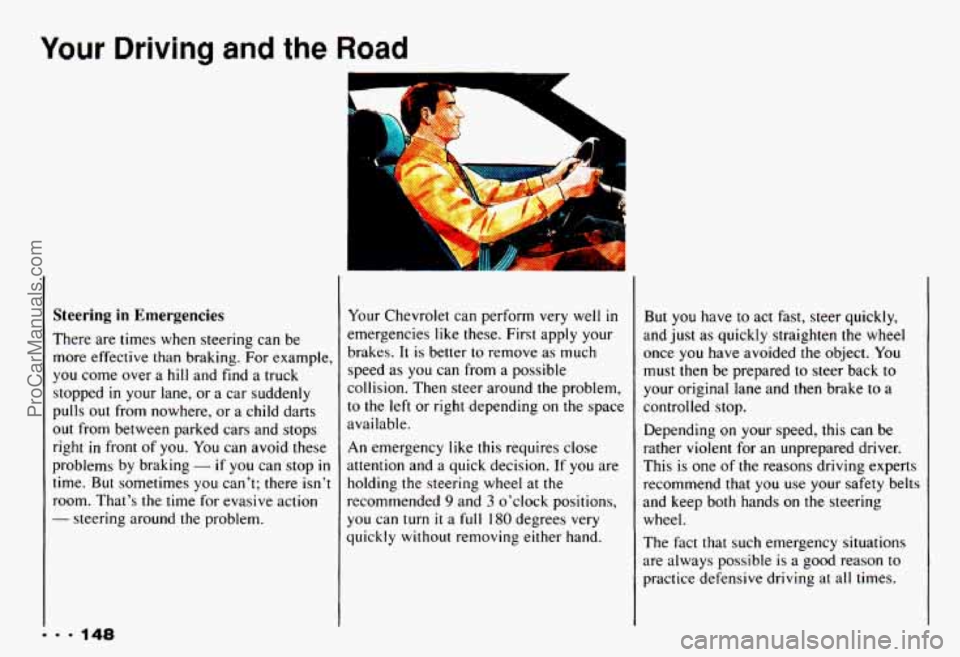
An emergency like this requires close
attention and a quick decision. If you are
holding the steering wheel at the
recommended
9 and 3 o’clock positions,
you can
turn it a full 180 degrees very
quickly without removing either hand.
But you have to act fast, steer quickly,
and just as quickly straighten the wheel
once you have avoided the object.
You
must then be prepared to steer back to
your original lane and then brake to a
controlled stop.
Depending on your speed, this can be
rather violent for an unprepared driver.
This is one of the reasons driving experts
recommend that you use your safety belts
and keep both hands on the steering
wheel.
The fact that such emergency situations
are always possible is a good reason
to
practice defensive driving at all times.
ProCarManuals.com
Page 156 of 358
Your Driving and the Road
The three types of skids correspond to
your Chevrolet’s three control systems. In
the braking skid your wheels aren’t
rolling. In the steering or cornering skid,
too much speed or steering in a curve
causes tires to slip and lose cornering
force. And
in the acceleration skid too
much throttle causes the driving wheels to
spin.
A cornering skid and an acceleration skid
are best handled by easing your foot off
the accelerator pedal. If your vehicle
starts to slide (as when you turn a corner
on a wet, snow- or ice-covered road),
ease your
foot off the accelerator pedal as
soon as you feel the vehicle start to slide.
Quickly steer the way
you want the vehicle to
go. If you
start steering quickly
enough, your vehicle will straighten out.
As it does, straighten the front wheels.
Of course, traction
is reduced when water,
snow, ice, gravel, or other material is on
the road. For safety, you’ll want to
slow
down and adjust your driving to these
conditions. It is important to slow down
on slippery surfaces because stopping
distance will be longer and vehicle control more limited. While
driving on a surface
with reduced
traction,
try your best to avoid sudden
steering, acceleration, or braking
(including engine braking by shifting to a
lower gear). Any sudden changes could
cause the tires to slide.
You may not
realize the surface is slippery until your
vehicle is skidding. Learn to recognize
warning clues
- such as enough
water, ice or packed snow on the road to
make
a “mirrored surface” - and slow
down when you have any doubt.
Remember:
Any anti-lock braking system
(ABS) helps avoid only the braking skid.
Steer the way you want to go.
ProCarManuals.com
Page 158 of 358
Your Driving and the Road
But if you’re driving, don’t wear
sunglasses at night. They may cut down
on glare from headlights, but they also
make a lot
of things invisible that should
remain visible
- such as parked cars,
obstacles, pedestrians,
or even trains
blocking railway crossings. You may
want to put
on your sunglasses after you
have pulled into a brightly-lighted service
or refreshment area. Eyes shielded from
that glare may adjust more quickly to
darkness back on the road. But be sure to
remove your sunglasses before you leave
the service
area.-^-
You can be temporarily blinded by
approaching lights.
It can take a second or
two, or even several seconds, for your
eyes to readjust to the dark. When you are
faced with severe glare (as from a driver
who doesn’t lower the high beams, or a
vehicle
with misaimed headlights), slow
down a
little. Avoid staring directly into
the approaching lights. If there is a line of
opposing traffic, make occasional glances
over the line
of headlights to make certain
that one
of the vehicles isn’t starting to
move into
your lane. Once you are past
the bright lights, give your eyes time to
readjust before resuming speed.
High Beams
[f the vehicle approaching you has its
high beams on, signal
by flicking yours to
high and then back to low beam. This is
:he usual signal to lower the headlight
beams. If the other driver
still doesn’t
lower the beams, resist the temptation
to
put your high beams on. This only makes
two half-blinded drivers.
On a freeway, use your high beams only
in remote areas where you won’t impair
approaching drivers. In some places, like
Zities, using high beams is illegal.
ProCarManuals.com
Page 173 of 358
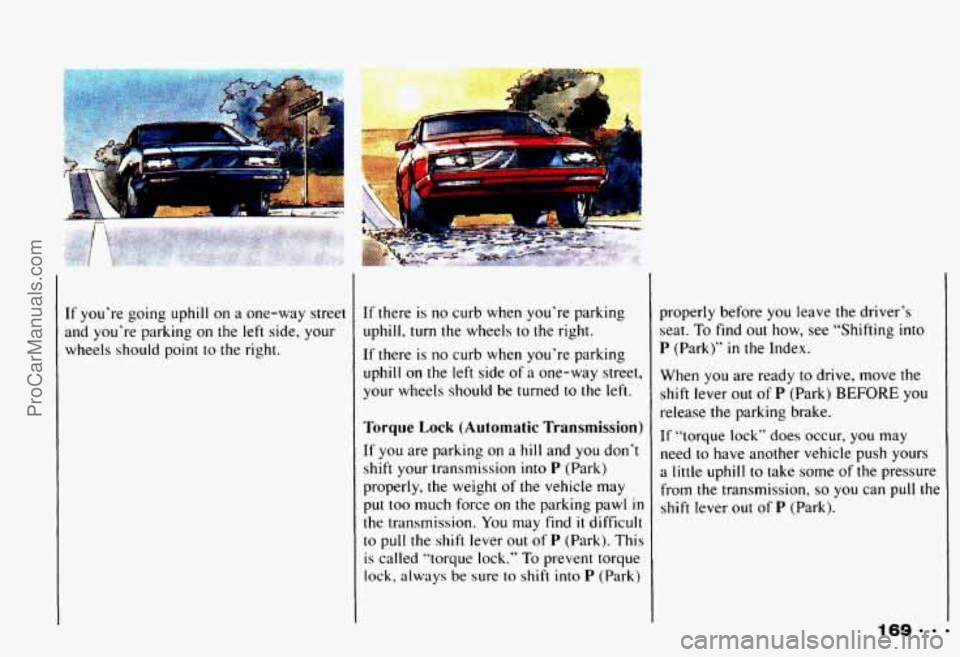
If you’re going uphill on a one-way street
and you’re parking on the left side, your wheels should point to the right. If there is no curb when you’re parking
uphill, turn the wheels
to the right.
If there is no curb when you’re parking
uphill on the left side of a one-way street,
your wheels should be turned to the left.
Torque Lock (Automatic Transmission)
If you are parking on a hill and you don’t
shift your transmission into
P (Park)
properly, the weight
of the vehicle may
put
too much force on the parking pawl in
the transmission. You may find it difficult
to pull the
shift lever out of P (Park). This
is called “torque lock.” To prevent torque
lock, always
be sure to shift into P (Park) properly before
you leave the driver’s
seat.
To find out how, see “Shifting into
P (Park)” in the Index.
When you are ready to drive, move the
shift lever out of
P (Park) BEFORE you
release the parking brake.
If “torque lock” does occur, you may
need to have another vehicle push yours
a little uphill to take some of the pressure
from the transmission,
so you can pull the
shift lever out of
P (Park).
ProCarManuals.com
Page 175 of 358
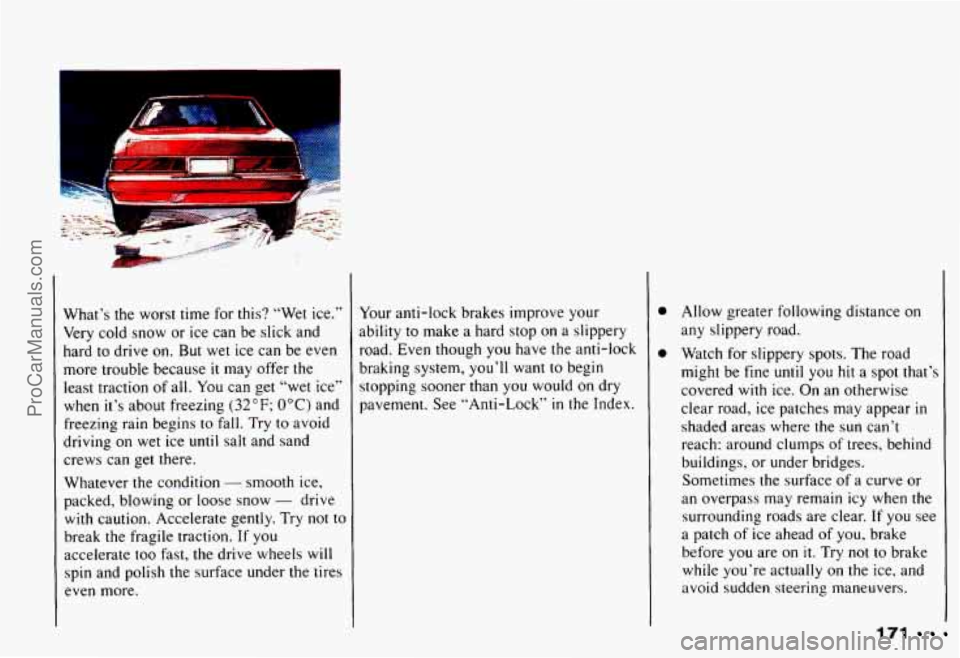
What’s the worst time for this? “Wet ice.”
Very cold snow or ice can be slick and
hard
to drive on. But wet ice can be even
more trouble because
it may offer the
least traction
of all. You can get “wet ice”
when it’s about freezing
(32°F; OOC) and
freezing
rain begins to fall. Try to avoid
driving on wet ice
until salt and sand
crews can get there.
Whatever
the condition - smooth ice,
packed, blowing or loose snow
- drive
with caution. Accelerate gently. Try not to
break the fragile traction. If you
accelerate
too fast, the drive wheels will
spin and polish the surface under the tires
even more. Your
anti-lock brakes improve your
ability
to make a hard stop on a slippery
road. Even though you have the anti-lock
braking system, you’ll want to begin
stopping sooner than you would on
dry
pavement. See “Anti-Lock” in the Index.
0
0
Allow greater following distance on
any slippery road.
Watch for slippery spots. The road
might be fine
until you hit a spot that’s
covered
with ice. On an otherwise
clear road, ice patches
may appear in
shaded areas where the sun can’t
reach: around clumps of trees, behind
buildings, or under bridges.
Sometimes
the surface of a curve or
an overpass may remain icy when the
surrounding roads are clear.
If you see
a patch of ice ahead of you, brake
before you are on
it. Try not to brake
while you’re actually on the ice, and
avoid sudden steering maneuvers.
171
ProCarManuals.com
Page 176 of 358
Your Driving and the Road
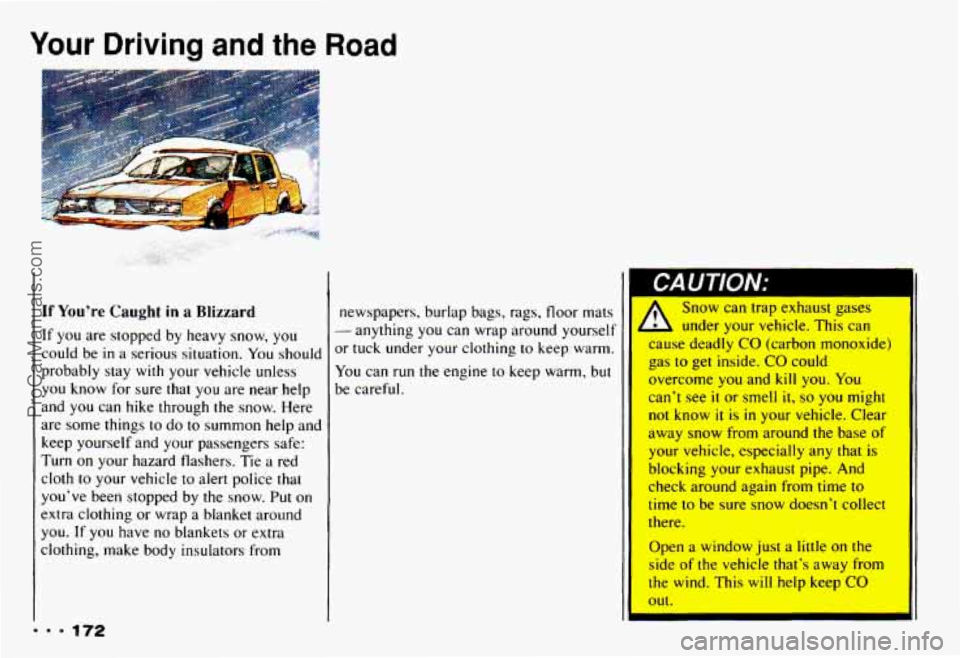
If You’re Caught in a Blizzard
If you are stopped by heavy snow, you
could be
in a serious situation. You should
probably stay
with your vehicle unless
you know for sure that you are near
help
and you can hike through the snow. Here
are some things to
do to summon help and
keep yourself and your passengers safe:
Turn on your hazard flashers. Tie a red
cloth to your vehicle
to alert police that
you’ve been stopped
by the snow. Put on
extra clothing or wrap a blanket around
you.
If you have no blankets or extra
clothing, make body insulators from newspapers, burlap bags, rags, floor mats
- anything
you can wrap around yourself
or tuck under your clothing to keep warm.
You can run the engine to keep warm, but
be careful. Snow can trap exhaust gases
L under your vehicle.
This can
cause deadly
CO (carbon monoxide)
gas to get inside. CO could
overcome you and
kill you. You
can’t see it or smell it, so you might
not know
it is in your vehicle. Clear
away snow from around the base of
your vehicle, especially any that is
blocking your exhaust pipe.
And
check around again from time to
time
to be sure snow doesn’t collect
there.
Open a window just a little on the
side
of the vehicle that’s away from
the wind. This
will help keep CO
out. I
m.. 172
ProCarManuals.com
Page 181 of 358
Here are some rules to follow:
0
Will you have to make any holes in
the body of your vehicle when you
install a trailer hitch?
If you do, then
be sure to seal the holes later when
you remove the
hitch. If you don't
seal them, deadly carbon monoxide
(CO) from your exhaust can get into
your vehicle (see "Carbon Monoxide"
in the Index). Dirt and water can, too.
The bumpers on your vehicle are not
intended for hitches.
Do not attach
rental hitches or other bumper-type
hitches
to them. Use only a
frame-mounted hitch that does not
attach
to the bumper.
Safety Chains
You should always attach chains between
your vehicle and your trailer. Cross the
safety chains under the tongue
of the
trailer
so that the tongue will not drop to
the road
if it becomes separated from the
hitch. Instructions about safety chains
may be provided by the hitch
manufacturer or by the trailer
manufacturer. Follow the manufacturer's
recommendation for attaching safety
chains. Always leave just enough slack
so
you can turn with your rig. And, never
a Jlow safety chains to drag on the ground.
Trailer Brakes
If your trailer weighs more than 1,000
pounds (450 kg) loaded, then it needs its
own brakes
- and they must be adequate.
Be sure
to read and follow the instructions
for the trailer brakes
so you'll be able to
install, adjust and maintain them properly.
Because you have anti-lock brakes, do
not
try to tap into your vehicle's brake
system. If you
do, both brake systems
won't
work well, or at all.
Driving with a Trailer
Towing a trailer requires a certain amount
of experience. Before setting out for the
open road, you'll want to get to know
your rig. Acquaint yourself
with the feel
of handling and braking with the added
ProCarManuals.com
Page 192 of 358
Problems an the Road
Fans or other moving engine
eep your hands away from moving
-u-ts once the engines are running.
L parts can injure you badly.
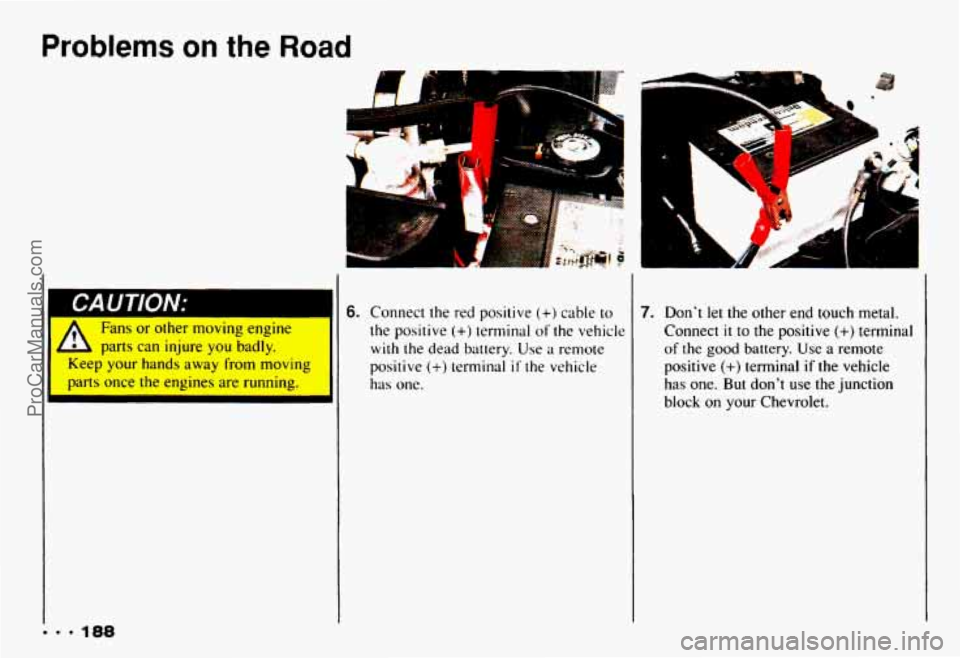
6. Connect the red positive (+) cable to
the positive
(+) terminal of the vehicle
with the dead battery. Use a remote
positive
(+) terminal if the vehicle
has one,
I
7. Don't let the other end touch metal.
Connect
it to the positive (+) terminal
of the good battery. Use a remote
positive
(+) terminal if the vehicle
has one.
But don't use the junction
block on your Chevrolet.
ProCarManuals.com
Page 195 of 358
When your vehicle is being towed, have
the ignition
key off. The steering wheel
should be clamped
in a straight-ahead
position,
with a clamping device designed
for towing service.
Do not use the
vehicle’s steering column lock for this.
The transmission should be in Neutral
and the parking brake released.
Don’t have your vehicle towed on the rear
wheels, unless you must.
If the vehicle
must be towed on the rear wheels, don’t
EO more than 35 mDh (55 kmh) or I
CAUTION:
RA
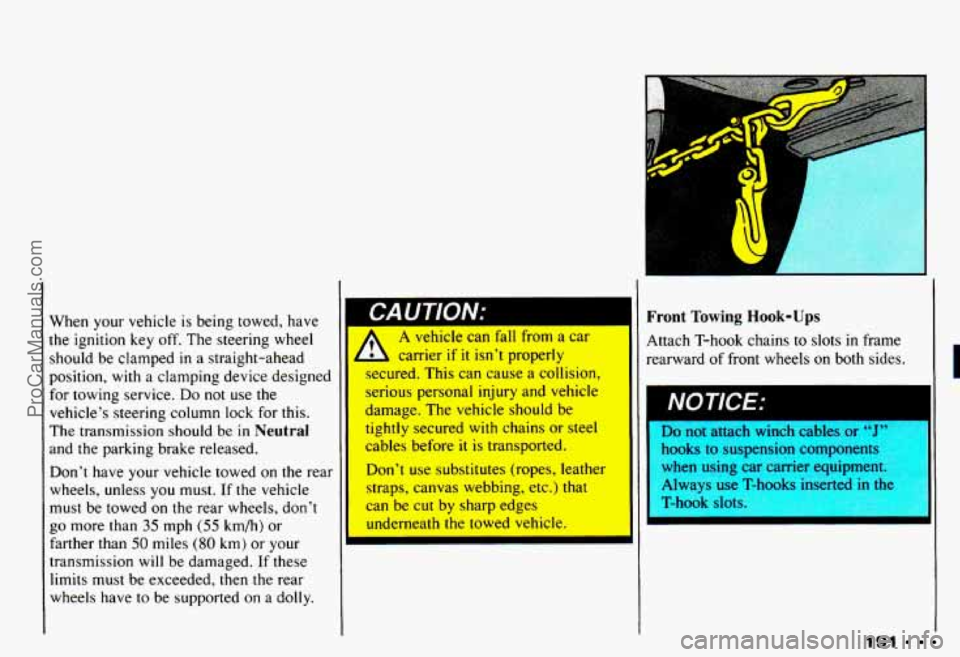
I Front Towing Hook-Ups
A vehicle can fall from a car
Attach T-hook chains to slots in frame
carrier if
it isn’t properly rearward of front wheels on both sides.
secured. This can cause a collision,
tightly secured with chains or steel
cables before
it is transported.
Don’t
use substitutes (ropes, leather
straps, canvas webbing, etc.) that
can be cut by sharp edges
underneath the towed vehicle.
Farther than
50 miles (80 km j or your
transmission
will be damaged. If these
limits must be exceeded, then
the rear
wheels have to be supported on
a dolly.
I.
I
Do not attach winch cables or
1 hooks to suspension components
en using car carrier equipment
I Always use T-hooks inserted in the
I I
I T-hook slots. II
191 ProCarManuals.com
Page 212 of 358
Problems on the Road
H
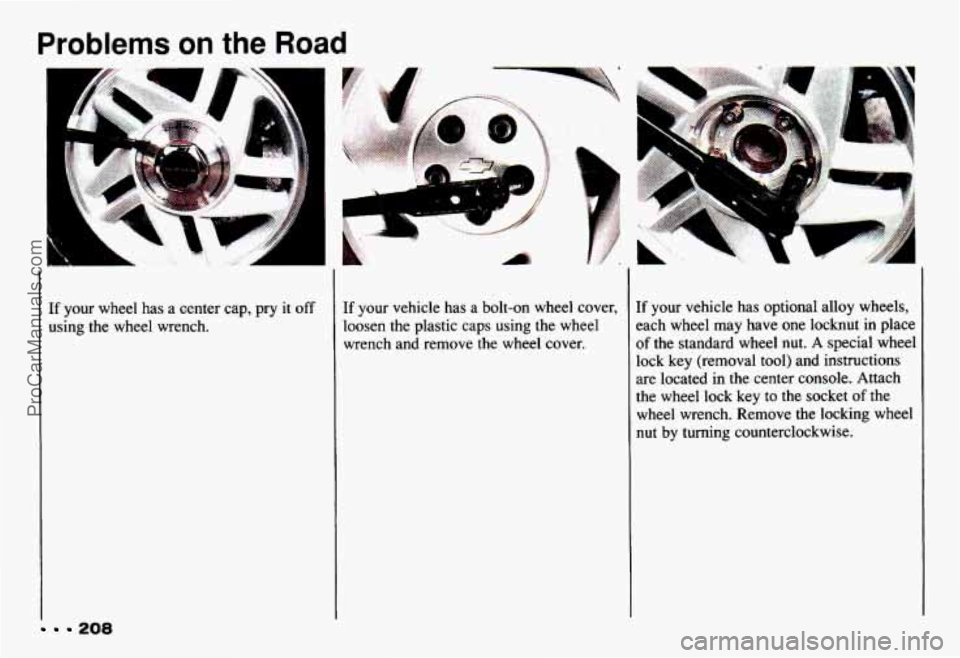
If your wheel has a center cap, pry it off
using the wheel wrench.
208
If your vehicle has a bolt-on wheel cover,
loosen the plastic caps using the wheel
wrench and remove the wheel cover. If your vehicle has optional alloy wheels,
each wheel may have one locknut in place
of the standard wheel nut. A special wheel
lock key (removal tool) and instructions
are located in the center console. Attach
the wheel lock key to the socket
of the
wheel wrench. Remove the locking wheel
nut by turning counterclockwise.
ProCarManuals.com