wiper blades CHEVROLET CLASSIC 2005 Owners Manual
[x] Cancel search | Manufacturer: CHEVROLET, Model Year: 2005, Model line: CLASSIC, Model: CHEVROLET CLASSIC 2005Pages: 320, PDF Size: 4.86 MB
Page 98 of 320
HI (High Speed):Move the lever up to the second
setting past INT, for wiping at high speed.
MIST:Move the lever all the way down to MIST for a
single wiping cycle. Hold it there until the windshield
wipers start; then let go. The windshield wipers will
stop after one wipe. If you want more wipes, hold the
band on mist longer.
Remember that damaged wiper blades may prevent
you from seeing well enough to drive safely. To avoid
damage, be sure to clear ice and snow from the
wiper blades before using them.
If they are frozen to the windshield, carefully loosen or
thaw them. If your blades do become damaged, get
new blades or blade inserts.
Heavy snow or ice can overload your wiper motor.
A circuit breaker will stop the motor until it cools.
Clear away snow or ice to prevent an overload.Cruise Control
With cruise control, you can maintain a speed of about
25 mph (40 km/h) or more without keeping your foot
on the accelerator. This can really help on long
trips. Cruise control does not work at speeds below
25 mph (40 km/h).
{CAUTION:
Cruise control can be dangerous where you
cannot drive safely at a steady speed. So, do
not use your cruise control on winding roads
or in heavy traffic.
Cruise control can be dangerous on slippery
roads. On such roads, fast changes in tire
traction can cause needless wheel spinning,
and you could lose control. Do not use cruise
control on slippery roads.
3-10
Page 157 of 320
The heavier the rain, the harder it is to see. Even if
your windshield wiper blades are in good shape, a heavy
rain can make it harder to see road signs and traffic
signals, pavement markings, the edge of the road, and
even people walking.
It is wise to keep your windshield wiping equipment in
good shape and keep your windshield washer tank
filled with washer fluid. Replace your windshield wiper
inserts when they show signs of streaking or missing
areas on the windshield, or when strips of rubber start
to separate from the inserts.
Driving too fast through large water puddles or even
going through some car washes can cause problems,
too. The water may affect your brakes. Try to avoid
puddles. But if you cannot, try to slow down before
you hit them.
{CAUTION:
Wet brakes can cause accidents. They will not
work as well in a quick stop and may cause
pulling to one side. You could lose control of
the vehicle.
After driving through a large puddle of water
or a car wash, apply your brake pedal lightly
until your brakes work normally.
Hydroplaning
Hydroplaning is dangerous. So much water can build
up under your tires that they can actually ride on
the water. This can happen if the road is wet enough
and you are going fast enough. When your vehicle
is hydroplaning, it has little or no contact with the road.
Hydroplaning does not happen often. But it can if
your tires do not have much tread or if the pressure in
one or more is low. It can happen if a lot of water is
standing on the road. If you can see reflections
from trees, telephone poles, or other vehicles, and
raindrops dimple the water’s surface, there could be
hydroplaning.
Hydroplaning usually happens at higher speeds. There
just is not a hard and fast rule about hydroplaning.
The best advice is to slow down when it is raining.
4-15
Page 161 of 320
Once you are moving on the freeway, make certain
you allow a reasonable following distance.
Expect to move slightly slower at night.
When you want to leave the freeway, move to the
proper lane well in advance. If you miss your exit,
do not, under any circumstances, stop and back up.
Drive on to the next exit.
The exit ramp can be curved, sometimes quite sharply.
The exit speed is usually posted. Reduce your speed
according to your speedometer, not to your sense
of motion. After driving for any distance at higher
speeds, you may tend to think you are going slower
than you actually are.
Before Leaving on a Long Trip
Make sure you are ready. Try to be well rested. If you
must start when you are not fresh — such as after
a day’s work — do not plan to make too many miles that
first part of the journey. Wear comfortable clothing
and shoes you can easily drive in.Is your vehicle ready for a long trip? If you keep it
serviced and maintained, it is ready to go. If it needs
service, have it done before starting out. Of course,
you will find experienced and able service experts in
GM dealerships all across North America. They will be
ready and willing to help if you need it.
Here are some things you can check before a trip:
•Windshield Washer Fluid:Is the reservoir full?
Are all windows clean inside and outside?
•Wiper Blades:Are they in good shape?
•Fuel, Engine Oil, Other Fluids:Have you checked
all levels?
•Lamps:Are they all working? Are the lenses clean?
•Tires:They are vitally important to a safe,
trouble-free trip. Is the tread good enough for
long-distance driving? Are the tires all inflated to
the recommended pressure?
•Weather Forecasts:What is the weather outlook
along your route? Should you delay your trip a
short time to avoid a major storm system?
•Maps:Do you have up-to-date maps?
4-19
Page 186 of 320
If a Tire Goes Flat........................................5-60
Changing a Flat Tire.....................................5-60
Removing the Spare Tire and Tools................5-62
Removing the Flat Tire and Installing
the Spare Tire..........................................5-63
Storing a Flat or Spare Tire and Tools............5-69
Compact Spare Tire......................................5-70
Appearance Care............................................5-71
Fabric/Carpet...............................................5-71
Vinyl...........................................................5-73
Instrument Panel..........................................5-73
Interior Plastic Components............................5-73
Glass Surfaces.............................................5-73
Care of Safety Belts......................................5-73
Weatherstrips...............................................5-74
Washing Your Vehicle...................................5-74
Cleaning Exterior Lamps/Lenses.....................5-74
Finish Care..................................................5-74
Windshield and Wiper Blades.........................5-75
Aluminum Wheels.........................................5-75Tires...........................................................5-76
Sheet Metal Damage.....................................5-76
Finish Damage.............................................5-76
Underbody Maintenance................................5-76
Chemical Paint Spotting.................................5-77
Vehicle Care/Appearance Materials..................5-77
Vehicle Identication......................................5-78
Vehicle Identification Number (VIN).................5-78
Service Parts Identification Label.....................5-78
Electrical System............................................5-79
Add-On Electrical Equipment..........................5-79
Headlamp Wiring..........................................5-79
Windshield Wiper Fuses................................5-79
Power Windows and Other Power Options.......5-79
Fuses and Circuit Breakers............................5-80
Instrument Panel Fuse Block..........................5-80
Engine Compartment Fuse Block....................5-83
Capacities and Specications..........................5-85
Normal Maintenance Replacement Parts..........5-86
Section 5 Service and Appearance Care
5-2
Page 230 of 320
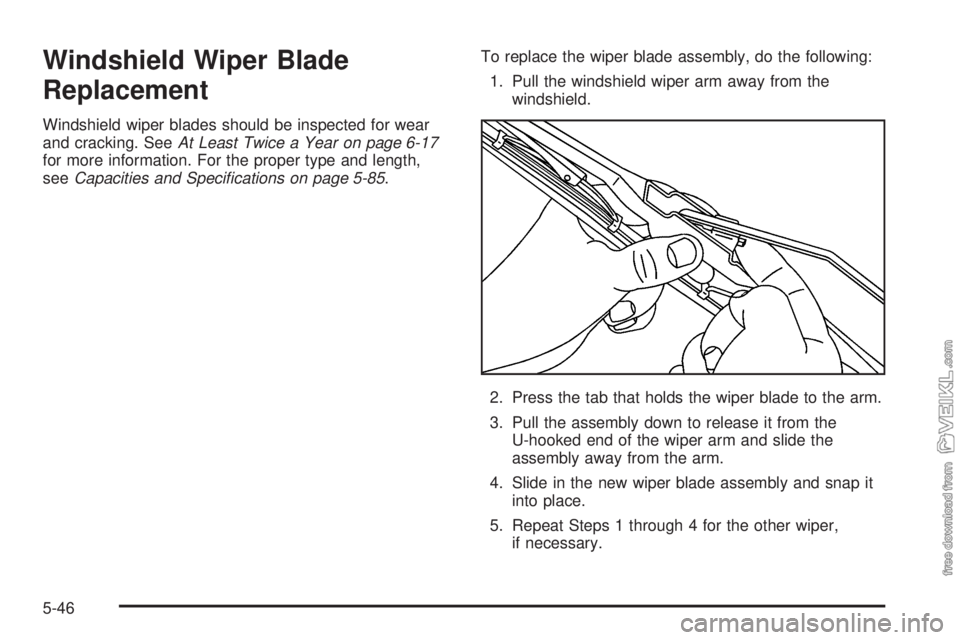
Windshield Wiper Blade
Replacement
Windshield wiper blades should be inspected for wear
and cracking. SeeAt Least Twice a Year on page 6-17
for more information. For the proper type and length,
seeCapacities and Specications on page 5-85.To replace the wiper blade assembly, do the following:
1. Pull the windshield wiper arm away from the
windshield.
2. Press the tab that holds the wiper blade to the arm.
3. Pull the assembly down to release it from the
U-hooked end of the wiper arm and slide the
assembly away from the arm.
4. Slide in the new wiper blade assembly and snap it
into place.
5. Repeat Steps 1 through 4 for the other wiper,
if necessary.
5-46
Page 259 of 320
Exterior painted surfaces are subject to aging, weather,
and chemical fallout that can take their toll over a
period of years. To help keep the paint finish looking
new, keep the vehicle in a garage or covered whenever
possible.
Windshield and Wiper Blades
If the windshield is not clear after using the windshield
washer, or if the wiper blade chatters when running,
wax, sap, or other material may be on the blade
or windshield.
Clean the outside of the windshield with a glass
cleaning liquid or powder and water solution. The
windshield is clean if beads do not form when it is rinsed
with water.
Grime from the windshield will stick to the wiper blades
and affect their performance. Clean the blade by
wiping vigorously with a cloth soaked in full-strength
windshield washer solvent. Then rinse the blade
with water.
Check the wiper blades and clean them as necessary;
replace blades that look worn.
Aluminum Wheels
Notice:If you use strong soaps, chemicals,
abrasive polishes, cleaners, brushes, or cleaners
that contain acid on aluminum or chrome-plated
wheels, you could damage the surface of the
wheel(s). The repairs would not be covered by your
warranty. Use only GM-approved cleaners on
aluminum or chrome-plated wheels.
Keep the wheels clean using a soft clean cloth with mild
soap and water. Rinse with clean water. After rinsing
thoroughly, dry with a soft clean towel. A wax may then
be applied.
Notice:Using chrome polish on aluminum wheels
could damage the wheels. The repairs would not
be covered by your warranty. Use chrome polish on
chrome wheels only.
The surface of these wheels is similar to the painted
surface of the vehicle. Do not use strong soaps,
chemicals, abrasive polishes, abrasive cleaners,
cleaners with acid, or abrasive cleaning brushes on
them because the surface could be damaged. Do not
use chrome polish on aluminum wheels.
5-75
Page 270 of 320
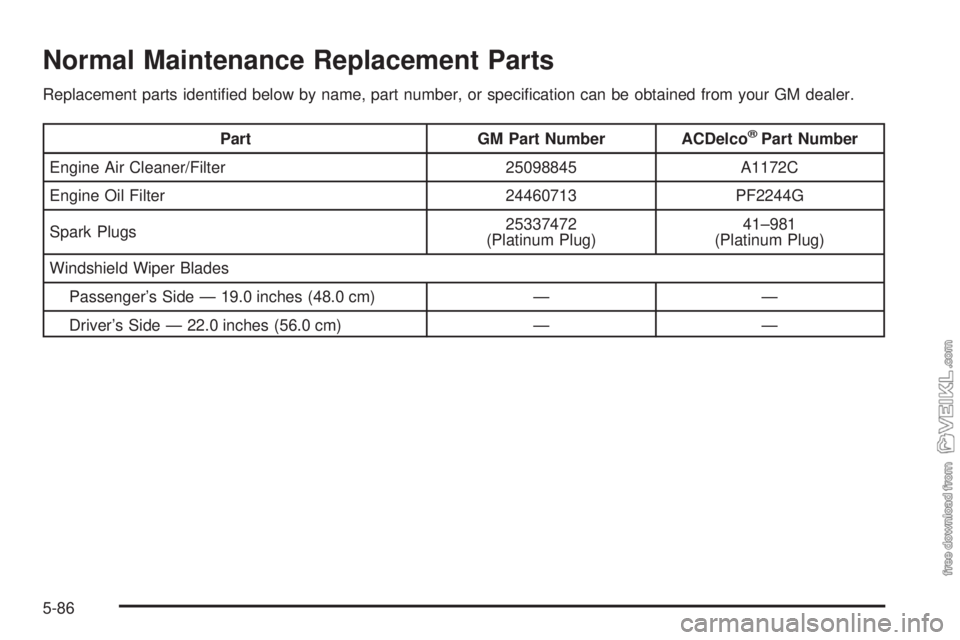
Normal Maintenance Replacement Parts
Replacement parts identified below by name, part number, or specification can be obtained from your GM dealer.
Part GM Part Number ACDelco®Part Number
Engine Air Cleaner/Filter 25098845 A1172C
Engine Oil Filter 24460713 PF2244G
Spark Plugs25337472
(Platinum Plug)41–981
(Platinum Plug)
Windshield Wiper Blades
Passenger’s Side — 19.0 inches (48.0 cm) — —
Driver’s Side — 22.0 inches (56.0 cm) — —
5-86
Page 287 of 320
At Least Twice a Year
Restraint System Check
Make sure the safety belt reminder light and all your
belts, buckles, latch plates, retractors and anchorages
are working properly. Look for any other loose or
damaged safety belt system parts. If you see anything
that might keep a safety belt system from doing its
job, have it repaired. Have any torn or frayed safety belts
replaced.
Also look for any opened or broken airbag coverings,
and have them repaired or replaced. (The airbag system
does not need regular maintenance.)
Wiper Blade Check
Inspect wiper blades for wear or cracking. Replace
blade inserts that appear worn or damaged or that
streak or miss areas of the windshield. Also see
Windshield and Wiper Blades on page 5-75.
Weatherstrip Lubrication
Silicone grease on weatherstrips will make them last
longer, seal better, and not stick or squeak. Apply
silicone grease with a clean cloth. During very cold,
damp weather more frequent application may be
required. SeePart D: Recommended Fluids and
Lubricants on page 6-22.
Automatic Transaxle Inspection
It is not necessary to check the transaxle fluid level.
A transaxle fluid leak is the only reason for fluid
loss. Check for leaks. If a leak occurs, take the vehicle
to your dealer and have it repaired as soon as
possible.
At Least Once a Year
Key Lock Cylinders Service
Lubricate the key lock cylinders with the lubricant
specified in Part D.
Body Lubrication Service
Lubricate all the body door hinges and latches, including
those for the hood and trunk lid. Part D tells you what
to use. More frequent lubrication may be required when
exposed to a corrosive environment.
6-17
Page 309 of 320
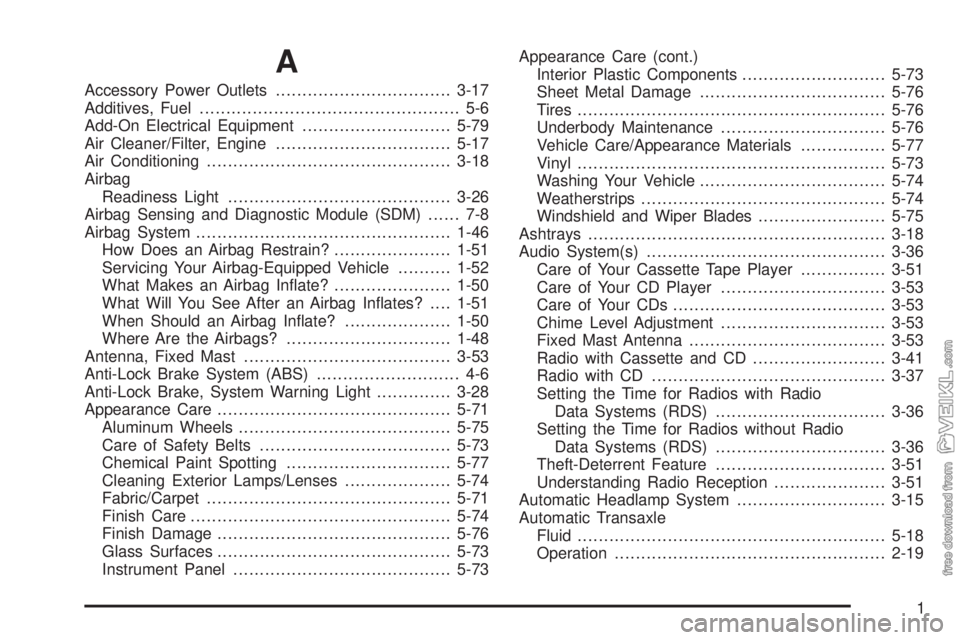
A
Accessory Power Outlets.................................3-17
Additives, Fuel................................................. 5-6
Add-On Electrical Equipment............................5-79
Air Cleaner/Filter, Engine.................................5-17
Air Conditioning..............................................3-18
Airbag
Readiness Light..........................................3-26
Airbag Sensing and Diagnostic Module (SDM)...... 7-8
Airbag System................................................1-46
How Does an Airbag Restrain?......................1-51
Servicing Your Airbag-Equipped Vehicle..........1-52
What Makes an Airbag Inflate?......................1-50
What Will You See After an Airbag Inflates?....1-51
When Should an Airbag Inflate?....................1-50
Where Are the Airbags?...............................1-48
Antenna, Fixed Mast.......................................3-53
Anti-Lock Brake System (ABS)........................... 4-6
Anti-Lock Brake, System Warning Light..............3-28
Appearance Care............................................5-71
Aluminum Wheels........................................5-75
Care of Safety Belts....................................5-73
Chemical Paint Spotting...............................5-77
Cleaning Exterior Lamps/Lenses....................5-74
Fabric/Carpet..............................................5-71
Finish Care.................................................5-74
Finish Damage............................................5-76
Glass Surfaces............................................5-73
Instrument Panel.........................................5-73Appearance Care (cont.)
Interior Plastic Components...........................5-73
Sheet Metal Damage...................................5-76
Tires..........................................................5-76
Underbody Maintenance...............................5-76
Vehicle Care/Appearance Materials................5-77
Vinyl..........................................................5-73
Washing Your Vehicle...................................5-74
Weatherstrips..............................................5-74
Windshield and Wiper Blades........................5-75
Ashtrays........................................................3-18
Audio System(s).............................................3-36
Care of Your Cassette Tape Player................3-51
Care of Your CD Player...............................3-53
Care of Your CDs........................................3-53
Chime Level Adjustment...............................3-53
Fixed Mast Antenna.....................................3-53
Radio with Cassette and CD.........................3-41
Radio with CD............................................3-37
Setting the Time for Radios with Radio
Data Systems (RDS)................................3-36
Setting the Time for Radios without Radio
Data Systems (RDS)................................3-36
Theft-Deterrent Feature................................3-51
Understanding Radio Reception.....................3-51
Automatic Headlamp System............................3-15
Automatic Transaxle
Fluid..........................................................5-18
Operation...................................................2-19
1
Page 311 of 320
Child Restraints (cont.)
Top Strap Anchor Location............................1-37
Where to Put the Restraint...........................1-35
Chime Level Adjustment..................................3-53
Cigarette Lighter.............................................3-18
Cleaning
Aluminum Wheels........................................5-75
Exterior Lamps/Lenses.................................5-74
Fabric/Carpet..............................................5-71
Finish Care.................................................5-74
Glass Surfaces............................................5-73
Instrument Panel.........................................5-73
Interior Plastic Components...........................5-73
Tires..........................................................5-76
Underbody Maintenance...............................5-76
Vinyl..........................................................5-73
Washing Your Vehicle...................................5-74
Weatherstrips..............................................5-74
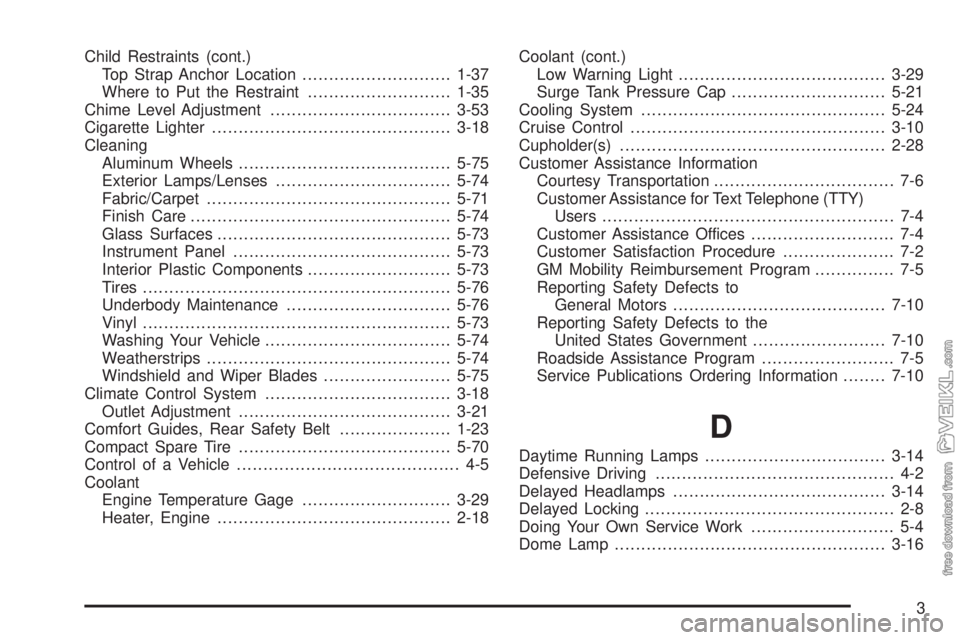
Windshield and Wiper Blades........................5-75
Climate Control System...................................3-18
Outlet Adjustment........................................3-21
Comfort Guides, Rear Safety Belt.....................1-23
Compact Spare Tire........................................5-70
Control of a Vehicle.......................................... 4-5
Coolant
Engine Temperature Gage............................3-29
Heater, Engine............................................2-18Coolant (cont.)
Low Warning Light.......................................3-29
Surge Tank Pressure Cap.............................5-21
Cooling System..............................................5-24
Cruise Control................................................3-10
Cupholder(s)..................................................2-28
Customer Assistance Information
Courtesy Transportation.................................. 7-6
Customer Assistance for Text Telephone (TTY)
Users....................................................... 7-4
Customer Assistance Offices........................... 7-4
Customer Satisfaction Procedure..................... 7-2
GM Mobility Reimbursement Program............... 7-5
Reporting Safety Defects to
General Motors........................................7-10
Reporting Safety Defects to the
United States Government.........................7-10
Roadside Assistance Program......................... 7-5
Service Publications Ordering Information........7-10
D
Daytime Running Lamps..................................3-14
Defensive Driving............................................. 4-2
Delayed Headlamps........................................3-14
Delayed Locking............................................... 2-8
Doing Your Own Service Work........................... 5-4
Dome Lamp...................................................3-16
3