engine CHEVROLET COLORADO 2007 1.G Workshop Manual
[x] Cancel search | Manufacturer: CHEVROLET, Model Year: 2007, Model line: COLORADO, Model: CHEVROLET COLORADO 2007 1.GPages: 496, PDF Size: 2.7 MB
Page 289 of 496
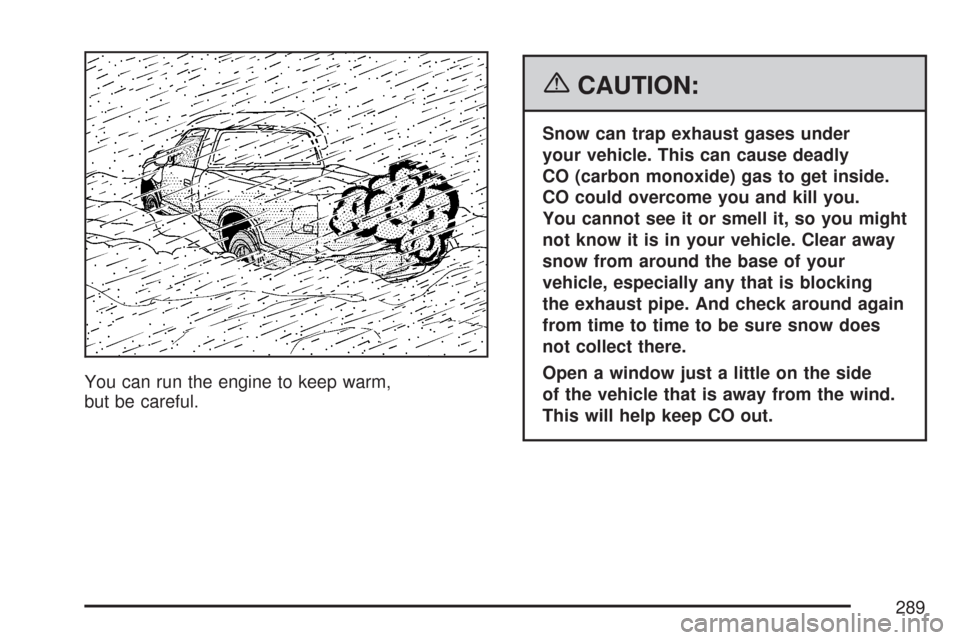
You can run the engine to keep warm,
but be careful.
{CAUTION:
Snow can trap exhaust gases under
your vehicle. This can cause deadly
CO (carbon monoxide) gas to get inside.
CO could overcome you and kill you.
You cannot see it or smell it, so you might
not know it is in your vehicle. Clear away
snow from around the base of your
vehicle, especially any that is blocking
the exhaust pipe. And check around again
from time to time to be sure snow does
not collect there.
Open a window just a little on the side
of the vehicle that is away from the wind.
This will help keep CO out.
289
Page 290 of 496
Run your engine only as long as you must. This
saves fuel. When you run the engine, make it
go a little faster than just idle. That is, push the
accelerator slightly. This uses less fuel for the heat
that you get and it keeps the battery charged.
You will need a well-charged battery to restart the
vehicle, and possibly for signaling later on with
your headlamps. Let the heater run for a while.
Then, shut the engine off and close the window
almost all the way to preserve the heat. Start
the engine again and repeat this only when you
feel really uncomfortable from the cold. But do it
as little as possible. Preserve the fuel as long
as you can. To help keep warm, you can get
out of the vehicle and do some fairly vigorous
exercises every half hour or so until help comes.If Your Vehicle is Stuck in Sand,
Mud, Ice, or Snow
In order to free your vehicle when it is stuck,
you will need to spin the wheels, but you do not
want to spin the wheels too fast. The method
known as rocking can help you get out when
you are stuck, but you must use caution.
{CAUTION:
If you let your vehicle’s tires spin at
high speed, they can explode, and you
or others could be injured. And, the
vehicle can overheat. That could cause
an engine compartment re or other
damage. When you are stuck, spin the
wheels as little as possible. Do not spin
the wheels above 35 mph (55 km/h) as
shown on the speedometer.
290
Page 307 of 496
Notice:Pulling a trailer improperly can
damage your vehicle and result in costly
repairs that would not be covered by your
warranty. Always follow the instructions in
this section and check with your dealer/retailer
for more information about towing a trailer
with your vehicle.
To identify the trailering capacity of your vehicle,
you should read the information in “Weight of
the Trailer” that appears later in this section.
Trailering is different than just driving your vehicle
by itself. Trailering means changes in handling,
acceleration, braking, durability and fuel economy.
Successful, safe trailering takes correct
equipment, and it has to be used properly.
That’s the reason for this part. In it are many
time-tested, important trailering tips and safety
rules. Many of these are important for your safety
and that of your passengers. So please read
this section carefully before you pull a trailer.If You Do Decide To Pull A Trailer
If you do, here are some important points:
There are many different laws, including speed
limit restrictions, having to do with trailering.
Make sure your rig will be legal, not only where
you live but also where you’ll be driving. A
good source for this information can be state
or provincial police.
Consider using a sway control. You can ask
a hitch dealer/retailer about sway controls.
Don’t tow a trailer at all during the rst
500 miles (800 km) your new vehicle is driven.
Your engine, axle or other parts could be
damaged.
307
Page 308 of 496
Then, during the rst 500 miles (800 km)
that you tow a trailer, don’t drive over
50 mph (80 km/h) and don’t make starts
at full throttle. This helps your engine and
other parts of your vehicle wear in at the
heavier loads.
You may want to shift the transmission to
THIRD (3) or, if necessary, a lower gear
selection if the transmission shifts too
often (e.g., under heavy loads and/or hilly
conditions). If you have a manual transmission
and you are towing a trailer, it’s better not
to use the highest gear.
Three important considerations have to do
with weight:
the weight of the trailer,
the weight of the trailer tongue
and the weight on your vehicle’s tires.
Weight of the Trailer
How heavy can a trailer safely be?
It depends on how you plan to use your rig.
For example, speed, altitude, road grades, outside
temperature and how much your vehicle is used
to pull a trailer are all important. It can also depend
on any special equipment that you have on
your vehicle, and the amount of tongue weight
the vehicle can carry. See “Weight of the Trailer
Tongue” later in this section for more information.
Maximum trailer weight is calculated assuming
only the driver is in the tow vehicle and it has
all the required trailering equipment. The weight
of additional optional equipment, passengers
and cargo in the tow vehicle must be subtracted
from the maximum trailer weight.
308
Page 309 of 496
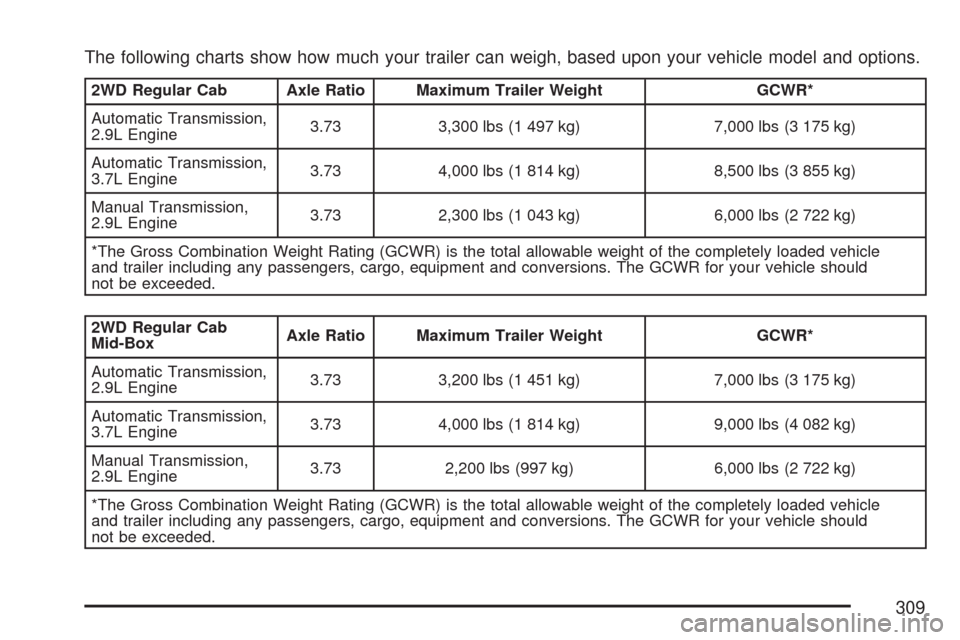
The following charts show how much your trailer can weigh, based upon your vehicle model and options.
2WD Regular Cab Axle Ratio Maximum Trailer Weight GCWR*
Automatic Transmission,
2.9L Engine3.73 3,300 lbs (1 497 kg) 7,000 lbs (3 175 kg)
Automatic Transmission,
3.7L Engine3.73 4,000 lbs (1 814 kg) 8,500 lbs (3 855 kg)
Manual Transmission,
2.9L Engine3.73 2,300 lbs (1 043 kg) 6,000 lbs (2 722 kg)
*The Gross Combination Weight Rating (GCWR) is the total allowable weight of the completely loaded vehicle
and trailer including any passengers, cargo, equipment and conversions. The GCWR for your vehicle should
not be exceeded.
2WD Regular Cab
Mid-BoxAxle Ratio Maximum Trailer Weight GCWR*
Automatic Transmission,
2.9L Engine3.73 3,200 lbs (1 451 kg) 7,000 lbs (3 175 kg)
Automatic Transmission,
3.7L Engine3.73 4,000 lbs (1 814 kg) 9,000 lbs (4 082 kg)
Manual Transmission,
2.9L Engine3.73 2,200 lbs (997 kg) 6,000 lbs (2 722 kg)
*The Gross Combination Weight Rating (GCWR) is the total allowable weight of the completely loaded vehicle
and trailer including any passengers, cargo, equipment and conversions. The GCWR for your vehicle should
not be exceeded.
309
Page 310 of 496
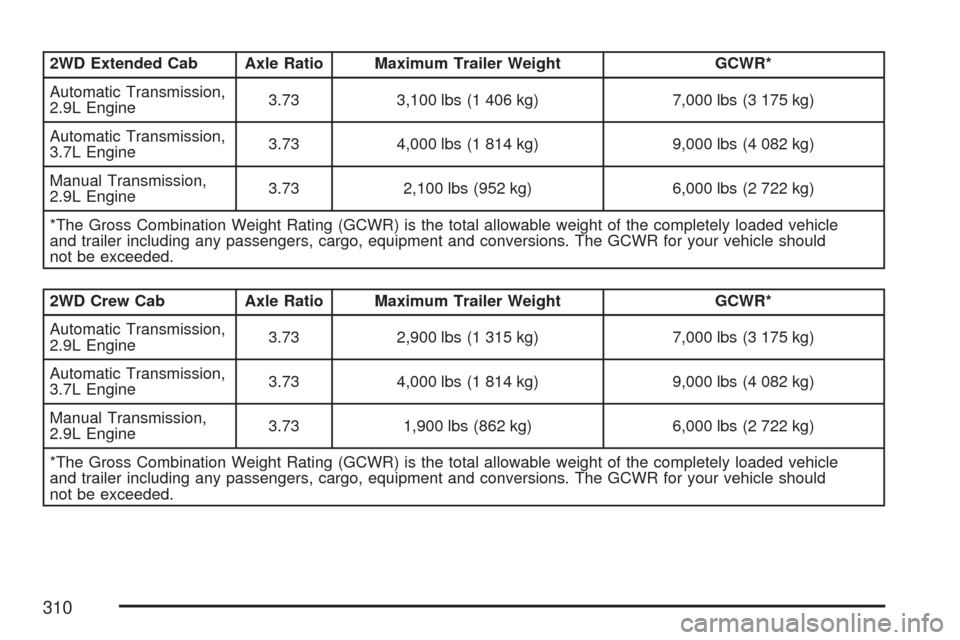
2WD Extended Cab Axle Ratio Maximum Trailer Weight GCWR*
Automatic Transmission,
2.9L Engine3.73 3,100 lbs (1 406 kg) 7,000 lbs (3 175 kg)
Automatic Transmission,
3.7L Engine3.73 4,000 lbs (1 814 kg) 9,000 lbs (4 082 kg)
Manual Transmission,
2.9L Engine3.73 2,100 lbs (952 kg) 6,000 lbs (2 722 kg)
*The Gross Combination Weight Rating (GCWR) is the total allowable weight of the completely loaded vehicle
and trailer including any passengers, cargo, equipment and conversions. The GCWR for your vehicle should
not be exceeded.
2WD Crew Cab Axle Ratio Maximum Trailer Weight GCWR*
Automatic Transmission,
2.9L Engine3.73 2,900 lbs (1 315 kg) 7,000 lbs (3 175 kg)
Automatic Transmission,
3.7L Engine3.73 4,000 lbs (1 814 kg) 9,000 lbs (4 082 kg)
Manual Transmission,
2.9L Engine3.73 1,900 lbs (862 kg) 6,000 lbs (2 722 kg)
*The Gross Combination Weight Rating (GCWR) is the total allowable weight of the completely loaded vehicle
and trailer including any passengers, cargo, equipment and conversions. The GCWR for your vehicle should
not be exceeded.
310
Page 311 of 496
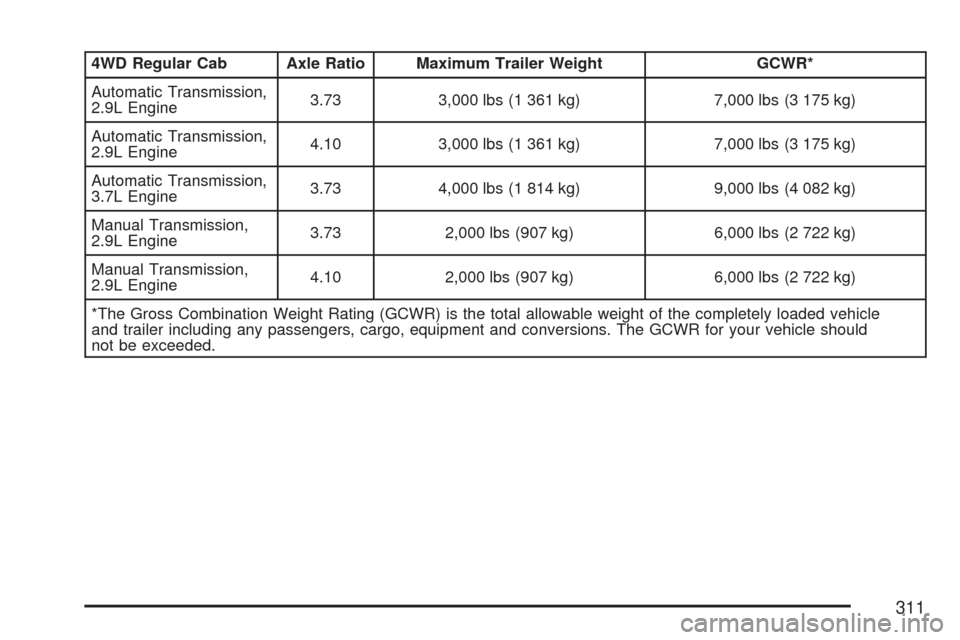
4WD Regular Cab Axle Ratio Maximum Trailer Weight GCWR*
Automatic Transmission,
2.9L Engine3.73 3,000 lbs (1 361 kg) 7,000 lbs (3 175 kg)
Automatic Transmission,
2.9L Engine4.10 3,000 lbs (1 361 kg) 7,000 lbs (3 175 kg)
Automatic Transmission,
3.7L Engine3.73 4,000 lbs (1 814 kg) 9,000 lbs (4 082 kg)
Manual Transmission,
2.9L Engine3.73 2,000 lbs (907 kg) 6,000 lbs (2 722 kg)
Manual Transmission,
2.9L Engine4.10 2,000 lbs (907 kg) 6,000 lbs (2 722 kg)
*The Gross Combination Weight Rating (GCWR) is the total allowable weight of the completely loaded vehicle
and trailer including any passengers, cargo, equipment and conversions. The GCWR for your vehicle should
not be exceeded.
311
Page 312 of 496
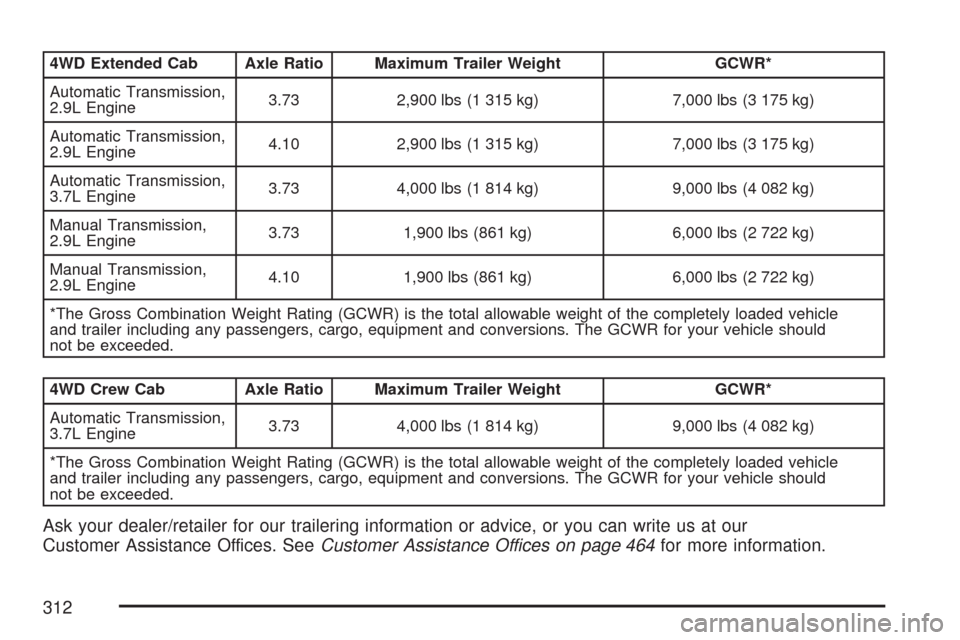
4WD Extended Cab Axle Ratio Maximum Trailer Weight GCWR*
Automatic Transmission,
2.9L Engine3.73 2,900 lbs (1 315 kg) 7,000 lbs (3 175 kg)
Automatic Transmission,
2.9L Engine4.10 2,900 lbs (1 315 kg) 7,000 lbs (3 175 kg)
Automatic Transmission,
3.7L Engine3.73 4,000 lbs (1 814 kg) 9,000 lbs (4 082 kg)
Manual Transmission,
2.9L Engine3.73 1,900 lbs (861 kg) 6,000 lbs (2 722 kg)
Manual Transmission,
2.9L Engine4.10 1,900 lbs (861 kg) 6,000 lbs (2 722 kg)
*The Gross Combination Weight Rating (GCWR) is the total allowable weight of the completely loaded vehicle
and trailer including any passengers, cargo, equipment and conversions. The GCWR for your vehicle should
not be exceeded.
4WD Crew Cab Axle Ratio Maximum Trailer Weight GCWR*
Automatic Transmission,
3.7L Engine3.73 4,000 lbs (1 814 kg) 9,000 lbs (4 082 kg)
*The Gross Combination Weight Rating (GCWR) is the total allowable weight of the completely loaded vehicle
and trailer including any passengers, cargo, equipment and conversions. The GCWR for your vehicle should
not be exceeded.
Ask your dealer/retailer for our trailering information or advice, or you can write us at our
Customer Assistance Offices. SeeCustomer Assistance Offices on page 464for more information.
312
Page 318 of 496
Making Turns
Notice:Making very sharp turns while
trailering could cause the trailer to come in
contact with the vehicle. Your vehicle could
be damaged. Avoid making very sharp
turns while trailering.
When you’re turning with a trailer, make wider turns
than normal. Do this so your trailer won’t strike soft
shoulders, curbs, road signs, trees or other objects.
Avoid jerky or sudden maneuvers. Signal well
in advance.
Turn Signals When Towing a Trailer
When you tow a trailer, your vehicle has to have
extra wiring and a heavy-duty turn signal asher.
The arrows on your instrument panel will ash
whenever you signal a turn or lane change.
Properly hooked up, the trailer lamps will also
ash, telling other drivers you’re about to
turn, change lanes or stop.
When towing a trailer, the arrows on your
instrument panel will ash for turns even if
the bulbs on the trailer are burned out.Thus, you may think drivers behind you are seeing
your signal when they are not. It’s important to
check occasionally to be sure the trailer bulbs are
still working.
Driving On Grades
Reduce speed and shift to a lower gear before
you start down a long or steep downgrade.
If you don’t shift down, you might have to use
your brakes so much that they would get hot
and no longer work well.
When towing at high altitude on steep uphill
grades, consider the following: Engine coolant
will boil at a lower temperature than at normal
altitudes. If you turn your engine off immediately
after towing at high altitude on steep uphill grades,
your vehicle may show signs similar to engine
overheating. To avoid this, let the engine run
while parked (preferably on level ground) with
the automatic transmission in PARK (P) (or
the manual transmission out of gear and the
parking brake applied) for a few minutes before
turning the engine off. If you do get the overheat
warning, seeEngine Overheating on page 348.
318
Page 319 of 496
Parking on Hills
{CAUTION:
You really should not park your
vehicle, with a trailer attached, on a hill.
If something goes wrong, your rig could
start to move. People can be injured,
and both your vehicle and the trailer
can be damaged.
But if you ever have to park your rig on a hill,
here’s how to do it:
1. Apply your regular brakes, but don’t shift into
PARK (P) yet, or into gear for a manual
transmission. When parking uphill, turn your
wheels away from the curb. When parking
downhill, turn your wheels into the curb.
2. Have someone place chocks under the
trailer wheels.
3. When the wheel chocks are in place,
release the regular brakes until the
chocks absorb the load.4. Reapply the regular brakes. Then apply your
parking brake, and then shift into PARK (P),
or REVERSE (R) for a manual transmission.
SeeParking Brake on page 133for more
information.
5. If you have a four-wheel-drive vehicle, be
sure the transfer case is in a drive gear
and not in NEUTRAL. SeeFour-Wheel
Drive on page 129for more information.
6. Release the regular brakes.
When You Are Ready to Leave
After Parking on a Hill
1. Apply your regular brakes and hold the
pedal down while you:
start your engine,
shift into a gear, and
release the parking brake.
2. Let up on the brake pedal.
3. Drive slowly until the trailer is clear
of the chocks.
4. Stop and have someone pick up and
store the chocks.
319