lock CHEVROLET CORVETTE 1995 4.G Workshop Manual
[x] Cancel search | Manufacturer: CHEVROLET, Model Year: 1995, Model line: CORVETTE, Model: CHEVROLET CORVETTE 1995 4.GPages: 386, PDF Size: 20.15 MB
Page 174 of 386
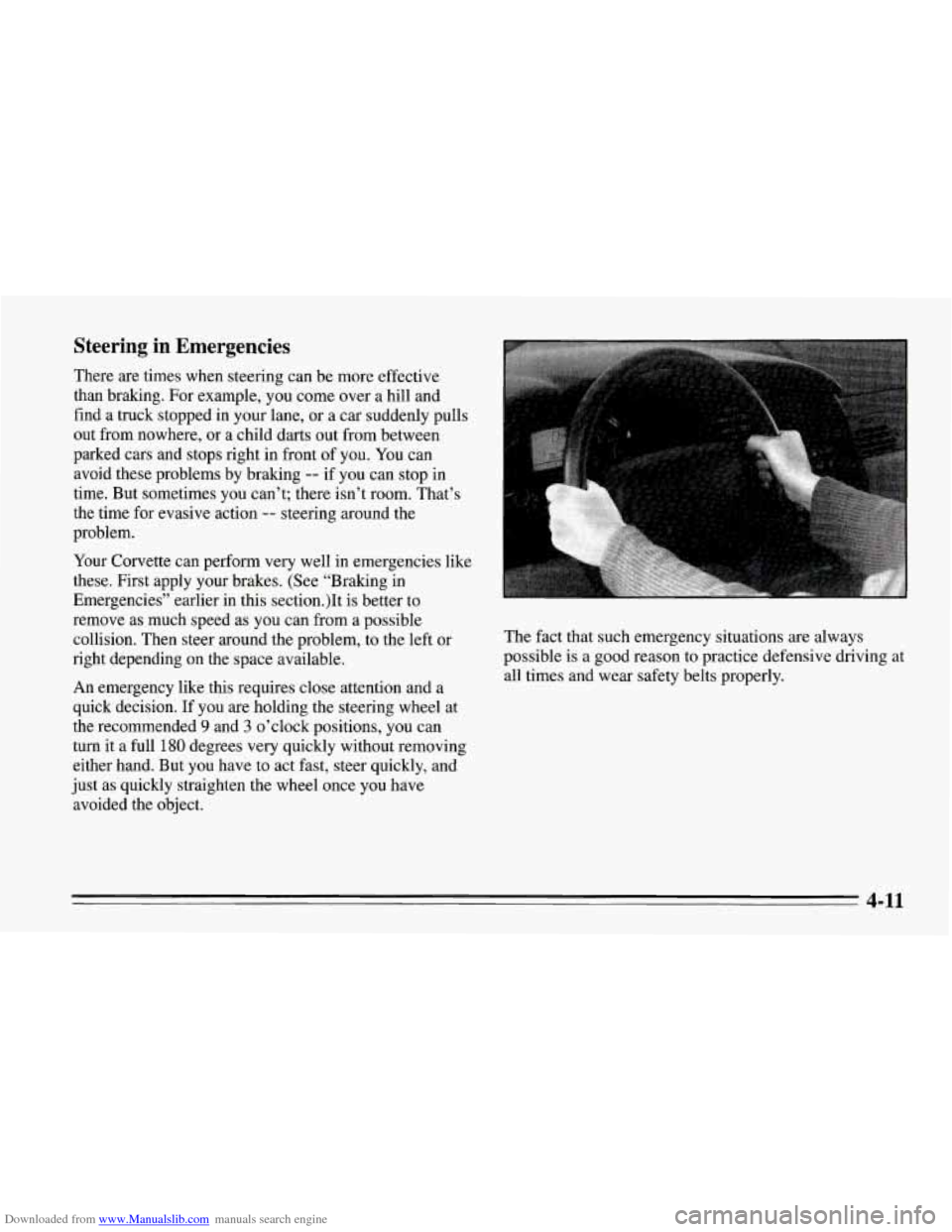
Downloaded from www.Manualslib.com manuals search engine An emergency like this requires close attention and a
quick decision. If you are holding the steering wheel at
the recommended
9 and 3 o'clock positions, you can
turn it a full
180 degrees very quickly without removing
either hand. But you have to act fast, steer quickly, and
just as quickly straighten the wheel once you have
avoided the object. The
fact that such emergency situations are always
possible is a good reason
to practice defensive driving at
all times and wear safety belts properly.
4-11
Page 177 of 386
Downloaded from www.Manualslib.com manuals search engine Loss of Control
Let’s review what driving experts say about what
happens when the three control systems (brakes, steering
and acceleration) don’t have enough friction where the
tires meet the road to do what the driver has asked.
In any emergency, don’t give up. Keep trying to steer and
constantly seek an escape route or area of less danger.
Skidding
In a skid, a driver can lose control of the vehicle.
Defensive dnvers avoid most skids by taking reasonable
care suited to existing conditions, and by not “overdriving”\
those conditions. But skids
are always possible.
The three types of skids correspond to your Corvette’s
three control systems. In the braking skid your wheels
aren’t rolling. In the steering or cornering skid, too
much speed or steering in a curve causes tires to slip and
lose cornering force. And in the acceleration skid too
much throttle causes the driving wheels to spin.
A cornering skid is best handled by easing your foot off
the accelerator pedal.
Remember: Any ASR system helps avoid only the
acceleration skid.
If your ASR system is off, then an acceleration skid is
also best handled by easing your foot off the accelerator
pedal.
If your vehicle starts to slide, ease your foot off the
accelerator pedal and quickly steer the way you want the
vehicle to go. If you start steering quickly enough, your
vehicle may straighten out. Always be ready for a
second skid if it occurs.
Of course, traction is reduced when water, snow, ice,
gravel, or other material is on the road. For safety, you’ll
want to slow down and adjust your driving to these
conditions. It is important to slow down on slippery
surfaces because stopping distance
will be longer and
vehicle control more limited.
While driving on a surface with reduced traction, try your
best to avoid sudden steering, acceleration, or braking
(including engine braking by shifting to a lower gear).
Any sudden changes could cause the tires to slide.
You
may not realize the surface is slippery until your vehicle
is skidding. Learn to recognize warning clues
-- such as
enough water,
ice or packed snow on the road to make a
“mirrored surface”
-- and slow down when you have
any doubt.
Remember: Any anti-lock brake system (ABS) helps
avoid only the braking skid.
I
4-14
Page 188 of 386
Downloaded from www.Manualslib.com manuals search engine Driving on Snow or Ice
Most of the time, those places where your tires meet the
road probably have good traction.
However, if there is snow or ice between your tires and the
road, you can have a very slippery situation. You’ll have a
lot less traction or
“grip” and will need to be very careful.
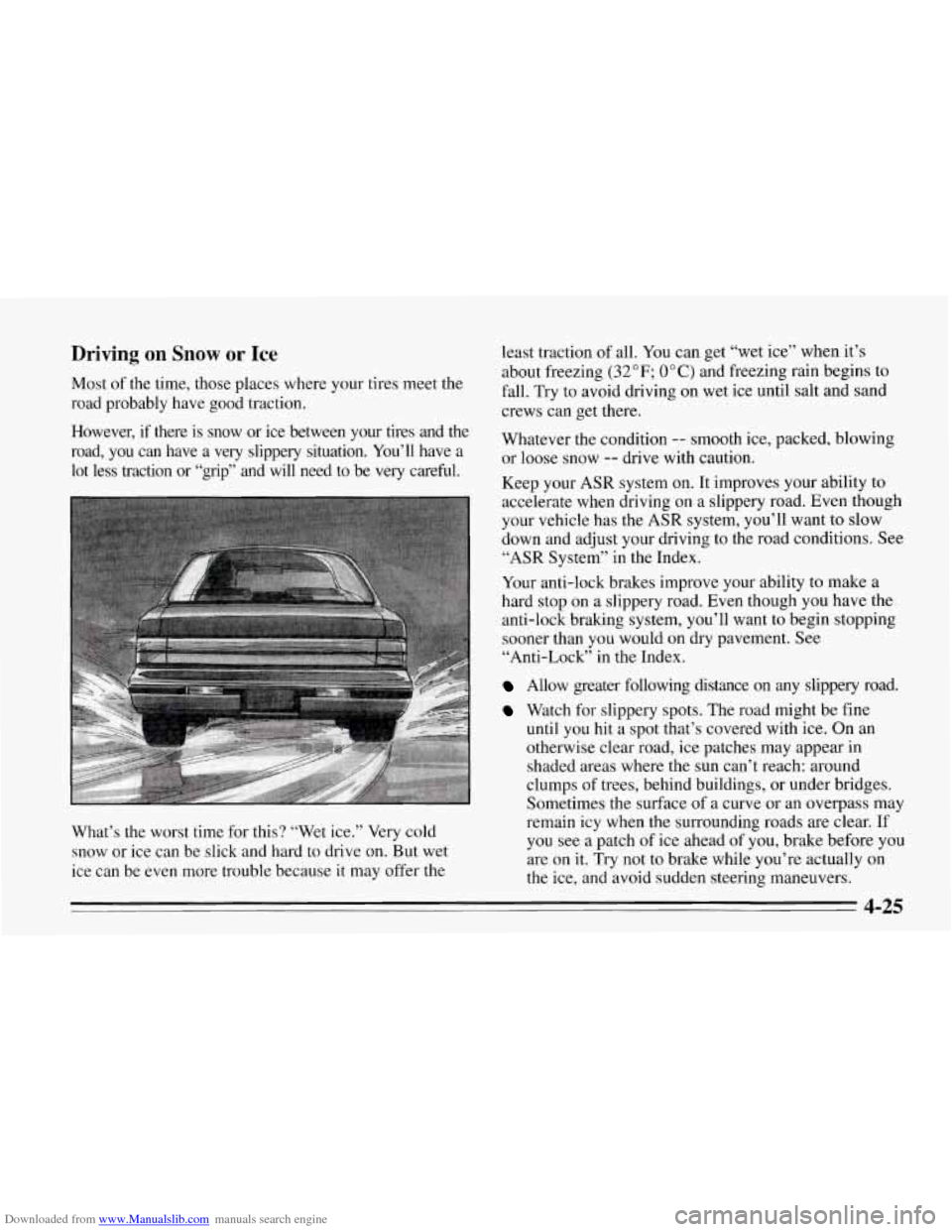
What’s the worst time for this? “Wet ice.” Very cold
snow or ice can be slick and hard to drive on. But wet
ice can be even more trouble because it may offer the least traction
of all. You can get “wet ice” when it’s
about freezing
(32°F; 0°C) and freezing rain begins to
fall. Try to avoid driving on wet ice until salt and sand
crews can get there.
Whatever the condition
-- smooth ice, packed, blowing
or loose snow
-- drive with caution.
Keep your ASR system on. It improves your ability to
accelerate when driving on a slippery road. Even though
your vehicle has the ASR system, you’ll want
to slow
down and adjust your driving to the road conditions. See
“ASR System’’ in the Index.
Your anti-lock brakes improve your ability to make a
hard stop on a slippery road. Even though you have the
anti-lock braking system, you’ll want to begin stopping
sooner than you would on dry pavement. See
“Anti-Lock” in the Index.
Allow greater following distance on any slippery road.
Watch for slippery spots. The road might be fine
until you hit a spot that’s covered with ice. On an
otherwise clear road, ice patches may appear in
shaded areas where the sun can’t reach: around
clumps of trees, behind buildings, or under bridges.
Sometimes the surface of a curve or an overpass may
remain icy when the surrounding roads
are clear. If
you see a patch of ice ahead of
you, brake before you
are on it. Try not to brake while you’re actually on
the ice, and avoid sudden steering maneuvers.
4-25
Page 201 of 386
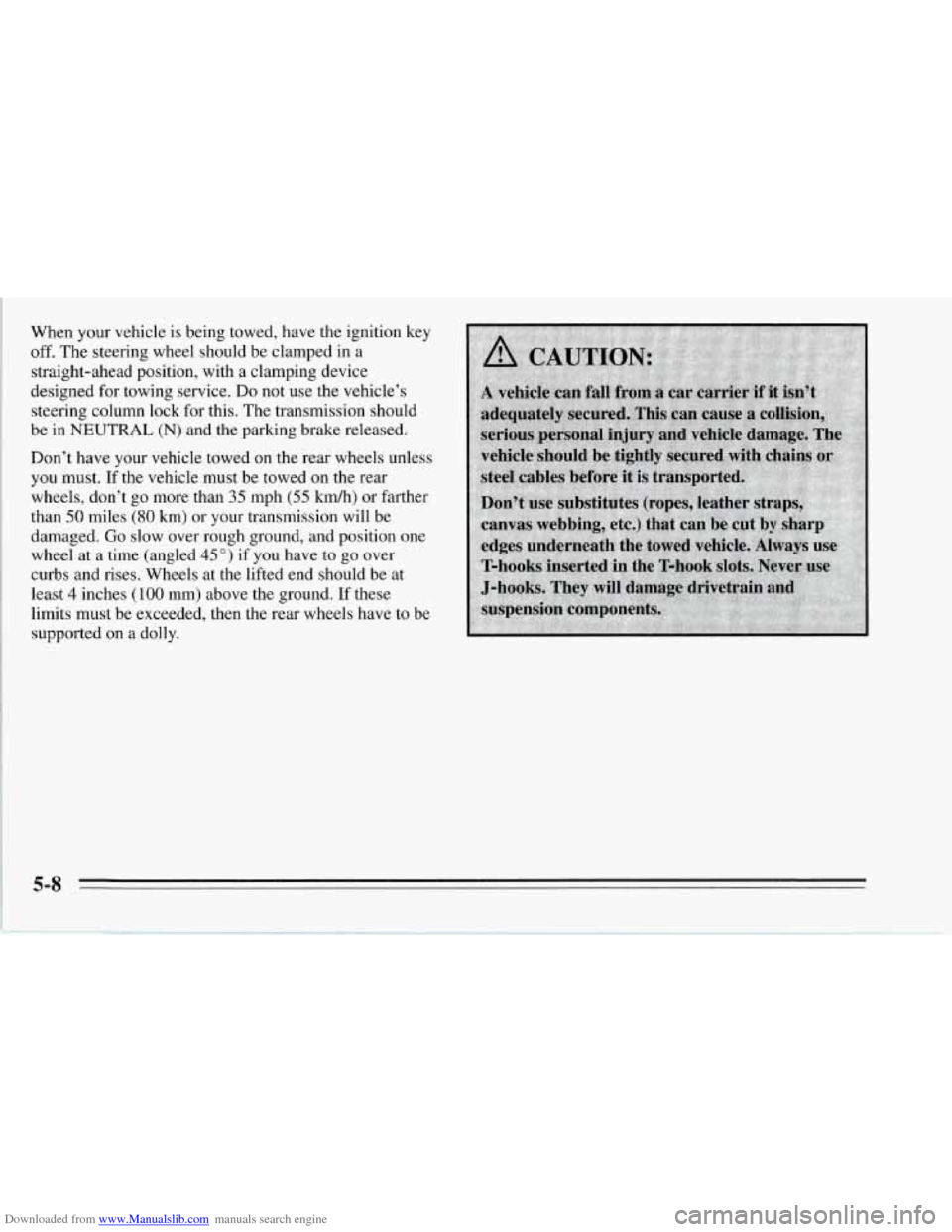
Downloaded from www.Manualslib.com manuals search engine When your vehicle is being towed, have the ign
off. The steering wheel should be clamped in a
straight-ahead position, with a clamping device
designed for towing service.
Do not use the veh .ition key
icle's
steering column lock for this. The transmission should
be in
NEUTRAL (N) and the parking brake released.
Don't have your vehicle towed on the rear wheels unless
you must.
If the vehicle must be towed on the rear
wheels, don't
go more than 35 mph (55 km/h) or farther
than
50 miles (80 km) or your transmission will be
damaged.
Go slow over rough ground, and position one
wheel at a time (angled
45 ") if you have to go over
curbs and rises. Wheels at the lifted end should be at
least
4 inches (100 mm) above the ground. If these
limits must be exceeded, then the rear wheels have to be
supported on a dolly.
-
Page 220 of 386
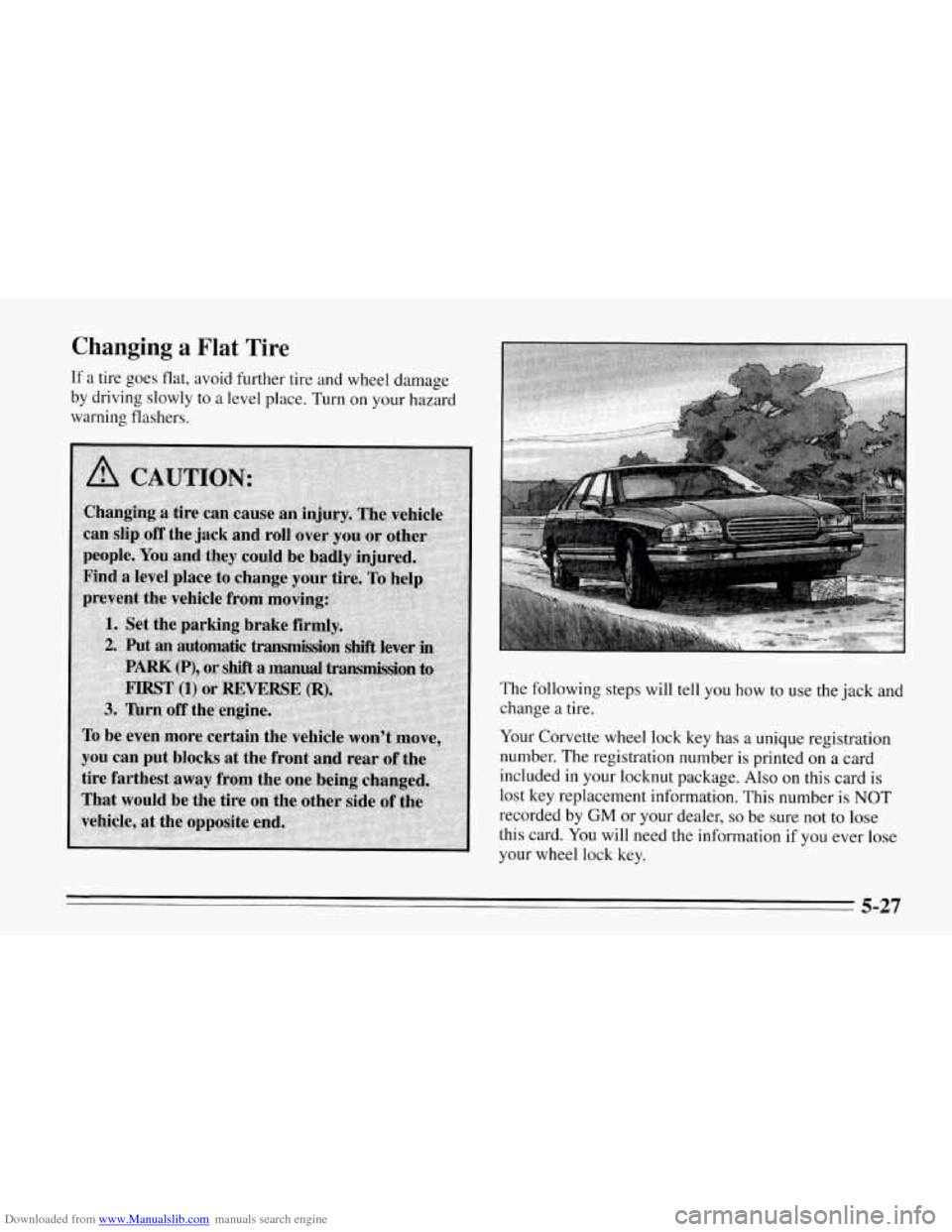
Downloaded from www.Manualslib.com manuals search engine Changing a Flat Tire
If a tire goes flat, avoid further tire and wheel damage
by driving slowly to
a level place. Turn on your hazard
warning flashers.
The following steps will tell you how to use the jack and
change
a tire.
Your Corvette wheel lock key has
a unique registration
number. The registration number is printed on
a card
included in your locknut package. Also on this card is
lost key replacement information. This number is
NOT
recorded by GM or your dealer, so be sure not to lose
this card. You will need the information if you ever
lose
your wheel lock key.
5-27
Page 221 of 386
Downloaded from www.Manualslib.com manuals search engine If you have someone else remove your wheels, make
sure you give them the special wheel nut socket and
wheel lock key. They are under the jack in the rear
storage compartment behind the passenger’s seat. The
socket can be used with an air
or torque wrench.
NOTICE:
Your wheels could be damaged if the wheel nut
socket
is not used to remove your Corvette’s
wheels.
Always use the wheel nut socket when you use the
wheel wrench provided with your Corvette.
The equipment you’ll need is behind the driver’s seat
and in the rear storage compartment behind the
passenger’s seat.
Move the driver’s seat all the way forward and fold the
seatback forward. The wheel wrench is on the floor
behind the seat. Loosen the wingnuts and slide the wheel
wrench out
of the clamps.
r
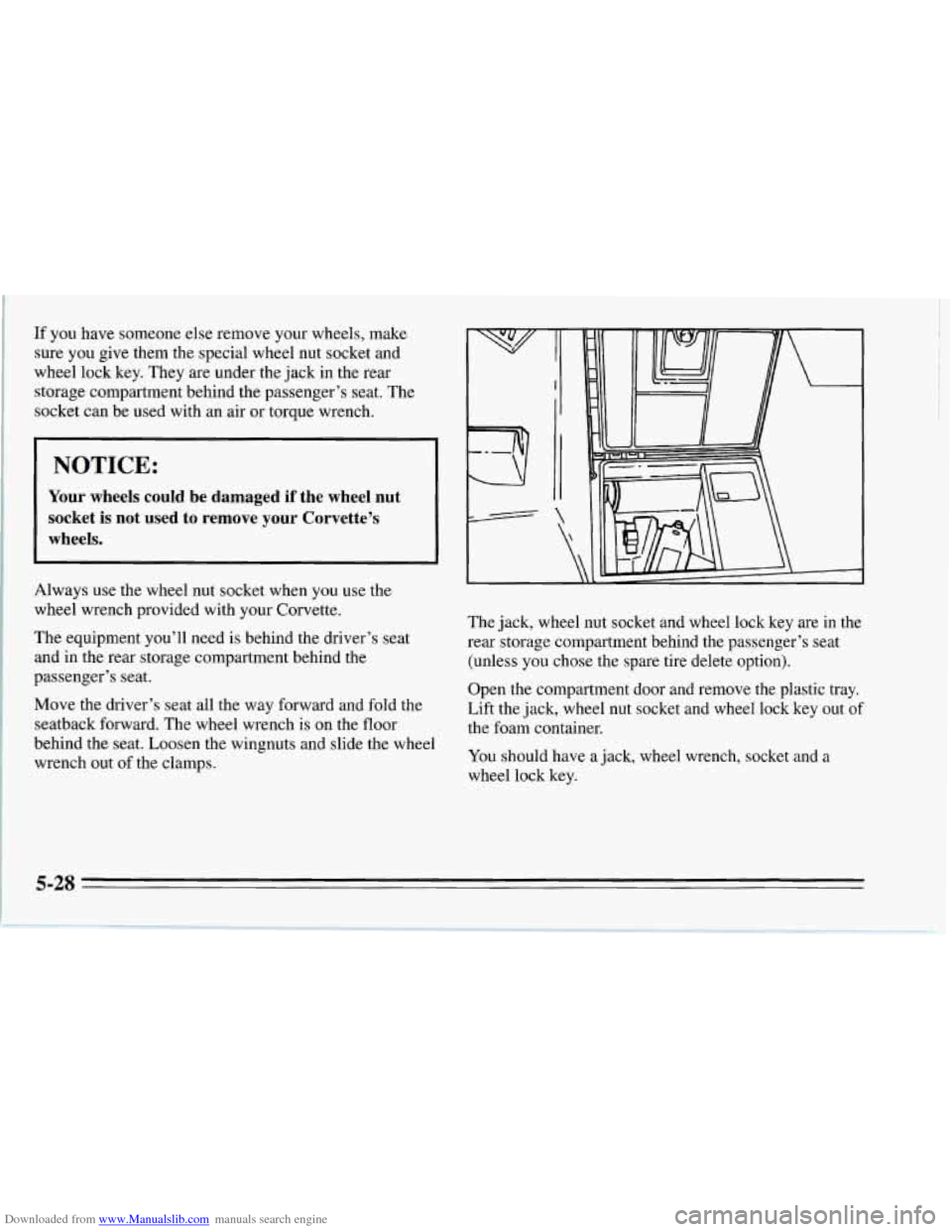
The jack, wheel nut socket and wheel lock key are in the
rear storage compartment behind the passenger’s seat
(unless you chose the spare tire delete option).
Open the compartment door and remove the plastic tray.
Lift the jack, wheel
nut socket and wheel lock key out of
the foam container.
You should have a jack, wheel wrench, socket and a
wheel lock key.
Page 222 of 386
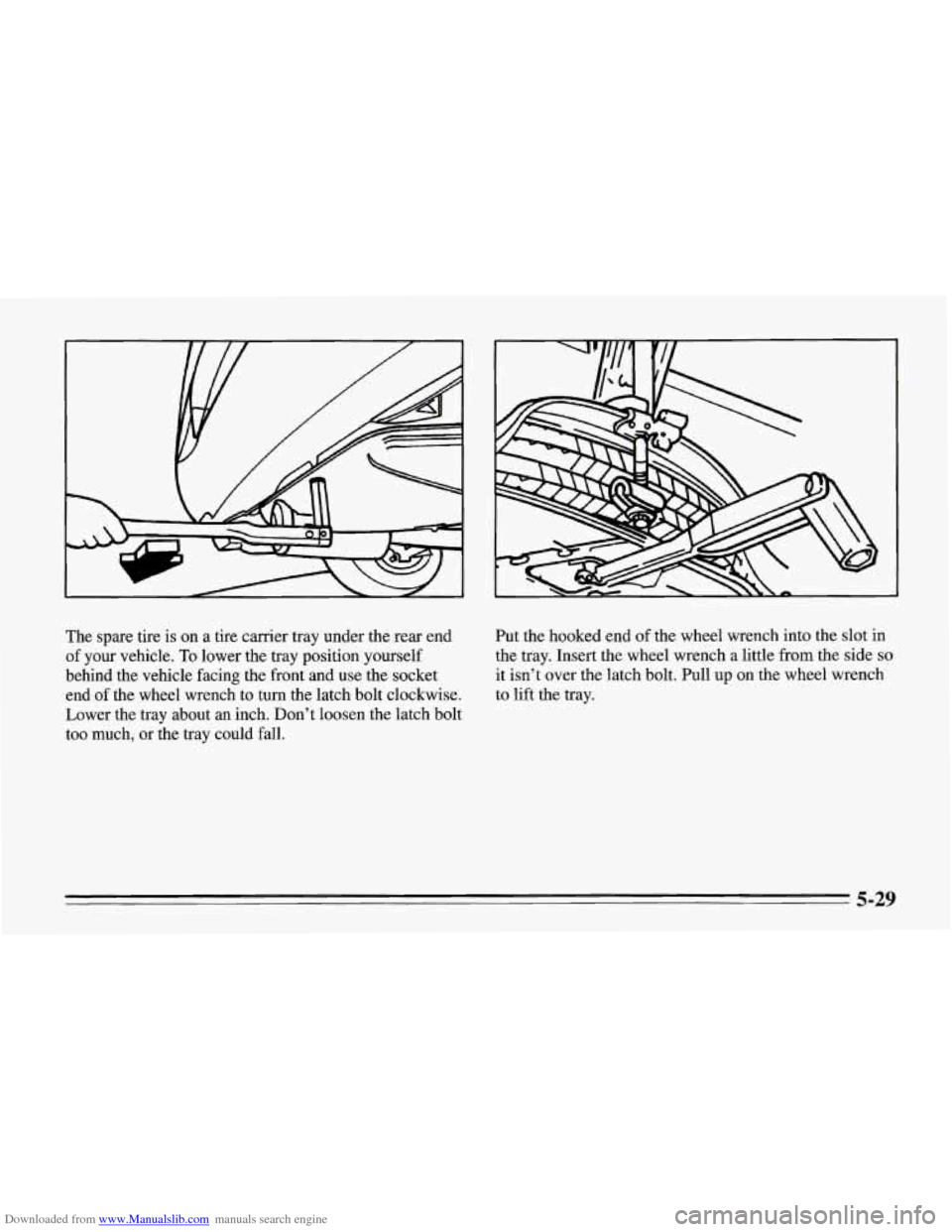
Downloaded from www.Manualslib.com manuals search engine The spare tire is on a tire carrier tray under the rear end
of your vehicle.
To lower the tray position yourself
behind the vehicle facing the front and use the socket
end of the wheel wrench to turn the latch bolt clockwise.
Lower the tray about an inch. Don’t loosen the latch bolt
too much, or the tray could fall. Put
the hooked end
of the wheel wrench into the slot in
the tray. Insert the wheel wrench a little from the side
so
it isn’t over the latch bolt. Pull up on the wheel wrench
to lift the tray.
5-29
Page 224 of 386
Downloaded from www.Manualslib.com manuals search engine P
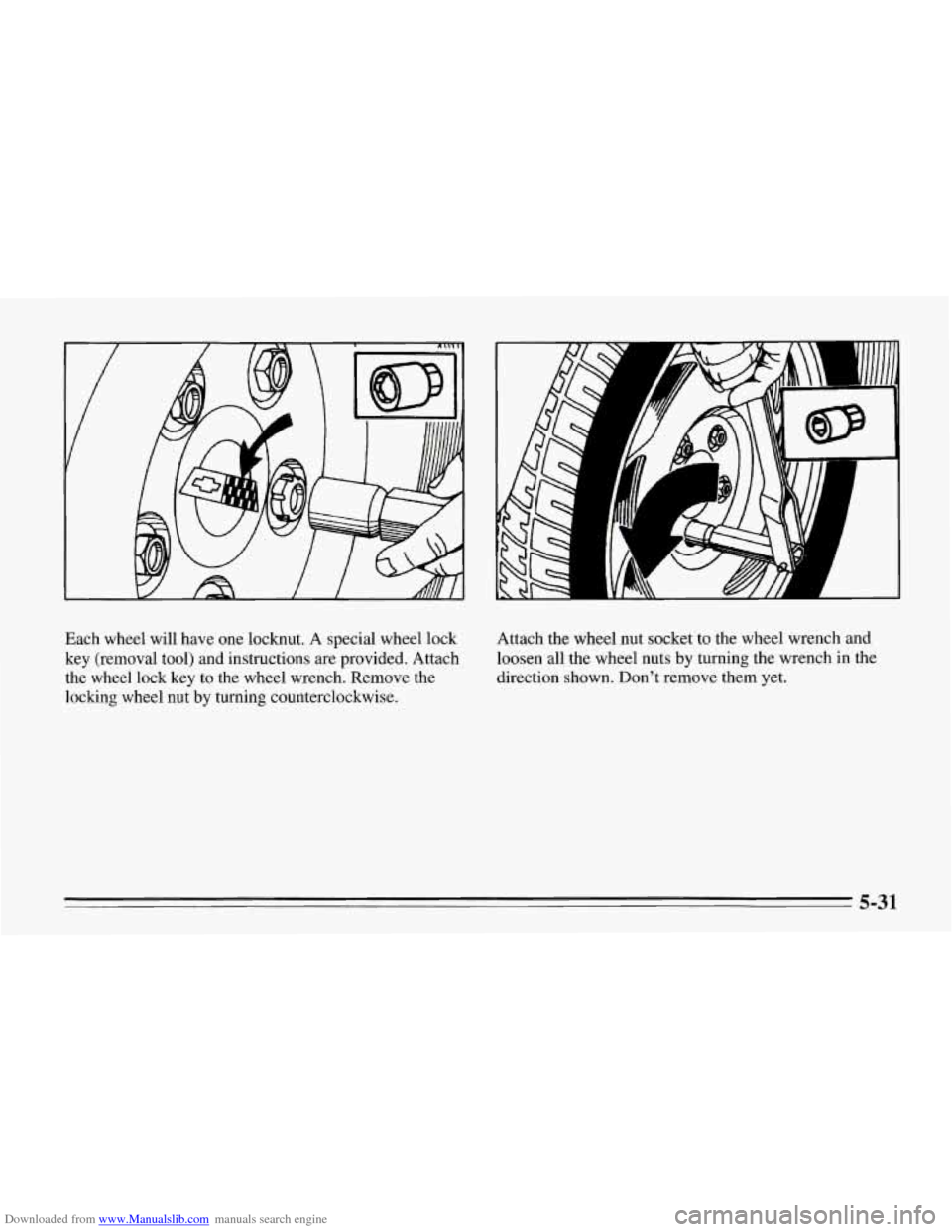
Each wheel will have one locknut. A special wheel lock
key (removal tool) and instructions are provided. Attach
the wheel lock key to the wheel wrench. Remove the
locking wheel nut by turning counterclockwise. Attach
the wheel nut socket to the wheel wrench and
loosen all the wheel nuts by turning the wrench in the
direction shown. Don’t remove them yet.
5-31
Page 225 of 386
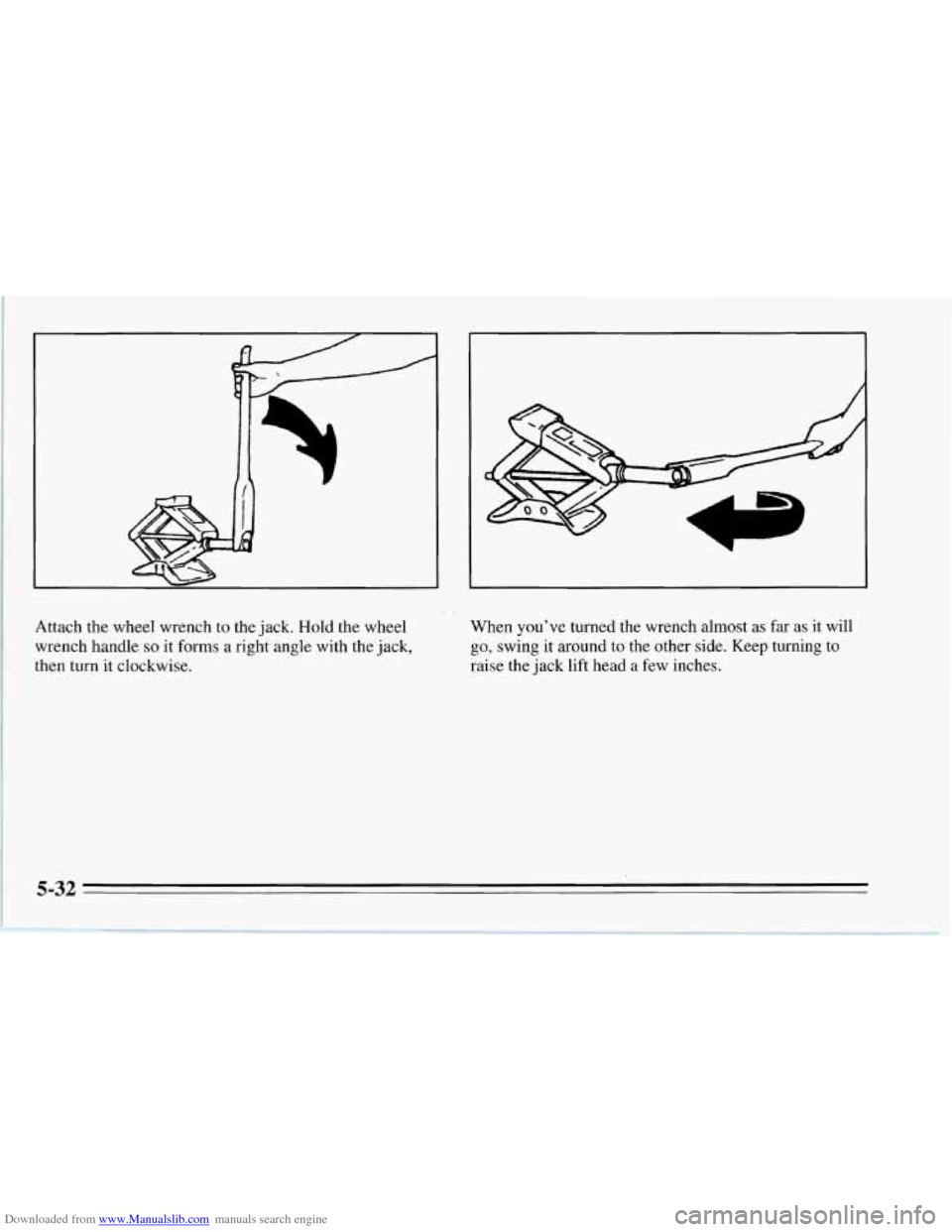
Downloaded from www.Manualslib.com manuals search engine Attach the wheel wrench to the jack. Hold the wheel
wrench handle
so it forms a right angle with the jack,
then turn it clockwise. When
you’ve turned the wrench almost as far as it will go, swing it around to the other side. Keep turning to
raise the jack lift head a few inches.
5-32
Page 227 of 386
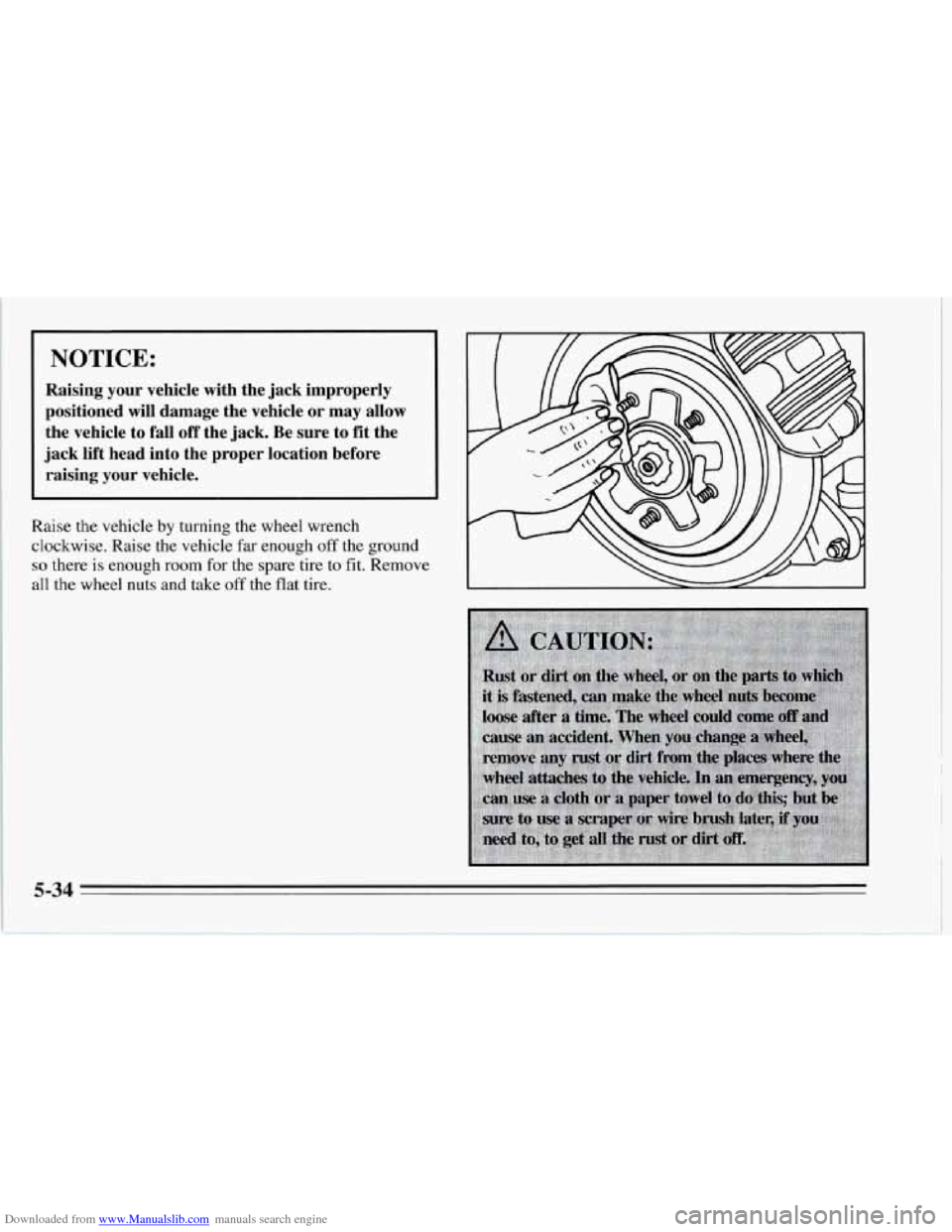
Downloaded from www.Manualslib.com manuals search engine NOTICE:
Raising your vehicle with the jack improperly
positioned will damage the vehicle or may allow
the vehicle to fall off the jack. Be sure
to fit the
jack lift head into the proper location before raising your vehicle.
Raise the vehicle by turning the wheel wrench
clockwise. Raise the vehicle far enough off the ground
so there is enough room for the spare tire to fit. Remove
all the wheel nuts and take
off the flat tire.
5-34