tire pressure CHEVROLET CORVETTE 2007 6.G User Guide
[x] Cancel search | Manufacturer: CHEVROLET, Model Year: 2007, Model line: CORVETTE, Model: CHEVROLET CORVETTE 2007 6.GPages: 488, PDF Size: 2.62 MB
Page 280 of 488
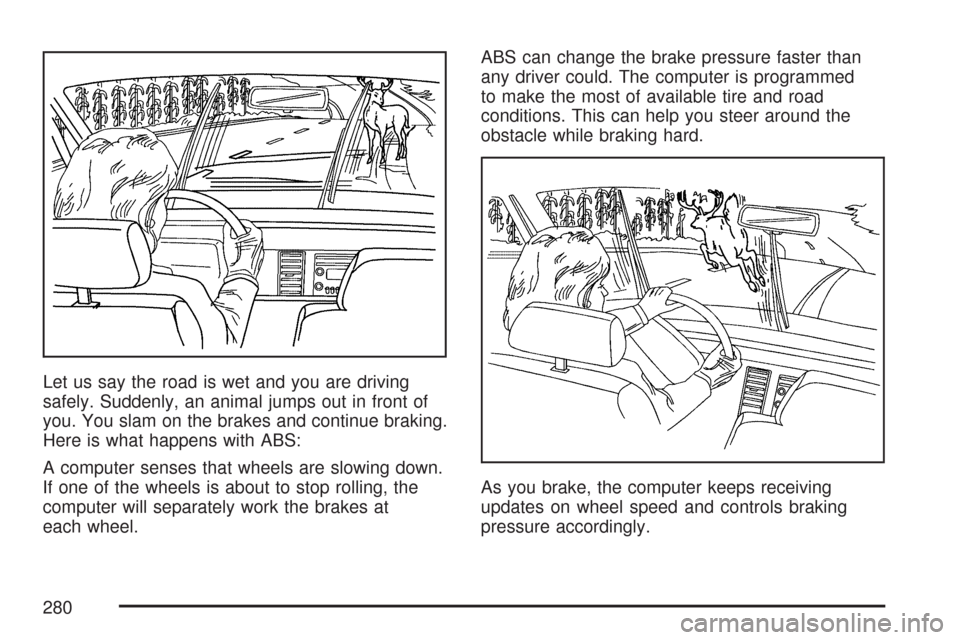
Let us say the road is wet and you are driving
safely. Suddenly, an animal jumps out in front of
you. You slam on the brakes and continue braking.
Here is what happens with ABS:
A computer senses that wheels are slowing down.
If one of the wheels is about to stop rolling, the
computer will separately work the brakes at
each wheel.ABS can change the brake pressure faster than
any driver could. The computer is programmed
to make the most of available tire and road
conditions. This can help you steer around the
obstacle while braking hard.
As you brake, the computer keeps receiving
updates on wheel speed and controls braking
pressure accordingly.
280
Page 284 of 488
The Active Handling System comes on
automatically whenever you start your vehicle.
To help maintain directional control of the vehicle,
you should always leave the system on. You
can turn the system off if you ever need to.
If you turn the Active Handling System off, the
Traction Control System will also be turned off.
Adjust your driving accordingly.
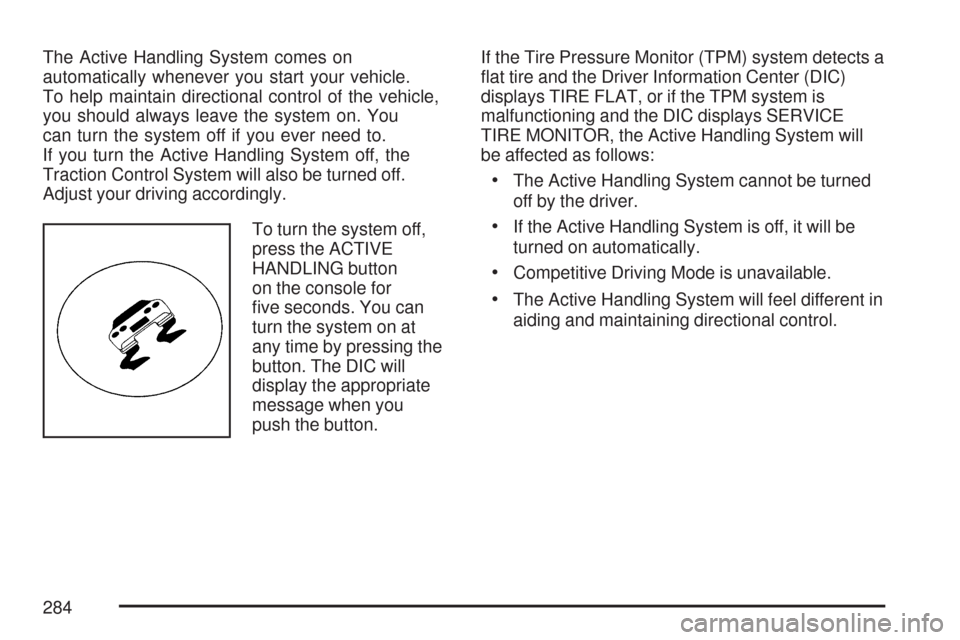
To turn the system off,
press the ACTIVE
HANDLING button
on the console for
ve seconds. You can
turn the system on at
any time by pressing the
button. The DIC will
display the appropriate
message when you
push the button.If the Tire Pressure Monitor (TPM) system detects a
at tire and the Driver Information Center (DIC)
displays TIRE FLAT, or if the TPM system is
malfunctioning and the DIC displays SERVICE
TIRE MONITOR, the Active Handling System will
be affected as follows:
The Active Handling System cannot be turned
off by the driver.
If the Active Handling System is off, it will be
turned on automatically.
Competitive Driving Mode is unavailable.
The Active Handling System will feel different in
aiding and maintaining directional control.
284
Page 296 of 488
Driving too fast through large water puddles or
even going through some car washes can cause
problems, too. The water may affect your
brakes. Try to avoid puddles. But if you cannot,
try to slow down before you hit them.
Hydroplaning
Hydroplaning is dangerous. So much water can
build up under your tires that they can actually ride
on the water. This can happen if the road is wet
enough and you are going fast enough. When your
vehicle is hydroplaning, it has little or no contact
with the road.
Hydroplaning does not happen often. But it can
if your tires do not have much tread or if the
pressure in one or more is low. It can happen if
a lot of water is standing on the road. If you
can see reections from trees, telephone poles,
or other vehicles, and raindrops dimple the
water’s surface, there could be hydroplaning.
Hydroplaning usually happens at higher speeds.
There just is not a hard and fast rule about
hydroplaning. The best advice is to slow down
when it is raining.
Driving Through Deep Standing Water
Notice:If you drive too quickly through deep
puddles or standing water, water can come
in through the engine’s air intake and badly
damage the engine. Never drive through water
that is slightly lower than the underbody of your
vehicle. If you cannot avoid deep puddles or
standing water, drive through them very slowly.
Driving Through Flowing Water
{CAUTION:
Flowing or rushing water creates strong
forces. If you try to drive through owing
water, as you might at a low water
crossing, your vehicle can be carried away.
As little as six inches of owing water
can carry away a smaller vehicle. If this
happens, you and other vehicle occupants
could drown. Do not ignore police warning
signs, and otherwise be very cautious
about trying to drive through owing water.
296
Page 300 of 488
Before Leaving on a Long Trip
Make sure you are ready. Try to be well rested.
If you must start when you are not fresh — such
as after a day’s work — do not plan to make
too many miles that rst part of the journey.
Wear comfortable clothing and shoes you can
easily drive in.
Is your vehicle ready for a long trip? If you keep it
serviced and maintained, it is ready to go. If it
needs service, have it done before starting out.
Of course, you will nd experienced and able
service experts in GM dealerships all across
North America. They will be ready and willing to
help if you need it.Here are some things you can check before a trip:Windshield Washer Fluid:Is the reservoir
full? Are all windows clean inside and outside?
Wiper Blades:Are they in good shape?
Fuel, Engine Oil, Other Fluids:Have you
checked all levels?
Lamps:Are they all working? Are the
lenses clean?
Tires:They are vitally important to a safe,
trouble-free trip. Is the tread good enough
for long-distance driving? Are the tires
all inated to the recommended pressure?
Weather Forecasts:What is the weather
outlook along your route? Should you
delay your trip a short time to avoid a major
storm system?
Maps:Do you have up-to-date maps?
300
Page 310 of 488
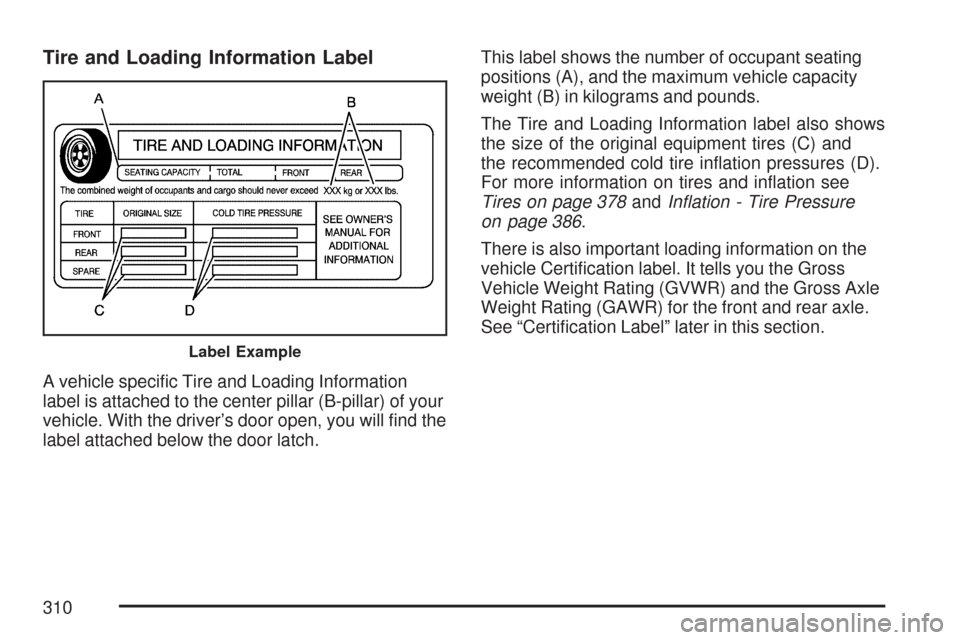
Tire and Loading Information Label
A vehicle specic Tire and Loading Information
label is attached to the center pillar (B-pillar) of your
vehicle. With the driver’s door open, you will nd the
label attached below the door latch.This label shows the number of occupant seating
positions (A), and the maximum vehicle capacity
weight (B) in kilograms and pounds.
The Tire and Loading Information label also shows
the size of the original equipment tires (C) and
the recommended cold tire ination pressures (D).
For more information on tires and ination see
Tires on page 378andInation - Tire Pressure
on page 386.
There is also important loading information on the
vehicle Certication label. It tells you the Gross
Vehicle Weight Rating (GVWR) and the Gross Axle
Weight Rating (GAWR) for the front and rear axle.
See “Certication Label” later in this section.
Label Example
310
Page 317 of 488
Service........................................................ 319
Accessories and Modications................... 319
California Proposition 65 Warning.............. 320
Doing Your Own Service Work.................. 320
Adding Equipment to the Outside
of Your Vehicle...................................... 321
Fuel............................................................. 321
Gasoline Octane........................................ 321
Gasoline Specications.............................. 322
California Fuel........................................... 322
Additives................................................... 323
Fuels in Foreign Countries........................ 324
Filling the Tank......................................... 324
Filling a Portable Fuel Container............... 327
Checking Things Under the Hood.............. 328
Hood Release........................................... 329
Engine Compartment Overview.................. 330
Engine Oil................................................. 333
Engine Oil Life System.............................. 340
Engine Air Cleaner/Filter............................ 342
Automatic Transmission Fluid.................... 345
Manual Transmission Fluid........................ 345
Hydraulic Clutch........................................ 346
Engine Coolant.......................................... 347
Coolant Surge Tank Pressure Cap............ 350Engine Overheating................................... 350
Overheated Engine Protection
Operating Mode..................................... 352
Cooling System......................................... 353
Power Steering Fluid................................. 358
Windshield Washer Fluid........................... 360
Brakes...................................................... 361
Battery...................................................... 364
Jump Starting............................................ 365
Rear Axle.................................................... 370
Bulb Replacement....................................... 371
High Intensity Discharge (HID) Lighting..... 371
Halogen Bulbs........................................... 372
Headlamps, Front Turn Signal, and
Parking Lamps....................................... 372
Taillamps, Turn Signal, and Stoplamps...... 374
Replacement Bulbs................................... 374
Windshield Replacement............................ 375
Windshield Wiper Blade Replacement....... 375
Tires............................................................ 378
Winter Tires.............................................. 379
Tire Sidewall Labeling............................... 380
Tire Terminology and Denitions............... 382
Extended Mobility Tires............................. 384
Ination - Tire Pressure............................. 386
Section 5 Service and Appearance Care
317
Page 318 of 488
High-Speed Operation............................... 388
Tire Pressure Monitor System................... 389
Tire Rotation............................................. 393
When It Is Time for New Tires.................. 393
Buying New Tires...................................... 394
Different Size Tires and Wheels................ 396
Uniform Tire Quality Grading..................... 396
Wheel Alignment and Tire Balance............ 398
Wheel Replacement.................................. 398
Tire Chains............................................... 401
Lifting Your Vehicle................................... 402
If a Tire Goes Flat.................................... 406
Appearance Care........................................ 407
Cleaning the Inside of Your Vehicle.......... 407
Fabric/Carpet............................................. 409
Coated Moldings....................................... 409
Leather...................................................... 410
Instrument Panel, Vinyl, and Other
Plastic Surfaces..................................... 410
Cargo Cover and Convenience Net........... 411
Care of Safety Belts.................................. 411
Weatherstrips............................................ 411
Washing Your Vehicle............................... 411
Cleaning Exterior Lamps/Lenses................ 412Finish Care............................................... 412
Windshield and Wiper Blades.................... 413
Removable Roof Panel.............................. 413
Convertible Top......................................... 414
Aluminum or Chrome-Plated Wheels
and Trim................................................ 414
Tires......................................................... 415
Finish Damage.......................................... 415
Underbody Maintenance............................ 416
Fiberglass Springs (Composite Springs)..... 416
Chemical Paint Spotting............................ 416
Vehicle Care/Appearance Materials............ 417
Vehicle Identication.................................. 418
Vehicle Identication Number (VIN)........... 418
Service Parts Identication Label............... 418
Electrical System........................................ 418
Add-On Electrical Equipment..................... 418
Headlamp Wiring....................................... 419
Windshield Wiper Fuses............................ 419
Power Windows and Other Power Options ... 419
Fuses and Circuit Breakers....................... 419
Instrument Panel Fuse Block..................... 419
Engine Compartment Fuse Block............... 422
Capacities and Specications.................... 426
Section 5 Service and Appearance Care
318
Page 378 of 488
Tires
Your new vehicle comes with high-quality tires
made by a leading tire manufacturer. If you ever
have questions about your tire warranty and where
to obtain service, see your GM Warranty booklet for
details. For additional information refer to the tire
manufacturer’s booklet included with your vehicle.
{CAUTION:
Poorly maintained and improperly
used tires are dangerous.
Overloading your tires can cause
overheating as a result of too much
friction. You could have an air-out
and a serious accident. SeeLoading
Your Vehicle on page 309.
CAUTION: (Continued)
CAUTION: (Continued)
Underinated tires pose the same
danger as overloaded tires. The
resulting accident could cause serious
injury. Check all tires frequently to
maintain the recommended pressure.
Tire pressure should be checked when
your tires are cold. SeeInflation - Tire
Pressure on page 386.
Overinated tires are more likely to
be cut, punctured, or broken by a
sudden impact — such as when
you hit a pothole. Keep tires at the
recommended pressure.
Worn, old tires can cause accidents.
If your tread is badly worn, or if
your tires have been damaged,
replace them.
SeeHigh-Speed Operation on page 388
for ination pressure adjustment for
high speed driving.
378
Page 379 of 488
Low-Prole Performance Tire
The original equipment tires on your vehicle are
classied as low-prole performance tires. These
tires are designed for very responsive driving on
wet or dry pavement. You may also notice more
road noise with low-prole tires and that they
tend to wear faster.
Notice:If your vehicle has low-prole tires,
they are more susceptible to damage from
road hazards or curb impact than standard
prole tires. Tire and/or wheel assembly
damage can occur when coming into contact
with road hazards like, potholes, or sharp
edged objects, or when sliding into a curb.
Your GM warranty does not cover this type
of damage. Keep tires set to the correct
ination pressure and, when possible avoid
contact with curbs, potholes, and other
road hazards.
Winter Tires
If you expect to drive on snow or ice covered
roads often, you may want to get winter tires
for your vehicle. All season tires provide good
overall performance on most surfaces butthey may not offer the traction you would like
or the same level of performance as winter tires
on snow or ice covered roads.
Winter tires, in general, are designed for increased
traction on snow and ice covered roads. With winter
tires, there may be decreased dry road traction,
increased road noise, and shorter tread life. After
switching to winter tires, be alert for changes in
vehicle handling and braking.
See your dealer for details regarding winter tire
availability and proper tire selection. Also, see
Buying New Tires on page 394.
If you choose to use winter tires:
Use tires of the same brand and tread type
on all four wheel positions.
Use only radial ply tires of the same size,
load range, and speed rating as the original
equipment tires.
Winter tires with the same speed rating as your
original equipment tires may not be available for H,
V, W, Y, and ZR speed rated tires. If you choose
winter tires with a lower speed rating, never
exceed the tire’s maximum speed capability.
379
Page 381 of 488
(F) Uniform Tire Quality Grading (UTQG):
Tire manufacturers are required to grade
tires based on three performance factors:
treadwear, traction and temperature resistance.
For more information seeUniform Tire Quality
Grading on page 396.
(G) Maximum Cold Ination Load Limit:
Maximum load that can be carried and the
maximum pressure needed to support that load.
Tire Size
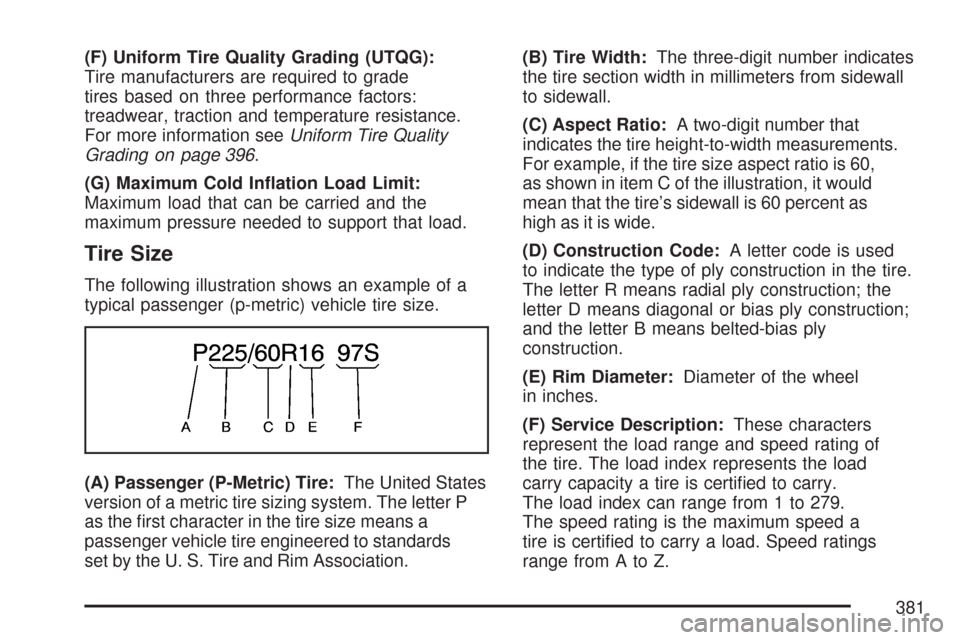
The following illustration shows an example of a
typical passenger (p-metric) vehicle tire size.
(A) Passenger (P-Metric) Tire:The United States
version of a metric tire sizing system. The letter P
as the rst character in the tire size means a
passenger vehicle tire engineered to standards
set by the U. S. Tire and Rim Association.(B) Tire Width:The three-digit number indicates
the tire section width in millimeters from sidewall
to sidewall.
(C) Aspect Ratio:A two-digit number that
indicates the tire height-to-width measurements.
For example, if the tire size aspect ratio is 60,
as shown in item C of the illustration, it would
mean that the tire’s sidewall is 60 percent as
high as it is wide.
(D) Construction Code:A letter code is used
to indicate the type of ply construction in the tire.
The letter R means radial ply construction; the
letter D means diagonal or bias ply construction;
and the letter B means belted-bias ply
construction.
(E) Rim Diameter:Diameter of the wheel
in inches.
(F) Service Description:These characters
represent the load range and speed rating of
the tire. The load index represents the load
carry capacity a tire is certied to carry.
The load index can range from 1 to 279.
The speed rating is the maximum speed a
tire is certied to carry a load. Speed ratings
range from A to Z.
381