air bleeding CHEVROLET DYNASTY 1993 User Guide
[x] Cancel search | Manufacturer: CHEVROLET, Model Year: 1993, Model line: DYNASTY, Model: CHEVROLET DYNASTY 1993Pages: 2438, PDF Size: 74.98 MB
Page 252 of 2438
WARNING: FAILURE TO DE-PRESSURIZE HYDRAU-
LIC ASSEMBLY/ACCUMULATOR PRIOR PERFORM-
ING THIS OPERATION. MAY RESULT IN PERSONAL
INJURY AND/OR DAMAGE TO PAINTED SURFACES
OF THE VEHICLE.
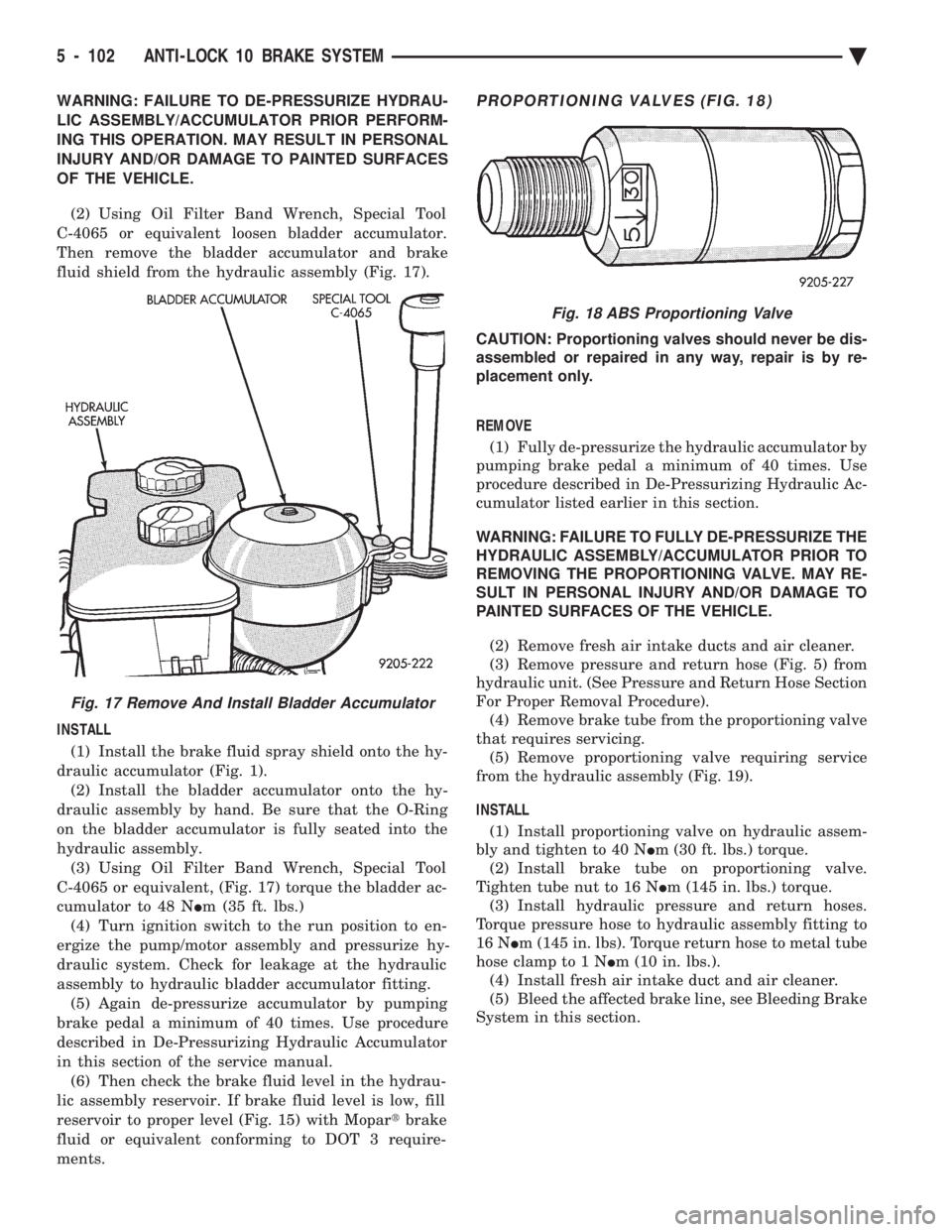
(2) Using Oil Filter Band Wrench, Special Tool
C-4065 or equivalent loosen bladder accumulator.
Then remove the bladder accumulator and brake
fluid shield from the hydraulic assembly (Fig. 17).
INSTALL
(1) Install the brake fluid spray shield onto the hy-
draulic accumulator (Fig. 1). (2) Install the bladder accumulator onto the hy-
draulic assembly by hand. Be sure that the O-Ring
on the bladder accumulator is fully seated into the
hydraulic assembly. (3) Using Oil Filter Band Wrench, Special Tool
C-4065 or equivalent, (Fig. 17) torque the bladder ac-
cumulator to 48 N Im (35 ft. lbs.)
(4) Turn ignition switch to the run position to en-
ergize the pump/motor assembly and pressurize hy-
draulic system. Check for leakage at the hydraulic
assembly to hydraulic bladder accumulator fitting. (5) Again de-pressurize accumulator by pumping
brake pedal a minimum of 40 times. Use procedure
described in De-Pressurizing Hydraulic Accumulator
in this section of the service manual. (6) Then check the brake fluid level in the hydrau-
lic assembly reservoir. If brake fluid level is low, fill
reservoir to proper level (Fig. 15) with Mopar tbrake
fluid or equivalent conforming to DOT 3 require-
ments.PROPORTIONING VALVES (FIG. 18)
CAUTION: Proportioning valves should never be dis-
assembled or repaired in any way, repair is by re-
placement only.
REMOVE (1) Fully de-pressurize the hydraulic accumulator by
pumping brake pedal a minimum of 40 times. Use
procedure described in De-Pressurizing Hydraulic Ac-
cumulator listed earlier in this section.
WARNING: FAILURE TO FULLY DE-PRESSURIZE THE
HYDRAULIC ASSEMBLY/ACCUMULATOR PRIOR TO
REMOVING THE PROPORTIONING VALVE. MAY RE-
SULT IN PERSONAL INJURY AND/OR DAMAGE TO
PAINTED SURFACES OF THE VEHICLE.
(2) Remove fresh air intake ducts and air cleaner.
(3) Remove pressure and return hose (Fig. 5) from
hydraulic unit. (See Pressure and Return Hose Section
For Proper Removal Procedure). (4) Remove brake tube from the proportioning valve
that requires servicing. (5) Remove proportioning valve requiring service
from the hydraulic assembly (Fig. 19).
INSTALL (1) Install proportioning valve on hydraulic assem-
bly and tighten to 40 N Im (30 ft. lbs.) torque.
(2) Install brake tube on proportioning valve.
Tighten tube nut to 16 N Im (145 in. lbs.) torque.
(3) Install hydraulic pressure and return hoses.
Torque pressure hose to hydraulic assembly fitting to
16 N Im (145 in. lbs). Torque return hose to metal tube
hose clamp to 1 N Im (10 in. lbs.).
(4) Install fresh air intake duct and air cleaner.
(5) Bleed the affected brake line, see Bleeding Brake
System in this section.
Fig. 17 Remove And Install Bladder Accumulator
Fig. 18 ABS Proportioning Valve
5 - 102 ANTI-LOCK 10 BRAKE SYSTEM Ä
Page 276 of 2438
As soon as the condition goes away, the Anti-Lock
Warning Light is turned off. Although a fault code
will be set in most cases.
BENDIX ABS SYSTEMS DIAGNOSTICS
Bendix Anti-Lock 6 Brake System Diagnostics, be-
yond basic mechanical diagnostics, covered earlier in
this section. Are accomplished by using the DRB II
scan tool. See testing procedures outlined in the Ben-
dix Anti-Lock 6 Diagnostics Manual for the 1992
M.Y. vehicles. Please refer to the above mentioned manual for
any further electronic diagnostics and service proce-
dures that are required on the Bendix Anti-Lock 6
Brake System.
ON-CAR ABS BRAKE SYSTEM SERVICE
GENERAL SERVICE PRECAUTIONS
The following are general cautions which should be
observed when servicing the Anti-Lock brake system
and/or other vehicle systems. Failure to observe
these precautions may result in Anti-Lock Brake
System component damage. If welding work is to be performed on the vehicle,
using an electric arc welder, the (CAB) connector
should be disconnected during the welding operation. The (CAB) connector should never be connected or
disconnected with the ignition switch in the ON po-
sition. Many components of the Anti-Lock Brake System
are not serviceable and must be replaced as an as-
sembly. Do not disassemble any component which is
not designed to be serviced.
CHECKING BRAKE FLUID LEVEL
CAUTION: Only use brake fluid conforming to DOT
3 specifications, such as Mopar or Equivalent. Do
not use any fluid which contains a petroleum base.
Do not use a container which has been used for pe-
troleum based fluids or a container which is wet
with water. Petroleum based fluids will cause swell-
ing and distortion of rubber parts in the hydraulic
brake system. Water will mix with brake fluid, low-
ering the fluid boiling point. Keep all brake fluid
containers capped to prevent contamination. Re-
move the front cap of the master cylinder reservoir
and fill to the bottom of the split ring.
For the specific procedure for the inspection of
brake fluid level and adding of brake to the reser-
voir. Refer to the Service Adjustments Section in this
group of the service manual.
BLEEDING BENDIX ANTI-LOCK 6 BRAKE SYSTEM
The Anti-Lock Brake System must be bled anytime
air is permitted to enter the hydraulic system, due to
disconnection of brake lines, hoses of components. If the Modulator Assembly is removed from the ve-
hicle, both the Base Brake System and the Anti-Lock
Brake System must be bled using the appropriate
procedures. It is important to note that excessive air
in the brake system will cause a soft or spongy feel-
ing brake pedal. During bleeding operations, be sure that the brake
fluid level remains close to the FULL level in the
reservoir. Check the fluid level periodically during
the bleeding procedure and add DOT 3 brake fluid as
required. The Bendix Anti-Lock 6 Brake System must be
bled as two independent braking systems. The non
ABS portion of the brake system is to be bled the
same as any non ABS system. Refer to the Service
Adjustments section in this manual for the proper
bleeding procedure to be used. This brake system can
be either pressure bled or manually bled. The Anti-Lock portion of brake system MUST be
bled separately. This bleeding procedure requires the
use of the DRB II Diagnostic tester and the bleeding
sequence procedure outlined below.
ABS BLEEDING PROCEDURE (FIG. 1)
(1) Assemble and install all brake system compo-
nents on vehicle making sure all hydraulic fluid
lines are installed and properly torqued. (2) Bleed the base brake system. Using the stan-
dard pressure or manual bleeding procedure as out-
lined in the Service Adjustments section of this
service manual. To perform the bleeding procedure on the ABS
unit. The battery and acid shield must be removed
from the vehicle. Reconnect the vehicles battery, to
the vehicles positive and negative battery cables us-
ing jumper cables. This is necessary to allow access
to the 4 bleeder screws located on the top of the Mod-
ulator assembly. (3) Connect the DRB II Diagnostics Tester to the
diagnostics connector. Located behind the Fuse Panel
access cover on the lower section of the dash panel to
the left of the steering column. (It is a blue 6 way
connector). (4) Using the DRB II check to make sure the
(CAB) does not have any fault codes stored. If it does
remove them using the DRB II.
5 - 126 ANTI-LOCK 6 BRAKE SYSTEM Ä
Page 277 of 2438
WARNING: WHEN BLEEDING THE MODULATOR
ASSEMBLY WEAR SAFETY GLASSES. A CLEAR
BLEED TUBE MUST BE ATTACHED TO THE
BLEEDER SCREWS AND SUBMERGED IN A CLEAR
CONTAINER FILLED PART WAY WITH CLEAN
BRAKE FLUID. DIRECT THE FLOW OF BRAKE
FLUID AWAY FROM THE PAINTED SURFACES OF
THE VEHICLE. BRAKE FLUID AT HIGH PRESSURE
MAY COME OUT OF THE BLEEDER SCREWS,
WHEN OPENED.
When bleeding the Modulator Assembly. The fol-
lowing bleeding sequence MUSTbe followed to in-
sure complete and adequate bleeding of the brakes
hydraulic system. The Modulator Assembly can be
bled using a Manual bleeding procedure or standard
Pressure Bleeding Equipment. If the brake system is to be bled using pressure
bleeding equipment. Refer to Bleeding Brake System,
in the Service Adjustments section at the beginning
of this group, for proper equipment usage and proce-
dures.
MODULATOR ASSEMBLY BLEEDING SEQUENCE
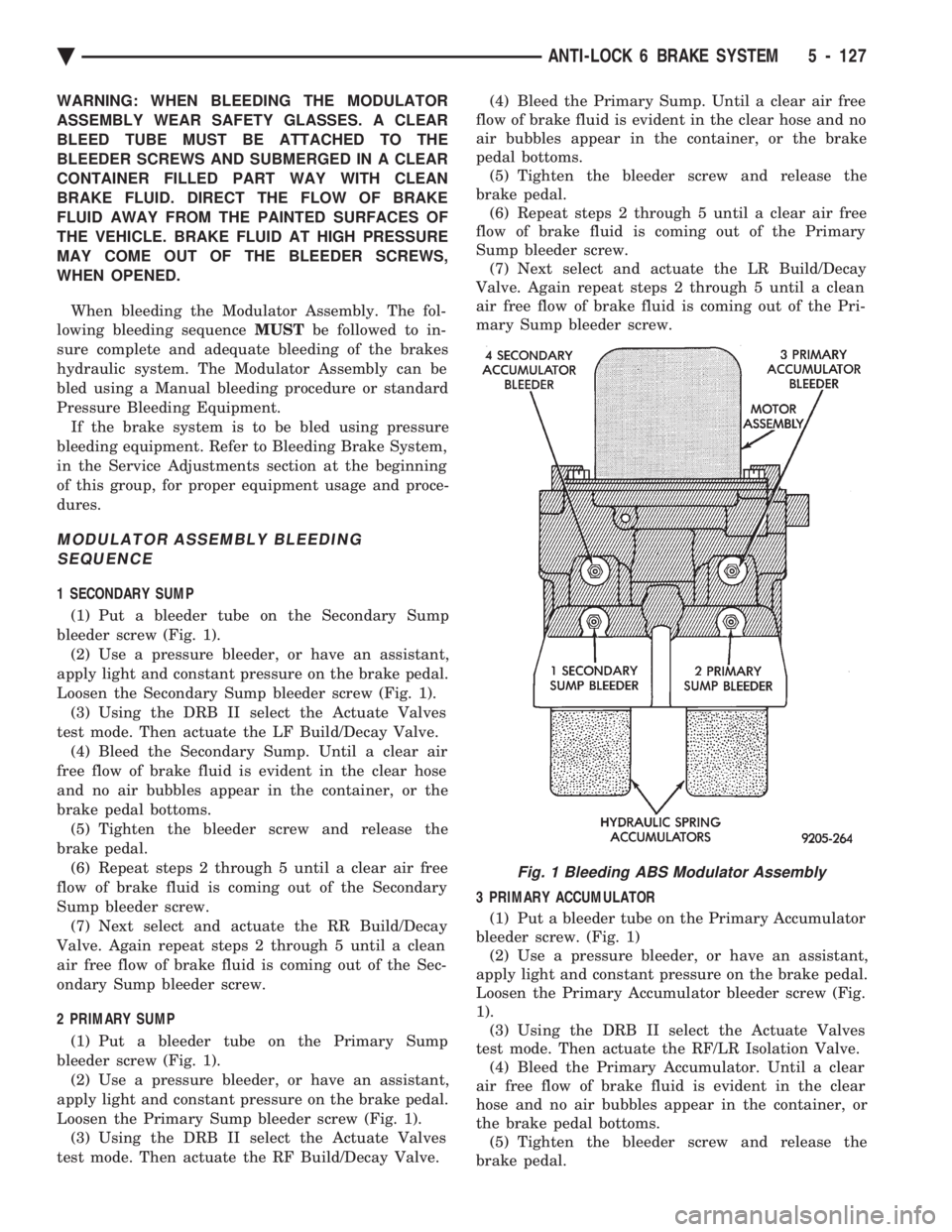
1 SECONDARY SUMP
(1) Put a bleeder tube on the Secondary Sump
bleeder screw (Fig. 1). (2) Use a pressure bleeder, or have an assistant,
apply light and constant pressure on the brake pedal.
Loosen the Secondary Sump bleeder screw (Fig. 1). (3) Using the DRB II select the Actuate Valves
test mode. Then actuate the LF Build/Decay Valve. (4) Bleed the Secondary Sump. Until a clear air
free flow of brake fluid is evident in the clear hose
and no air bubbles appear in the container, or the
brake pedal bottoms. (5) Tighten the bleeder screw and release the
brake pedal. (6) Repeat steps 2 through 5 until a clear air free
flow of brake fluid is coming out of the Secondary
Sump bleeder screw. (7) Next select and actuate the RR Build/Decay
Valve. Again repeat steps 2 through 5 until a clean
air free flow of brake fluid is coming out of the Sec-
ondary Sump bleeder screw.
2 PRIMARY SUMP
(1) Put a bleeder tube on the Primary Sump
bleeder screw (Fig. 1). (2) Use a pressure bleeder, or have an assistant,
apply light and constant pressure on the brake pedal.
Loosen the Primary Sump bleeder screw (Fig. 1). (3) Using the DRB II select the Actuate Valves
test mode. Then actuate the RF Build/Decay Valve. (4) Bleed the Primary Sump. Until a clear air free
flow of brake fluid is evident in the clear hose and no
air bubbles appear in the container, or the brake
pedal bottoms. (5) Tighten the bleeder screw and release the
brake pedal. (6) Repeat steps 2 through 5 until a clear air free
flow of brake fluid is coming out of the Primary
Sump bleeder screw. (7) Next select and actuate the LR Build/Decay
Valve. Again repeat steps 2 through 5 until a clean
air free flow of brake fluid is coming out of the Pri-
mary Sump bleeder screw.
3 PRIMARY ACCUMULATOR
(1) Put a bleeder tube on the Primary Accumulator
bleeder screw. (Fig. 1) (2) Use a pressure bleeder, or have an assistant,
apply light and constant pressure on the brake pedal.
Loosen the Primary Accumulator bleeder screw (Fig.
1). (3) Using the DRB II select the Actuate Valves
test mode. Then actuate the RF/LR Isolation Valve. (4) Bleed the Primary Accumulator. Until a clear
air free flow of brake fluid is evident in the clear
hose and no air bubbles appear in the container, or
the brake pedal bottoms. (5) Tighten the bleeder screw and release the
brake pedal.
Fig. 1 Bleeding ABS Modulator Assembly
Ä ANTI-LOCK 6 BRAKE SYSTEM 5 - 127
Page 289 of 2438
SERVICE ADJUSTMENTS INDEX
page page
Bleeding Bendix Antilock 4 Brake System ....... 3
Master Cylinder Fluid Level .................. 3 Testing for Fluid Contamination
............... 4
MASTER CYLINDER FLUID LEVEL
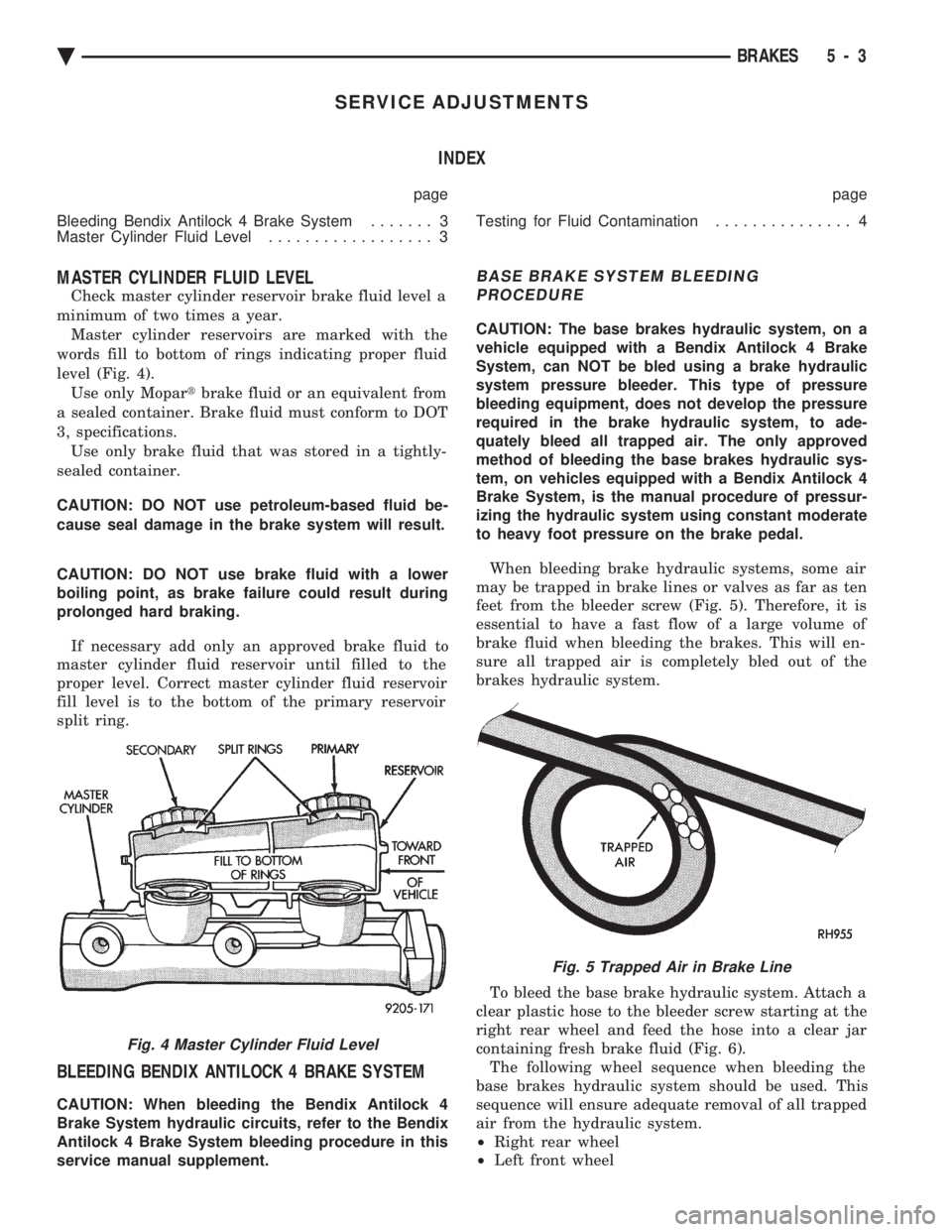
Check master cylinder reservoir brake fluid level a
minimum of two times a year. Master cylinder reservoirs are marked with the
words fill to bottom of rings indicating proper fluid
level (Fig. 4). Use only Mopar tbrake fluid or an equivalent from
a sealed container. Brake fluid must conform to DOT
3, specifications. Use only brake fluid that was stored in a tightly-
sealed container.
CAUTION: DO NOT use petroleum-based fluid be-
cause seal damage in the brake system will result.
CAUTION: DO NOT use brake fluid with a lower
boiling point, as brake failure could result during
prolonged hard braking.
If necessary add only an approved brake fluid to
master cylinder fluid reservoir until filled to the
proper level. Correct master cylinder fluid reservoir
fill level is to the bottom of the primary reservoir
split ring.
BLEEDING BENDIX ANTILOCK 4 BRAKE SYSTEM
CAUTION: When bleeding the Bendix Antilock 4
Brake System hydraulic circuits, refer to the Bendix
Antilock 4 Brake System bleeding procedure in this
service manual supplement.
BASE BRAKE SYSTEM BLEEDING PROCEDURE
CAUTION: The base brakes hydraulic system, on a
vehicle equipped with a Bendix Antilock 4 Brake
System, can NOT be bled using a brake hydraulic
system pressure bleeder. This type of pressure
bleeding equipment, does not develop the pressure
required in the brake hydraulic system, to ade-
quately bleed all trapped air. The only approved
method of bleeding the base brakes hydraulic sys-
tem, on vehicles equipped with a Bendix Antilock 4
Brake System, is the manual procedure of pressur-
izing the hydraulic system using constant moderate
to heavy foot pressure on the brake pedal.
When bleeding brake hydraulic systems, some air
may be trapped in brake lines or valves as far as ten
feet from the bleeder screw (Fig. 5). Therefore, it is
essential to have a fast flow of a large volume of
brake fluid when bleeding the brakes. This will en-
sure all trapped air is completely bled out of the
brakes hydraulic system.
To bleed the base brake hydraulic system. Attach a
clear plastic hose to the bleeder screw starting at the
right rear wheel and feed the hose into a clear jar
containing fresh brake fluid (Fig. 6). The following wheel sequence when bleeding the
base brakes hydraulic system should be used. This
sequence will ensure adequate removal of all trapped
air from the hydraulic system.
² Right rear wheel
² Left front wheel
Fig. 4 Master Cylinder Fluid Level
Fig. 5 Trapped Air in Brake Line
Ä BRAKES 5 - 3
Page 297 of 2438
The instrument panel bulb can be checked each
time the ignition switch is turned to the start posi-
tion or the parking brake is set.
HYDRAULIC SYSTEM SERVICE PROCEDURES
BRAKE WARNING SYSTEM
CHECKING BRAKE WARNING SWITCH UNIT
The Red Brake Warning light will come on when the
parking brake is applied with the ignition key turned
ON. The same light will also illuminate should one of
the two service brake hydraulic systems fail.
CAUTION:Make sure air does not enter the hydraulic
system during this test procedure. See bleeding with-
out a pressure bleeder at the beginning of this section
for master cylinder fluid level checking procedures.
To test the service brake warning system lamp.
Raise vehicle on a hoist and open a wheel cylinder
bleeder while a helper depresses the brake pedal and
observes the warning light.
If light fails to come on, inspect for a burned out bulb,
disconnected socket, or a broken or disconnected wire at
the switch. If the bulb is not burned out and the wire
continuity is not interrupted. Check the service brake
warning switch operation with a test lamp between the
switch terminal and a known good ground. Be sure to
fill master cylinder and bleed brake system after correc-
tion has been made, if necessary.
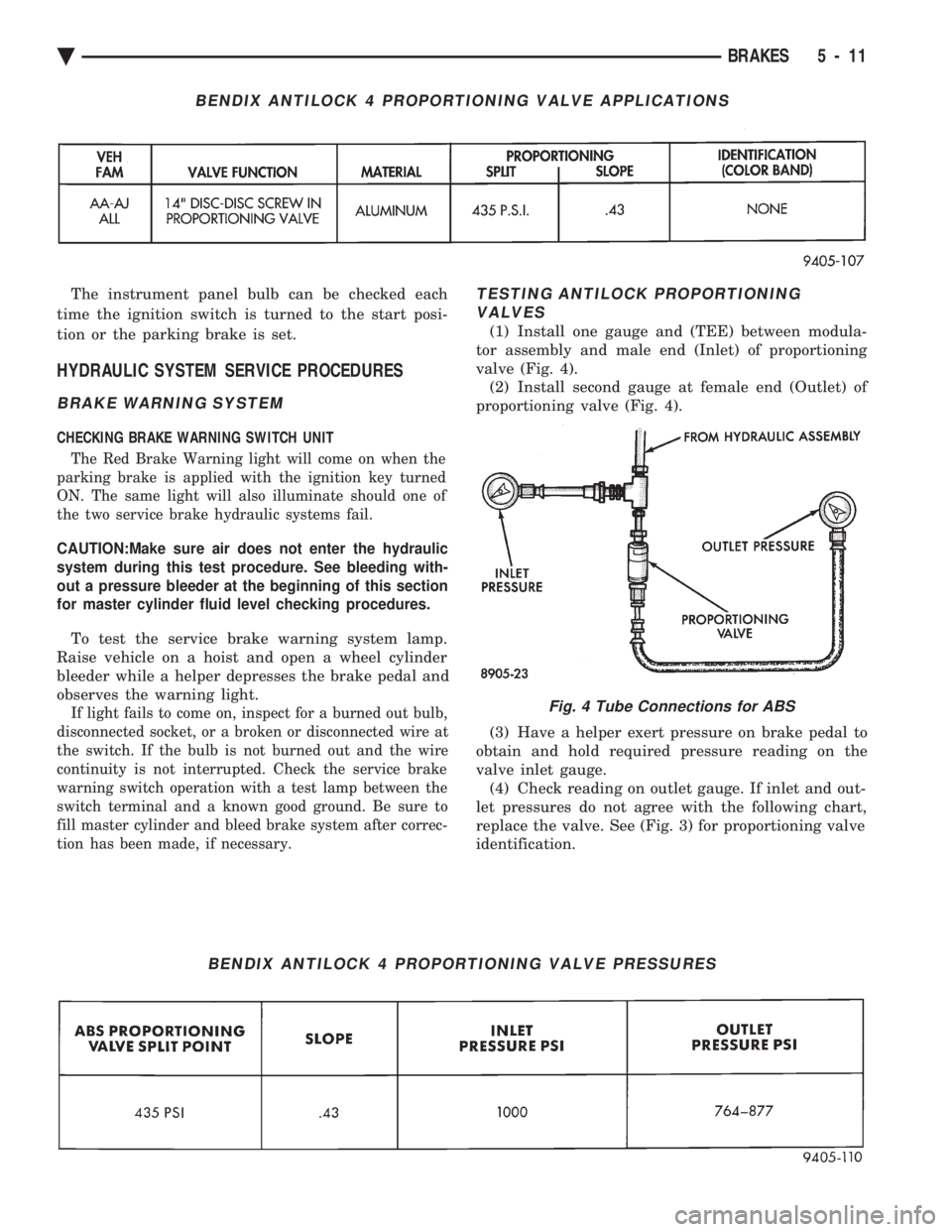
TESTING ANTILOCK PROPORTIONING VALVES
(1) Install one gauge and (TEE) between modula-
tor assembly and male end (Inlet) of proportioning
valve (Fig. 4). (2) Install second gauge at female end (Outlet) of
proportioning valve (Fig. 4).
(3) Have a helper exert pressure on brake pedal to
obtain and hold required pressure reading on the
valve inlet gauge. (4) Check reading on outlet gauge. If inlet and out-
let pressures do not agree with the following chart,
replace the valve. See (Fig. 3) for proportioning valve
identification.
BENDIX ANTILOCK 4 PROPORTIONING VALVE APPLICATIONS
BENDIX ANTILOCK 4 PROPORTIONING VALVE PRESSURES
Fig. 4 Tube Connections for ABS
Ä BRAKES 5 - 11
Page 311 of 2438
LATCHING VERSUS NON-LATCHING ABS FAULTS
Some faults detected by the CAB are latching; the
fault is latched and ABS is disabled until the igni-
tion switch is reset. Thus ABS is disabled even if the
original fault has disappeared. Other faults are non-
latching; any warning lights that are turned on, are
only turned on as long as the fault condition exists.
As soon as the condition goes away, the Antilock
Warning Light is turned off. Although a fault code
will be set in most cases.
BENDIX ANTILOCK 4 BRAKE SYSTEM DIAGNOSTICS
Bendix Antilock 4 Brake System Diagnostics, be-
yond basic mechanical diagnostics, covered earlier in
this section, are accomplished by using the DRB scan
tool. See testing procedures outlined in the 1994 Ben-
dix Antilock 4 Diagnostics Manual. Please refer to the above mentioned manual for
any further electronic diagnostics and service proce-
dures that are required on the Bendix Antilock 4
Brake System.
ON-CAR ABS BRAKE SYSTEM SERVICE
GENERAL SERVICE PRECAUTIONS
The following are general cautions which should be
observed when servicing the Bendix Antilock 4
Brake System and other vehicle electronic systems.
Failure to observe these precautions may result in
Antilock Brake System component damage. If welding work is to be performed on a vehicle us-
ing an electric arc welder, disconnect the 60 way wir-
ing harness connector from the CAB, prior to
performing the welding operation. The wiring harness connector should never be con-
nected or disconnected from the CAB with the igni-
tion key in the ON or Run position. (3) Most components making up the assemblies of
the Bendix Antilock 4 Brake System can not be ser-
viced separately from those assemblies. This will re-
quire replacement of the complete assembly for the
servicing of these components. Do not disassemble
any component from an assembly which is desig-
nated as non-serviceable.
CHECKING BRAKE FLUID LEVEL
CAUTION: Only use brake fluid conforming to DOT
3 specifications, such as Mopar or Equivalent. Do
not use any fluid which contains a petroleum base.
Do not use a container which has been used for pe-
troleum based fluids or a container which is wet
with water. Petroleum based fluids will cause swell-
ing and distortion of rubber parts in the hydraulic
brake system. Water will mix with brake fluid, low-
ering the boiling point of the brake fluid, possibly causing brake fluid to boil resulting in brake fade.
Keep all brake fluid containers capped to prevent
contamination. Remove the front cap of the master
cylinder reservoir and fill to the bottom of the split
ring.
For the specific procedure for the inspection of
brake fluid level and adding of brake to the reser-
voir. Refer to the Service Adjustments Section in this
group of the service manual.
BLEEDING BENDIX ANTILOCK 4 BRAKE SYSTEM
The base brakes and Antilock Brake System must
be bled anytime air is permitted to enter the hydrau-
lic system, due to disconnection of brake lines, hoses
or components. If the Antilock Modulator Assembly is removed
from the vehicle, both the Base Brake System and
the Antilock Brake System must be bled using the
appropriate procedure. It is important to note that
excessive air in the brake system will cause a soft or
spongy feeling brake pedal. During brake bleeding operations, ensure that
brake fluid level remains close to the FULL level in
the reservoir. Check brake fluid level periodically
during bleeding procedure, adding DOT 3 brake fluid
as required.
CAUTION: The base brake and Antilock brake hy-
draulic systems, on the Bendix Antilock 4 Brake
System, can NOT be bled using any type of brake
pressure bleeding equipment. This type of bleeding
equipment does not develop the pressure required
in the brake hydraulic system, to adequately bleed
all trapped air. The only approved method for bleed-
ing air out of the hydraulic system on vehicles
equipped with the Bendix Antilock 4 Brake System,
is the manual procedure of pressurizing the hydrau-
lic system using constant, moderate to heavy foot
pressure on the brake pedal.
The Bendix Antilock 4 Brake System must be bled
as two independent brake systems. The non ABS por-
tion of the brake system is to be bled the same as
any non ABS system. Refer to the Service Adjust-
ments section in this manual for the proper bleeding
procedure to be used. The Bendix Antilock 4 Brake
System can only be bled using a manual method of
pressurizing the brakes hydraulic system. The Antilock portion of brake system MUST be
bled separately. This bleeding procedure requires the
use of the DRB Diagnostic tester and the bleeding se-
quence procedure outlined below.
Ä ANTILOCK 4 BRAKE SYSTEM 5 - 25
Page 312 of 2438
BENDIX ANTILOCK 4 MODULATOR ASSEMBLY BLEEDING PROCEDURE
(1) Assemble and install all brake system compo-
nents on the vehicle, making sure all hydraulic fluid
lines are installed and properly torqued. (2) Bleed the base brake system, using ONLYthe
bleeding procedure outlined in the Service Adjust-
ments section of this service manual supplement. To perform the bleeding procedure on the ABS modu-
lator assembly, the battery, battery tray and acid shield
must be removed from vehicle. Then reconnect the
vehicle's battery to vehicle's battery cables, using
ONLY approved battery jumper cables. (3) Connect the DRB Diagnostics Tester to the vehi-
cle's diagnostics connector. The vehicle diagnostic con-
nector is located behind the fuse panel access cover on
the lower section of the dash panel left of the steering
column. The diagnostic connector is a blue 6 way
connector. (4) Using the DRB check to make sure the CAB does
not have any stored fault codes. If it does, remove them
using the DRB.
WARNING: WHEN BLEEDING THE MODULATOR AS-
SEMBLY WEAR SAFETY GLASSES. A CLEAR BLEED
TUBE MUST BE ATTACHED TO THE MODULATOR
BLEED SCREWS AND SUBMERGED IN A CLEAR
CONTAINER FILLED PART WAY WITH FRESH CLEAN
BRAKE FLUID. DIRECT THE FLOW OF BRAKE FLUID
AWAY FROM THE PAINTED SURFACES OF THE VE-
HICLE. BRAKE FLUID AT HIGH PRESSURE MAY
COME OUT OF THE BLEEDER SCREWS, WHEN
OPENED.
When bleeding Antilock modulator assembly, the
following bleeding sequence MUSTbe followed to
insure a complete bleeding of all air from the Antilock
brake, and base brake hydraulic systems. The modu-
lator assembly can ONLY be bled using a manual
bleeding procedure to pressurize the hydraulic
system.
MODULATOR ASSEMBLY CIRCUIT BLEEDING PROCEDURE AND SEQUENCE
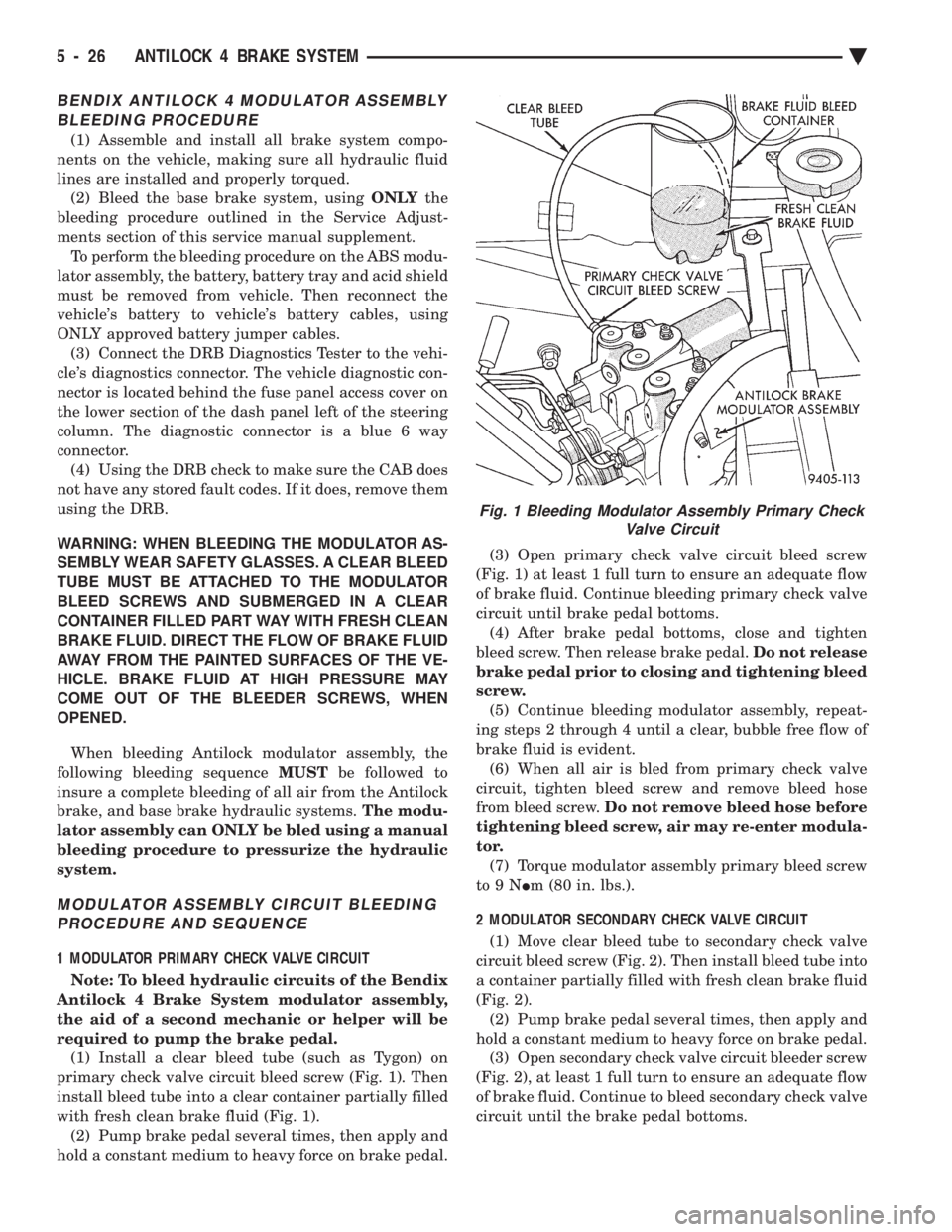
1 MODULATOR PRIMARY CHECK VALVE CIRCUIT
Note: To bleed hydraulic circuits of the Bendix
Antilock 4 Brake System modulator assembly,
the aid of a second mechanic or helper will be
required to pump the brake pedal. (1) Install a clear bleed tube (such as Tygon) on
primary check valve circuit bleed screw (Fig. 1). Then
install bleed tube into a clear container partially filled
with fresh clean brake fluid (Fig. 1). (2) Pump brake pedal several times, then apply and
hold a constant medium to heavy force on brake pedal. (3) Open primary check valve circuit bleed screw
(Fig. 1) at least 1 full turn to ensure an adequate flow
of brake fluid. Continue bleeding primary check valve
circuit until brake pedal bottoms. (4) After brake pedal bottoms, close and tighten
bleed screw. Then release brake pedal. Do not release
brake pedal prior to closing and tightening bleed
screw. (5) Continue bleeding modulator assembly, repeat-
ing steps 2 through 4 until a clear, bubble free flow of
brake fluid is evident. (6) When all air is bled from primary check valve
circuit, tighten bleed screw and remove bleed hose
from bleed screw. Do not remove bleed hose before
tightening bleed screw, air may re-enter modula-
tor. (7) Torque modulator assembly primary bleed screw
to9N Im (80 in. lbs.).
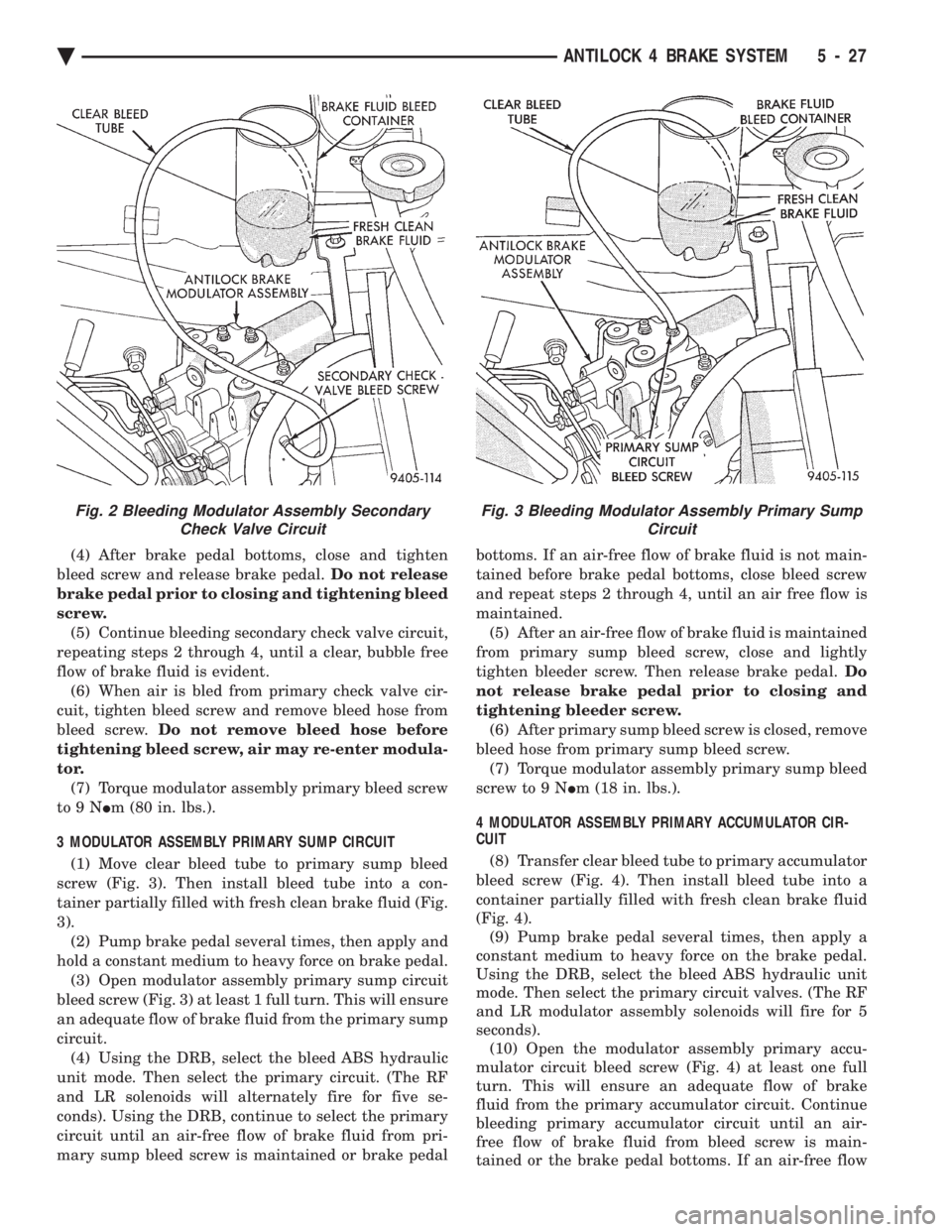
2 MODULATOR SECONDARY CHECK VALVE CIRCUIT (1) Move clear bleed tube to secondary check valve
circuit bleed screw (Fig. 2). Then install bleed tube into
a container partially filled with fresh clean brake fluid
(Fig. 2). (2) Pump brake pedal several times, then apply and
hold a constant medium to heavy force on brake pedal. (3) Open secondary check valve circuit bleeder screw
(Fig. 2), at least 1 full turn to ensure an adequate flow
of brake fluid. Continue to bleed secondary check valve
circuit until the brake pedal bottoms.
Fig. 1 Bleeding Modulator Assembly Primary Check Valve Circuit
5 - 26 ANTILOCK 4 BRAKE SYSTEM Ä
Page 313 of 2438
(4) After brake pedal bottoms, close and tighten
bleed screw and release brake pedal. Do not release
brake pedal prior to closing and tightening bleed
screw. (5) Continue bleeding secondary check valve circuit,
repeating steps 2 through 4, until a clear, bubble free
flow of brake fluid is evident. (6) When air is bled from primary check valve cir-
cuit, tighten bleed screw and remove bleed hose from
bleed screw. Do not remove bleed hose before
tightening bleed screw, air may re-enter modula-
tor. (7) Torque modulator assembly primary bleed screw
to9N Im (80 in. lbs.).
3 MODULATOR ASSEMBLY PRIMARY SUMP CIRCUIT (1) Move clear bleed tube to primary sump bleed
screw (Fig. 3). Then install bleed tube into a con-
tainer partially filled with fresh clean brake fluid (Fig.
3). (2) Pump brake pedal several times, then apply and
hold a constant medium to heavy force on brake pedal. (3) Open modulator assembly primary sump circuit
bleed screw (Fig. 3) at least 1 full turn. This will ensure
an adequate flow of brake fluid from the primary sump
circuit. (4) Using the DRB, select the bleed ABS hydraulic
unit mode. Then select the primary circuit. (The RF
and LR solenoids will alternately fire for five se-
conds). Using the DRB, continue to select the primary
circuit until an air-free flow of brake fluid from pri-
mary sump bleed screw is maintained or brake pedal bottoms. If an air-free flow of brake fluid is not main-
tained before brake pedal bottoms, close bleed screw
and repeat steps 2 through 4, until an air free flow is
maintained.
(5) After an air-free flow of brake fluid is maintained
from primary sump bleed screw, close and lightly
tighten bleeder screw. Then release brake pedal. Do
not release brake pedal prior to closing and
tightening bleeder screw. (6) After primary sump bleed screw is closed, remove
bleed hose from primary sump bleed screw. (7) Torque modulator assembly primary sump bleed
screw to 9 N Im (18 in. lbs.).
4 MODULATOR ASSEMBLY PRIMARY ACCUMULATOR CIR-
CUIT
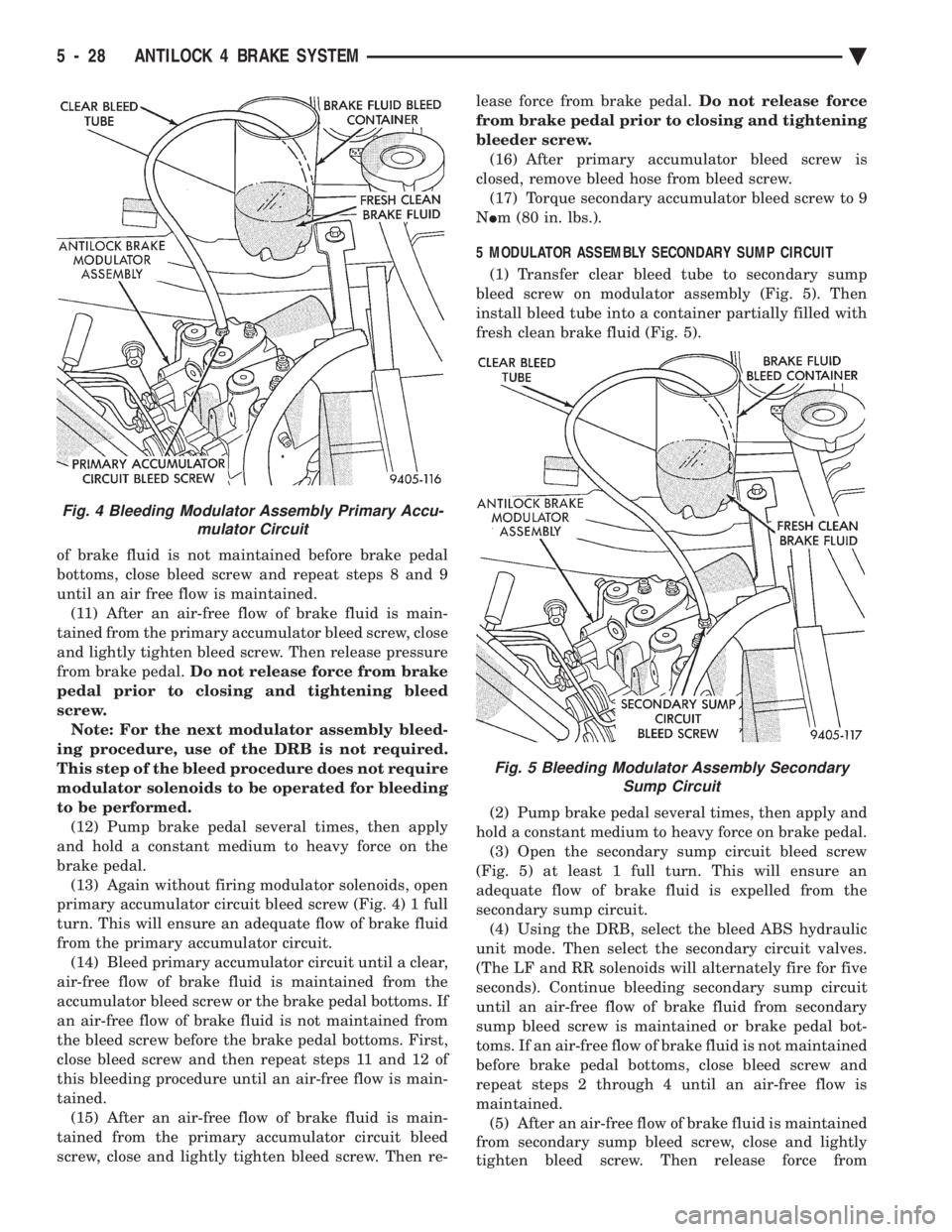
(8) Transfer clear bleed tube to primary accumulator
bleed screw (Fig. 4). Then install bleed tube into a
container partially filled with fresh clean brake fluid
(Fig. 4). (9) Pump brake pedal several times, then apply a
constant medium to heavy force on the brake pedal.
Using the DRB, select the bleed ABS hydraulic unit
mode. Then select the primary circuit valves. (The RF
and LR modulator assembly solenoids will fire for 5
seconds). (10) Open the modulator assembly primary accu-
mulator circuit bleed screw (Fig. 4) at least one full
turn. This will ensure an adequate flow of brake
fluid from the primary accumulator circuit. Continue
bleeding primary accumulator circuit until an air-
free flow of brake fluid from bleed screw is main-
tained or the brake pedal bottoms. If an air-free flow
Fig. 3 Bleeding Modulator Assembly Primary Sump CircuitFig. 2 Bleeding Modulator Assembly SecondaryCheck Valve Circuit
Ä ANTILOCK 4 BRAKE SYSTEM 5 - 27
Page 314 of 2438
of brake fluid is not maintained before brake pedal
bottoms, close bleed screw and repeat steps 8 and 9
until an air free flow is maintained.(11) After an air-free flow of brake fluid is main-
tained from the primary accumulator bleed screw, close
and lightly tighten bleed screw. Then release pressure
from brake pedal. Do not release force from brake
pedal prior to closing and tightening bleed
screw. Note: For the next modulator assembly bleed-
ing procedure, use of the DRB is not required.
This step of the bleed procedure does not require
modulator solenoids to be operated for bleeding
to be performed. (12) Pump brake pedal several times, then apply
and hold a constant medium to heavy force on the
brake pedal. (13) Again without firing modulator solenoids, open
primary accumulator circuit bleed screw (Fig. 4) 1 full
turn. This will ensure an adequate flow of brake fluid
from the primary accumulator circuit. (14) Bleed primary accumulator circuit until a clear,
air-free flow of brake fluid is maintained from the
accumulator bleed screw or the brake pedal bottoms. If
an air-free flow of brake fluid is not maintained from
the bleed screw before the brake pedal bottoms. First,
close bleed screw and then repeat steps 11 and 12 of
this bleeding procedure until an air-free flow is main-
tained. (15) After an air-free flow of brake fluid is main-
tained from the primary accumulator circuit bleed
screw, close and lightly tighten bleed screw. Then re- lease force from brake pedal.
Do not release force
from brake pedal prior to closing and tightening
bleeder screw. (16) After primary accumulator bleed screw is
closed, remove bleed hose from bleed screw. (17) Torque secondary accumulator bleed screw to 9
N Im (80 in. lbs.).
5 MODULATOR ASSEMBLY SECONDARY SUMP CIRCUIT (1) Transfer clear bleed tube to secondary sump
bleed screw on modulator assembly (Fig. 5). Then
install bleed tube into a container partially filled with
fresh clean brake fluid (Fig. 5).
(2) Pump brake pedal several times, then apply and
hold a constant medium to heavy force on brake pedal. (3) Open the secondary sump circuit bleed screw
(Fig. 5) at least 1 full turn. This will ensure an
adequate flow of brake fluid is expelled from the
secondary sump circuit. (4) Using the DRB, select the bleed ABS hydraulic
unit mode. Then select the secondary circuit valves.
(The LF and RR solenoids will alternately fire for five
seconds). Continue bleeding secondary sump circuit
until an air-free flow of brake fluid from secondary
sump bleed screw is maintained or brake pedal bot-
toms. If an air-free flow of brake fluid is not maintained
before brake pedal bottoms, close bleed screw and
repeat steps 2 through 4 until an air-free flow is
maintained. (5) After an air-free flow of brake fluid is maintained
from secondary sump bleed screw, close and lightly
tighten bleed screw. Then release force from
Fig. 4 Bleeding Modulator Assembly Primary Accu- mulator Circuit
Fig. 5 Bleeding Modulator Assembly SecondarySump Circuit
5 - 28 ANTILOCK 4 BRAKE SYSTEM Ä
Page 315 of 2438
brake pedal. Do not release brake pedal prior to
closing and tightening bleeder screw. (6) After secondary sump bleed screw is closed, re-
move bleed hose from bleed screw. (7) Torque secondary sump bleed screw to 9 N Im (80
in. lbs.).
6 MODULATOR ASSEMBLY SECONDARY ACCUMULATOR
CIRCUIT
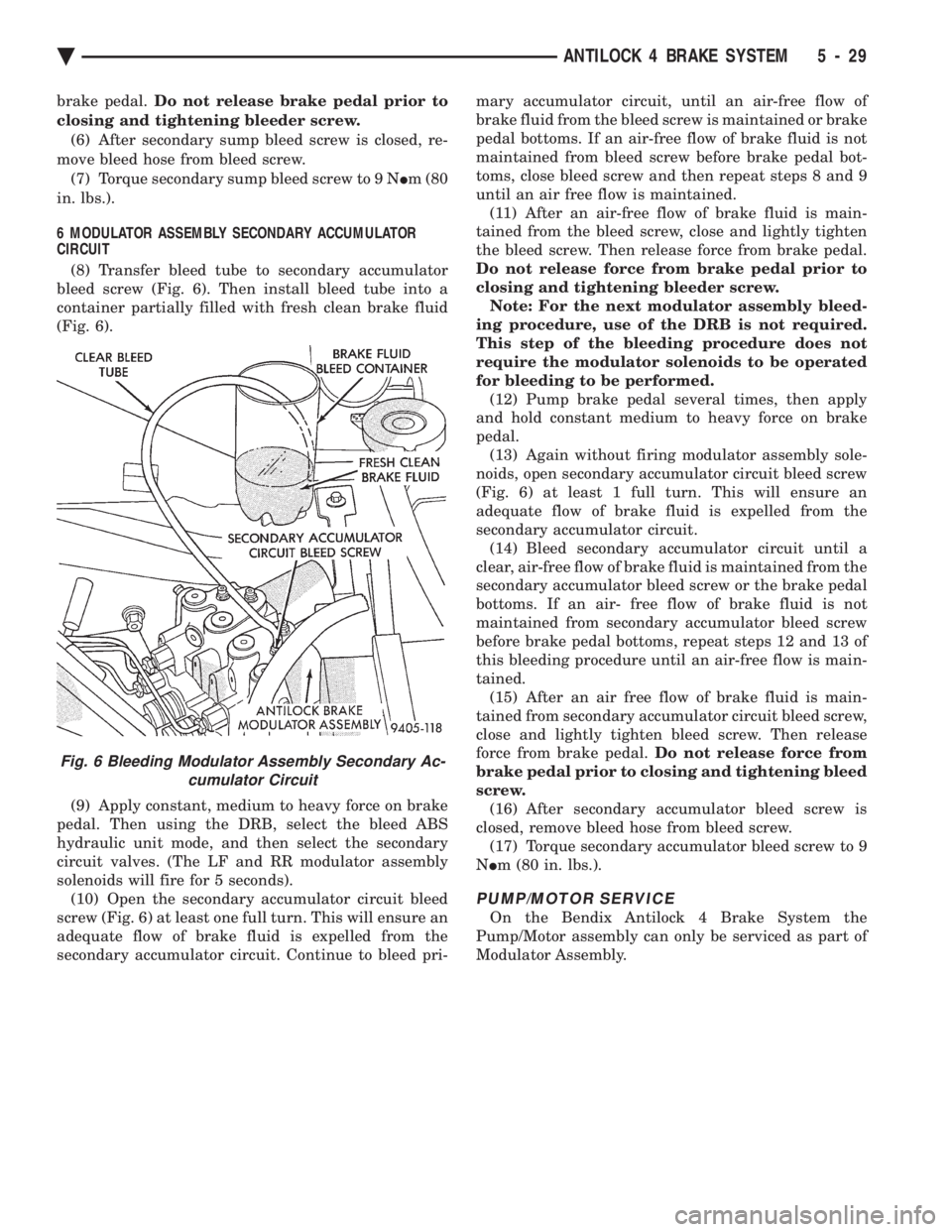
(8) Transfer bleed tube to secondary accumulator
bleed screw (Fig. 6). Then install bleed tube into a
container partially filled with fresh clean brake fluid
(Fig. 6).
(9) Apply constant, medium to heavy force on brake
pedal. Then using the DRB, select the bleed ABS
hydraulic unit mode, and then select the secondary
circuit valves. (The LF and RR modulator assembly
solenoids will fire for 5 seconds). (10) Open the secondary accumulator circuit bleed
screw (Fig. 6) at least one full turn. This will ensure an
adequate flow of brake fluid is expelled from the
secondary accumulator circuit. Continue to bleed pri- mary accumulator circuit, until an air-free flow of
brake fluid from the bleed screw is maintained or brake
pedal bottoms. If an air-free flow of brake fluid is not
maintained from bleed screw before brake pedal bot-
toms, close bleed screw and then repeat steps 8 and 9
until an air free flow is maintained. (11) After an air-free flow of brake fluid is main-
tained from the bleed screw, close and lightly tighten
the bleed screw. Then release force from brake pedal.
Do not release force from brake pedal prior to
closing and tightening bleeder screw. Note: For the next modulator assembly bleed-
ing procedure, use of the DRB is not required.
This step of the bleeding procedure does not
require the modulator solenoids to be operated
for bleeding to be performed. (12) Pump brake pedal several times, then apply
and hold constant medium to heavy force on brake
pedal. (13) Again without firing modulator assembly sole-
noids, open secondary accumulator circuit bleed screw
(Fig. 6) at least 1 full turn. This will ensure an
adequate flow of brake fluid is expelled from the
secondary accumulator circuit. (14) Bleed secondary accumulator circuit until a
clear, air-free flow of brake fluid is maintained from the
secondary accumulator bleed screw or the brake pedal
bottoms. If an air- free flow of brake fluid is not
maintained from secondary accumulator bleed screw
before brake pedal bottoms, repeat steps 12 and 13 of
this bleeding procedure until an air-free flow is main-
tained. (15) After an air free flow of brake fluid is main-
tained from secondary accumulator circuit bleed screw,
close and lightly tighten bleed screw. Then release
force from brake pedal. Do not release force from
brake pedal prior to closing and tightening bleed
screw. (16) After secondary accumulator bleed screw is
closed, remove bleed hose from bleed screw. (17) Torque secondary accumulator bleed screw to 9
N Im (80 in. lbs.).
PUMP/MOTOR SERVICE
On the Bendix Antilock 4 Brake System the
Pump/Motor assembly can only be serviced as part of
Modulator Assembly.
Fig. 6 Bleeding Modulator Assembly Secondary Ac- cumulator Circuit
Ä ANTILOCK 4 BRAKE SYSTEM 5 - 29