ignition CHEVROLET KODIAK 2005 User Guide
[x] Cancel search | Manufacturer: CHEVROLET, Model Year: 2005, Model line: KODIAK, Model: CHEVROLET KODIAK 2005Pages: 374, PDF Size: 5.46 MB
Page 81 of 374
Automatic Transmission
Move your shift lever to PARK (P) or NEUTRAL (N).
Your engine will not start in any other position — that is
a safety feature. To restart when you are already
moving, use NEUTRAL (N) only.
Notice:Do not try to shift to PARK (P) if your
vehicle is moving. If you do, you could damage the
transmission. Shift to PARK (P) only when your
vehicle is stopped.
Manual Transmission
Move your shift lever to NEUTRAL and hold the
clutch pedal to the floor while starting the engine.
Your vehicle will not start if the clutch pedal is not
all the way down — that is a safety feature.
Starting Your Engine
1. Turn your ignition key to RUN.
Observe the wait to start light. SeeWait to
Start Indicator (Diesel Engine) on page 3-36.
This light may not come on if the engine is hot.
2. As soon as the wait to start light goes off,
immediately turn the ignition key to START.
When the engine starts, let go of the key.
If your vehicle is equipped with a DURAMAX
®6600
engine, it has a fast warm-up glow plug system.
The wait to start light will illuminate for a much
shorter time than most diesel engines, due to the
rapid heating of the glow plug system.
Notice:Holding your key in START for longer than
15 seconds at a time will cause your battery to
be drained much sooner. And the excessive heat
can damage your starter motor.
Notice:If the wait to start light stays on after
starting your vehicle, your vehicle may not run
properly. Have your vehicle serviced right away.
3. If the engine does not start after 15 seconds
of cranking, turn the ignition key to OFF. Wait
one minute for the starter to cool, then try the same
steps again.
2-15
Page 83 of 374
Cold Weather Starting
(Caterpillar®Diesel)
Because the diesel engine uses compression ignition,
it is harder to start in cold weather than a gasoline
engine. The air intake heater and use of the proper
engine oil, optional engine coolant heaters and optional
ether injection systems help cold weather starting.
See the Caterpillar
®Diesel Engine Operation &
Maintenance Manual for more information.
Restarting the Diesel Engine While
Moving (Automatic Transmission)
If you have to restart the engine while the vehicle is
moving, you will first have to shift to NEUTRAL (N).
This safety feature prevents starting the engine when
the transmission is in a drive gear for more information.
Stopping the Diesel Engine
1. Set the parking brake and shift to NEUTRAL (N)
or PARK (P).
2. Turn the ignition key to OFF.
If your vehicle has a two-speed axle, see
Two-Speed Rear Axle Electric Shift Control on
page 2-26.
If you have a Caterpillar
®diesel engine, see your
Caterpillar®Diesel Engine Operation & Maintenance
Manual for additional information.
Diesel Engine Warm-Up
Several factors affect how quickly your diesel engine
warms up. These can include outside temperature,
engine load, idle time and your vehicle’s option content.
Your vehicle may be equipped with some features
that can help the engine reach operating temperature
sooner. Some of these features are discussed below.
Also, remember that an automatic transmission
adds heat to the cooling system through the heat
exchanger in the radiator. Because of this, vehicles
equipped with automatic transmissions are often able to
retain engine coolant heat better than manual
transmission vehicles.
See your Caterpillar
®Operation & Maintenance manual
for additional diesel engine warm-up information.
2-17
Page 84 of 374
If Your Diesel Engine Will Not Start
If you have run out of fuel, seeRunning Out of Fuel on
page 5-15.
If you are not out of fuel, and your engine will not start,
do this:
Turn your ignition key to RUN. Immediately after the wait
to start light goes off, turn the ignition key to START.
If the light does not go off, wait a few seconds, then try
starting your engine again. And, see your dealer as
soon as you can for a starting system check.
If the light comes on and then goes off and you know
your batteries are charged, but your engine still will not
start, your vehicle needs service.
If the light does not come on when the engine is cold,
your vehicle needs service.
If your batteries do not have enough charge to start
your engine, seeBattery on page 5-55.
Be sure you have the right oil for your engine, and that
you have changed the oil at the proper times. If you
use the wrong oil, your engine may be harder to start.Be sure you are using the proper fuel for existing
weather conditions. SeeWhat Fuel to Use on page 5-8.
If the engine starts, runs a short time, then stops,
your vehicle needs service.
{CAUTION:
Do not use gasoline or starting aids, such as
ether, in the air intake. They could damage
your engine. There could also be a re, which
could cause serious personal injury.
Engine Alarm and Automatic
Shutdown
Your check gages warning light will come on if the
system senses high engine temperature or low engine
oil pressure. If high engine temperature or low engine oil
pressure is detected, you will also hear a tone alarm
at two beats per second. The alarm and the light
will remain on until the condition is fixed. If the engine
temperature or oil pressure condition worsens, the
tone alarm will go to five beats per second.
2-18
Page 86 of 374
Manual High Idle System
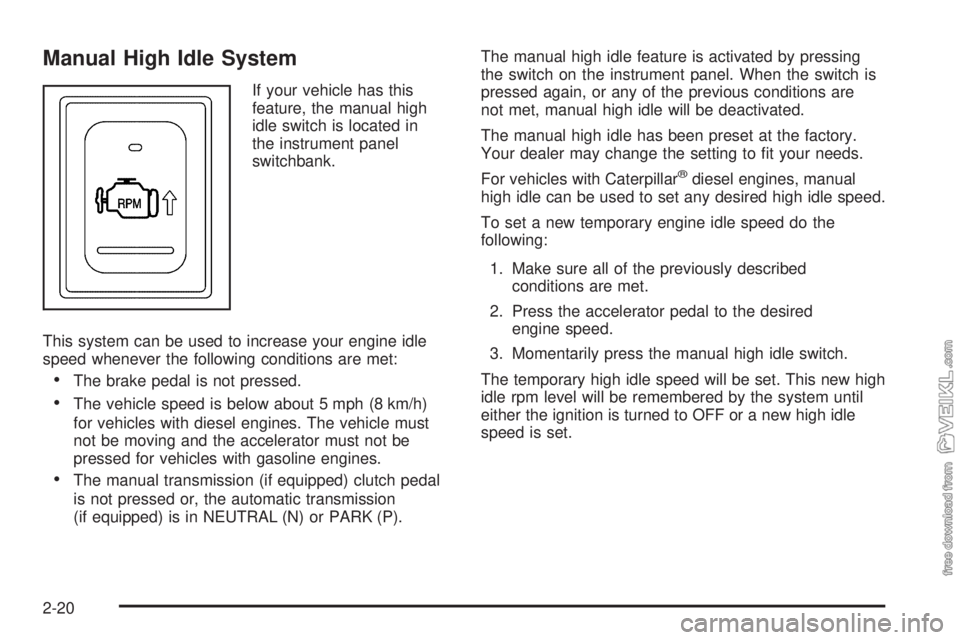
If your vehicle has this
feature, the manual high
idle switch is located in
the instrument panel
switchbank.
This system can be used to increase your engine idle
speed whenever the following conditions are met:
•The brake pedal is not pressed.
•The vehicle speed is below about 5 mph (8 km/h)
for vehicles with diesel engines. The vehicle must
not be moving and the accelerator must not be
pressed for vehicles with gasoline engines.
•The manual transmission (if equipped) clutch pedal
is not pressed or, the automatic transmission
(if equipped) is in NEUTRAL (N) or PARK (P).The manual high idle feature is activated by pressing
the switch on the instrument panel. When the switch is
pressed again, or any of the previous conditions are
not met, manual high idle will be deactivated.
The manual high idle has been preset at the factory.
Your dealer may change the setting to fit your needs.
For vehicles with Caterpillar
®diesel engines, manual
high idle can be used to set any desired high idle speed.
To set a new temporary engine idle speed do the
following:
1. Make sure all of the previously described
conditions are met.
2. Press the accelerator pedal to the desired
engine speed.
3. Momentarily press the manual high idle switch.
The temporary high idle speed will be set. This new high
idle rpm level will be remembered by the system until
either the ignition is turned to OFF or a new high idle
speed is set.
2-20
Page 87 of 374
Exhaust Restrictor
(DURAMAX
®Diesel)
If your vehicle is equipped with a DURAMAX®6600
engine, it has a cold temperature high idle feature which
elevates the engines idle speed from 660 to 1500 rpms,
and restricts the exhaust gas flow, when outside
temperatures are below 32°F (0°C), and the engine
coolant temperature is below 150°F (65°C). This feature
enhances heater performance by raising the engine
coolant temperature faster.
This feature is already turned on. This feature can be
turned off and on by doing the following brake stomp
procedure:
1. Turn the ignition to RUN, with the vehicle off.
2. Press the accelerator pedal to the floor and
hold while quickly pressing the brake pedal
three times in less than eight seconds.
3. Release the accelerator pedal and start
the engine.If this feature is turned on when the engine is started,
the green exhaust brake/restrictor light below the
radio controls will be lit for 10 seconds. If this feature is
turned on and the algorithm comes on, based upon
the temperature conditions and other conditions, then
the green exhaust brake/restrictor light will remain lit and
the engine will slowly ramp up to the high idle speed
after a delay of a few seconds up to approximately
two minutes.
When the engine is started, it will slowly ramp up to the
high idle speed after a delay of a few seconds up to
about two minutes. For this method to work properly
there must be no throttle or brake pedal faults, and the
throttle pedal must not fall below 75 percent of wide
open throttle while pressing the brake pedal.
The engine idle speed will return to normal once the
following conditions are met:
•Once engine coolant temperature reaches
150°F (65°C).
•Air intake temperature reaches 41°F (5°C).
2-21
Page 89 of 374
During this warm-up period, check your warning lights
and gages:
•If oil pressure does not begin to rise within
15 seconds of starting, stop the engine and find the
cause. SeeOil Pressure Gage on page 3-37for
more information.
•If the engine coolant temperature gage needle goes
into the hot area on the gage, stop the engine and
find the cause of the overheating. SeeEngine
Coolant Temperature Gage on page 3-35for
more information.
•If you have air brakes, the dual-needle air pressure
gage should read at least 115 psi (790 kPa) for
both service systems before you try to move
the vehicle. When air pressure is below 60 psi
(420 kPa), the LOW AIR light will come on and you
will hear a tone alarm. SeeBrake System Warning
Light on page 3-31for more information. If the
pressure does not build up or drops during warm-up,
stop the engine and find the cause before you try
to move the vehicle. Recommended air pressure
before driving is 120 psi (830 kPa). SeeAir
Pressure Gage on page 3-44for more information.
•The charging system light should come on when
the ignition key is turned to RUN or START and
should go out when the engine is running above
idle. If the light does not go out or comes back on
during normal engine operation, have the charging
system checked right away. (This light tells you
if the generator is not charging; it does not reflect
the condition of the battery.) SeeCharging System
Light on page 3-30for more information.
•The voltmeter charge indicator gage tells you the
condition of your battery’s charge. The gage
should be in the center area during engine
operation. The red area on the left indicates an
undercharge condition; the red area on the
right indicates an overcharge. If the gage is in
either red area, have the battery and charging
system checked right away. SeeVoltmeter Gage
on page 3-30for more information.
Notice:Do not allow the engine to operate at low
idle for more than ve minutes. This can cause
low engine operating temperatures which can
affect engine operation and reduce engine life.
Engine idle speed should be increased to 1200 rpm
whenever extended idle is required. Once started,
the engine should be placed under load to allow the
engine coolant temperature to reach 150°F (66°C)
before shutting off the engine.
2-23
Page 100 of 374
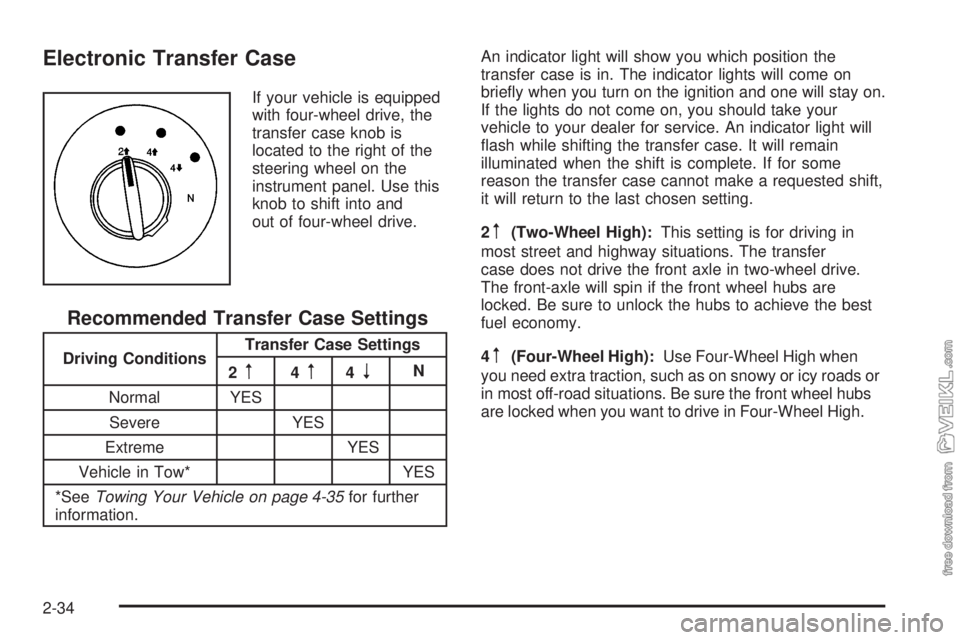
Electronic Transfer Case
If your vehicle is equipped
with four-wheel drive, the
transfer case knob is
located to the right of the
steering wheel on the
instrument panel. Use this
knob to shift into and
out of four-wheel drive.
Recommended Transfer Case Settings
Driving ConditionsTransfer Case Settings
2m4m4nN
Normal YES
Severe YES
Extreme YES
Vehicle in Tow* YES
*SeeTowing Your Vehicle on page 4-35for further
information.An indicator light will show you which position the
transfer case is in. The indicator lights will come on
briefly when you turn on the ignition and one will stay on.
If the lights do not come on, you should take your
vehicle to your dealer for service. An indicator light will
flash while shifting the transfer case. It will remain
illuminated when the shift is complete. If for some
reason the transfer case cannot make a requested shift,
it will return to the last chosen setting.
2
m(Two-Wheel High):This setting is for driving in
most street and highway situations. The transfer
case does not drive the front axle in two-wheel drive.
The front-axle will spin if the front wheel hubs are
locked. Be sure to unlock the hubs to achieve the best
fuel economy.
4
m(Four-Wheel High):Use Four-Wheel High when
you need extra traction, such as on snowy or icy roads or
in most off-road situations. Be sure the front wheel hubs
are locked when you want to drive in Four-Wheel High.
2-34
Page 103 of 374
Shifting Into NEUTRAL
Before shifting the transfer case to NEUTRAL, first
make sure the vehicle is parked so that it will not roll.
1. Set the parking brake.
2. Start the vehicle.
3. Put the transmission in NEUTRAL (N).
4. Shift the transfer case to Two-Wheel High.
5. Turn the transfer case knob all of the way past
Four-Wheel Low and hold it there for a minimum
of 10 seconds. The neutral indicator light will
come on.
6. Shift the transmission to REVERSE (R) for
one second, then shift the transmission to
DRIVE (D) for one second.
7. Turn the ignition to OFF.
8. Place the transmission shift lever in PARK. (P).
9. Turn the ignition to LOCK.
Shifting Out of NEUTRAL
To shift the transfer case out of NEUTRAL, do the
following:
1. Set the parking brake and apply the regular
brake pedal.
2. Turn the ignition to RUN with the engine off.
3. Put the transmission in NEUTRAL (N).
4. Turn the transfer case knob to the desired shift
position (Two-Wheel High, Four-Wheel High,
Four-Wheel Low).
5. After the transfer case has shifted out of NEUTRAL,
the indicator light will go out.
6. Release the parking brake.
7. Start the engine and shift the transmission lever to
the desired position.
Excessively shifting the transfer case into or out of the
different modes may cause the transfer case to enter the
shift protection mode. This will protect the transfer case
from possible damage and will only allow the transfer
case to respond to one shift per 10 seconds. The transfer
case may stay in this mode for up to three minutes.
2-37
Page 105 of 374
To set the hand lever parking brake, hold the regular
brake pedal down with your right foot. Pull up on
the handle with your right hand, until it stops.
If the ignition is on when the parking brake is set,
the brake system warning light will come on.
To release the foot pedal parking brake, hold the
regular brake pedal down. Pull the brake release handle,
located just above the parking brake pedal, to release
the parking brake.
To release the hand lever parking brake, hold the
regular brake pedal down and push down on the handle
until it stops.
If the ignition is on when the parking brake is released,
the brake system warning light will go off.
Propshaft Brake Burnish Procedure
It is recommended that the propshaft-mounted parking
brake be burnished as part of the new vehicle break-in.
The parking brake will work best after it has been
burnished following these instructions:
Make 10 stops, using the parking brake hand lever or
foot pedal, from 20 mph (32 km/h) about 2 1/2 miles
(4 km) apart. Between stops, drive the vehicle at
20 mph (32 km/h) to allow the brake to cool.Notice:Driving with the parking brake on can
damage the transmission and brake system parts.
Verify that the parking brake is fully released and the
brake warning light is off before driving.
Rear Wheel Park Brake Burnish
Procedure
It is recommended that the rear wheel mounted
parking brake be burnished as part of the new vehicle
break-in. The parking brake will work best after it
has been burnished following these instructions:
Make one or two stops using the parking brake hand
lever or foot pedal from 55 mph (92 km/h) to a stop
with moderate apply. Each stop should occur within
1/4 of a mile.
Notice:Driving with the parking brake on can
overheat the brake system and cause premature
wear or damage to brake system parts. Verify that
the parking brake is fully released and the brake
warning light is off before driving.
2-39
Page 120 of 374
Hazard Warning Flashers
Your hazard warning flashers let you warn others. They
also let police know you have a problem. Your front
and rear turn signal lamps will flash on and off.
The hazard warning
flasher button is located
on top of the steering
column.
Your hazard warning flashers work no matter what
position your key is in, and even if the key is not in
the ignition.
Press the button to make the front and rear turn signal
lamps flash on and off. Press the button again to
turn the flashers off.
When the hazard warning flashers are on, your turn
signals will not work.
Other Warning Devices
If you carry reflective triangles, you can set them up at
the side of the road about 300 feet (100 m) behind
your vehicle.
Horn
Sound the horn by pushing the center of the steering
wheel. If you have the optional air horn, it is controlled
by a cord that you’ll find up above and to the left of
the driver. The harder you pull on the cord, the louder
the air horn will sound. The air horn works only after
your air brake system pressure gets up to about
115 psi (790 kPa). The air horn will work properly
unless the air brake system pressure drops below
60 psi (415 kPa).
3-6