differential CHEVROLET PLYMOUTH ACCLAIM 1993 Owner's Manual
[x] Cancel search | Manufacturer: CHEVROLET, Model Year: 1993, Model line: PLYMOUTH ACCLAIM, Model: CHEVROLET PLYMOUTH ACCLAIM 1993Pages: 2438, PDF Size: 74.98 MB
Page 322 of 2438
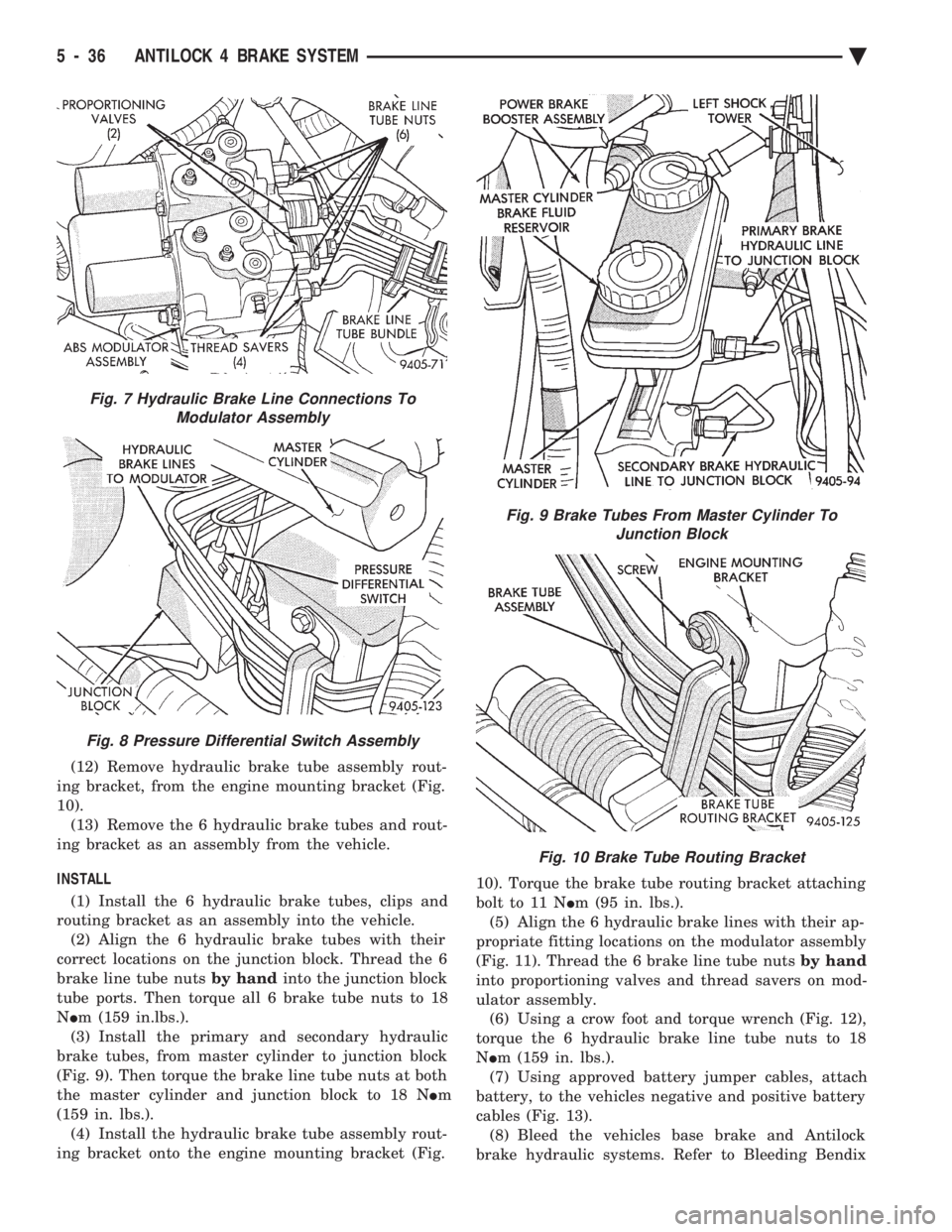
(12) Remove hydraulic brake tube assembly rout-
ing bracket, from the engine mounting bracket (Fig.
10). (13) Remove the 6 hydraulic brake tubes and rout-
ing bracket as an assembly from the vehicle.
INSTALL (1) Install the 6 hydraulic brake tubes, clips and
routing bracket as an assembly into the vehicle. (2) Align the 6 hydraulic brake tubes with their
correct locations on the junction block. Thread the 6
brake line tube nuts by handinto the junction block
tube ports. Then torque all 6 brake tube nuts to 18
N Im (159 in.lbs.).
(3) Install the primary and secondary hydraulic
brake tubes, from master cylinder to junction block
(Fig. 9). Then torque the brake line tube nuts at both
the master cylinder and junction block to 18 N Im
(159 in. lbs.). (4) Install the hydraulic brake tube assembly rout-
ing bracket onto the engine mounting bracket (Fig. 10). Torque the brake tube routing bracket attaching
bolt to 11 N
Im (95 in. lbs.).
(5) Align the 6 hydraulic brake lines with their ap-
propriate fitting locations on the modulator assembly
(Fig. 11). Thread the 6 brake line tube nuts by hand
into proportioning valves and thread savers on mod-
ulator assembly. (6) Using a crow foot and torque wrench (Fig. 12),
torque the 6 hydraulic brake line tube nuts to 18
N Im (159 in. lbs.).
(7) Using approved battery jumper cables, attach
battery, to the vehicles negative and positive battery
cables (Fig. 13). (8) Bleed the vehicles base brake and Antilock
brake hydraulic systems. Refer to Bleeding Bendix
Fig. 7 Hydraulic Brake Line Connections To Modulator Assembly
Fig. 8 Pressure Differential Switch Assembly
Fig. 9 Brake Tubes From Master Cylinder To Junction Block
Fig. 10 Brake Tube Routing Bracket
5 - 36 ANTILOCK 4 BRAKE SYSTEM Ä
Page 1961 of 2438
TRANSAXLE
CONTENTS
page page
41TE FOUR SPEED AUTOMATIC TRANSAXLE . 85
41TE FOUR SPEED TRANSAXLE HYDRAULICSCHEMATICS ........................ 170
41TE ON-BOARD DIAGNOSTICS .......... 145
A-523, A-543, and A-568 MANUAL TRANSAXLE ........................... 1 SPECIFICATIONS
...................... 183
THREE SPEED TORQUEFLITE AUTOMATIC TRANSAXLE .......................... 35
THREE SPEED TRANSAXLE HYDRAULIC SCHEMATICS ........................ 162
A-523, A-543, and A-568 MANUAL TRANSAXLE INDEX
page page
Bearing Adjustment Procedure .............. 31
Differential Bearing Preload Adjustment ........ 33
Gearshift Linkage Adjustment (Cable Operated) . . 2
General Information ........................ 1 In-Car Transaxle Disassemble/Assemble
........ 4
Out of Car TransaxleÐDisassemble and Assemble . 6
Subassembly-Recondition .................. 15
Transaxle Removal and Installation ............ 5
GENERAL INFORMATION
Safety goggles should be worn at all times
when working on these transaxles. All manual
transaxles use SAE 5W-30 engine oil, meeting SG
and/or SG-CC qualifications, as the lubricant in order
to reduce wear. This 5-speed manual transaxles combine gear reduc-
tion, ratio selection, and differential functions in one
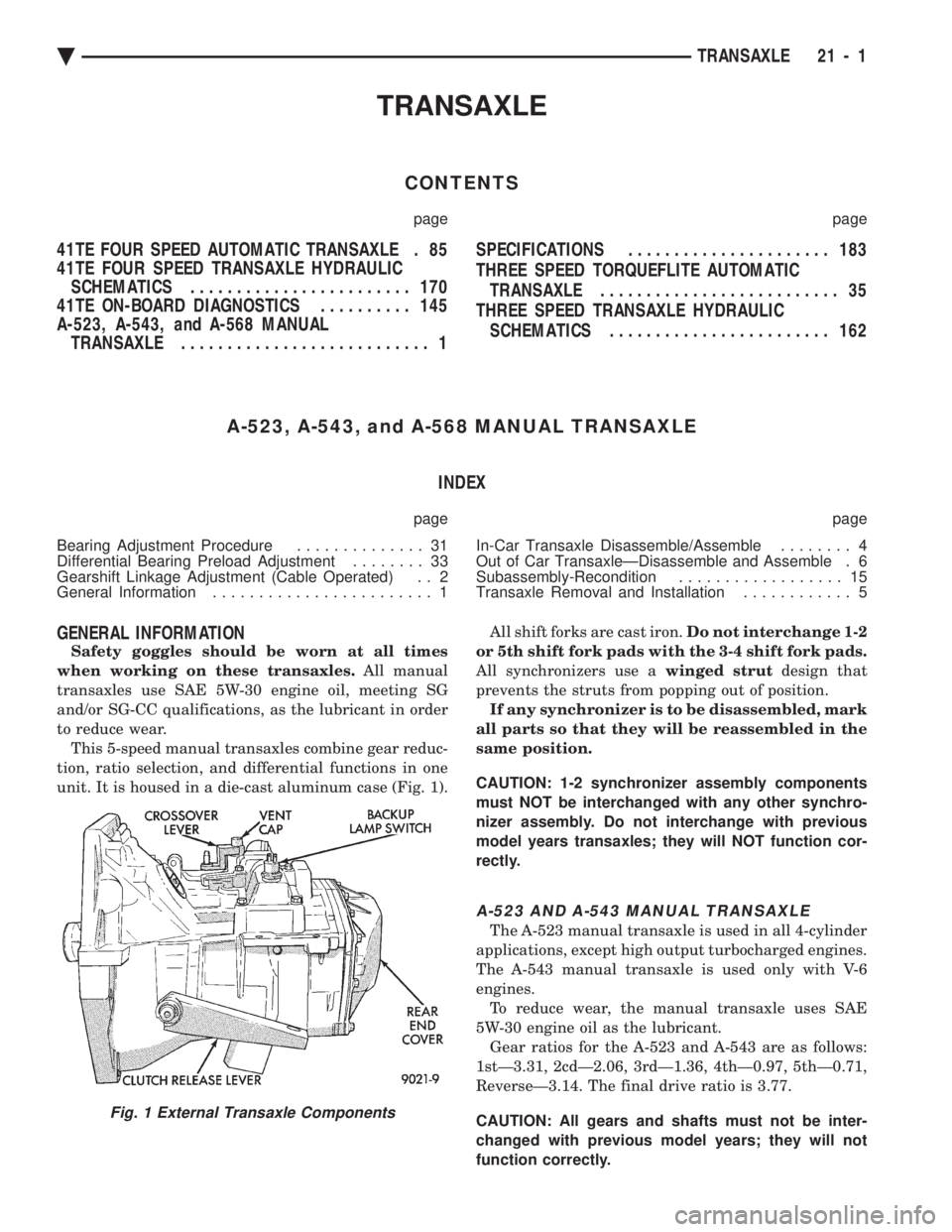
unit. It is housed in a die-cast aluminum case (Fig. 1). All shift forks are cast iron.
Do not interchange 1-2
or 5th shift fork pads with the 3-4 shift fork pads.
All synchronizers use a winged strutdesign that
prevents the struts from popping out of position. If any synchronizer is to be disassembled, mark
all parts so that they will be reassembled in the
same position.
CAUTION: 1-2 synchronizer assembly components
must NOT be interchanged with any other synchro-
nizer assembly. Do not interchange with previous
model years transaxles; they will NOT function cor-
rectly.
A-523 AND A-543 MANUAL TRANSAXLE
The A-523 manual transaxle is used in all 4-cylinder
applications, except high output turbocharged engines.
The A-543 manual transaxle is used only with V-6
engines. To reduce wear, the manual transaxle uses SAE
5W-30 engine oil as the lubricant. Gear ratios for the A-523 and A-543 are as follows:
1stÐ3.31, 2cdÐ2.06, 3rdÐ1.36, 4thÐ0.97, 5thÐ0.71,
ReverseÐ3.14. The final drive ratio is 3.77.
CAUTION: All gears and shafts must not be inter-
changed with previous model years; they will not
function correctly.
Fig. 1 External Transaxle Components
Ä TRANSAXLE 21 - 1
Page 1964 of 2438
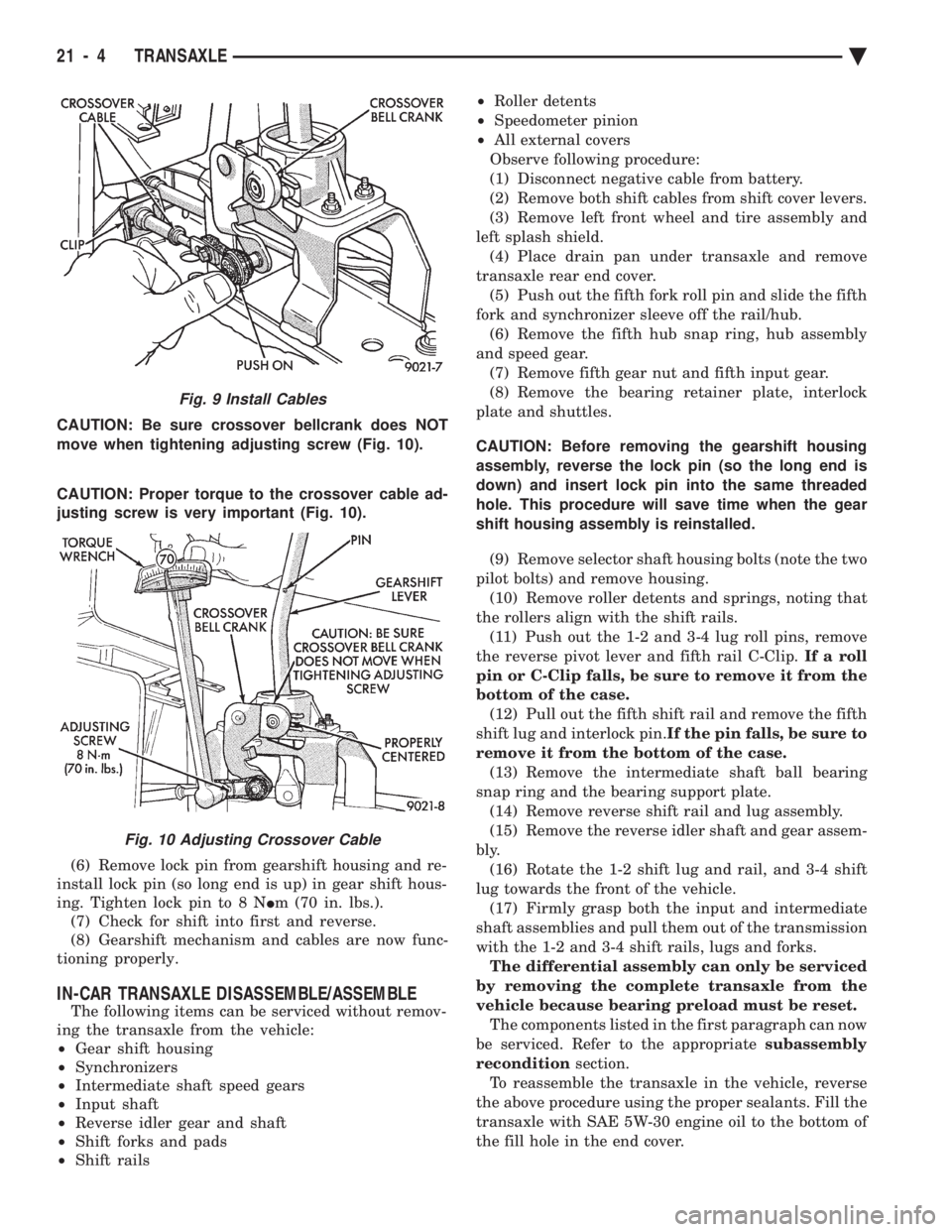
CAUTION: Be sure crossover bellcrank does NOT
move when tightening adjusting screw (Fig. 10).
CAUTION: Proper torque to the crossover cable ad-
justing screw is very important (Fig. 10).
(6) Remove lock pin from gearshift housing and re-
install lock pin (so long end is up) in gear shift hous-
ing. Tighten lock pin to 8 N Im (70 in. lbs.).
(7) Check for shift into first and reverse.
(8) Gearshift mechanism and cables are now func-
tioning properly.
IN-CAR TRANSAXLE DISASSEMBLE/ASSEMBLE
The following items can be serviced without remov-
ing the transaxle from the vehicle:
² Gear shift housing
² Synchronizers
² Intermediate shaft speed gears
² Input shaft
² Reverse idler gear and shaft
² Shift forks and pads
² Shift rails ²
Roller detents
² Speedometer pinion
² All external covers
Observe following procedure:
(1) Disconnect negative cable from battery.
(2) Remove both shift cables from shift cover levers.
(3) Remove left front wheel and tire assembly and
left splash shield. (4) Place drain pan under transaxle and remove
transaxle rear end cover. (5) Push out the fifth fork roll pin and slide the fifth
fork and synchronizer sleeve off the rail/hub. (6) Remove the fifth hub snap ring, hub assembly
and speed gear. (7) Remove fifth gear nut and fifth input gear.
(8) Remove the bearing retainer plate, interlock
plate and shuttles.
CAUTION: Before removing the gearshift housing
assembly, reverse the lock pin (so the long end is
down) and insert lock pin into the same threaded
hole. This procedure will save time when the gear
shift housing assembly is reinstalled. (9) Remove selector shaft housing bolts (note the two
pilot bolts) and remove housing. (10) Remove roller detents and springs, noting that
the rollers align with the shift rails. (11) Push out the 1-2 and 3-4 lug roll pins, remove
the reverse pivot lever and fifth rail C-Clip. If a roll
pin or C-Clip falls, be sure to remove it from the
bottom of the case. (12) Pull out the fifth shift rail and remove the fifth
shift lug and interlock pin. If the pin falls, be sure to
remove it from the bottom of the case. (13) Remove the intermediate shaft ball bearing
snap ring and the bearing support plate. (14) Remove reverse shift rail and lug assembly.
(15) Remove the reverse idler shaft and gear assem-
bly. (16) Rotate the 1-2 shift lug and rail, and 3-4 shift
lug towards the front of the vehicle. (17) Firmly grasp both the input and intermediate
shaft assemblies and pull them out of the transmission
with the 1-2 and 3-4 shift rails, lugs and forks. The differential assembly can only be serviced
by removing the complete transaxle from the
vehicle because bearing preload must be reset. The components listed in the first paragraph can now
be serviced. Refer to the appropriate subassembly
recondition section.
To reassemble the transaxle in the vehicle, reverse
the above procedure using the proper sealants. Fill the
transaxle with SAE 5W-30 engine oil to the bottom of
the fill hole in the end cover.
Fig. 9 Install Cables
Fig. 10 Adjusting Crossover Cable
21 - 4 TRANSAXLE Ä
Page 1966 of 2438
OUT OF CAR TRANSAXLEÐDISASSEMBLE AND
ASSEMBLE
DIFFERENTIAL
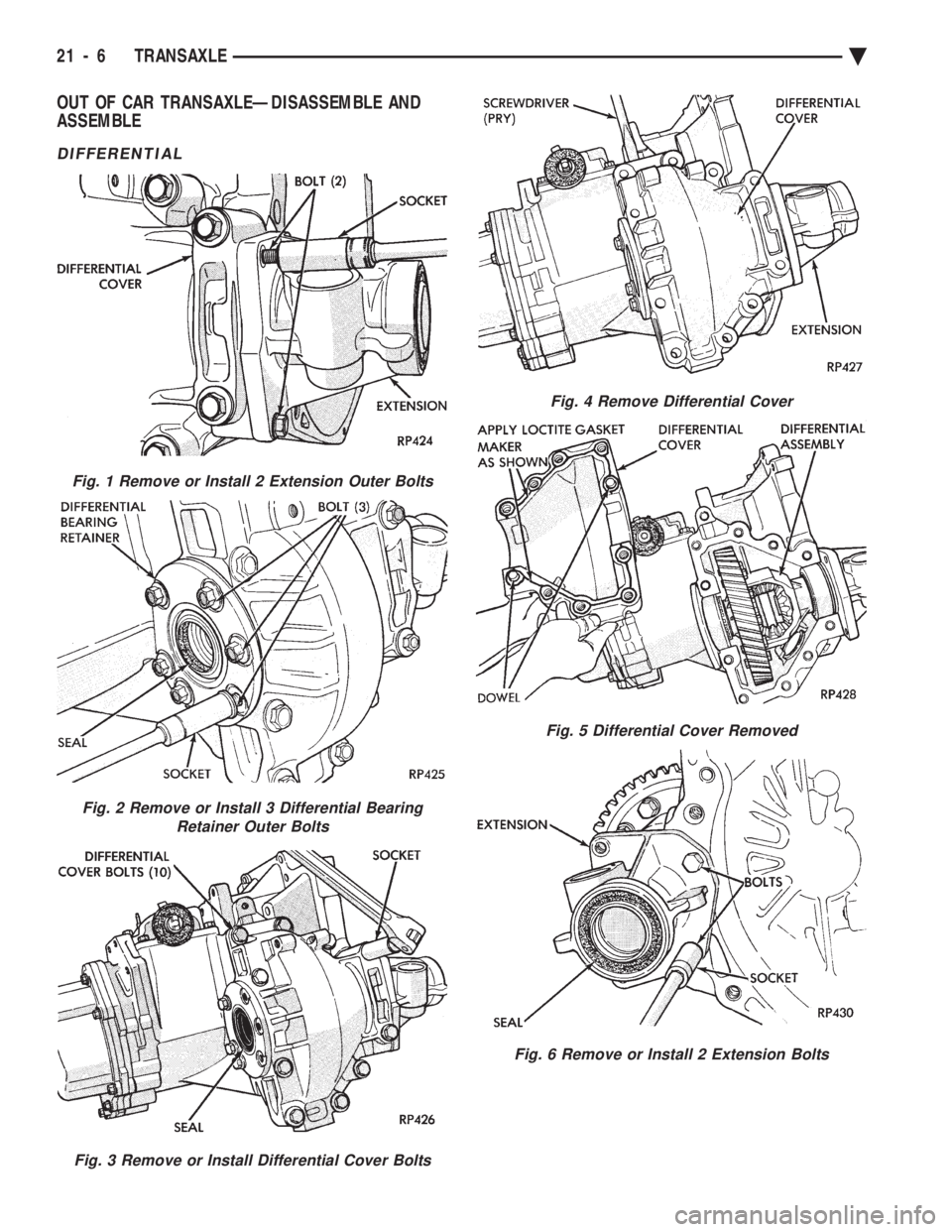
Fig. 1 Remove or Install 2 Extension Outer Bolts
Fig. 2 Remove or Install 3 Differential Bearing Retainer Outer Bolts
Fig. 3 Remove or Install Differential Cover Bolts
Fig. 4 Remove Differential Cover
Fig. 5 Differential Cover Removed
Fig. 6 Remove or Install 2 Extension Bolts
21 - 6 TRANSAXLE Ä
Page 1967 of 2438
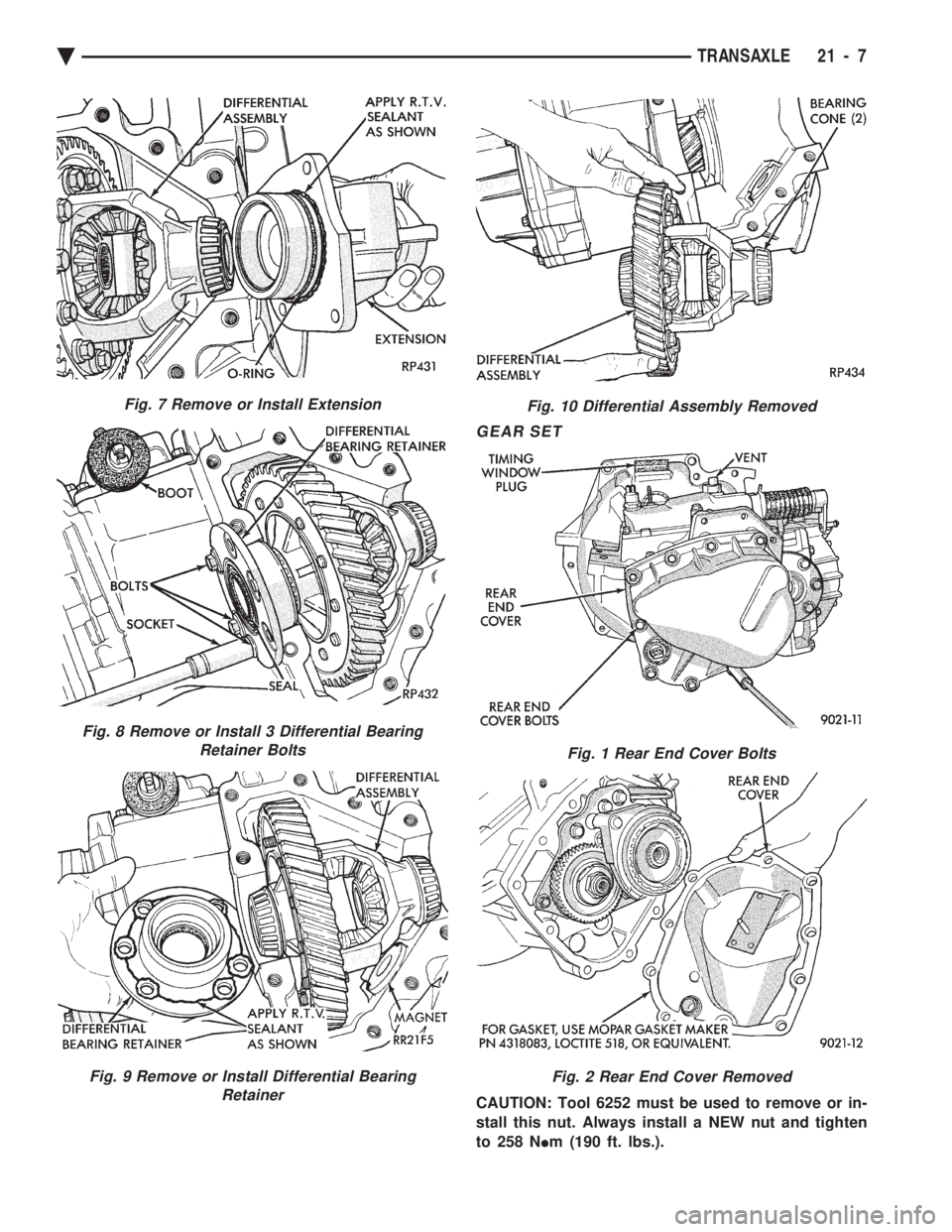
GEAR SET
CAUTION: Tool 6252 must be used to remove or in-
stall this nut. Always install a NEW nut and tighten
to 258 N Im (190 ft. lbs.).
Fig. 7 Remove or Install Extension
Fig. 8 Remove or Install 3 Differential Bearing
Retainer Bolts
Fig. 9 Remove or Install Differential Bearing Retainer
Fig. 10 Differential Assembly Removed
Fig. 1 Rear End Cover Bolts
Fig. 2 Rear End Cover Removed
Ä TRANSAXLE 21 - 7
Page 1984 of 2438
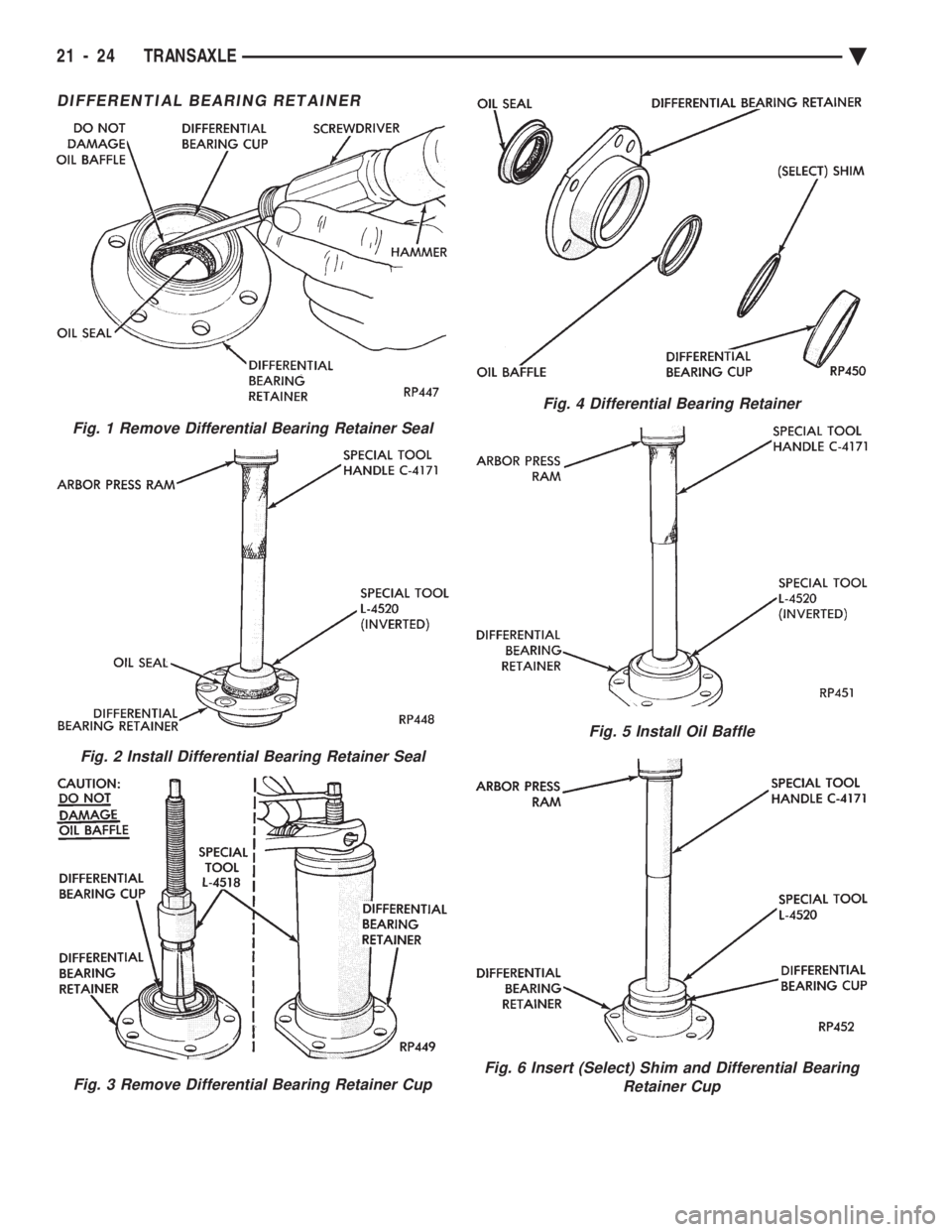
DIFFERENTIAL BEARING RETAINER
Fig. 1 Remove Differential Bearing Retainer Seal
Fig. 2 Install Differential Bearing Retainer Seal
Fig. 3 Remove Differential Bearing Retainer Cup
Fig. 4 Differential Bearing Retainer
Fig. 5 Install Oil Baffle
Fig. 6 Insert (Select) Shim and Differential Bearing Retainer Cup
21 - 24 TRANSAXLE Ä
Page 1987 of 2438
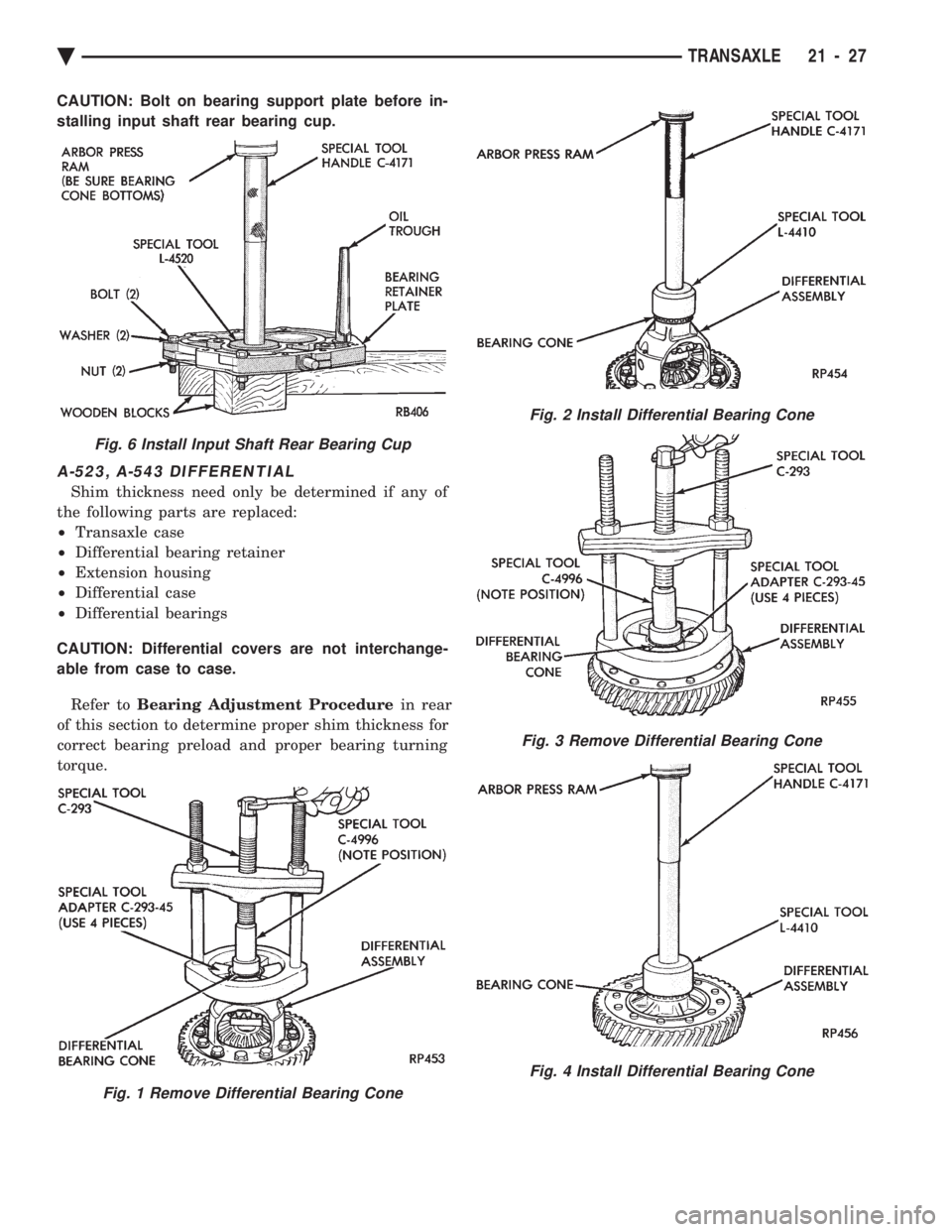
CAUTION: Bolt on bearing support plate before in-
stalling input shaft rear bearing cup.
A-523, A-543 DIFFERENTIAL
Shim thickness need only be determined if any of
the following parts are replaced:
² Transaxle case
² Differential bearing retainer
² Extension housing
² Differential case
² Differential bearings
CAUTION: Differential covers are not interchange-
able from case to case.
Refer to Bearing Adjustment Procedure in rear
of this section to determine proper shim thickness for
correct bearing preload and proper bearing turning
torque.
Fig. 6 Install Input Shaft Rear Bearing Cup
Fig. 1 Remove Differential Bearing Cone
Fig. 2 Install Differential Bearing Cone
Fig. 3 Remove Differential Bearing Cone
Fig. 4 Install Differential Bearing Cone
Ä TRANSAXLE 21 - 27
Page 1988 of 2438
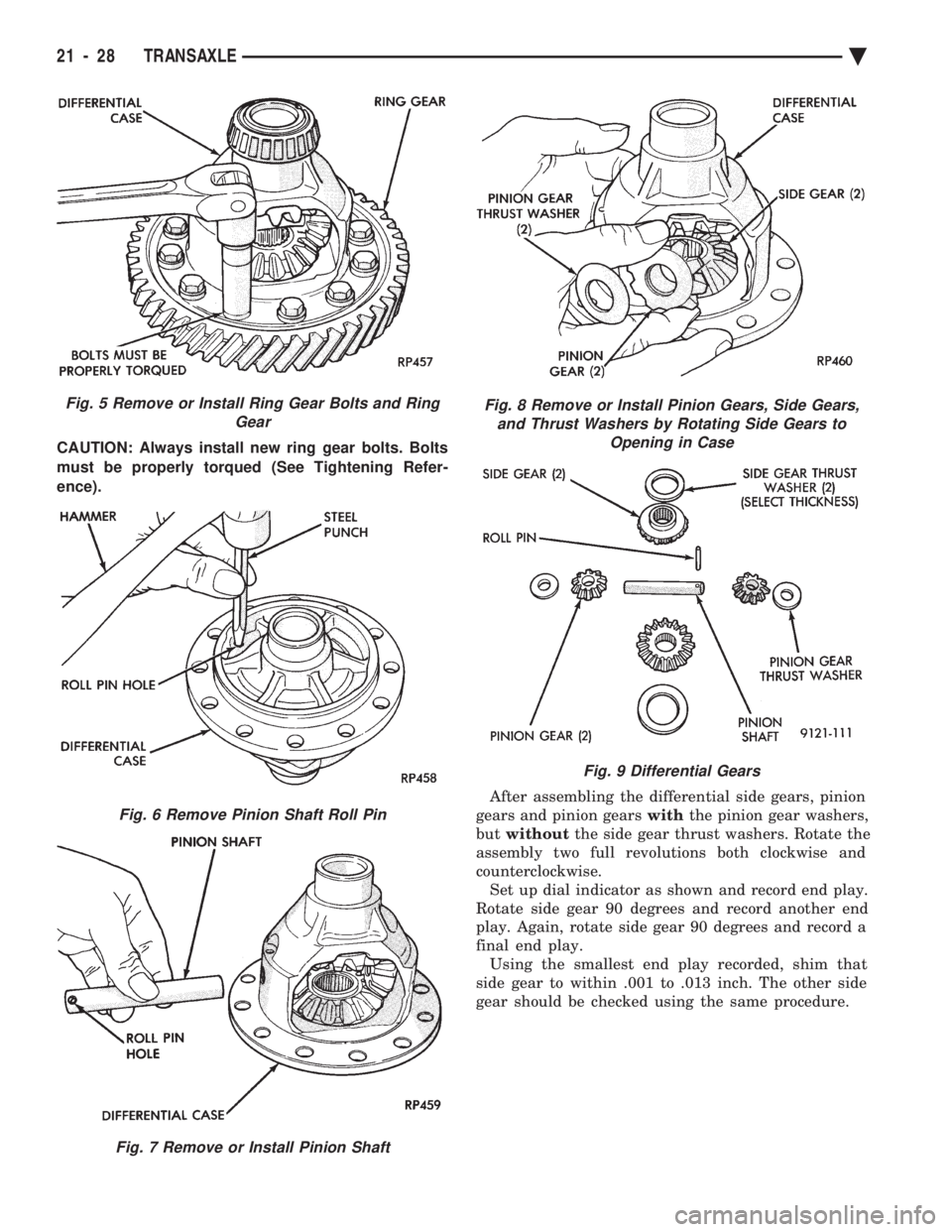
CAUTION: Always install new ring gear bolts. Bolts
must be properly torqued (See Tightening Refer-
ence). After assembling the differential side gears, pinion
gears and pinion gears withthe pinion gear washers,
but without the side gear thrust washers. Rotate the
assembly two full revolutions both clockwise and
counterclockwise. Set up dial indicator as shown and record end play.
Rotate side gear 90 degrees and record another end
play. Again, rotate side gear 90 degrees and record a
final end play. Using the smallest end play recorded, shim that
side gear to within .001 to .013 inch. The other side
gear should be checked using the same procedure.
Fig. 5 Remove or Install Ring Gear Bolts and Ring Gear
Fig. 6 Remove Pinion Shaft Roll Pin
Fig. 7 Remove or Install Pinion Shaft
Fig. 8 Remove or Install Pinion Gears, Side Gears,and Thrust Washers by Rotating Side Gears to Opening in Case
Fig. 9 Differential Gears
21 - 28 TRANSAXLE Ä
Page 1989 of 2438
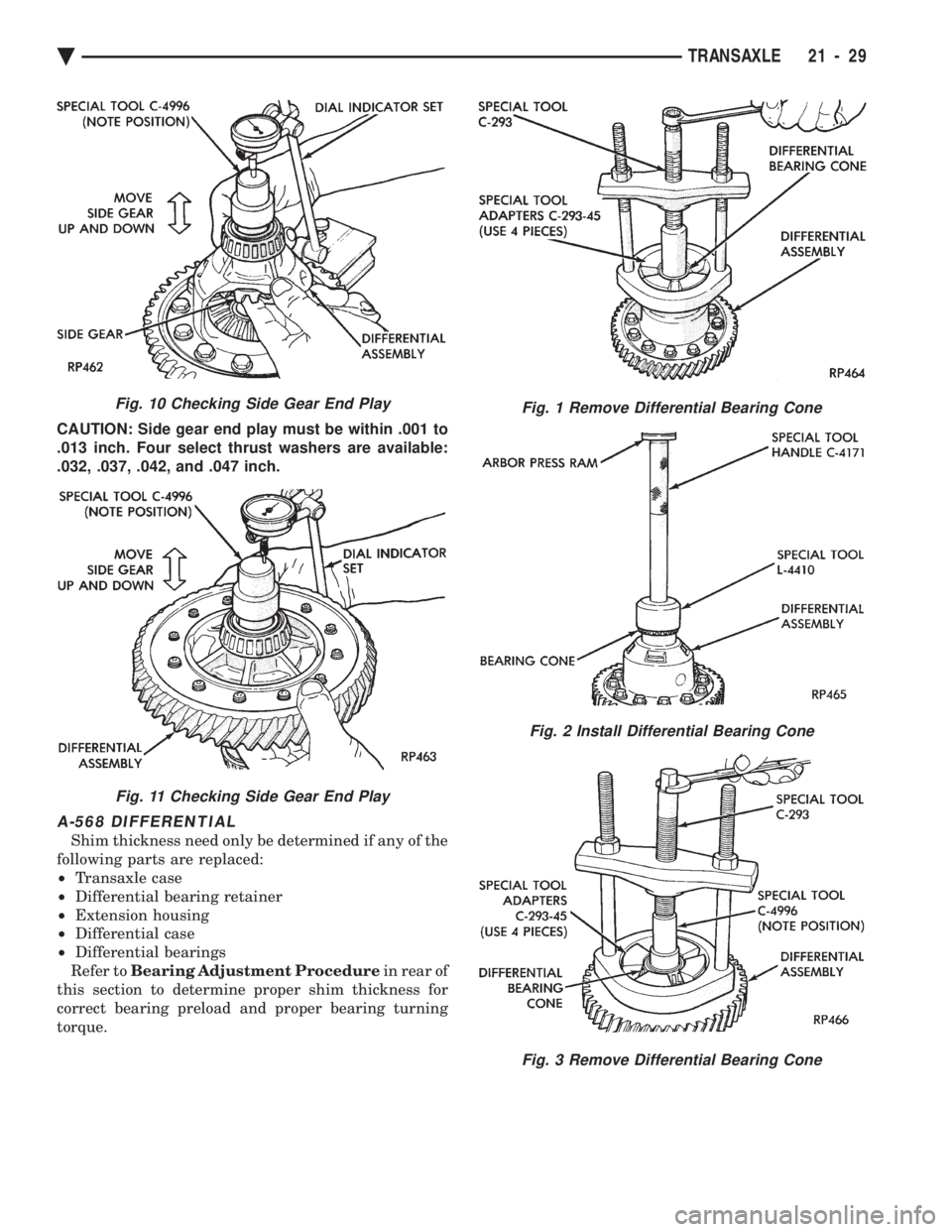
CAUTION: Side gear end play must be within .001 to
.013 inch. Four select thrust washers are available:
.032, .037, .042, and .047 inch.
A-568 DIFFERENTIAL
Shim thickness need only be determined if any of the
following parts are replaced:
² Transaxle case
² Differential bearing retainer
² Extension housing
² Differential case
² Differential bearings
Refer to Bearing Adjustment Procedure in rear of
this section to determine proper shim thickness for
correct bearing preload and proper bearing turning
torque.
Fig. 1 Remove Differential Bearing Cone
Fig. 2 Install Differential Bearing Cone
Fig. 3 Remove Differential Bearing Cone
Fig. 10 Checking Side Gear End Play
Fig. 11 Checking Side Gear End Play
Ä TRANSAXLE 21 - 29
Page 1990 of 2438
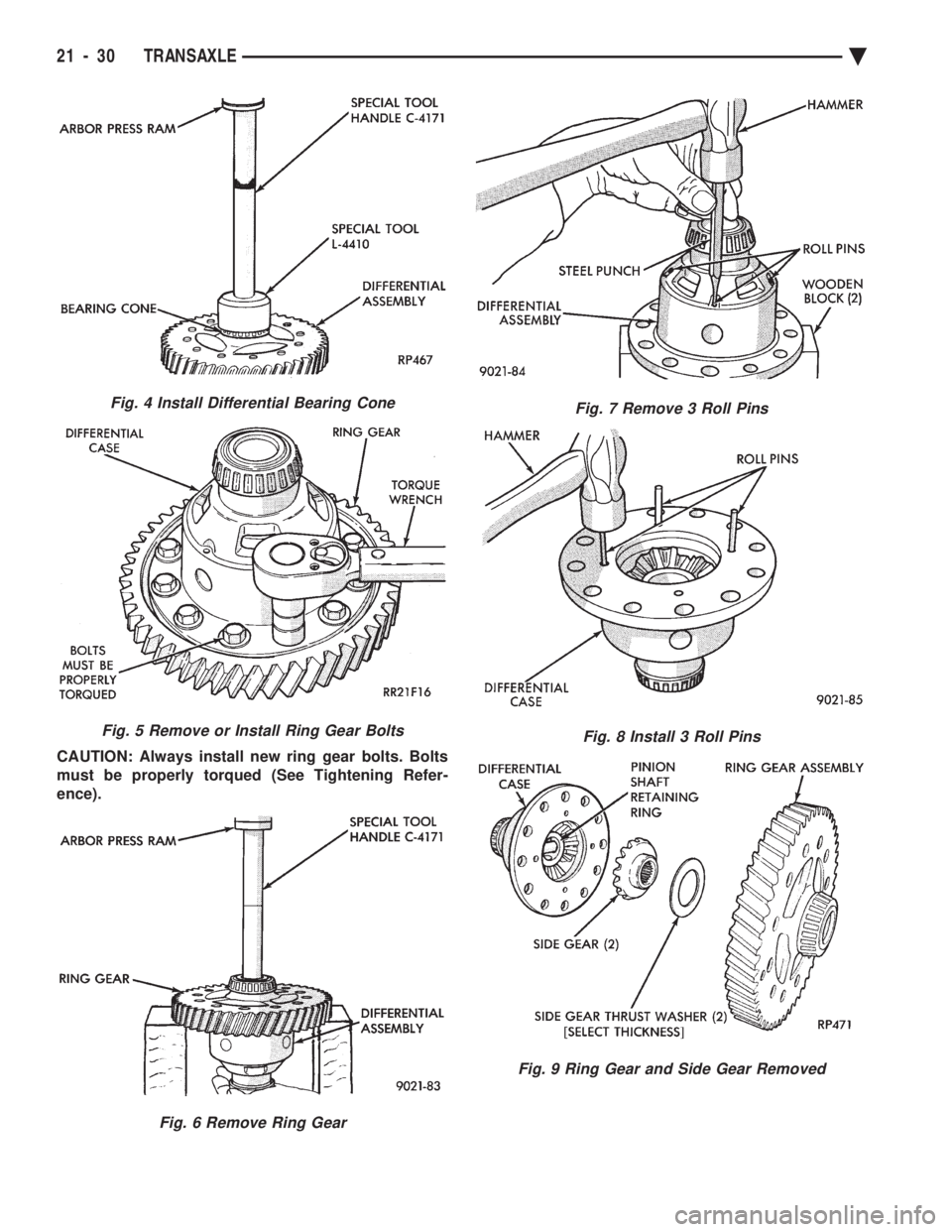
CAUTION: Always install new ring gear bolts. Bolts
must be properly torqued (See Tightening Refer-
ence).
Fig. 4 Install Differential Bearing Cone
Fig. 5 Remove or Install Ring Gear Bolts
Fig. 6 Remove Ring Gear
Fig. 7 Remove 3 Roll Pins
Fig. 8 Install 3 Roll Pins
Fig. 9 Ring Gear and Side Gear Removed
21 - 30 TRANSAXLE Ä