check engine CHEVROLET S10 1995 2.G Owner's Manual
[x] Cancel search | Manufacturer: CHEVROLET, Model Year: 1995, Model line: S10, Model: CHEVROLET S10 1995 2.GPages: 354, PDF Size: 18.92 MB
Page 143 of 354
Downloaded from www.Manualslib.com manuals search engine Passing
The driver of a vehicle about to pass another on a two-lane highway waits
for just the right moment, accelerates, moves around
the vehicle ahead, then
goes back
into the right lane again. A simple maneuver?
Not necessarily! Passing another vehicle
on a two-lane highway is a
potentially dangerous move, since the passing vehicle occupies the same
lane
as oncoming traffic for several seconds. A miscalculation, an error in
judgment,
or a brief surrender to frustration or anger can suddenly put the
passing driver face to face with
the worst of all traffic accidents - the
head-on collision.
So here are some tips for passing:
0
0
0
0
0
0
“Drive ahead.” Look down the road, to the sides, and to crossroads for
situations
that might affect your passing patterns. If you have any doubt
whatsoever about making
a successful pass, wait for a better time.
Watch for traffic signs, pavement markings, and
lines. If you can see a
sign up ahead that might indicate a turn or an intersection, delay your
pass. A broken center line usually indicates it’s all right to pass
(providing the road ahead is clear). Never cross
a solid line on your
side of the lane or
a double solid line, even if the road seems empty of
approaching traffic.
Do not get too close to the vehicle you want to pass while you’re
awaiting an opportunity. For one thing, following too closely reduces
your area
of vision, especially if you’re following a larger vehicle.
Also,
you won’t have adequate space if the vehicle ahead suddenly
slows or stops. Keep back
a reasonable distance.
When it looks like
a chance to pass is coming up, start to accelerate but
stay
in the right lane and don’t get too close. Time your move so you
will be increasing speed as the time comes to move into the other lane.
If the way is clear to pass, you will have a “running start” that more
than makes up for the distance you would lose by dropping back. And
if something happens to cause you
to cancel your pass, you need only
slow down and drop back again and wait for another opportunity.
If other cars are lined up to pass a slow vehicle, wait your turn. But
take care that someone isn’t trying to pass you as you pull out to pass
the slow vehicle. Remember to glance over your shoulder and check
the blind spot.
Check your mirrors, glance over your shoulder, and start your left lane
change signal before moving
out of the right lane to pass. When you
are far enough ahead
of the passed vehicle to see its front in your inside
mirror, activate your right lane change signal and move back
into the
right lane. (Remember that your right outside mirror
is convex. The
vehicle
you just passed may seem to be farther away from you than it
really is.)
4- 10
Page 145 of 354
Downloaded from www.Manualslib.com manuals search engine Remember: If you have the four-wheel anti-lock braking system, it helps
avoid only the braking skid. The rear-wheel anti-lock braking system helps
avoid only a rear braking skid. In a braking skid (where the front wheels are
no longer rolling), release enough pressure
on the brakes to get the front
wheels rolling again. This restores steering control. Push the brake pedal
down steadily when you have to stop suddenly. As long as the front wheels
are rolling, you will have steering control.
Driving Guidelines
OR-Road Driving with Your Four-wheel Drive
Vehicle
This off-road guide is for vehicles that have four-wheel drive.
Also, see “Anti-Lock Brakes” in the Index.
If your vehicle doesn’t have four-wheel drive, you shouldn’t drive off-road
unless you’re on a level, solid surface.
Off-road driving can be great fun. But it does have some definite hazards.
The greatest of these is the terrain itself.
“Off-roading” means you’ve left the great North American road system
behind. Traffic lanes aren’t marked. Curves aren’t banked. There are no
road signs. Surfaces can be slippery, rough, uphill or downhill. In short,
you’ve gone right back to nature.
Off-road driving involves some new skills. And that’s why it’s very
important that
you read this guide. You’ll find many driving tips and
suggestions. These will help make your off-road driving safer and more
enjoyable.
Before You Go Off-Roading
There are some things to do before you go out. For example, be sure to have
all necessary maintenance and service work done. Check to make sure all
underbody shields (if
so equipped) are properly attached. Be sure you read
all the information about your four-wheel drive vehicle
in this manual. Is
there enough fuel? Is the spare tire fully inflated? Are the fluid levels up
where they should be? What are the local laws that apply to off-roading
where you’ll be driving? If you don’t know, you should check with law
enforcement people in the area. Will you be
on someone’s private land? If
so, be sure to get the necessary permission.
4- 12
Page 156 of 354
Downloaded from www.Manualslib.com manuals search engine Driving through rushing water can be dangerous. Deep water can sweep your vehicle downstream and you and your
passengers
could drown. If it’s only inches deep, it can still wash
away the ground from under your tires, and you could lose
traction and roll the vehicle over. Ron’t drive through rush\
ing water.
After Off-Road Driving
Remove any brush or debris that has collected on the underbody, chassis or
under the hood. These accumulations can be a fire hazard.
After operation in mud
or sand, have the brake linings cleaned and checked.
These substances can cause glazing and uneven braking. Check the body
structure, steering, suspension, wheels, tires, and exhaust system for
damage. Also, check the fuel lines and cooling system for any leakage.
Your vehicle will require more frequent service due to off-road
use. Refer
to the Maintenance Schedule for additional information.
Driving at Night
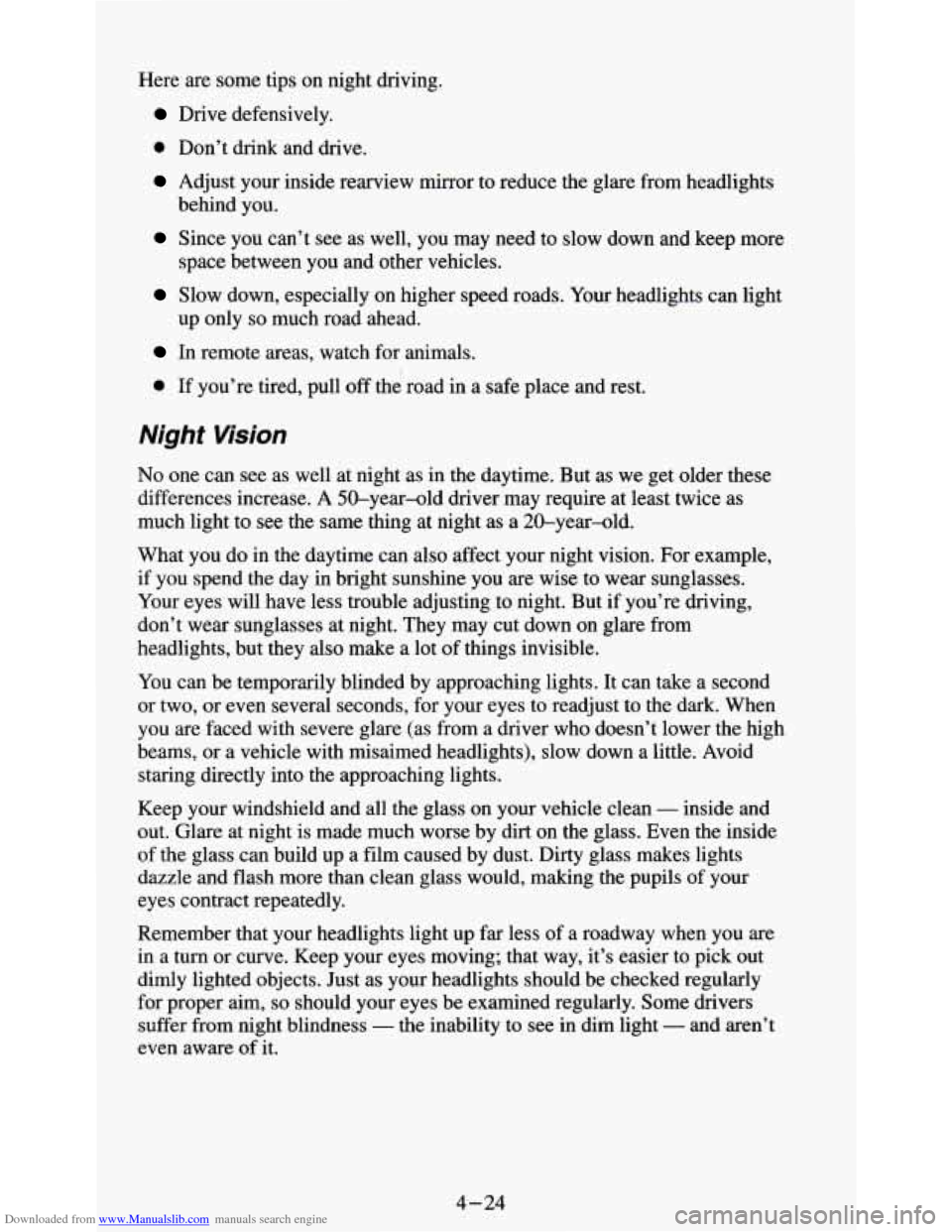
Night driving is more dangerous than day driving. One reason is that some
drivers
are likely to be impaired - by alcohol or drugs, with night vision
problems, or by fatigue.
4-23
Page 157 of 354
Downloaded from www.Manualslib.com manuals search engine Here are some tips on night driving.
Drive defensively.
0 Don’t drink and drive.
Adjust your inside rearview mirror to reduce the glare from headlights
Since you can’t see as well, you may need to slow down and keep more
behind you.
space
between you and other vehicles.
Slow down, especially on higher speed roads. Your headlights can light
up
only so much road ahead.
In remote areas, watch for animals.
0 If you’re tired, pull off the road in a safe place and rest.
Night Vision
No one can see as well at night as in the daytime. But as we get older these
differences increase. A 50-year-old driver may require at least twice as
much light to see the same thing at night as a 20-year-old.
What you do in the daytime can also affect your night vision.
For example,
if you spend the day in bright sunshine you
are wise to wear sunglasses.
Your eyes will have less trouble adjusting to night. But
if you’re driving,
don’t wear sunglasses at night. They may cut down on glare from
headlights, but they also make a lot of things invisible.
You can be temporarily blinded by approaching lights. It can take a second
or
two, or even several seconds, for your eyes to readjust to the dark. When
you
are faced with severe glare (as from a driver who doesn’t lower the high
beams, or a vehicle with misaimed headlights), slow down a little. Avoid
staring directly into the approaching lights.
Keep your windshield and all the glass on your vehicle clean
- inside and
out. Glare at night is made much worse by dirt on the glass. Even the inside
of the glass can build up a film caused by dust. Dirty glass makes lights
dazzle and flash more than clean glass would, making
the pupils of your
eyes contract repeatedly.
Remember that your headlights light up far less of a roadway when you
are
in a turn or curve. Keep your eyes moving; that way, it’s easier to pick out
dimly lighted objects. Just as your headlights should be checked regularly
for proper aim,
so should your eyes be examined regularly. Some drivers
suffer from night blindness
- the inability to see in dim light - and aren’t
even aware
of it,
4-24
Page 160 of 354
Downloaded from www.Manualslib.com manuals search engine City Driving
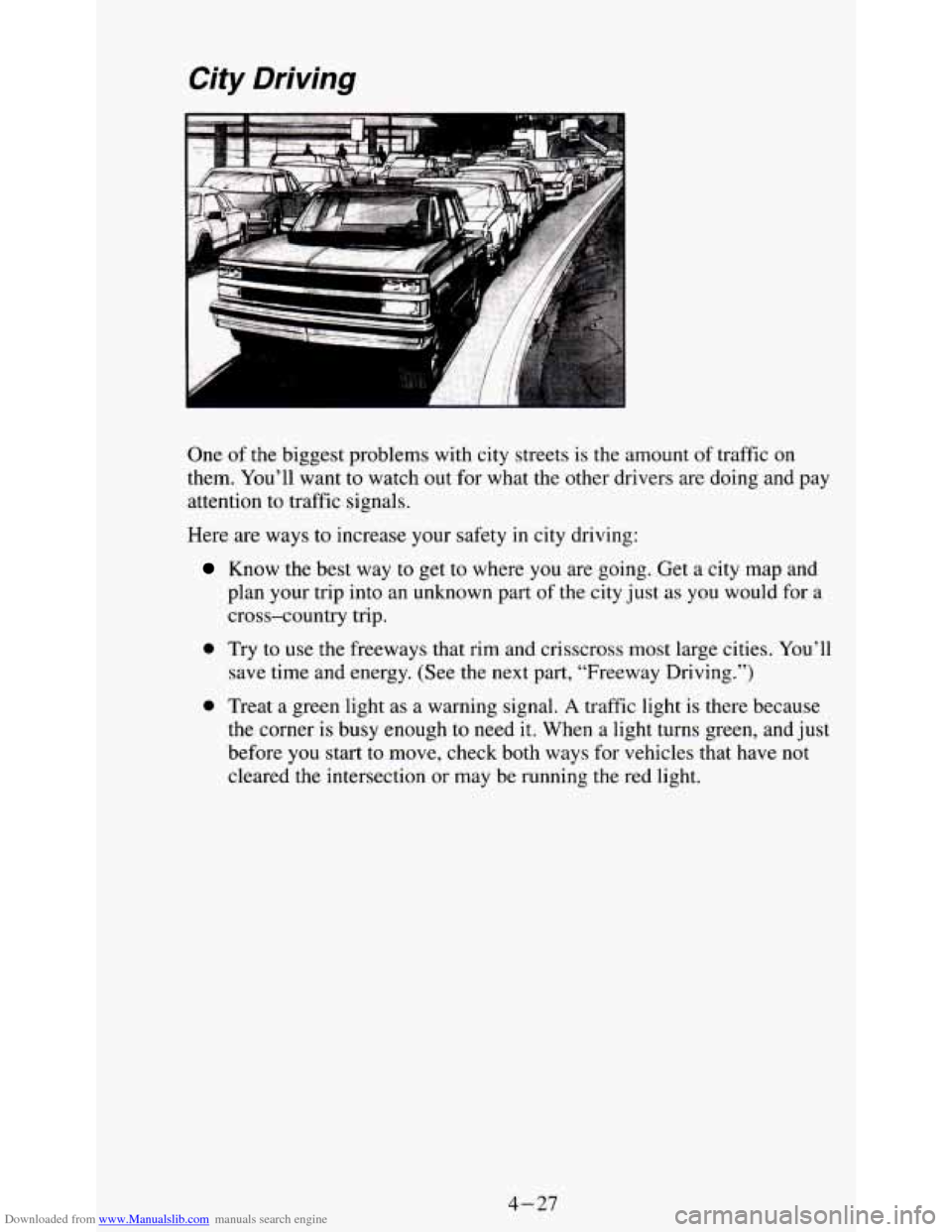
One of the biggest problems with city streets is the amount of traffic on
them. You’ll want to watch out for what the other drivers are doing and pay
attention to traffic signals.
Here are ways to increase your safety in city driving:
Know the best way to get to where you are going. Get a city map and
plan your trip into an unknown part of the city just
as you would for a
cross-country trip.
0 Try to use the freeways that rim and crisscross most large cities. You’ll
save time and energy. (See the next part, “Freeway Driving.”)
0 Treat a green light as a warning signal. A traffic light is there because
the corner is busy enough to need it. When a light turns green, and just
before you start to move, check both ways for vehicles that have not
cleared the intersection
or may be running the red light.
4-27
Page 161 of 354
Downloaded from www.Manualslib.com manuals search engine Freeway Driving
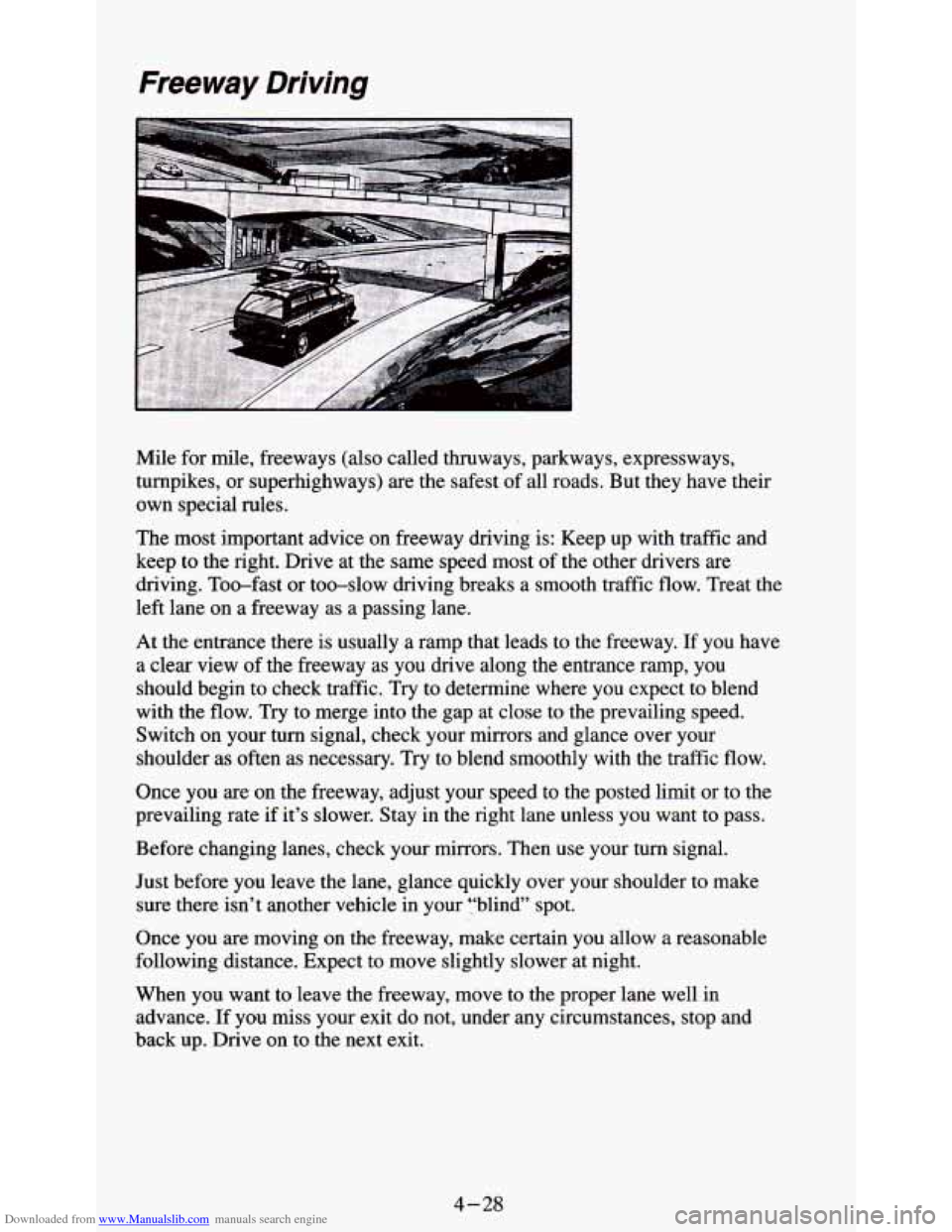
Mile for mile, freeways (also called thruways, parkways, expressways,
turnpikes, or superhighways)
are the safest of all roads. But they have their
own special rules.
The most important advice on freeway driving is: Keep up with traffic and
keep to the right. Drive at the same speed most of the other drivers are
driving. Too-fast or too-slow driving breaks a smooth traffic flow. Treat
the
left lane on a freeway as a passing lane.
At the entrance there is usually a ramp that leads to the freeway. If you have
a clear view of the freeway as you drive along the entrance ramp, you
should begin to check traffic. Try to determine where you expect to blend
with the
flow. Try to merge into the gap at close to the prevailing speed.
Switch on your turn signal, check your mirrors and glance over your
shoulder as often as necessary.
Try to blend smoothly with the traffic flow.
Once you are on the freeway, adjust your speed to the posted limit or to the
prevailing rate if it’s slower. Stay in the right lane unless you want to pass.
Before changing lanes, check your mirrors. Then use your turn signal.
Just before you leave the lane, glance quickly over your shoulder to make
sure there
isn’t another vehicle in your ‘.‘blind” spot.
Once you are moving on the freeway, make certain you allow a reasonable
following distance. Expect to move slightly slower at night.
When you want to leave the freeway, move to the proper lane well in
advance. If you miss your exit
do not, under any circumstances, stop and
back up. Drive on to the next exit.
4-28
Page 162 of 354
Downloaded from www.Manualslib.com manuals search engine The exit ramp can be curved, sometimes quite sharply.
The
exit speed is usually posted.
Reduce your speed according to your speedometer, not
to your sense of
motion. After driving for any distance at higher speeds, you may tend to
think you are going slower than you actually are.
Before Leaving on a Long Trip
Make sure you’re ready. Try to be well rested. If you must start when you’re
not fresh
- such as after a day’s work - don’t plan to make too many
miles that first part of the journey. Wear comfortable clothing and shoes you
can easily drive
in.
Is your vehicle ready for a long trip? If you keep it serviced and maintained,
it’s ready to
go. If it needs service, have it done before starting out. Of
course, you’ll find experienced and able service experts in GM dealerships
all across North America. They’ll be ready and willing to help if you need
it.
Here are some things you can check before a trip:
Windshield Washer Fluid: Is the reservoir full? Are all windows clean
inside and outside?
Wiper Blades: Are they in good shape?
Fuel, Engine Oil, Other Fluids: Have you checked all levels?
Lights: Are they all working? Are the lenses clean?
0 Tires: They are vitally important to a safe, trouble-free trip. Is the tread
good enough for long-distance driving? Are the tires all inflated to the
recommended pressure?
Weather Forecasts: What’s the weather outlook along your route?
Maps: Do you have up-to-date maps?
Should
you delay your trip a short time to avoid a major storm system?
Highway Hypnosis
Is there actually such a condition as “highway hypnosis”? Or is it just plain
falling asleep at the wheel? Call it highway hypnosis, lack of awareness, or
whatever.
There
is something about an easy stretch of road with the same scenery,
along with the hum of the tires on the road,
the drone of the engine, and the
rush of the wind against the vehicle that can make you sleepy. Don’t let it
happen to you! If it does, your vehicle can leave the road in
less than a
second,
and you could crash and be injured.
What can you
do about highway hypnosis? First, be aware that it can
happen.
4-29
Page 163 of 354
Downloaded from www.Manualslib.com manuals search engine Then here are some tips:
Make sure your vehicle is well ventilated, with a comfortably cool
interior.
0 Keep your eyes moving. Scan the road ahead and to the sides. Check
If you get sleepy, pull off the road into a rest, service, or parking area
your
mirrors and your instruments frequently.
and take
a nap, get some exercise, or both. For safety, treat drowsiness
on the highway as an emergency.
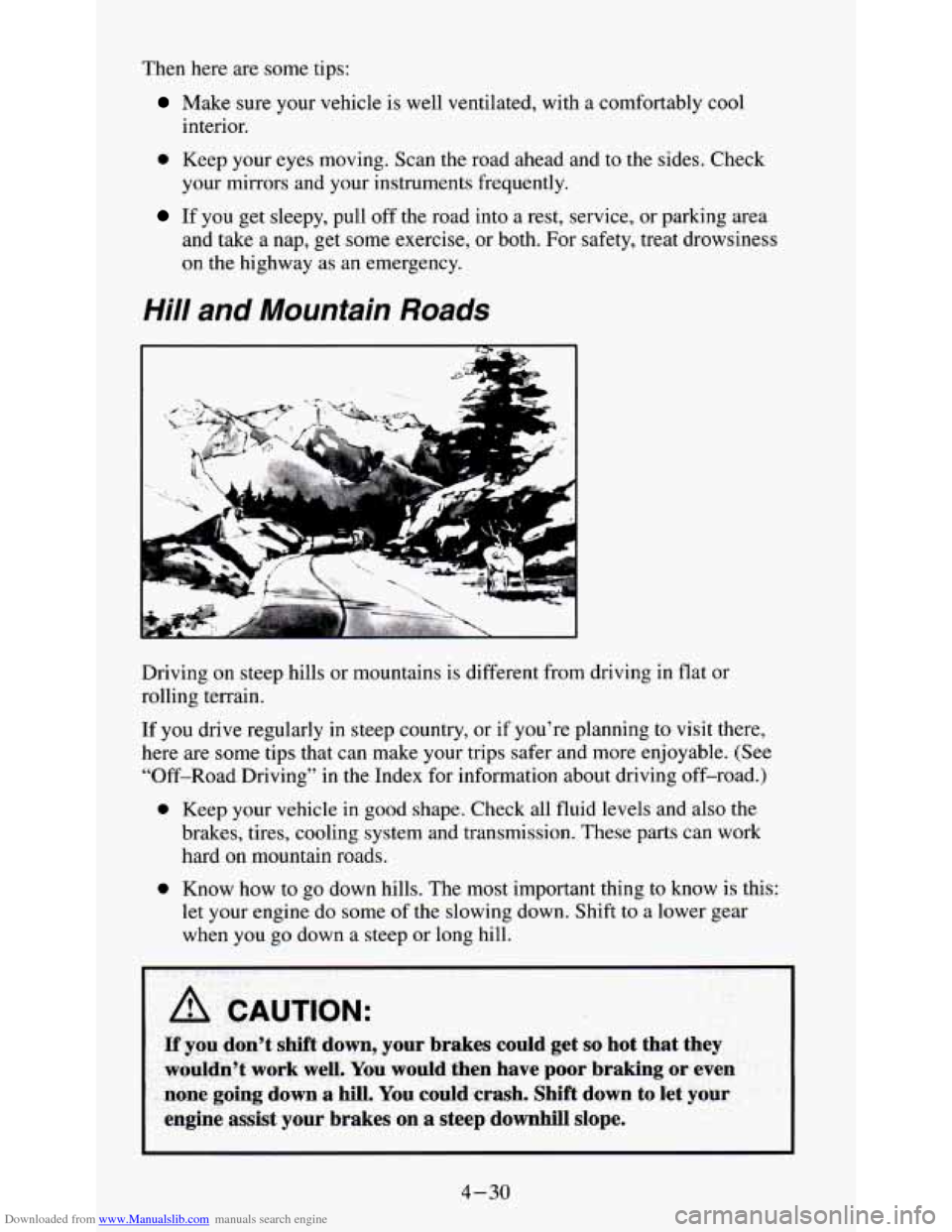
Hill and Mountain Roads
Driving on steep hills or mountains is different from driving in flat or
rolling terrain.
If you drive regularly in steep country, or if you’re planning
to visit there,
here are some tips that can make your trips safer and more enjoyable. (See
“Off-Road Driving” in the Index for information about driving off-road.)
0 Keep your vehicle in good shape. Check all fluid levels and also the
brakes, tires, cooling system and transmission. These parts can work
hard on mountain roads.
0 Know how to go down hills. -The most important thing to know is this:
let your engine do some
of the slowing down. Shift to a lower gear
when you
go down a steep or long hill.
4-30
Page 174 of 354
Downloaded from www.Manualslib.com manuals search engine Truck Loading Information
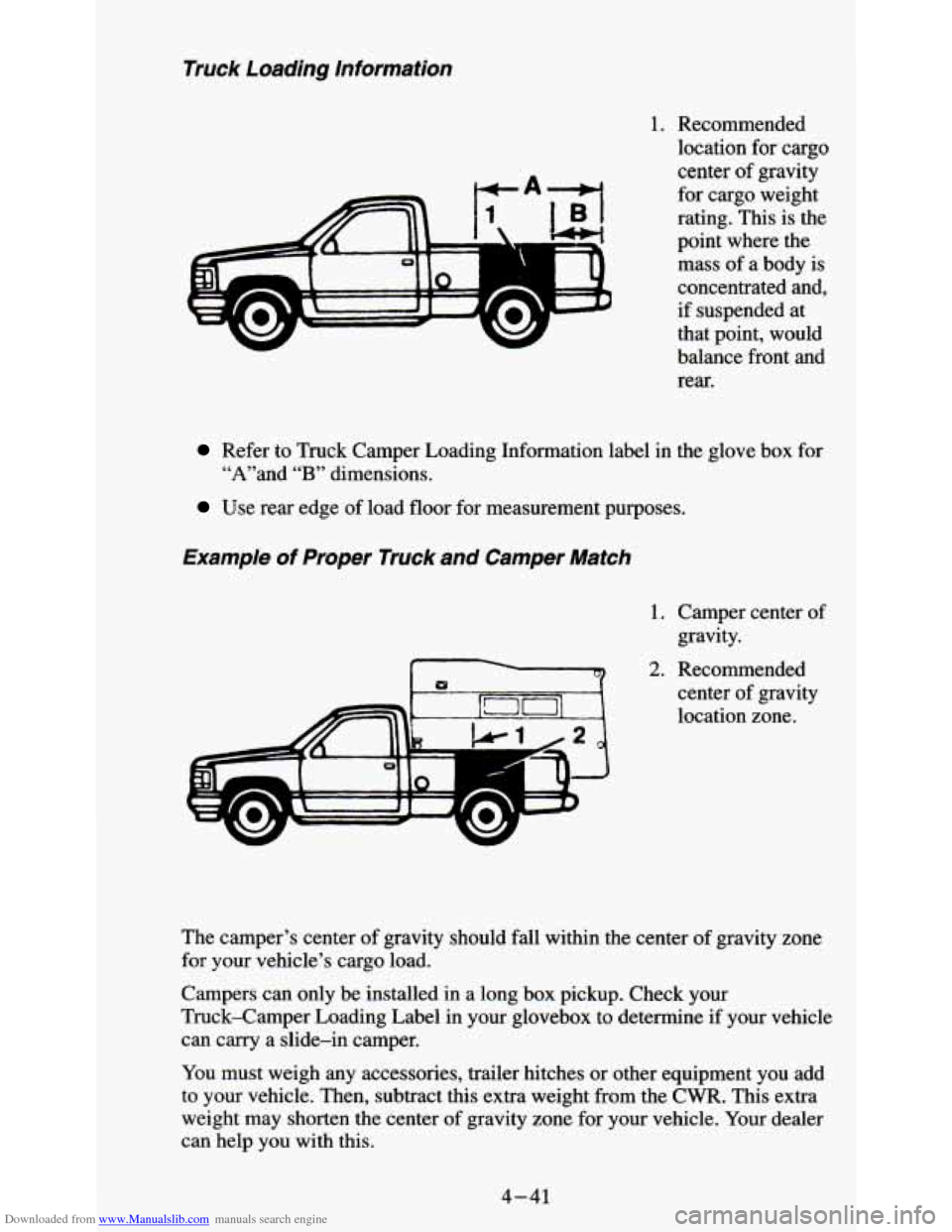
1. Recommended location for cargo
center
of gravity
for cargo weight
rating. This is the
point where the
mass of a body is
concentrated and,
if suspended at
that point, would
balance front and
rear.
Refer to Truck Camper Loading Information label in the glove box for
Use rear edge of load floor for measurement purposes.
“”’and
“B” dimensions.
Example of Proper Truck and Camper Match
1. Camper center of
gravity.
2. Recommended
center
of gravity
location zone.
The camper’s center of gravity should fall within the center\
of gravity zone
for your vehicle’s cargo load.
Campers can only be installed
in a long box pickup. Check your
Truck-Camper Loading Label
in your glovebox to determine if your vehicle
can carry a slide-in camper.
You must weigh any accessories, trailer hitches or other equipment you add
to your vehicle. Then, subtract this extra weight from the CWR. This extra
weight may shorten the center
of gravity zone for your vehicle. Your dealer
can help you with this.
4-41
Page 175 of 354
Downloaded from www.Manualslib.com manuals search engine If your slide-in camper and its load weigh less than the CWR, the center of
gravity zone for your vehicle may be larger.
Your dealer can help you make a good vehicle-camper match. He’ll also
help you determine your CWR.
After you’ve loaded your vehicle and camper, drive to a weigh station and
weigh on the front and rear wheels separately. This will tell you the loads on
your axles. The loads on the front and rear axles shouldn’t be more than
either
of the GAWRs. The total of the axle loads should not be more than
the GVWR.
Open your driver’s door and look at the door lock pillar for the
Certificatiomire label to find out your GAWR and GVWR.
If you’ve gone over your weight ratings, move or take
out some things until
all the weights fall below the ratings. Of course, you should always tie down
any loose items when
you load your vehicle or camper.
When you install and load your slide-in camper, check the manufacturer’s
instructions.
If you want more information
on curb weights, cargo weights, cargo weight
rating and the correct center of gravity zone for your vehicle, your dealer
can help you. Just ask for a copy of “Consumer Information, Truck-Camper
Loading.”
Trailer Recommendations
You must subtract your hitch loads from the CWR for your vehicle. Weigh
your vehicle with your trailer attached,
so that you won’t go over the
GVWR or the GAWR.
You’ll get the best performance if you spread out the weight of your load
the right way, and if you choose the correct hitch and trailer brakes.
For more information, see “Towing a Trailer” in the Index.
Pickup Conversion to Chassis Cab
General Motors is aware that some vehicle owners may consider having the
pickup box removed and a commercial or recreational body installed.
However, we recommend that conversions of this type not be done to
pickups. Owners should be aware that, as manufactured, there are
differences between
a chassis cab and a pickup with the box removed which
may affect vehicle safety. For specific information
on this pickup, contact
the GM Zone Office for your area. (See the “Warranty and Owner
Assistance” booklet for Zone Office.)
4-42