climate control CHEVROLET SILVERADO 2007 1.G Owner's Manual
[x] Cancel search | Manufacturer: CHEVROLET, Model Year: 2007, Model line: SILVERADO, Model: CHEVROLET SILVERADO 2007 1.GPages: 684, PDF Size: 3.4 MB
Page 246 of 684
Defogging and Defrosting
Fog on the inside of the windows is a result of high
humidity (moisture) condensing on the cool window
glass. This can be minimized if the climate control
system is used properly. There are two modes to
clear fog or frost from the windshield.
Use the mode up and down arrows to select the
defog or defrost modes.
-(Defog):Press this button to clear the
windows of fog or moisture and warm the
passengers. This mode directs air to the
windshield, oor outlets, and side window vents.
When this mode is selected, the system turns
off recirculation and runs the air conditioning
compressor unless the outside temperature is
close to freezing. The recirculation mode cannot
be selected while in the defog mode. Do not drive
the vehicle until all the windows are clear.
0(Defrost):Press this button to remove fog or
frost from the windshield more quickly. This mode
directs a portion of the air to the windshield and side
window vents and some to the oor vents. In this
mode, the system will automatically force outside
air into your vehicle. The recirculation mode cannot
be selected while in the defrost mode. The air
conditioning compressor will run automatically in
this setting, unless the outside temperature is close
to freezing. Do not drive the vehicle until all the
windows are clear.
Rear Window Defogger
The rear window defogger uses a warming grid to
remove fog from the rear window.
<(Rear Window Defogger):If your vehicle
has this feature, press this button to turn the
defogger on or off. It will automatically turn
off several minutes after it has been activated.
The defogger can also be turned off by turning the
engine off. Do not drive the vehicle until all the
windows are clear.
246
Page 385 of 684
The traction control
disable button is located
on the instrument
panel below the climate
controls.
The traction control part of StabiliTrak
®can be
turned off by pressing and releasing the
StabiliTrak
®button if both systems (traction control
and StabiliTrak®) were previously on. To disable
both traction control and StabiliTrak®, press
and hold the button for ve seconds.
Traction control and StabiliTrak
®can be turned on
by pressing and releasing the StabiliTrak®button if
not automatically shut off for any other reason.
When the TCS or StabiliTrak
®system is turned off,
the StabiliTrak®light and the appropriate TCS
off or StabiliTrak®off message will be displayed on
the DIC to warn the driver. Your vehicle will still
have brake-traction control when traction control is
off, but will not be able to use the engine speed
management system. See “Traction Control
Operation” next for more information.When the traction control system has been turned
off, you may still hear system noises as a result
of the brake-traction control coming on.
It is recommended to leave the system on for
normal driving conditions, but it may be necessary
to turn the system off if your vehicle is stuck in
sand, mud, ice or snow, and you want to
“rock” your vehicle to attempt to free it. It may also
be necessary to turn off the system when driving
in extreme off-road conditions where high
wheel spin is required. SeeIf Your Vehicle is
Stuck in Sand, Mud, Ice, or Snow on page 424.
When the transfer case is in 4LO, the stability
system is automatically disabled, the StabiliTrak
®
light will come on and the STABILITRAK OFF
message will appear on the DIC. Both traction
control and StabiliTrak
®are automatically disabled
in this condition.
385
Page 475 of 684
Driving with a Trailer
{CAUTION:
If you have a rear-most window open and
you pull a trailer with your vehicle, carbon
monoxide (CO) could come into your
vehicle. You cannot see or smell CO. It
can cause unconsciousness or death. See
Engine Exhaust on page 169. To maximize
your safety when towing a trailer:
Have your exhaust system inspected
for leaks, and make necessary repairs
before starting on your trip.
Keep the rear-most windows closed.
CAUTION: (Continued)
CAUTION: (Continued)
If exhaust does come into your vehicle
through a window in the rear or
another opening, drive with your front,
main heating or cooling system on
and with the fan on any speed. This
will bring fresh, outside air into your
vehicle. Do not use the climate control
setting for maximum air because it
only recirculates the air inside your
vehicle. SeeClimate Control System
(With Air Conditioning ) on page 236
orClimate Control System (Heater
Only) on page 239.
Towing a trailer requires a certain amount of
experience. Before setting out for the open road,
you’ll want to get to know your rig. Acquaint
yourself with the feel of handling and braking with
the added weight of the trailer. And always
keep in mind that the vehicle you are driving is
now a good deal longer and not nearly as
responsive as your vehicle is by itself.
475
Page 575 of 684
Uniform Tire Quality Grading
Quality grades can be found where applicable on
the tire sidewall between tread shoulder and
maximum section width. For example:
Treadwear 200 Traction AA Temperature A
The following information relates to the system
developed by the United States National Highway
Traffic Safety Administration (NHTSA), which
grades tires by treadwear, traction, and
temperature performance. This applies only to
vehicles sold in the United States. The grades are
molded on the sidewalls of most passenger car
tires. The Uniform Tire Quality Grading (UTQG)
system does not apply to deep tread, winter-type
snow tires, space-saver, or temporary use
spare tires, tires with nominal rim diameters of
10 to 12 inches (25 to 30 cm), or to some
limited-production tires.
While the tires available on General Motors
passenger cars and light trucks may vary with
respect to these grades, they must also conform
to federal safety requirements and additional
General Motors Tire Performance Criteria (TPC)
standards.
Treadwear
The treadwear grade is a comparative rating
based on the wear rate of the tire when tested
under controlled conditions on a specied
government test course. For example, a tire
graded 150 would wear one and a half (1.5) times
as well on the government course as a tire
graded 100. The relative performance of tires
depends upon the actual conditions of their use,
however, and may depart signicantly from
the norm due to variations in driving habits, service
practices, and differences in road characteristics
and climate.
Traction – AA, A, B, C
The traction grades, from highest to lowest, are
AA, A, B, and C. Those grades represent the tire’s
ability to stop on wet pavement as measured
under controlled conditions on specied
government test surfaces of asphalt and concrete.
A tire marked C may have poor traction
performance.
Warning:The traction grade assigned to this tire
is based on straight-ahead braking traction
tests, and does not include acceleration, cornering,
hydroplaning, or peak traction characteristics.
575
Page 613 of 684
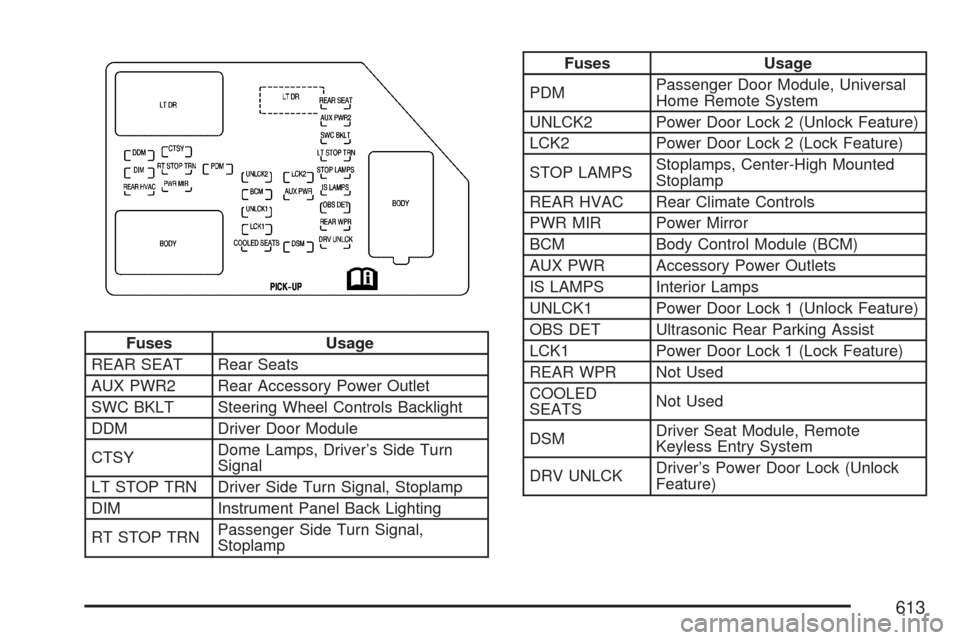
Fuses Usage
REAR SEAT Rear Seats
AUX PWR2 Rear Accessory Power Outlet
SWC BKLT Steering Wheel Controls Backlight
DDM Driver Door Module
CTSYDome Lamps, Driver’s Side Turn
Signal
LT STOP TRN Driver Side Turn Signal, Stoplamp
DIM Instrument Panel Back Lighting
RT STOP TRNPassenger Side Turn Signal,
Stoplamp
Fuses Usage
PDMPassenger Door Module, Universal
Home Remote System
UNLCK2 Power Door Lock 2 (Unlock Feature)
LCK2 Power Door Lock 2 (Lock Feature)
STOP LAMPSStoplamps, Center-High Mounted
Stoplamp
REAR HVAC Rear Climate Controls
PWR MIR Power Mirror
BCM Body Control Module (BCM)
AUX PWR Accessory Power Outlets
IS LAMPS Interior Lamps
UNLCK1 Power Door Lock 1 (Unlock Feature)
OBS DET Ultrasonic Rear Parking Assist
LCK1 Power Door Lock 1 (Lock Feature)
REAR WPR Not Used
COOLED
SEATSNot Used
DSMDriver Seat Module, Remote
Keyless Entry System
DRV UNLCKDriver’s Power Door Lock (Unlock
Feature)
613
Page 618 of 684
Fuses Usage
35 Sunroof
36Key Ignition System, Theft Deterrent
System
37 Windshield Wiper
38 SEO B2 Uptter Usage (Battery)
39 Electric Adjustable Pedals
40 Climate Controls (Battery)
41 Airbag System (Ignition)
42 Amplier
43 Audio System
44Miscellaneous (Ignition), Cruise
Control
45 Tailgate Open/Close Assist
46 Airbag System (Battery)
47OnStar
®, Rear Seat Entertainment
Display
Fuses Usage
48 Instrument Panel Cluster
49 Power Take-Off
50Auxiliary Climate Control (Ignition),
Compass-Temperature Mirror
51Center High-Mounted Stoplamp
(CHMSL)
52 Rear Defogger
53 Heated Mirrors
54 SEO B1 Uptter Usage (Battery)
55Cigarette Lighter, Auxiliary Power
Outlet
56Automatic Level Control Compressor
Relay, SEO Uptter Usage
57 Climate Controls (Ignition)
58Engine Control Module, Secondary
Fuel Pump (Ignition)
618
Page 619 of 684
J-Case Fuses Usage
59 Cooling Fan 1
60 Automatic Level Control Compressor
61 Heavy Duty Anti-lock Brake System
62 Cooling Fan 2
63 Anti-lock Brake System 1
64 Starter
65 Stud 2 (Trailer Brakes)
66 Left Bussed Electrical Center 1
67 Not Used
68 Heated Windshield Washer System
69 Four-Wheel Drive System
70Stud 1 (Trailer Connector Battery
Power) (Optional – 40A Fuse
Required)
71 Mid-Bussed Electrical Center 1
72 Climate Control Blower
73 Tailgate Open/Close Assist
74 Left Bussed Electrical Center 2Relays Usage
FAN HI Cooling Fan High Speed
FAN LO Cooling Fan Low Speed
ENG EXH VLV Not Used
FAN CNTRL Cooling Fan Control
HDLP LO/HID Low-Beam Headlamp
FOG LAMP Front Fog Lamps
A/C CMPRSR Air Conditioning Compressor
STRTR Starter
PWR/TRN Powertrain
FUEL PMP Fuel Pump
PRK LAMP Parking Lamps
REAR DEFOG Rear Defogger
RUN/CRANK Switched Power
619
Page 672 of 684
Cleaning (cont.)
Washing Your Vehicle.............................. 605
Weatherstrips........................................... 604
Windshield and Wiper Blades................... 606
Climate Control System......................236, 239
Dual Automatic......................................... 240
Outlet Adjustment..................................... 247
Clock.......................................................... 303
Collision Damage Repair............................. 660
Comfort Guides, Rear Safety Belt................. 42
Compass............................................171, 175
Content Theft-Deterrent............................... 130
Control of a Vehicle..................................... 380
Coolant
Engine Temperature Gage........................ 260
Heater, Engine......................................... 138
Surge Tank Pressure Cap........................ 517
Cooling System........................................... 521
Cruise Control............................................. 220
Cruise Control Light.................................... 267
Cupholder(s)................................................ 198
Customer Assistance Information
Courtesy Transportation........................... 657
Customer Assistance for Text
Telephone (TTY) Users......................... 652
Customer Assistance Offices.................... 652
Customer Satisfaction Procedure.............. 648Customer Assistance Information (cont.)
GM Mobility Reimbursement Program...... 653
Reporting Safety Defects to General
Motors.................................................. 665
Reporting Safety Defects to the
Canadian Government.......................... 665
Reporting Safety Defects to the
United States Government.................... 664
Roadside Assistance Program.................. 654
Service Publications Ordering
Information........................................... 666
D
Daytime Running Lamps............................. 224
Defensive Driving........................................ 376
Delayed Locking.......................................... 121
Disc, MP3..........................................341, 347
Doing Your Own Service Work.................... 489
Dome Lamp Override.................................. 228
Dome Lamps............................................... 228
Door
Delayed Locking...................................... 121
Locks....................................................... 120
Power Door Locks................................... 121
Programmable Automatic Door Locks....... 121
672
Page 673 of 684
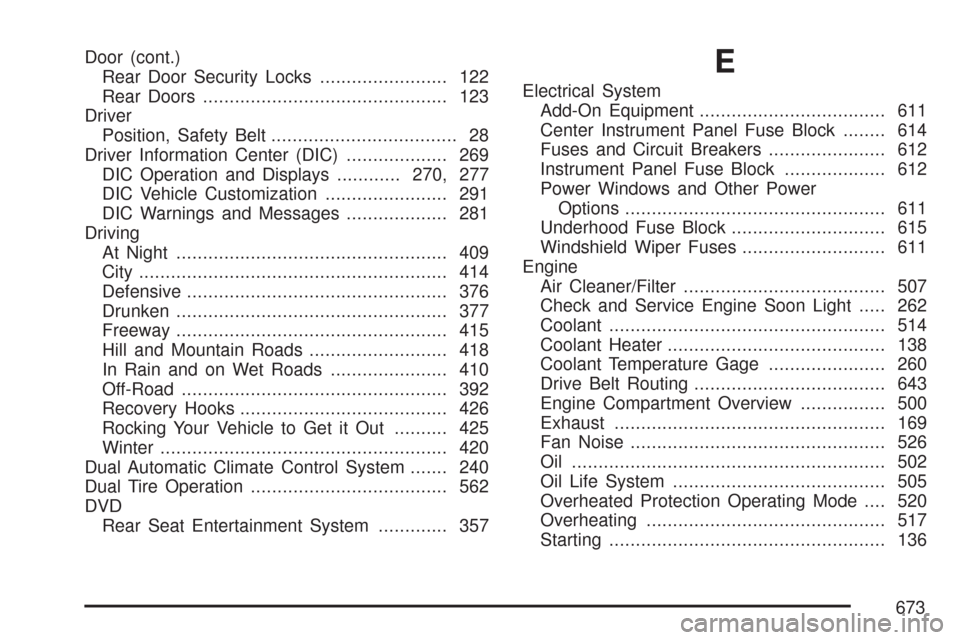
Door (cont.)
Rear Door Security Locks........................ 122
Rear Doors.............................................. 123
Driver
Position, Safety Belt................................... 28
Driver Information Center (DIC)................... 269
DIC Operation and Displays............270, 277
DIC Vehicle Customization....................... 291
DIC Warnings and Messages................... 281
Driving
At Night................................................... 409
City.......................................................... 414
Defensive................................................. 376
Drunken................................................... 377
Freeway................................................... 415
Hill and Mountain Roads.......................... 418
In Rain and on Wet Roads...................... 410
Off-Road.................................................. 392
Recovery Hooks....................................... 426
Rocking Your Vehicle to Get it Out.......... 425
Winter...................................................... 420
Dual Automatic Climate Control System....... 240
Dual Tire Operation..................................... 562
DVD
Rear Seat Entertainment System............. 357E
Electrical System
Add-On Equipment................................... 611
Center Instrument Panel Fuse Block........ 614
Fuses and Circuit Breakers...................... 612
Instrument Panel Fuse Block................... 612
Power Windows and Other Power
Options................................................. 611
Underhood Fuse Block............................. 615
Windshield Wiper Fuses........................... 611
Engine
Air Cleaner/Filter...................................... 507
Check and Service Engine Soon Light..... 262
Coolant.................................................... 514
Coolant Heater......................................... 138
Coolant Temperature Gage...................... 260
Drive Belt Routing.................................... 643
Engine Compartment Overview................ 500
Exhaust................................................... 169
Fan Noise................................................ 526
Oil ........................................................... 502
Oil Life System........................................ 505
Overheated Protection Operating Mode.... 520
Overheating............................................. 517
Starting.................................................... 136
673