automatic transmission CHEVROLET SUBURBAN 1997 User Guide
[x] Cancel search | Manufacturer: CHEVROLET, Model Year: 1997, Model line: SUBURBAN, Model: CHEVROLET SUBURBAN 1997Pages: 433, PDF Size: 21.49 MB
Page 240 of 433
Other Warning Devices
If you carry reflective triangles, you can set one up at
the side of the road about
300 feet (100 m) behind
your vehicle.
Jump Starting
If your battery (or batteries) has run down, you may
want to
use another vehicle and some jumper cables to
start your vehicle. But please use the following steps to
do it safely.
Batteries can hurt you. They can be
dangerous because:
0 They contain acid that can burn you.
0 They contain gas that can explode or ignite.
0 They contain enough electricity to burn you.
If you don’t follow these steps exactly, some or all
of these things can hurt you.
NOTICE:
Ignoring these steps could result in costly damage
to your vehicle that wouldn’t be covered
by your
vehicle warranty.
Trying to start your vehicle by pushing
or pulling
it could damage your vehicle. With an automatic
transmission, it won’t start that
way.
1. Check the other vehicle. It must have a 12-volt
battery with a negative ground system.
2. Get the vehicles close enough
so the jumper cables
can reach, but be sure the vehicle’s aren’t touching
each other. If they are, it could cause a ground
connection you don’t want. You wouldn’t be able to
start your vehicle, and the bad grounding could
damage the electrical systems.
To avoid the possibility of the vehicles rolling, set the
parking brake
fiiy on both vehicles involved in the
jump
start procedure. Put an automatic transmission
in
PARK (P). If you have a four-wheel-drive vehicle,
be sure the transfer case is not
in NEUTRAL (N).
5-3
ProCarManuals.com
Page 249 of 433
If No Steam Is Coming From Your Engine
If you get the overheat warning but see or hear no
steam, the problem may not be too serious. Sometimes
the engine can get a little too hot when you:
Climb a long hill on a hot day.
Stop after high-speed driving.
Idle for long periods in traffic.
0 Tow a trailer. See “Driving on Grades” in the Index.
If you get the overheat warning with no sign of steam,
try this for a minute or
so:
1. If you have an air conditioner, turn it off.
2. Turn on your heater to full hot at the highest fan
speed and open the window as necessary.
3. If you’re in a traffic jam, shift to NEUTRAL (N);
otherwise, shift to the highest gear while
driving
-- AUTOMATIC OVERDRIVE (a)
for automatic transmissions. If you
no longer have
the overheat warning, you can
drive. Just to be safe, drive slower for about
10 minutes.
If the warning doesn’t come back on, you can
drive normally.
If the warning continues, pull over, stop, and park your
vehicle right away.
If there’s still no sign
of steam, push the accelerator until
the engine speed is about twice as fast as normal idle
speed. Bring the engine speed back to normal idle speed
after two or three minutes. Now see if the warning stops,
But then, if you still have the warning,
turn oflthe
engine
and get everyone out of the vehicle until it
cools down.
YOU may decide not
to lift the hood but to get service
help right away.
5-12
ProCarManuals.com
Page 280 of 433
Section 6 Service and Appearance Care
Here you will find information about the care of your vehicle. This section begins with service and fuel information,
and then it shows how to check important fluid and lubricant levels. There is also technical information about your
vehicle, and a part devoted to its appearance care.
6-2
6-3
6-5
6-6
6-8
6- 14
6-18
6-20
6-24 6-24
6-26
6-29
6-29
6-30
6-30
6-32 Service
Fuel (Gasoline Engine)
Fuels
in Foreign Countries -- Gasoline
Engines
Filling Your Tank
Checking Things Under the Hood
Engine Oil (Gasoline Engine)
Air Cleaner (Gasoline Engines)
Automatic Transmission Fluid
Rear Axle
Four-wheel Drive
Engine Coolant
Radiator Pressure Cap
Thermostat
Power Steering Fluid
Windshield Washer Fluid
Brakes
6-36
6-37
6-44
6-44
6-52
6-53
6-56
6-57
6-59
6-60 6-6 1
6-62
6-67
6-69
6-70
6-72 Battery
Bulb Replacement
Windshield Wiper Blade Replacement
Tires Appearance Care
Cleaning the Inside
of Your Vehicle
Care of the Safety Belts
Cleaning the Outside of Your Vehicle
Underbody Maintenance
Appearance Care Materials Chart
Vehicle Identification Number (VIN)
Electrical System
Replacement Bulbs
Capacities and Specifications
Normal Replacement Parts
Air Conditioning Specifications
6-1
ProCarManuals.com
Page 290 of 433
A. Battery
B. Air Cleaner
C. Radiator Cap
D. Coolant Recovery Tank
E. Air Filter Restriction Indicator
F. Engine Oil Dipstick
G. Automatic Transmission Dipstick
H. Fan
I. Power Steering Fluid Reservoir
J. Engine Oil Fill
K. Brake Fluid Reservoir
L. Windshield Washer Fluid Reservoir
M. Fusemelay Center
6-11
ProCarManuals.com
Page 292 of 433
A. Battery
B. Coolant Recovery Tank
C.
Air Cleaner
D. Radiator Cap
E. Air Filter Restriction Indicator
F. Engine Oil Dipstick
G. Automatic Transmission Dipstick
H. Engine Oil Fill
I. Fan
J. Power Steering Fluid Reservoir
K. Brake Fluid Reservoir
L. Windshield Washer Fluid Reservoir
M. FuseRelay Center
6-13
ProCarManuals.com
Page 299 of 433
Refer to the Maintenance Schedule to determine when to
replace the
air filter. See “Owner Checks and Services”
in the Index.
A CAUTION:
Operating the engine with the air cleaner off can
cause you or others to be burned. The air cleaner
not only cleans the air, it stops flame if the engine
backfhes.
If it isn’t there, and the engine
backfires, you could be burned. Don’t drive with
it
off, and be careful working on the engine with
the
air cleaner off.
NOTICE:
If the air cleaner is off, a backfire can cause a
damaging engine fire. And, dirt can easily get
into your engine, which will damage
it. Always
have the air cleaner in place when you’re driving.
Automatic Transmission Fluid
When to Check and Change
A good time to check your automatic transmission fluid
level is when the engine oil is changed.
Change both the fluid and filter every
50,000 miles
(83 000 km) if the vehicle is mainly driven under one or
more
of these conditions:
0 In heavy city traffic where the outside temperature
regularly reaches
90°F (32 “C) or higher.
In hilly or mountainous terrain.
When doing frequent trailer towing.
0 Uses such as found in taxi, police or delivery service.
If you do not use your vehicle under any of these
conditions, the fluid and filter do not require changing.
See “Scheduled Maintenance Services” in the Index.
How to Check
Because this operation can be a little difficult, you
may choose to have this done at your
GM dealership
Service Department.
ProCarManuals.com
Page 302 of 433
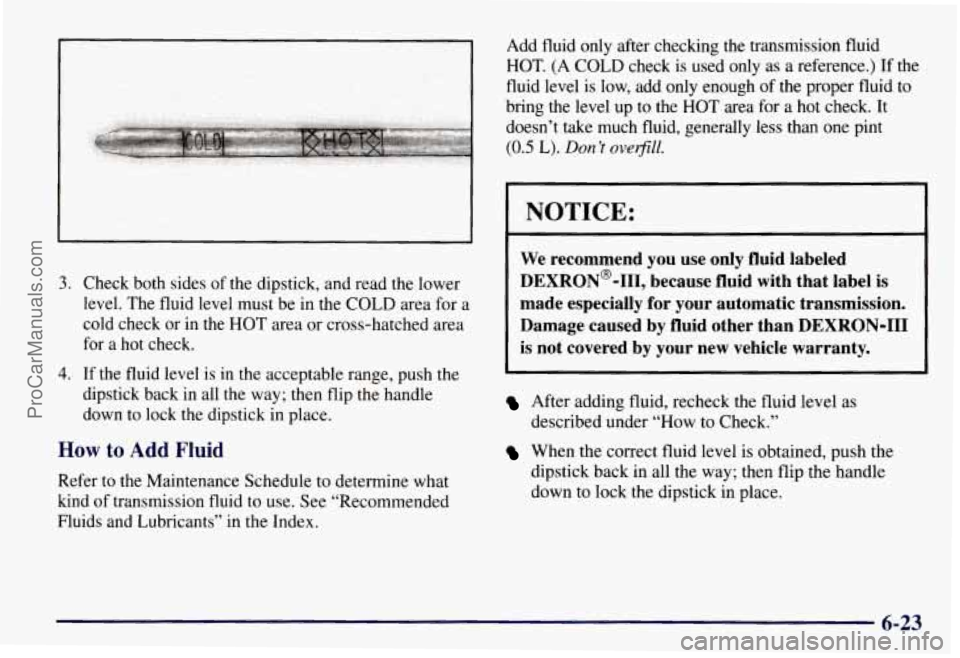
3. Check both sides of the dipstick, and read the lower
level. The fluid level must be in the COLD area for a
cold check or in the
HOT area or cross-hatched area
for a hot check.
4. If the fluid level is in the acceptable range, push the
dipstick back in all the way; then flip the handle
down to lock the dipstick in place.
How to Add Fluid
Refer to the Maintenance Schedule to determine what
kind
of transmission fluid to use. See “Recommended
Fluids and Lubricants” in the Index. Add
fluid only after checking the transmission fluid
HOT. (A COLD check is used only as a reference.) If the
fluid level is low, add only enough of the proper fluid to
bring the level up to the HOT area for
a hot check. It
doesn’t take much fluid, generally less
than one pint
(0.5 L). Don’t ove$ll.
NOTICE:
We recommend you use only fluid labeled
DEXRON@-111, because fluid with that label is
made especially for your automatic transmission.
Damage caused by fluid other than DEXRON-I11
is not covered by your new vehicle warranty.
After adding fluid, recheck the fluid level as
When the correct fluid level is obtained, push the
described under “How
to Check.”
dipstick back in all the way; then flip the handle
down to lock the dipstick in place.
6-23
ProCarManuals.com
Page 344 of 433
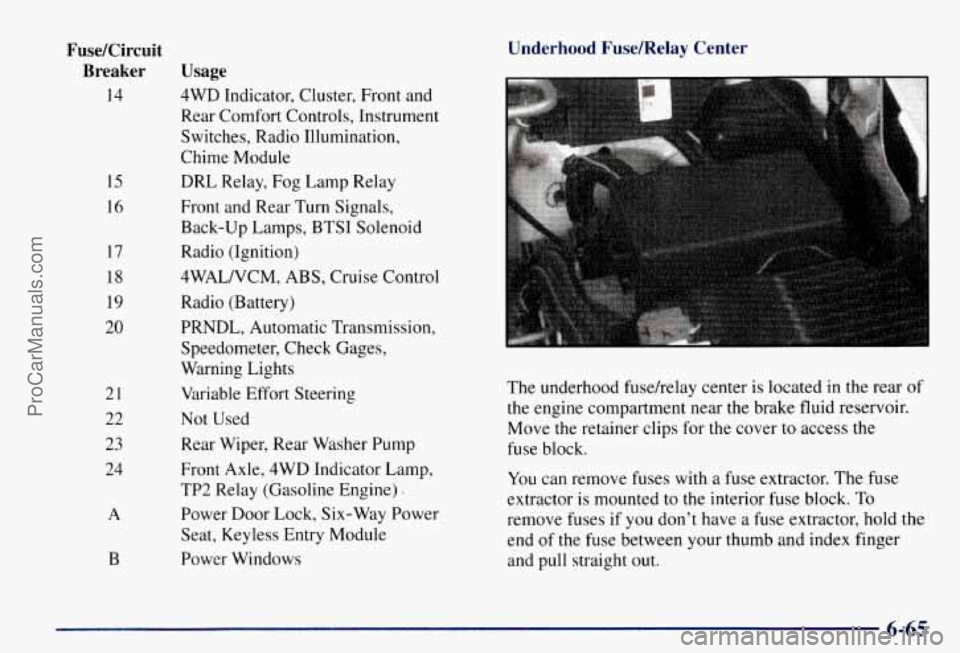
15
16
Fuse/Circuit Breaker Usage
14 4WD Indicator, Cluster, Front and
Rear Comfort Controls, Instrument
Switches, Radio Illumination,
Chime Module
DRL Relay, Fog Lamp Relay
17
18
19
20
21
22
23
24
A
B Front and Rear Turn Signals,
Back-up
Lamps, BTSI Solenoid
Radio (Ignition)
4WALNCM, ABS, Cruise Control
Radio (Battery)
PRNDL, Automatic Transmission, Speedometer, Check Gages,
Warning Lights
Variable Effort Steering
Not Used
Rear Wiper, Rear Washer Pump
Front Axle, 4WD Indicator Lamp,
TP2 Relay (Gasoline Engine)
Power Door Lock, Six-Way Power
Seat, Keyless Entry Module
Power Windows
Underhood Fuse/Relay Center
The underhood fusehelay center is located in the rear of
the engine compartment near the brake fluid reservoir.
Move the retainer clips for the cover to access the
fuse block.
You can remove fuses with a fuse extractor. The fuse
extractor is mounted to the interior fuse block. To
remove fuses if you don't have a fuse extractor, hold the
end of the fuse between your thumb and index finger
and pull straight out.
6-65
ProCarManuals.com
Page 358 of 433
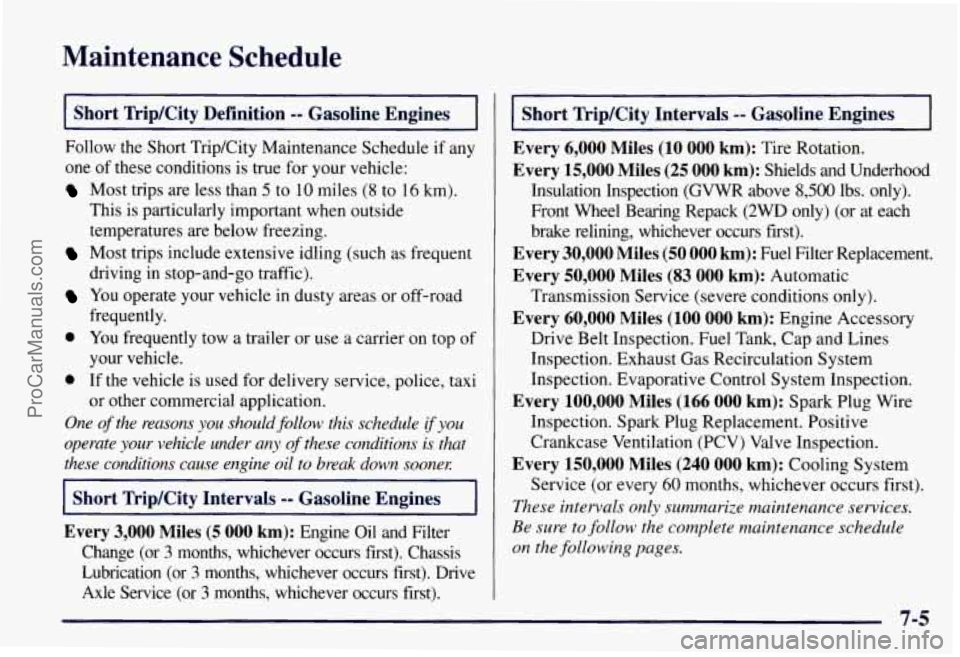
Maintenance Schedule
Short Trip/City Definition -- Gasoline Engines .
Follow the Short Trip/City Maintenance Schedule if any
one of these conditions is true for your vehicle:
Most trips are less than 5 to 10 miles (8 to 16 km).
This is particularly important when outside
temperatures are below freezing.
driving in stop-and-go traffic).
frequently. your vehicle.
or other commercial application.
Most trips include extensive idling (such as frequent
You operate your vehicle in dusty areas or off-road
0 You frequently tow a trailer or use a carrier on top of
0 If the vehicle is used for delivery service, police, taxi
One of the reasons you should *follow this schedule if you
operate your vehicle under any of these conditions is that
these conditions cause engine oil to break down soonez
Short Trip/City Intervals -- Gasoline Engines
Every
3,000 Miles (5 000 km): Engine Oil and Filter
Change (or
3 months, whichever occurs first). Chassis
Lubrication (or
3 months, whichever occurs first). Drive
Axle Service (or
3 months, whichever occurs first).
Short Trip/City Intervals -- Gasoline Engines
Every 6,000 Miles
(10 000 km): Tire Rotation.
Every 15,000 Miles (25 000 km): Shields and Underhood
Insulation Inspection
(GVWR above 8,500 lbs. only).
Front Wheel Bearing Repack
(2WD only) (or at each
brake relining, whichever occurs first).
Every 30,000 Miles (50 000 km): Fuel Filter Replacement.
Every 50,000 Miles (83 000 km): Automatic
Transmission Service (severe conditions only).
Every 60,000 Miles (100 000 km): Engine Accessory
Drive Belt Inspection. Fuel Tank, Cap and Lines
Inspection. Exhaust Gas Recirculation System
Inspection. Evaporative Control System Inspection.
Every 100,000 Miles (166 000 km): Spark Plug Wire
Inspection. Spark Plug Replacement. Positive
Crankcase Ventilation
(PCV) Valve Inspection.
Service (or every 60 months, whichever occurs first).
Every 150,000 Miles (240 000 km): Cooling System
These intervals only summarize maintenance services.
Be sure to follow the complete maintenance schedule
on the following pages.
7-5
ProCarManuals.com
Page 359 of 433
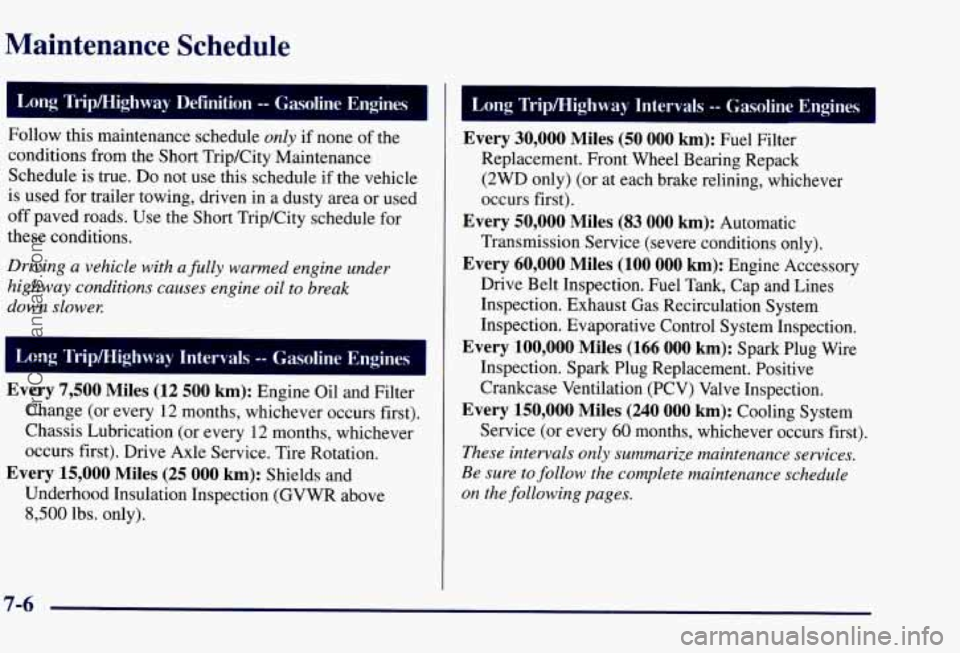
Maintenance Schedule
I Long Trip/Highway Definition -- Gacoline Engines
Follow this maintenance schedule only if none of the
conditions from the Short Trip/City Maintenance
Schedule is true. Do not use this schedule if the vehicle
is used for trailer towing, driven in a dusty area or used
off paved roads. Use the Short Trip/City schedule for
these conditions.
Driving a vehicle with a fully warmed engine under
highway conditions causes engine oil to break
down slowel:
1 Long TripMighway Intervals -- Gasoline Engines I
Every 7,500 Miles (12 500 km): Engine Oil and Filter
Change (or every
12 months, whichever occurs first).
Chassis Lubrication (or every 12 months, whichever
occurs first). Drive Axle Service. Tire Rotation.
Underhood Insulation Inspection (GVWR above
8,500 lbs. only).
Every 15,000 Miles (25 000 km): Shields and
Long TripMighway Intervals -- Gasoline Engines
Every
30,000 Miles (50 000 km): Fuel Filter
Replacement. Front Wheel Bearing Repack
(2WD only) (or at each brake relining, whichever
occurs first).
Every 50,000 Miles (83 000 km): Automatic
Transmission Service (severe conditions only).
Every 60,000 Miles (100 000 km): Engine Accessory
Drive Belt Inspection. Fuel Tank, Cap and Lines
Inspection. Exhaust Gas Recirculation System
Inspection. Evaporative Control System Inspection.
Every 100,000 Miles (166 000 km): Spark Plug Wire
Inspection. Spark Plug Replacement. Positive
Crankcase Ventilation (PCV) Valve Inspection.
Every 150,000 Miles (240 000 km): Cooling System
Service (or every
60 months, whichever occurs first).
These intervals only summarize maintenance services.
Be sure to
follow the complete maintenance schedule
on the following pages.
7-6
ProCarManuals.com