ECU CHEVROLET TRACKER 1993 User Guide
[x] Cancel search | Manufacturer: CHEVROLET, Model Year: 1993, Model line: TRACKER, Model: CHEVROLET TRACKER 1993Pages: 339, PDF Size: 15.75 MB
Page 115 of 339

EJECT
Press A to remove the tape or stop
the tape and switch to radio.
Radio Monitor
Press the RADIO MNTR button to hear
the radio when you are fast forwarding
or reversing a cassette tape.
You can use
the TUNE, SEEK and PRESET SCAN
buttons while in the radio monitor
mode.
Theft-Deterrent Feature
The theft-deterrent feature for the
AM/FM stereo with cassette tape player
can be used or ignored. If ignored,
the
system plays normally. If it is used,
your system won’t be usable
if it’s ever
l stolen.
Setting Your Security Code
The instructions below tell you how to
enter a security code into the system. If
your
vehicle loses battery power for any
reason, you must enter
the security code
again before the system will turn on.
1. Write down any four-digit number
2. Turn the ignition switch to the ACC
3. Turn the audio system off.
4. Press the 1 and 4 buttons together.
and keep it in
a safe place.
or
ON position.
Hold them down until
“-L” shows
on the display.
You are now ready to enter your
security code. Don’t wait more than
15
seconds between steps.
5. Press 4SEEKb and/or 4TUNEb
and “OOOO” will appear on the
display.
6. Press SEEK4 and hold it until the
first digit of your code appears.
Release the button.
7. Press SEEK, and hold it until the
second digit of your code appears.
Release the button.
8. Press TUNE4 and hold it until the
third digit of your code appears.
Release the button.
113. 9
ProCarManuals.com
Page 116 of 339
Comfort Controls & Audio Systems
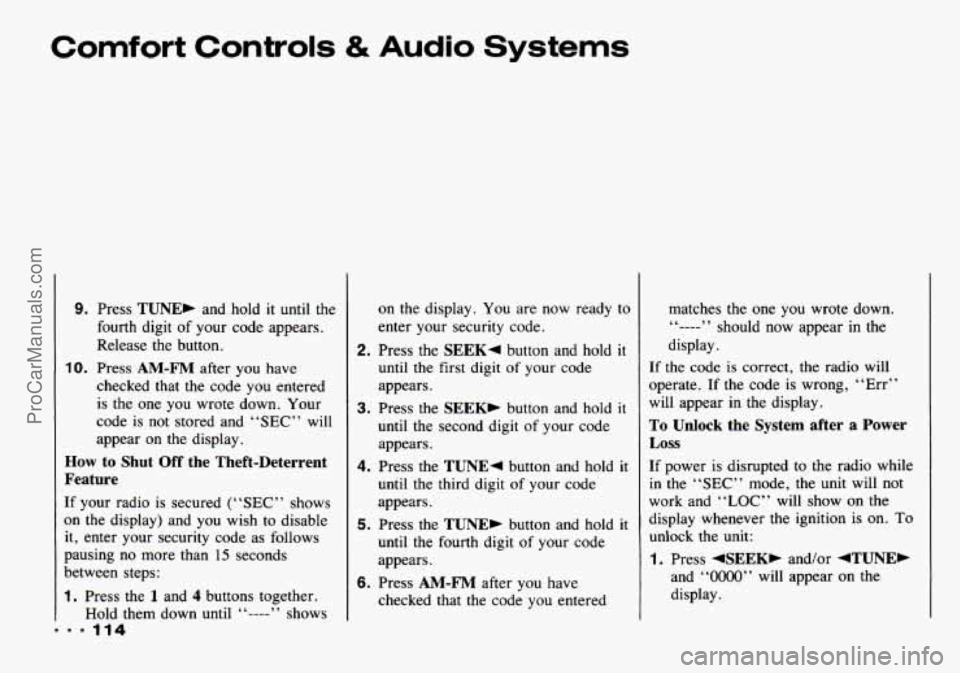
9. Press TUNE, and hold it until the
fourth digit
of your code appears.
Release
the button.
checked that
the code you entered
is the one you wrote down. Your
code is not stored and “SEC” will
appear
on the display.
How to Shut Off the Theft-Deterrent
Feature
If your radio is secured (“SEC” shows
on the display) and you wish to disable
it, enter your security code as follows
pausing
no more than 15 seconds
between steps:
1 . Press the 1 and 4 buttons together.
10. Press AM-FM after you have
Hold them down until
“----” shows on the
display.
You are now ready to
enter your security code.
2. Press the SEEK4 button and hold it
until the first digit of your code
appears.
3. Press the SEEK, button and hold it
until the second digit of your code
appears.
4. Press the TUNE4 button and hold it
until the third digit
of your code
appears.
5. Press the TUNE, button and hold it
until the fourth digit of your code
appears.
checked that the code you entered
6. Press AM-FM after you have matches the
one you wrote down.
“ ---- ” should now appear in the
display.
If the code is correct, the radio will
operate. If
the code is wrong, ‘bErr”
will appear in the display.
To Unlock the System after a Power
Loss
If power is disrupted to the radio while
in the “SEC” mode, the unit will not
work and
“LOC” will show on the
display whenever the ignition is on. To
unlock the unit:
1. Press 4SEEKb and/or 4TUNEF
and “00o0” will appear on the
display.
ProCarManuals.com
Page 143 of 339
signs. Surfaces can be slippery, rough,
uphill or downhill. In short, you’ve
gone right back to nature.
Off-road driving involves some new
skills. And that’s why
it’s very
important that you read this guide.
You’ll find many driving tips and
suggestions. These will help make your
off-road driving safer and more
enjoyable.
Before You Go Off-Roading
There are some things to do before you
go out. For example, be sure to have all
necessary maintenance and service work
done. Be sure
to read all the information
about your four-wheel drive vehicle in
this manual.
Is there enough fuel? Is the spare
tire fully inflated? Are the fluid
levels up where they should be? What
are the local laws that apply to
off-roading where you’ll be driving? If
you don’t
know, you should check with
law enforcement people in the area. Wil
you be on someone’s private land?
If so
be sure to get the necessary permission.
Loading Your Vehicle for Off-Road
Driving
There are some important things to
remember about how to load your
vehicle.
The heaviest things should be on the
load floor and forward of your rear
axle. Put heavier items as far forward
as you can.
Be sure the load is secured properly,
so driving on the off-road terrain
doesn’t
toss things around.
ProCarManuals.com
Page 144 of 339
Your Driving and the Road
A Cargo on the load floor
L piled higher than the
seatbacks can be thrown forwarc
during a sudden stop. You or
your passengers could be
injured. Keep cargo below the
top of the seatbacks.
floor can be tossed about when
driving over rough terrain. You
or your passengers can be strucl
by flying objects. Secure the
cargo properly.
Heavy loads on the roof raise
the vehicle’s center of gravity,
making it more likely to roll
over. You can be seriously or
fatally injured if the vehicle rolls
over. Put heavy loads inside the
cargo area, not on the roof.
Keep cargo
in the cargo area as
far forward and low as possible.
Unsecured cargo on the load
I
You’ll find other important information
in this manual. See “Vehicle Loading,”
and “Tires” in the Index.
Traveling to Remote Areas
It makes sense to plan your trip,
especially when going to a remote area.
Know the terrain and plan your route.
You are much less likely to get bad
surprises. Get accurate maps
of trails
and terrain.
Try to learn of any blocked
or closed roads.
It’s also
a good idea to travel with at
least one other vehicle.
If something
happens to one of them,
the other can
help quickly. Does
your vehicle have a winch? If
so,
be sure to read the winch instructions.
In a remote area, a winch can be handy
if you get stuck. But you’ll want to
know how to use it properly.
... 142
ProCarManuals.com
Page 176 of 339
Your Driving and the Road
rn
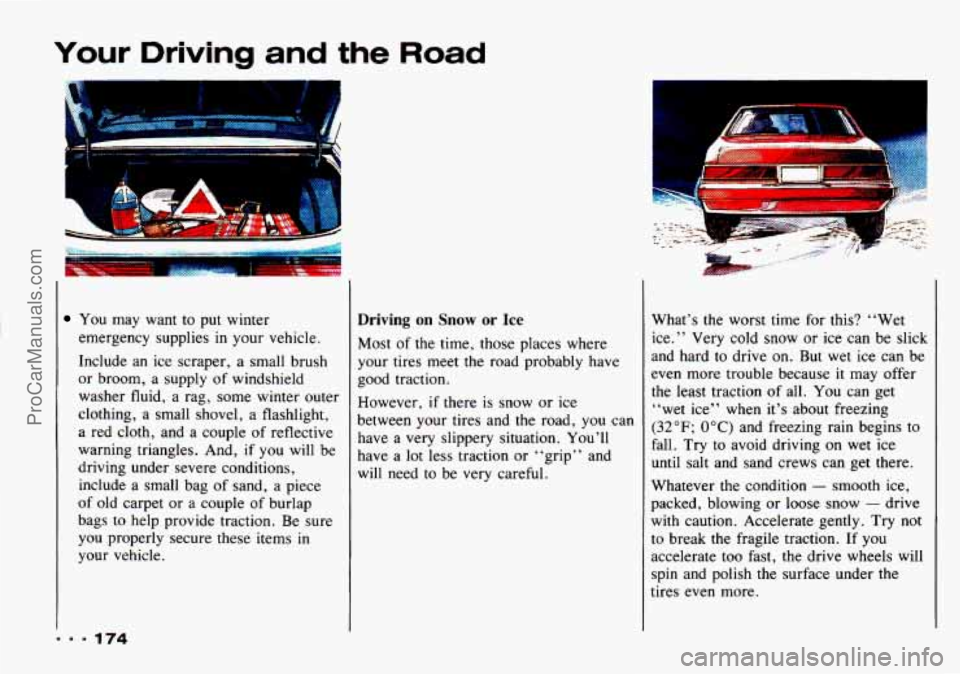
You may want to put winter
emergency supplies in your vehicle.
Include an ice scraper, a small brush
or broom, a supply of windshield
washer fluid, a rag, some winter outer
clothing, a small shovel, a flashlight,
a red cloth, and a couple of reflective
warning triangles. And, if
you will be
driving under severe conditions,
include
a small bag of sand, a piece
of old carpet or
a couple of burlap
bags to help provide traction.
Be sure
you properly secure these items
in
your vehicle.
... 174
Driving on Snow or Ice
Most of the time, those places where
your tires meet the road probably have
good traction.
However,
if there is snow or ice
between your tires and the road, you can
have a very slippery situation. You’ll
have a lot less traction or “grip” and
will need to be very careful.
t
What’s the worst time for this? “Wet
ice.
” Very cold snow or ice can be slick
and hard to drive on. But wet ice can be
even more trouble because it may offer
the least traction
of all. You can get
“wet ice” when it’s about freezing
(32°F; OOC) and freezing rain begins to
fall.
Try to avoid driving on wet ice
until salt and sand crews can get there.
Whatever the condition
- smooth ice,
packed, blowing or loose snow
- drive
with caution. Accelerate gently.
Try not
to break the fragile traction. If you
accelerate too fast, the drive wheels will
spin and polish the surface under the
tires even more.
ProCarManuals.com
Page 184 of 339
Your Driving and the Road
Will the trailer brake parts take
3,000 psi (20 650 kPa) of pressure? If
not, the trailer brake system must not
be used with your vehicle.
If everything checks out this far, then
make the brake fluid tap at the port
on the master cylinder that sends fluid
to the rear brakes. But don’t use
copper tubing
for this. If you do, it
will bend and finally break off. Use
steel brake tubing.
88. 182
Driving With a Trailer
Towing a trailer requires a certain
amount
of experience. Before setting out
for the open road, you’ll want to get to
know your rig. Acquaint yourself with
the feel of handling and braking with the
added weight
of the trailer. And always
keep in mind that the vehicle you are
driving is now a good deal longer and
not nearly
so responsive as your vehicle
is by itself. Before you
start, check
the trailer hitch
and platform, safety chains, electrical
connector, lights, tires and mirror
adjustment. If the trailer has electric
brakes, start your vehicle and trailer
moving and then apply the trailer brake
controller by hand to be sure the brakes
are working. This lets you check your
electrical connection at the same time.
During your trip, check occasionally to
be sure that the load is secure, and that
the lights and any trailer brakes are still
working.
ProCarManuals.com
Page 199 of 339
That your vehicle has rear-wheel
drive, or that
it has the
four-wheel-drive option.
vehicle.
The make, model, and year of your
Whether you can still move the shift
levers for the transmission and
transfer case,
if you have one.
If there was an accident, what was
damaged.
When the towing service arrives, let the
tow operator know that this manual
contains detailed towing instructions and
illustrations. The operator may want to
see them.
* T- help avoid injury to you or
Never let passengers ride in a
vehicle that is being towed.
Never tow faster than safe or
posted speeds
Never tow with damaged parts
not fully secured.
0 Never get under your vehicle
after it
has been lifted by the
tow truck.
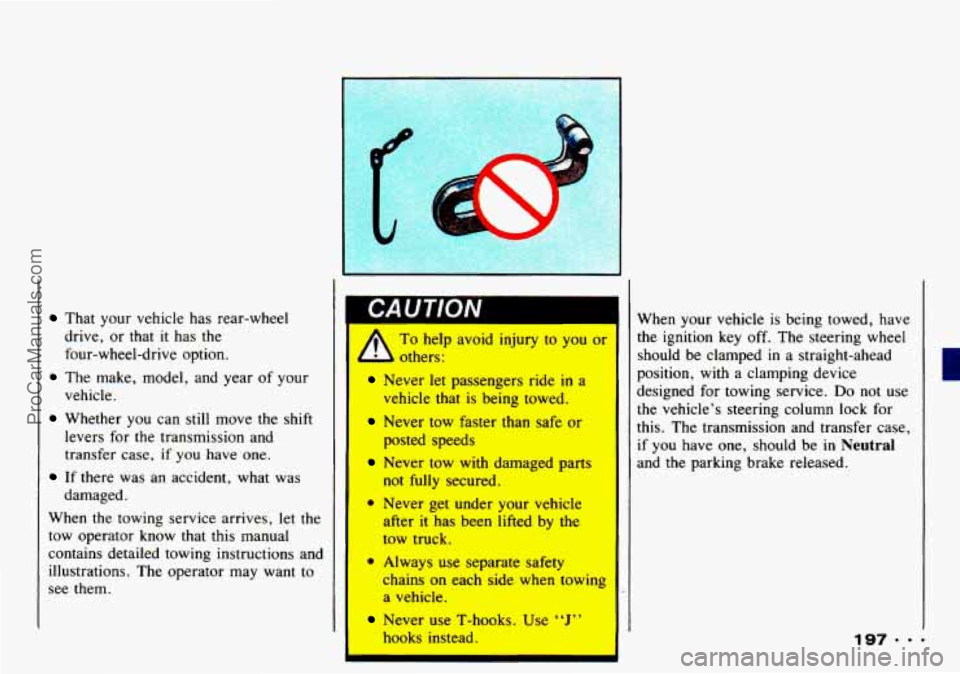
chains on each side when towing
a vehicle.
hooks instead.
* Always use separate safety
Never use T-hooks. Use “J”
When your vehicle is being towed, have
the ignition key off. The steering wheel
should be clamped
in a straight-ahead
position, with
a clamping device
designed for towing service.
Do not use
the vehicle’s steering column lock for
this. The transmission and transfer case,
if you have one, should be in Neutral
and the parking brake released.
ProCarManuals.com
Page 200 of 339
Problems on the Road
front with sling-type or wheel lift
equipment, the rear wheels must be
supported on a dolly.
If your vehicle has four-wheel drive,
don’t have it towed on the front wheels
unless you must. If a vehicle with
four-wheel drive must be towed on the
front wheels, set your manual,
free-wheeling hubs to
FREE or unlock
your automatic free-wheeling hubs, and
set your transfer case to two-wheel
drive.
If your vehicle must be towed on
the front wheels, don’t go more than
55 mph (90 km/h).
= 9.198
CAUTION Don’t have your vehicle towed with the I
rear wheels in contact with the ground.
If
a vehicle must be towed from the I A vehicle can fall from a car A
’ carrier if it isn’t properly
,,cured. This can cause a
collision, serious personal injury
and vehicle damage. The vehicle
should be tightly secured with
chains or steel cables before it is
transported.
Don’t use substitutes (ropes,
leather straps, canvas webbing,
etc.) that can be cut by sharp
edges underneath
the towed
vehicle.
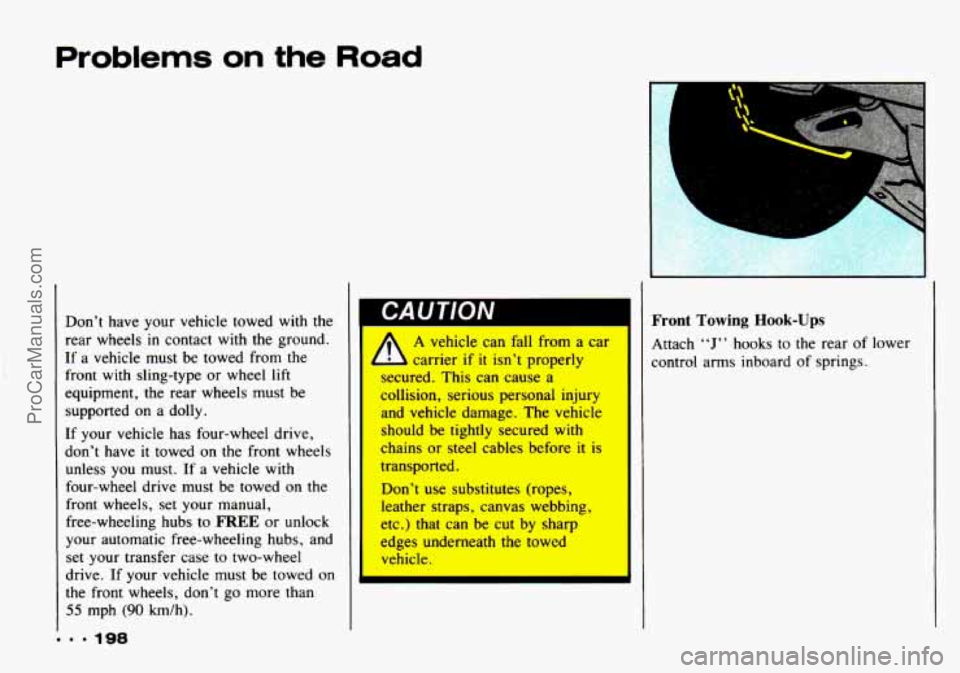
Front Towing Hook-Ups
Attach “J” hooks to the rear o
control arms inboard of springs
If lower
ProCarManuals.com
Page 255 of 339
NOTICE I
Your warranty does not cover
parts or components that fail
because of overloading.
If you put things inside your vehicle -
like suitcases, tools, packages, or
anything else - they will go as fast as
the vehicle goes. If you have to stop or
turn quickly, or if there is a crash,
they’ll keep going. Things
you put inside your
vehicle
can strike and injure
people
in a sudden stop or turn, or
in a crash.
Put things in the rear area of
your vehicle. Try to spread the
weight evenly.
* Never stack heavier things, like
suitcases, inside the vehicle so
that some of them are above the
tops
of the seats.
* When you carry something
inside the vehicle, secure it
whenever
you can.
9 Don’t have a seat folded down
unless you need to.
Tires
We don’t make tires. Your new vehicle
comes with high quality tires made by a
leading tire manufacturer. These tires
are warranted by the tire manufacturers
and their warranties are delivered with
every new
Geo. If your spare tire is a
different brand than your road tires, you
will have
a tire warranty folder from
each
of these manufacturers.
253 9 9 .
ProCarManuals.com
Page 327 of 339
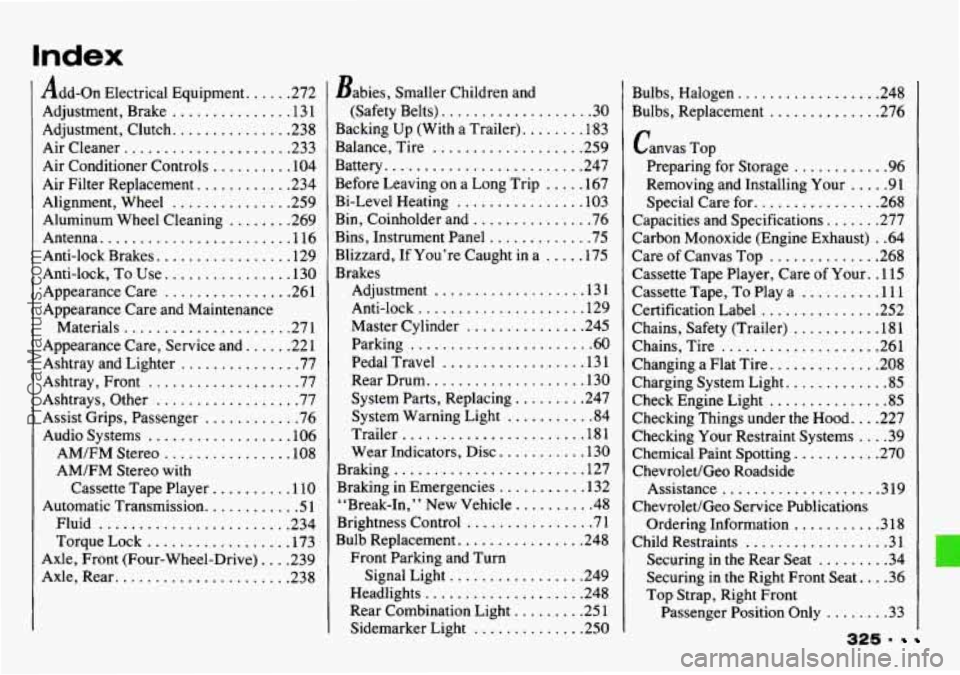
Index
Add-on Electrical Equipment ...... 272
Adjustment. Brake
............... 13 1
Adjustment. Clutch
............... 238
Air Cleaner
..................... 233
Air Conditioner Controls
.......... 104
Air Filter Replacement
............ 234
Alignment. Wheel
............... 259
Aluminum Wheel Cleaning
........ 269
Antenna
........................ 116
Anti-lock Brakes
................. 129
Anti-lock. To Use
................ 130
Appearance Care
................ 26 1
Appearance Care and Maintenance
Materials
..................... 27 1
Appearance Care. Service and
...... 22 1
Ashtray. Front ................... 77
Assist Grips. Passenger
............ 76
Audio Systems
.................. 106
AM/FM Stereo
................ 108
AM/FM Stereo with
Cassette Tape Player
.......... 110
Automatic Transmission
............ 5 1
Fluid ........................ 234
TorqueLock
.................. 173
Axle. Front (Four-Wheel-Drive)
.... 239
Axle, Rear
...................... 238
Ashtray and
Lighter
............... 77
Ashtrays, Other
.................. 77
Babies. Smaller Children and
(Safety Belts)
................... 30
Backing Up (With a Trailer)
........ 183
Balance. Tire
................... 259
Battery
......................... 247
Bi-Level Heating
................ 103
Bin. Coinholder and
............... 76
Bins. Instrument Panel
............. 75
Brakes
Before Leaving on a Long
Trip
..... 167
Blizzard. If You’re Caught
in a ..... 175
Adjustment
.................. -13 1
Anti-lock
..................... 129
Master Cylinder
............... 245
Parking
....................... 60
PedalTravel
.................. 131
Rear Drum
.................... 130
System Parts. Replacing
......... 247
System Warning Light
........... 84
Trailer
....................... 18 1
Wear Indicators. Disc
........... 130
Braking ........................ 127
Braking in Emergencies
........... 132
“Break-In.
.. New Vehicle .......... 48
Brightness Control
................ 7 1
Bulb Replacement ................ 248
Front Parking and Turn
Signal Light
................. 249
Headlights
.................... 248
Sidemarker Light
.............. 250
Rear Combination Light
......... 25
1 Bulbs. Halogen
.................. 248
Bulbs. Replacement
.............. 276
Canvas TOP
Preparing for Storage
............ 96
Removing and Installing Your
..... 91
Special Care
for ................ 268
Carbon Monoxide (Engine Exhaust)
. . 64
Care of Canvas Top
.............. 268
Cassette Tape Player. Care of Your
. . 115
Cassette Tape. To Play a
.......... 111
Certification Label
............... 252
Chains. Safety (Trailer)
........... 181
Chains. Tire
.................... 261
Changing a Flat Tire
.............. 208
Charging System Light
............. 85
Check Engine Light
............... 85
Capacities
and Specifications
....... 277
Checking Things under the Hood
.... 227
Checking Your Restraint Systems
.... 39
Chemical Paint Spotting ........... 270
Chevrolet/Geo Roadside
Assistance
.................... 319
Chevrolet/Geo Service Publications
Ordering Information
........... 318
Child Restraints
.................. 31
Securing in the Rear Seat
......... 34
Securing in the Right Front Seat .... 36
Top Strap. Right Front
Passenger Position Only
........ 33
325 .
ProCarManuals.com