steering wheel CHEVROLET TRACKER 1997 Owner's Manual
[x] Cancel search | Manufacturer: CHEVROLET, Model Year: 1997, Model line: TRACKER, Model: CHEVROLET TRACKER 1997Pages: 388, PDF Size: 20.12 MB
Page 192 of 388
If you have a four-wheel-drive vehicle with manual
freewheeling hubs, it can be towed from the front with
all four wheels on the ground. Follow these steps:
1. Set the parking brake.
2. Turn the ignition key to ACC to unlock the
steering wheel.
3. Shift your automatic transmission into PARK (P), or
your manual transmission to SECOND (2).
4. Shift the transfer case to NEUTRAL (N).
5. Set the hubs to FREE. See “Four-Wheel-Drive” in
the Index.
6. Release the parking brake.
Stop towing every
200 miles (300 km) and start
the engine. Leave the transfer case shift lever
in
NEUTRAL (N). Shift your automatic transmission
to
DRIVE (D); leave a manual transmission in
SECOND (2) with the clutch engaged. Run the engine at
medium speed for one minute to circulate oil in the
transfer case.
Turn the ignition key to ACC. Now you
can continue towing your Geo.
I NOTICE:
The front wheels transmit shocks during towing.
The steering column may not be strong enough to
withstand the shocks. Always unlock the steering
wheel before towing.
NOTICE:
Make sure that the towing speed does not
exceed
50 mph (80 kmh), or your Geo could be
badly damaged.
4-46
ProCarManuals.com
Page 200 of 388
Following Distance
Stay at least twice as far behind the vehicle ahead as you
would when driving your vehicle without a trailer. This
can help you avoid situations that require heavy braking
and sudden turns.
Passing
You’ll need more passing distance up ahead when
you’re towing
a trailer. And, because you’re a good deal
longer, you’ll need to
go much farther beyond the
passed vehicle before you can return to your lane.
Backing Up
Hold the bottom of the steering wheel with one hand.
Then, to move the trailer to the left, just move that hand
to the left. To move the trailer to the right, move your
hand to the right. Always back up slowly and,
if
possible, have someone guide you.
Making Turns
NOTICE:
Making very sharp turns while trailering could
cause the trailer
to come in contact with the
vehicle. Your vehicle could be damaged. Avoid
making very sharp turns while trailering.
When you’re turning with a trailer, make wider turns than
normal.
Do this so your trailer won’t strike soft shoulders,
curbs, road signs, trees or other objects. Avoid jerky or
sudden maneuvers. Signal well
in advance.
4-54
ProCarManuals.com
Page 211 of 388
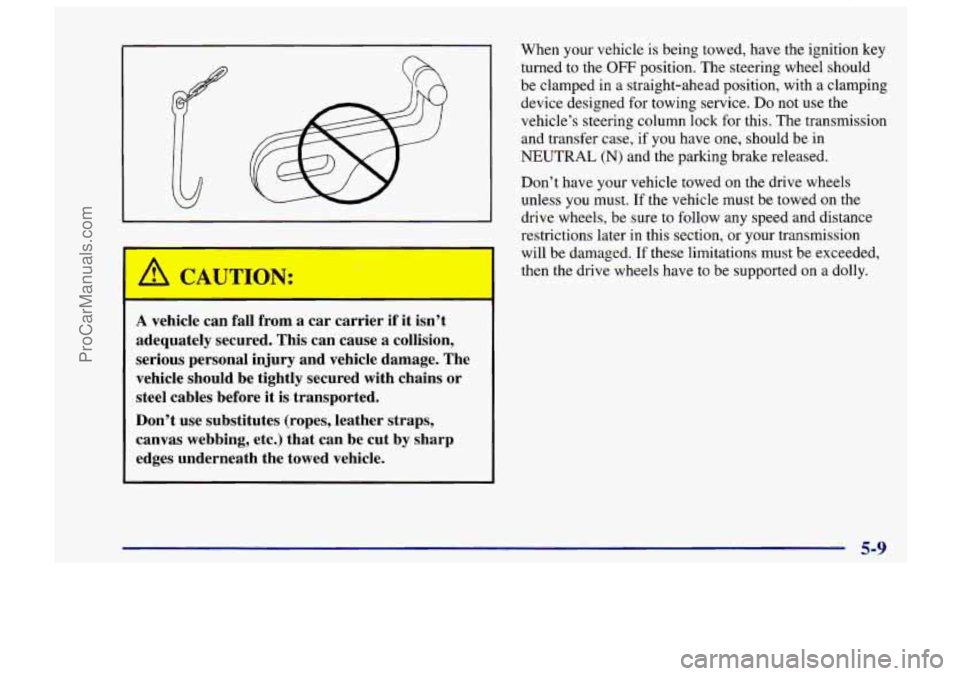
A vehicle can fall from a car carrier if it isn’t
adequately secured. This can cause
a collision,
serious personal injury and vehicle damage. The
vehicle should be tightly secured with chains or
steel cables before it
is transported.
Don’t use substitutes (ropes, leather straps,
canvas webbing, etc.) that can be cut by sharp
edges underneath the towed vehicle.
When your vehicle is being towed, have the ignition key
turned to the
OFF position. The steering wheel should
be clamped in a straight-ahead position, with a clamping device designed for towing service.
Do not use the
vehicle’s steering column lock for this. The transmission
and transfer case, if you have one, should
be in
NEUTRAL (N) and the parking brake released.
Don’t have your vehicle towed on the drive wheels
unless you must. If the vehicle must be towed on the
drive wheels, be sure to follow any speed and distance
restrictions later in this section,
or your transmission
will be damaged.
If these limitations must be exceeded,
then the drive wheels have to be supported on a dolly.
5-9
I
ProCarManuals.com
Page 225 of 388
If a Tire Goes Flat
It’s unusual for a tire to “blow out’’ while you’re driving,
especially if you maintain your tires properly. If air goes
out of a tire, it’s much more likely to leak out slowly.
But if you should ever have a “blowout,” here are a few
tips about what to expect and what to do:
If a front tire fails, the flat tire will create a drag that
pulls the vehicle toward that side. Take your foot off the
accelerator pedal and grip the steering wheel firmly.
Steer to maintain lane position, and then gently brake to
a stop well out of the traffic lane.
A rear blowout, particularly on a curve, acts much like a
skid and may require the same correction you’d
use in a
skid. In any rear blowout, remove your foot from the
accelerator pedal. Get the vehicle under control
by
steering the way you want the vehicle to go. It may be
very bumpy and noisy, but you can still steer. Gently
brake
to a stop -- well off the road if possible.
If a tire goes flat, the next part shows how to use your
jacking equipment to change a flat tire safely.
Changing a Flat Tire
If a tire goes flat, avoid further tire and wheel damage
by driving slowly
to a level place. Turn on your hazard
warning flashers.
Changing a tire can cause an injury. T vehicle
can slip off the jack and roll over you or other
people. You and they could be badly injured.
Find
a level place to change your tire. To help
prevent the vehicle from moving:
1. Set the parking brake firmly.
2. Put an automatic transmission shift
lever in
PARK (P) or shift a manual
transmission to FIRST
(1) or
REVERSE (R).
3. If you have a four-wheel-drive vehicle,
be sure the transfer case is in a drive
gear
-- not in NEUTRAL (N).
4. Turn off the engine.
To be even more certain the vehicle won’t move,
you can put blocks at the front and rear of the
tire farthest away from the one being changed.
That would be the tire on the other side of the
vehicle, at the opposite end.
ProCarManuals.com
Page 237 of 388
Rocking Your Vehicle To Get It Out
First, turn your steering wheel left and right. That will
clear the area around your front wheels. Then shift back
and forth between REVERSE
(R) and a forward gear (or
with a manual transmission, between FIRST (1) or
SECOND
(2) and REVERSE(R)), spinning the wheels
as little
as possible. Release the accelerator pedal while
you shift, and press lightly
on the accelerator pedal
when the transmission is
in gear. If that doesn’t get you
out after a few tries, you may need
to be towed out, Or,
you can use your recovery hooks if your vehicle has
them. If you do need to be towed
out, see “Towing Your
Vehicle”
in the Index.
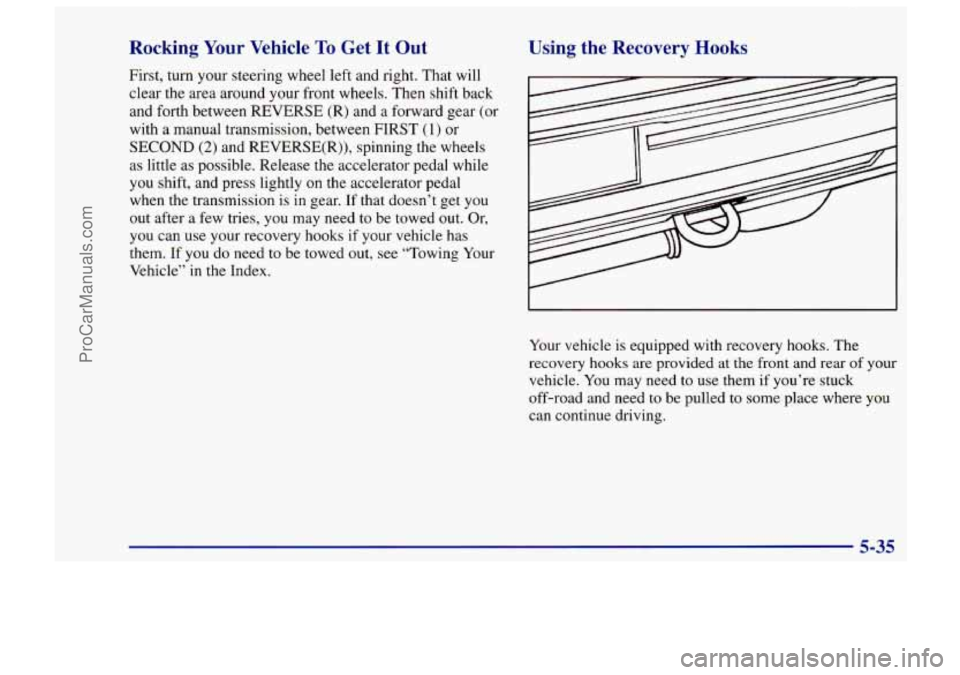
Using the Recovery Hooks
Your vehicle is equipped with recovery hooks. The
recovery hooks are provided
at the front and rear of your
vehicle. You may need to
use them if you’re stuck
off-road and need to be pulled
to some place where you
can continue driving.
5-35
I
ProCarManuals.com
Page 303 of 388
GeGS Section 7 Maintenance Schedule
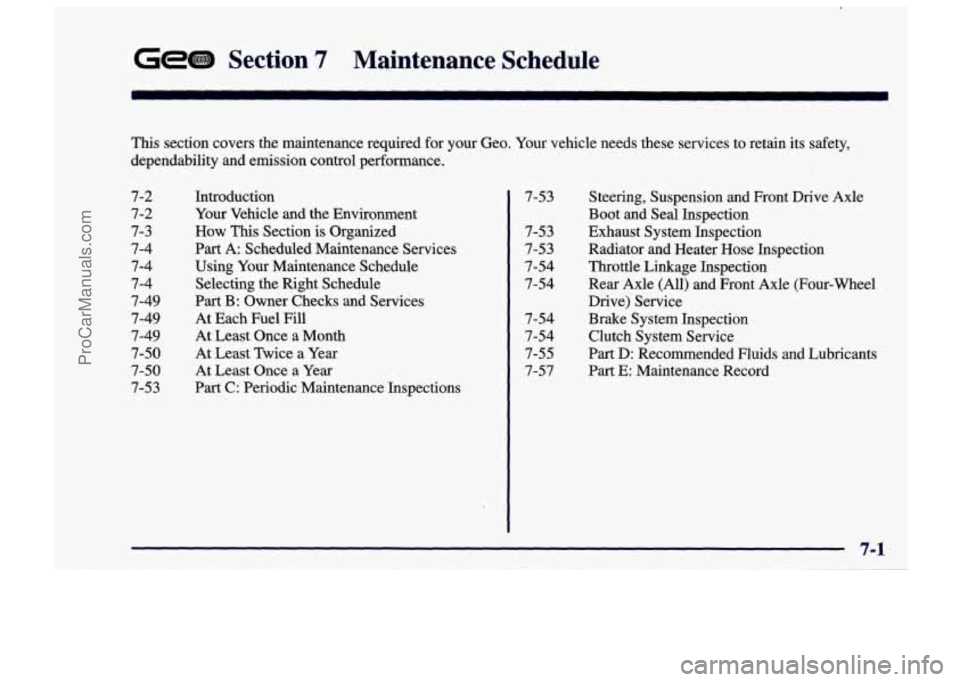
This section covers the maintenance required for your Geo. Your vehicle needs these services to retain its safety,
dependability and emission control performance.
7-2
7-2
7-3
7-4 7-4
7-4
7-49 7-49
7-49
7-50
7-50
7-53
Introduction Your Vehicle and the Environment
How This Section is Organized
Part A: Scheduled Maintenance Services
Using Your Maintenance Schedule
Selecting the Right Schedule
Part B: Owner Checks and Services
At Each Fuel Fill
At Least Once a Month
At Least Twice
a Year
At Least Once a Year
Part C: Periodic Maintenance Inspections
7-53
7-53
7-53
7-54
7-54
7-54
7-54
7-55
7-57
Steering, Suspension and Front Drive Axle
Boot and Seal Inspection
Exhaust System Inspection
Radiator and Heater Hose Inspection
Throttle Linkage Inspection Rear Axle (All) and Front Axle (Four-wheel
Drive) Service
Brake System Inspection
Clutch System Service
Part D: Recommended Fluids and Lubricants
Part E: Maintenance Record
7-1
ProCarManuals.com
Page 357 of 388
Part D: Recommended Fluids
and Lubricants
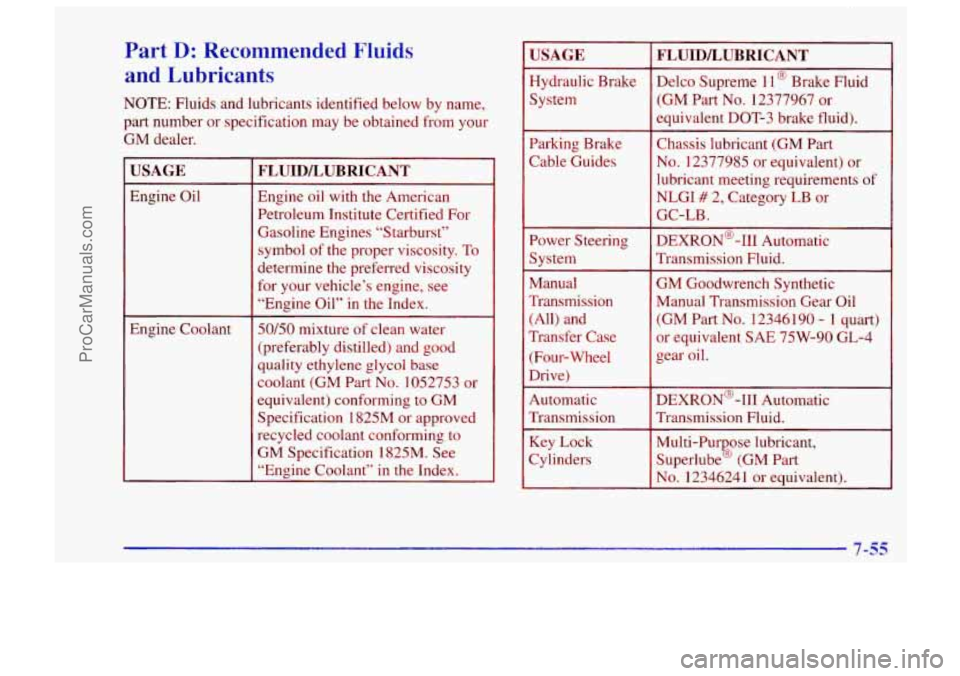
NOTE: Fluids and lubricants identified below by name,
part number or specification may be obtained from your
GM dealer.
USAGE
Engine Oil
Engine Coolant
FLUIDLUBRICANT
Engine oil with the American
Petroleum Institute Certified For
Gasoline Engines “Starburst”
symbol of the proper viscosity. To
determine the preferred viscosity for your vehicle’s engine, see
“Engine Oil” in the Index.
50150 mixture of clean water
(preferably distilled) and good
quality ethylene
glycol base
coolant (GM Part
No. 1052753 or
equivalent) conforming to GM
Specification 1825M or approved
recycled coolant conforming to
GM Specification 1825M. See
“Engine Coolant” in
the Index.
USAGE
Hydraulic Brake
System
Parking Brake Cable Guides
Power Steering System
Manual
Transmission (All) and
Transfer Case
(Four- Wheel
Drive)
Automatic
Transmission
Key Lock
Cylinders
FLUIDLUBRICANT
Delco Supreme 11 @ Brake Fluid
(GM Part No. 12377967 or
equivalent DOT-3 brake fluid).
Chassis lubricant (GM
Part
No. 12377985 or equivalent) or
lubricant meeting requirements
of
NLGI # 2, Category LB or
DEXRON@-111 Automatic.
Transmission Fluid.
GM Goodwrench Synthetic
Manual Transmission Gear Oil
(GM Part No. 12346190
- 1 quart)
or equivalent
SAE 75W-90 GL-4
gear oil.
DEXRON@-I11 Automatic
Transmission Fluid.
Multi-Pur ose lubricant, Superlube
& (GM Part
No. 12346241 or equivalent).
GC-LB.
ProCarManuals.com
Page 379 of 388
Gear Positions. Manual Transmission ............... 2- 14
Glove Box
.................................... 2-41
Gross Axle Weight Rating ........................ 4-47
Gross Vehicle Weight Rating
...................... 4-47
Guide en FranGais
11
GV WR. ....................................... 4-47
.. .................................
Halogen Bulbs .. ............................. 6-33
Hazard Warning Flashers
.......................... 5-2
Head Restraints
................................. 1-4
Headlamps
.................................... 2-3 1
Bulb Replacement ............................ 6-34
HighLow Beam Changer
...................... 2-3 1
Hearing Impaired. Customer Assistance .............. 8-4
Heating
........................................ 3-4
Highway Hypnosis
.............................. 4-38
Hill and Mountain Roads
......................... 4-38
Hitches. Trailer
................................. 4-52
Checking Things Under
......................... 6-7
Hood Latch Operation Check
..................... 7-49
Hubs, Freewheeling ............................. 2- 17
Hydroplaning
.................................. 4-34
Hood
Prop
........................................ 6-8
Release
...................................... 6-7
Horn ......................................... 2-29
Ignition Positions
............................... 2-7
Ignition Transaxle
Lock Check .................... 7-52
Inflation. Tire .................................. 6-41
Inside Daymight Rearview
Mirror ................. 2-39 Inspections
Brakesystem
................................ 7-54
FrontAxle
.................................. 7-54
Exhaust
Systems
............................. 7-53
Front Drive Axle Boot
......................... 7-53
Front Drive Axle Seal
......................... 7-53
Radiator and Heater Hose
...................... 7-53
RearAxle
................................... 7-54
Steering
.................................... 7-53
Suspension
.................................. 7-53
Throttle Linkage
.............................. 7-54
Instrument Panel
............................... 2-58
Brightness Control
............................ 2-38
Cleaning
.................................... 6-51
Cluster ..................................... 2-60
FuseBlock .................................. 6-59
Interior Lamps
................................. 2-38
Jack. Tire
.................................... 5-25
Jump Starting ................................... 5-3
Key Lock Cylinders Service ..................... 7-50
Keys
.......................................... 2-2
Labels Certification
................................. 4-47
Service Parts Identification
..................... 6-58
Tire-Loading Information ...................... 4-47
Vehicle Identification Number
................... 6-58
9-5
ProCarManuals.com