lock CHEVROLET TRACKER 1997 Repair Manual
[x] Cancel search | Manufacturer: CHEVROLET, Model Year: 1997, Model line: TRACKER, Model: CHEVROLET TRACKER 1997Pages: 388, PDF Size: 20.12 MB
Page 163 of 388
Environmental Concerns
Off-road driving can provide wholesome and satisfying
recreation. However, it also raises environmental
concerns. Geo recognizes these concerns and urges
every off-roader
to follow these basic rules for
protecting the environment:
0
0
0
0
Always use established trails, roads and areas that
have been specially set aside for public off-road
recreational driving; obey all posted regulations.
Avoid any driving practice that could damage the
environment
-- shrubs, flowers, trees, grasses -- or
disturb wildlife (this includes wheel-spinning,
breaking down trees or unnecessary driving through
streams or over soft ground).
Always carry a litter bag
. . . make sure all refuse is
removed from any campsite before leaving.
Take extreme care with open fires (where permitted),
camp stoves and lanterns.
Never park your vehicle over dry grass
or other
combustible materials that could catch fire from the
heat of the vehicle’s exhaust system.
Traveling to Remote Areas
It makes sense to plan your trip, especially when going
to a remote area. Know the terrain and plan your route.
You are much less likely to get bad surprises. Get
accurate maps
of trails and terrain. Try to learn of any
blocked or closed roads.
It’s also a good idea
to travel with at least one other
vehicle. If something happens to one of them, the other
can help quickly.
Does your vehicle have a winch? If
so, be sure to read
the winch instructions. In a remote area, a winch can be
handy
if you get stuck. But you’ll want to know how to
use it properly.
4-17
ProCarManuals.com
Page 166 of 388
Driving on Off-Road Hills
Off-road driving often takes you up, down or across a
hill. Driving safely on hills requires good judgment and
an understanding
of what your vehicle can and can’t do.
There are some hills that simply can’t be driven, no
matter how well built the vehicle. incline
with only
a small change in elevation where you
can easily see all the way to the top.
On a large hill, the
incline may get steeper as you near the top, but you may
not see this because
the crest of the hill is hidden by
bushes, grass or shrubs.
Here are some other things to consider as you approach
a hill.
0 Is there a constant incline, or does the hill get sharply ’
steeper in places?
0 Is there good traction on the hillside, or will the
Many hills are simply too steep for any vehicle. If surface cause tire slipping?
you drive up them, you will stall. If you drive
down them, you can’t control your speed. If
you
drive across them, you will roll over. You could be
seriously injured or killed. If
you have any doubt Are there obstructions on the hill that can block your
about the steepness, don’t drive the hill. path (boulders, trees, logs or ruts)?
0 Is there a straight path up or down the hill so you
won’t have
to make turning maneuvers?
Approaching a Hill
When you approach a hill, you need to decide if it’s one
of those hills that’s just too steep
to climb, descend or
cross. Steepness can be hard
to judge. On a very small
hill, for example, there may be a smooth, constant
What’s beyond the hill? Is there a cliff, an
embankment, a drop-off, a fence? Get out and walk the
hill if you don’t know. It’s the smart way to find out.
0 Is the hill simply too rough? Steep hills often have
ruts, gullies, troughs and exposed rocks because they
are more susceptible to the effects of erosion.
4-20
ProCarManuals.com
Page 168 of 388
&.’ What should I do if my vehicle stalls, or is about
A: If this happens, there are some things you should
to stall, and I can’t make it up the hill?
do, and there are some things you must not do.
First, here’s what you
should do:
Push the brake pedal to stop the vehicle and keep it
from rolling backwards. Also, apply the parking brake.
If your engine is still running, shift the transmission
to REVERSE (R), release the parking brake, and
slowly back down the hill in REVERSE
(R).
If your engine has stopped running, you’ll need to
restart
it. With the brake pedal depressed and the
parking brake still applied, shift the transmission to
PARK
(P) (or, shift to NEUTRAL (N) if your
vehicle has a manual transmission) and restart the
engine. Then, shift to REVERSE (R), release the
parking brake, and slowly back down the hill as
straight as possible in REVERSE (R).
0 As you are backing down the hill, put your left hand
on the steering wheel at the 12 o’clock position. This
way, you’ll be able to tell
if your wheels are straight and maneuver
as you back down. It’s best that you
back down the hill with your wheels straight rather
than in the left or right direction. Turning the wheel
too far to the left or right will increase the possibility
of a rollover.
Here are some things you
must not do if you stall, or
are about to stall, when going up a hill.
Never attempt to prevent a stall by shifting into
NEUTRAL
(N) (or depressing the clutch, if you
have a manual transmission) to “rev-up” the engine
and regain forward momentum. This won’t work.
Your vehicle will roll backwards very quickly and
you could go out of control.
Instead, apply the regular brake to stop the vehicle. Then
apply the parking brake. Shift to REVERSE (R), release
the parking brake, and slowly back straight down.
Never attempt to turn around if you are about to stall
when going up a hill. If the hill is steep enough to
stall your vehicle, it’s steep enough to cause you to
roll over if you turn around.
If you can’t make it up
the hill,
you must back straight down the hill.
4-22
I
ProCarManuals.com
Page 171 of 388
0 Unless you have anti-lock: Avoid braking so hard that
you lock the wheels when going downhill. If your
wheels are locked, you can't steer your vehicle.
If your
wheels lock up during downhill braking,
you may feel
the vehicle starting to slide sideways. To regain your
direction, just ease
off the brakes and steer to keep the
front
of the vehicle pointing straight downhill.
e." Am I likely to stall when going downhill?
A: It's much more likely to happen going uphill. But if
0
0
0
0
it happens going downhill, here's what to do.
Stop your vehicle by applying the regular brakes.
Apply the parking brake.
Shift
to PARK (P) (or to NEUTRAL (N) with the
manual transmission) and, while still braking, restart
the engine.
Shift back to a low gear, release the parking brake,
and drive straight down.
If the engine won't start, get
out and get help.
Driving Across an Incline
Sooner or later, an off-road trail will probably go across
the incline of a hill. If this happens, you have
to decide
whether
to try to drive across the incline. Here are some
things to consider:
0
0
A hill that can be driven straight up or down may be
too steep to drive across. When you go straight up
or down a hill, the length of the wheel base (the
distance from the front wheels to the rear wheels)
reduces the likelihood the vehicle will tumble end
over end. But when you drive across an incline, the
much more narrow track width (the distance between
the left and right wheels) may not prevent the vehicle
from tilting and rolling over. Also, driving across an
incline puts more weight on the downhill wheels.
This could cause a downhill slide
or a rollover.
Surface conditions can be a problem when you drive
across a hill. Loose gravel, muddy spots, or even wet
grass can cause your tires to slip sideways, downhill.
If the vehicle slips sideways,
it can hit something
that will trip
it (a rock, a rut, etc.) and roll over.
4-25
ProCarManuals.com
Page 187 of 388
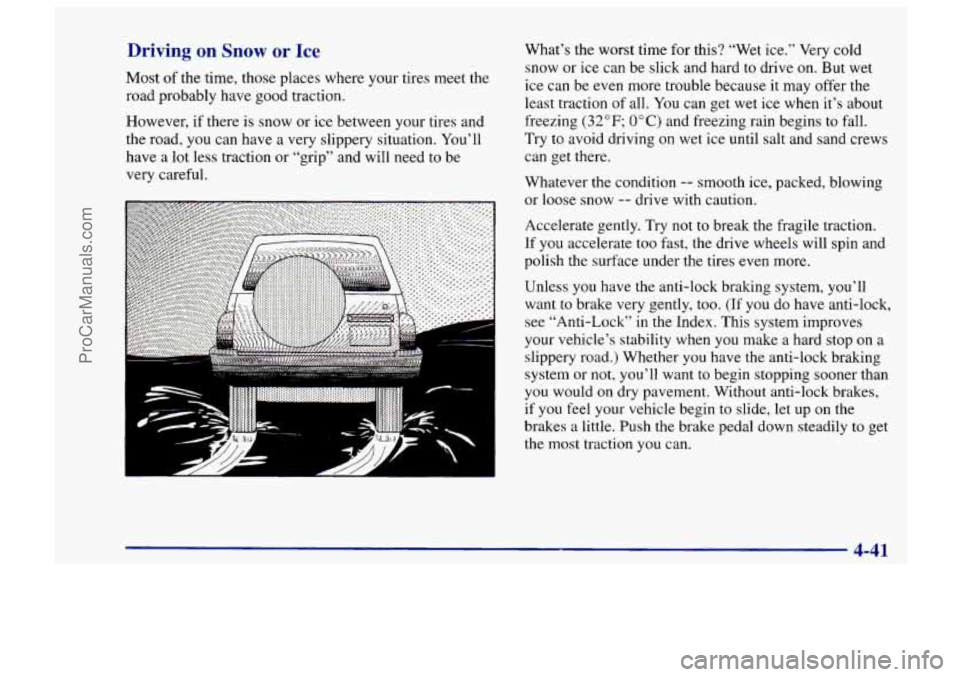
Driving on Snow or Ice
Most of the time, those places where your tires meet the
road probably have good traction.
However, if there is snow or ice between your tires and
the road, you can have a very slippery situation. You’ll
have a lot less traction or “grip” and will need to be
very careful. What’s
the worst time for this? “Wet ice.” Very cold
snow or ice can be slick and hard to drive on. But wet
ice can be even more trouble because it may offer the
least traction of all.
You can get wet ice when it’s about
freezing
(32 OF; 0 O C) and freezing rain begins to fall.
Try to avoid driving
on wet ice until salt and sand crews
can get there.
Whatever the condition
-- smooth ice, packed, blowing
or loose snow
-- drive with caution.
Accelerate gently. Try
not to break the fragile traction.
If you accelerate too fast, the drive wheels will spin and
polish the surface under the tires even more.
Unless you have the anti-lock braking system, you’ll
want to brake very gently, too.
(If you do have anti-lock,
see “Anti-Lock” in the Index. This system improves
your vehicle’s stability when you make a hard stop on a
slippery road.) Whether
you have the anti-lock braking
system or not, you’ll want to begin stopping sooner than
you would on dry pavement. Without anti-lock brakes,
if you feel your vehicle begin
to slide, let up on the
brakes a little. Push the brake pedal down steadily to get
the most traction you can.
4-41
I
ProCarManuals.com
Page 188 of 388
Remember, unless you have anti-lock, if you brake so
hard that your wheels stop rolling, you’ll just slide.
Brake
so your wheels always keep rolling and you can
still steer.
Whatever your braking system, allow greater
following distance on any slippery road.
Watch for slippery spots. The road might be fine
until you hit
a spot that’s covered with ice. On an
otherwise clear road, ice patches may appear
in
shaded areas where the sun can’t reach: around
clumps
of trees, behind buildings or under bridges.
Sometimes the surface
of a curve or an overpass may
remain icy when the surrounding roads are clear. If
you see a patch of ice ahead of you, brake before you
are on
it. Try not to brake while you’re actually on
the ice, and avoid sudden steering maneuvers.
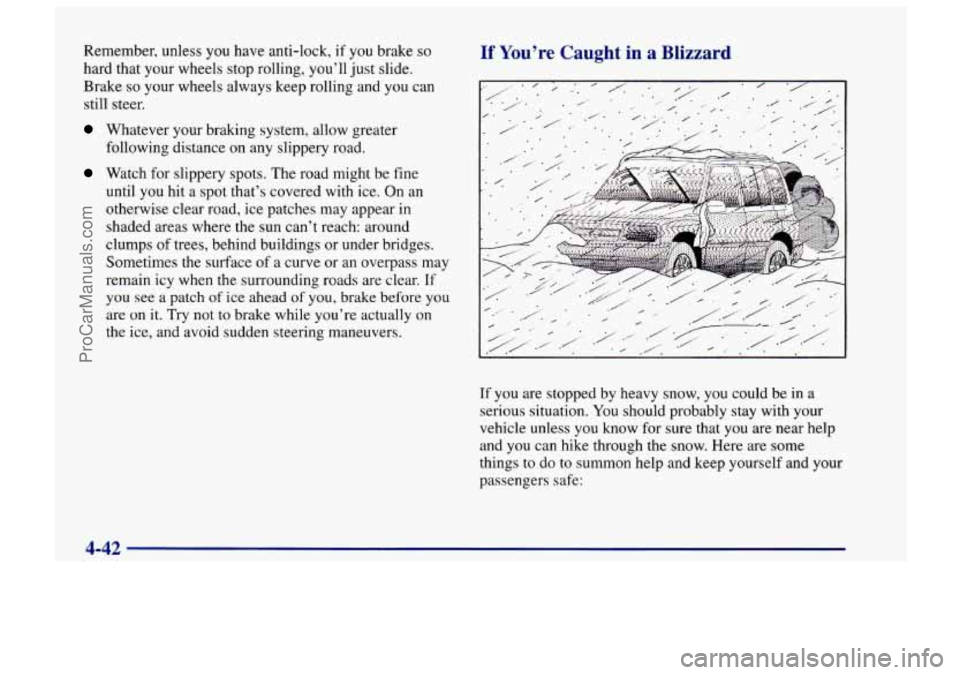
If You’re Caught in a Blizzard
If you are stopped by heavy snow, you could be in a
serious situation.
You should probably stay with your
vehicle unless you know for sure that you are near help
and you can hike through the snow. Here are some
things to do to summon help and keep yourself and your
passengers safe:
4-42
ProCarManuals.com
Page 189 of 388
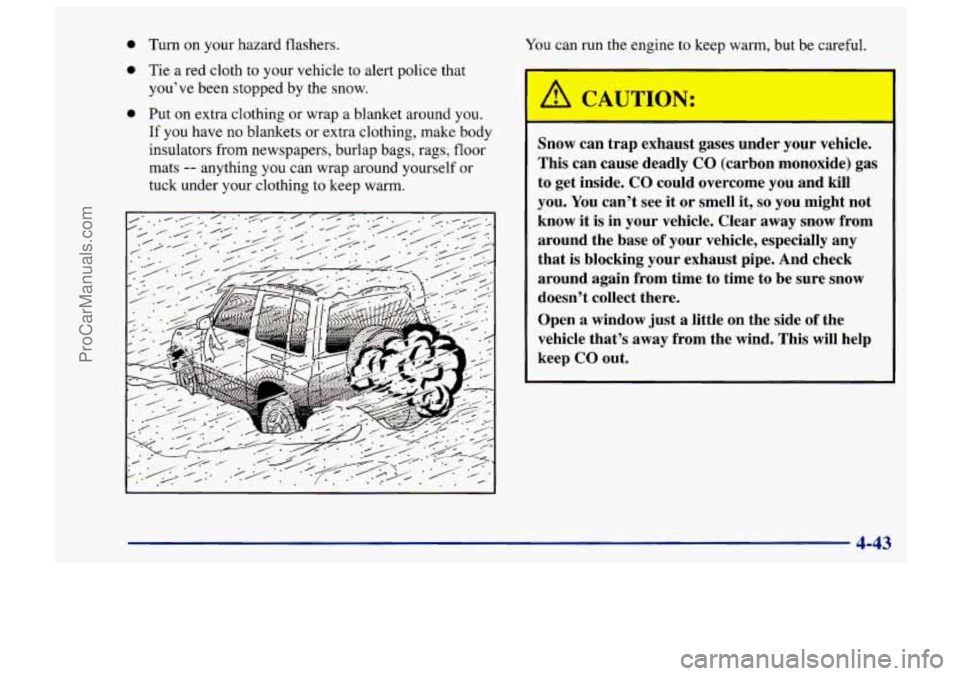
0 Turn on your hazard flashers.
0 Tie a red cloth to your vehicle to alert police that
you’ve been stopped by the snow.
0 Put on extra clothing or wrap a blanket around you.
If you have no blankets or extra clothing, make body
insulators from newspapers, burlap bags, rags, floor
mats
-- anything you can wrap around yourself or
tuck under your clothing to keep warm. You
can run the engine to keep warm, but
be careful.
Snow can trap exhaust gases under your vehicle.
This can cause deadly
CO (carbon monoxide) gas
to get inside.
CO could overcome you and kill
you.
You can’t see it or smell it, so you might not
know
it is in your vehicle. Clear away snow from
around the base of your vehicle, especially any
that is blocking your exhaust pipe. And check
around again from time to time to be sure snow
doesn’t collect there.
Open a window just a little on the side of the
vehicle that’s away from the wind. This will help
keep
CO out.
4-43
ProCarManuals.com
Page 191 of 388
I NOTICE:
Do not tow your Geo with the rear wheels in
contact with the ground, or the transmission
could be damaged.
2.
3.
4.
Set the parking brake.
If your Geo is a four-wheel-drive vehicle, set your
manual free-wheeling hubs to
FREE or unlock your
automatic freewheeling hubs. See “Four-wheel
Drive” in the Index.
Turn the ignition key to ACC to unlock the
steering wheel.
I NOTICE:
Make sure that the towing speed does not
exceed
55 mph (90 km/h), or your Geo could be
badly damaged.
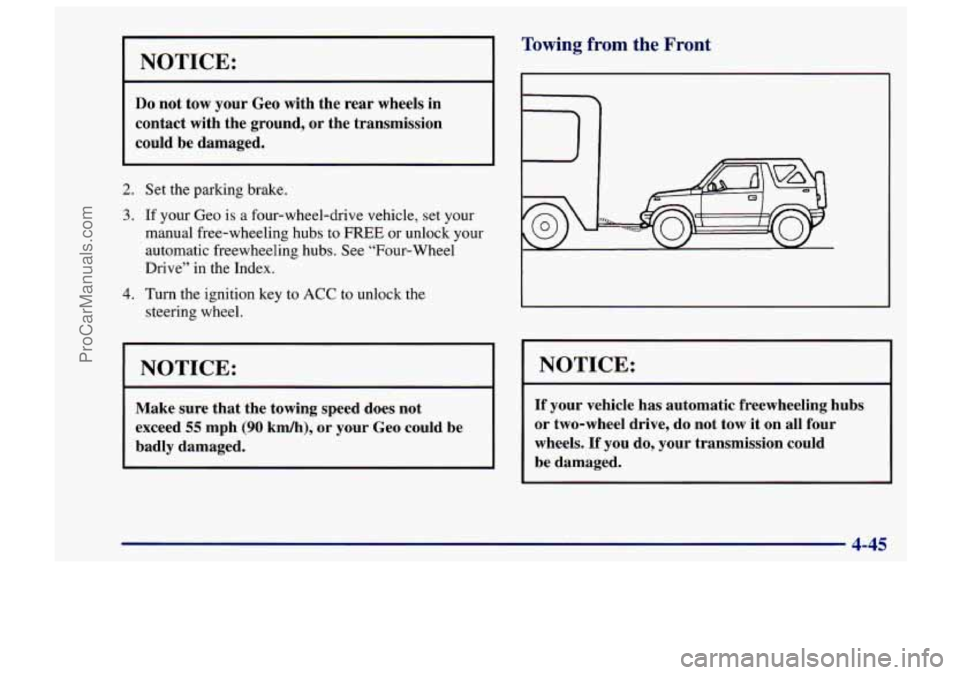
Towing from the Front
h
I1 I
I NOTICE: I
If your vehicle has automatic freewheeling hubs
or two-wheel drive,
do not tow it on all four
wheels.
If you do, your transmission could
be damaged.
4-45
I
ProCarManuals.com
Page 192 of 388
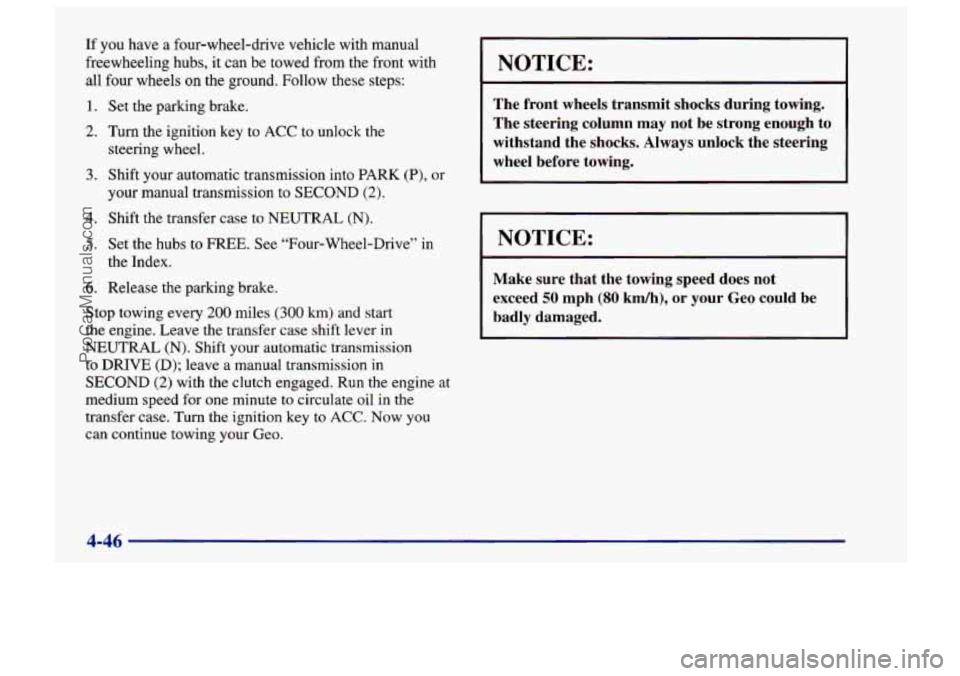
If you have a four-wheel-drive vehicle with manual
freewheeling hubs, it can be towed from the front with
all four wheels on the ground. Follow these steps:
1. Set the parking brake.
2. Turn the ignition key to ACC to unlock the
steering wheel.
3. Shift your automatic transmission into PARK (P), or
your manual transmission to SECOND (2).
4. Shift the transfer case to NEUTRAL (N).
5. Set the hubs to FREE. See “Four-Wheel-Drive” in
the Index.
6. Release the parking brake.
Stop towing every
200 miles (300 km) and start
the engine. Leave the transfer case shift lever
in
NEUTRAL (N). Shift your automatic transmission
to
DRIVE (D); leave a manual transmission in
SECOND (2) with the clutch engaged. Run the engine at
medium speed for one minute to circulate oil in the
transfer case.
Turn the ignition key to ACC. Now you
can continue towing your Geo.
I NOTICE:
The front wheels transmit shocks during towing.
The steering column may not be strong enough to
withstand the shocks. Always unlock the steering
wheel before towing.
NOTICE:
Make sure that the towing speed does not
exceed
50 mph (80 kmh), or your Geo could be
badly damaged.
4-46
ProCarManuals.com
Page 193 of 388
Loading Your Vehicle
TIRE PLACARD
I GWVR IGWR FRT~ GAWR RR 1
LB/Kg
TI RES
I RIMS
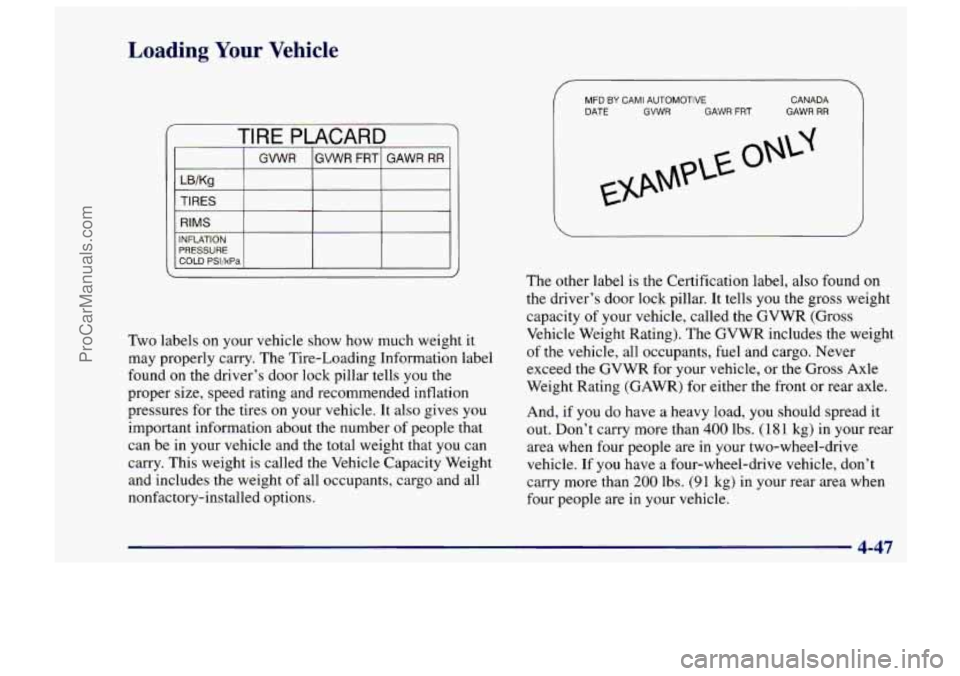
Two labels on your vehicle show how much weight it
may properly carry. The Tire-Loading Information label
found
on the driver’s door lock pillar tells you the
proper size, speed rating and recommended inflation
pressures for the tires on your vehicle. It also gives
you
important information about the number of people that
can be in your vehicle and the total weight that you can
carry. This weight is called the Vehicle Capacity Weight
and includes the weight of all occupants, cargo and all
nonfactory-installed options.
MFD BY CAM1 AUTOMOTIVE
DATE
GVWR GAWR FRT
CANADA
GAWR RR
The other label is the Certification label, also found on
the driver’s door lock pillar. It tells
you the gross weight
capacity
of your vehicle, called the GVWR (Gross
Vehicle Weight Rating). The GVWR includes the weight
of the vehicle, all occupants, fuel and cargo. Never
exceed the GVWR for your vehicle, or the
Gross Axle
Weight Rating (GAWR) for either the front or rear axle.
And,
if you do have a heavy load, you should spread it
out. Don’t carry more than
400 lbs. (181 kg) in your rear
area when four people are in your two-wheel-drive
vehicle. If you have a four-wheel-drive vehicle, don’t
carry more than
200 Ibs. (91 kg) in your rear area when
four people are in your vehicle.
4-47
I
ProCarManuals.com