transmission oil CHEVROLET TRACKER 2003 2.G Owners Manual
[x] Cancel search | Manufacturer: CHEVROLET, Model Year: 2003, Model line: TRACKER, Model: CHEVROLET TRACKER 2003 2.GPages: 372, PDF Size: 2.65 MB
Page 147 of 372
·Sometimes when the engine is idling at a stop, the
light may blink on and off. This is normal.
·If you make a hard stop, the light may come on for
a moment. This is normal.
{CAUTION:
Do not keep driving if the oil pressure is low.
If you do, your engine can become so hot that
it catches ®re. You or others could be burned.
Check your oil as soon as possible and have
your vehicle serviced.
Notice:Damage to your engine from neglected oil
problems can be costly and is not covered by
your warranty.
Overdrive Off Light
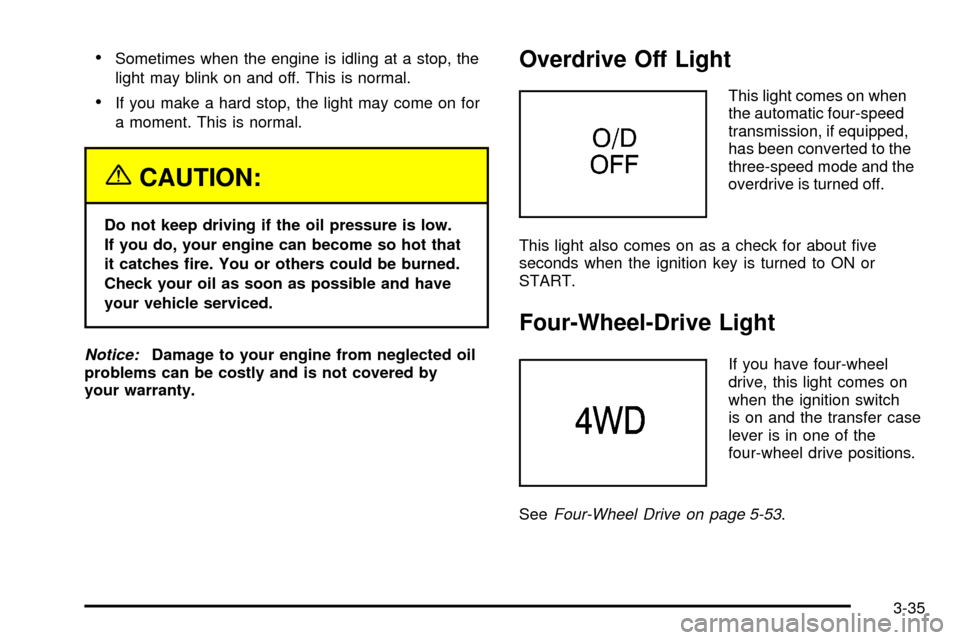
This light comes on when
the automatic four-speed
transmission, if equipped,
has been converted to the
three-speed mode and the
overdrive is turned off.
This light also comes on as a check for about ®ve
seconds when the ignition key is turned to ON or
START.
Four-Wheel-Drive Light
If you have four-wheel
drive, this light comes on
when the ignition switch
is on and the transfer case
lever is in one of the
four-wheel drive positions.
See
Four-Wheel Drive on page 5-53.
3-35
Page 205 of 372
Stop towing every 200 miles (300 km) and start the
engine. Leave the transfer case shift lever in NEUTRAL.
Shift your automatic transmission to DRIVE (D);
leave a manual transmission in SECOND (2) with the
clutch engaged. Run the engine at 2,000 rpm for
one minute to circulate oil in the transfer case. Turn the
ignition key to ACC. Now, you can continue towing
your vehicle.
Notice:Locking the steering column when towing
your vehicle may damage the steering column.
Always unlock the steering column before towing.
Notice:If you exceed 55 mph (90 km/h) while
towing your vehicle, it could be damaged. Never
exceed 55 mph (90 km/h) while towing your vehicle.
{CAUTION:
Shifting a four-wheel-drive vehicle's transfer
case into NEUTRAL can cause your vehicle to
roll even if the transmission is in Park (P) for
an automatic transmission, or if your vehicle is
in gear, for a manual transmission. You or
others could be injured. Make sure the parking
brake is ®rmly set before you shift the transfer
case to NEUTRAL.
4-49
Page 215 of 372
5. If you have a four-wheel-drive vehicle, be sure the
transfer case is in a drive gear ± not in NEUTRAL.
6. Release the regular brakes.
{CAUTION:
It can be dangerous to get out of your vehicle if
the shift lever is not fully in PARK (P) with the
parking brake ®rmly set. Your vehicle can roll.
If you have left the engine running, the vehicle
can move suddenly. You or others could be
injured. To be sure your vehicle won't move,
even when you're on fairly level ground, use the
steps that follow.
Always put the shift lever fully in PARK (P) with
the parking brake ®rmly set.
If the transfer case on four-wheel-drive vehicles
is in NEUTRAL, your vehicle will be free to roll,
even if your shift lever is in PARK (P). So, be
sure the transfer case is in a drive gear Ð not in
NEUTRAL.
When You Are Ready to Leave After
Parking on a Hill
1. Apply your regular brakes and hold the pedal down
while you:
·start your engine,
·shift into a gear, and
·release the parking brake.
2. Let up on the brake pedal.
3. Drive slowly until the trailer is clear of the chocks.
4. Stop and have someone pick up and store the
chocks.
Maintenance When Trailer Towing
Your vehicle will need service more often when you're
pulling a trailer. See the Maintenance Schedule for more
on this. Things that are especially important in trailer
operation are automatic transmission ¯uid (don't over®ll),
engine oil, axle lubricant, belts, cooling system and
brake system. Each of these is covered in this manual,
and the Index will help you ®nd them quickly. If you're
trailering, it's a good idea to review these sections
before you start your trip.
Check periodically to see that all hitch nuts and bolts
are tight.
4-59
Page 217 of 372

Service............................................................5-3
Doing Your Own Service Work.........................5-3
Adding Equipment to the Outside
of Your Vehicle...........................................5-4
Fuel................................................................5-4
Gasoline Octane............................................5-4
Gasoline Speci®cations....................................5-5
California Fuel...............................................5-5
Additives.......................................................5-5
Fuels in Foreign Countries...............................5-6
Filling Your Tank............................................5-6
Filling a Portable Fuel Container.......................5-9
Checking Things Under the Hood.....................5-9
Hood Release..............................................5-10
Engine Compartment Overview.......................5-12
Engine Oil...................................................5-16
Engine Air Cleaner/Filter................................5-20
Automatic Transmission Fluid.........................5-23
Manual Transmission Fluid.............................5-26
Hydraulic Clutch...........................................5-27
Engine Coolant.............................................5-28
Radiator Pressure Cap..................................5-30
Engine Overheating.......................................5-31
Cooling System............................................5-33
Power Steering Fluid.....................................5-40Windshield Washer Fluid................................5-41
Brakes........................................................5-42
Battery........................................................5-45
Jump Starting...............................................5-46
Rear Axle.......................................................5-52
Four-Wheel Drive............................................5-53
Bulb Replacement..........................................5-55
Halogen Bulbs..............................................5-55
Headlamps..................................................5-55
Front Turn Signal and Parking Lamps..............5-57
Sidemarker Lamps........................................5-57
Rear Combination Lamps...............................5-58
Replacement Bulbs.......................................5-59
Tires..............................................................5-59
In¯ation - Tire Pressure.................................5-60
Tire Inspection and Rotation...........................5-60
When It Is Time for New Tires.......................5-62
Buying New Tires.........................................5-62
Uniform Tire Quality Grading..........................5-63
Wheel Alignment and Tire Balance..................5-64
Wheel Replacement......................................5-64
Tire Chains..................................................5-66
If a Tire Goes Flat........................................5-66
Changing a Flat Tire.....................................5-67
Section 5 Service and Appearance Care
5-1
Page 229 of 372

A. Engine Compartment Fuse Block. See ªEngine
Compartment Fuse Blockº underFuses and Circuit
Breakers on page 5-89.
B. Engine Air Cleaner/Filter. See
Engine Air
Cleaner/Filter on page 5-20.
C. Battery. See
Battery on page 5-45.
D. Power Steering Fluid Reservoir. See
Power Steering
Fluid on page 5-40.
E. Automatic Transmission Dipstick (If Equipped).
See
Automatic Transmission Fluid on page 5-23.F. Radiator Pressure Cap. See
Radiator Pressure Cap
on page 5-30.
G. Engine Oil Dipstick. See
Engine Oil on page 5-16.
H. Engine Oil Fill Cap. See
Engine Oil on page 5-16.
I. Brake Fluid Reservoir. See
Brakes on page 5-42.
J. Engine Coolant Recovery Tank. See
Engine Coolant
on page 5-28.
K. Windshield Washer Reservoir. See
Windshield
Washer Fluid on page 5-41.
5-13
Page 231 of 372

A. Engine Compartment Fuse Block. See ªEngine
Compartment Fuse Blockº underFuses and Circuit
Breakers on page 5-89.
B. Engine Air Cleaner/Filter. See
Engine Air
Cleaner/Filter on page 5-20.
C. Battery. See
Battery on page 5-45.
D. Radiator Pressure Cap. See
Radiator Pressure Cap
on page 5-30.
E. Engine Oil Fill Cap. See
Engine Oil on page 5-16.
F. Automatic Transmission Dipstick. See
Automatic
Transmission Fluid on page 5-23.G. Engine Oil Dipstick. See
Engine Oil on page 5-16.
H. Power Steering Fluid Reservoir. See
Power Steering
Fluid on page 5-40.
I. Brake Fluid Reservoir. See
Brakes on page 5-42.
J. Engine Coolant Recovery Tank. See
Engine Coolant
on page 5-28.
K. Windshield Washer Reservoir. See
Windshield
Washer Fluid on page 5-41.
5-15
Page 239 of 372

Automatic Transmission Fluid
When to Check and Change
A good time to check your automatic transmission ¯uid
level is when the engine oil is changed.
Change both the ¯uid and ®lter every 15,000 miles
(25 000 km) if the vehicle is mainly driven under one or
more of these conditions:
·In heavy city traffic where the outside temperature
regularly reaches 90ÉF (32ÉC) or higher.
·In hilly or mountainous terrain.
·When doing frequent trailer towing.
·Uses such as found in taxi, police or delivery
service.
If you do not use your vehicle under any of these
conditions, change the ¯uid and ®lter every
100,000 miles (166 000 km).
See
Maintenance Requirements on page 6-2.
How to Check
Because this operation can be a little difficult, you may
choose to have this done at the dealership service
department.
If you do it yourself, be sure to follow all the instructions
here, or you could get a false reading on the dipstick.
Notice:Too much or too little ¯uid can damage
your transmission. Too much can mean that some
of the ¯uid could come out and fall on hot engine
part or exhaust system parts, starting a ®re.
Too little ¯uid could cause the transmission to
overheat. Be sure to get an accurate reading if you
check your transmission ¯uid.
Wait at least 30 minutes before checking the
transmission ¯uid level if you have been driving:
·When outside temperatures are above 90ÉF (32ÉC).
·At high speed for quite a while.
·In heavy traffic ± especially in hot weather.
·While pulling a trailer.
To get the right reading, the ¯uid should be at normal
operating temperature, which is 180ÉF to 200ÉF
(82ÉC to 93ÉC).
5-23
Page 242 of 372
Manual Transmission Fluid
When to Check and Change
A good time to have it checked is when the engine oil
is changed. Refer to the Maintenance Schedule to
determine when to change your transmission ¯uid.
See
Part A: Scheduled Maintenance Services on
page 6-4.
How to Check
Because this operation can be a little difficult, you may
choose to have this done at your Chevrolet dealership
service department.
If you do it yourself, be sure to follow all the instructions
here, or you could get a false reading.
Notice:Too much or too little ¯uid can damage
your transmission. Too much can mean that some
of the ¯uid could come out and fall on hot engine
part or exhaust system parts, starting a ®re.
Too little ¯uid could cause the transmission to
overheat. Be sure to get an accurate reading if you
check your transmission ¯uid.Check the ¯uid level only when your engine is off, the
vehicle is parked on a level place and the transmission
is cool enough for you to rest your ®ngers on the
transmission case.
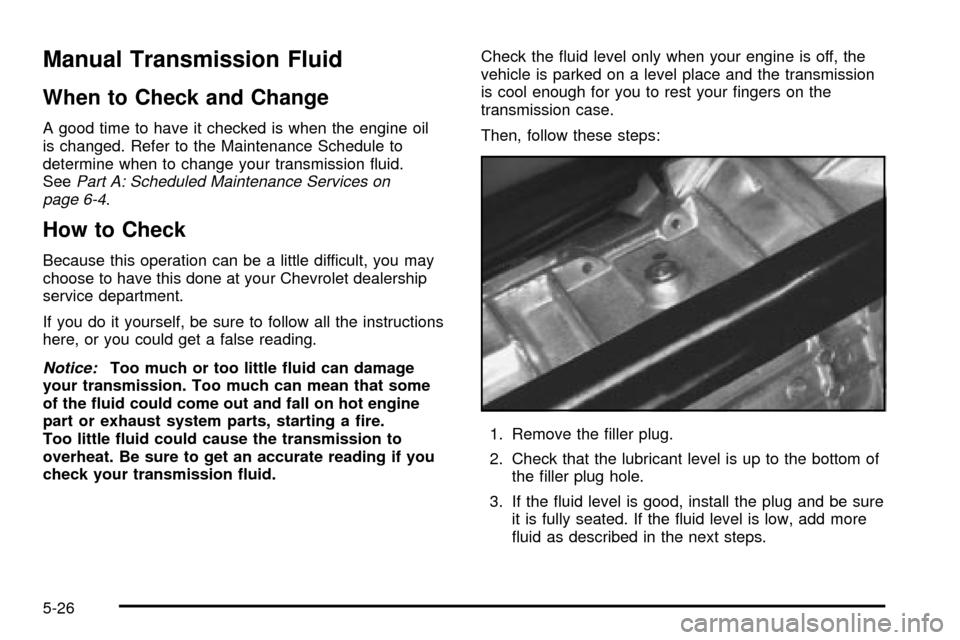
Then, follow these steps:
1. Remove the ®ller plug.
2. Check that the lubricant level is up to the bottom of
the ®ller plug hole.
3. If the ¯uid level is good, install the plug and be sure
it is fully seated. If the ¯uid level is low, add more
¯uid as described in the next steps.
5-26
Page 309 of 372
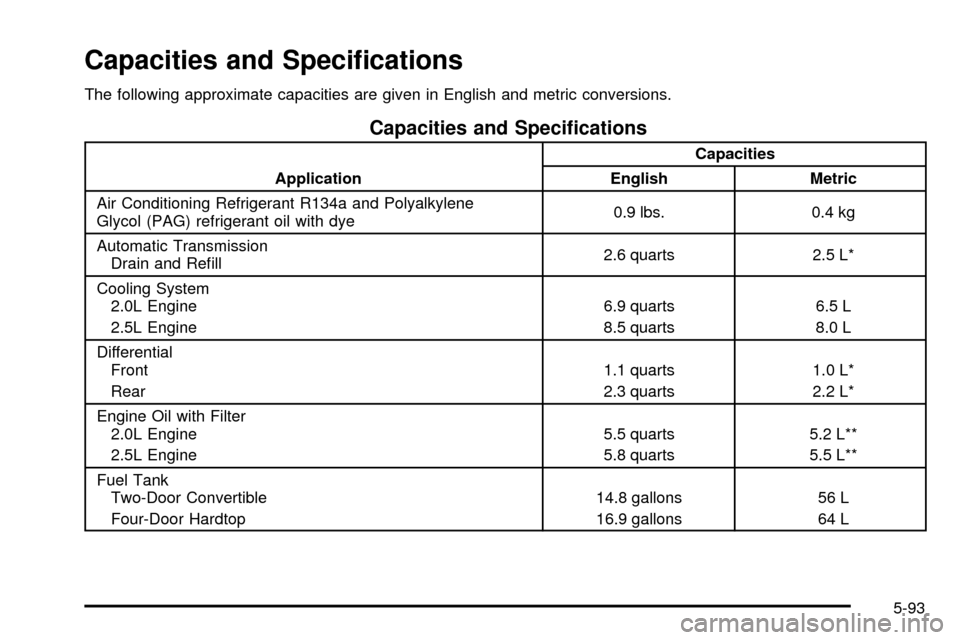
Capacities and Speci®cations
The following approximate capacities are given in English and metric conversions.
Capacities and Speci®cations
ApplicationCapacities
English Metric
Air Conditioning Refrigerant R134a and Polyalkylene
Glycol (PAG) refrigerant oil with dye0.9 lbs. 0.4 kg
Automatic Transmission
Drain and Re®ll2.6 quarts 2.5 L*
Cooling System
2.0L Engine
2.5L Engine6.9 quarts
8.5 quarts6.5 L
8.0 L
Differential
Front
Rear1.1 quarts
2.3 quarts1.0 L*
2.2 L*
Engine Oil with Filter
2.0L Engine
2.5L Engine5.5 quarts
5.8 quarts5.2 L**
5.5 L**
Fuel Tank
Two-Door Convertible
Four-Door Hardtop14.8 gallons
16.9 gallons56 L
64 L
5-93
Page 310 of 372
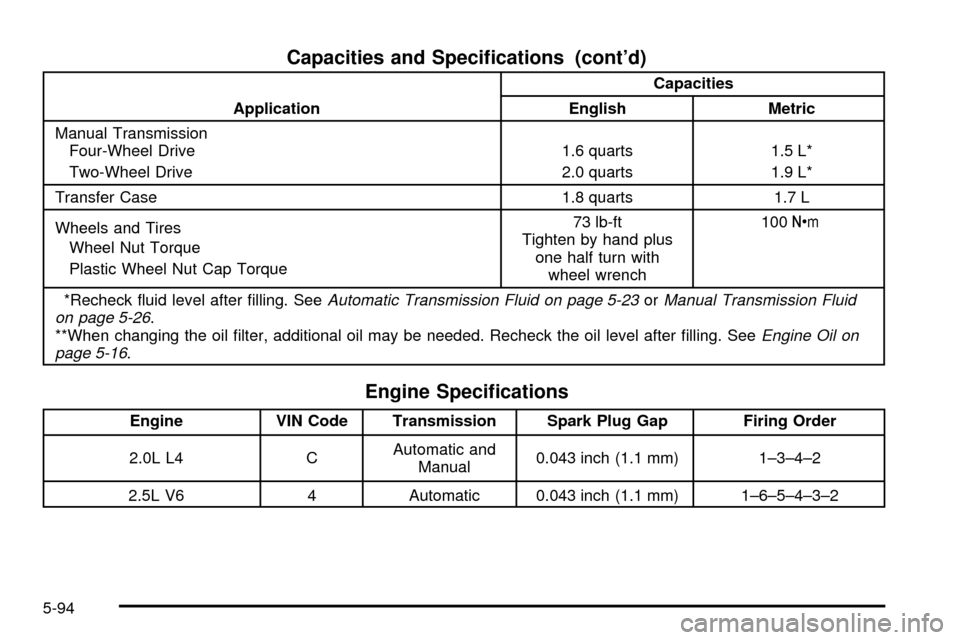
Capacities and Speci®cations (cont'd)
ApplicationCapacities
English Metric
Manual Transmission
Four-Wheel Drive
Two-Wheel Drive1.6 quarts
2.0 quarts1.5 L*
1.9 L*
Transfer Case 1.8 quarts 1.7 L
Wheels and Tires
Wheel Nut Torque
Plastic Wheel Nut Cap Torque73 lb-ft
Tighten by hand plus
one half turn with
wheel wrench100Y
*Recheck ¯uid level after ®lling. See
Automatic Transmission Fluid on page 5-23orManual Transmission Fluid
on page 5-26.
**When changing the oil ®lter, additional oil may be needed. Recheck the oil level after ®lling. SeeEngine Oil on
page 5-16.
Engine Speci®cations
Engine VIN Code Transmission Spark Plug Gap Firing Order
2.0L L4 CAutomatic and
Manual0.043 inch (1.1 mm) 1±3±4±2
2.5L V6 4 Automatic 0.043 inch (1.1 mm) 1±6±5±4±3±2
5-94