ECU CHEVROLET TRACKER 2004 2.G Owner's Manual
[x] Cancel search | Manufacturer: CHEVROLET, Model Year: 2004, Model line: TRACKER, Model: CHEVROLET TRACKER 2004 2.GPages: 374, PDF Size: 2.57 MB
Page 57 of 374
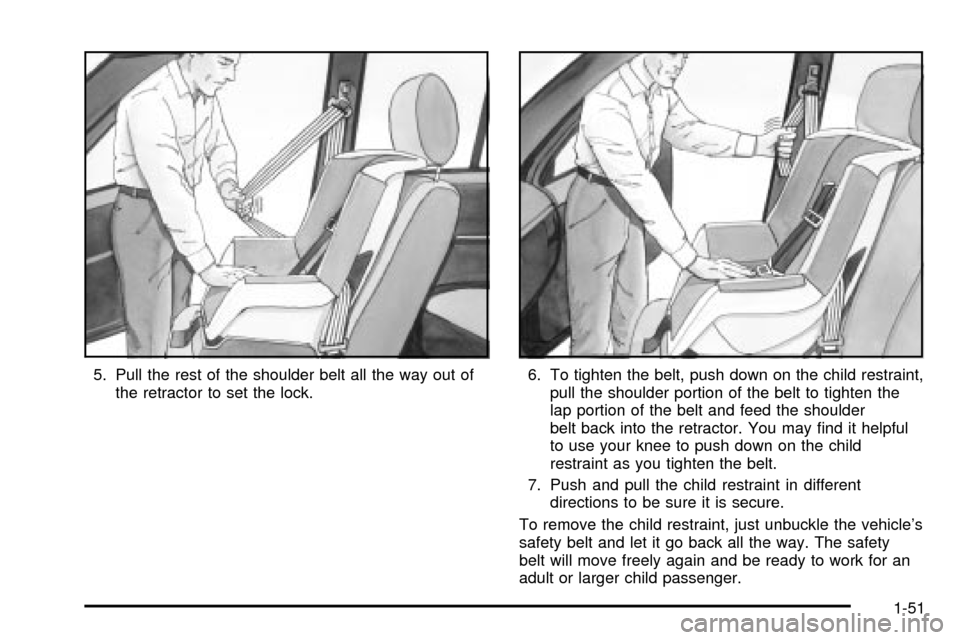
5. Pull the rest of the shoulder belt all the way out of
the retractor to set the lock.6. To tighten the belt, push down on the child restraint,
pull the shoulder portion of the belt to tighten the
lap portion of the belt and feed the shoulder
belt back into the retractor. You may ®nd it helpful
to use your knee to push down on the child
restraint as you tighten the belt.
7. Push and pull the child restraint in different
directions to be sure it is secure.
To remove the child restraint, just unbuckle the vehicle's
safety belt and let it go back all the way. The safety
belt will move freely again and be ready to work for an
adult or larger child passenger.
1-51
Page 59 of 374

{CAUTION:
Air bags in¯ate with great force, faster than the
blink of an eye. If you're too close to an
in¯ating air bag, as you would be if you were
leaning forward, it could seriously injure you.
Safety belts help keep you in position before
and during a crash. Always wear your safety
belt, even with air bags. The driver should sit
as far back as possible while still maintaining
control of the vehicle.
{CAUTION:
Anyone who is up against, or very close to,
any air bag when it in¯ates can be seriously
injured or killed. Air bags plus lap-shoulder
belts offer the best protection for adults, but
not for young children and infants.
CAUTION: (Continued)
CAUTION: (Continued)
Neither the vehicle's safety belt system nor its
air bag system is designed for them. Young
children and infants need the protection that a
child restraint system can provide. Always
secure children properly in your vehicle. To
read how, see
Older Children on page 1-29and
Infants and Young Children on page 1-31.
There is a air bag
readiness light on the
instrument panel, which
shows AIR BAG.
The system checks the air bag electrical system for
malfunctions. The light tells you if there is an electrical
problem. See
Air Bag Readiness Light on page 3-29for more information.
1-53
Page 67 of 374

Keys...............................................................2-2
Remote Keyless Entry System.........................2-3
Remote Keyless Entry System Operation...........2-4
Doors and Locks.............................................2-6
Door Locks....................................................2-6
Power Door Locks..........................................2-7
Rear Door Security Locks................................2-8
Leaving Your Vehicle......................................2-9
Tailgate........................................................2-9
Windows........................................................2-10
Manual Windows..........................................2-11
Power Windows............................................2-11
Sun Visors...................................................2-11
Starting and Operating Your Vehicle................2-12
New Vehicle Break-In....................................2-12
Ignition Positions..........................................2-12
Starting Your Engine.....................................2-14
Engine Coolant Heater..................................2-15
Automatic Transmission Operation...................2-16
Manual Transmission Operation......................2-20Four-Wheel Drive..........................................2-22
Parking Brake..............................................2-24
Shifting Into Park (P).....................................2-25
Shifting Out of Park (P).................................2-27
Parking Your Vehicle.....................................2-28
Parking Over Things That Burn.......................2-28
Engine Exhaust............................................2-29
Running Your Engine While You Are Parked. . . .2-30
Mirrors...........................................................2-31
Manual Rearview Mirror.................................2-31
Outside Manual Mirrors..................................2-32
Outside Power Mirrors...................................2-32
Outside Convex Mirror...................................2-33
Storage Areas................................................2-33
Glove Box...................................................2-33
Cupholder(s)................................................2-33
Coinholder(s)................................................2-33
Luggage Carrier...........................................2-34
Convenience Net..........................................2-36
Cargo Cover................................................2-36
Section 2 Features and Controls
2-1
Page 72 of 374

Resynchronization
Your remote keyless entry system is equipped with a
security system that prevents anyone from recording and
playing back your signal. The transmitter does not
send the same signal twice to the receiver. The receiver
will not respond to a signal that has been sent to it
more than once.
To resynchronize your transmitter and receiver, follow
these directions:
1. Stand close to your vehicle.
2. Press and hold the LOCK and UNLOCK buttons on
the transmitter at the same time for at least seven
seconds.
During this time, the doors should lock and unlock
once. This con®rms the resynchronization. If
the doors do not lock and unlock, see your dealer
for service.
Doors and Locks
Door Locks
{CAUTION:
Unlocked doors can be dangerous.
·Passengers Ð especially children Ð can
easily open the doors and fall out of a
moving vehicle. When a door is locked, the
handle will not open it. You increase the
chance of being thrown out of the vehicle
in a crash if the doors are not locked. So,
wear safety belts properly and lock the
doors whenever you drive.
·Young children who get into unlocked
vehicles may be unable to get out. A child
can be overcome by extreme heat and can
suffer permanent injuries or even death
from heat stroke. Always lock your vehicle
whenever you leave it.
·Outsiders can easily enter through an
unlocked door when you slow down or
stop your vehicle. Locking your doors can
help prevent this from happening.
2-6
Page 74 of 374

Rear Door Security Locks
Your vehicle may be equipped with rear door security
locks that help prevent passengers from opening
the rear doors of your vehicle from the inside.
The rear security door
locks are located on the
inside of the rear doors.
Using the Rear Door Security Lock
1. Move the lever down to engage the lock.
2. Close the door.
3. Do the same to the other rear door lock.
The rear doors of your vehicle cannot be opened from
the inside when this feature is in use.
Opening a Rear Door When the
Security Lock Is On
If you want to open a rear door when the security lock
is on, unlock the door, then open the door from the
outside.
If you don't cancel the security lock feature, adults or
older children who ride in the rear won't be able to open
the rear door from the inside. You should let adults
and older children know how these security locks work,
and how to cancel the locks.
2-8
Page 75 of 374

Canceling a Rear Door Security Lock
1. Unlock the door from the inside and open the door
from the outside.
2. Move the lever up to disengage the lock.
3. Do the same for the other rear door.
The rear door locks will now work normally.
Leaving Your Vehicle
If you are leaving the vehicle, take your keys, open your
door and set the locks from inside. Then get out and
close the door.
Tailgate
{CAUTION:
It can be dangerous to drive with the tailgate
open because carbon monoxide (CO) gas can
come into your vehicle. You can not see or
smell CO. It can cause unconsciousness and
even death. If you must drive with the tailgate
open or if electrical wiring or other cable
connections must pass through the seal
between the body and the tailgate:
·Make sure all other windows are shut.
·Turn the fan on your heating or cooling
system to its highest speed and select the
control setting that will force outside air
into your vehicle. See
Climate Control
System on page 3-19.
·If you have air outlets on or under the
instrument panel, open them all the way.
See
Engine Exhaust on page 2-29.
Tailgate Lock Release
Use your key to lock or unlock your tailgate.
2-9
Page 100 of 374

Luggage Carrier
{CAUTION:
If you try to carry something on top of your
vehicle that is longer or wider than the luggage
carrier Ð like paneling, plywood, a mattress
and so forth Ð the wind can catch it as you
drive along. This can cause you to lose
control. What you are carrying could be
violently torn off, and this could cause you or
other drivers to have a collision, and of course
damage your vehicle. You may be able to carry
something like this inside. But, never carry
something longer or wider than the luggage
carrier on top of your vehicle.Your vehicle's luggage carrier has side rails and may be
equipped with crossrails attached to the roof to secure
cargo.
Use GM accessory racks that are compatible with your
luggage carrier for transporting sports equipment.
These are available through your GM dealer.
The crossrails, if equipped, are adjustable, but are only
designed to move a limited amount. The front and
rear crossrails are not interchangeable. If you do remove
the crossrails, make sure to mark them with front or
rear. When replacing the front and rear crossrails, make
sure to but them back in the same position they
came from as the front rail is slightly longer than the
rear rail.
Just loosen the slider knobs at each end of the crossrail
to move them.
·The front crossrail has limited movement when
traveling rearward.
·The back crossrail has limited movement when
traveling forward.
After adjusting them, make sure both sides of the
crossrails are even, then tighten the slider knobs.
2-34
Page 101 of 374

Be sure the cargo is properly loaded. Follow these
guidelines:
·Carrying small, heavy loads on the roof is not
recommended.
·Do not load cargo directly on the roof panel.
·Tie the load to the tie down loops at both ends of
the crossrails to keep loads from shifting.
·If you need to carry long items, move the crossrails
as far apart as possible. Tie the load to the tie
downs provided. Do not tie the load so tightly that
the crossrails and side rails are damaged.
Notice:Loading cargo on the luggage carrier that
weighs more than 100 lbs. (45 kg) or hangs over the
rear or sides of the vehicle may damage your
vehicle. Load cargo so that it rests on the slats as
far forward as possible and against the side
rails, making sure to fasten it securely.
Don't exceed the maximum vehicle capacity when
loading your vehicle. For more information on vehicle
capacity and loading, see
Loading Your Vehicle on
page 4-51.
To prevent damage or loss of cargo as you're driving,
check now and then to make sure the luggage
carrier and cargo are still securely fastened.
2-35
Page 164 of 374

Off-Road Driving with Your
Four-Wheel-Drive Vehicle
This off-road guide is for vehicles that have four-wheel
drive.
Also, see
Braking on page 4-7.
If your vehicle does not have four-wheel drive, you
should not drive off-road unless you are on a level,
solid surface.
Off-road driving can be great fun. But it does have
some de®nite hazards. The greatest of these is
the terrain itself.
ªOff-roadingº means you have left the great North
American road system behind. Traffic lanes are not
marked. Curves are not banked. There are no
road signs. Surfaces can be slippery, rough, uphill or
downhill. In short, you have gone right back to nature.
Off-road driving involves some new skills. And that
is why it is very important that you read this guide. You
will ®nd many driving tips and suggestions. These
will help make your off-road driving safer and more
enjoyable.
Before You Go Off-Roading
There are some things to do before you go out. For
example, be sure to have all necessary maintenance
and service work done. Check to make sure all
underbody shields (if so equipped) are properly
attached. Be sure you read all the information about
your four-wheel-drive vehicle in this manual. Is
there enough fuel? Is the spare tire fully in¯ated? Are
the ¯uid levels up where they should be? What are the
local laws that apply to off-roading where you will be
driving? If you do not know, you should check with law
enforcement people in the area. Will you be on
someone's private land? If so, be sure to get the
necessary permission.
Loading Your Vehicle for Off-Road
Driving
There are some important things to remember about
how to load your vehicle.
·The heaviest things should be on the load ¯oor and
forward of your rear axle. Put heavier items as far
forward as you can.
·Be sure the load is secured properly, so driving on
the off-road terrain does not toss things around.
4-16
Page 165 of 374

{CAUTION:
·Cargo on the load ¯oor piled higher than
the seatbacks can be thrown forward
during a sudden stop. You or your
passengers could be injured. Keep cargo
below the top of the seatbacks.
·Unsecured cargo on the load ¯oor can be
tossed about when driving over rough
terrain. You or your passengers can be
struck by ¯ying objects. Secure the cargo
properly.
·Heavy loads on the roof raise the vehicle's
center of gravity, making it more likely to
roll over. You can be seriously or fatally
injured if the vehicle rolls over. Put heavy
loads inside the cargo area, not on the
roof. Keep cargo in the cargo area as far
forward and low as possible.
You will ®nd other important information in this manual.
See
Loading Your Vehicle on page 4-51,Luggage
Carrier on page 2-34andTires on page 5-55.
Environmental Concerns
Off-road driving can provide wholesome and satisfying
recreation. However, it also raises environmental
concerns. We recognize these concerns and urge every
off-roader to follow these basic rules for protecting
the environment:
·Always use established trails, roads and areas that
have been specially set aside for public off-road
recreational driving; obey all posted regulations.
·Avoid any driving practice that could damage
the environment Ð shrubs, ¯owers, trees,
grasses Ð or disturb wildlife (this includes
wheel-spinning, breaking down trees or
unnecessary driving through streams or over
soft ground.)
·Always carry a litter bag Ð make sure all refuse is
removed form any campsite before leaving.
·Take extreme care with open ®res
(where permitted), camp stoves and lanterns.
·Never park your vehicle over dry grass or other
combustible materials that could catch ®re form
the heat of the vehicle's exhaust system.
4-17