air filter CHEVROLET TRACKER 2004 2.G Owners Manual
[x] Cancel search | Manufacturer: CHEVROLET, Model Year: 2004, Model line: TRACKER, Model: CHEVROLET TRACKER 2004 2.GPages: 374, PDF Size: 2.57 MB
Page 103 of 374

Instrument Panel Overview...............................3-2
Hazard Warning Flashers................................3-4
Other Warning Devices...................................3-5
Horn.............................................................3-5
Tilt Wheel.....................................................3-5
Turn Signal/Multifunction Lever.........................3-6
Exterior Lamps.............................................3-13
Interior Lamps..............................................3-16
Accessory Power Outlets...............................3-18
Ashtrays and Cigarette Lighter........................3-19
Climate Controls............................................3-19
Climate Control System.................................3-19
Outlet Adjustment.........................................3-22
Passenger Compartment Air Filter...................3-23
Warning Lights, Gages and Indicators.............3-26
Warning Lights, Gages, and Indicators.............3-26
Instrument Panel Cluster................................3-27
Speedometer and Odometer...........................3-28
Tachometer.................................................3-28Safety Belt Reminder Light.............................3-28
Air Bag Readiness Light................................3-29
Charging System Light..................................3-30
Brake System Warning Light..........................3-30
Anti-Lock Brake System Warning Light.............3-31
Engine Coolant Temperature Gage..................3-32
Malfunction Indicator Lamp.............................3-33
Oil Pressure Light.........................................3-36
Overdrive Off Light........................................3-37
Four-Wheel-Drive Light..................................3-37
Power Indicator Light.....................................3-37
Fuel Gage...................................................3-38
Audio System(s).............................................3-39
Setting the Time...........................................3-39
Radio with CD..............................................3-40
Radio Reception...........................................3-45
Care of Your CDs.........................................3-45
Care of Your CD Player................................3-45
Fixed Mast Antenna......................................3-45
Section 3 Instrument Panel
3-1
Page 122 of 374

Operation
9
(Fan):Move the lever away from OFF to turn the
system on. Slide the top right lever to the left or right to
increase or decrease the fan speed.
If the air¯ow seems low when the fan is at the highest
setting, the passenger compartment air ®lter, if
equipped, may need to be replaced. For more
information, see
Passenger Compartment Air Filter on
page 3-23andShort Trip/City Scheduled Maintenance
on page 6-7.
Slide the top left lever to the left or right to direct the
air¯ow inside of your vehicle.
To change the current mode, select one of the following:
H(Vent):This mode directs air to the instrument
panel outlets.
)(Bi-Level):This mode directs most of the air to the
instrument panel outlets, and then directs the remaining
air to the ¯oor outlets.
6(Floor):This mode directs half of the air to the
¯oor outlets with some air directed to the outboard
outlets (for the side windows) and some air directed to
the windshield.
This lever can also be used to select defog or defrost
mode. Information on defogging and defrosting can
be found later in this section.
:(Outside Air):Slide the lower right lever to the
right for outside air. With the lever in this position,
outside air will circulate throughout your vehicle.
?(Recirculation):Slide the lower right lever to the
left for recirculated air. With the lever in this position
outside air and odors can be prevented from entering
your vehicle and also helps heat or cool the air
inside your vehicle more quickly.
If the lever is in the middle of the two positions, you will
have both outside and recirculated air inside your
vehicle.
If you are in city traffic, your vehicle is stopped and
idling or the weather is hot, the system may be switched
from the outside air mode to the recirculation mode.
To help prevent the air inside of your vehicle from
becoming too stale, be sure to return to outside air
periodically.
3-20
Page 125 of 374

Operation Tips
·Clear away any ice, snow or leaves from the air
inlets at the base of the windshield that may
block the ¯ow of air into your vehicle.
·Use of non-GM approved hood de¯ectors may
adversely affect the performance of the system.
·Keep the path under the front seats clear of objects
to help circulate the air inside of your vehicle more
effectively.
·If the air¯ow seems low when the fan is at the
highest setting, the passenger compartment
air ®lters, if equipped, may need to be replaced. For
more information, see ªPassenger Compartment
Air Filterº following and
Short Trip/City Scheduled
Maintenance on page 6-7.
Passenger Compartment Air Filter
All models come equipped from the factory with a slot in
the ventilation system that is ready to accept passenger
compartment air ®lters. These ®lters are available for
purchase from your dealer. You will need to install
two ®lters to provide the proper ®ltration.
Both outside and recirculated air ¯ows through these
®lters and removes certain contaminates including pollen
and dust particles.
Reductions in air¯ow which occur more quickly in dusty
areas, may indicate that the ®lters need to be replaced
earlier than listed in the maintenance schedule. For how
often to replace your air ®lters, see
Maintenance
Requirements on page 6-2.
The access panel for the air ®lters is behind the
glove box.
3-23
Page 213 of 374

Service............................................................5-3
Doing Your Own Service Work.........................5-3
Adding Equipment to the Outside of Your
Vehicle......................................................5-4
Fuel................................................................5-4
Gasoline Octane............................................5-4
Gasoline Speci®cations....................................5-4
California Fuel...............................................5-5
Additives.......................................................5-6
Fuels in Foreign Countries...............................5-6
Filling Your Tank............................................5-7
Filling a Portable Fuel Container.......................5-9
Checking Things Under the Hood....................5-10
Hood Release..............................................5-10
Engine Compartment Overview.......................5-12
Engine Oil...................................................5-13
Engine Air Cleaner/Filter................................5-18
Automatic Transmission Fluid.........................5-20
Manual Transmission Fluid.............................5-23
Hydraulic Clutch...........................................5-24
Engine Coolant.............................................5-25
Radiator Pressure Cap..................................5-28
Engine Overheating.......................................5-28
Cooling System............................................5-31
Power Steering Fluid.....................................5-37Windshield Washer Fluid................................5-37
Brakes........................................................5-39
Battery........................................................5-42
Jump Starting...............................................5-43
Rear Axle.......................................................5-48
Four-Wheel Drive............................................5-49
Bulb Replacement..........................................5-51
Halogen Bulbs..............................................5-51
Headlamps..................................................5-51
Front Turn Signal and Parking Lamps..............5-53
Sidemarker Lamps........................................5-53
Rear Combination Lamps...............................5-54
Replacement Bulbs.......................................5-55
Tires..............................................................5-55
In¯ation - Tire Pressure.................................5-63
Tire Inspection and Rotation...........................5-64
When It Is Time for New Tires.......................5-66
Buying New Tires.........................................5-67
Uniform Tire Quality Grading..........................5-68
Wheel Alignment and Tire Balance..................5-69
Wheel Replacement......................................5-70
Tire Chains..................................................5-71
If a Tire Goes Flat........................................5-72
Changing a Flat Tire.....................................5-72
Section 5 Service and Appearance Care
5-1
Page 225 of 374

A. Engine Compartment Fuse Block. See ªEngine
Compartment Fuse Blockº underFuses and Circuit
Breakers on page 5-94.
B. Engine Air Cleaner/Filter. See
Engine Air
Cleaner/Filter on page 5-18.
C. Battery. See
Battery on page 5-42.
D. Radiator Pressure Cap. See
Radiator Pressure Cap
on page 5-28.
E. Engine Oil Fill Cap. See
Engine Oil on page 5-13.
F. Automatic Transmission Dipstick. See
Automatic
Transmission Fluid on page 5-20.
G. Engine Oil Dipstick. See
Engine Oil on page 5-13.
H. Power Steering Fluid Reservoir. See
Power Steering
Fluid on page 5-37.
I. Brake Master Cylinder Reservoir. See
Brakes on
page 5-39.
J. Coolant Recovery Tank. See
Engine Coolant on
page 5-25.
K. Windshield Washer Reservoir. See
Windshield
Washer Fluid on page 5-37.
Engine Oil
If the engine oil pressure
light appears on the
instrument cluster, it
means you need to check
your engine oil level
right away.
For more information, see
Oil Pressure Light on
page 3-36.
You should check your engine oil level regularly; this is
an added reminder.
5-13
Page 230 of 374
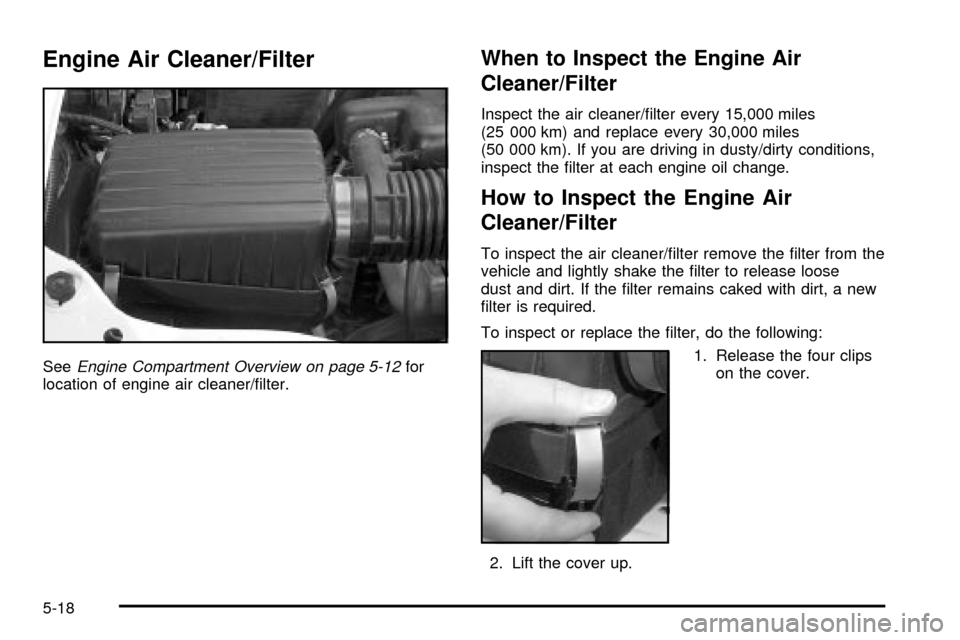
Engine Air Cleaner/Filter
SeeEngine Compartment Overview on page 5-12for
location of engine air cleaner/®lter.
When to Inspect the Engine Air
Cleaner/Filter
Inspect the air cleaner/®lter every 15,000 miles
(25 000 km) and replace every 30,000 miles
(50 000 km). If you are driving in dusty/dirty conditions,
inspect the ®lter at each engine oil change.
How to Inspect the Engine Air
Cleaner/Filter
To inspect the air cleaner/®lter remove the ®lter from the
vehicle and lightly shake the ®lter to release loose
dust and dirt. If the ®lter remains caked with dirt, a new
®lter is required.
To inspect or replace the ®lter, do the following:
1. Release the four clips
on the cover.
2. Lift the cover up.
5-18
Page 310 of 374
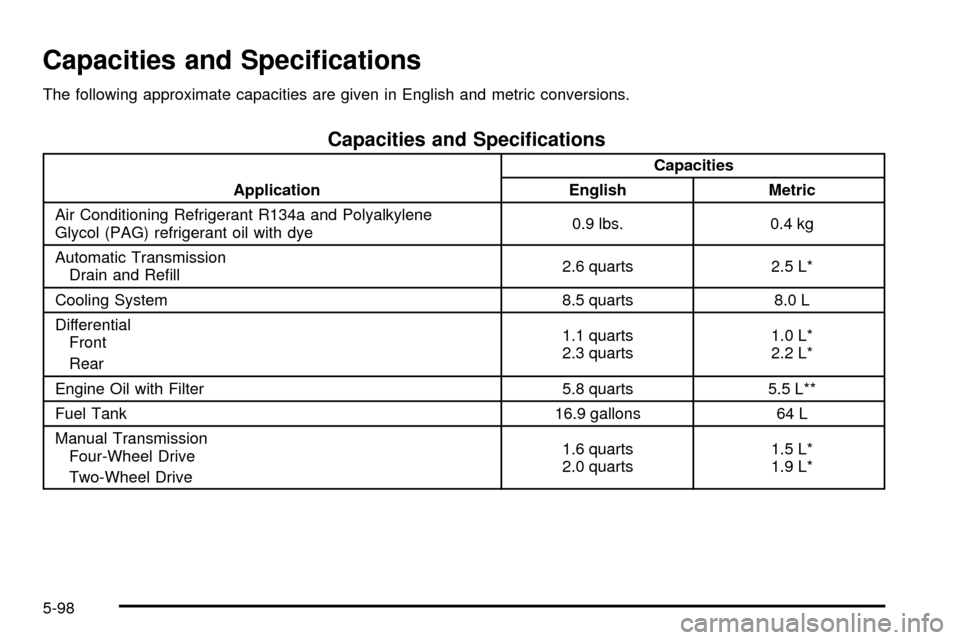
Capacities and Speci®cations
The following approximate capacities are given in English and metric conversions.
Capacities and Speci®cations
ApplicationCapacities
English Metric
Air Conditioning Refrigerant R134a and Polyalkylene
Glycol (PAG) refrigerant oil with dye0.9 lbs. 0.4 kg
Automatic Transmission
Drain and Re®ll2.6 quarts 2.5 L*
Cooling System 8.5 quarts 8.0 L
Differential
Front
Rear1.1 quarts
2.3 quarts1.0 L*
2.2 L*
Engine Oil with Filter 5.8 quarts 5.5 L**
Fuel Tank 16.9 gallons 64 L
Manual Transmission
Four-Wheel Drive
Two-Wheel Drive1.6 quarts
2.0 quarts1.5 L*
1.9 L*
5-98
Page 312 of 374
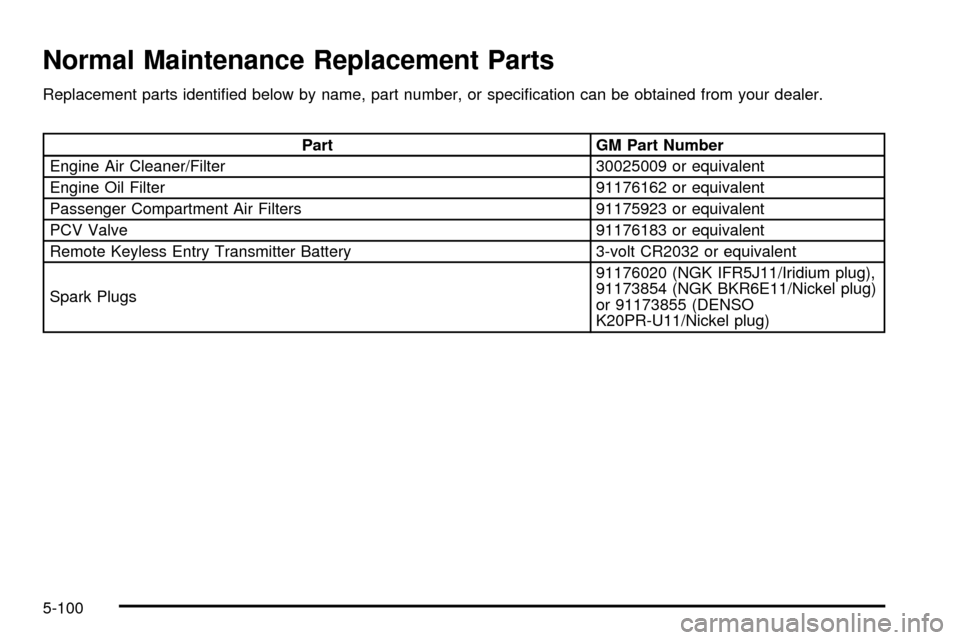
Normal Maintenance Replacement Parts
Replacement parts identi®ed below by name, part number, or speci®cation can be obtained from your dealer.
Part GM Part Number
Engine Air Cleaner/Filter 30025009 or equivalent
Engine Oil Filter 91176162 or equivalent
Passenger Compartment Air Filters 91175923 or equivalent
PCV Valve 91176183 or equivalent
Remote Keyless Entry Transmitter Battery 3-volt CR2032 or equivalent
Spark Plugs91176020 (NGK IFR5J11/Iridium plug),
91173854 (NGK BKR6E11/Nickel plug)
or 91173855 (DENSO
K20PR-U11/Nickel plug)
5-100
Page 319 of 374

Short Trip/City De®nition
Follow the Short Trip/City Scheduled Maintenance if any
one of these conditions is true for your vehicle:
·Most trips are less than 5 miles (8 km). This is
particularly important when outside temperatures
are below freezing.
·Most trips include extensive idling (such as frequent
driving in stop-and-go traffic).
·You frequently tow a trailer or use a carrier on top
of your vehicle.
·If the vehicle is used for delivery service, police,
taxi or other commercial application.
One of the reasons you should follow this schedule if
you operate your vehicle under any of these conditions
is that these conditions cause engine oil to break
down sooner.
Short Trip/City Intervals
Every 3,000 Miles (5 000 km):Engine Oil and Filter
Change (or 3 months, whichever occurs ®rst).
Every 6,000 Miles (10 000 km):Passenger
Compartment Air Filter Inspection (If Equipped).
Tire Rotation.
Every 15,000 Miles (25 000 km):Engine Air Cleaner
Filter Inspection. Automatic Transmission Service
(severe conditions only). Manual Transmission Fluid
Change. Transfer Case Fluid Change. Differential Fluid
Change. Propeller Shafts and U-Joints Inspection
(or every 15 months, whichever occurs ®rst).
Every 30,000 Miles (50 000 km):Engine Air Cleaner
Filter Replacement. Air Filter Replacement (If Equipped).
Ignition Coil Plug Cap Inspection (or every 30 months,
whichever occurs ®rst). Engine Accessory Drive Belt
Inspection (or every 30 months, whichever occurs ®rst).
Cooling System Service (or every 30 months,
whichever occurs ®rst). Fuel Tank, Cap, and Lines
Inspection. Fuel Filter Replacement (or every 30 months,
whichever occurs ®rst).
6-5
Page 320 of 374

Every 45,000 Miles (75 000 km):Automatic
Transmission Fluid Hose Inspection (or every
45 months, whichever occurs ®rst).
Every 60,000 Miles (100 000 km):Fuel Tank Cap
Gasket Replacement. Emission System Hoses
Inspection. Brake Fluid Service. Spark Plug
Replacement.
Every 100,000 Miles (166 000 km):Automatic
Transmission Service (normal conditions).
Every 120 000 Miles (200 000 km):Evaporative
Emissions Canister and Air Suction Filter Replacement
(or every 120 months, whichever occurs ®rst). Engine
Accessory Drive Belt Replacement (or every
120 months, whichever occurs ®rst).
These intervals only summarize maintenance services.
Be sure to follow the complete scheduled maintenance
on the following pages.
Long Trip/Highway De®nition
Follow this scheduled maintenanceonlyif none of the
conditions from the Short Trip/City Scheduled
Maintenance are true. Do not use this schedule if the
vehicle is used for trailer towing, driven in a dusty area
or used off paved roads. Use the Short Trip/City
schedule for these conditions.
Driving a vehicle with a fully warmed engine under
highway conditions will cause engine oil to break down
slower.
Long Trip/Highway Intervals
Every 7,500 Miles (12 500 km):Engine Oil and Filter
Change (or every 7.5 months, whichever occurs
®rst). Tire Rotation.
Every 15,000 Miles (25 000 km):Engine Air Cleaner
Filter Inspection. Automatic Transmission Service
(severe conditions only). Passenger Compartment Air
Filter Inspection (If Equipped). Propeller Shafts and
U-Joints Inspection (or every 15 months, whichever
occurs ®rst).
6-6