climate control CHRYSLER 200 2017 2.G Owner's Manual
[x] Cancel search | Manufacturer: CHRYSLER, Model Year: 2017, Model line: 200, Model: CHRYSLER 200 2017 2.GPages: 539, PDF Size: 5.18 MB
Page 331 of 539
Apple iPhone iOS 6 or later supports readingincoming
text messages only. To enable this feature on your Apple
iPhone, follow these 4 simple steps:
TIP: Voice Text Reply is not compatible with iPhone, but if
your vehicle is equipped with Siri Eyes Free, you can use
your voice to send a text message.Climate (8.4/8.4 NAV)
Too hot? Too cold? Adjust vehicle temperatures hands-free
and keep everyone comfortable while you keep moving
ahead. (If vehicle is equipped with climate control.)
Push the VR button
. After the beep, say one of the
following commands:
• Set driver temperature to 70degrees
• Set passenger temperature to 70degrees
TIP: Voice Command for Climate may only be used to
adjust the interior temperature of your vehicle. Voice
Command will not work to adjust the heated seats or
steering wheel if equipped.
iPhone Notification Settings
1 — Select “Settings”
2 — Select “Bluetooth”
3 — Select the (i) for the paired vehicle
4 — Turn on “Show Notifications”
4
UNDERSTANDING YOUR INSTRUMENT PANEL 329
Page 371 of 539
6. Push the “ESC Off” button located in the lower switchbank below the climate control four times within twenty
seconds. The “ESC Off Indicator Light” should turn on
and turn off two times.
7. Rotate the steering wheel back to center and then an additional slighty more than one-half turn to the right.
8. Turn the ignition switch to the OFF position and then back to the ON position. If the sequence was completed
properly, the “ESC Off Indicator Light” will blink sev-
eral times to confirm HSA is disabled.
9. Repeat these steps if you want to return this feature to its previous setting.
Traction Control System (TCS)
This system monitors the amount of wheel spin of each of
the driven wheels. If wheel spin is detected, the TCS may
apply brake pressure to the spinning wheel(s) and/or
reduce engine power to provide enhanced acceleration and
stability. A feature of the TCS, Brake Limited Differential
(BLD), functions similar to a limited slip differential and
controls the wheel spin across a driven axle. If one wheel
on a driven axle is spinning faster than the other, the
system will apply the brake of the spinning wheel. This will allow more engine torque to be applied to the wheel
that is not spinning. BLD may remain enabled even if TCS
and ESC are in a reduced mode.
Electronic Stability Control (ESC)
This system enhances directional control and stability of
the vehicle under various driving conditions. ESC corrects
for oversteering or understeering of the vehicle by apply-
ing the brake of the appropriate wheel(s) to assist in
counteracting the oversteer or understeer condition. En-
gine power may also be reduced to help the vehicle
maintain the desired path.
ESC uses sensors in the vehicle to determine the vehicle
path intended by the driver and compares it to the actual
path of the vehicle. When the actual path does not match
the intended path, ESC applies the brake of the appropriate
wheel to assist in counteracting the oversteer or understeer
condition.
•
Oversteer - when the vehicle is turning more than
appropriate for the steering wheel position.
• Understeer - when the vehicle is turning less than
appropriate for the steering wheel position.
The “ESC Activation/Malfunction Indicator Light” located
in the instrument cluster will start to flash as soon as the
5
STARTING AND OPERATING 369
Page 485 of 539
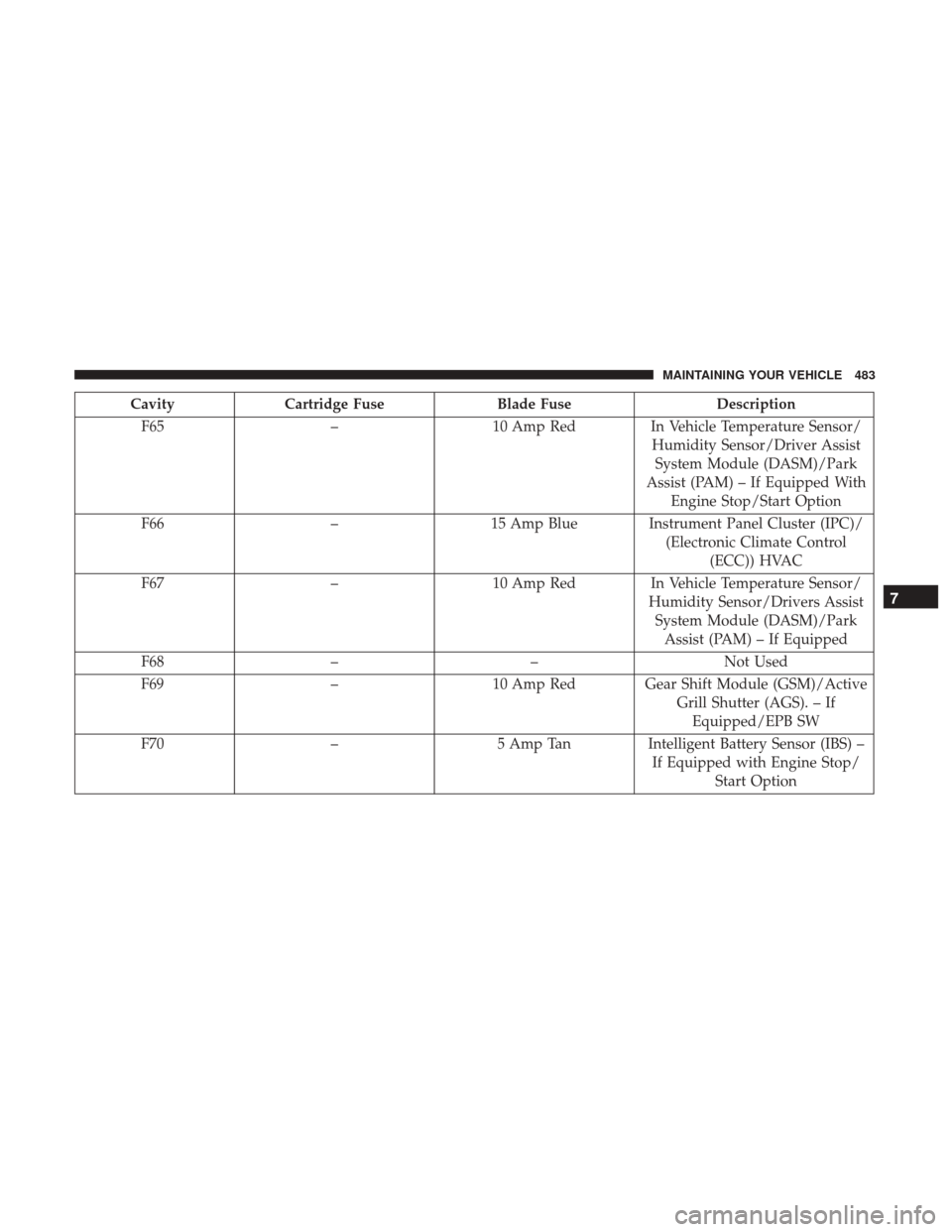
CavityCartridge Fuse Blade Fuse Description
F65 –10 Amp RedIn Vehicle Temperature Sensor/
Humidity Sensor/Driver Assist System Module (DASM)/Park
Assist (PAM) – If Equipped With Engine Stop/Start Option
F66 –15 Amp Blue Instrument Panel Cluster (IPC)/
(Electronic Climate Control(ECC)) HVAC
F67 –10 Amp RedIn Vehicle Temperature Sensor/
Humidity Sensor/Drivers Assist System Module (DASM)/Park Assist (PAM) – If Equipped
F68 – –Not Used
F69 –10 Amp Red Gear Shift Module (GSM)/Active
Grill Shutter (AGS). – IfEquipped/EPB SW
F70 –5 Amp TanIntelligent Battery Sensor (IBS) –
If Equipped with Engine Stop/ Start Option
7
MAINTAINING YOUR VEHICLE 483
Page 519 of 539
Call toll free at:
•1-800-890-4038 (U.S.)
• 1-800-387-1143 (Canada)
Or
Visit us on the Worldwide Web at:
• www.techauthority.com
DEPARTMENT OF TRANSPORTATION UNIFORM
TIRE QUALITY GRADES
The following tire grading categories were established by
the National Highway Traffic Safety Administration. The
specific grade rating assigned by the tire’s manufacturer in
each category is shown on the sidewall of the tires on your
vehicle.
All passenger vehicle tires must conform to Federal safety
requirements in addition to these grades.
Treadwear
The Treadwear grade is a comparative rating, based on the
wear rate of the tire when tested under controlled condi-
tions on a specified government test course. For example, a
tire graded 150 would wear one and one-half times as well
on the government course as a tire graded 100. The relative
performance of tires depends upon the actual conditions of
their use, however, and may depart significantly from the
norm due to variations in driving habits, service practices,
and differences in road characteristics and climate.
Traction Grades
The Traction grades, from highest to lowest, are AA, A, B,
and C. These grades represent the tire’s ability to stop on
wet pavement, as measured under controlled conditions on
specified government test surfaces of asphalt and concrete.
A tire marked C may have poor traction performance.
WARNING!
The traction grade assigned to this tire is based on
straight-ahead braking traction tests, and does not
include acceleration, cornering, hydroplaning, or peak
traction characteristics.
9
IF YOU NEED CONSUMER ASSISTANCE 517
Page 524 of 539
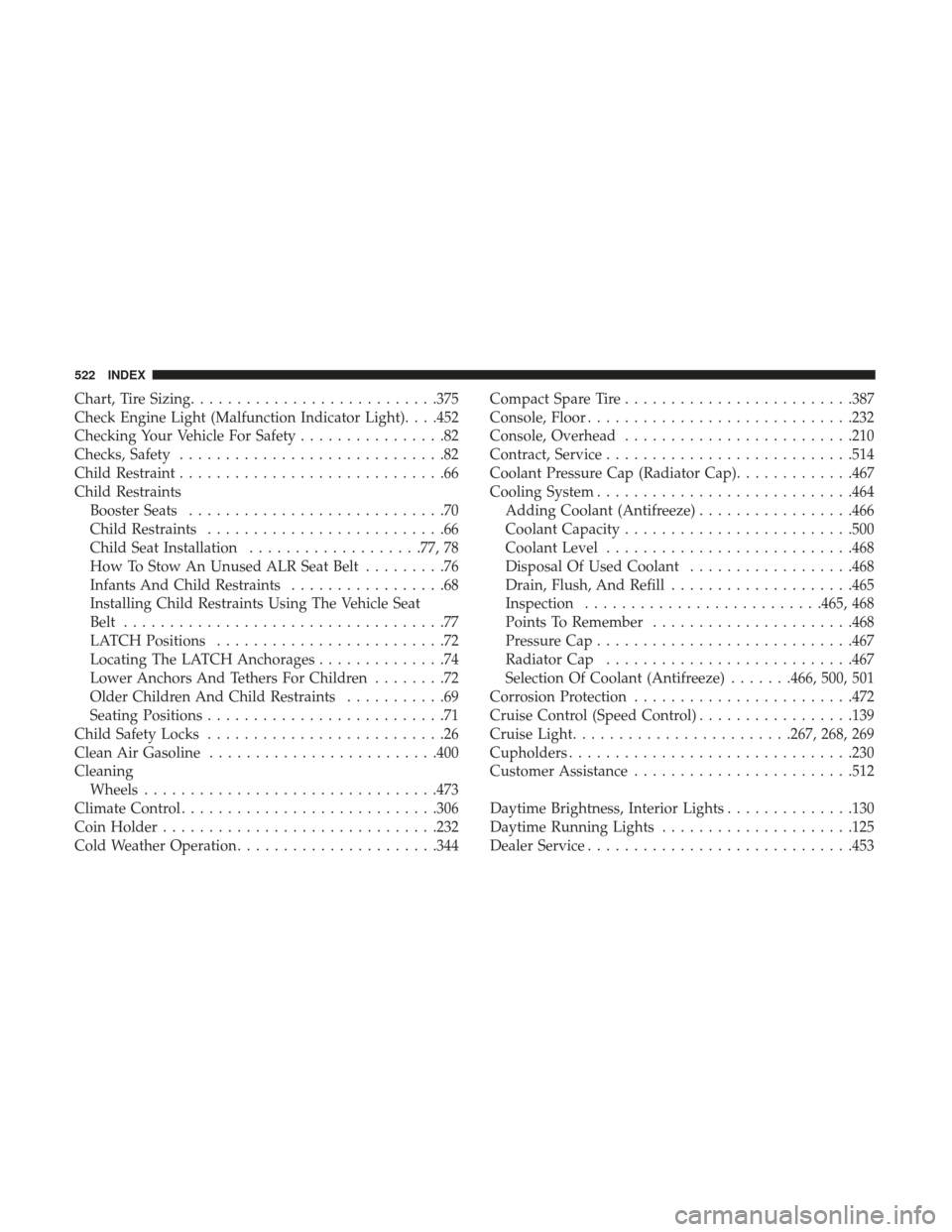
Chart, Tire Sizing.......................... .375
Check Engine Light (Malfunction Indicator Light). . . .452
Checking Your Vehicle For Safety ................82
Checks, Safety .............................82
Child Restraint .............................66
Child Restraints Booster Seats ............................70
Child Restraints ..........................66
Child Seat Installation ...................77, 78
How To Stow An Unused ALR Seat Belt .........76
Infants And Child Restraints .................68
Installing Child Restraints Using The Vehicle Seat
Belt ...................................77
LATCH Positions .........................72
Locating The LATCH Anchorages ..............74
Lower Anchors And Tethers For Children ........72
Older Children And Child Restraints ...........69
Seating Positions ..........................71
Child Safety Locks ..........................26
Clean Air Gasoline ........................ .400
Cleaning Wheels ............................... .473
Climate Control ........................... .306
Coin Holder ............................. .232
Cold Weather Operation ..................... .344Compact Spare Tire
........................ .387
Console, Floor ............................ .232
Console, Overhead ........................ .210
Contract, Service .......................... .514
Coolant Pressure Cap (Radiator Cap) .............467
Cooling System ........................... .464
Adding Coolant (Antifreeze) .................466
Coolant Capacity ........................ .500
Coolant Level .......................... .468
Disposal Of Used Coolant ..................468
Drain, Flush, And Refill ....................465
Inspection ......................... .465, 468
Points To Remember ..................... .468
Pressure Cap ........................... .467
Radiator Cap .......................... .467
Selection Of Coolant (Antifreeze) .......466, 500, 501
Corrosion Protection ....................... .472
Cr
uise Control (Speed Control) .................139
Cruise Light ....................... .267, 268, 269
Cupholders .............................. .230
Customer Assistance ....................... .512
Daytime Brightness, Interior Lights ..............130
Daytime Running Lights .....................125
Dealer Service ............................ .453
522 INDEX