oil CHRYSLER ASPEN 2008 2.G User Guide
[x] Cancel search | Manufacturer: CHRYSLER, Model Year: 2008, Model line: ASPEN, Model: CHRYSLER ASPEN 2008 2.GPages: 479, PDF Size: 4.3 MB
Page 209 of 479
Unless reset, this message will continue to display each
time you turn the ignition switch to the ON/RUN
position. To turn off the message temporarily, press and
release the Trip Odometer button on the instrument
cluster. To reset the oil change indicator system (after
performing the scheduled maintenance) refer to the fol-
lowing procedure.
1. Turn the ignition switch to the ON position(Do not
start the engine).
2. Fully depress the accelerator pedal slowly three
times within 10 seconds.
3. Turn the ignition switch to the OFF/LOCK position.
NOTE:If the indicator message illuminates when you
start the vehicle, the oil change indicator system did not
reset. If necessary repeat this procedure.16. Odometer
The odometer shows the total distance the vehicle has
been driven.
U.S. federal regulations require that upon transfer of
vehicle ownership, the seller certify to the purchaser the
correct mileage that the vehicle has been driven. There-
fore, if the odometer reading is changed during repair or
replacement, be sure to keep a record of the reading
before and after the service so that the correct mileage can
be determined.
17. Fog Light Indicator
This light shows when the fog lights are ON.
18. Electronic Stability Program (ESP) Indicator Light
The yellow ESP indicator light in the speedom-
eter area illuminates with the key in the igni-
tion switch turned to the ON/RUN position. It
should go out with the engine running. The
208 INSTRUMENT PANEL AND CONTROLS
Page 263 of 479
and adjust the temperature control and blower speed as
necessary to maintain comfort. For high humidity condi-
tions, it may be necessary to remain in the Recirculation
mode to maintain comfort.
Window Fogging
Windows will fog on the inside when the humidity inside
the vehicle is high. This often occurs in mild or cool
temperatures when it's rainy or humid. In most cases,
turning on the air conditioning (pressing the snowflake
button) will clear the fog. Adjust the temperature control,
air direction and blower speed to maintain comfort.
As the temperature gets colder it may be necessary to
direct air onto the windshield by using Mix Mode
position on the control. Adjust the temperature control
and blower speed to maintain comfort. Interior fogging
on the windshield can be quickly removed by selecting
the defrost mode.Regular cleaning of the inside of the windows with a
non-filming cleaning solution (vinegar and water works
very well) will help prevent contaminants (cigarette
smoke, perfumes, etc.) from sticking to the windows.
Contaminants increase the rate of window fogging.Summer Operation
Air conditioned vehicles must be protected with a high
quality antifreeze coolant during summer to provide
proper corrosion protection and to raise the boiling point
of the coolant for protection against overheating. A 50 %
concentration is recommended.
Winter Operation
When operating the system during the winter months,
make sure the air intake, located directly in front of the
windshield, is free of ice, slush, snow, or other obstruc-
tions. This will also prevent snow ingestion into the
ducts.
262 INSTRUMENT PANEL AND CONTROLS
Page 271 of 479
NFuel Requirements....................340
NSelection Of Engine Oil For Flexible Fuel
Vehicles (E-85) And Gasoline Vehicles.......340
NStarting............................341
NCruising Range.......................341
NReplacement Parts.....................341
mVehicle Loading........................342
NCertification Label.....................342
NCurb Weight.........................343
NLoading............................343
mTrailer Towing.........................345
NCommon Towing Definitions.............345NTrailer Hitch Classification...............350
NTrailer Towing Weights (Maximum Trailer
Weight Ratings)......................351
NTrailer And Tongue Weight..............351
NTowing Requirements..................352
NTowing Tips.........................357
mSnowplow............................359
mRecreational Towing (Behind Motorhome, Etc.) . . 360
NRecreational Towing 2WD Models.........360
NRecreational Towing 4WD Models.........360
mEquipment Identification Plate.............364
270 STARTING AND OPERATING
Page 289 of 479
CAUTION!
²Driving through standing water may cause dam-
age to your vehicle's drivetrain components. Al-
ways inspect your vehicle's fluids (i.e., engine oil,
transmission, axle, etc.) for signs of contamination
(i.e., fluid that is milky or foamy in appearance)
after driving through standing water. Do not con-
tinue to operate the vehicle if any fluid appears
contaminated, as this may result in further dam-
age. Such damage is not covered by the New
Vehicle Limited Warranty.
²Getting water inside your vehicle's engine can
cause it to lock up and stall out, and cause serious
internal damage to the engine. Such damage is not
covered by the New Vehicle Limited Warranty.
WARNING!
²Driving through standing water limits your vehi-
cle's traction capabilities. Do not exceed 5 mph (8
km/h) when driving through standing water.
²Driving through standing water limits your vehi-
cle's braking capabilities, which increases stop-
ping distances. Therefore, after driving through
standing water, drive slowly and lightly press on
the brake pedal several times to dry the brakes.
²Getting water inside your vehicle's engine can
cause it to lock up and stall out, and leave you
stranded.
²Failure to follow these warnings may result in
injuries that are serious or fatal to you, your
passengers, and others around you.
288 STARTING AND OPERATING
Page 320 of 479

WARNING!
Tires and spare tire should be replaced after six years,
regardless of the remaining tread. Failure to follow
this warning can result in sudden tire failure. You
could lose control and have an accident resulting in
serious injury or death.
Keep dismounted tires in a cool, dry place with as little
exposure to light as possible. Protect tires from contact
with oil, grease, and gasoline.
Replacement Tires
The tires on your new vehicle provide a balance of many
characteristics. They should be inspected regularly for
wear and correct cold tire inflation pressure. The manu-
facturer strongly recommends that you use tires equiva-
lent to the originals in size, quality and performance
when replacement is needed (refer to the paragraph on
ªTread Wear Indicatorsº). Refer to the ªTire and Loading
Informationº placard for the size designation of your tire.
The service description and load identification will be
found on the original equipment tire. Failure to use
equivalent replacement tires may adversely affect the
safety, handling, and ride of your vehicle. We recommend
that you contact your original equipment or an autho-
rized tire dealer with any questions you may have on tire
specifications or capability.
STARTING AND OPERATING 319
5
Page 341 of 479
Fuel Requirements
Your vehicle will operate on both unleaded gasoline with
an octane rating of 87, or E-85 fuel, or any mixture of
these two.
For best results, a refueling pattern that alternates be-
tween E-85 and unleaded gasoline should be avoided.
When you do switch fuels, it is recommended that you:
²do not switch when the fuel gauge indicates less than
1/4 full
²do not add less than five gallons (19 Liters) when
refueling
²operate the vehicle immediately after refueling for a
period of at least five minutes
Observing these precautions will avoid possible hard
starting and/or significant deterioration in drivability
during warm up.NOTE:When the ambient temperature is above 90ÉF
(32ÉC), you may experience hard starting and rough idle
following startup, even if the above recommendations
are followed.
Selection Of Engine Oil For Flexible Fuel Vehicles
(E-85) and Gasoline Vehicles
FFV vehicles operated on E-85 require specially formu-
lated engine oils. These special requirements are included
in Mopartengine oils, and in equivalent oils meeting
DaimlerChrysler Specification MS-6395. The manufac-
turer only recommends engine oils that are API Certified
and meet the requirements of Material Standard MS-
6395. MS-6395 contains additional requirements, devel-
oped during extensive fleet testing, to provide additional
protection to DaimlerChrysler Corporation engines. Use
Mopartor an equivalent oil meeting the specification
MS-6395.
340 STARTING AND OPERATING
Page 375 of 479
WARNING!
Raising the vehicle higher than necessary can make
the vehicle unstable and cause an accident. It could
slip off the jack and hurt someone near it. Raise the
vehicle only enough to remove the tire.
5. Remove the wheel nuts and pull the wheel off. Install
the spare wheel and wheel nuts with the cone shaped end
of the nuts toward the wheel. Lightly tighten the nuts. To
avoid risk of forcing the vehicle off the jack, do not fully
tighten the nuts until the vehicle has been lowered.
NOTE:Do not oil wheel studs. For chrome wheels, do
not substitute with chrome plated wheel nuts.
6. Using the wheel wrench, finish tightening the nuts in
a crisscross pattern. Correct nut tightness is 135 10 ft lbs
(183 14 N´m) dynamic torque. If in doubt about thecorrect tightness, have them checked with a torque
wrench by your authorized dealer or at a service station.WARNING!
A loose tire or jack thrown forward in a collision or
hard stop could injure someone in the vehicle. Al-
ways stow the jack, tools and the extra tire and wheel
in the places provided.
7. Remove wheel blocks. Do not install chrome or alu-
minum wheel center caps on the spare wheel. This may
result in cap damage.
8. Lower the jack to its fully closed position. Stow the
replaced tire, jack, and tools as previously described.
9. Adjust the tire pressure when possible.
NOTE:Do not oil wheel studs. For chrome wheels, do
not substitute with chrome plated wheel nuts.
374 WHAT TO DO IN EMERGENCIES
Page 382 of 479
MAINTAINING YOUR VEHICLE
CONTENTS
mEngine Compartment 4.7L V-8..............384
mEngine Compartment 5.7L HEMI V-8.........385
mOnboard Diagnostic System Ð OBD II........386
NLoose Fuel Filler Cap Message............386
mEmissions Inspection And Maintenance
Programs............................387
mReplacement Parts......................388
mDealer Service.........................389
mMaintenance Procedures..................389NEngine Oil..........................390
NEngine Oil Filter......................393
NDrive Belts Ð Check Condition And Tension . . 393
NSpark Plugs.........................394
NEngine Air Cleaner Filter................394
NEngine Fuel Filter.....................395
NCatalytic Converter....................395
NMaintenance Free Battery................396
NPower Steering Ð Fluid Check............398
7
Page 391 of 479
These items should be inspected if a malfunction is
observed or suspected.
Engine Oil
Checking Oil Level
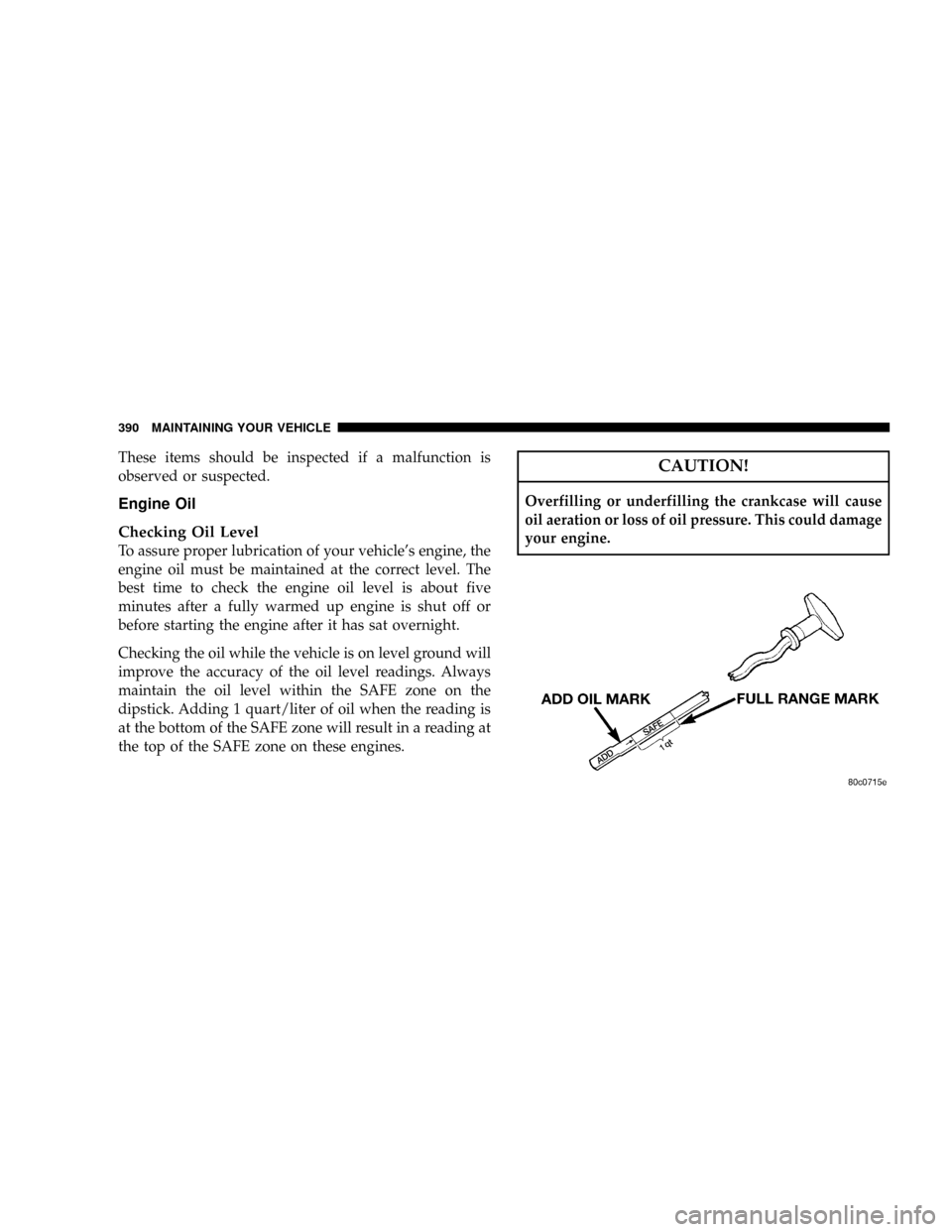
To assure proper lubrication of your vehicle's engine, the
engine oil must be maintained at the correct level. The
best time to check the engine oil level is about five
minutes after a fully warmed up engine is shut off or
before starting the engine after it has sat overnight.
Checking the oil while the vehicle is on level ground will
improve the accuracy of the oil level readings. Always
maintain the oil level within the SAFE zone on the
dipstick. Adding 1 quart/liter of oil when the reading is
at the bottom of the SAFE zone will result in a reading at
the top of the SAFE zone on these engines.
CAUTION!
Overfilling or underfilling the crankcase will cause
oil aeration or loss of oil pressure. This could damage
your engine.
390 MAINTAINING YOUR VEHICLE
Page 392 of 479

Change Engine Oil
Follow the Maintenance Schedule for recommended en-
gine oil and filter change intervals.
NOTE:Under no circumstances should oil change in-
tervals exceed 6,000 miles (10 000 km) or 6 months,
whichever comes first.
4x4 Models, If Used Primarily For Off-Road Operation
Every 50 hours of use.
Dusty Conditions
Driving through dust-laden air increases the problems of
keeping abrasive materials out of the engine. Under these
conditions, special attention should be given to the
engine air cleaner and the crankcase inlet air cleaner. The
crankcase ventilation system should also be checked
periodically. Make sure that these units are always clean.
This will tend to reduce to a minimum the amount of
abrasive material that may enter the engine.
Engine Oil Selection
For best performance and maximum protection under all
types of operating conditions, the manufacturer only
recommends engine oils that are API certified and meet
the requirements of DaimlerChrysler Material Standard
MS-6395.
American Petroleum Institute (API) Engine Oil
Identification Symbol
This symbol means that the oil has
been certified by the American
Petroleum Institute (API). The
manufacturer only recommends
API Certified engine oils.
MAINTAINING YOUR VEHICLE 391
7