automatic transmission CHRYSLER ASPEN 2008 2.G Owner's Manual
[x] Cancel search | Manufacturer: CHRYSLER, Model Year: 2008, Model line: ASPEN, Model: CHRYSLER ASPEN 2008 2.GPages: 479, PDF Size: 4.3 MB
Page 377 of 479
JUMP±STARTING PROCEDURES
WARNING!
²Battery fluid is a corrosive acid solution; do not
allow battery fluid to contact eyes, skin or cloth-
ing. Don't lean over battery when attaching
clamps or allow the clamps to touch each other. If
acid splashes in eyes or on skin, flush the contami-
nated area immediately with large quantities of
water.
²A battery generates hydrogen gas which is flam-
mable and explosive. Keep flame or spark away
from the vent holes. Do not use a booster battery
or any other booster source with an output that
exceeds 12 volts.Check the Battery Test Indicator (if equipped). If a light or
bright colored dot is visible in the indicator (if equipped),
DO NOT jump-start the battery.
If the indicator (if equipped) is dark or shows a green dot,
proceed as follows:
1. Wear eye protection and remove all metal jewelry such
as watch bands or bracelets which might make an
unintended electrical contact.
2. Park the booster vehicle within cable reach but with-
out letting the vehicles touch. Set the parking brake, place
the automatic transmission in PARK and turn the ignition
OFF on both vehicles.
3. Turn OFF heater, radio and all unnecessary electrical
loads.
376 WHAT TO DO IN EMERGENCIES
Page 383 of 479
NAir Conditioner Maintenance.............398
NFront Suspension Ball Joints..............399
NDrive Shaft Constant Velocity Joints........400
NBody Lubrication.....................400
NWindshield Wiper Blades................400
NWindshield And Rear Window Washers.....401
NExhaust System......................401
NCooling System.......................402
NEmission Related Components............407
NBrake System........................408
NAutomatic Transmission................410
NTransfer Case........................413
NAxles..............................413NAppearance Care And Protection From
Corrosion...........................414
mFuse Block............................419
NFuses (Interior).......................420
NFuses (Power Distribution Center).........423
NFuses (Integrated Power Module)..........426
mVehicle Storage........................428
mReplacement Light Bulbs.................429
mBulb Replacement......................429
NHeadlights/Parking/Turn Signal..........429
NTail Lights, Turn Signals And Backup Lights Ð
Replacement.........................431
NLicense Lights........................433
NCenter High-Mounted Stoplight...........434
382 MAINTAINING YOUR VEHICLE
Page 387 of 479
ONBOARD DIAGNOSTIC SYSTEM Ð OBD II
Your vehicle is equipped with a sophisticated onboard
diagnostic system called OBD II. This system monitors
the performance of the emissions, engine, and automatic
transmission control systems. When these systems are
operating properly, your vehicle will provide excellent
performance and fuel economy, as well as engine emis-
sions well within current government regulations.
If any of these systems require service, the OBD II system
will turn on the Malfunction Indicator Light (MIL). It will
also store diagnostic codes and other information to
assist your service technician in making repairs. Al-
though your vehicle will usually be drivable and not
need towing, see your authorized dealer for service as
soon as possible.CAUTION!
²Prolonged driving with the MIL on could cause
further damage to the emission control system. It
could also affect fuel economy and driveability.
The vehicle must be serviced before any emissions
tests can be performed.
²If the MIL is flashing while the engine is running,
severe catalytic converter damage and power loss
will soon occur. Immediate service is required.
Loose Fuel Filler Cap Message
After fuel is added, the vehicle diagnostic system can
determine if the fuel filler cap is possibly loose, improp-
erly installed, or damaged. A loose fuel filler cap message
will be displayed in the instrument cluster. Tighten the
gas cap until a9clicking9sound is heard. This is an
indication that the gas cap is properly tightened. Press
386 MAINTAINING YOUR VEHICLE
Page 411 of 479
CAUTION!
Do not allow a petroleum-base fluid to contaminate
the brake fluid. Seal damage may result.
Brake Hoses
Inspection should be performed whenever the brake
system is serviced or at intervals specified. Inspect hy-
draulic brake hoses for surface cracking, scuffing or worn
spots. If there is any evidence of cracking, scuffing, or
worn spots, the hose should be replaced immediately!
Eventual deterioration of the hose can take place with
possible burst failure.
WARNING!
Worn brake hoses can burst and cause brake failure.
You could have an accident. If you see any sign of
cracking, scuffing, or worn spots, have the brake
hoses replaced immediately.
Automatic Transmission
Fluid Level Check
NOTE:If equipped with a dipstick, use the following
procedure. If your vehicle has a capped dipstick, it is
sealed and should not be tampered with. Your authorized
dealer has the proper tools to ensure that the fluid level
is set properly.
Check the fluid level while the transmission is at normal
operating temperature 180ÉF (82ÉC). This occurs after at
410 MAINTAINING YOUR VEHICLE
Page 412 of 479
least 15 miles (24 km) of driving. At normal operating
temperature the fluid cannot be held comfortably be-
tween the fingertips.
To check the automatic transmission fluid level properly,
the following procedure must be used:
1. Operate the engine at idle speed and normal operating
temperature.
2. The vehicle must be on level ground.
3. Fully apply the parking brake and press the brake
pedal.
4. Place the shift lever momentarily in each gear position
ending with the lever in PARK.
5. Remove the dipstick, wipe it clean and reinsert it until
seated.6. Remove the dipstick again and note the fluid level on
both sides. The fluid level should be between the ªHOTº
(upper) reference holes on the dipstick at normal operat-
ing temperature. Verify that solid coating of oil is seen on
both sides of the dipstick. If the fluid is low, add as
required into the dipstick tube.Do not overfill.After
adding any quantity of oil through the oil fill tube, wait
a minimum of two minutes for the oil to fully drain into
the transmission before rechecking the fluid level.
NOTE:If it is necessary to check the transmissionbelow
the operating temperature, the fluid level should be
between the two ªCOLDº (lower) holes on the dipstick
with the fluid at approximately 70ÉF (21ÉC) (room tem-
perature). If the fluid level is correctly established at
room temperature, it should be between the ªHOTº
(upper) reference holes when the transmission reaches
180ÉF ( 82ÉC). Remember it is best to check the level at the
normal operating temperature.
MAINTAINING YOUR VEHICLE 411
7
Page 413 of 479

CAUTION!
Be aware that if the fluid temperature is below 50ÉF
(10ÉC) it may not register on the dipstick. Do not add
fluid until the temperature is elevated enough to
produce an accurate reading.
7. Check for leaks. Release parking brake.
To prevent dirt and water from entering the transmission
after checking or replenishing fluid, make certain that the
dipstick cap is properly reseated. It is normal for the
dipstick cap to spring back slightly from its fully seated
position, as long as its seal remains engaged in the
dipstick tube.
Automatic Transmission Fluid And Filter Change
Follow the Maintenance Schedule for recommended
transmission fluid and filter change intervals.
Selection of Lubricant
It is important that the proper lubricant is used in the
transmission to assure optimum transmission perfor-
mance. Use only manufacturer 's recommended transmis-
sion fluid; for correct fluid type, refer to ªAutomatic
Transmissionº under ªFluids, Lubricants and Genuine
Partsº in this section. It is important that the transmission
fluid be maintained at the prescribed level using the
recommended fluid.
Special Additives
Automatic Transmission Fluid (ATF) is an engineered
product and its performance may be impaired by supple-
mental additives. Therefore, do not add any fluid addi-
tives to the transmission. The only exception to this
policy is the use of special dyes to aid in detecting fluid
leaks. In addition, avoid using transmission sealers as
they may adversely affect seals.
412 MAINTAINING YOUR VEHICLE
Page 414 of 479
CAUTION!
Using a transmission fluid other than the manufac-
turer's recommended fluid may cause deterioration
in transmission shift quality and/or torque converter
shudder. Using a transmission fluid other than the
manufacturer's recommended fluid will result in
more frequent fluid and filter changes. For correct
fluid type, refer to ªAutomatic Transmissionº under
ªFluids, Lubricants and Genuine Partsº in this
section.
Transfer Case
Inspect the transfer case for fluid leaks. If a fluid leak is
evident the transfer case fluid level may be low. Have the
transfer case serviced immediately.
CAUTION!
Damage may result from operation of the vehicle
with low transfer case fluid.
Drain And Refill
Follow the Maintenance Schedule for recommended
transfer case fluid change intervals.
Lubricant Selection
For correct fluid type, refer to ºTransfer Caseº under
ªFluids, Lubricants and Genuine Partsº in this section.
Axles
For correct fluid type, refer to ºFront or Rear Axleº under
ªFluids, Lubricants and Genuine Partsº in this section.
Drain And Refill
Follow the Maintenance Schedule for recommended axle
fluid change intervals.
MAINTAINING YOUR VEHICLE 413
7
Page 439 of 479
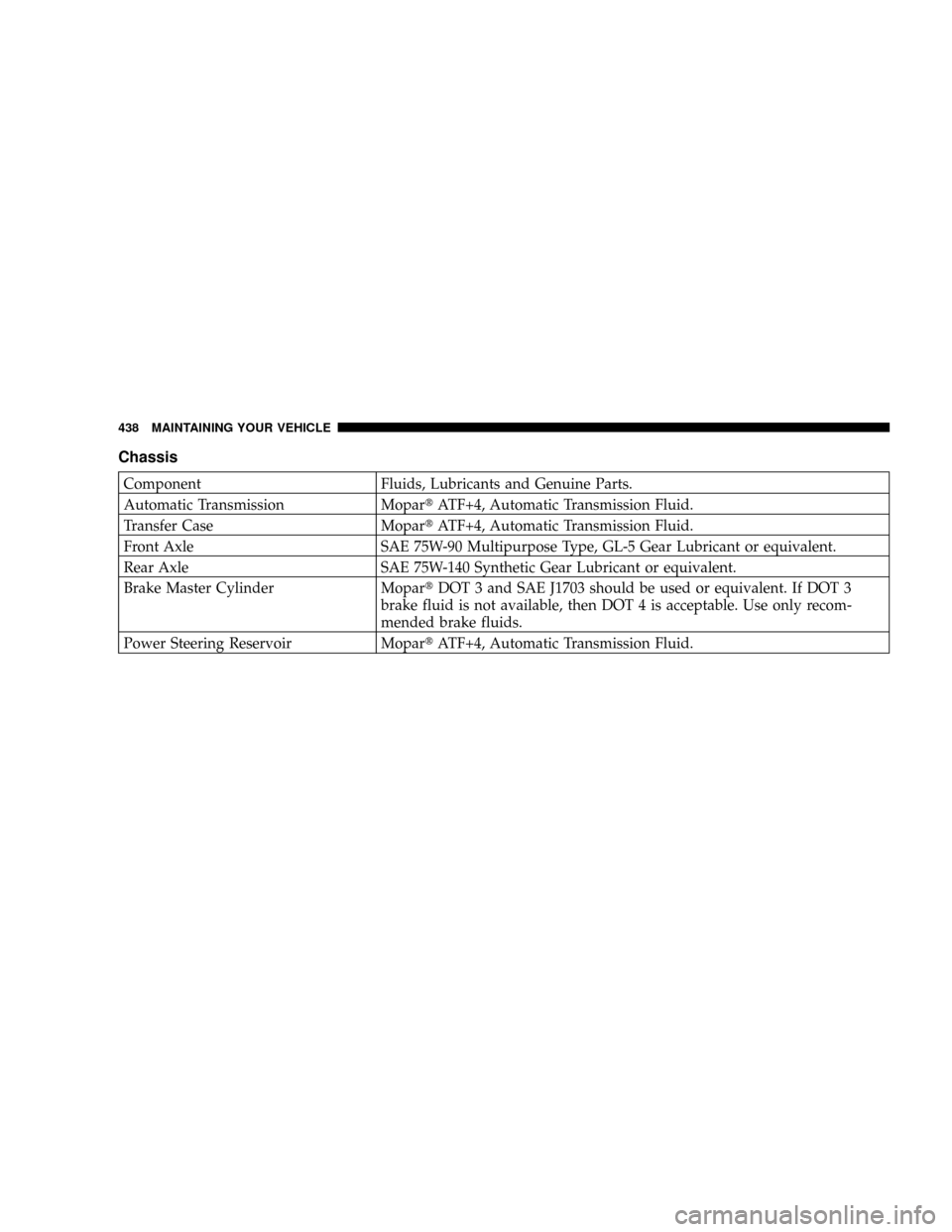
Chassis
Component Fluids, Lubricants and Genuine Parts.
Automatic Transmission MopartATF+4, Automatic Transmission Fluid.
Transfer Case MopartATF+4, Automatic Transmission Fluid.
Front Axle SAE 75W-90 Multipurpose Type, GL-5 Gear Lubricant or equivalent.
Rear Axle SAE 75W-140 Synthetic Gear Lubricant or equivalent.
Brake Master Cylinder MopartDOT 3 and SAE J1703 should be used or equivalent. If DOT 3
brake fluid is not available, then DOT 4 is acceptable. Use only recom-
mended brake fluids.
Power Steering Reservoir MopartATF+4, Automatic Transmission Fluid.
438 MAINTAINING YOUR VEHICLE
Page 445 of 479
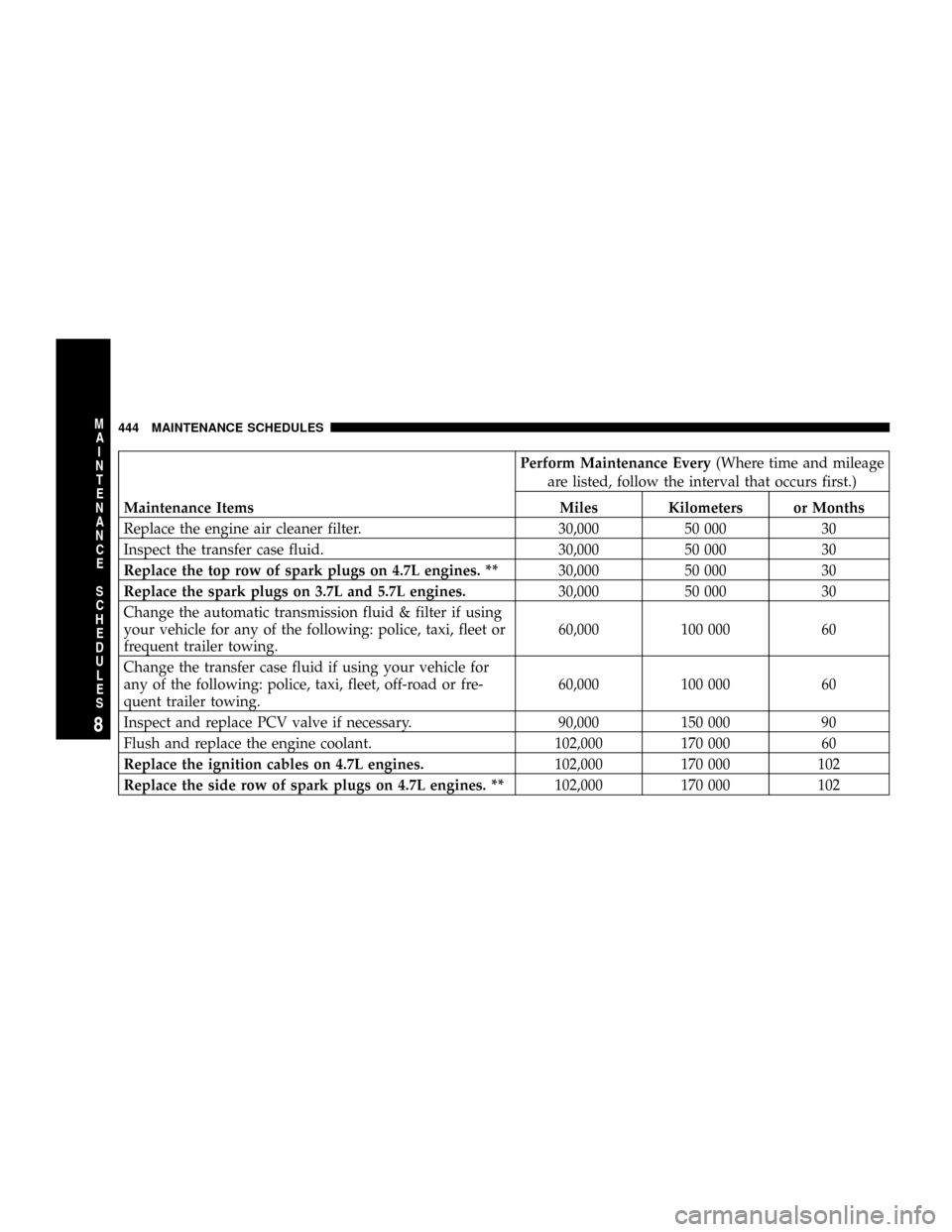
Perform Maintenance Every(Where time and mileage
are listed, follow the interval that occurs first.)
Maintenance Items Miles Kilometers or Months
Replace the engine air cleaner filter. 30,000 50 000 30
Inspect the transfer case fluid. 30,000 50 000 30
Replace the top row of spark plugs on 4.7L engines. **30,000 50 000 30
Replace the spark plugs on 3.7L and 5.7L engines.30,000 50 000 30
Change the automatic transmission fluid & filter if using
your vehicle for any of the following: police, taxi, fleet or
frequent trailer towing.60,000 100 000 60
Change the transfer case fluid if using your vehicle for
any of the following: police, taxi, fleet, off-road or fre-
quent trailer towing.60,000 100 000 60
Inspect and replace PCV valve if necessary. 90,000 150 000 90
Flush and replace the engine coolant. 102,000 170 000 60
Replace the ignition cables on 4.7L engines.102,000 170 000 102
Replace the side row of spark plugs on 4.7L engines. **102,000 170 000 102
444 MAINTENANCE SCHEDULES
8
M
A
I
N
T
E
N
A
N
C
E
S
C
H
E
D
U
L
E
S
Page 446 of 479
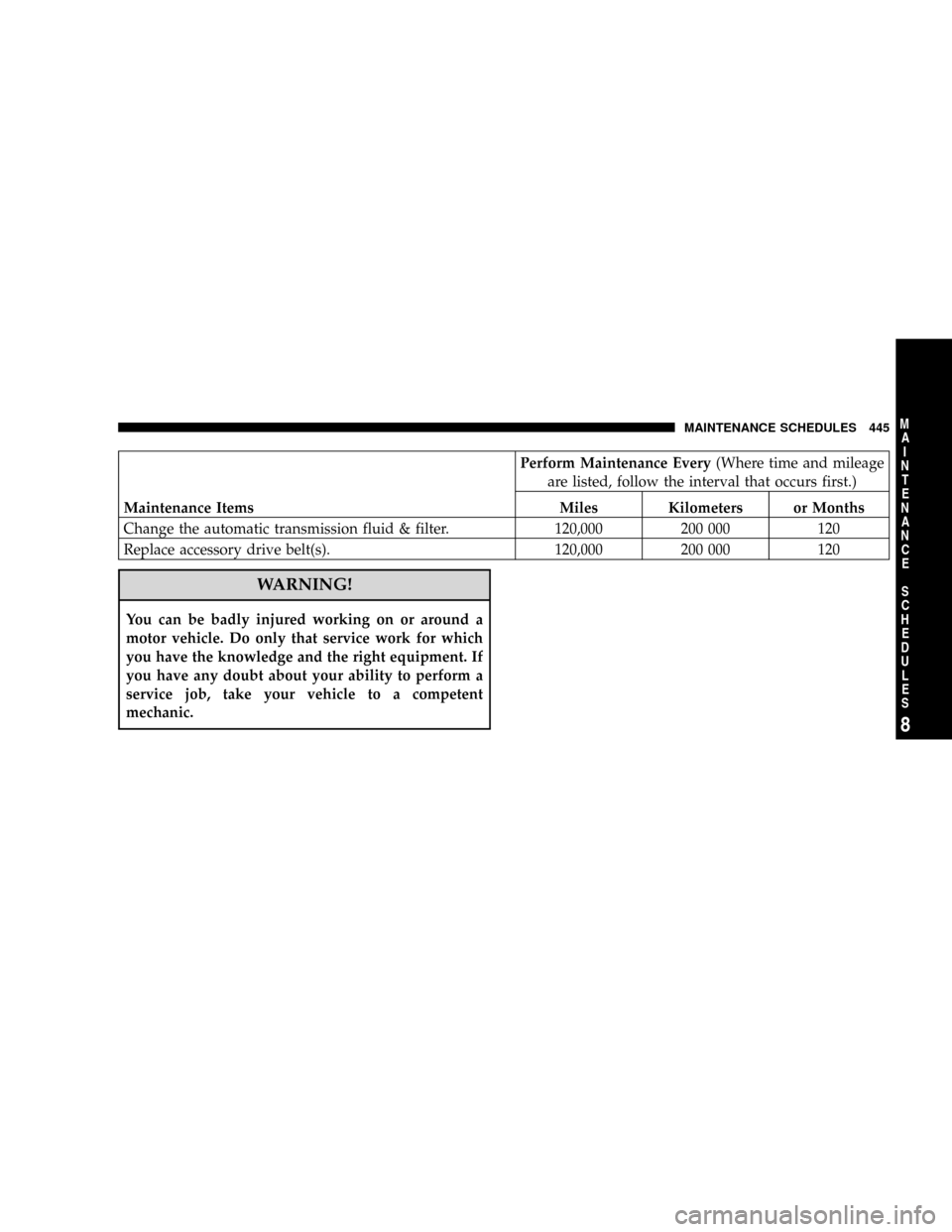
Perform Maintenance Every(Where time and mileage
are listed, follow the interval that occurs first.)
Maintenance Items Miles Kilometers or Months
Change the automatic transmission fluid & filter. 120,000 200 000 120
Replace accessory drive belt(s). 120,000 200 000 120
WARNING!
You can be badly injured working on or around a
motor vehicle. Do only that service work for which
you have the knowledge and the right equipment. If
you have any doubt about your ability to perform a
service job, take your vehicle to a competent
mechanic.
MAINTENANCE SCHEDULES 445
8
M
A
I
N
T
E
N
A
N
C
E
S
C
H
E
D
U
L
E
S