child seat CHRYSLER ASPEN 2009 2.G User Guide
[x] Cancel search | Manufacturer: CHRYSLER, Model Year: 2009, Model line: ASPEN, Model: CHRYSLER ASPEN 2009 2.GPages: 481, PDF Size: 9.28 MB
Page 69 of 481
²Check belt fit periodically. A child's squirming or
slouching can move the belt out of position.
²If the shoulder belt contacts the face or neck, move the
child closer to the center of the vehicle. Never allow a
child to put the shoulder belt under an arm.
WARNING!
²Improper installation can lead to failure of an
infant or child restraint. It could come loose in a
collision. The child could be badly injured or
killed. Follow the manufacturer's directions ex-
actly when installing an infant or child restraint.
²A rearward-facing infant restraint should only be
used in a rear seat. A rearward-facing infant re-
straint in the front seat may be struck by a deploy-
ing passenger airbag which may cause severe
injuries or be fatal to the infant.Here are some tips for getting the most out of your child
restraint:
²Before buying any restraint system, make sure that it
has a label certifying that it meets all applicable Safety
Standards. The manufacturer recommends that you
try a child restraint in the vehicle seats where you will
use it before you buy it.
²The restraint must be appropriate for your child's
weight and height. Check the label on the restraint for
weight and height limits.
²Carefully follow the instructions that come with the
restraint. If you install the restraint improperly, it may
not work when you need it.
²The second row seating positions and all third row
seats have either cinching latch plates or an automatic
locking retractor. These are designed to keep the lap
portion tight around the child restraint so that it is not
necessary to use a locking clip.
THINGS TO KNOW BEFORE STARTING YOUR VEHICLE 67
2
Page 70 of 481
²Buckle the child into the restraint exactly as the
manufacturer's instructions tell you.
²When your child restraint is not in use, secure it in the
vehicle with the seat belt or remove it from the vehicle.
Do not leave it loose in the vehicle. In a sudden stop or
collision, it could strike the occupants or seatbacks and
cause serious personal injury.
LATCH - Child Seat Anchorage System (Lower
Anchors and Tether for CHildren)
Your vehicle's second row seat is equipped with the child
restraint anchorage system called LATCH. The LATCH
system provides for the installation of the child restraint
without using the vehicle's seat belts, instead securing
the child restraint using lower anchorages and upper
tether straps from the child restraint to the vehicle
structure. LATCH-compatible child restraint systems are
now available. However, because the lower anchorages
are to be introduced over a period of years, child restraintsystems having attachments for those anchorages will
continue to also have features for installation using the
vehicle's seat belts. Child restraints having tether straps
and hooks for connection to the top tether anchorages
have been available for some time. For some older child
restraints, many child restraint manufacturers offer
add-on tether strap kits or retro-fit kits. You are urged to
take advantage of all the available attachments provided
with your child restraint in any vehicle.
All three second row seating positions have lower an-
chorages that are capable of accommodating LATCH-
compatible child seats having flexible, webbing-mounted
lower attachments. Child seats with fixed lower attach-
ments must be installed in the outboard positions only.
Regardless of the specific type of lower attachment,
NEVERinstall LATCH-compatible child seats such that
two seats share a common lower anchorage. If you are
installing LATCH-compatible child restraints in adjacent
rear seating positions, you can use the LATCH anchors or
68 THINGS TO KNOW BEFORE STARTING YOUR VEHICLE
Page 71 of 481
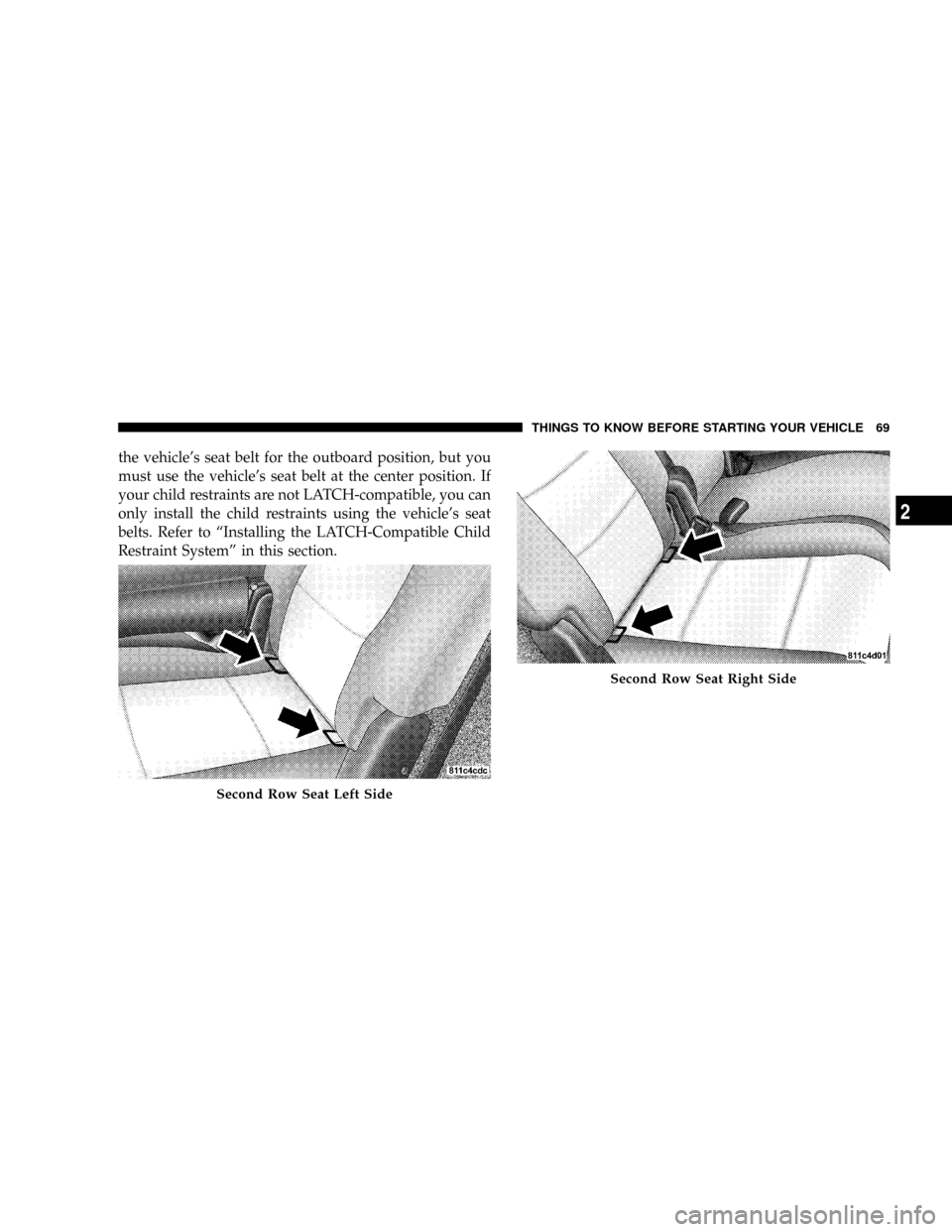
the vehicle's seat belt for the outboard position, but you
must use the vehicle's seat belt at the center position. If
your child restraints are not LATCH-compatible, you can
only install the child restraints using the vehicle's seat
belts. Refer to ªInstalling the LATCH-Compatible Child
Restraint Systemº in this section.
Second Row Seat Left Side
Second Row Seat Right Side
THINGS TO KNOW BEFORE STARTING YOUR VEHICLE 69
2
Page 72 of 481
Installing the LATCH-Compatible Child Restraint
System
We urge that you carefully follow the directions of the
manufacturer when installing your child restraint. Not all
child restraint systems will be installed as described here.
Again, carefully follow the installation instructions that
were provided with the child restraint system. The rear
seat lower anchorages are round bars, located at the rear
of the seat cushion where it meets the seatback, and are
just visible when you lean into the rear seat to install the
child restraint. You will easily feel them if you run your
finger along the intersection of the seatback and seat
cushion surfaces. In addition, there are tether strap
anchorages behind each second row seating position
located on the back of the seat. Many, but not all restraint
systems will be equipped with separate straps on each
side, with each having a hook or connector for attach-
ment to the lower anchorage and a means of adjusting
the tension in the strap. Forward-facing toddler restraintsand some rear-facing infant restraints will also be
equipped with a tether strap, a hook for attachment to the
tether strap anchorage and a means of adjusting the
tension of the strap. You will first loosen the adjusters on
the lower straps and on the tether strap so that you can
more easily attach the hooks or connectors to the vehicle
anchorages. Next, attach the lower hooks or connectors
over the top of the anchorage bars, pushing aside the seat
cover material. Then attach the tether strap to the anchor-
age located on the back of the seat, being careful to route
the tether strap to provide the most direct path between
the anchor and the child restraint. If your vehicle is
equipped with adjustable rear head restraints, raise the
head restraint and, route the tether strap under the head
restraint and between the two posts. Finally, tighten all
three straps as you push the child restraint rearward and
downward into the seat, removing slack in the straps
according to the child restraint manufacturer's instruc-
tions.
70 THINGS TO KNOW BEFORE STARTING YOUR VEHICLE
Page 73 of 481
NOTE:When using the LATCH attaching system to
install a child restraint, please ensure that all seat belts
not being used for occupant restraints are stowed and out
of reach of children. It is recommended that before
installing the child restraint, buckle the seat belt so the
seat belt is tucked behind the child restraint and out of
reach. This should stow the seat belt out of the reach of an
inquisitive child. Remind all children in the vehicle that
the seat belts are not toys and should not be played with,
and never leave an unattended child in the vehicle.
WARNING!
Improper installation of a child restraint to the
LATCH anchorages can lead to failure of an infant or
child restraint. The child could be badly injured or
killed. Follow the manufacturer's directions exactly
when installing an infant or child restraint.
Installing Child Restraints Using the Vehicle Seat
Belt
The seat belts in the passenger seating positions are
equipped with either an Automatic Locking Retractor
(ALR) or a cinching latch plate or both. Both types of seat
belts are designed to keep the lap portion of the seat belt
tight around the child restraint so that it is not necessary
to use a locking clip. The ALR will make a ratcheting
noise if you extract the entire belt from the retractor and
then allow the belt to retract into the retractor. For
additional information on ALR, refer to ªAutomatic
Locking Modeº in this section.
To install a child restraint, first, pull enough of the seat
belt webbing from the retractor to route it through the
belt path of the child restraint and slide the latch plate
into the buckle. Next, extract all the seat belt webbing out
of the retractor and then allow the belt to retract into the
retractor. Finally, pull on any excess webbing to tighten
THINGS TO KNOW BEFORE STARTING YOUR VEHICLE 71
2
Page 74 of 481
the lap portion around the child restraint. Any seat belt
system will loosen with time, so check the belt occasion-
ally, and pull it tight if necessary.Child Restraints in Third Row Seating (If
Equipped)
For vehicles equipped with third row split bench (60/40)
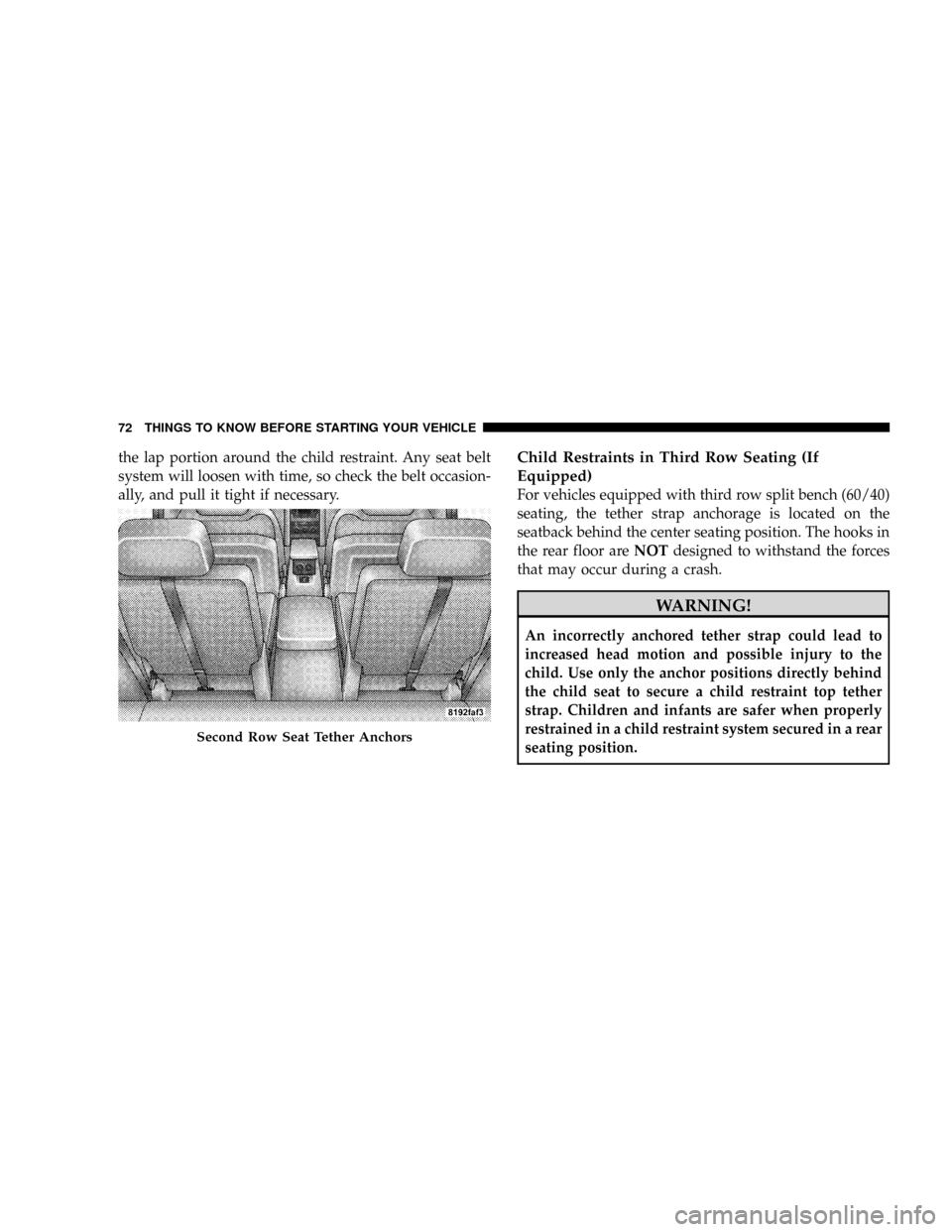
seating, the tether strap anchorage is located on the
seatback behind the center seating position. The hooks in
the rear floor areNOTdesigned to withstand the forces
that may occur during a crash.
WARNING!
An incorrectly anchored tether strap could lead to
increased head motion and possible injury to the
child. Use only the anchor positions directly behind
the child seat to secure a child restraint top tether
strap. Children and infants are safer when properly
restrained in a child restraint system secured in a rear
seating position.
Second Row Seat Tether Anchors
72 THINGS TO KNOW BEFORE STARTING YOUR VEHICLE
Page 75 of 481
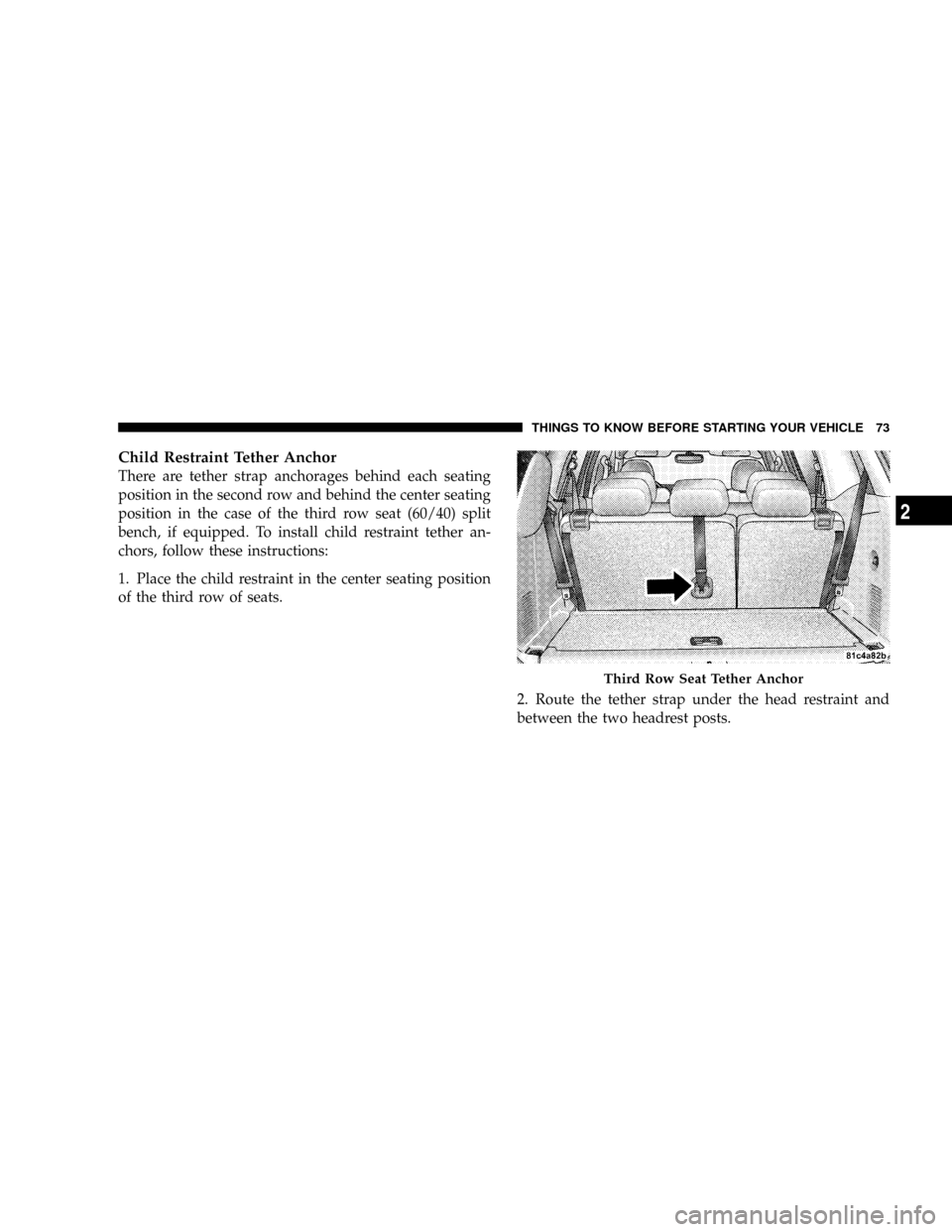
Child Restraint Tether Anchor
There are tether strap anchorages behind each seating
position in the second row and behind the center seating
position in the case of the third row seat (60/40) split
bench, if equipped. To install child restraint tether an-
chors, follow these instructions:
1. Place the child restraint in the center seating position
of the third row of seats.
2. Route the tether strap under the head restraint and
between the two headrest posts.
Third Row Seat Tether Anchor
THINGS TO KNOW BEFORE STARTING YOUR VEHICLE 73
2
Page 76 of 481
3. Attach the tether strap hook of the child restraint to
the tether anchor located on the seatback and remove the
slack in the tether strap according to the manufacturer 's
instructions.
WARNING!
An incorrectly anchored tether strap could lead to
seat failure and injury to the child. In a collision, the
seat could come loose and allow the child to crash
into the inside of the vehicle or other passengers, or
even be thrown from the vehicle. Use only the anchor
positions directly behind the child seat to secure a
child restraint top tether strap. For instructions, refer
to ªChild Restraint Tether Anchorº in this section.
See your authorized dealer for help if necessary.
Transporting Pets
Airbags deploying in the front seat could harm your pet.
An unrestrained pet will be thrown about and possiblyinjured, or injure a passenger during panic braking or in
a collision. Pets should be restrained in the rear seat in
pet harnesses or pet carriers that are secured by seat belts.
ENGINE BREAK-IN RECOMMENDATIONS
A long break-in period is not required for the engine in
your vehicle.
Drive moderately during the first 300 miles (500 km).
After the initial 60 miles (100 km), speeds up to 50 or 55
mph (80 or 90 km/h) are desirable.
While cruising, brief full-throttle acceleration within the
limits of local traffic laws, contributes to a good break-in.
Wide-open throttle acceleration in low gear can be detri-
mental and should be avoided.
The engine oil installed in the engine at the factory is a
high-quality energy conserving type lubricant. Oil
changes should be consistent with anticipated climate
conditions under which vehicle operations will occur.
74 THINGS TO KNOW BEFORE STARTING YOUR VEHICLE
Page 186 of 481
To close the sunroof, hold the switch in the forward
position. Again, any release of the switch will stop the
movement and the sunroof will remain in a partial open
condition until the switch is pushed forward again. To
close fully, hold the switch in the forward position until
the glass movement has stopped.
The sunshade can be opened manually. It will also open
as the sunroof opens. The sunshade cannot be closed if
the sunroof is open.
WARNING!
Never leave children alone in a vehicle. Leaving
unattended children in a vehicle is dangerous for a
number of reasons. A child or others could be seri-
ously or fatally injured. Don't leave the key in the
ignition. A child could operate power windows,
other controls, or move the vehicle.
WARNING!
In an accident, there is a greater risk of being thrown
from a vehicle with an open sunroof. You could also
be seriously injured or killed. Always fasten your
seat belt properly and make sure all passengers are
properly secured too.
Do not allow small children to operate the sunroof.
Never allow fingers or other body parts, or any object
to project through the sunroof opening. Injury may
result.
Wind Buffeting
Wind buffeting can be described as the perception of
pressure on the ears or a helicopter type sound in the
ears. Your vehicle may exhibit wind buffeting with the
windows down, or the sunroof (if equipped) in certain
open or partially open positions. This is a normal occur-
rence and can be minimized. If the buffeting occurs with
184 UNDERSTANDING THE FEATURES OF YOUR VEHICLE
Page 277 of 481
STARTING PROCEDURES
Before starting your vehicle, adjust your seat, adjust the
inside and outside mirrors, fasten your seat belt, and if
present, instruct all other occupants to buckle their seat
belts.
WARNING!
²Never leave children alone in a vehicle. Leaving
unattended children in a vehicle is dangerous for a
number of reasons. A child or others could be
seriously or fatally injured. Do not leave the key in
the ignition. A child could operate power win-
dows, other controls, or move the vehicle.
²Do not leave animals or children inside parked
vehicles in hot weather; interior heat buildup may
cause serious injury or death.
(Continued)
WARNING! (Continued)
²Be sure to turn off the engine and remove the key
from the ignition switch if you want to rest or
sleep in your car. Accidents can be caused by
inadvertently moving the shift lever. Accidents
can also be caused by pressing the accelerator
pedal. This may cause excessive heat in the ex-
haust system, resulting in overheating and vehicle
fire, which may cause serious or fatal injuries.
Normal Starting
The shift lever must be in the NEUTRAL or PARK
position before you can start the engine. Apply the brakes
before shifting into any driving gear.
NOTE:Normal starting of either a cold or a warm
engine is obtained without pumping or depressing the
accelerator pedal.
STARTING AND OPERATING 275
5