oil CHRYSLER ASPEN 2009 2.G User Guide
[x] Cancel search | Manufacturer: CHRYSLER, Model Year: 2009, Model line: ASPEN, Model: CHRYSLER ASPEN 2009 2.GPages: 481, PDF Size: 9.28 MB
Page 211 of 481
2. Fully depress the accelerator pedal slowly three
times within 10 seconds.
3. Turn the ignition switch to the OFF/LOCK position.
NOTE:If the indicator message illuminates when you
start the vehicle, the oil change indicator system did not
reset. If necessary repeat this procedure.
16. Odometer
The odometer shows the total distance the vehicle has
been driven.
U.S. federal regulations require that upon transfer of
vehicle ownership, the seller certify to the purchaser the
correct mileage that the vehicle has been driven. There-
fore, if the odometer reading is changed during repair or
replacement, be sure to keep a record of the reading
before and after the service so that the correct mileage can
be determined.17. Fog Light Indicator
This light shows when the fog lights are ON.
18. Electronic Stability Program (ESP) Indicator Light
The yellow Electronic Stability Program (ESP)
indicator light in the speedometer area illumi-
nates with the key in the ignition switch turned
to the ON/RUN position and it should go out
with the engine running. The ESP is also combined with
the Traction Control System (TCS), when the9ESP/TCSº
Indicator Light9starts to flash as soon as the tires lose
traction and the ESP system becomes active. The9ESP/
TCS Indicator Light9also flashes when TCS is active. If
the9ESP/TCS Indicator Light9begins to flash during
acceleration, ease up on the accelerator and apply as little
throttle as possible. Be sure to adapt your speed and
driving to the prevailing road conditions. The ªESP/TCS
Indicator Lightº becomes illuminated when the ESP-Off
UNDERSTANDING YOUR INSTRUMENT PANEL 209
4
Page 270 of 481
Regular cleaning of the inside of the windows with a
non-filming cleaning solution (vinegar and water works
very well) will help prevent contaminants (cigarette
smoke, perfumes, etc.) from sticking to the windows.
Contaminants increase the rate of window fogging.
Summer Operation
Air conditioned vehicles must be protected with a high
quality antifreeze coolant during summer to provide
proper corrosion protection and to raise the boiling point
of the coolant for protection against overheating. A 50 %
concentration is recommended.
Winter Operation
When operating the system during the winter months,
make sure the air intake, located directly in front of the
windshield, is free of ice, slush, snow, or other obstruc-
tions. This will also prevent snow ingestion into the
ducts.
268 UNDERSTANDING YOUR INSTRUMENT PANEL
Page 276 of 481
NEthanol Fuel (E-85)................... 342
NFuel Requirements.................... 342
NSelection Of Engine Oil For Flexible Fuel
Vehicles (E-85) And Gasoline Vehicles...... 343
NStarting........................... 343
NCruising Range...................... 343
NReplacement Parts.................... 343
mAdding Fuel......................... 344
NFuel Filler Cap (Gas Cap)............... 344
NLoose Fuel Filler Cap (Gas Cap) Message.... 345
mVehicle Loading....................... 346
NCertification Label.................... 346
NCurb Weight........................ 348NLoading........................... 348
mTrailer Towing........................ 349
NCommon Towing Definitions............ 349
NTrailer Hitch Classification.............. 353
NTrailer Towing Weights (Maximum Trailer
Weight Ratings)...................... 354
NTrailer And Tongue Weight.............. 354
NTowing Requirements................. 355
NTowing Tips........................ 360
mSnowplow........................... 362
m
Recreational Towing (Behind Motorhome, Etc.). . 362
N2WD Models........................ 362
N4WD Models........................ 362
274 STARTING AND OPERATING
Page 294 of 481
CAUTION!
²Driving through standing water may cause dam-
age to your vehicle's drivetrain components. Al-
ways inspect your vehicle's fluids (i.e., engine oil,
transmission/transaxle, axle, etc.) for signs of con-
tamination (i.e., fluid that is milky or foamy in
appearance) after driving through standing water.
Do not continue to operate the vehicle if any fluid
appears contaminated, as this may result in further
damage. Such damage is not covered by the New
Vehicle Limited Warranty.
²Getting water inside your vehicle's engine can
cause it to lock up and stall out, and cause serious
internal damage to the engine. Such damage is not
covered by the New Vehicle Limited Warranty.
WARNING!
²Driving through standing water limits your vehi-
cle's traction capabilities. Do not exceed 5 mph (8
km/h) when driving through standing water.
²Driving through standing water limits your vehi-
cle's braking capabilities, which increases stop-
ping distances. Therefore, after driving through
standing water, drive slowly and lightly press on
the brake pedal several times to dry the brakes.
²Getting water inside your vehicle's engine can
cause it to lock up and stall out, and leave you
stranded.
²Failure to follow these warnings may result in
injuries that are serious or fatal to you, your
passengers, and others around you.
292 STARTING AND OPERATING
Page 325 of 481
Keep dismounted tires in a cool, dry place with as little
exposure to light as possible. Protect tires from contact
with oil, grease, and gasoline.
Replacement Tires
The tires on your new vehicle provide a balance of many
characteristics. They should be inspected regularly for
wear and correct cold tire inflation pressure. The manu-
facturer strongly recommends that you use tires equiva-
lent to the originals in size, quality and performance
when replacement is needed. (Refer to the paragraph on
ªTread Wear Indicatorsº). Refer to the ªTire and Loading
Informationº placard for the size designation of your tire.
The service description and load identification will be
found on the original equipment tire. Failure to use
equivalent replacement tires may adversely affect the
safety, handling, and ride of your vehicle. We recommend
that you contact your original equipment or an autho-
rized tire dealer with any questions you may have on tire
specifications or capability.
WARNING!
DO NOT use a tire, wheel size or rating other than
that specified for your vehicle. Some combinations of
unapproved tires and wheels may change suspension
dimensions and performance characteristics, result-
ing in changes to steering, handling, and braking of
your vehicle. This can cause unpredictable handling
and stress to steering and suspension components.
You could lose control and have an accident resulting
in serious injury or death. Use only the tire and
wheel sizes with load ratings approved for your
vehicle.
STARTING AND OPERATING 323
5
Page 339 of 481
CAUTION!
DO NOT use gasoline containing Methanol or E85
Ethanol. Use of these blends may result in starting
and driveability problems and may damage critical
fuel system components.
Problems that result from using methanol/gasoline
blends are not the responsibility of the manufacturer.
While MTBE is an oxygenate made from Methanol, it
does not have the negative effects of Methanol.
E-85 Usage In Non-Flex Fuel Vehicles
Non-FFV vehicles are compatible with gasoline contain-
ing 10% ethanol (E10). Gasoline with higher ethanol
content may void the vehicle's warranty.
If a Non-FFV vehicle is inadvertently fueled with E-85
fuel, the engine will have some or all of these symptoms:
²operate in a lean mode
²OBD II ªMalfunction Indicator Lightº on
²poor engine performance
²poor cold start and cold drivability
²increased risk for fuel system component corrosion
To fix a Non-FFV vehicle inadvertently fueled once with
E-85 perform the following:
²drain the fuel tank (see your authorized dealer)
²change the engine oil and oil filter
²disconnect and reconnect the battery to reset the
engine controller memory
More extensive repairs will be required for prolonged
exposure to E-85 fuel.
STARTING AND OPERATING 337
5
Page 345 of 481
Selection Of Engine Oil For Flexible Fuel Vehicles
(E-85) and Gasoline Vehicles
FFV vehicles operated on E-85 require specially formu-
lated engine oils. These special requirements are included
in MOPARtengine oils, and in equivalent oils meeting
Chrysler Specification MS-6395. The manufacturer only
recommends engine oils that are API Certified and meet
the requirements of Material Standard MS-6395. MS-6395
contains additional requirements, developed during ex-
tensive fleet testing, to provide additional protection to
Chrysler LLC engines. Use MOPARtor an equivalent oil
meeting the specification MS-6395.
Starting
The characteristics of E-85 fuel make it unsuitable for use
when ambient temperatures fall below 0ÉF (-18ÉC). In the
range of 0ÉF (-18ÉC) to 32ÉF (0ÉC), you may experience an
increase in the time it takes for your engine to start, and
a deterioration in drivability (sags and/or hesitations)
until the engine is fully warmed up.
CAUTION!
Do not use ethanol mixture greater than 85% in your
vehicle. It will cause difficulty in cold starting and
may affect drivability.
Cruising Range
Because E-85 fuel contains less energy per gallon/Liter
than gasoline, you will experience an increase in fuel
consumption. You can expect your miles per gallon
(mpg)/miles per liter and your driving range to decrease
by about 30%, compared to gasoline operation.
Replacement Parts
Many components in your Flexible Fuel Vehicle (FFV) are
designed to be compatible with ethanol. Always be sure
that your vehicle is serviced with correct ethanol, com-
patible parts.
STARTING AND OPERATING 343
5
Page 377 of 481
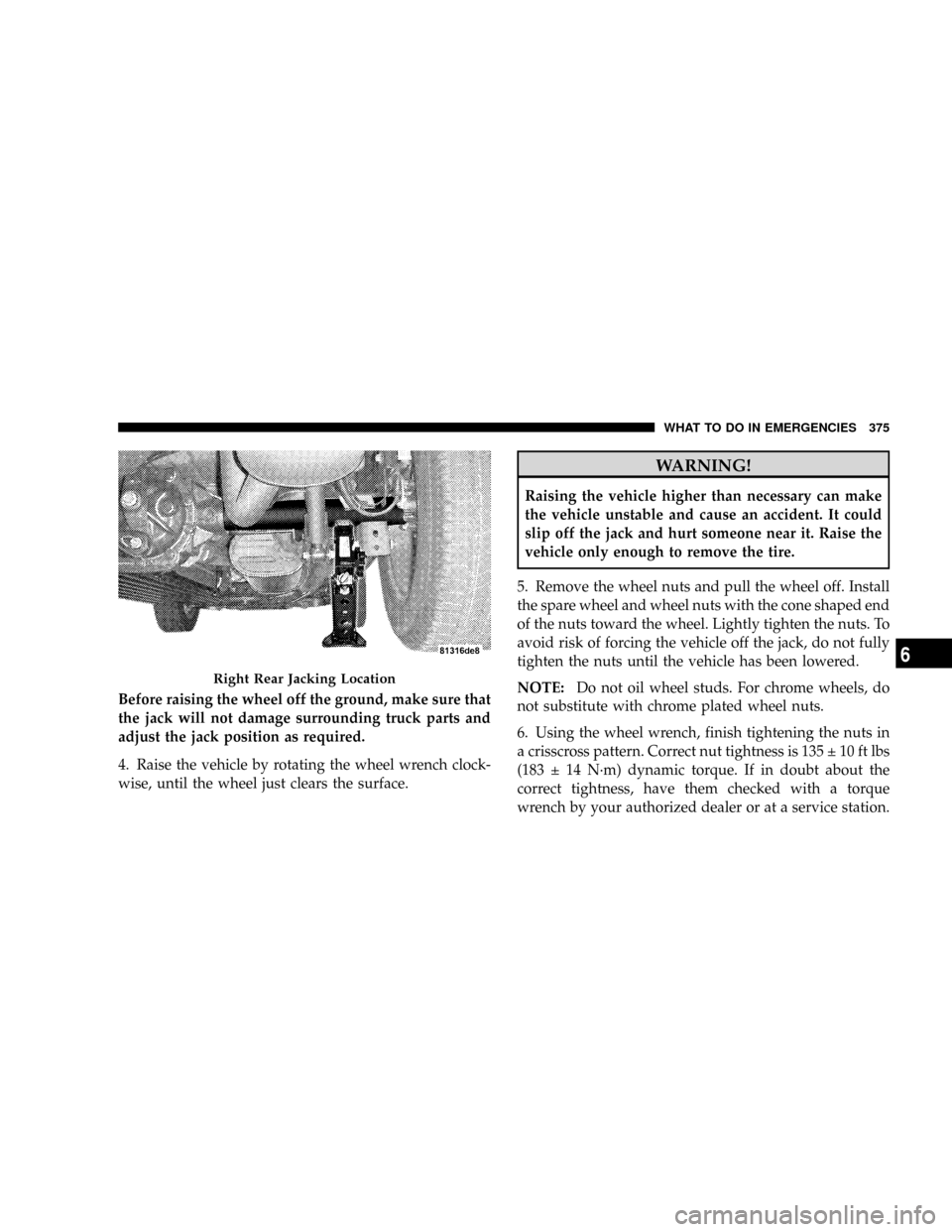
Before raising the wheel off the ground, make sure that
the jack will not damage surrounding truck parts and
adjust the jack position as required.
4. Raise the vehicle by rotating the wheel wrench clock-
wise, until the wheel just clears the surface.
WARNING!
Raising the vehicle higher than necessary can make
the vehicle unstable and cause an accident. It could
slip off the jack and hurt someone near it. Raise the
vehicle only enough to remove the tire.
5. Remove the wheel nuts and pull the wheel off. Install
the spare wheel and wheel nuts with the cone shaped end
of the nuts toward the wheel. Lightly tighten the nuts. To
avoid risk of forcing the vehicle off the jack, do not fully
tighten the nuts until the vehicle has been lowered.
NOTE:Do not oil wheel studs. For chrome wheels, do
not substitute with chrome plated wheel nuts.
6. Using the wheel wrench, finish tightening the nuts in
a crisscross pattern. Correct nut tightness is 135 10 ft lbs
(183 14 N´m) dynamic torque. If in doubt about the
correct tightness, have them checked with a torque
wrench by your authorized dealer or at a service station.
Right Rear Jacking Location
WHAT TO DO IN EMERGENCIES 375
6
Page 378 of 481
WARNING!
A loose tire or jack thrown forward in a collision or
hard stop could injure someone in the vehicle. Al-
ways stow the jack, tools and the extra tire and wheel
in the places provided.
7. Remove wheel blocks. Do not install chrome or alu-
minum wheel center caps on the spare wheel. This may
result in cap damage.
8. Lower the jack to its fully closed position. Stow the
replaced tire, jack, and tools as previously described.
9. Adjust the tire pressure when possible.
NOTE:Do not oil wheel studs. For chrome wheels, do
not substitute with chrome plated wheel nuts.
WARNING!
Carefully follow these tire changing warnings to
help prevent personal injury or damage to your
vehicle:
²Always park on a firm, level surface as far from
the edge of the roadway as possible before raising
the vehicle.
²Block the wheel diagonally opposite the wheel to
be raised.
²Apply the parking brake firmly before jacking.
²Never start the engine with the vehicle on a jack.
²Do not let anyone sit in the vehicle when it is on a
jack.
²Do not get under the vehicle when it is on a jack.
²Only use the jack in the positions indicated.
(Continued)
376 WHAT TO DO IN EMERGENCIES
Page 385 of 481
MAINTAINING YOUR VEHICLE
CONTENTS
mEngine Compartment ± 4.7L.............. 385
mEngine Compartment ± 5.7L.............. 386
mOnboard Diagnostic System Ð OBD II....... 387
NLoose Fuel Filler Cap Message........... 387
mEmissions Inspection And Maintenance
Programs............................ 388
mReplacement Parts..................... 389
mDealer Service........................ 390
mMaintenance Procedures................. 390NEngine Oil......................... 390
NEngine Oil Filter..................... 392
NEngine Air Cleaner Filter............... 393
NMaintenance-Free Battery............... 393
NAir Conditioner Maintenance............ 394
NDrive Shaft Constant Velocity Joints....... 395
NBody Lubrication..................... 396
NWindshield Wiper Blades............... 396
NWindshield And Rear Window Washers..... 397
7