seat adjustment CHRYSLER VOYAGER 1996 Owner's Guide
[x] Cancel search | Manufacturer: CHRYSLER, Model Year: 1996, Model line: VOYAGER, Model: CHRYSLER VOYAGER 1996Pages: 1938, PDF Size: 55.84 MB
Page 1711 of 1938
GEARSHIFT CROSSOVER CABLE
Before replacing the gearshift cables for a hard-
shifting complaint, disconnect both cables at the
transaxle. Then, from the driver's seat, manually
operate the gearshift lever through all gear ranges. If
the gearshift lever moves smoothly, the cable(s)
should NOT be replaced. If the gear lever binds
replace the cable that is causing the binding condi-
tion. If the problem still exists, check the crossover
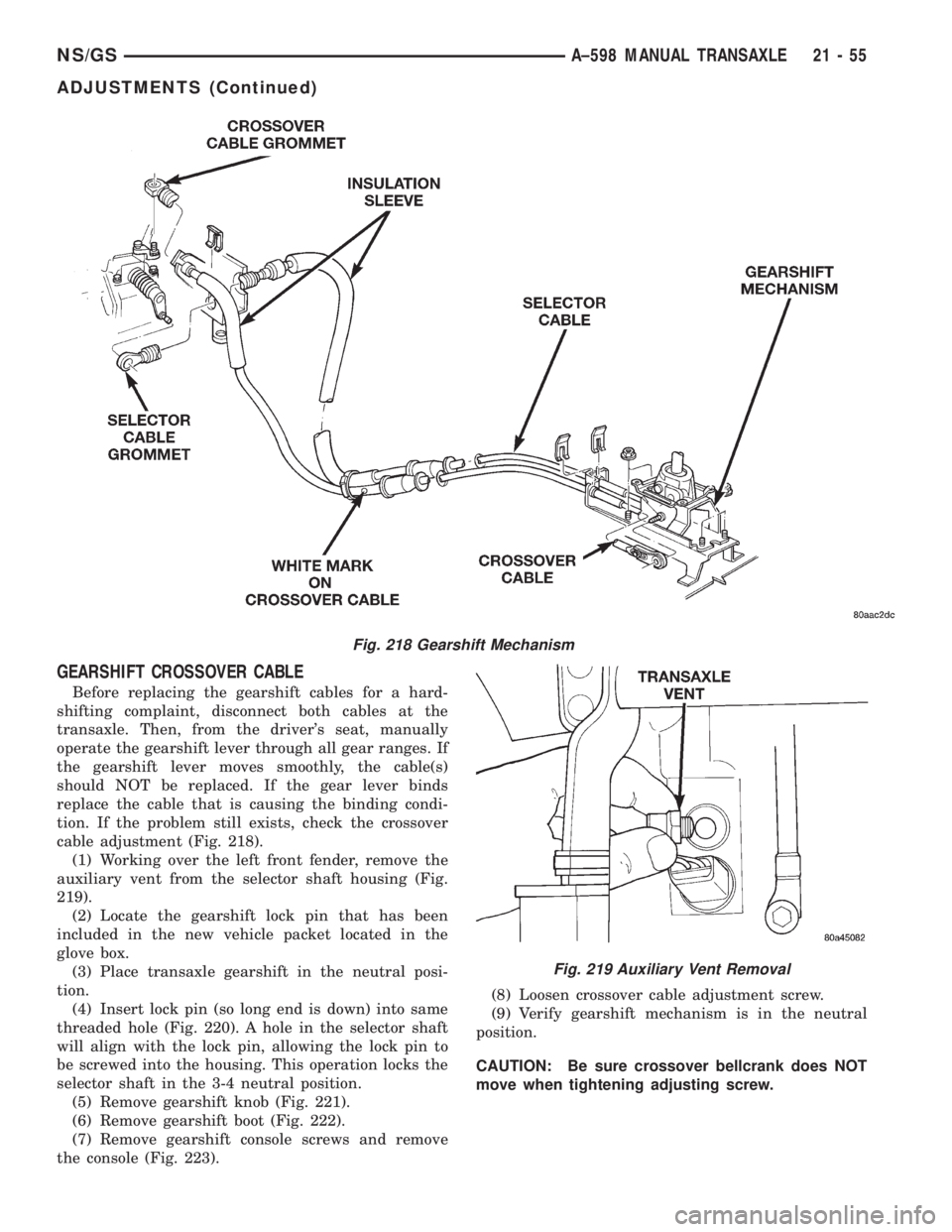
cable adjustment (Fig. 218).
(1) Working over the left front fender, remove the
auxiliary vent from the selector shaft housing (Fig.
219).
(2) Locate the gearshift lock pin that has been
included in the new vehicle packet located in the
glove box.
(3) Place transaxle gearshift in the neutral posi-
tion.
(4) Insert lock pin (so long end is down) into same
threaded hole (Fig. 220). A hole in the selector shaft
will align with the lock pin, allowing the lock pin to
be screwed into the housing. This operation locks the
selector shaft in the 3-4 neutral position.
(5) Remove gearshift knob (Fig. 221).
(6) Remove gearshift boot (Fig. 222).
(7) Remove gearshift console screws and remove
the console (Fig. 223).(8) Loosen crossover cable adjustment screw.
(9) Verify gearshift mechanism is in the neutral
position.
CAUTION: Be sure crossover bellcrank does NOT
move when tightening adjusting screw.
Fig. 218 Gearshift Mechanism
Fig. 219 Auxiliary Vent Removal
NS/GSA±598 MANUAL TRANSAXLE 21 - 55
ADJUSTMENTS (Continued)
Page 1713 of 1938
been replaced, you must perform the differential
bearing preload shim adjustment. If the transaxle
case has been replaced, you must perform both pro-
cedures.
GENERAL RULES ON SERVICING BEARINGS
(1) Use extreme care when removing and install-
ing bearing cups and cones. Burrs or nicks on the
bearing seat will give a false end play reading while
gauging for proper shims. Improperly seated bearing
cups and cones are subject to low±mileage failure.
(2) Bearing cups and cones should be replaced if
they show signs of pitting or heat distress. If distress
is seen on either the cup or bearing rollers, both cup
and cone must be replaced.(3) Bearing preload and drag torque specifications
must be maintained to avoid premature bearing fail-
ures. Used (original) bearings may lose up to 50% of
their original drag torque after break in. All bearing
adjustments must be made with no other component
interference or gear intermesh.
(4) Replace bearings as a pair: If one differential
bearing is defective, replace both differential bear-
ings.
(5) Bearing cones must not be reused if removed.
(6) Turning torque readings should be obtained
while smoothly rotating in either direction.
INTERMEDIATE SHAFT BEARING PRELOAD
The intermediate shaft preload must be checked if
the housing, intermediate shaft, bearing plate, bear-
ings, or transaxle case are replaced.
The intermediate shaft bearing preload procedure
must be done with the transaxle out of the vehicle
and on a bench.
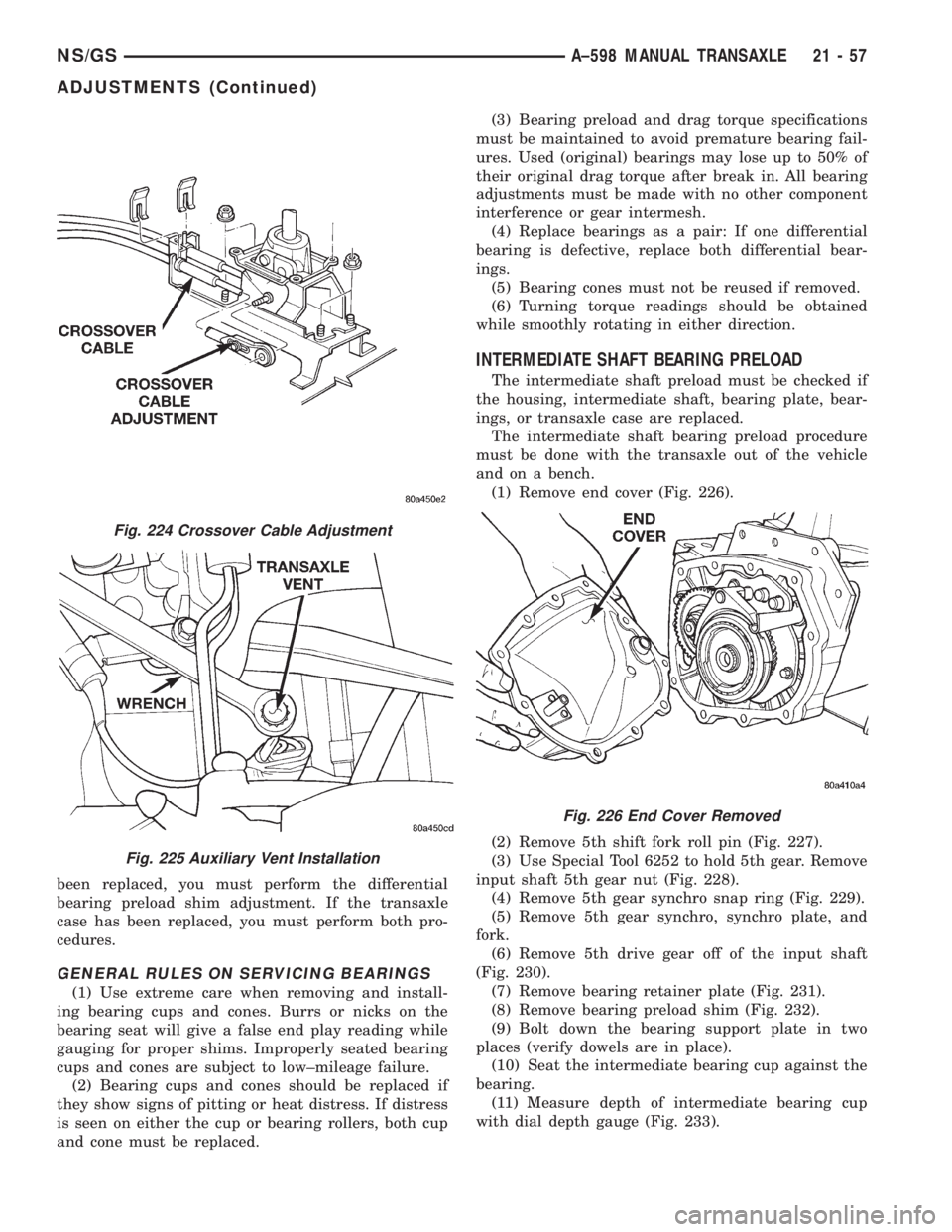
(1) Remove end cover (Fig. 226).
(2) Remove 5th shift fork roll pin (Fig. 227).
(3) Use Special Tool 6252 to hold 5th gear. Remove
input shaft 5th gear nut (Fig. 228).
(4) Remove 5th gear synchro snap ring (Fig. 229).
(5) Remove 5th gear synchro, synchro plate, and
fork.
(6) Remove 5th drive gear off of the input shaft
(Fig. 230).
(7) Remove bearing retainer plate (Fig. 231).
(8) Remove bearing preload shim (Fig. 232).
(9) Bolt down the bearing support plate in two
places (verify dowels are in place).
(10) Seat the intermediate bearing cup against the
bearing.
(11) Measure depth of intermediate bearing cup
with dial depth gauge (Fig. 233).
Fig. 224 Crossover Cable Adjustment
Fig. 225 Auxiliary Vent Installation
Fig. 226 End Cover Removed
NS/GSA±598 MANUAL TRANSAXLE 21 - 57
ADJUSTMENTS (Continued)
Page 1740 of 1938
(4) Remove seat back hinge from seat.
(5) Disengage synchronizing cable housing from
seat back hinge.
(6) Disengage synchronizing cable end from (clip
on left side) hinge latch release arm.
(7) Remove hinge from seat.
INSTALLATION
(1) Place hinge in position on seat.
(2) Engage synchronizing cable end into (clip on
left side) hinge latch release arm.
(3) Engage synchronizing cable housing into seat
back hinge.
(4) Place seat back hinge in position on seat.
(5) Install bolts to hold seat back hinge to seat
cushion frame.
(6) Install shoulder bolts to hold seat back hinge to
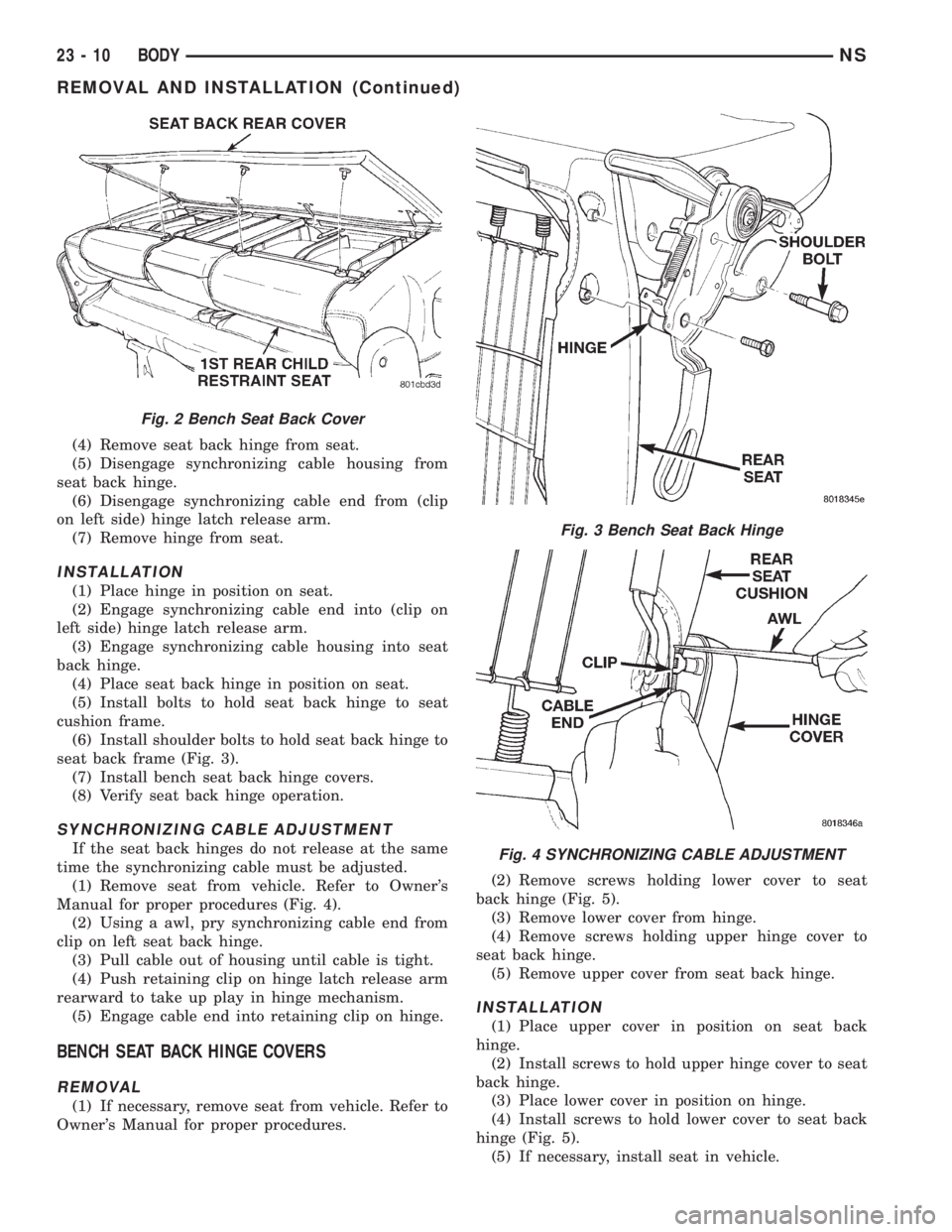
seat back frame (Fig. 3).
(7) Install bench seat back hinge covers.
(8) Verify seat back hinge operation.
SYNCHRONIZING CABLE ADJUSTMENT
If the seat back hinges do not release at the same
time the synchronizing cable must be adjusted.
(1) Remove seat from vehicle. Refer to Owner's
Manual for proper procedures (Fig. 4).
(2) Using a awl, pry synchronizing cable end from
clip on left seat back hinge.
(3) Pull cable out of housing until cable is tight.
(4) Push retaining clip on hinge latch release arm
rearward to take up play in hinge mechanism.
(5) Engage cable end into retaining clip on hinge.
BENCH SEAT BACK HINGE COVERS
REMOVAL
(1) If necessary, remove seat from vehicle. Refer to
Owner's Manual for proper procedures.(2) Remove screws holding lower cover to seat
back hinge (Fig. 5).
(3) Remove lower cover from hinge.
(4) Remove screws holding upper hinge cover to
seat back hinge.
(5) Remove upper cover from seat back hinge.
INSTALLATION
(1) Place upper cover in position on seat back
hinge.
(2) Install screws to hold upper hinge cover to seat
back hinge.
(3) Place lower cover in position on hinge.
(4) Install screws to hold lower cover to seat back
hinge (Fig. 5).
(5) If necessary, install seat in vehicle.
Fig. 2 Bench Seat Back Cover
Fig. 3 Bench Seat Back Hinge
Fig. 4 SYNCHRONIZING CABLE ADJUSTMENT
23 - 10 BODYNS
REMOVAL AND INSTALLATION (Continued)
Page 1810 of 1938
UPPER C-PILLAR TRIM
REMOVAL
(1) Remove quarter trim bolster.
(2) Remove seat belt turning loop from height
adjuster.
(3) Remove screw holding C-pillar trim panel to
C-pillar on right side of SWB vehicle.
(4) Disengage hidden clips holding trim to upper
C-pillar.
(5) Remove upper C-pillar trim from vehicle.
INSTALLATION
(1) Place upper C-pillar trim in position on vehicle.
(2) Engage hidden clips to hold trim to upper
C-pillar.
(3) Install screw to hold C-pillar trim panel to
C-pillar on right side of SWB vehicle.
(4) Install seat belt turning loop onto height
adjuster. Tighten all seat belt bolts to 39 N´m (29 in.
lbs.) torque.
(5) Install quarter trim bolster.
ADJUSTMENTS
SLIDING DOOR ADJUSTMENTS
PRELIMINARY CHECKS
(1) Close sliding door, visually checking C-post
striker alignment entry into latch. Striker at this
point must not affect alignment.(2) On vehicles with left sliding doors, check the
fuel door blocker striker entry into latch. Striker at
this point must not affect alignment.
(3) Check C-post and B-post for door to aperture
gaps and door to door gaps. All gaps should be 5 mm
61 mm.
(4) C
heck door for height using character lines as a
reference. Also check roof contour as a controlling factor.
UP/DOWN ADJUSTMENT
(1) Visually inspect the sliding door for fitting low
at the rear of the door by checking the alignment of
the belt line of the door to quarter panel.
(2) Fully open the sliding door.
(3) Verify that all center hinge bolts are tight.
(4) Adjust the rear of the sliding door up by turn-
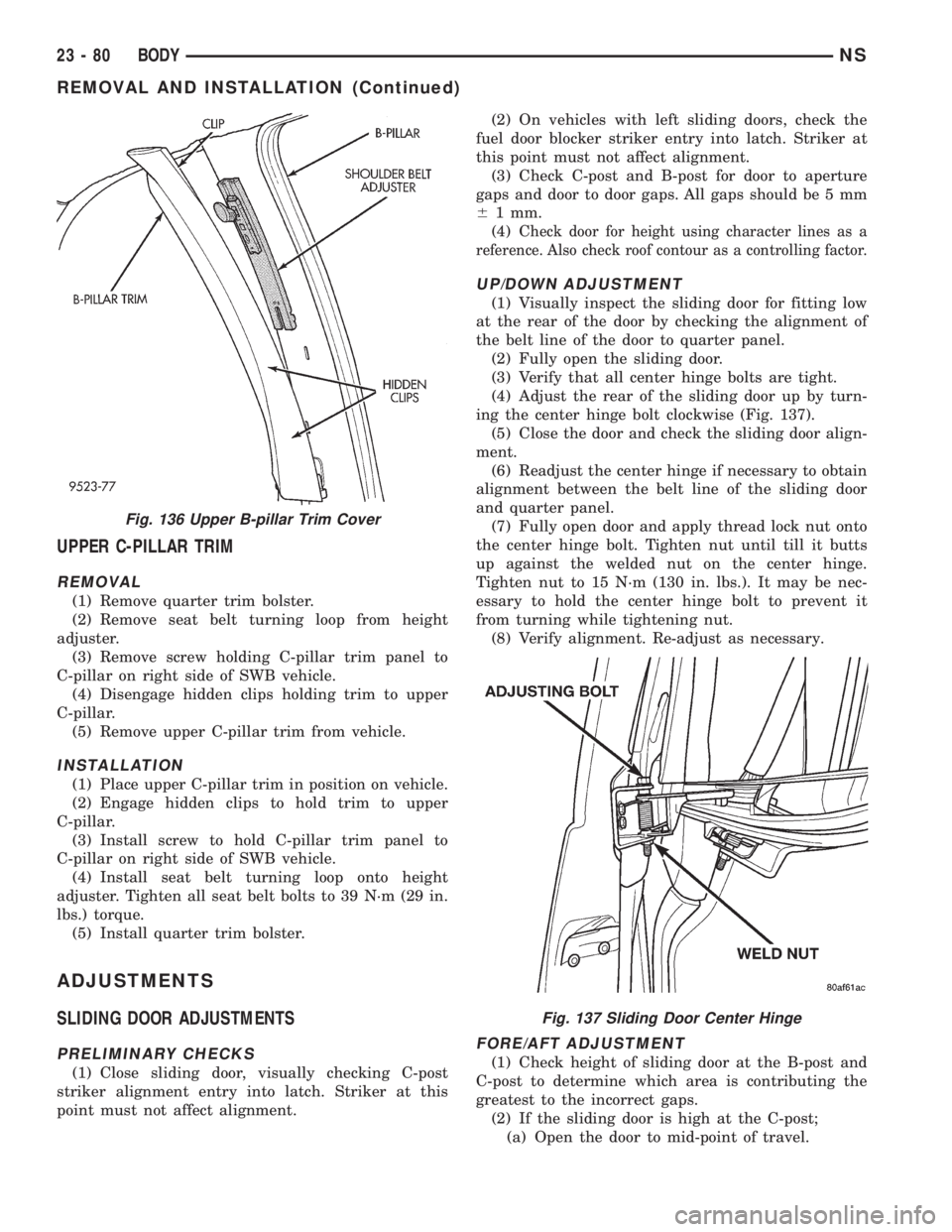
ing the center hinge bolt clockwise (Fig. 137).
(5) Close the door and check the sliding door align-
ment.
(6) Readjust the center hinge if necessary to obtain
alignment between the belt line of the sliding door
and quarter panel.
(7) Fully open door and apply thread lock nut onto
the center hinge bolt. Tighten nut until till it butts
up against the welded nut on the center hinge.
Tighten nut to 15 N´m (130 in. lbs.). It may be nec-
essary to hold the center hinge bolt to prevent it
from turning while tightening nut.
(8) Verify alignment. Re-adjust as necessary.
FORE/AFT ADJUSTMENT
(1) Check height of sliding door at the B-post and
C-post to determine which area is contributing the
greatest to the incorrect gaps.
(2) If the sliding door is high at the C-post;
(a) Open the door to mid-point of travel.
Fig. 136 Upper B-pillar Trim Cover
Fig. 137 Sliding Door Center Hinge
23 - 80 BODYNS
REMOVAL AND INSTALLATION (Continued)