traction control CHRYSLER VOYAGER 1996 Service Manual
[x] Cancel search | Manufacturer: CHRYSLER, Model Year: 1996, Model line: VOYAGER, Model: CHRYSLER VOYAGER 1996Pages: 1938, PDF Size: 55.84 MB
Page 84 of 1938
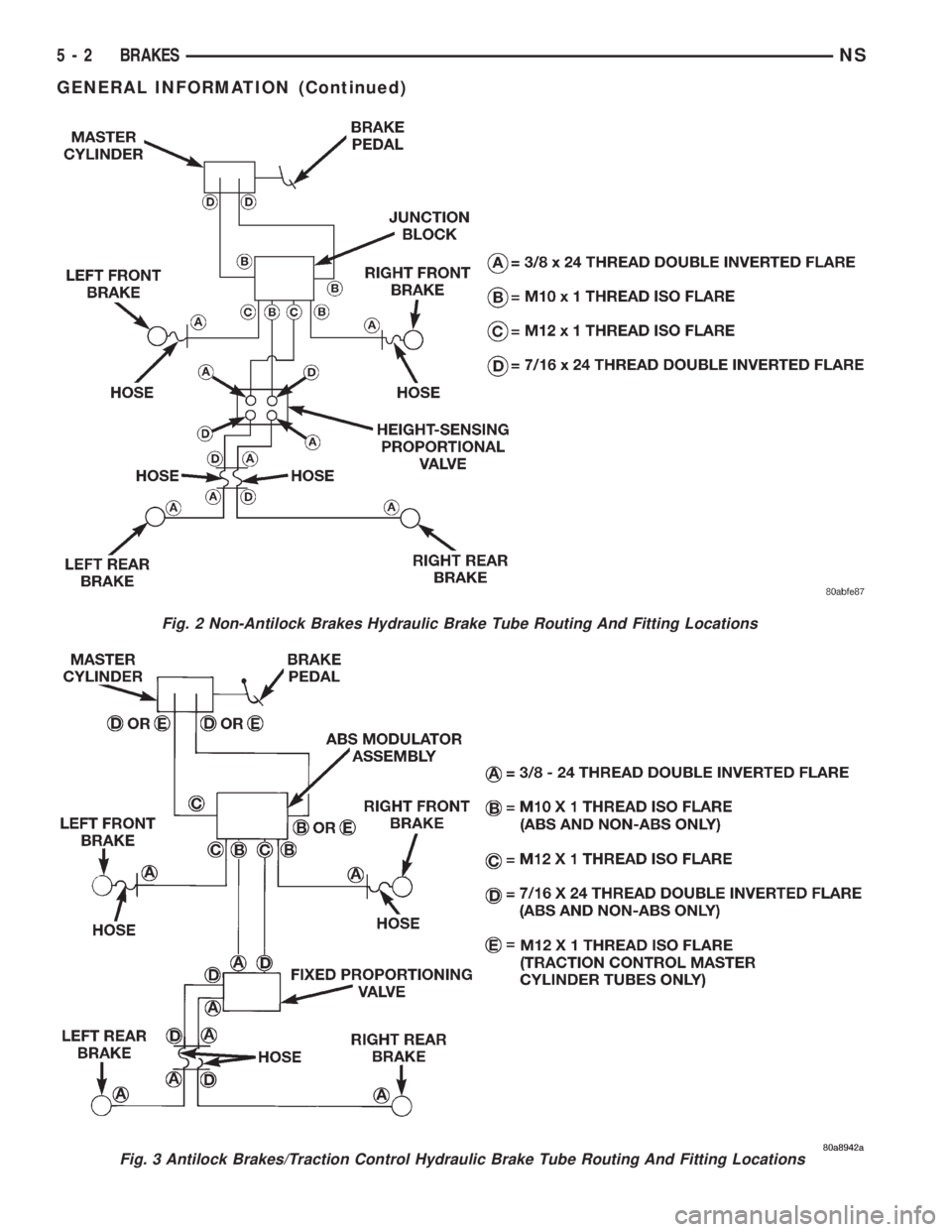
Fig. 2 Non-Antilock Brakes Hydraulic Brake Tube Routing And Fitting Locations
Fig. 3 Antilock Brakes/Traction Control Hydraulic Brake Tube Routing And Fitting Locations
5 - 2 BRAKESNS
GENERAL INFORMATION (Continued)
Page 85 of 1938
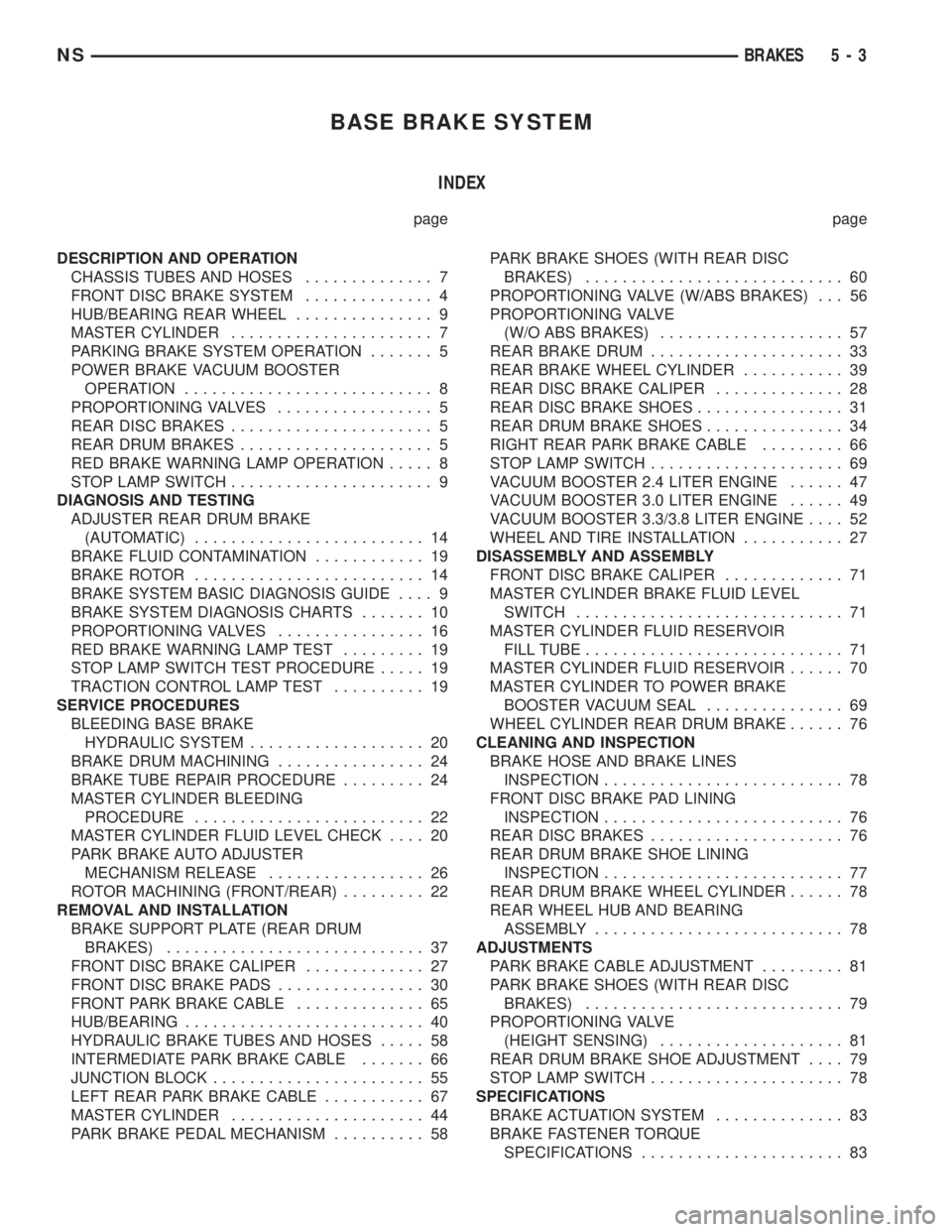
BASE BRAKE SYSTEM
INDEX
page page
DESCRIPTION AND OPERATION
CHASSIS TUBES AND HOSES.............. 7
FRONT DISC BRAKE SYSTEM.............. 4
HUB/BEARING REAR WHEEL............... 9
MASTER CYLINDER...................... 7
PARKING BRAKE SYSTEM OPERATION....... 5
POWER BRAKE VACUUM BOOSTER
OPERATION........................... 8
PROPORTIONING VALVES................. 5
REAR DISC BRAKES...................... 5
REAR DRUM BRAKES..................... 5
RED BRAKE WARNING LAMP OPERATION..... 8
STOP LAMP SWITCH...................... 9
DIAGNOSIS AND TESTING
ADJUSTER REAR DRUM BRAKE
(AUTOMATIC)......................... 14
BRAKE FLUID CONTAMINATION............ 19
BRAKE ROTOR......................... 14
BRAKE SYSTEM BASIC DIAGNOSIS GUIDE.... 9
BRAKE SYSTEM DIAGNOSIS CHARTS....... 10
PROPORTIONING VALVES................ 16
RED BRAKE WARNING LAMP TEST......... 19
STOP LAMP SWITCH TEST PROCEDURE..... 19
TRACTION CONTROL LAMP TEST.......... 19
SERVICE PROCEDURES
BLEEDING BASE BRAKE
HYDRAULIC SYSTEM................... 20
BRAKE DRUM MACHINING................ 24
BRAKE TUBE REPAIR PROCEDURE......... 24
MASTER CYLINDER BLEEDING
PROCEDURE......................... 22
MASTER CYLINDER FLUID LEVEL CHECK.... 20
PARK BRAKE AUTO ADJUSTER
MECHANISM RELEASE................. 26
ROTOR MACHINING (FRONT/REAR)......... 22
REMOVAL AND INSTALLATION
BRAKE SUPPORT PLATE (REAR DRUM
BRAKES)............................ 37
FRONT DISC BRAKE CALIPER............. 27
FRONT DISC BRAKE PADS................ 30
FRONT PARK BRAKE CABLE.............. 65
HUB/BEARING.......................... 40
HYDRAULIC BRAKE TUBES AND HOSES..... 58
INTERMEDIATE PARK BRAKE CABLE....... 66
JUNCTION BLOCK....................... 55
LEFT REAR PARK BRAKE CABLE........... 67
MASTER CYLINDER..................... 44
PARK BRAKE PEDAL MECHANISM.......... 58PARK BRAKE SHOES (WITH REAR DISC
BRAKES)............................ 60
PROPORTIONING VALVE (W/ABS BRAKES) . . . 56
PROPORTIONING VALVE
(W/O ABS BRAKES).................... 57
REAR BRAKE DRUM..................... 33
REAR BRAKE WHEEL CYLINDER........... 39
REAR DISC BRAKE CALIPER.............. 28
REAR DISC BRAKE SHOES................ 31
REAR DRUM BRAKE SHOES............... 34
RIGHT REAR PARK BRAKE CABLE......... 66
STOP LAMP SWITCH..................... 69
VACUUM BOOSTER 2.4 LITER ENGINE...... 47
VACUUM BOOSTER 3.0 LITER ENGINE...... 49
VACUUM BOOSTER 3.3/3.8 LITER ENGINE.... 52
WHEEL AND TIRE INSTALLATION........... 27
DISASSEMBLY AND ASSEMBLY
FRONT DISC BRAKE CALIPER............. 71
MASTER CYLINDER BRAKE FLUID LEVEL
SWITCH............................. 71
MASTER CYLINDER FLUID RESERVOIR
FILL TUBE............................ 71
MASTER CYLINDER FLUID RESERVOIR...... 70
MASTER CYLINDER TO POWER BRAKE
BOOSTER VACUUM SEAL............... 69
WHEEL CYLINDER REAR DRUM BRAKE...... 76
CLEANING AND INSPECTION
BRAKE HOSE AND BRAKE LINES
INSPECTION.......................... 78
FRONT DISC BRAKE PAD LINING
INSPECTION.......................... 76
REAR DISC BRAKES..................... 76
REAR DRUM BRAKE SHOE LINING
INSPECTION.......................... 77
REAR DRUM BRAKE WHEEL CYLINDER...... 78
REAR WHEEL HUB AND BEARING
ASSEMBLY........................... 78
ADJUSTMENTS
PARK BRAKE CABLE ADJUSTMENT......... 81
PARK BRAKE SHOES (WITH REAR DISC
BRAKES)............................ 79
PROPORTIONING VALVE
(HEIGHT SENSING).................... 81
REAR DRUM BRAKE SHOE ADJUSTMENT.... 79
STOP LAMP SWITCH..................... 78
SPECIFICATIONS
BRAKE ACTUATION SYSTEM.............. 83
BRAKE FASTENER TORQUE
SPECIFICATIONS...................... 83
NSBRAKES 5 - 3
Page 89 of 1938
(Fig. 8). The actuator assembly is mounted between
the height sensing proportioning valve and the actua-
tor bracket on the left rear leaf spring (Fig. 8). As the
rear height of the vehicle changes depending on the
load the vehicle is carrying the height change is
transferred to the height sensing proportioning valve.
This change in vehicle height is transferred through
the movement of the left rear leaf spring. As the posi-
tion of the left rear leaf spring changes this move-
ment is transferred through the actuator bracket
(Fig. 8) to the actuator assembly (Fig. 8) and then to
the proportioning valve.
Thus, the height sensing proportioning valve
allows the brake system to maintain the optimal
front to rear brake balance regardless of the vehicle
load condition. Under a light load condition, hydrau-
lic pressure to the rear brakes is minimized. As the
load condition of the vehicle increases, so does the
hydraulic pressure to the rear brakes.
The proportioning valve section of the valve oper-
ates by transmitting full input hydraulic pressure to
the rear brakes up to a certain point, called the split
point. Beyond the split point the proportioning valve
reduces the amount of hydraulic pressure to the rear
brakes according to a certain ratio. Thus, on light
brake applications, approximately equal hydraulic
pressure will be transmitted to the front and rear
brakes. At heavier brake applications, the hydraulic
pressure transmitted to the rear brakes will be lower
then the front brakes. This will prevent premature
rear wheel lock-up and skid.
The height sensing section of the valve thus
changes the split point of the proportioning valve,
based on the rear suspension height of the vehicle.
When the height of the rear suspension is low, the
proportioning valve interprets this as extra load and
the split point of the proportioning valve is raised to
allow more rear braking. When the height of the rear
suspension is high, the proportioning valve interprets
this as a lightly loaded vehicle and the split point of
the proportioning valve is lowered and rear braking
is reduced.
CHASSIS TUBES AND HOSES
The purpose of the chassis brake tubes and flex
hoses is to transfer the pressurized brake fluid devel-
oped by the master cylinder to the wheel brakes of
the vehicle. The chassis tubes are steel with a corro-
sion resistant coating applied to the external surfaces
and the flex hoses are made of reinforced rubber. The
rubber flex hoses allow for the movement of the vehi-
cles suspension.
MASTER CYLINDER
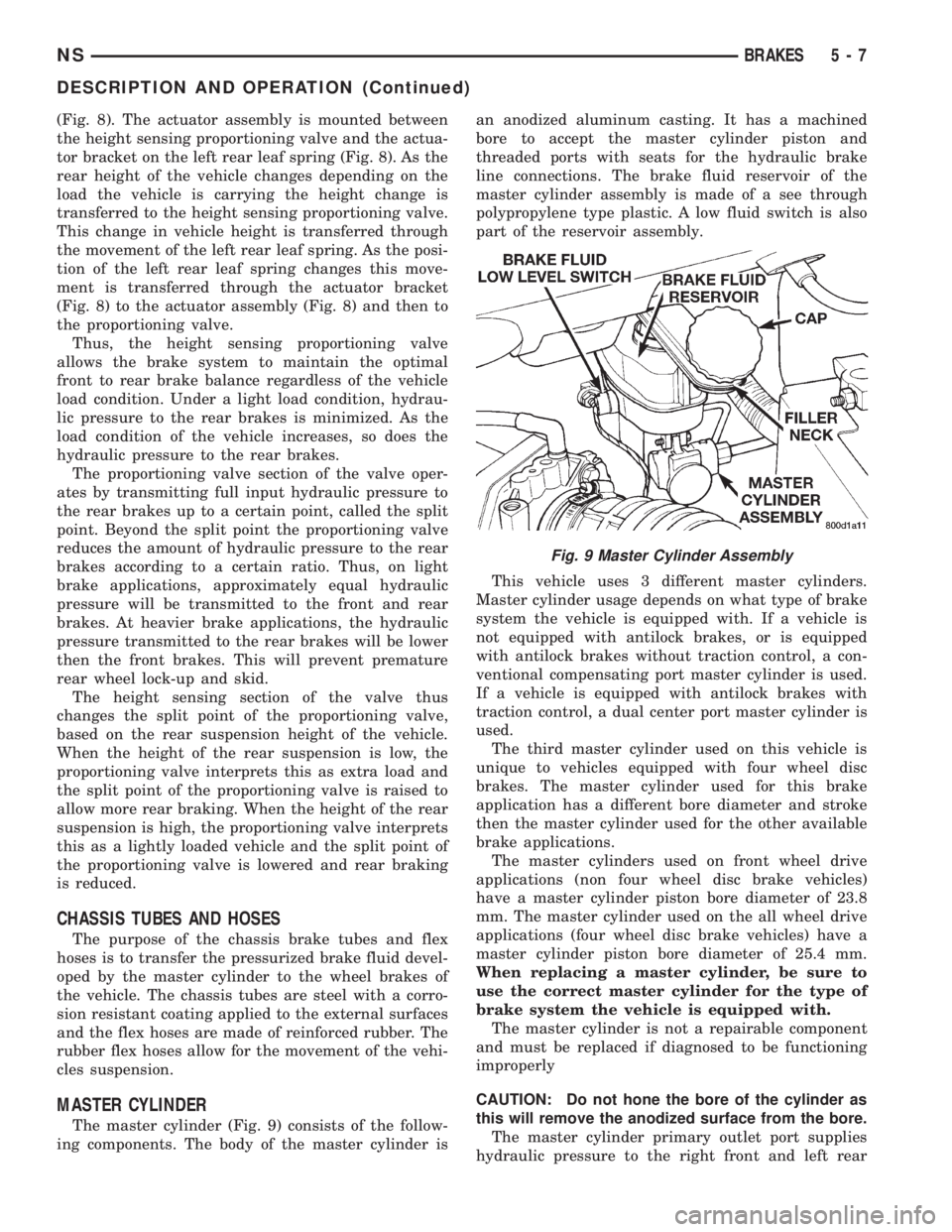
The master cylinder (Fig. 9) consists of the follow-
ing components. The body of the master cylinder isan anodized aluminum casting. It has a machined
bore to accept the master cylinder piston and
threaded ports with seats for the hydraulic brake
line connections. The brake fluid reservoir of the
master cylinder assembly is made of a see through
polypropylene type plastic. A low fluid switch is also
part of the reservoir assembly.
This vehicle uses 3 different master cylinders.
Master cylinder usage depends on what type of brake
system the vehicle is equipped with. If a vehicle is
not equipped with antilock brakes, or is equipped
with antilock brakes without traction control, a con-
ventional compensating port master cylinder is used.
If a vehicle is equipped with antilock brakes with
traction control, a dual center port master cylinder is
used.
The third master cylinder used on this vehicle is
unique to vehicles equipped with four wheel disc
brakes. The master cylinder used for this brake
application has a different bore diameter and stroke
then the master cylinder used for the other available
brake applications.
The master cylinders used on front wheel drive
applications (non four wheel disc brake vehicles)
have a master cylinder piston bore diameter of 23.8
mm. The master cylinder used on the all wheel drive
applications (four wheel disc brake vehicles) have a
master cylinder piston bore diameter of 25.4 mm.
When replacing a master cylinder, be sure to
use the correct master cylinder for the type of
brake system the vehicle is equipped with.
The master cylinder is not a repairable component
and must be replaced if diagnosed to be functioning
improperly
CAUTION: Do not hone the bore of the cylinder as
this will remove the anodized surface from the bore.
The master cylinder primary outlet port supplies
hydraulic pressure to the right front and left rear
Fig. 9 Master Cylinder Assembly
NSBRAKES 5 - 7
DESCRIPTION AND OPERATION (Continued)
Page 101 of 1938
(5) With the aid of a helper, apply pressure to the
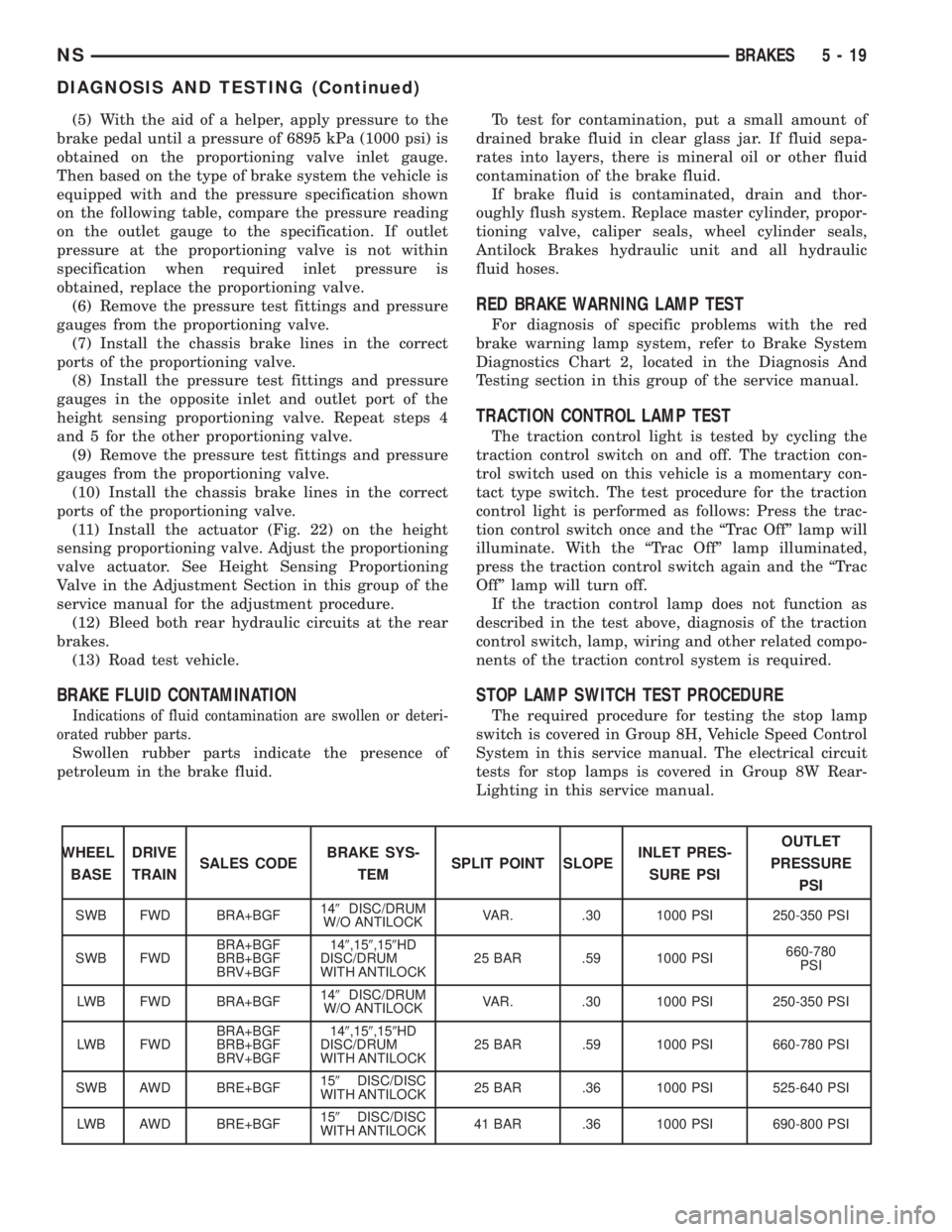
brake pedal until a pressure of 6895 kPa (1000 psi) is
obtained on the proportioning valve inlet gauge.
Then based on the type of brake system the vehicle is
equipped with and the pressure specification shown
on the following table, compare the pressure reading
on the outlet gauge to the specification. If outlet
pressure at the proportioning valve is not within
specification when required inlet pressure is
obtained, replace the proportioning valve.
(6) Remove the pressure test fittings and pressure
gauges from the proportioning valve.
(7) Install the chassis brake lines in the correct
ports of the proportioning valve.
(8) Install the pressure test fittings and pressure
gauges in the opposite inlet and outlet port of the
height sensing proportioning valve. Repeat steps 4
and 5 for the other proportioning valve.
(9) Remove the pressure test fittings and pressure
gauges from the proportioning valve.
(10) Install the chassis brake lines in the correct
ports of the proportioning valve.
(11) Install the actuator (Fig. 22) on the height
sensing proportioning valve. Adjust the proportioning
valve actuator. See Height Sensing Proportioning
Valve in the Adjustment Section in this group of the
service manual for the adjustment procedure.
(12) Bleed both rear hydraulic circuits at the rear
brakes.
(13) Road test vehicle.
BRAKE FLUID CONTAMINATION
Indications of fluid contamination are swollen or deteri-
orated rubber parts.
Swollen rubber parts indicate the presence of
petroleum in the brake fluid.To test for contamination, put a small amount of
drained brake fluid in clear glass jar. If fluid sepa-
rates into layers, there is mineral oil or other fluid
contamination of the brake fluid.
If brake fluid is contaminated, drain and thor-
oughly flush system. Replace master cylinder, propor-
tioning valve, caliper seals, wheel cylinder seals,
Antilock Brakes hydraulic unit and all hydraulic
fluid hoses.
RED BRAKE WARNING LAMP TEST
For diagnosis of specific problems with the red
brake warning lamp system, refer to Brake System
Diagnostics Chart 2, located in the Diagnosis And
Testing section in this group of the service manual.
TRACTION CONTROL LAMP TEST
The traction control light is tested by cycling the
traction control switch on and off. The traction con-
trol switch used on this vehicle is a momentary con-
tact type switch. The test procedure for the traction
control light is performed as follows: Press the trac-
tion control switch once and the ªTrac Offº lamp will
illuminate. With the ªTrac Offº lamp illuminated,
press the traction control switch again and the ªTrac
Offº lamp will turn off.
If the traction control lamp does not function as
described in the test above, diagnosis of the traction
control switch, lamp, wiring and other related compo-
nents of the traction control system is required.
STOP LAMP SWITCH TEST PROCEDURE
The required procedure for testing the stop lamp
switch is covered in Group 8H, Vehicle Speed Control
System in this service manual. The electrical circuit
tests for stop lamps is covered in Group 8W Rear-
Lighting in this service manual.
WHEEL
BASEDRIVE
TRAINSALES CODEBRAKE SYS-
TEMSPLIT POINT SLOPEINLET PRES-
SURE PSIOUTLET
PRESSURE
PSI
SWB FWD BRA+BGF149DISC/DRUM
W/O ANTILOCKVAR. .30 1000 PSI 250-350 PSI
SWB FWDBRA+BGF
BRB+BGF
BRV+BGF149,159,159HD
DISC/DRUM
WITH ANTILOCK25 BAR .59 1000 PSI660-780
PSI
LWB FWD BRA+BGF149DISC/DRUM
W/O ANTILOCKVAR. .30 1000 PSI 250-350 PSI
LWB FWDBRA+BGF
BRB+BGF
BRV+BGF149,159,159HD
DISC/DRUM
WITH ANTILOCK25 BAR .59 1000 PSI 660-780 PSI
SWB AWD BRE+BGF159DISC/DISC
WITH ANTILOCK25 BAR .36 1000 PSI 525-640 PSI
LWB AWD BRE+BGF159DISC/DISC
WITH ANTILOCK41 BAR .36 1000 PSI 690-800 PSI
NSBRAKES 5 - 19
DIAGNOSIS AND TESTING (Continued)
Page 104 of 1938
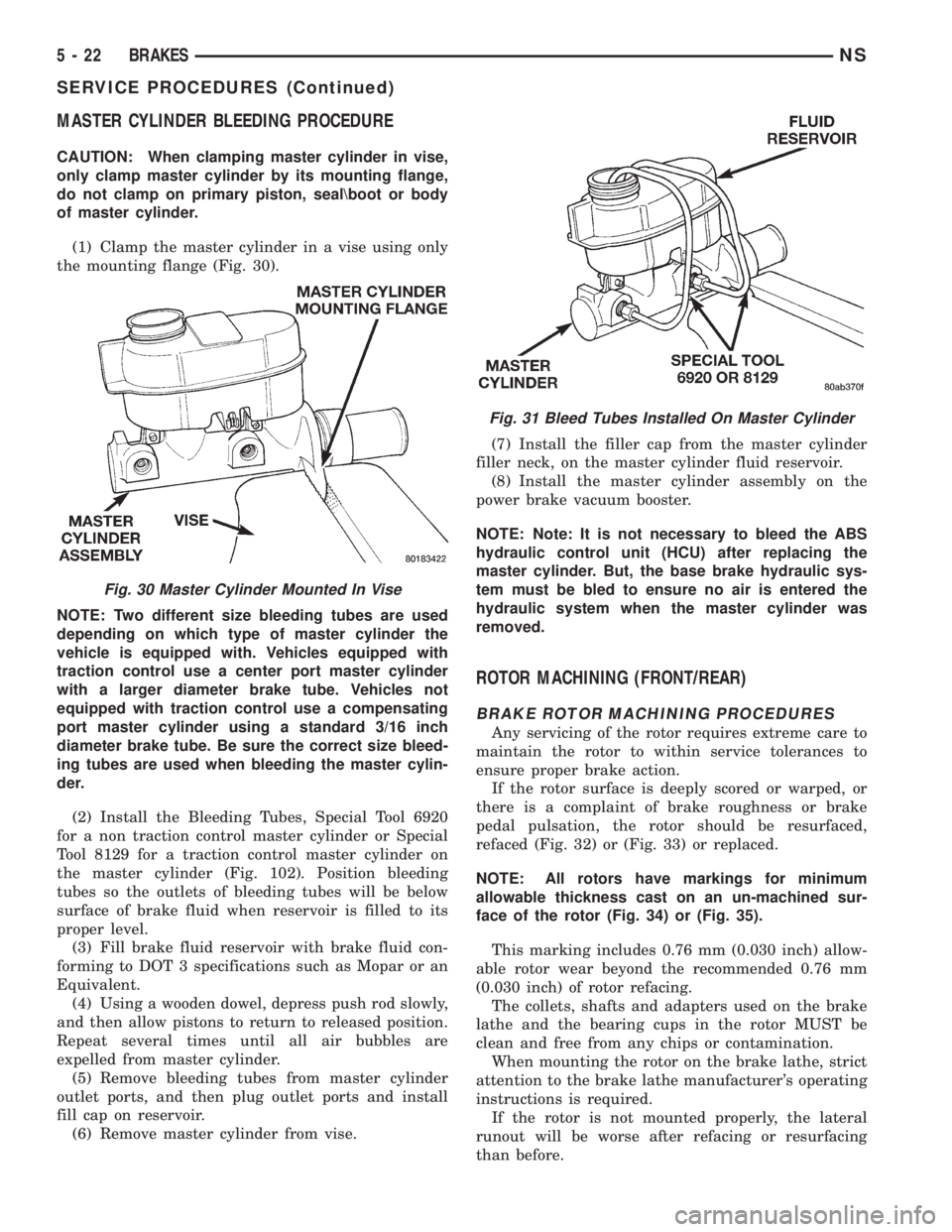
MASTER CYLINDER BLEEDING PROCEDURE
CAUTION: When clamping master cylinder in vise,
only clamp master cylinder by its mounting flange,
do not clamp on primary piston, seal\boot or body
of master cylinder.
(1) Clamp the master cylinder in a vise using only
the mounting flange (Fig. 30).
NOTE: Two different size bleeding tubes are used
depending on which type of master cylinder the
vehicle is equipped with. Vehicles equipped with
traction control use a center port master cylinder
with a larger diameter brake tube. Vehicles not
equipped with traction control use a compensating
port master cylinder using a standard 3/16 inch
diameter brake tube. Be sure the correct size bleed-
ing tubes are used when bleeding the master cylin-
der.
(2) Install the Bleeding Tubes, Special Tool 6920
for a non traction control master cylinder or Special
Tool 8129 for a traction control master cylinder on
the master cylinder (Fig. 102). Position bleeding
tubes so the outlets of bleeding tubes will be below
surface of brake fluid when reservoir is filled to its
proper level.
(3) Fill brake fluid reservoir with brake fluid con-
forming to DOT 3 specifications such as Mopar or an
Equivalent.
(4) Using a wooden dowel, depress push rod slowly,
and then allow pistons to return to released position.
Repeat several times until all air bubbles are
expelled from master cylinder.
(5) Remove bleeding tubes from master cylinder
outlet ports, and then plug outlet ports and install
fill cap on reservoir.
(6) Remove master cylinder from vise.(7) Install the filler cap from the master cylinder
filler neck, on the master cylinder fluid reservoir.
(8) Install the master cylinder assembly on the
power brake vacuum booster.
NOTE: Note: It is not necessary to bleed the ABS
hydraulic control unit (HCU) after replacing the
master cylinder. But, the base brake hydraulic sys-
tem must be bled to ensure no air is entered the
hydraulic system when the master cylinder was
removed.
ROTOR MACHINING (FRONT/REAR)
BRAKE ROTOR MACHINING PROCEDURES
Any servicing of the rotor requires extreme care to
maintain the rotor to within service tolerances to
ensure proper brake action.
If the rotor surface is deeply scored or warped, or
there is a complaint of brake roughness or brake
pedal pulsation, the rotor should be resurfaced,
refaced (Fig. 32) or (Fig. 33) or replaced.
NOTE: All rotors have markings for minimum
allowable thickness cast on an un-machined sur-
face of the rotor (Fig. 34) or (Fig. 35).
This marking includes 0.76 mm (0.030 inch) allow-
able rotor wear beyond the recommended 0.76 mm
(0.030 inch) of rotor refacing.
The collets, shafts and adapters used on the brake
lathe and the bearing cups in the rotor MUST be
clean and free from any chips or contamination.
When mounting the rotor on the brake lathe, strict
attention to the brake lathe manufacturer's operating
instructions is required.
If the rotor is not mounted properly, the lateral
runout will be worse after refacing or resurfacing
than before.
Fig. 30 Master Cylinder Mounted In Vise
Fig. 31 Bleed Tubes Installed On Master Cylinder
5 - 22 BRAKESNS
SERVICE PROCEDURES (Continued)
Page 106 of 1938
BRAKE DRUM MACHINING
Measure the runout and diameter of the rear brake
using only accurate measuring equipment. There
should be no variation in the drum diameter greater
than 0.090 mm (0.004 inch). Drum runout should not
exceed 0.15 mm (0.006 inch) out of round. If the
drum runout or diameter variation exceed these val-
ues the drum should be refaced. For best results in
eliminating the irregularities that cause brake rough-
ness and surge, the amount of material removed dur-
ing a single cut should be limited to 0.13 mm (0.005
inch). When the entire braking surface has been
cleaned. A final cut of 0.0254 mm (0.001 inch) will
assure a good drum surface providing the equipment
used is capable of the precision required for resurfac-
ing brake drums. Deeper cuts are permissible for the
sole purpose of removing deep score marks.Do not
reface more than 1.52 mm (0.060 inch) over the
standard drum diameter.
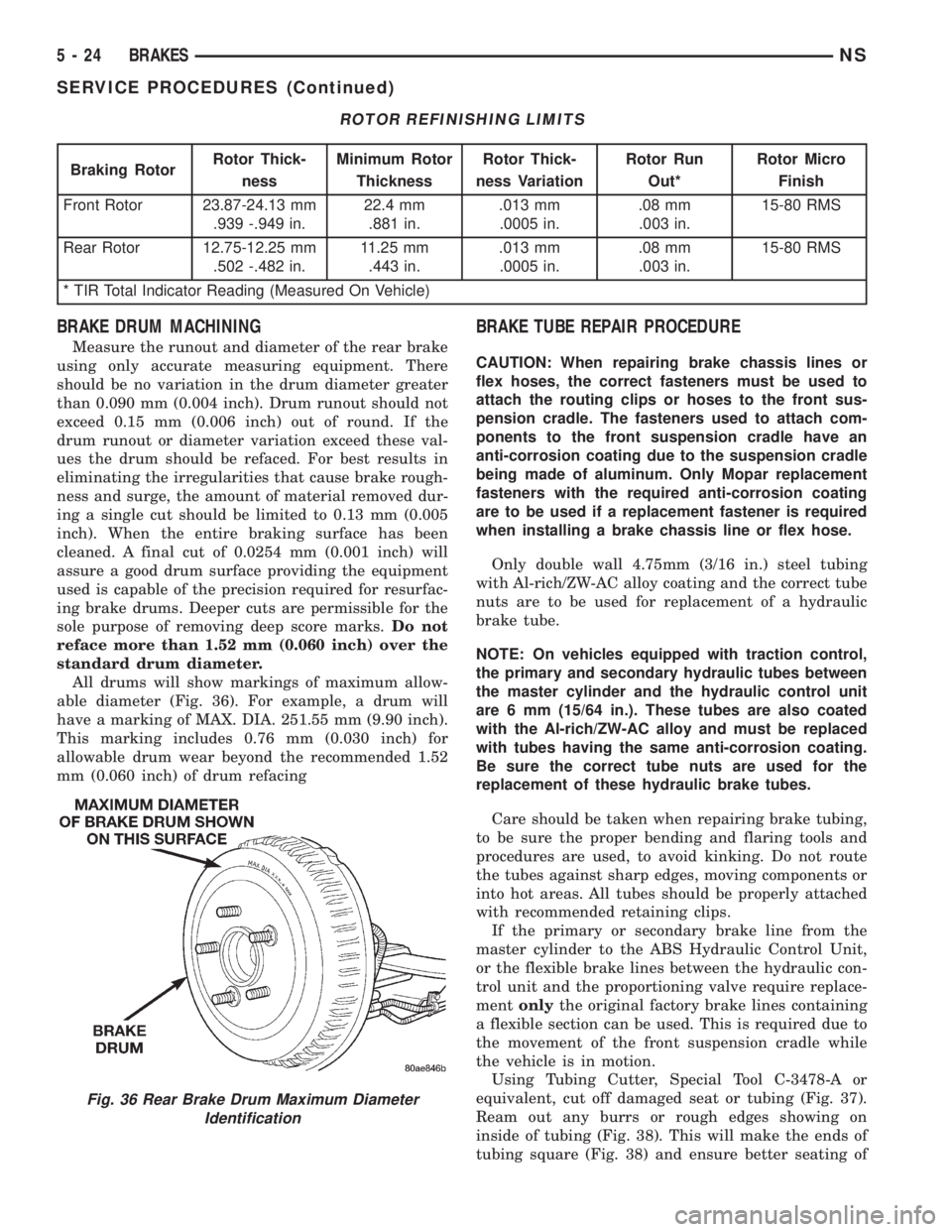
All drums will show markings of maximum allow-
able diameter (Fig. 36). For example, a drum will
have a marking of MAX. DIA. 251.55 mm (9.90 inch).
This marking includes 0.76 mm (0.030 inch) for
allowable drum wear beyond the recommended 1.52
mm (0.060 inch) of drum refacing
BRAKE TUBE REPAIR PROCEDURE
CAUTION: When repairing brake chassis lines or
flex hoses, the correct fasteners must be used to
attach the routing clips or hoses to the front sus-
pension cradle. The fasteners used to attach com-
ponents to the front suspension cradle have an
anti-corrosion coating due to the suspension cradle
being made of aluminum. Only Mopar replacement
fasteners with the required anti-corrosion coating
are to be used if a replacement fastener is required
when installing a brake chassis line or flex hose.
Only double wall 4.75mm (3/16 in.) steel tubing
with Al-rich/ZW-AC alloy coating and the correct tube
nuts are to be used for replacement of a hydraulic
brake tube.
NOTE: On vehicles equipped with traction control,
the primary and secondary hydraulic tubes between
the master cylinder and the hydraulic control unit
are 6 mm (15/64 in.). These tubes are also coated
with the Al-rich/ZW-AC alloy and must be replaced
with tubes having the same anti-corrosion coating.
Be sure the correct tube nuts are used for the
replacement of these hydraulic brake tubes.
Care should be taken when repairing brake tubing,
to be sure the proper bending and flaring tools and
procedures are used, to avoid kinking. Do not route
the tubes against sharp edges, moving components or
into hot areas. All tubes should be properly attached
with recommended retaining clips.
If the primary or secondary brake line from the
master cylinder to the ABS Hydraulic Control Unit,
or the flexible brake lines between the hydraulic con-
trol unit and the proportioning valve require replace-
mentonlythe original factory brake lines containing
a flexible section can be used. This is required due to
the movement of the front suspension cradle while
the vehicle is in motion.
Using Tubing Cutter, Special Tool C-3478-A or
equivalent, cut off damaged seat or tubing (Fig. 37).
Ream out any burrs or rough edges showing on
inside of tubing (Fig. 38). This will make the ends of
tubing square (Fig. 38) and ensure better seating of
ROTOR REFINISHING LIMITS
Braking RotorRotor Thick-
nessMinimum Rotor
ThicknessRotor Thick-
ness VariationRotor Run
Out*Rotor Micro
Finish
Front Rotor 23.87-24.13 mm
.939 -.949 in.22.4 mm
.881 in..013 mm
.0005 in..08 mm
.003 in.15-80 RMS
Rear Rotor 12.75-12.25 mm
.502 -.482 in.11.25 mm
.443 in..013 mm
.0005 in..08 mm
.003 in.15-80 RMS
* TIR Total Indicator Reading (Measured On Vehicle)
Fig. 36 Rear Brake Drum Maximum Diameter
Identification
5 - 24 BRAKESNS
SERVICE PROCEDURES (Continued)
Page 126 of 1938

caliper adapter and hub/bearing are squarely seated
against the axle. Then tighten the hub/bearing
mounting bolts to a torque of 129 N´m (95 ft. lbs.).
(3) Install driveshaft in hub/bearing and on output
shaft of rear drive line module. Driveshaft is
installed by first sliding the outer joint of the drive-
shaft into the hub/bearing and then compressing the
inner joint on the driveshaft and installing it on the
output shaft the drive line module.
(4) Install rotor on hub/bearing.
(5) Carefully lower disc brake caliper and brake
shoes over rotor and onto caliper adapter by revers-
ing the removal procedure (Fig. 92).
CAUTION: When installing guide pin bolts extreme
caution should be taken not to crossthread the cal-
iper guide pin bolts.
(6) Install the disc brake caliper guide pin bolts
(Fig. 91). Tighten the guide pin bolts to a torque of
22 N´m (192 in. lbs.).
(7) Clean all foreign material off the threads of the
outer C/V joint stub shaft. Install the washer and
hub nut (Fig. 88) on the stub shaft of the outer C/V
joint.
(8) Lower vehicle.
(9) Set the park brake.This is required to keep
the driveshaft from rotating when tightening
and torquing the hub nut and driveshaft inner
joint to driveline module mounting nuts.
(10) Raise vehicle.
(11) Tighten the driveshaft inner joint to drive line
module output shaft mounting bolts (Fig. 89) to a
torque of 61 N´m (45 ft. lbs.).
(12) Tighten the outer C/V joint hub nut (Fig. 88)
to a torque of 244 N´m (180 ft. lbs.).
(13) Install the spring washer (Fig. 87) on the stub
shaft of the outer C/V joint.
(14) Install the nut retainer and cotter pin (Fig.
86) on the stub shaft of the outer C/V joint.
(15) Install the wheel speed sensor on the hub/
bearing and adapter. Install the wheel speed sensor
attaching bolt (Fig. 90). Tighten the wheel speed sen-
sor attaching bolt to a torque of 12 N´m (105 in. lbs).
(16) Install wheel and tire.
(17) Tighten the wheel mounting stud nuts in
proper sequence until all nuts are torqued to half
specification. Then repeat the tightening sequence to
the full specified torque of 129 N´m (95 ft. lbs.).
(18) Remove jackstands or lower hoist.
CAUTION: Before moving vehicle, pump the brake
pedal several times to insure the vehicle has a firm
brake pedal to adequately stop vehicle.
(19) Road test vehicle to ensure proper operation
of the brake system.MASTER CYLINDER
CAUTION: Different types of master cylinders are
used on this vehicle. Vehicles equipped with trac-
tion control use a center port master cylinder. Vehi-
cles not equipped with traction control use a
compensating port master cylinder. Be sure to ver-
ify if the vehicle is equipped with traction control
and that the correct replacement master cylinder is
used. Also, vehicles that are equipped with four
wheel disc brakes have a master with a different
size piston bore than the other master cylinders. If
a new master cylinder is being installed, be sure
the correct master cylinder is used for the type of
brake system the vehicle is equipped with.
REMOVE
CAUTION: Vacuum in the power brake booster
must be pumped down (removed) before removing
master cylinder from power brake booster. This is
necessary to prevent the power brake booster from
sucking in any contamination as the master cylin-
der is removed. This can be done simply by pump-
ing the brake pedal, with the vehicle's engine not
running, until a firm feeling brake pedal is achieved.
(1) With engine not running, pump the brake
pedal until a firm pedal is achieved (4-5 strokes).
CAUTION: Before removing the master cylinder
filler tube from the brake fluid reservoir, the filler
tube, brake fluid reservoir and master cylinder must
be thoroughly cleaned. This must be done to pre-
vent dirt particles from falling into the brake fluid
reservoir and entering the brakes hydraulic system.
(2) Thoroughly clean all surfaces of the filler neck,
brake fluid reservoir, and master cylinder. Use only a
solvent such as Mopar Brake Parts Cleaner or an
equivalent.
(3) Remove master cylinder filler tube from brake
fluid reservoir by pushing down and rotating (Fig.
97). Then remove the cap from the removed filler
tube and install it on the master cylinder reservoir.
(4) Remove vehicle wiring harness connector, from
the brake fluid level sensor, in master cylinder brake
fluid reservoir (Fig. 98).
(5) Disconnect the primary and secondary brake
tubes from the master cylinder housing (Fig. 99).
Install sealing plugs in the open brake tube outlets
on master cylinder assembly.
5 - 44 BRAKESNS
REMOVAL AND INSTALLATION (Continued)
Page 128 of 1938
NOTE: Two different size bleeding tubes are used
depending on which type of master cylinder the
vehicle is equipped with. Vehicles equipped with
traction control use a center port master cylinder
with a larger diameter brake tube. Vehicles not
equipped with traction control use a compensating
port master cylinder using a standard 3/16 inch
diameter brake tube. Be sure the correct size bleed-
ing tubes are used when bleeding the master cylin-
der.
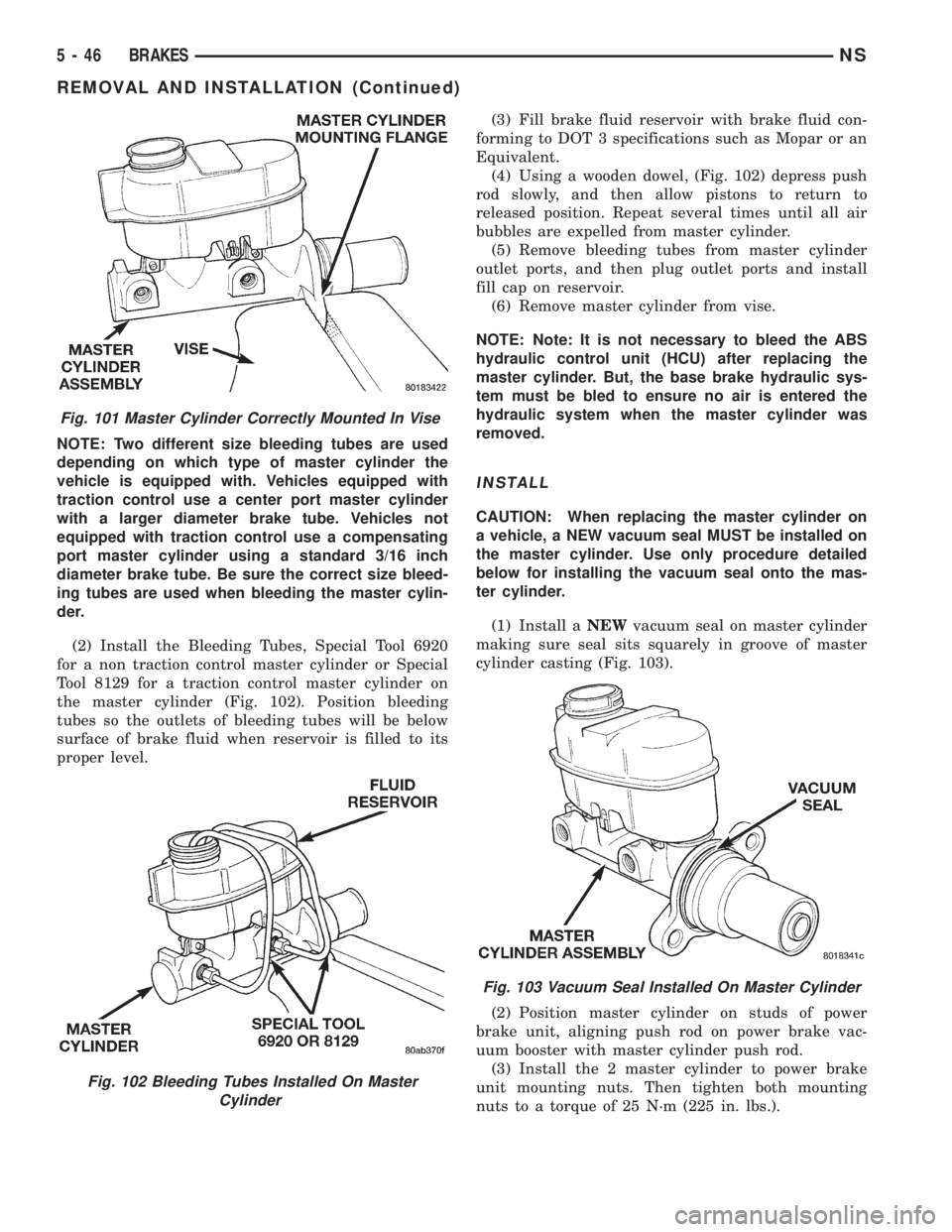
(2) Install the Bleeding Tubes, Special Tool 6920
for a non traction control master cylinder or Special
Tool 8129 for a traction control master cylinder on
the master cylinder (Fig. 102). Position bleeding
tubes so the outlets of bleeding tubes will be below
surface of brake fluid when reservoir is filled to its
proper level.(3) Fill brake fluid reservoir with brake fluid con-
forming to DOT 3 specifications such as Mopar or an
Equivalent.
(4) Using a wooden dowel, (Fig. 102) depress push
rod slowly, and then allow pistons to return to
released position. Repeat several times until all air
bubbles are expelled from master cylinder.
(5) Remove bleeding tubes from master cylinder
outlet ports, and then plug outlet ports and install
fill cap on reservoir.
(6) Remove master cylinder from vise.
NOTE: Note: It is not necessary to bleed the ABS
hydraulic control unit (HCU) after replacing the
master cylinder. But, the base brake hydraulic sys-
tem must be bled to ensure no air is entered the
hydraulic system when the master cylinder was
removed.
INSTALL
CAUTION: When replacing the master cylinder on
a vehicle, a NEW vacuum seal MUST be installed on
the master cylinder. Use only procedure detailed
below for installing the vacuum seal onto the mas-
ter cylinder.
(1) Install aNEWvacuum seal on master cylinder
making sure seal sits squarely in groove of master
cylinder casting (Fig. 103).
(2) Position master cylinder on studs of power
brake unit, aligning push rod on power brake vac-
uum booster with master cylinder push rod.
(3) Install the 2 master cylinder to power brake
unit mounting nuts. Then tighten both mounting
nuts to a torque of 25 N´m (225 in. lbs.).
Fig. 101 Master Cylinder Correctly Mounted In Vise
Fig. 102 Bleeding Tubes Installed On Master
Cylinder
Fig. 103 Vacuum Seal Installed On Master Cylinder
5 - 46 BRAKESNS
REMOVAL AND INSTALLATION (Continued)
Page 140 of 1938
INSTALL
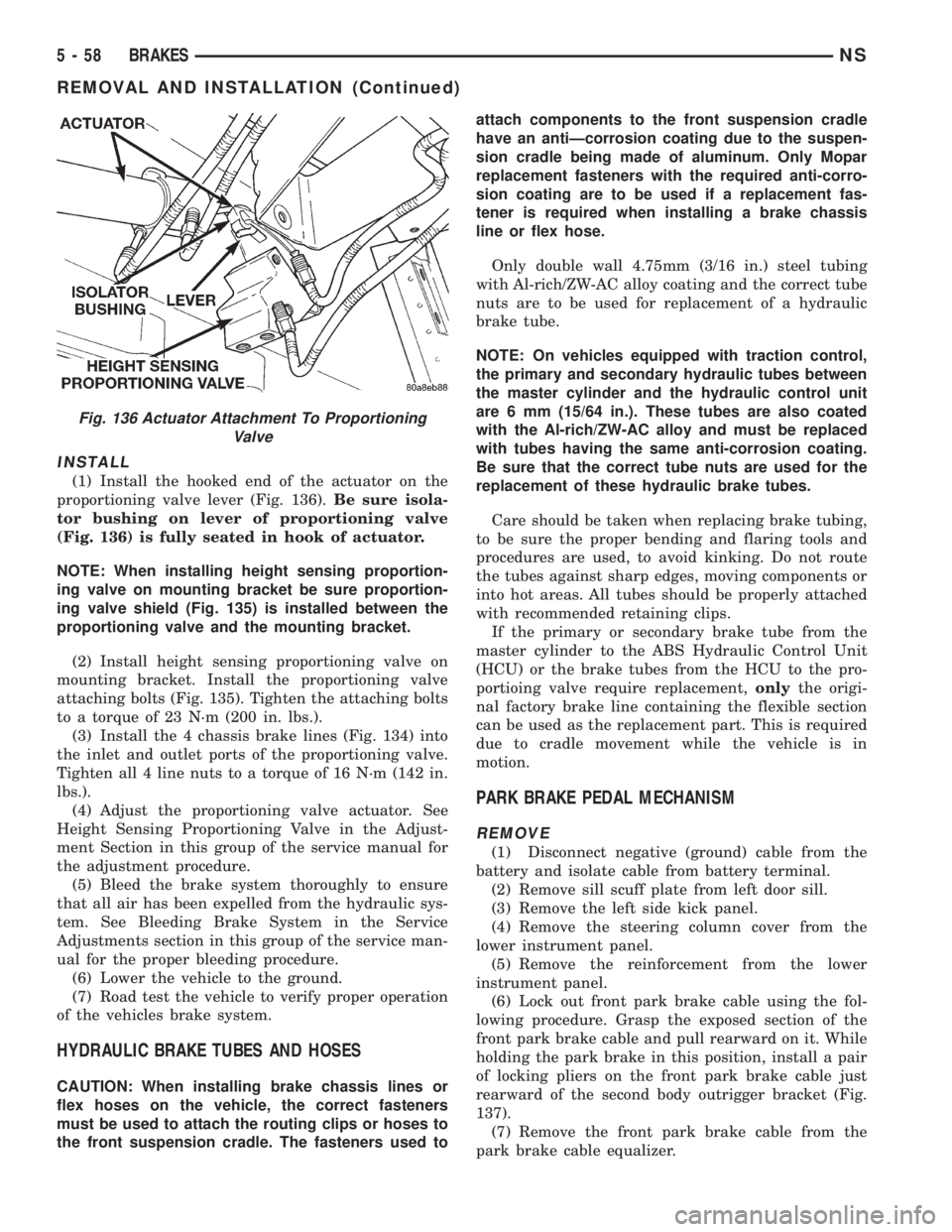
(1) Install the hooked end of the actuator on the
proportioning valve lever (Fig. 136).Be sure isola-
tor bushing on lever of proportioning valve
(Fig. 136) is fully seated in hook of actuator.
NOTE: When installing height sensing proportion-
ing valve on mounting bracket be sure proportion-
ing valve shield (Fig. 135) is installed between the
proportioning valve and the mounting bracket.
(2) Install height sensing proportioning valve on
mounting bracket. Install the proportioning valve
attaching bolts (Fig. 135). Tighten the attaching bolts
to a torque of 23 N´m (200 in. lbs.).
(3) Install the 4 chassis brake lines (Fig. 134) into
the inlet and outlet ports of the proportioning valve.
Tighten all 4 line nuts to a torque of 16 N´m (142 in.
lbs.).
(4) Adjust the proportioning valve actuator. See
Height Sensing Proportioning Valve in the Adjust-
ment Section in this group of the service manual for
the adjustment procedure.
(5) Bleed the brake system thoroughly to ensure
that all air has been expelled from the hydraulic sys-
tem. See Bleeding Brake System in the Service
Adjustments section in this group of the service man-
ual for the proper bleeding procedure.
(6) Lower the vehicle to the ground.
(7) Road test the vehicle to verify proper operation
of the vehicles brake system.
HYDRAULIC BRAKE TUBES AND HOSES
CAUTION: When installing brake chassis lines or
flex hoses on the vehicle, the correct fasteners
must be used to attach the routing clips or hoses to
the front suspension cradle. The fasteners used toattach components to the front suspension cradle
have an antiÐcorrosion coating due to the suspen-
sion cradle being made of aluminum. Only Mopar
replacement fasteners with the required anti-corro-
sion coating are to be used if a replacement fas-
tener is required when installing a brake chassis
line or flex hose.
Only double wall 4.75mm (3/16 in.) steel tubing
with Al-rich/ZW-AC alloy coating and the correct tube
nuts are to be used for replacement of a hydraulic
brake tube.
NOTE: On vehicles equipped with traction control,
the primary and secondary hydraulic tubes between
the master cylinder and the hydraulic control unit
are 6 mm (15/64 in.). These tubes are also coated
with the Al-rich/ZW-AC alloy and must be replaced
with tubes having the same anti-corrosion coating.
Be sure that the correct tube nuts are used for the
replacement of these hydraulic brake tubes.
Care should be taken when replacing brake tubing,
to be sure the proper bending and flaring tools and
procedures are used, to avoid kinking. Do not route
the tubes against sharp edges, moving components or
into hot areas. All tubes should be properly attached
with recommended retaining clips.
If the primary or secondary brake tube from the
master cylinder to the ABS Hydraulic Control Unit
(HCU) or the brake tubes from the HCU to the pro-
portioing valve require replacement,onlythe origi-
nal factory brake line containing the flexible section
can be used as the replacement part. This is required
due to cradle movement while the vehicle is in
motion.
PARK BRAKE PEDAL MECHANISM
REMOVE
(1) Disconnect negative (ground) cable from the
battery and isolate cable from battery terminal.
(2) Remove sill scuff plate from left door sill.
(3) Remove the left side kick panel.
(4) Remove the steering column cover from the
lower instrument panel.
(5) Remove the reinforcement from the lower
instrument panel.
(6) Lock out front park brake cable using the fol-
lowing procedure. Grasp the exposed section of the
front park brake cable and pull rearward on it. While
holding the park brake in this position, install a pair
of locking pliers on the front park brake cable just
rearward of the second body outrigger bracket (Fig.
137).
(7) Remove the front park brake cable from the
park brake cable equalizer.
Fig. 136 Actuator Attachment To Proportioning
Valve
5 - 58 BRAKESNS
REMOVAL AND INSTALLATION (Continued)
Page 165 of 1938
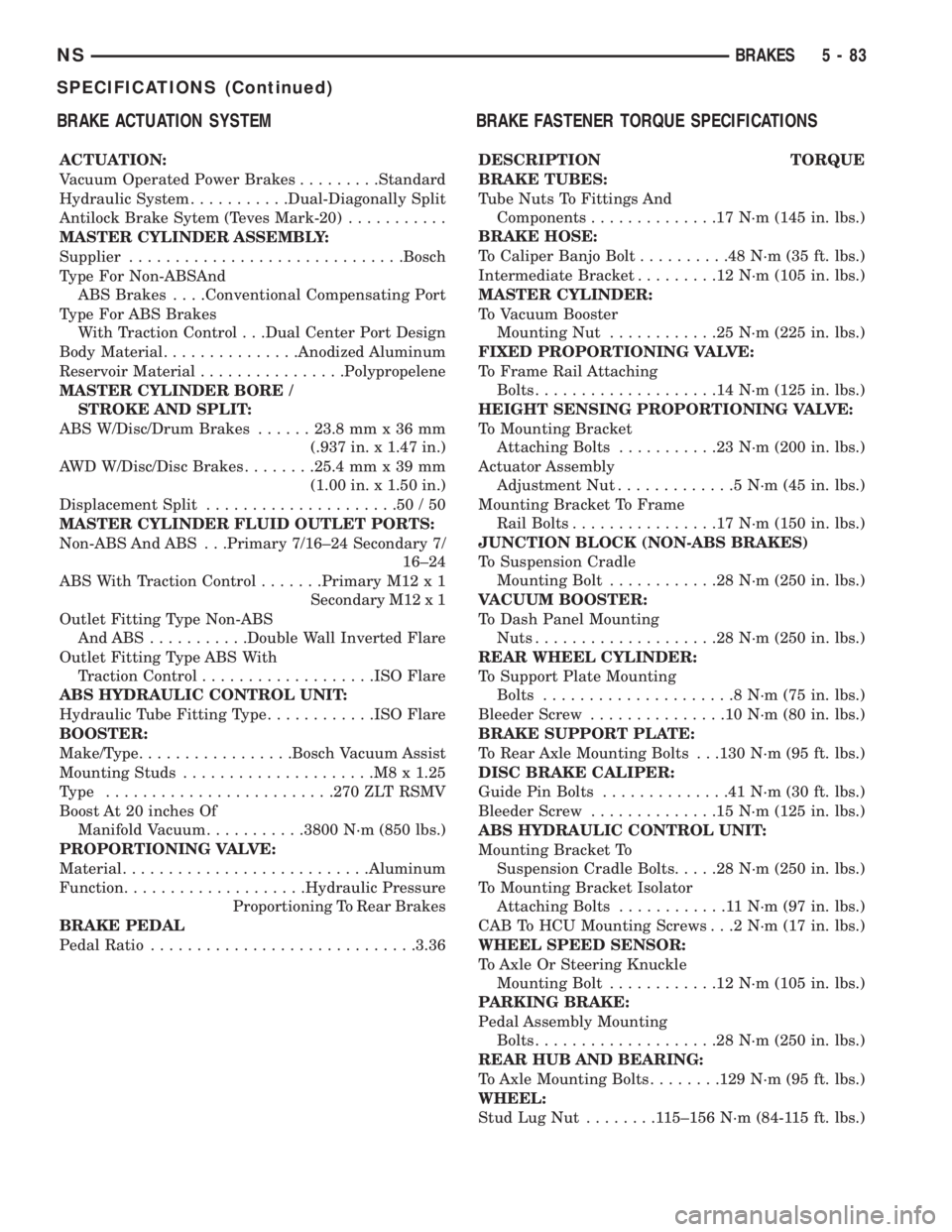
BRAKE ACTUATION SYSTEM
ACTUATION:
Vacuum Operated Power Brakes.........Standard
Hydraulic System...........Dual-Diagonally Split
Antilock Brake Sytem (Teves Mark-20)...........
MASTER CYLINDER ASSEMBLY:
Supplier..............................Bosch
Type For Non-ABSAnd
ABS Brakes. . . .Conventional Compensating Port
Type For ABS Brakes
With Traction Control . . .Dual Center Port Design
Body Material...............Anodized Aluminum
Reservoir Material................Polypropelene
MASTER CYLINDER BORE /
STROKE AND SPLIT:
ABS W/Disc/Drum Brakes......23.8 mm x 36 mm
(.937 in. x 1.47 in.)
AWD W/Disc/Disc Brakes........25.4 mm x 39 mm
(1.00 in. x 1.50 in.)
Displacement Split.....................50/50
MASTER CYLINDER FLUID OUTLET PORTS:
Non-ABS And ABS . . .Primary 7/16±24 Secondary 7/
16±24
ABS With Traction Control.......Primary M12 x 1
Secondary M12 x 1
Outlet Fitting Type Non-ABS
AndABS...........Double Wall Inverted Flare
Outlet Fitting Type ABS With
Traction Control...................ISO Flare
ABS HYDRAULIC CONTROL UNIT:
Hydraulic Tube Fitting Type............ISO Flare
BOOSTER:
Make/Type.................Bosch Vacuum Assist
Mounting Studs.....................M8x1.25
Type .........................270 ZLT RSMV
Boost At 20 inches Of
Manifold Vacuum...........3800 N´m (850 lbs.)
PROPORTIONING VALVE:
Material...........................Aluminum
Function....................Hydraulic Pressure
Proportioning To Rear Brakes
BRAKE PEDAL
Pedal Ratio.............................3.36
BRAKE FASTENER TORQUE SPECIFICATIONS
DESCRIPTION TORQUE
BRAKE TUBES:
Tube Nuts To Fittings And
Components..............17N´m(145 in. lbs.)
BRAKE HOSE:
To Caliper Banjo Bolt..........48N´m(35ft.lbs.)
Intermediate Bracket.........12N´m(105 in. lbs.)
MASTER CYLINDER:
To Vacuum Booster
Mounting Nut............25N´m(225 in. lbs.)
FIXED PROPORTIONING VALVE:
To Frame Rail Attaching
Bolts....................14N´m(125 in. lbs.)
HEIGHT SENSING PROPORTIONING VALVE:
To Mounting Bracket
Attaching Bolts...........23N´m(200 in. lbs.)
Actuator Assembly
Adjustment Nut.............5N´m(45in.lbs.)
Mounting Bracket To Frame
Rail Bolts................17N´m(150 in. lbs.)
JUNCTION BLOCK (NON-ABS BRAKES)
To Suspension Cradle
Mounting Bolt............28N´m(250 in. lbs.)
VACUUM BOOSTER:
To Dash Panel Mounting
Nuts....................28N´m(250 in. lbs.)
REAR WHEEL CYLINDER:
To Support Plate Mounting
Bolts.....................8N´m(75in.lbs.)
Bleeder Screw...............10N´m(80in.lbs.)
BRAKE SUPPORT PLATE:
To Rear Axle Mounting Bolts . . .130 N´m (95 ft. lbs.)
DISC BRAKE CALIPER:
Guide Pin Bolts..............41N´m(30ft.lbs.)
Bleeder Screw..............15N´m(125 in. lbs.)
ABS HYDRAULIC CONTROL UNIT:
Mounting Bracket To
Suspension Cradle Bolts.....28N´m(250 in. lbs.)
To Mounting Bracket Isolator
Attaching Bolts............11N´m(97in.lbs.)
CAB To HCU Mounting Screws . . .2 N´m (17 in. lbs.)
WHEEL SPEED SENSOR:
To Axle Or Steering Knuckle
Mounting Bolt............12N´m(105 in. lbs.)
PARKING BRAKE:
Pedal Assembly Mounting
Bolts....................28N´m(250 in. lbs.)
REAR HUB AND BEARING:
To Axle Mounting Bolts........129 N´m (95 ft. lbs.)
WHEEL:
Stud Lug Nut........115±156 N´m (84-115 ft. lbs.)
NSBRAKES 5 - 83
SPECIFICATIONS (Continued)