brake Citroen C1 2014 1.G User Guide
[x] Cancel search | Manufacturer: CITROEN, Model Year: 2014, Model line: C1, Model: Citroen C1 2014 1.GPages: 256, PDF Size: 5.63 MB
Page 80 of 256
78
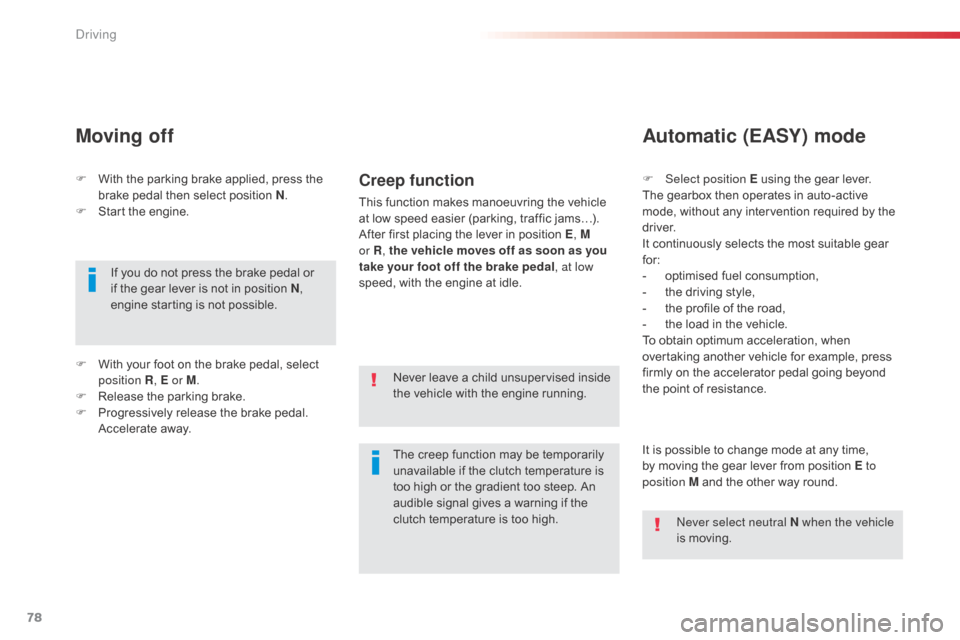
F With the parking brake applied, press the brake pedal then select position N .
F
S
tart the engine.
Moving off
If you do not press the brake pedal or
if the gear lever is not in position N ,
engine starting is not possible.
Never leave a child unsupervised inside
the vehicle with the engine running.F
Sel
ect position E using the gear lever.
The gearbox then operates in auto-active
mode, without any intervention required by the
driver.
It continuously selects the most suitable gear
for:
- o ptimised fuel consumption,
-
t
he driving style,
-
t
he profile of the road,
-
t
he load in the vehicle.
To obtain optimum acceleration, when
overtaking another vehicle for example, press
firmly on the accelerator pedal going beyond
the point of resistance.
Automatic (EASY) mode
It is possible to change mode at any time,
by moving the gear lever from position E to
position M and the other way round.
F
W
ith your foot on the brake pedal, select
position R , E or M.
F
R
elease the parking brake.
F
P
rogressively release the brake pedal.
A
ccelerate away.
Creep function
This function makes manoeuvring the vehicle
at low speed easier (parking, traffic jams…).
After first placing the lever in position E
, M
or
R, the vehicle moves off as soon as you
take your foot off the brake pedal , at low
speed, with the engine at idle.
The creep function may be temporarily
unavailable if the clutch temperature is
too high or the gradient too steep. An
audible signal gives a warning if the
clutch temperature is too high.
ne
ver select neutral N when the vehicle
is moving.
Driving
Page 82 of 256
80
To engage reverse, the vehicle must be
stationary with your foot on the brake pedal.
F
Sel
ect position R .
Reverse
There is an audible signal on engaging reverse. The vehicle can be stopped whatever the
position of the gear lever (
N, E or R ).
However, there is an audible signal on opening
the driver's door if the gear lever is not in
position N .
Stopping the vehicle
In all cases, it is essential that you
apply the parking brake to immobilise
the vehicle.
When the vehicle is stopped with the
engine running, always put the gear
lever into neutral N .
Before doing anything under the
bonnet, check that the gear lever is
in neutral N and the parking brake is
applied. With the ignition on, illumination
of this warning lamp indicates a
gearbox fault.
Contact a CITROËN dealer or a
qualified workshop.
Operating fault
driving
Page 84 of 256
82
Hill start assist
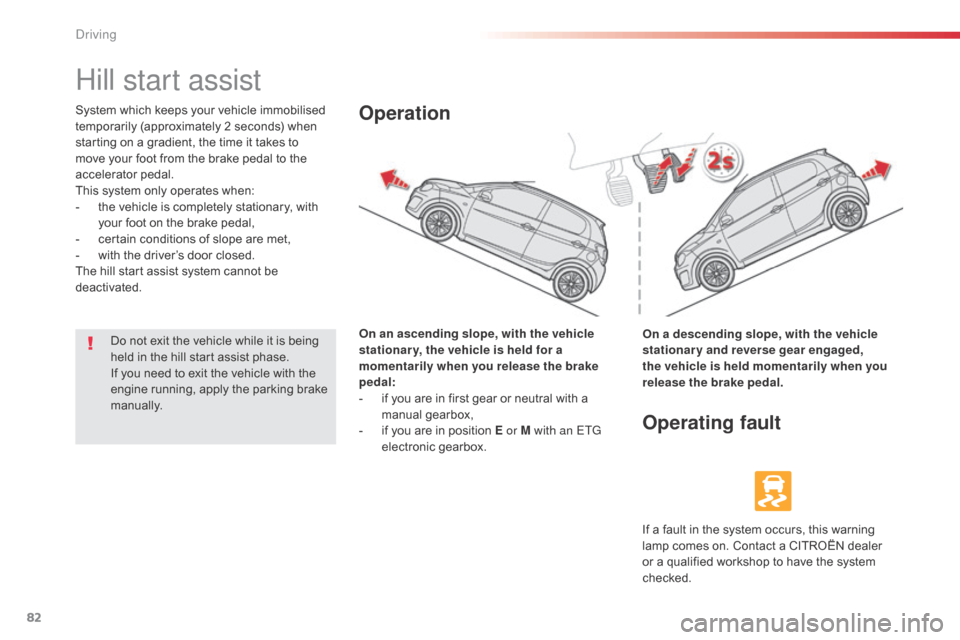
System which keeps your vehicle immobilised
temporarily (approximately 2 seconds) when
starting on a gradient, the time it takes to
move your foot from the brake pedal to the
accelerator pedal.
This system only operates when:
-
t
he vehicle is completely stationary, with
your foot on the brake pedal,
-
c
ertain conditions of slope are met,
-
w
ith the driver’s door closed.
The hill start assist system cannot be
deactivated.
On an ascending slope, with the vehicle
stationar y, the vehicle is held for a
momentarily when you release the brake
pedal:
-
i
f you are in first gear or neutral with a
manual gearbox,
-
i
f you are in position E or M with an ETG
electronic gearbox.Operation
On a descending slope, with the vehicle
stationary and reverse gear engaged,
the vehicle is held momentarily when you
release the brake pedal.
Operating fault
If a fault in the system occurs, this warning
lamp comes on. Contact a CITROËN dealer
or a qualified workshop to have the system
checked.
Do not exit the vehicle while it is being
held in the hill start assist phase.
If you need to exit the vehicle with the
engine running, apply the parking brake
manually.
driving
Page 109 of 256
107
Electronic Stability Control (ESC) incorporating
the following systems:
-
a
nti-lock braking system (ABS) and the
electronic brake force distribution (EBFD),
-
em
ergency braking assistance,
-
t
raction control (TRC),
-
d
ynamic stability control (DSC).
Electronic stability control (ESC)
Definitions
Anti-lock braking system (ABS)
and electronic brake force
distribution (EBFD)
These systems improve the stability and
manoeuvrability of your vehicle when braking
and contribute towards better control in
corners, in particular on poor or slippery road
surfaces.
The ABS prevents wheel lock in the event of
emergency braking.
The electronic brake force distribution system
manages the braking pressure wheel by wheel.
Emergency braking assistance
In an emergency, this system enables you to
reach the optimum braking pressure more
quickly and therefore reduce the stopping
distance.
It is triggered according to the speed at which
the brake pedal is pressed. This is felt by a
reduction in the resistance of the pedal and an
increase in the effectiveness of the braking.
Traction control (TRC)
This system optimises traction in order to limit
wheel slip by acting on the brakes of the driving
wheels and on the engine. It also improves
the directional stability of the vehicle on
acceleration.
Dynamic stability control (DSC)
If there is a difference between the path
followed by the vehicle and that required by the
driver, this system monitors each wheel and
automatically acts on the brake of one or more
wheels and on the engine to return the vehicle
to the required path, within the limits of the laws
of physics.
7
Safety
Page 110 of 256
108
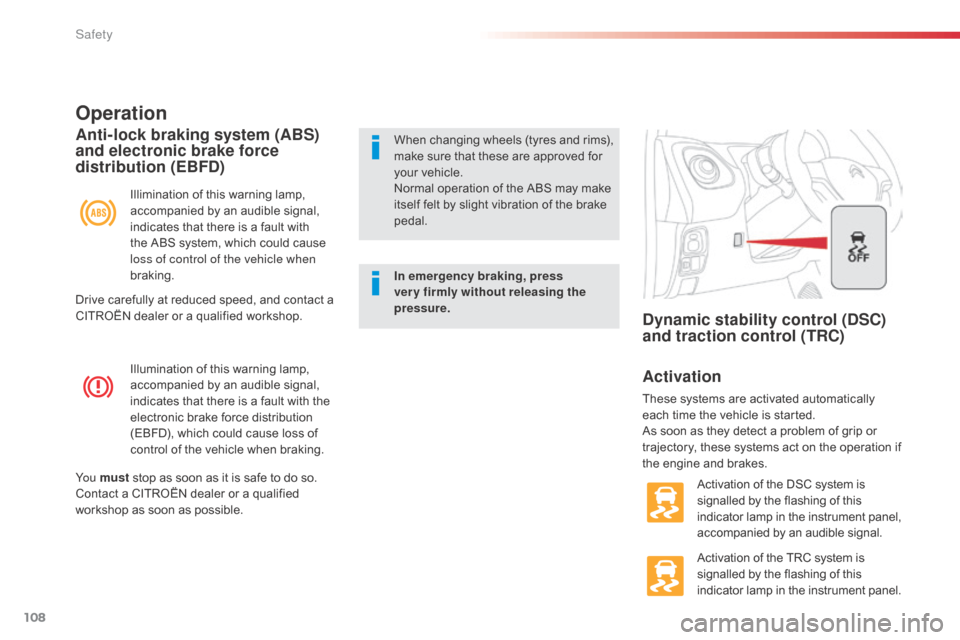
Illumination of this warning lamp,
accompanied by an audible signal,
indicates that there is a fault with the
electronic brake force distribution
(EBFD), which could cause loss of
control of the vehicle when braking.
Operation
Illimination of this warning lamp,
accompanied by an audible signal,
indicates that there is a fault with
the ABS system, which could cause
loss of control of the vehicle when
braking.
Anti-lock braking system (ABS)
and electronic brake force
distribution (EBFD)When changing wheels (tyres and rims),
make sure that these are approved for
your vehicle.
Normal operation of the ABS may make
itself felt by slight vibration of the brake
pedal.
In emergency braking, press
very firmly without releasing the
pressure.
Yo u must stop as soon as it is safe to do so.
Contact a CITROËN dealer or a qualified
workshop as soon as possible.
Dynamic stability control (DSC)
and traction control (TRC)
Activation
These systems are activated automatically
each time the vehicle is started.
As soon as they detect a problem of grip or
trajectory, these systems act on the operation if
the engine and brakes.
Activation of the DSC system is
signalled by the flashing of this
indicator lamp in the instrument panel,
accompanied by an audible signal.
Activation of the TRC system is
signalled by the flashing of this
indicator lamp in the instrument panel.
Drive carefully at reduced speed, and contact a
CITROËN dealer or a qualified workshop.
Safety
Page 143 of 256
141
Changing a wheel
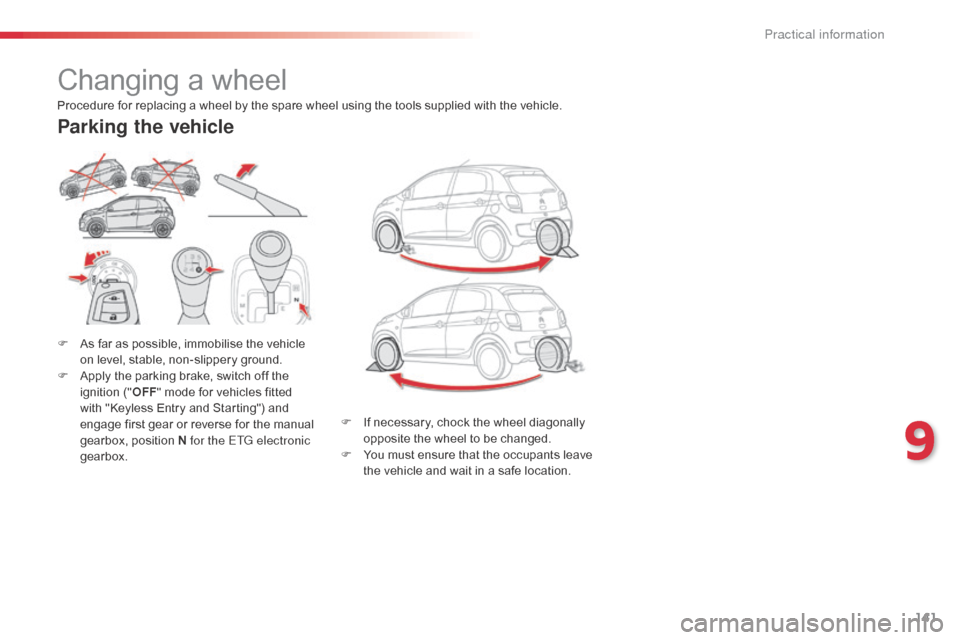
F As far as possible, immobilise the vehicle on level, stable, non-slippery ground.
F
A
pply the parking brake, switch off the
ignition (" OFF" mode for vehicles fitted
with "Keyless Entry and Starting") and
engage first gear or reverse for the manual
gearbox, position N for the ETG electronic
gearbox.
Parking the vehicle
Procedure for replacing a wheel by the spare wheel using the tools supplied with the vehicle.
F
I
f necessary, chock the wheel diagonally
opposite the wheel to be changed.
F
Y
ou must ensure that the occupants leave
the vehicle and wait in a safe location.
9
Practical information
Page 148 of 256
146
Snow chains
In wintry conditions, snow chains improve traction as well as the behaviour of the vehicle when
braking.
Advice on installation
F If you have to fit the chains during a journey, stop the vehicle on a flat sur face
on the side of the road.
F
A
pply the parking brake and position any
wheel chocks to prevent movement of your
vehicle.
F
F
it the chains following the instructions
provided by the manufacturer.
F
M
ove off gently and drive for a few
moments, without exceeding 30 mph
(50 km/h).
F
S
top your vehicle and check that the snow
chains are correctly tightened.
Take account of the legislation in force
in your country on the use of snow
chains and the maximum running speed
authorised. The snow chains must be fitted only
to the front wheels. They must never
be fitted to "space-saver" type spare
wheels.
Avoid driving with snow chains on roads
that have been cleared of snow, to
avoid damaging your vehicle's tyres and
the road sur face. If your vehicle is fitted
with alloy wheels, check that no part of
the chain or its fixings is in contact with
the wheel rim.
Use only the chains designed to be fitted to the
type of wheel fitted to your vehicle:
Original tyre size Maximum link size.165/65 R14 9 mm
165/60 R15
For more information on snow chains,
contact a CITROËN dealer or a
qualified workshop.
It is strongly recommended that before
you leave, you practise fitting the snow
chains on a level and dry sur face.
Practical information
Page 152 of 256
150
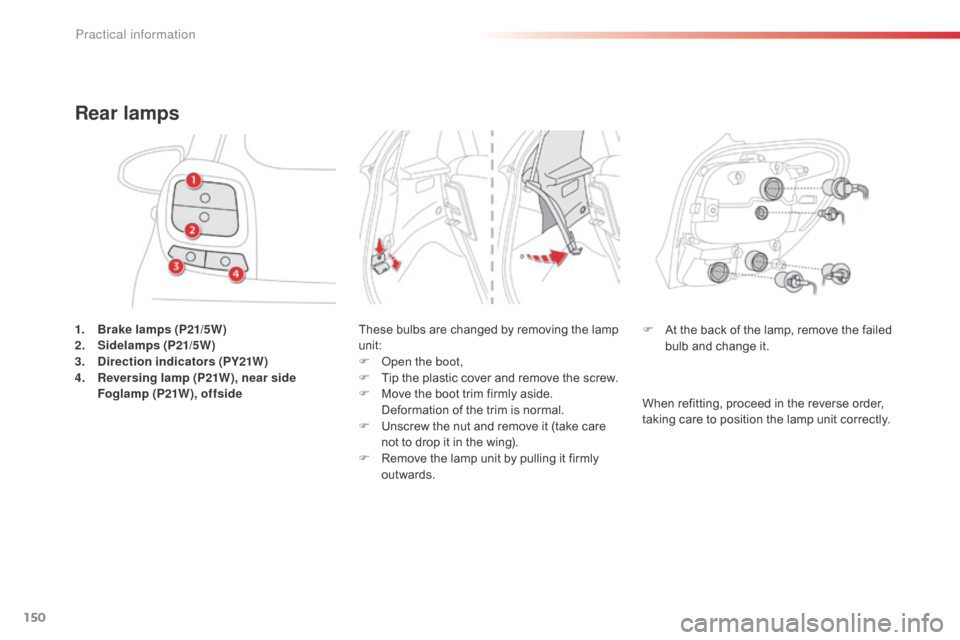
1. Brake lamps (P21/5W)
2. Sidelamps (P21/5W)
3.
D
irection indicators (PY21W)
4.
R
eversing lamp (P21W), near side
F
oglamp (P21W), offside
Rear lamps
These bulbs are changed by removing the lamp
unit:
F o
p
en the boot,
F
T
ip the plastic cover and remove the screw.
F
M
ove the boot trim firmly aside.
D
eformation of the trim is normal.
F
U
nscrew the nut and remove it (take care
not to drop it in the wing).
F
R
emove the lamp unit by pulling it firmly
outwards. F
A t the back of the lamp, remove the failed
bulb and change it.
When refitting, proceed in the reverse order,
taking care to position the lamp unit correctly.
Practical information
Page 153 of 256
151
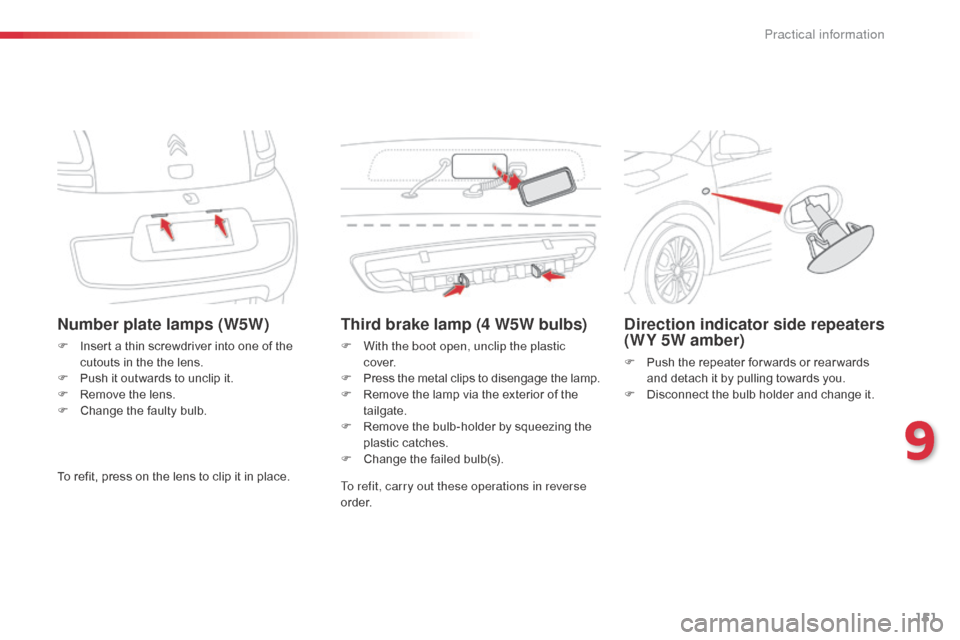
Number plate lamps (W5W)
F Insert a thin screwdriver into one of the cutouts in the the lens.
F
P
ush it outwards to unclip it.
F
R
emove the lens.
F
C
hange the faulty bulb.
Third brake lamp (4 W5W bulbs)
F With the boot open, unclip the plastic c ove r.
F
P
ress the metal clips to disengage the lamp.
F
R
emove the lamp via the exterior of the
tailgate.
F
R
emove the bulb-holder by squeezing the
plastic catches.
F
C
hange the failed bulb(s).
Direction indicator side repeaters
(WY 5W amber)
F Push the repeater for wards or rear wards and detach it by pulling towards you.
F
D
isconnect the bulb holder and change it.
To refit, press on the lens to clip it in place. To refit, carry out these operations in reverse
o r d e r.
9
Practical information
Page 157 of 256
155
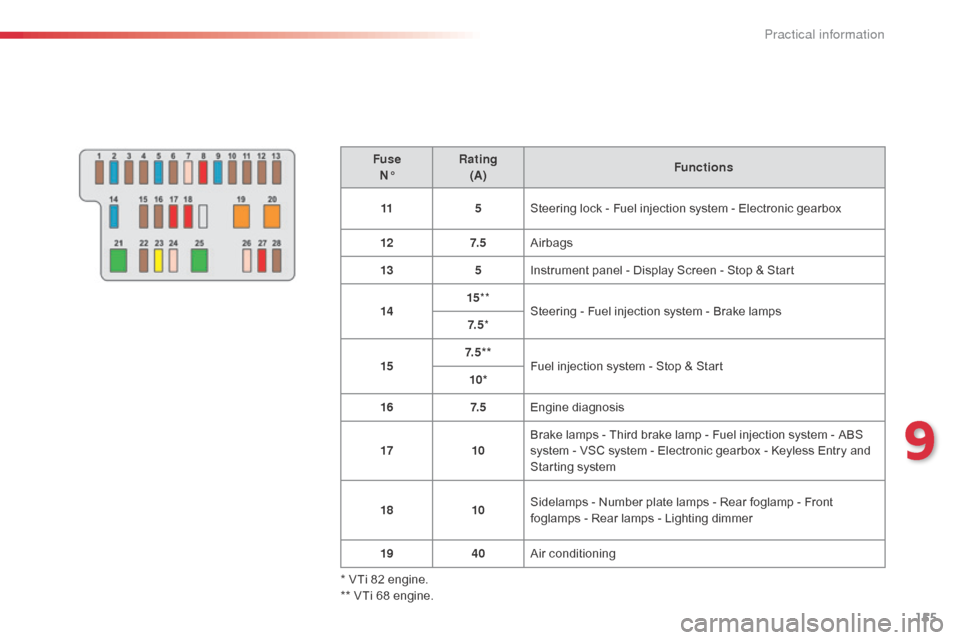
FuseN° Rating
(A) Functions
11 5Steering lock - Fuel injection system - Electronic gearbox
12 7. 5Airbags
13 5Instrument panel - Display Screen - Stop & Start
14 15
**
Steering - Fuel injection system - Brake lamps
7. 5 *
15 7. 5 * *
Fuel injection system - Stop & Start
10*
16 7. 5Engine diagnosis
17 10Brake lamps - Third brake lamp - Fuel injection system -
ABS
system - VSC system - Electronic gearbox - Keyless Entry and
Starting system
18 10Sidelamps - Number plate lamps - Rear foglamp - Front
foglamps - Rear lamps - Lighting dimmer
19 40Air conditioning
* VTi 82 engine.
** VTi 68 engine.
9
Practical information