wheel Citroen C4 AIRCROSS 2017 1.G Owner's Guide
[x] Cancel search | Manufacturer: CITROEN, Model Year: 2017, Model line: C4 AIRCROSS, Model: Citroen C4 AIRCROSS 2017 1.GPages: 368, PDF Size: 11.54 MB
Page 153 of 368
151
C4-Aircross_en_Chap06_securite_ed01-2016
Airbags
General information
System designed to contribute towards
improving the safety of the occupants (with
the exception of the rear centre passenger)
in the event of violent collisions. The airbags
supplement the action of the seat belts fitted
with force limiters (all except the centre rear
passenger belt).
If a collision occurs, the electronic detectors
record and analyse the front and side impacts
sustained in the impact detection zones:
-
i
n the case of a serious impact, the airbags
are deployed instantly and contribute
towards better protection of the occupants
of the vehicle (with the exception of the
rear centre passenger); immediately after
the impact, the airbags deflate rapidly so
that they do not hinder visibility or the exit
of the occupants,
-
i
n the case of a minor or rear impact or in
certain roll-over conditions, the airbags
may not be deployed; the seat belt
alone contributes towards ensuring your
protection in these situations.
The airbags do not operate when the
ignition is switched off.
This equipment will only deploy once.
If a second impact occurs (during the
same or a subsequent accident), the
airbag will not be deployed again. Deployment of one or more of the
airbags is accompanied by a slight
emission of smoke and a noise, due
to the activation of the pyrotechnic
cartridge incorporated in the system.
This smoke is not harmful, but sensitive
individuals may experience slight
irritation.
The noise of detonation associated with
the deployment of one or more airbags
may result in a slight loss of hearing for
a short time.
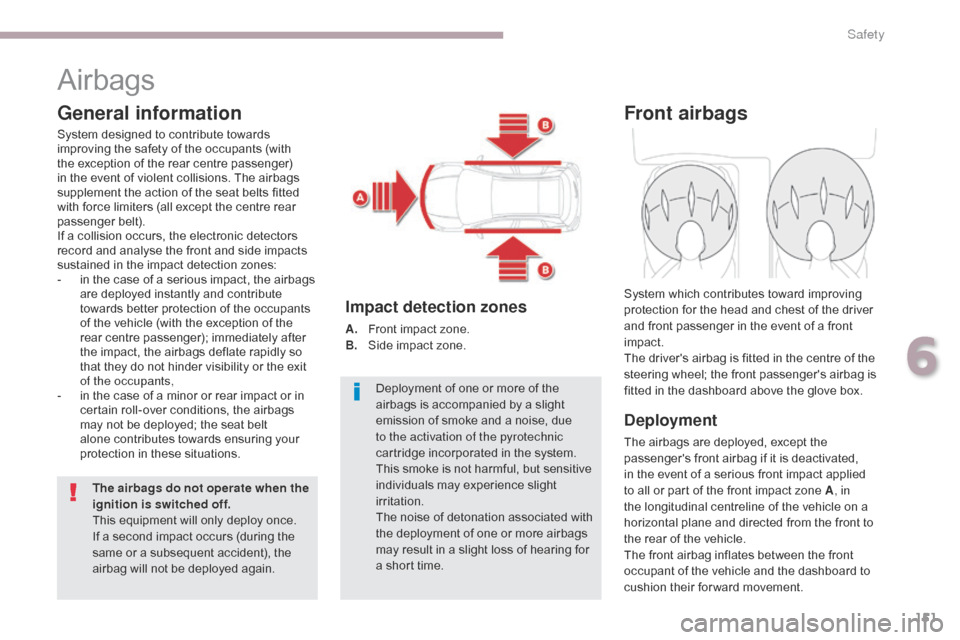
Impact detection zones
A. Front impact zone.
B. S
ide impact zone.
Front airbags
Deployment
The airbags are deployed, except the
passenger's front airbag if it is deactivated,
in the event of a serious front impact applied
to all or part of the front impact zone A , in
the longitudinal centreline of the vehicle on a
horizontal plane and directed from the front to
the rear of the vehicle.
The front airbag inflates between the front
occupant of the vehicle and the dashboard to
cushion their for ward movement. System which contributes toward improving
protection for the head and chest of the driver
and front passenger in the event of a front
impact.
The driver's airbag is fitted in the centre of the
steering wheel; the front passenger's airbag is
fitted in the dashboard above the glove box.
6
Safety
Page 157 of 368
155
C4-Aircross_en_Chap06_securite_ed01-2016
For the airbags to be fully
effective, observe the safety
recommendations below:
Sit in a normal upright position.
Wear a correctly adjusted seat belt.
Do not leave anything between the
occupants and the airbags (a child, pet,
object...), nor fix or attach anything close to
the inflation trajectory of the airbags; this
could cause injuries during their deployment.
Never modify the original definition of your
vehicle, particularly in the area directly
around the airbags.
After an accident or if the vehicle has been
stolen or broken into, have the airbag
systems checked.
All work on the airbag system must be
carried out by a CITROËN dealer or a
qualified workshop.
Even if all of the precautions mentioned
are observed, a risk of injury or of minor
burns to the head, chest or arms when an
airbag is deployed cannot be ruled out. The
bag inflates almost instantly (within a few
milliseconds) then deflates within the same
time discharging the hot gas via openings
provided for this purpose.
Knee airbag*
Do not sit with your knees any nearer to the
steering wheel than necessary.
Front airbags
Do not drive holding the steering wheel by its
spokes or resting your hands on the centre
part of the wheel.
Passengers must not place their feet on the
dashboard.
Do not smoke as deployment of the airbags
can cause burns or the risk of injury from a
cigarette or pipe.
Never remove or pierce the steering wheel or
hit it violently.
Do not fit or attach anything to the steering
wheel or dashboard, this could cause
injuries with deployment of the airbags.
Advice
Lateral airbags
Use only approved covers on the seats,
compatible with the deployment the lateral
airbags. For information on the range of seat
covers suitable for your vehicle, you can
contact a CITROËN dealer.
Do not fix or attach anything to the seat
backs (clothing...). This could cause injury
to the chest or arms if the lateral airbag is
deployed.
Do not sit with the upper part of the body any
nearer to the door than necessary.
* Depending on country of sale. Avoid attaching a heavy object to the key as
it could become a dangerous projectile if the
airbag were deployed.
Curtain airbags
Do not fix or attach anything to the roof. This
could cause injury to the head if the curtain
airbag is deployed.
If fitted on your vehicle, do not remove the
grab handles installed on the roof, they play
a part in securing the curtain airbags.
6
Safety
Page 177 of 368
175
C4-Aircross_en_Chap07_info-pratiques_ed01-2016
For more information on snow chains,
contact a CITROËN dealer or a
qualified workshop.
Snow chains
In wintry conditions, snow chains improve traction as well as the behaviour of the vehicle when
braking.
Advice on installation
F If you have to fit the chains during a journey, stop the vehicle on a flat sur face
on the side of the road.
F
A
pply the parking brake and position any
wheel chocks to prevent movement of
your
vehicle.
F
F
it the chains following the instructions
provided by the manufacturer.
F
M
ove off gently and drive for a few
moments, without exceeding 30 mph
(50 km/h).
F
S
top your vehicle and check that the snow
chains are correctly tightened.
The snow chains must be fitted only
to the front wheels. They must never
be fitted to "space-saver" type spare
wheels.
Take account of the legislation in force
in your country on the use of snow
chains and the maximum running speed
authorised.
Avoid driving with snow chains on roads
that have been cleared of snow, to
avoid damaging your vehicle's tyres and
the road sur face. If your vehicle is fitted
with alloy wheels, check that no part of
the chain or its fixings is in contact with
the wheel rim.Use only chains designed for fitment to the type
of road wheels on your vehicle:
Original equipment tyre size Maximum link size
215/70 R16 12 mm
225/55 R18
It is strongly recommended that before
you leave, you practise fitting the snow
chains on a level and dry sur face.
7
Practical information
Page 191 of 368

189
C4-Aircross_en_Chap08_En-cas-de-panne_ed01-2016
This kit is installed in the boot under the floor. Complete system consisting of a compressor and a sealant cartridge which permits the temporary
repair of a tyre so that you can drive to the nearest garage.
It is designed to repair most punctures which could affect the tyre, located on the tyre tread or
shoulder.
Temporary puncture repair kit
Access to the kit
For access to it:
F O pen the boot.
F
L
ift and remove the floor.
F
T
ake out the kit. The vehicle's electric system allows the
connection of the compressor for long
enough to inflate a tyre after a puncture
repair.
Composition of the kit
1. 12 V compressor with integral pressure gauge, to measure and adjust the tyre
pressure.
As the compressor is not sealed, keep it
away from sand, dust and water.
The puncture repair kit cannot be used
in the following circumstances:
-
t
he use-by date for the sealant
cartridge has been exceeded (see
the label on the cartridge),
-
m
ore than one tyre is punctured
whereas you have just one sealant
cartridge supplied with the kit,
-
t
he hole in the tyre exceeds 4 mm
in diameter,
-
t
he puncture is on the sidewall of
the tyre,
-
y
ou have continued to drive with a
flat tyre,
-
t
he bead of the tyre is detached
from the wheel rim,
-
t
he wheel rim is damaged.
8
In the event of a breakdown
Page 192 of 368
190
C4-Aircross_en_Chap08_En-cas-de-panne_ed01-2016
After repairing the tyre, the speed
restriction sticker should be affixed
to the centre of the vehicle's steering
wheel to remind you that this wheel
must only be used temporarily.
Do not exceed a speed of 50 mph
(80 km/h) when driving with a tyre
repaired using this type of kit.
Repair procedure
F Stop the vehicle in as safe a location as possible and on a level and stable sur face.
E
nsure that the tyre valve is not at the
bottom of the wheel, in contact with the
ground.
F
A
pply the parking brake.
F
P
lace the gear lever in position R for
vehicles with a manual gearbox, or in
position P for vehicles with a CVT gearbox.
F
S
witch off the ignition.
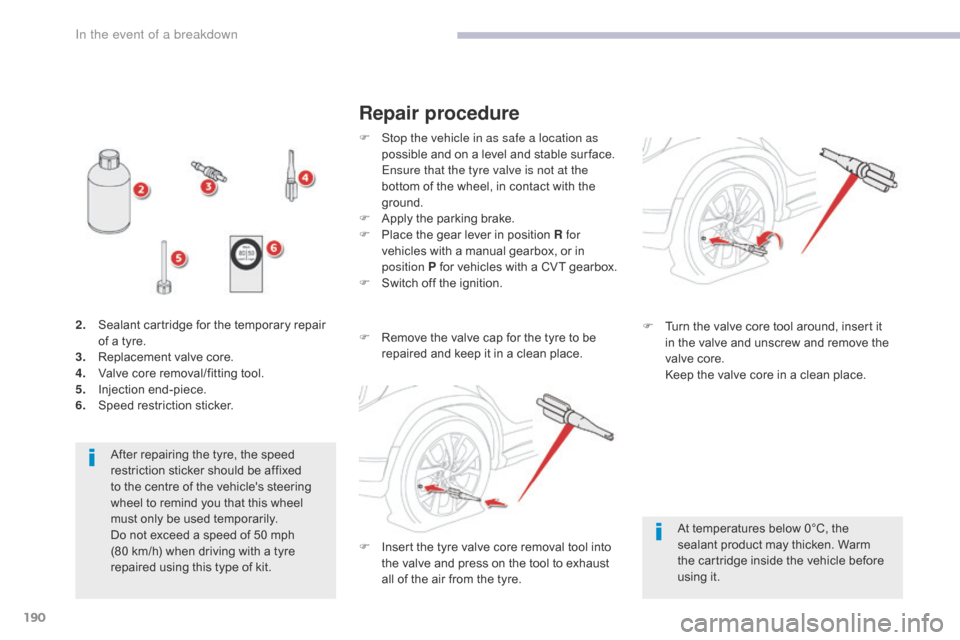
2.
S
ealant cartridge for the temporary repair
of a tyre.
3.
R
eplacement valve core.
4.
V
alve core removal/fitting tool.
5.
I
njection end-piece.
6.
S
peed restriction sticker. F
R
emove the valve cap for the tyre to be
repaired and keep it in a clean place.
At temperatures below 0°C, the
sealant product may thicken. Warm
the cartridge inside the vehicle before
using it.
F
T
urn the valve core tool around, insert it
in the valve and unscrew and remove the
valve core.
K
eep the valve core in a clean place.
F
I
nsert the tyre valve core removal tool into
the valve and press on the tool to exhaust
all of the air from the tyre.
In the event of a breakdown
Page 193 of 368
191
C4-Aircross_en_Chap08_En-cas-de-panne_ed01-2016
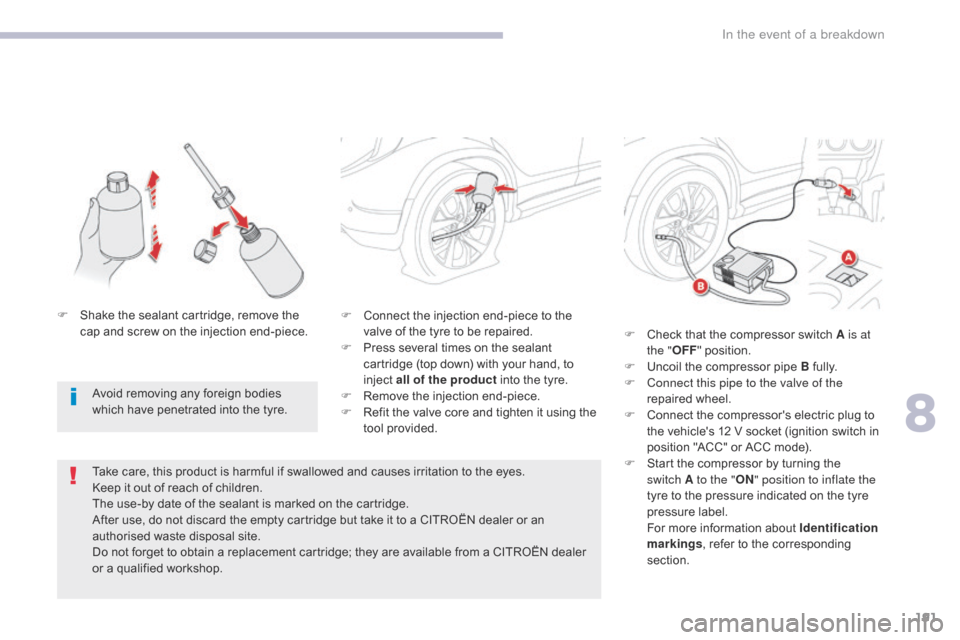
F Connect the injection end-piece to the valve of the tyre to be repaired.
F
P
ress several times on the sealant
cartridge (top down) with your hand, to
inject all of the product into the tyre.
F
R
emove the injection end-piece.
F
R
efit the valve core and tighten it using the
tool provided.
Take care, this product is harmful if swallowed and causes irritation to the eyes.
Keep it out of reach of children.
The use-by date of the sealant is marked on the cartridge.
After use, do not discard the empty cartridge but take it to a CITROËN dealer or an
authorised waste disposal site.
Do not forget to obtain a replacement cartridge; they are available from a CITROËN dealer
or a qualified workshop. F
C
heck that the compressor switch A is at
the " OFF" position.
F
U
ncoil the compressor pipe B fully.
F
C
onnect this pipe to the valve of the
repaired wheel.
F
C
onnect the compressor's electric plug to
the vehicle's 12 V socket (ignition switch in
position "ACC" or ACC mode).
F
S
tart the compressor by turning the
switch
A to the "ON" position to inflate the
tyre to the pressure indicated on the tyre
pressure label.
F
or more information about Identification
markings , refer to the corresponding
section.
Avoid removing any foreign bodies
which have penetrated into the tyre.
F
S
hake the sealant cartridge, remove the
cap and screw on the injection end-piece.
8
In the event of a breakdown
Page 194 of 368
192
C4-Aircross_en_Chap08_En-cas-de-panne_ed01-2016
F If the specified pressure has not been reached after about 10 minutes, this means
that the tyre is not repairable; contact a
CITROËN dealer or a qualified workshop
for roadside assistance.
F
R
emove the compressor and stow the kit.Do not operate the compressor for more
than 10 minutes continuously.
If the compressor seems extremely
hot, switch it off and disconnect it
immediately. Leave it to cool for at
least
30 minutes. As soon as possible after a repair using
the kit, go to a CITROËN dealer or a
qualified workshop.
Make sure that you tell the technician
that you have used the kit. After
checking, the technician will advise you
whether the tyre can be repaired or if it
must be replaced.
If the vehicle is fitted with under-
inflation detection, the under-inflation
warning lamp remains on until the
system has been reinitialised.
For more information on Under-
inflation detection
, refer to the
corresponding section. F
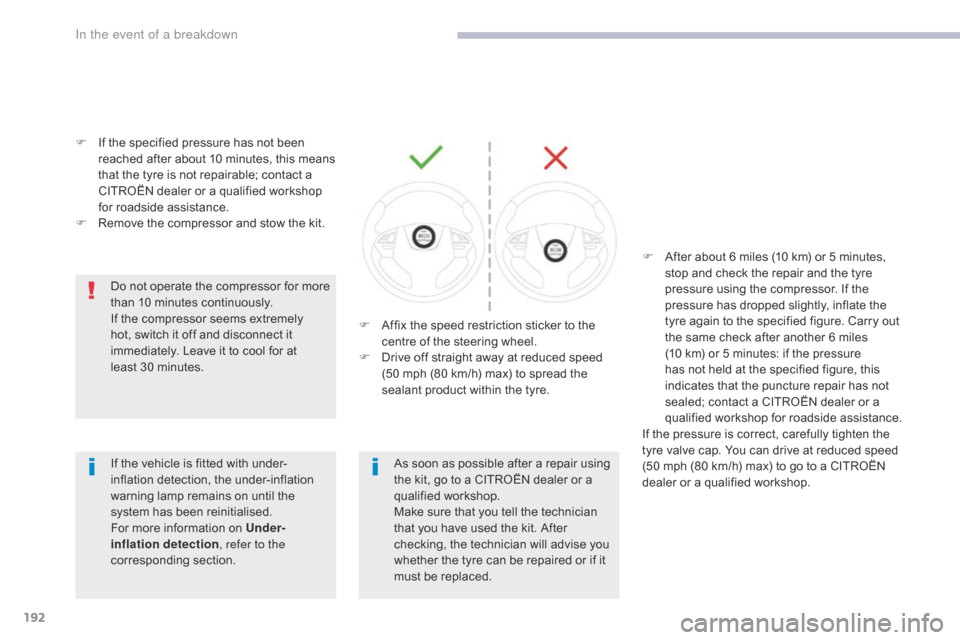
A
ffix the speed restriction sticker to the
centre of the steering wheel.
F
D
rive off straight away at reduced speed
(50 mph (80 km/h) max) to spread the
sealant product within the tyre. F
A
fter about 6 miles (10 km) or 5 minutes,
stop and check the repair and the tyre
pressure using the compressor. If the
pressure has dropped slightly, inflate the
tyre again to the specified figure. Carry out
the same check after another 6 miles
(10 km) or 5 minutes: if the pressure
has not held at the specified figure, this
indicates that the puncture repair has not
sealed; contact a CITROËN dealer or a
qualified workshop for roadside assistance.
If the pressure is correct, carefully tighten the
tyre valve cap. You can drive at reduced speed
(50 mph (80 km/h) max) to go to a CITROËN
dealer or a qualified workshop.
In the event of a breakdown
Page 195 of 368
193
C4-Aircross_en_Chap08_En-cas-de-panne_ed01-2016
Changing a wheel
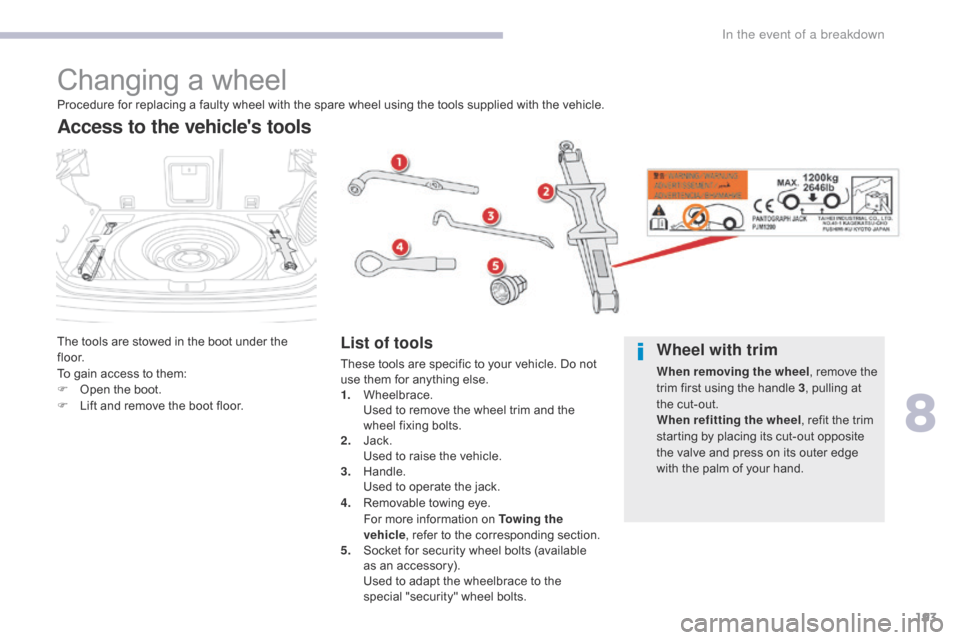
The tools are stowed in the boot under the
f l o o r.
To gain access to them:
F
O
pen the boot.
F
L
ift and remove the boot floor.
Access to the vehicle's tools
List of tools
These tools are specific to your vehicle. Do not
use them for anything else.
1.
W
heelbrace.
U
sed to remove the wheel trim and the
wheel fixing bolts.
2.
J
ack.
U
sed to raise the vehicle.
3.
H
andle.
U
sed to operate the jack.
4.
R
emovable towing eye.
F
or more information on To w i n g the
vehicle , refer to the corresponding section.
5.
S
ocket for security wheel bolts (available
as an accessory).
U
sed to adapt the wheelbrace to the
special "security" wheel bolts.
Procedure for replacing a faulty wheel with the spare wheel using the tools supplied with the vehicle.Wheel with trim
When removing the wheel
, remove the
trim first using the handle 3 , pulling at
the cut-out.
When refitting the wheel , refit the trim
starting by placing its cut-out opposite
the valve and press on its outer edge
with the palm of your hand.
8
In the event of a breakdown
Page 196 of 368
194
C4-Aircross_en_Chap08_En-cas-de-panne_ed01-2016
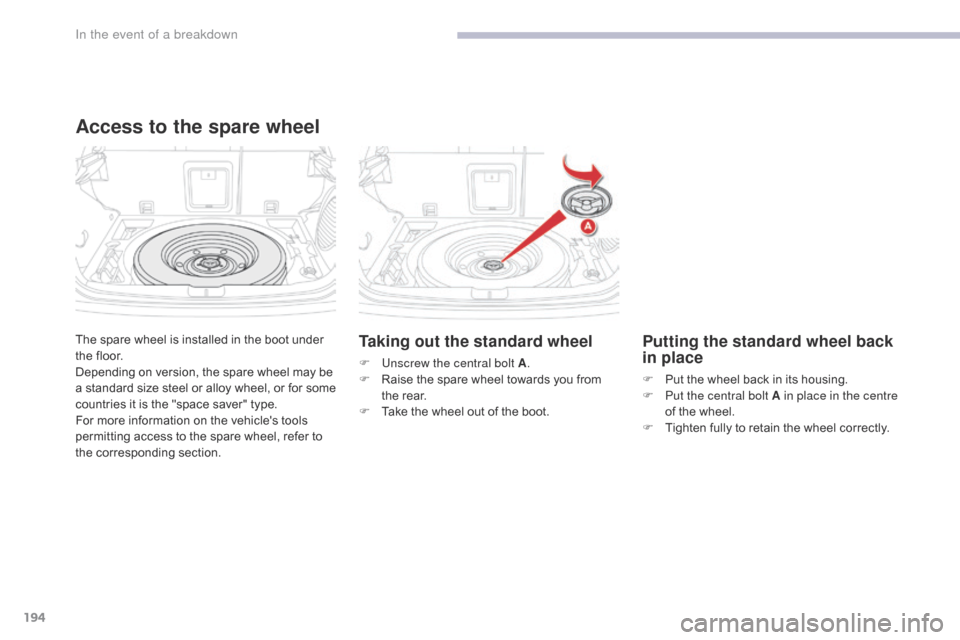
The spare wheel is installed in the boot under
the floor.
Depending on version, the spare wheel may be
a standard size steel or alloy wheel, or for some
countries it is the "space saver" type.
For more information on the vehicle's tools
permitting access to the spare wheel, refer to
the corresponding section.
Access to the spare wheel
Taking out the standard wheel
F Unscrew the central bolt A.
F R aise the spare wheel towards you from
the rear.
F
T
ake the wheel out of the boot.
Putting the standard wheel back
in place
F Put the wheel back in its housing.
F P ut the central bolt A in place in the centre
of the wheel.
F
T
ighten fully to retain the wheel correctly.
In the event of a breakdown
Page 197 of 368
195
C4-Aircross_en_Chap08_En-cas-de-panne_ed01-2016
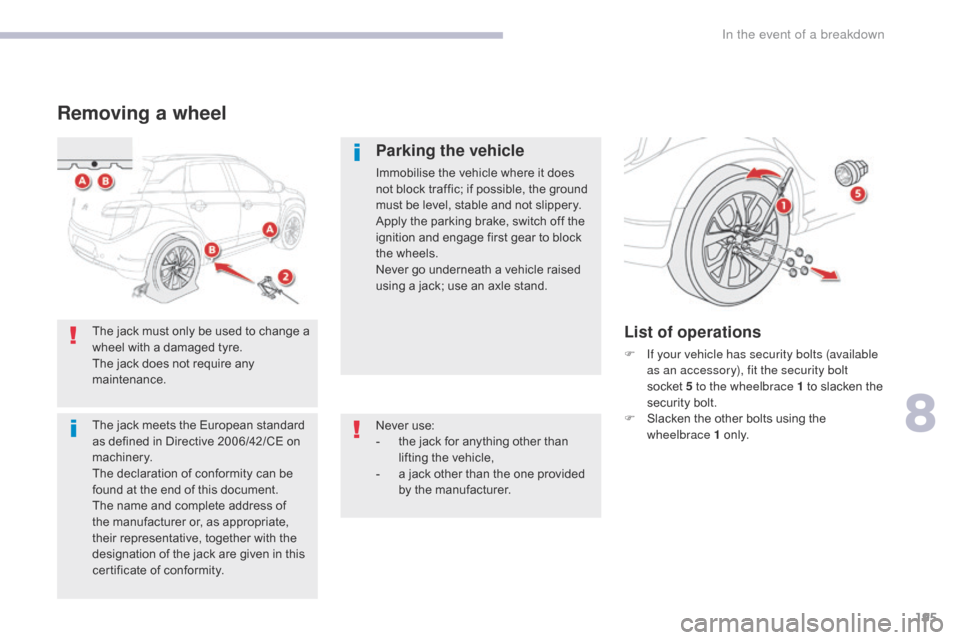
Removing a wheel
Parking the vehicle
Immobilise the vehicle where it does
not block traffic; if possible, the ground
must be level, stable and not slippery.
Apply the parking brake, switch off the
ignition and engage first gear to block
the wheels.
Never go underneath a vehicle raised
using a jack; use an axle stand.
List of operations
F If your vehicle has security bolts (available as an accessory), fit the security bolt
socket 5 to the wheelbrace 1 to slacken the
security bolt.
F
S
lacken the other bolts using the
wheelbrace 1 o n l y.
Never use:
-
t
he jack for anything other than
lifting the vehicle,
-
a j
ack other than the one provided
by the manufacturer.
The jack must only be used to change a
wheel with a damaged tyre.
The jack does not require any
maintenance.
The jack meets the European standard
as defined in Directive 2006/42/CE on
machinery.
The declaration of conformity can be
found at the end of this document.
The name and complete address of
the manufacturer or, as appropriate,
their representative, together with the
designation of the jack are given in this
certificate of conformity.
8
In the event of a breakdown