wheel CITROEN C4 PICASSO 2020 Workshop Manual
[x] Cancel search | Manufacturer: CITROEN, Model Year: 2020, Model line: C4 PICASSO, Model: CITROEN C4 PICASSO 2020Pages: 316, PDF Size: 10.36 MB
Page 182 of 316
180
This system is a visual aid that cannot in
a ny circumstances replace the need for
vigilance on the part of the driver.
The images provided by the camera(s)
may be distorted by the relief. The
presence of areas in shadow, bright
sunlight, or poor lighting conditions may
make the image dark and reduce contrast.
Forward vision
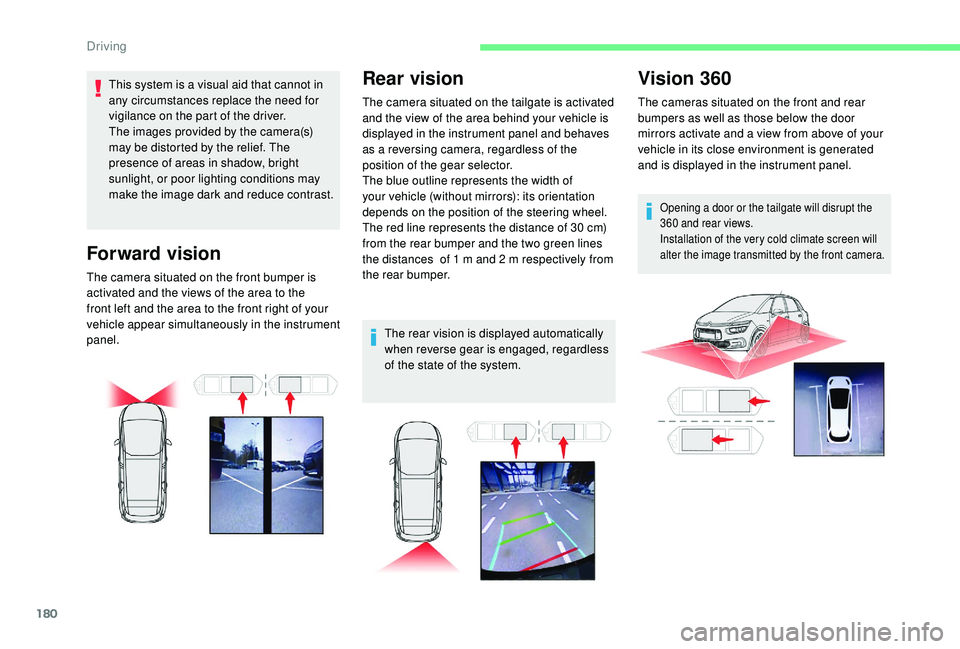
The camera situated on the front bumper is
activated and the views of the area to the
front left and the area to the front right of your
vehicle appear simultaneously in the instrument
panel.
Rear vision
The camera situated on the tailgate is activated
and the view of the area behind your vehicle is
displayed in the instrument panel and behaves
as a
reversing camera, regardless of the
position of the gear selector.
The blue outline represents the width of
your vehicle (without mirrors): its orientation
depends on the position of the steering wheel.
The red line represents the distance of 30 cm)
from the rear bumper and the two green lines
the distances of 1 m and 2 m respectively from
the rear bumper.
The rear vision is displayed automatically
when reverse gear is engaged, regardless
of the state of the system.
Vision 360
The cameras situated on the front and rear
bumpers as well as those below the door
mirrors activate and a view from above of your
vehicle in its close environment is generated
and is displayed in the instrument panel.
Opening a door or the tailgate will disrupt the
3 60 and rear views.
Installation of the very cold climate screen will
alter the image transmitted by the front camera.
Driving
Page 183 of 316

181
Operation
Function activation
On display of the menu, select one of the three
views:
"Front camera".
"360 camera".
"Rear camera".
The selected view comes up in the instrument
panel.The display disappears from the
instrument panel above 9
mph (15 km/h).
Function deactivation
F Accelerate to over 19 mph (30 km/h). Check the cleanliness of the camera
lenses regularly.
High pressure jet wash
When washing your vehicle, keep the
nozzle at least 12
inches (30 cm) from the
cameras.
With the engine running:
F
I
n the Driving menu, select the "
Driving
functions " tab, then "Panoramic visual aid". or
F
I
n the Driving menu, select the "
Driving
functions " tab, then "Panoramic visual aid".
F
Sel
ect "Camera OFF".
Park Assist
This system provides active assistance with
parking: it detects a
parking space then
operates the steering system to park in this
space.
With a
manual gearbox , the driver manages
the accelerator, brakes, gears and clutch.
With an automatic gearbox (EAT6/EAT8) , the
driver manages the accelerator, brakes and
gears.
During phases of entry into and exit from
a
parking space, the system provides visual
and audible information to the driver in order
to make the manoeuvres safe. It may be
necessary to move for wards and backwards
more than once. The driver can take control at any time by
gripping the steering wheel.
This manoeuvring assistance system
cannot, in any circumstances, replace the
need for vigilance on the part of the driver.
The driver must remain in control of their
vehicle ensuring that the space remains
clear throughout the manoeuvre.
In some circumstances, the sensors may
not detect small obstacles located in their
blind spots.
The Park Assist system cannot work with
the engine off.
A. Parallel parking.
B. Exit from a
parallel parking space.
C. Bay parking.
The Park Assist system provides assistance for
the following manoeuvres:
6
Driving
Page 184 of 316

182
During manoeuvring phases, the steering
wheel per forms rapid turns: do not hold
the steering wheel, do not put your hands
between the spokes of the steering wheel.
Watch out for any object that could block
the manoeuvre (loose clothing, scar ves,
ties, etc.) - injury risk!
When the Park Assist is active, it prevents
the Stop & Start going into STOP mode.
In STOP mode, activating Park Assist
restarts the engine.
The Park Assist system takes control
of the assistance for a maximum of
4
manoeuvre cycles. The function is
deactivated after these 4
cycles. If you
think that your vehicle is not positioned
correctly, you should then take control of
the steering to carry out the manoeuvre. The sequence of manoeuvres and the
driving instructions are displayed in the
instrument panel.
You should always check the surroundings
of your vehicle before starting
a
manoeuvre.The parking sensors function is
not available during parking space
measurement. It intervenes later when
manoeuvring to warn you that your vehicle
is approaching an obstacle: the audible
signal becomes continuous when the
obstacle is less than thirty centimetres
away.
If you have deactivated the parking
sensors, they are automatically
reactivated during assisted parking
manoeuvres.
Activation of Park Assist deactivates the
Blind Spot Detection.
Operation
Assistance with parallel parking
manoeuvres
F When you have found a
parking space.
F
P
ress this button.
The assistance is activated:
the display of this symbol and
a
speed limit indicate that
the steering manoeuvres are
controlled by the system: do not
touch the steering wheel.
The assistance is deactivated:
the display of this symbol
indicates that the steering
manoeuvres are no longer
controlled by the system:
you must take control of the
steering.
Driving
Page 185 of 316
183
This indicator lamp comes on in
the instrument panel to confirm the
activation of the system.
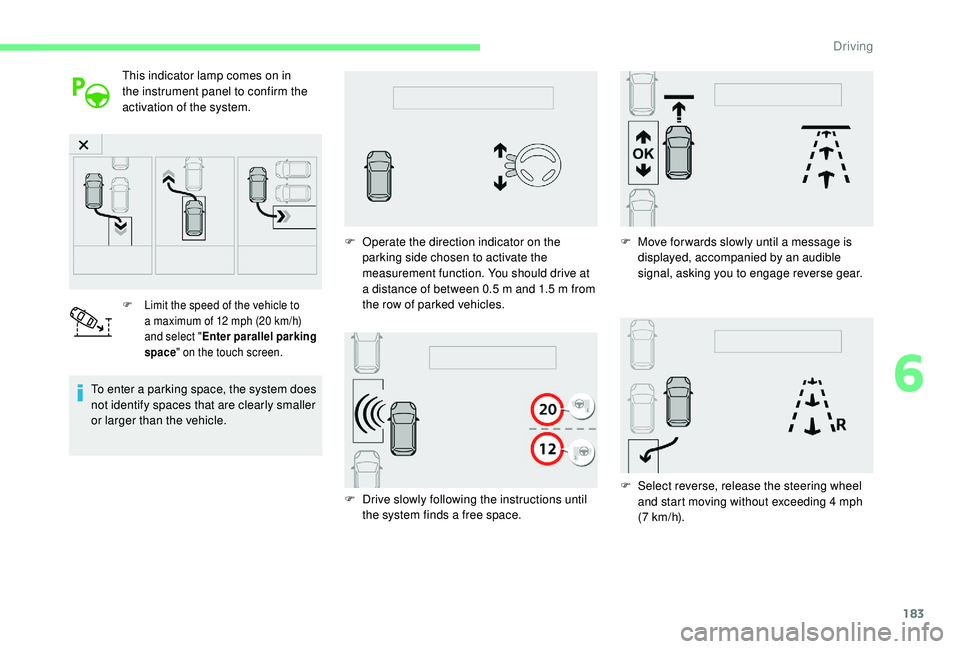
F Limit the speed of the vehicle to a maximum of 12 mph (20 km/h)
and select " Enter parallel parking
space " on the touch screen.
To enter a parking space, the system does
n ot identify spaces that are clearly smaller
or larger than the vehicle. F
O
perate the direction indicator on the
parking side chosen to activate the
measurement function. You should drive at
a distance of between 0.5 m and 1.5 m from
the row of parked vehicles.
F
D
rive slowly following the instructions until
the system finds a
free space.F
M
ove for wards slowly until a message is
displayed, accompanied by an audible
signal, asking you to engage reverse gear.
F
S
elect reverse, release the steering wheel
and start moving without exceeding 4
mph
(7
km/h).
6
Driving
Page 186 of 316

184
F The assisted parking manoeuvre is in progress.
Without exceeding 4
mph (7 km/h), move
for wards and backwards, aided by the
warnings from the "Parking sensors"
system, until the end of the manoeuvre is
indicated.
Assistance in exiting a parallel
p arking space
F When you want to leave a parallel parking
space, start the engine.
F
W
ith the vehicle stationary,
press this button.
This indicator lamp comes on in
the instrument panel to confirm the
activation of the system.
F
P
ress "Exit parking space " on
the touch screen.
F
A
t the end of the manoeuvre, the indicator
lamp in the instrument panel goes off,
accompanied by a
message and an audible
signal.
The assistance is deactivated: you can take
over control. F
T
he assisted parking manoeuvre is in
progress. Without exceeding 3
mph
(5
km/h), move for wards and backwards,
aided by the warnings from the "Parking
sensors" system, until the indication of the
end of the manoeuvre.
F
O
perate the direction indicator for the exit
side chosen. F
E
ngage reverse or forward gear and release
the steering wheel.
The manoeuvre is complete when the vehicle's
front wheels are clear of the parking space.
Driving
Page 187 of 316
185
Assistance with bay parking
manoeuvres
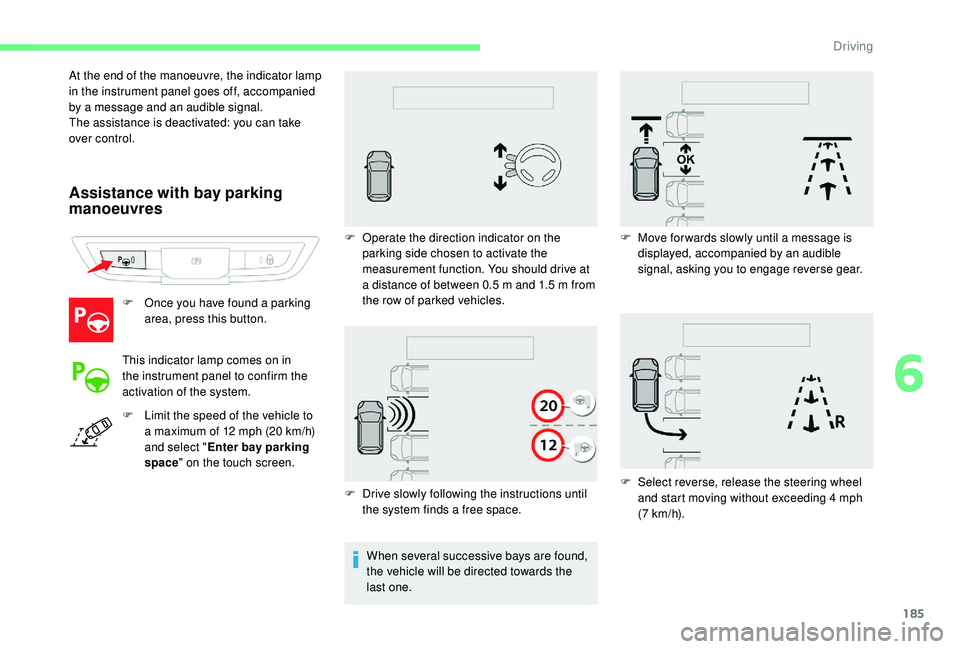
F Once you have found a parking
area, press this button.
This indicator lamp comes on in
the instrument panel to confirm the
activation of the system.
F
L
imit the speed of the vehicle to
a
maximum of 12 mph (20 km/h)
and select " Enter bay parking
space " on the touch screen.
F
D
rive slowly following the instructions until
the system finds a
free space.
At the end of the manoeuvre, the indicator lamp
in the instrument panel goes off, accompanied
by a
message and an audible signal.
The assistance is deactivated: you can take
over control.
F
O
perate the direction indicator on the
parking side chosen to activate the
measurement function. You should drive at
a distance of between 0.5 m and 1.5 m from
the row of parked vehicles.
When several successive bays are found,
the vehicle will be directed towards the
last one. F
M
ove for wards slowly until a message is
displayed, accompanied by an audible
signal, asking you to engage reverse gear.
F
S
elect reverse, release the steering wheel
and start moving without exceeding 4
mph
(7
km/h).
6
Driving
Page 188 of 316

186
F The assisted parking manoeuvre is in progress.
Without exceeding 4
mph (7 km/h), follow
the instructions displayed in the instrument
panel, aided by the warnings from the
"Parking sensors" system, until the end of
the manoeuvre is indicated. During a
bay parking manoeuvre, the Park
Assist system is automatically deactivated
once the rear of the vehicle is within
20 inches (50 cm) of an obstacle.
During parking and exit from parking
manoeuvres, the reversing camera
function may come into operation. It
facilitates monitoring of the surroundings
of the vehicle, by displaying additional
information in the instrument panel.
For more information on the Reversing
camera , refer to the corresponding
section.
Deactivation
- if the speed of the vehicle exceeds the stated limit,
-
w
hen the driver interrupts movement of the
steering wheel,
-
a
fter 4 manoeuvre cycles,
-
o
n opening the driver's door,
-
i
f one of the front wheels encounters an
obstacle.
The indicator lamp in the instrument panel goes
off and a
message is displayed accompanied
by an audible signal.
The driver should then take back control of the
vehicle's steering.
If the system is deactivated during
a
manoeuvre, the driver should reactivate
it to repeat the measurement.
Switching off
The system is switched off automatically:
- w hen towing a trailer, connected electrically,
-
i
f the driver's door is opened,
-
i
f the speed of the vehicle is above 43 mph
(70
km/h).
To switch the system off for a
prolonged period,
contact a
CITROËN dealer or a qualified
workshop.
At the end of the manoeuvre, the indicator lamp
in the instrument panel goes off, accompanied
by a
message and an audible signal.
The assistance is deactivated: you can take
over control. The system is deactivated by pressing the
control.
The system is deactivated automatically:
-
o
n switching off the ignition,
-
i
f the engine stalls,
-
i
f no manoeuvre is per formed within
5
minutes of selecting the type of
manoeuvre
-
a
fter a
prolonged stop of the vehicle during
a
manoeuvre,
-
i
f the wheel anti-slip regulation (ASR) is
triggered,
Driving
Page 193 of 316

191
Misfuel prevention (Diesel)
(Depending on the country of sale.)
Mechanical device which prevents filling the
tank of a Diesel vehicle with petrol. It helps
avoid the risk of engine damage that can result
from filling with the wrong fuel.
Operation
It remains possible to use a fuel can to fill
t he tank.
In order to ensure a
good flow of fuel,
do not place the nozzle of the fuel can in
direct contact with the flap of the misfuel
prevention device and pour slowly. Travelling abroad
As Diesel fuel pump nozzles may be
different in other countries, the presence
of the misfuel prevention device may make
refuelling impossible.
Not all Diesel vehicles are fitted with
misfuel protection, so before travelling
abroad, we recommend that you check
with the CITROËN dealer network,
whether your vehicle is suitable for the
fuel pumps in the country in which you
intend to travel.
When a petrol filler nozzle is introduced into
the fuel filler neck of a Diesel vehicle, it comes
into contact with the flap. The system remains
closed and prevents filling.
Do not persist but introduce a Diesel type
filler nozzle.
Snow chains
In wintry conditions, snow chains
improve traction as well as the
behaviour of the vehicle when
braking.
Snow chains must be fitted only to the
front wheels. They must never be fitted to
"space-saver" type spare wheels.
Take account of the legislation in force in
your country on the use of snow chains
and the maximum authorised speed.
Installation tips
F If you have to fit the chains during a journey,
stop the vehicle on a flat sur face on the side
of the road.
F
A
pply the parking brake and position any
wheel chocks under the wheels to prevent
movement of your vehicle.
F
F
it the chains following the instructions
provided by the manufacturer.
F
M
ove off gently and drive for a few
moments, without exceeding 31
mph
(50
km/h).
F
S
top your vehicle and check that the snow
chains are correctly tightened.
It is strongly recommended that before
you leave, you practise fitting the snow
chains on a
level and dry sur face.
Avoid driving with snow chains on roads
that have been cleared of snow to avoid
damaging your vehicle's tyres and the
road sur face. If your vehicle is fitted with
alloy wheels, check that no part of the
chain or its fixings is in contact with the
wheel rim.
7
Practical information
Page 194 of 316

192
Only use the chains designed to be fitted to the
type of wheels fitted to your vehicle:Original tyre size Chain type205/60
R16Maximum link size:
9
mm
205/55
R17
225/45
R18THULE K-Summit
K34
model
exclusively
For more information on snow chains, contact
a
CITROËN dealer or a qualified workshop.
Towing device
Load distribution
F Distribute the load in the trailer so that the
heaviest items are as close as possible to
the axle and the nose weight approaches the
maximum permitted without exceeding it.
Air density decreases with altitude, thus
reducing engine performance. The maximum
towed load must be reduced by 10% for every
1,000
metres of altitude. Use towing devices and their genuine
harnesses approved by CITROËN. It
is recommended that the installation
be per formed by a
CITROËN dealer or
a
qualified workshop.
If the towing device is not fitted by
a CITROËN dealer, it must still be
fitted in accordance with the vehicle
manufacturer's instructions.
Important : for versions equipped with
the motorised tailgate with "Hands-Free
Tailgate Access" function, if a towing
device other than a genuine CITROËN
one is installed, it is imperative to
visit a CITROËN dealer or a qualified
workshop to recalibrate the detection
system: risk of "Hands-Free Tailgate
Access" function failure.
Certain driving or manoeuvring aid
functions are automatically disabled if an
approved towing system is used. Obser ve the maximum authorised towable
weight, indicated on your vehicle's
registration certificate, the manufacturer's
label as well as in the Technical data
section of this guide.
Complying with the maximum
authorised nose weight (towball)
also includes the use of accessories
(bicycle carriers, tow boxes, etc.).
Obser ve the legislation in force in the
country in which you are driving.
Vehicle equipped with motorised tailgate
with " Hands-Free Tailgate Access "
function
To avoid unwanted opening of the tailgate
when using the towing device:
-
p
lease deactivate this function in advance
in your vehicle's configuration menu,
-
o
r remove the electronic key from the
recognition zone, with the tailgate closed.
Practical information
Page 205 of 316

203
Manual gearbox
The gearbox does not require any
maintenance (no oil change).
Automatic gearbox
The gearbox does not require any
maintenance (no oil change).
Brake pads
Brake wear depends on the style
of driving, particularly in the case
of vehicles used in town, over short
distances. It may be necessary to
have the condition of the brakes
checked, even between vehicle
services.
Unless there is a
leak in the circuit, a drop in
the brake fluid level indicates that the brake
pads are worn.
Brake disc wear
For information on checking brake
disc wear, contact a CITROËN
dealer or a
qualified workshop.
Electric parking brake
This system does not require any
specific check. However, in the
event of a problem, have the system
checked by a
CITROËN dealer or
a
qualified workshop.
For more information on the Electric
parking brake , refer to the corresponding
section.
Wheels and tyres
The pressure must be checked on
all tyres, including the spare wheel,
when the tyres are "cold", at least
once a
month and before a long
j o u r n ey. The pressures given on the tyre pressure label
are valid for "cold" tyres. If you have driven for
more than 10
minutes or more than 6 miles
(10 kilometres) at more than 31 mph (50 km/h),
0.3 bar (30 kPa) should be added to the values
given on the label.
Under-inflation increases fuel consumption.
Non-compliant tyre pressure causes premature
wear on tyres and has an adverse effect on the
vehicle's road holding – Risk of an accident!
Driving with worn or damaged tyres reduces
braking efficiency and control of the vehicle's
steering. Regular inspections of the condition
of tyres (tread and sides) and rims are
recommended as well as making sure that
valves are fitted.
Using different size wheels and tyres from
those specified can affect the lifetime of tyres,
wheel rotation, ground clearance and the
speedometer reading and have an adverse
effect on road holding.
Fitting different tyres on the front and rear axles
can cause the ESC to mistime.
7
Practical information