fuel Citroen C5 RHD 2015 (RD/TD) / 2.G User Guide
[x] Cancel search | Manufacturer: CITROEN, Model Year: 2015, Model line: C5 RHD, Model: Citroen C5 RHD 2015 (RD/TD) / 2.GPages: 344, PDF Size: 12.96 MB
Page 31 of 344
29
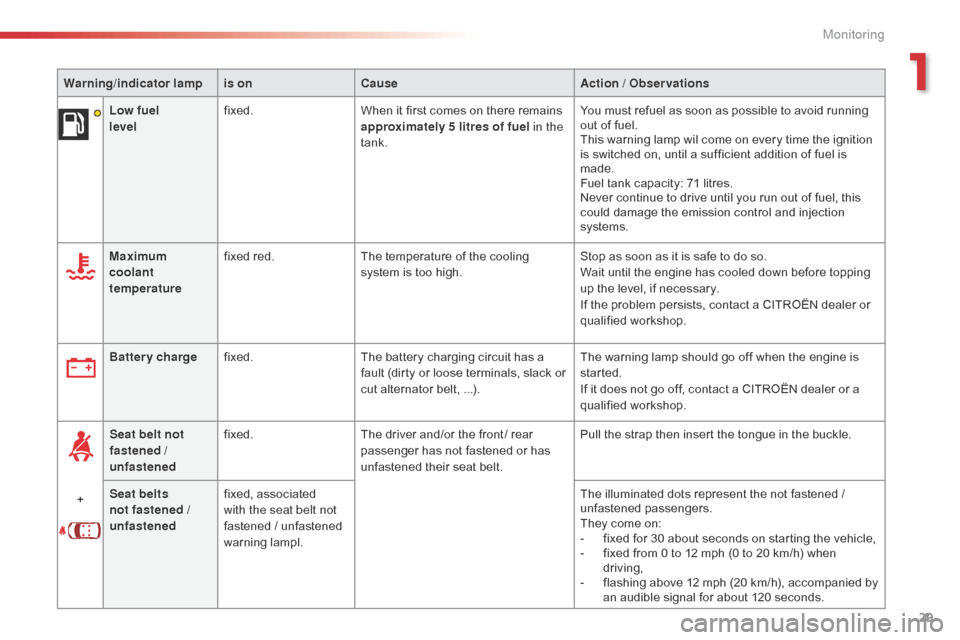
Warning/indicator lampis on Cause Action / Observations
Low fuel
level fixed.
When it first comes on there remains
approximately 5
litres of fuel in the
tank. You must refuel as soon as possible to avoid running
out of fuel.
This warning lamp wil come on every time the ignition
is switched on, until a sufficient addition of fuel is
made.
Fuel tank capacity: 71 litres.
Never continue to drive until you run out of fuel, this
could damage the emission control and injection
systems.
Maximum
coolant
temperature fixed red.
The temperature of the cooling
system is too high. Stop as soon as it is safe to do so.
Wait until the engine has cooled down before topping
up the level, if necessary.
If the problem persists, contact a CITROËN dealer or
qualified workshop.
Battery charge fixed. The battery charging circuit has a
fault (dirty or loose terminals, slack or
cut alternator belt, ...). The warning lamp should go off when the
engine is
started.
If it does not go off, contact a CITROËN dealer or a
qualified workshop.
+ Seat belt not
fastened /
unfastened
fixed.
The driver and/or the front / rear
passenger has not fastened or has
unfastened their seat belt. Pull the strap then insert the tongue in the buckle.
Seat belts
not fastened /
unfastened fixed, associated
with the seat belt not
fastened
/ unfastened
warning lampl. The illuminated dots represent the not fastened /
unfastened passengers.
They come on:
-
f
ixed for 30 about seconds on starting the vehicle,
-
f
ixed from 0 to 12 mph (0 to 20 km/h) when
driving,
-
f
lashing above 12 mph (20 km/h), accompanied by
an audible signal for about 120 seconds.
1
Monitoring
Page 40 of 344
38
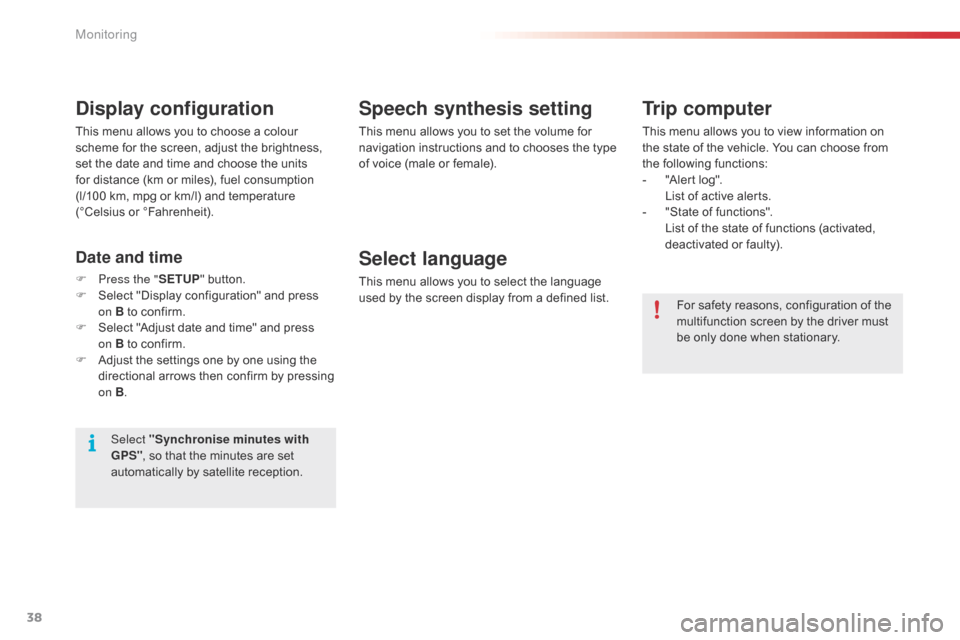
Speech synthesis setting
This menu allows you to set the volume for
navigation instructions and to chooses the type
of voice (male or female).
Select language
This menu allows you to select the language
used by the screen display from a defined list.
Select "Synchronise minutes with
GPS" , so that the minutes are set
automatically by satellite reception.
Display configuration
This menu allows you to choose a colour
scheme for the screen, adjust the brightness,
set the date and time and choose the units
for distance (km or miles), fuel consumption
(l/100
km, mpg or km/l) and temperature
(°Celsius or °Fahrenheit).
Date and time
F Press the " SETUP" button.
F S elect "Display configuration" and press
on
B to confirm.
F
S
elect "Adjust date and time" and press
on
B to confirm.
F
A
djust the settings one by one using the
directional arrows then confirm by pressing
on B .
Trip computer
This menu allows you to view information on
the state of the vehicle. You can choose from
the following functions:
-
"
Alert log".
L
ist of active alerts.
-
"
State of functions".
L
ist of the state of functions (activated,
deactivated or faulty).
For safety reasons, configuration of the
multifunction screen by the driver must
be only done when stationary.
Monitoring
Page 70 of 344

68
We recommend use of the automatic regulation
of the air conditioning.
It permits automatic and optimised control
of all of the following functions: air flow,
temperature in the passenger compartment
and air distribution, by means of various
sensors (ambient temperature, sunshine).
This eliminates any need for you to change
your settings other than the temperature value
displayed.
F Take care not to cover the sunshine sensor A .
If you select the automatic mode
(by pressing the "AUTO" control) and leave
all of the vents open, optimum comfort will be
maintained and humidity and condensation will
be removed regardless of the exterior climatic
conditions.
The temperature in the passenger compartment
can only be lower than the ambient temperature
if the air conditioning is on.
In order to be effective, the air conditioning must
be used with the windows closed. If the vehicle
has been parked in the sun for a long period and
the interior temperature is very high, first ventilate
the passenger compartment with the windows
open for a few minutes, then close the windows.
Heating, ventilation and air conditioning recommendations
To keep the air conditioning system in
good working order it is essential that it is
operated at least once a month.
The air conditioning uses engine power
during its operation. As a result, the fuel
consumption of the vehicle increases.
In certain cases of particularly arduous use
(e.g. towing the maximum load on a steep
gradient in high temperatures), switching off
the air conditioning saves engine power and
improves the towing capacity.
Air inlet
Check that the exterior grille for the air inlet,
at the bottom of the windscreen, is clean and
free of dead leaves, snow, etc.
When washing the vehicle using a high
pressure nozzle, avoid spraying at the air
inlet. Maximum comfort is obtained by means of
a good distribution of air in the passenger
compartment, both in the front and in the rear.
To obtain a uniform distribution of air, take
care not to block the exterior air intake grille
located at the base of the windscreen, the
vents, the air outlets under the front seats and
the air extractor located behind the flaps in
the boot.
The front and rear vents are fitted with
thumbwheels to adjust the air flow and
direction. We recommend that you leave all of
the vents open.
Dust filter / Odour filter
(active carbon)
There is a filter for excluding odours and
dust.
This filter must be changed in line with the
vehicle's servicing schedule. (Refer to the
maintenance and warranty guide).
Air conditioning
Air circulation
Ease of use and comfort
Page 74 of 344

72
F Press control 7, with the
engine running, to demist
the rear screen and the door
mirrors. The indicator lamp
comes on.
7. Rear demisting - defrosting
This function enables you to isolate the passenger
compartment from exterior fumes and odours.
However, demisting resumes when the engine
is switched on again.
Switch off the rear screen and door mirrors
demisting when you consider this necessary
as low current consumption reduces fuel
consumption. F
P
ress control 8 to set the air
intake mode, the indicator
lamp comes on.
Demisting is switched off automatically to
prevent an excessive consumption of current
and in relation to the ambient temperature.
It may be stopped by pressing control 7 again
or when the engine is switched off. It must be cancelled as soon as possible to
permit renewal of the air in the passenger
compartment and demisting.
The heated rear screen operates independently
of the air conditioning system.
With Stop & Start, when demisting has
been activated, the STOP mode is not
available. You can store the air conditioning
settings. Refer to the "Storing driving
positions" section.When starting with the engine cold,
the flow will reach its optimum level
gradually to prevent an excessive
distribution of cold air.
When entering the vehicle after it has
been parked for a fairly long period, if
the interior temperature is very different
from your comfort setting there is
no need to change the temperature
displayed in order to quickly reach the
level of comfort required. The system
automatically uses its maximum
per formance to correct the difference in
temperature as quickly as possible.
The water resulting from the air
conditioning condensation is
discharged via an opening provided
for this purpose; therefore, a puddle of
water may form underneath the vehicle
when stationary.
In all seasons, if the weather is cool,
the air conditioning is useful as it
removes the humidity from the air
and the condensation. Avoid driving
for prolonged periods with the air
conditioning switched off.
8. Intake of exterior air /
Recirculation of interior air
Ease of use and comfort
Page 78 of 344
76
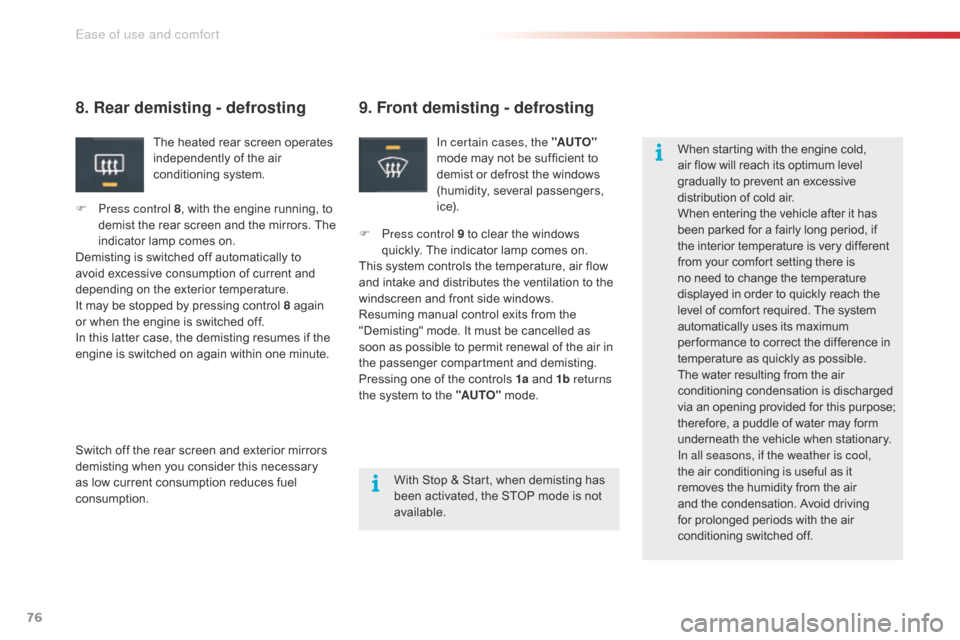
9. Front demisting - defrosting
In certain cases, the "AUTO"
mode may not be sufficient to
demist or defrost the windows
(humidity, several passengers,
i c e).
8. Rear demisting - defrosting
Switch off the rear screen and exterior mirrors
demisting when you consider this necessary
as low current consumption reduces fuel
consumption. The heated rear screen operates
independently of the air
conditioning system.
F Press control
8, with the engine running, to
demist the rear screen and the mirrors. The
indicator lamp comes on.
Demisting is switched off automatically to
avoid excessive consumption of current and
depending on the exterior temperature.
It may be stopped by pressing control 8 again
or when the engine is switched off.
In this latter case, the demisting resumes if the
engine is switched on again within one minute. F
P
ress control 9 to clear the windows
quickly. The indicator lamp comes on.
This system controls the temperature, air flow
and intake and distributes the ventilation to the
windscreen and front side windows.
Resuming manual control exits from the
"Demisting" mode. It must be cancelled as
soon as possible to permit renewal of the air in
the passenger compartment and demisting.
Pressing one of the controls 1a and 1b returns
the system to the "AUTO" mode.
With Stop & Start, when demisting has
been activated, the STOP mode is not
available. When starting with the engine cold,
air flow will reach its optimum level
gradually to prevent an excessive
distribution of cold air.
When entering the vehicle after it has
been parked for a fairly long period, if
the interior temperature is very different
from your comfort setting there is
no need to change the temperature
displayed in order to quickly reach the
level of comfort required. The system
automatically uses its maximum
per formance to correct the difference in
temperature as quickly as possible.
The water resulting from the air
conditioning condensation is discharged
via an opening provided for this purpose;
therefore, a puddle of water may form
underneath the vehicle when stationary.
In all seasons, if the weather is cool,
the air conditioning is useful as it
removes the humidity from the air
and the condensation. Avoid driving
for prolonged periods with the air
conditioning switched off.
Ease of use and comfort
Page 84 of 344

82
Reinitialising the remote control
If the vehicle's battery is disconnected or the
remote control's battery is replaced, the remote
control must be reinitialised.
After switching on the power, press button 4
(OFF) for 1 second within the next 5 seconds.
If the operation has taken place correctly the
message "OK" is displayed on the remote
control screen.
If a problem occurs, the message " F A I L"
appears. Repeat the operation. Always switch off the programmable
heating while filling with fuel to avoid
any risk of fire or explosion.
To avoid any risk of poisoning and
asphyxiation, the programmable
heating must not be used, even for
short periods, in an enclosed space
such as a garage or workshop which
is not equipped with an exhaust gas
extraction system.
Do not park the vehicle on an
inflammable sur face (dry grass, dead
leaves, paper…), there is a risk of fire.
The programmable heating system
is supplied by the vehicle's fuel tank.
Before use, ensure that the quantity
of fuel remaining is sufficient. If the
fuel tank is at the reserve, we strongly
advise that you do not programme the
heating.
The interior volumetric protection alarm
movement sensor may be disturbed by
the flow of air from the programmable
heating when it is in operation.
To avoid any unexpected triggering
of the alarm during use of the
programmable heating, it is advisable
to deactivate the interior volumetric
protection.
An adaptation of your programmable
heating allows you to pre-heat your
vehicle's passenger compartment.
Contact a CITROËN dealer or a
qualified workshop.
Ease of use and comfort
Page 122 of 344

120
System which reduces fuel consumption by advising the driver to change up.
The system intervenes only when driving
economically.
Depending on the driving situation and your
vehicle's equipment, the system may advise
you to skip one or more gears. You can
follow this instruction without engaging the
intermediate gears.
The gear engagement recommendations must
not be considered compulsory. In fact, the
configuration of the road, the amount of traffic
and safety remain determining factors when
choosing the best gear. Therefore, the driver
remains responsible for deciding whether or not
to follow the advice given by the system.
This function cannot be deactivated.Example:
-
Y
ou are in third gear.
-
Y
ou press the accelerator pedal
moderately. The information appears in the instrument
panel in the form of an arrow accompanied by
the suggested gear.
Gear efficiency indicator*
In the case of driving which makes
particular demands on the per formance
of the engine (firm pressure on the
accelerator pedal, for example, when
overtaking...), the system will not
recommend a gear change.
The system never suggests:
-
e
ngaging first gear,
-
enga
ging reverse gear,
-
e
ngaging a lower gear.
Operation
* Depending on engine. -
T
he system may suggest that you engage
a higher gear, if appropriate.
With an electronic or automatic
gearbox, the system is only active in
manual mode.
Driving
Page 123 of 344

121
Stop & Start
Operation
- with an electronic gearbox, at speeds
below 4 mph (6 km/h), press the brake
pedal or put the gear lever in position N .
Going into engine STOP
mode
The "ECO" warning lamp comes
on in the instrument panel and the
engine goes into standby:
If your vehicle is fitted with the
system, a time counter calculates
the sum of the periods in STOP
mode during a journey. It rests itself
to zero every time the ignition is
switched on with the key.
Special cases: STOP mode not
available
In this case, the "ECO" warning
lamp flashes for a few seconds then
goes
off.
This operation is perfectly normal. STOP mode is not invoked when:
-
t
he driver's door is open,
-
t
he driver's seat belt is not fastened,
-
t
he vehicle has not exceeded 6 mph
(10 km/h) since the last engine start using
the key,
-
t
he electric parking brake is applied or
being applied,
-
t
he engine is needed to maintain a
comfortable temperature in the passenger
compartment,
-
d
emisting is active,
-
s
ome special conditions (battery charge,
engine temperature, braking assistance,
ambient temperature...) where the engine is
needed to assure control of a system.
The Stop & Start
system puts the engine temporarily into standby - STOP mode - during stops in the traffic (red lights, traffic jams, or other...).
The
engine restarts automatically - START mode - as soon as you want to move off. The restart takes place instantly, quickly and silently.
Per fect for urban use, the Stop & Start system reduces fuel consumption and exhaust emissions as well as the noise level when stationary.
Never refuel with the engine in STOP
mode; you must switch off the ignition
with the key. For your comfort, during parking
maoeuvres, STOP mode is not
available for a few seconds after
coming out of reverse gear.
STOP mode does not affect the
functionality of the vehicle, such as for
example, braking, power steering...
4
driving
Page 126 of 344

124
Tyre under-inflation detection
System which automatically checks the
pressures of the tyres while driving.
The system continuously monitors the
pressures of the four tyres, as soon as the
vehicle is moving.The tyre under-inflation detection
system is an aid to driving which does
not replace the need for vigilance on
the part of the driver. This system does not avoid the need
to check the tyre pressures regularly
(including the spare wheel) and before
a long journey.
Driving with under-inflated tyres
adversely affects road holding,
extends braking distances and causes
premature tyre wear, particularly under
arduous conditions (vehicle loaded,
high speed, long journey).
The tyre pressures for your vehicle can
be found on the tyre pressure label (see
the "Identification markings" section).
The tyre pressures must be checked
when the tyres cold (vehicle stopped
for 1 hour or after driving for less then
6 miles (10 km) at moderate speed).
Other wise, add 0.3 bar to the values
indicated on the label.
Driving with under-inflated tyres
increases fuel consumption.
A pressure sensor is located in the valve of
each tyre (except the spare wheel).
The system triggers an alert if a drop in
pressure is detected in one or more tyres.
driving
Page 185 of 344

183
Fuel tank
Capacity of the tank: approximately 71 litres*.
Low fuel level
When the minimum level
in the tank is reached, this
warning lamp comes on in the
instrument panel, accompanied
by an audible warning and a message in the
multifunction screen. When it first comes on,
there remains around 5 litres of fuel in the tank.
You must refuel to avoid running out of fuel.
F
P
ress at the top left corner, then pull on its
edge. F
t
urn the key a quarter turn to lock and
unlock the filler cap,
F
w
hen refuelling, place the cap on hook A,
F
f
ill the tank, but do not persist after the
third cut-off ; this could cause your vehicle
to malfunction.
While you are refuelling, the engine must be
stopped and the ignition switched off.
For a petrol engine with a catalytic
converter, unleaded fuel is compulsory.
Opening the fuel flap Refuelling
* 55 litres for Slovakia. Additions of fuel must be of at least
5 litres to be taken into account by the
fuel gauge.
The filler neck is narrower to ensure
that only unleaded petrol nozzles can
be put in.
Opening the filler cap may create a
noise of an inrush of air. This vacuum,
which is entirely normal, is caused by
the sealing of the fuel system.
With Stop & Start, never refuel with the
system in STOP mode; you must switch
off the ignition with the key.
8
Practical information