belt Citroen C5 RHD 2015 (RD/TD) / 2.G Owner's Manual
[x] Cancel search | Manufacturer: CITROEN, Model Year: 2015, Model line: C5 RHD, Model: Citroen C5 RHD 2015 (RD/TD) / 2.GPages: 344, PDF Size: 12.96 MB
Page 5 of 344
.
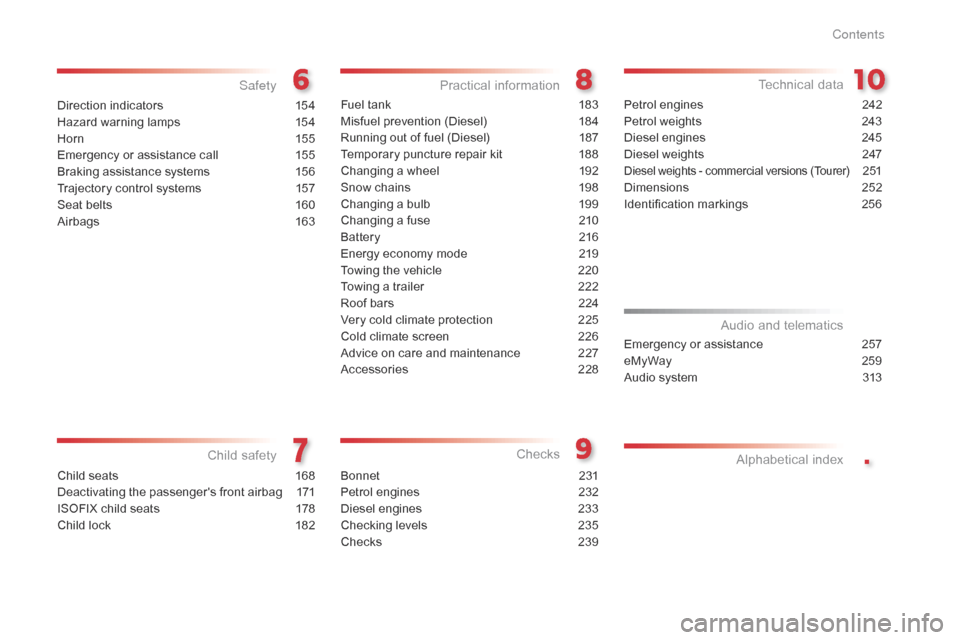
Direction indicators 154
Hazard warning lamps
1
54
Hor n
15
5
Emergency or assistance call
1
55
Braking assistance systems
1
56
Trajectory control systems
1
57
Seat belts
1
60
Airbags
1
63Fuel tank
1 83
Misfuel prevention (Diesel) 1 84
Running out of fuel (Diesel)
1
87
Temporary puncture repair kit
1
88
Changing a wheel
1
92
Snow chains
1
98
Changing a bulb
1
99
Changing a fuse
2
10
Battery
2
16
Energy economy mode
2
19
Towing the vehicle
2
20
Towing a trailer
2
22
Roof bars
2
24
Very cold climate protection
2
25
Cold climate screen
2
26
Advice on care and maintenance
2
27
Accessories
2
28
Bonnet
23
1
Petrol engines
2
32
Diesel engines
2
33
Checking levels
2
35
Checks
23
9Petrol engines
2 42
Petrol weights 2 43
Diesel engines
2
45
Diesel weights
2
47
Diesel weights - commercial versions (Tourer) 2 51
Dimensions
2
52
Identification markings
2
56
Emergency or assistance
2
57
eMyWay
2
59
Audio system
3
13
Audio and telematics Alphabetical index
Child safety Practical information
Checks
Safety
Technical data
Child seats 1
68
Deactivating the passenger's front airbag
1
71
ISOFIX child seats
1
78
Child lock
1
82
Contents
Page 7 of 344
5
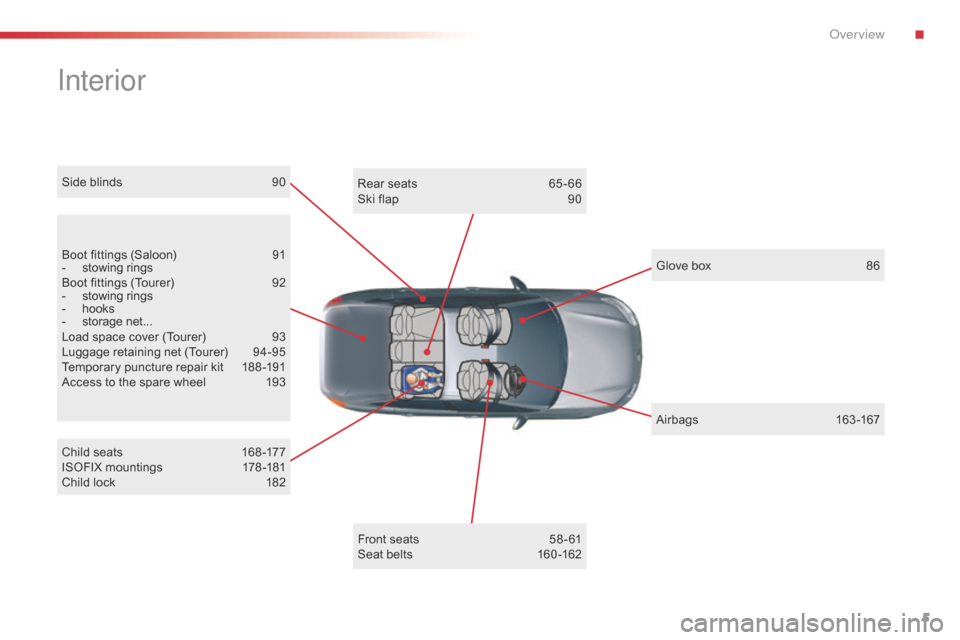
Interior
Boot fittings (Saloon) 91
- stowing rings
B
oot fittings (Tourer)
9
2
-
stowing rings
-
hooks
-
storage net...
L
oad space cover (Tourer)
9
3
Luggage retaining net (Tourer)
9
4-95
Temporary puncture repair kit
1
88 -191
Access to the spare wheel
1
93
Child seats
1
68 -177
ISOFIX mountings
1
78 -181
Child lock
1
82Rear seats
6
5 - 66
Ski flap
9
0
Front seats
5
8 - 61
Seat belts
1
60 -162Airbags
16
3 -167
Side blinds
9
0
Glove box 8 6
.
over view
Page 31 of 344
29
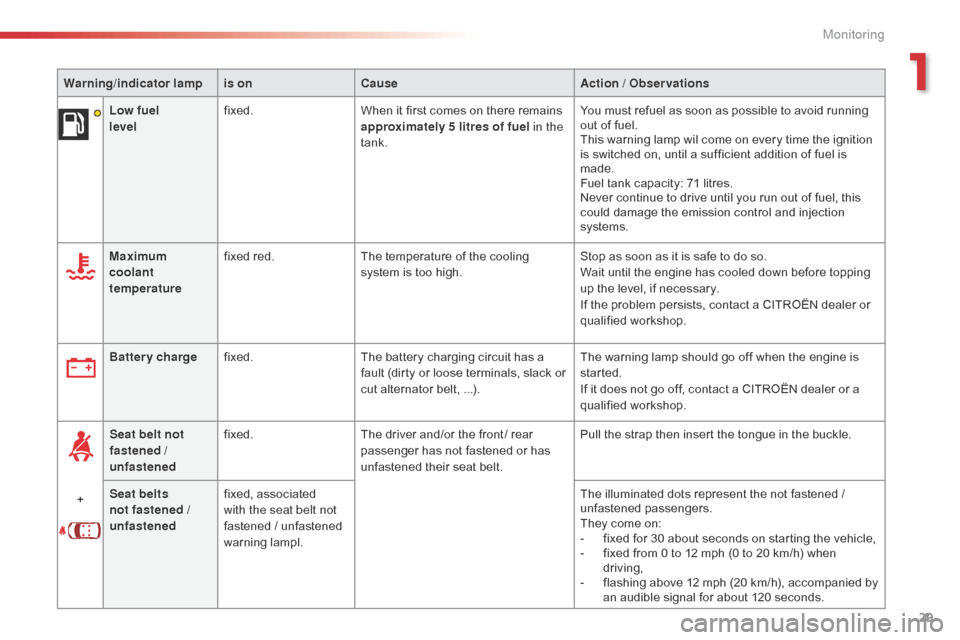
Warning/indicator lampis on Cause Action / Observations
Low fuel
level fixed.
When it first comes on there remains
approximately 5
litres of fuel in the
tank. You must refuel as soon as possible to avoid running
out of fuel.
This warning lamp wil come on every time the ignition
is switched on, until a sufficient addition of fuel is
made.
Fuel tank capacity: 71 litres.
Never continue to drive until you run out of fuel, this
could damage the emission control and injection
systems.
Maximum
coolant
temperature fixed red.
The temperature of the cooling
system is too high. Stop as soon as it is safe to do so.
Wait until the engine has cooled down before topping
up the level, if necessary.
If the problem persists, contact a CITROËN dealer or
qualified workshop.
Battery charge fixed. The battery charging circuit has a
fault (dirty or loose terminals, slack or
cut alternator belt, ...). The warning lamp should go off when the
engine is
started.
If it does not go off, contact a CITROËN dealer or a
qualified workshop.
+ Seat belt not
fastened /
unfastened
fixed.
The driver and/or the front / rear
passenger has not fastened or has
unfastened their seat belt. Pull the strap then insert the tongue in the buckle.
Seat belts
not fastened /
unfastened fixed, associated
with the seat belt not
fastened
/ unfastened
warning lampl. The illuminated dots represent the not fastened /
unfastened passengers.
They come on:
-
f
ixed for 30 about seconds on starting the vehicle,
-
f
ixed from 0 to 12 mph (0 to 20 km/h) when
driving,
-
f
lashing above 12 mph (20 km/h), accompanied by
an audible signal for about 120 seconds.
1
Monitoring
Page 68 of 344

66
Rear head restraints
The rear head restraints can be removed and
have two positions:
-
h
igh, position for use,
-
l
ow, storage position.
To raise a head restraint, pull it upwards.
To lower it, press the lug then the head
restraint.
To remove it, place it in the high position, push
the lug and pull it upwards.
To refit it, engage the head restraint rods in the
holes taking care to remain in line with the seat
back.
Never drive with the head restraints
removed, they must be in place and
correctly adjusted.
Returning the seat backrest
to its original position
When returning the rear seat to its original position:
F put the seat backrest 2 in the upright position and
secure it,
F fold the seat cushion 1 ,
F
refit the head restraints or put them back in place.When returning the rear seat to its original
position, take care not to trap the seat belts and
ensure that their buckles are positioned correctly.
The red indicator on the control 3 should no
longer be visible; if it is, push the seat fully
back.
Folding the seat
In order to fold a rear seat without any risk of
damage, always start with the seat cushion,
never with the seat backrest :
F
m
ove the corresponding front seat for ward
if necessary,
F
r
aise the front of the seat cushion 1 ,
F
t
ilt the seat cushion 1 fully against the front
seat,
F
c
heck that the seat belt is positioned
correctly on the side of the seat backrest,
F
l
ower or remove the head restraints if
necessary,
F
p
ull the control 3 for ward to release the
seat backrest 2 ,
F
t
ilt the seat backrest 2 .
The seat cushion 1 can be removed to increase
the load volume.
Ease of use and comfort
Page 123 of 344

121
Stop & Start
Operation
- with an electronic gearbox, at speeds
below 4 mph (6 km/h), press the brake
pedal or put the gear lever in position N .
Going into engine STOP
mode
The "ECO" warning lamp comes
on in the instrument panel and the
engine goes into standby:
If your vehicle is fitted with the
system, a time counter calculates
the sum of the periods in STOP
mode during a journey. It rests itself
to zero every time the ignition is
switched on with the key.
Special cases: STOP mode not
available
In this case, the "ECO" warning
lamp flashes for a few seconds then
goes
off.
This operation is perfectly normal. STOP mode is not invoked when:
-
t
he driver's door is open,
-
t
he driver's seat belt is not fastened,
-
t
he vehicle has not exceeded 6 mph
(10 km/h) since the last engine start using
the key,
-
t
he electric parking brake is applied or
being applied,
-
t
he engine is needed to maintain a
comfortable temperature in the passenger
compartment,
-
d
emisting is active,
-
s
ome special conditions (battery charge,
engine temperature, braking assistance,
ambient temperature...) where the engine is
needed to assure control of a system.
The Stop & Start
system puts the engine temporarily into standby - STOP mode - during stops in the traffic (red lights, traffic jams, or other...).
The
engine restarts automatically - START mode - as soon as you want to move off. The restart takes place instantly, quickly and silently.
Per fect for urban use, the Stop & Start system reduces fuel consumption and exhaust emissions as well as the noise level when stationary.
Never refuel with the engine in STOP
mode; you must switch off the ignition
with the key. For your comfort, during parking
maoeuvres, STOP mode is not
available for a few seconds after
coming out of reverse gear.
STOP mode does not affect the
functionality of the vehicle, such as for
example, braking, power steering...
4
driving
Page 124 of 344

122
- gear lever in position A or M, release the
brake pedal,
-
o
r gear lever in position N and the brake
pedal released, move the gear lever to
position A or M ,
-
o
r engage reverse gear.
Going into engine START
mode
The "ECO" warning lamp goes
off and the engine starts with an
electronic gearbox :
Special cases: START invoked
automatically
In this case the "ECO" warning
lamp flashes for a few seconds, then
goes
off.
This operation is perfectly normal. START mode is invoked automatically when:
-
t
he driver's door is open,
-
t
he driver's seat belt is not fastened,
-
t
he speed of the vehicle exceeds 7 mph
(11
km/h) with an electronic gearbox,
-
t
he electric parking brake is being applied,
-
s
ome special conditions (battery charge,
engine temperature, braking assistance,
ambient temperature...) where the engine is
needed for control of a system. At any time, press the "ECO OFF" switch to
deactivate the system.
This is confirmed by the switch warning lamp
coming on accompanied by a message in
the screen.
Deactivation
If the system has been deactivated
in STOP mode, the engine restarts
immediately.
Driving
Page 162 of 344

160
Seat belts
Front seat belts
Fastening
F Pull the belt down in front of you in a steady movement, making sure that it does not
become twisted.
F
P
ress the fastening into its buckle.
F
C
heck that it is properly secured and that
the automatic locking mechanism operates
correctly by pulling sharply on the belt
strap.
F
T
he lap strap should be positioned as low
down as possible in the lap and as tight as
possible.
F
T
he diagonal strap should be positioned
across the chest and away from the neck.
Each belt has a reel that adjusts its length
automatically to the girth of the seat occupant.
The front seat belts are fitted with a
pretensioning system and force limiter.
This system improves safety in the front seats
in the event of a front impact.
Depending on the seriousness of the impact,
the pretensioning system instantly tightens the
seat belt against the body of the occupant. The pretensioning seat belts are active when
the ignition is on.
The force limiter reduces the pressure of the
seat belt against the chest of the occupant,
so increasing his protection.
Height adjustment
When correctly adjusted, the seat belt shoulder
strap falls over the middle of the shoulder.
F
T
o adjust the belt, squeeze the control and
slide it in the direction required.
Unfastening
F To unfasten the belt, press on the red button in the buckle.
The belt retracts automatically when not in use.
Safety
Page 163 of 344

161
Rear seat belts
Fastening
F Pull the strap, then insert the tongue in the buckle.
F
C
heck that the seat belt is fastened
correctly by pulling the strap.
Unfastening
F Press the red button on the buckle.
Each rear seat is fitted with a three-point inertia
reel seat belt with force limiter.
This display screen is located in the roof
console.
The seat belt fastened/unfastened status
for each seating position is indicated by the
lighting or flashing of the warning lamps linked
to each position:
A.
F
ront and/or rear seat belts not fastened/
unfastened warning lamp.
B.
F
ront left-hand seat belt warning lamp.
C. F ront right-hand seat belt warning lamp.
D. R ear right-hand seat belt warning lamp.
E.
R
ear centre seat belt warning lamp.
F.
R
ear left-hand seat belt warning lamp.
G.
F
ront passenger's airbag deactivation
warning lamp.
H.
P
assenger's front airbag activation warning
lamp.
Seat belts and passenger's
front airbag warning lamp
display screen
6
Safety
Page 164 of 344

162
The driver must ensure that passengers use
the seat belts correctly and that they are all
restrained securely before setting off.
Wherever you are seated in the vehicle,
always fasten your seat belt, even for short
journeys.
Do not interchange the seat belt buckles as
they will not fulfil their role fully.
The seat belts are fitted with an inertia reel
permitting automatic adjustment of the length
of the strap to your size. The seat belt is
stowed automatically when not in use.
Before and after use, ensure that the seat
belt is reeled in correctly.
The lower part of the strap must be
positioned as low as possible on the pelvis.
The upper part must be positioned in the
hollow of the shoulder.
The inertia reels are fitted with an automatic
locking device which comes into operation in
the event of a collision, emergency braking
or if the vehicle rolls over. You can release
the device by pulling the strap firmly and
then releasing it so that it reels in slightly.In order to be effective, a seat belt must:
-
b e tightened as close to the body as
possible,
-
b
e pulled in front of you with a smooth
movement, checking that it does not
twist,
-
b
e used to restrain only one person,
-
n
ot bear any trace of cuts or fraying,
-
n
ot be converted or modified to avoid
affecting its performance.Recommendations for children
Use a suitable child seat if the passenger is
less than 12 years old or shorter than one
and a half metres.
Never use the same seat belt to secure more
than one person.
Never allow a child to travel on your lap.
For more information, refer to the "Child
seats" section.
In accordance with current safety
regulations, for all repairs on your vehicle's
seat belts, go to a qualified workshop with
the skills and equipment needed, which a
CITROËN dealer is able to provide.
Have your seat belts checked regularly by
a CITROËN dealer or a qualified workshop,
particularly if the straps show signs of
damage.
Clean the seat belt straps with soapy
water or a textile cleaning product, sold by
CITROËN dealers.
After folding or moving a seat or rear bench
seat, ensure that the seat belt is positioned
and reeled in correctly.
In the event of an impact
Depending on the nature and seriousness
of the impact , the pretensioning device may
be deployed before and independently of the
airbags. Deployment of the pretensioners
is accompanied by a slight discharge of
harmless smoke and a noise, due to the
activation of the pyrotechnic cartridge
incorporated in the system.
In all cases, the airbag warning lamp
comes on.
Following an impact, have the seat belts
system checked, and if necessary replaced,
by a CITROËN dealer or a qualified
workshop.
Safety
Page 165 of 344

163
Airbags
System designed to contribute towards
improving the safety of the occupants (with
the exception of the rear centre passenger)
in the event of a violent collision. The airbags
supplement the action of the force-limiting
seat belts. If a collision occurs, the electronic
detectors record and analyse the front and
side impacts sustained in the impact detection
zones:
-
i
n the case of a serious impact, the airbags
are deployed instantly and contribute
towards best protecting the occupants of
the vehicle (with the exception of the rear
centre passenger); immediately after the
impact, the airbags deflate rapidly so that
they do not hinder visibility or the exit of the
occupants,
-
i
n the case of a minor or rear impact or in
certain roll-over conditions, the airbags
may not be deployed; the seat belt alone
contributes towards your protection in
these situations.
Impact detection zones
A. Front impact zone.
B. S ide impact zone.
The airbags do not operate when
the ignition is switched off.
This equipment will only deploy once.
If a second impact occurs (during
the same or a subsequent accident),
the deployment of airbag will not be
triggered again. Deployment of one or more airbags
is accompanied by a slight emission
of smoke and a noise, due to the
activation of the pyrotechnic cartridge
incorporated in the system.
This smoke is not harmful, but sensitive
individuals may experience slight
irritation.
The noise of the detonation related to
the deployment of one or more airbags
may result in a slight loss of hearing for
a short time.
6
Safety