wheel Citroen DS3 2011 1.G User Guide
[x] Cancel search | Manufacturer: CITROEN, Model Year: 2011, Model line: DS3, Model: Citroen DS3 2011 1.GPages: 324, PDF Size: 25.11 MB
Page 143 of 324
141Safety
Automatic operation of
hazard warning lamps
When braking in an emergency, depending on
the deceleration, the hazard warning lamps
come on automatically.
They switch off automatically the first time you
accelerate.
)
You can also switch them off by pressing
the button.
Horn
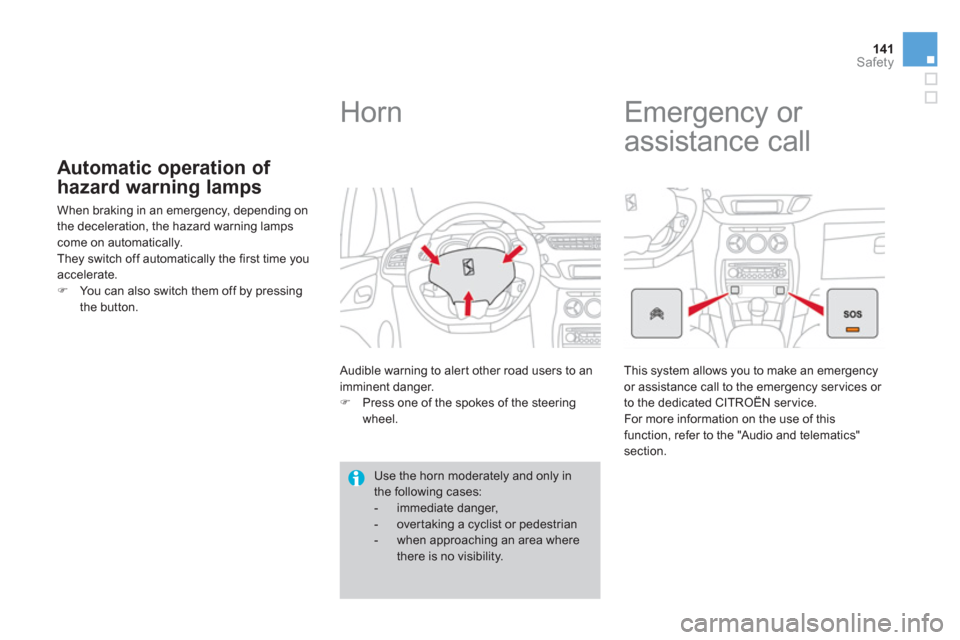
Audible warning to aler t other road users to an
imminent danger.
)
Press one of the spokes of the steering
wheel.
Use the horn moderately and only in
the following cases:
- immediate danger,
- over taking a cyclist or pedestrian
- when approaching an area where
there is no visibility.
Emergency or
assistance call
This system allows you to make an emergency
or assistance call to the emergency ser vices or
to the dedicated CITROËN ser vice.
For more information on the use of this
function, refer to the "Audio and telematics"
section.
Page 144 of 324
Braking assistance systems
Group of supplementary systems which help
you to obtain optimum braking in complete
safety in emergency situations:
- anti-lock braking system (ABS),
- electronic brake force distribution (EBFD),
- emergency braking assistance (EBA).
Anti-lock braking system
and electronic brake force
distribution
Linked systems which improve the stability and
manoeuvrability of your vehicle when braking,
in par ticular on poor or slippery sur faces.
Activation
The anti-lock braking system comes into
operation automatically when there is a risk of
wheel lock.
Normal operation of the ABS may make itself
felt by slight vibration of the brake pedal.
When braking in an emergency, press
very firmly without releasing the
pressure.
Operating fault
If this warning lamp comes on,
together with the STOP
and ABS
warning lamps, accompanied
by an audible signal and a message in the
multifunction screen, it indicates a malfunction
of the electronic brake force distribution which
could result in loss of control of the vehicle
when braking.
You must stop as soon as it is safe to do so.
When replacing wheels (tyres and
rims), ensure that they conform to the
manufacturer's recommendations.
If this warning lamp comes on,
accompanied by an audible signal
and a message in the multifunction
screen, it indicates a malfunction of the anti-
lock braking system which could result in loss
of control of the vehicle when braking.
In either case, contact a CITROËN dealer or a
qualified workshop.
Page 145 of 324
143Safety
Emergency braking assistance
System which, in an emergency, enables you
to obtain the optimum braking pressure more
quickly, thus reducing the stopping distance.
Activation
It is triggered by the speed at which the brake
pedal is pressed.
The effect of this is a reduction in the
resistance of the pedal and an increase in
braking efficiency.
When braking in an emergency, press
firmly without releasing the pressure.
Trajectory control systems
Anti-slip regulation (ASR)
and electronic stability
programme (ESP)
The anti-slip regulation (also known as Traction
Control) optimises traction to prevent skidding
of the wheels, by acting on the brakes of the
driving wheels and on the engine.
The electronic stability programme acts on the
brake of one or more wheels and on the engine
to keep the vehicle on the trajectory required
by the driver, within the limits of the laws of
physics.
Activation
These systems are activated automatically
each time the vehicle is star ted.
They come into operation in the event of a grip
or trajectory problem.
This is indicated by flashing of this
warning lamp in the instrument panel.
Page 146 of 324
Deactivation
In exceptional conditions (starting a vehicle
which is bogged down, stuck in snow, on soft
ground...), it may be advisable to deactivate the
ASR and ESP systems, so that the wheels can
move freely and regain grip.
)
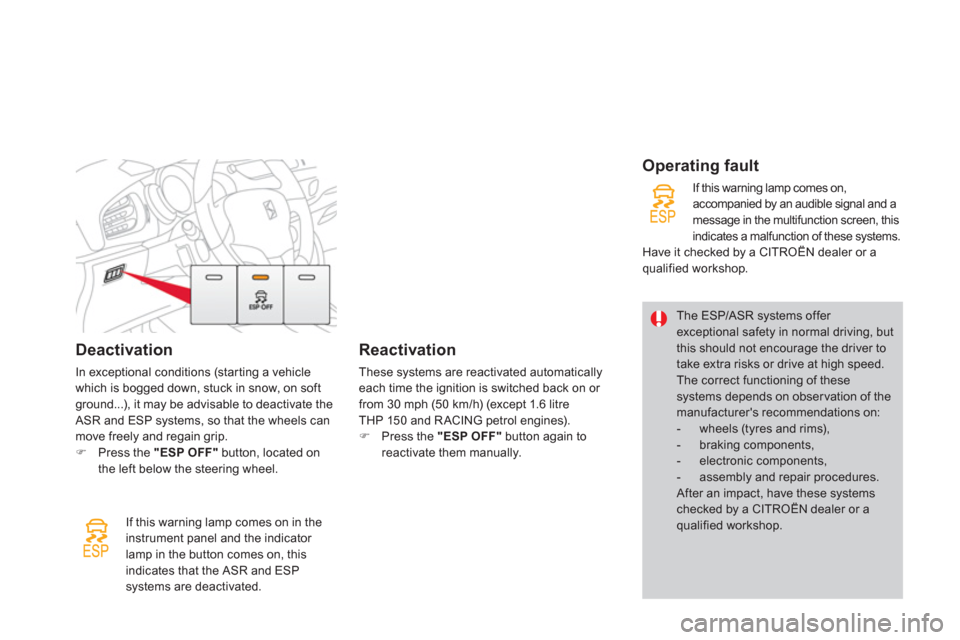
Press the "ESP OFF"
button, located on
the left below the steering wheel.
If this warning lamp comes on in the
instrument panel and the indicator
lamp in the button comes on, this
indicates that the ASR and ESP
systems are deactivated.
Reactivation
These systems are reactivated automatically
each time the ignition is switched back on or
from 30 mph (50 km/h) (except 1.6 litre
THP 150 and R ACING petrol engines).
)
Press the "ESP OFF"
button again to
reactivate them manually.
Operating fault
The ESP/ASR systems offer
exceptional safety in normal driving, but
this should not encourage the driver to
take extra risks or drive at high speed.
The correct functioning of these
systems depends on obser vation of the
manufacturer's recommendations on:
- wheels (tyres and rims),
- braking components,
- electronic components,
- assembly and repair procedures.
After an impact, have these systems
checked by a CITROËN dealer or a
qualified workshop.
If this warning lamp comes on,
accompanied by an audible signal and a
message in the multifunction screen, this
indicates a malfunction of these systems.
Have it checked by a CITROËN dealer or a
qualified workshop.
Page 151 of 324
149Safety
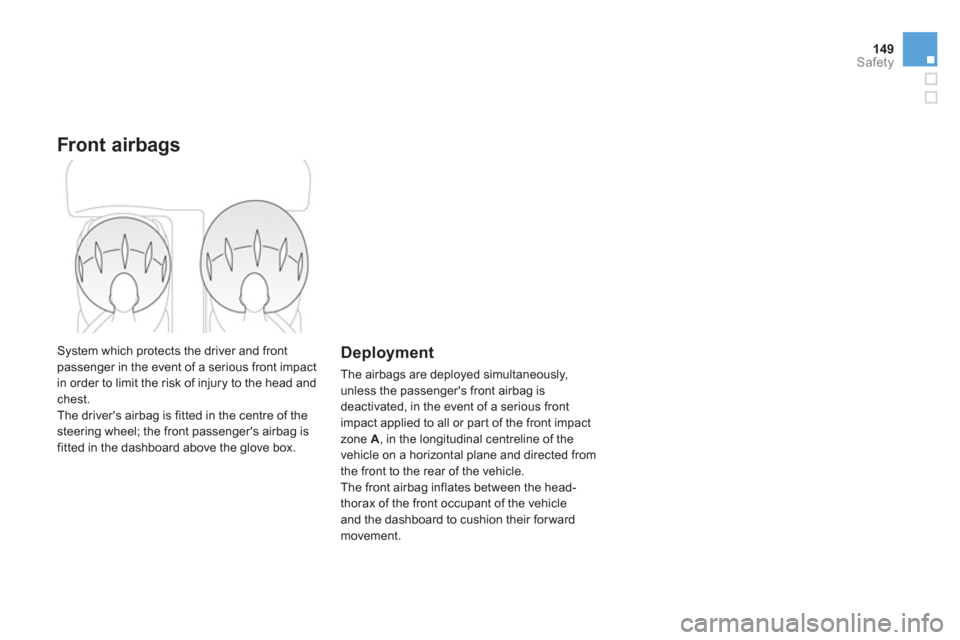
Front airbags
System which protects the driver and front
passenger in the event of a serious front impact
in order to limit the risk of injury to the head and
chest.
The driver's airbag is fitted in the centre of the
steering wheel; the front passenger's airbag is
fitted in the dashboard above the glove box.
Deployment
The airbags are deployed simultaneously,
unless the passenger's front airbag is
deactivated, in the event of a serious front
impact applied to all or par t of the front impact
zone A
, in the longitudinal centreline of the
vehicle on a horizontal plane and directed from
the front to the rear of the vehicle.
The front airbag inflates between the head-
thorax of the front occupant of the vehicle
and the dashboard to cushion their for ward
movement.
Page 155 of 324
153Safety
For the airbags to be fully effective, observe the following safety rules:
Front airbags
Do not drive holding the steering wheel by its
spokes or resting your hands on the centre
part of the wheel.
Passengers must not place their feet on the
dashboard.
If possible, do not smoke as deployment of
the airbags can cause burns or the risk of
injury from a cigarette or pipe.
Never remove or pierce the steering wheel or
hit it violently.
Lateral airbags
Use only approved covers on the seats,
compatible with the deployment the lateral
airbags. For information on the range of seat
covers suitable for your vehicle, you can
contact a CITROËN dealer (see "Practical
information - § Accessories").
Do not fix or attach anything to the seat
backs (clothing...). This could cause injury
to the chest or arms if the lateral airbag is
deployed.
Do not sit with the upper par t of the body any
nearer to the door than necessary.
Curtain airbags
Do not fix or attach anything to the roof.
This could cause injury to the head if the
cur tain airbag is deployed.
Do not remove the grab handles installed
on the roof, they play a par t in securing the
curtain airbags.
Sit in a normal upright position.
Wear a correctly adjusted seat belt.
Do not leave anything between the occupants
and the airbags (a child, pet, object...). This
could hamper the operation of the airbags or
injure the occupants.
After an accident or if the vehicle has been
stolen or broken into, have the airbag
systems checked.
All work on the airbag system must be carried
out by a CITROËN dealer or a qualified
workshop.
Even if all of the precautions mentioned
are obser ved, a risk of injury or of minor
burns to the head, chest or arms when an
airbag is deployed cannot be ruled out. The
bag inflates almost instantly (within a few
milliseconds) then deflates within the same
time discharging the hot gas via openings
provided for this purpose.
Page 158 of 324
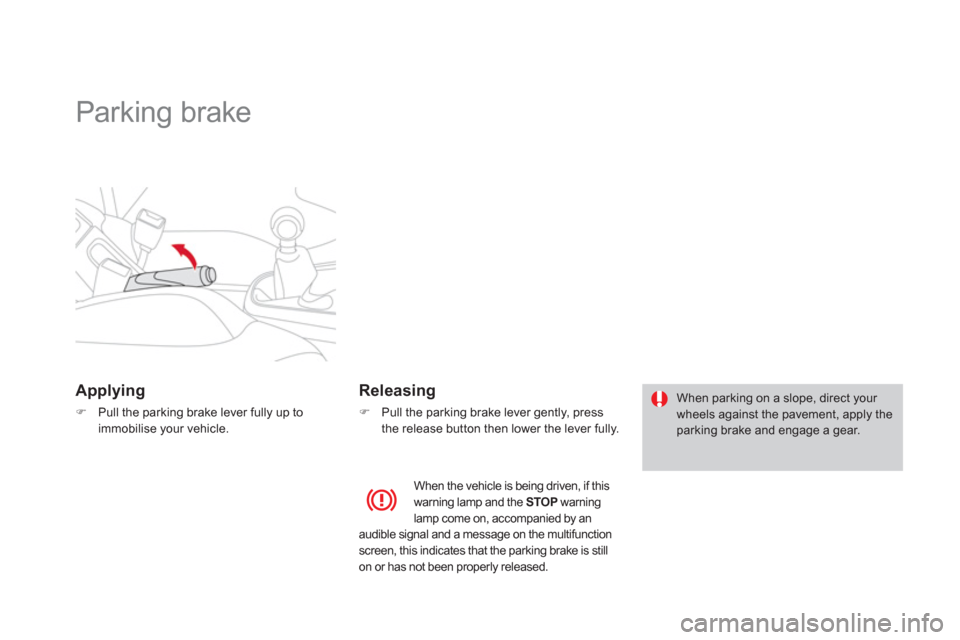
Parking brake
Applying
)
Pull the parking brake lever fully up to
immobilise your vehicle.
Releasing
)
Pull the parking brake lever gently, press
the release button then lower the lever fully. When parking on a slope, direct your
wheels against the pavement, apply the
parking brake and engage a gear.
When the vehicle is being driven, if this
warning lamp and the STOP
warning
lamp come on, accompanied by an
audible signal and a message on the multifunction
screen, this indicates that the parking brake is still
on or has not been properly released.
Page 161 of 324
159Driving
SensoDrive gearbox
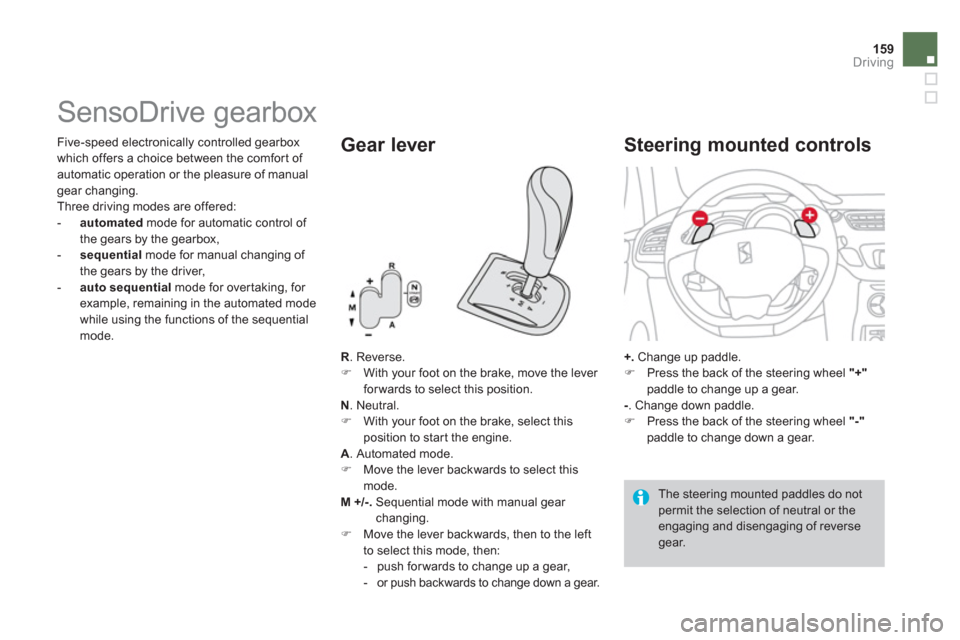
R
. Reverse.
)
With your foot on the brake, move the lever
forwards to select this position.
N
. Neutral.
)
With your foot on the brake, select this
position to star t the engine.
A
. Automated mode.
)
Move the lever backwards to select this
mode.
M +/-.
Sequential mode with manual gear
changing.
)
Move the lever backwards, then to the left
to select this mode, then:
- push for wards to change up a gear,
-
or push backwards to change down a gear.
Gear lever
+.
Change up paddle.
)
Press the back of the steering wheel "+"
paddle to change up a gear.
-
. Change down paddle.
)
Press the back of the steering wheel "-"
paddle to change down a gear.
Steering mounted controls
The steering mounted paddles do not
permit the selection of neutral or the
engaging and disengaging of reverse
gear. Five-speed electronically controlled gearbox
which offers a choice between the comfor t of
automatic operation or the pleasure of manual
gear changing.
Three driving modes are offered:
- automated
mode for automatic control of
the gears by the gearbox,
- sequential
mode for manual changing of
the gears by the driver,
- auto sequential
mode for overtaking, for
example, remaining in the automated mode
while using the functions of the sequential
mode.
Page 171 of 324
169Driving
System which prevents the vehicle from
exceeding the speed programmed by the driver.
When the programmed speed limit is reached,
pressing the accelerator pedal in the normal
manner no longer has any effect.
The speed limiter is switched on
manually:
it requires a programmed speed of at least
20 mph (30 km/h).
The speed limiter is switched off
by manual
operation of the control.
The programmed speed can be exceeded
temporarily by pressing the accelerator firmly.
To return to the programmed speed, simply
slow down to a speed below the programmed
speed.
The programmed speed remains in the memory
when the ignition is switched off.
Speed limiter
The speed limiter cannot, in any circumstances,
replace the need to respect speed limits,
nor can it replace the need for vigilance and
responsibility on the part of the driver.
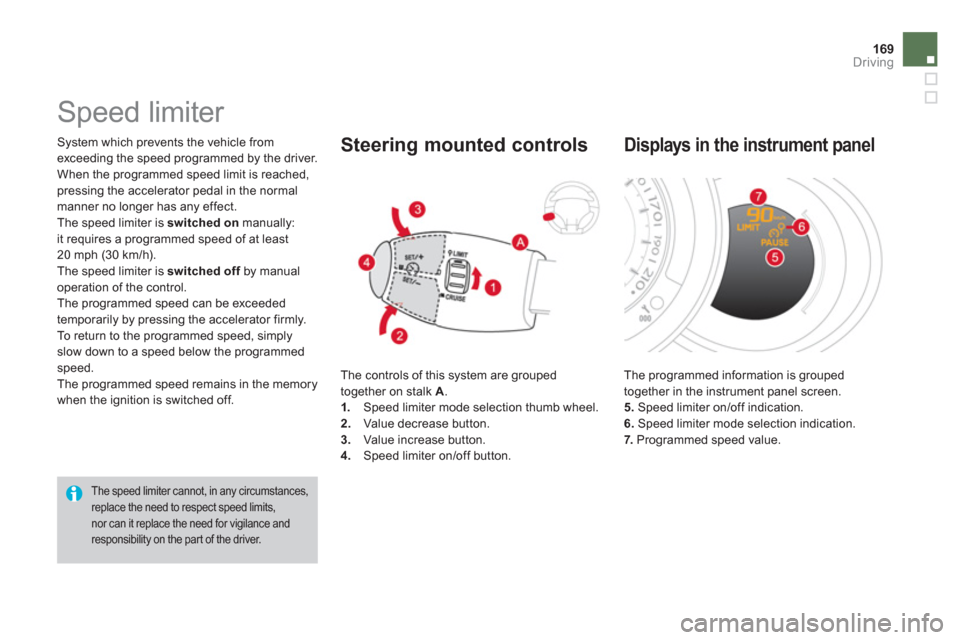
The controls of this system are grouped
together on stalk A
.
1.
Speed limiter mode selection thumb wheel.
2.
Value decrease button.
3.
Value increase button.
4.
Speed limiter on/off button.
Steering mounted controls
The programmed information is grouped
together in the instrument panel screen.
5.
Speed limiter on/off indication.
6.
Speed limiter mode selection indication.
7.
Programmed speed value.
Displays in the instrument panel
Page 172 of 324
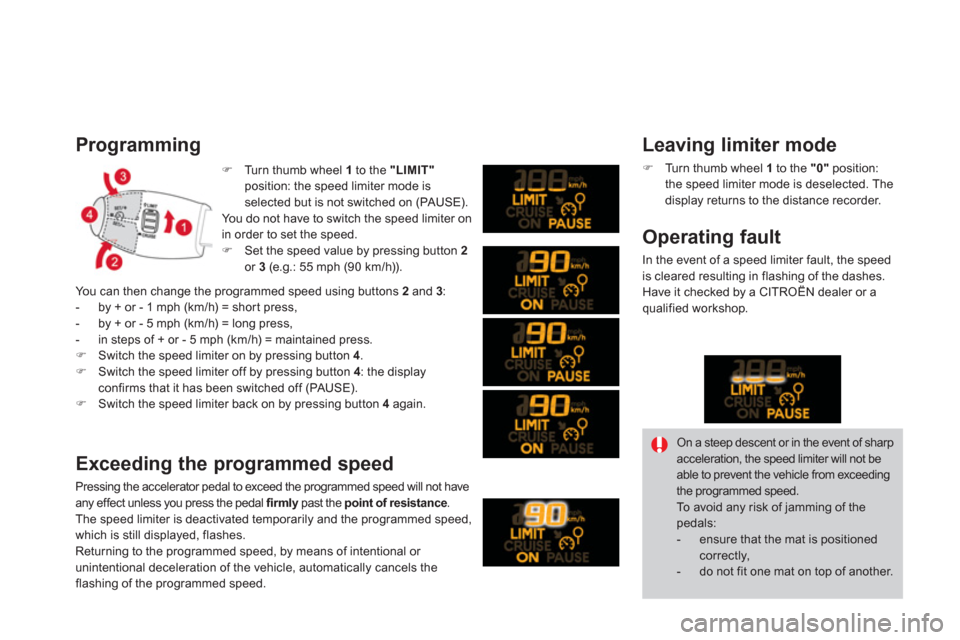
)
Turn thumb wheel 1
to the "LIMIT"
position: the speed limiter mode is
selected but is not switched on (PAUSE).
You do not have to switch the speed limiter on
in order to set the speed.
)
Set the speed value by pressing button 2
or 3
(e.g.: 55 mph (90 km/h)).
Programming
You can then change the programmed speed using buttons 2
and 3
:
- by + or - 1 mph (km/h) = shor t press,
- by + or - 5 mph (km/h) = long press,
- in steps of + or - 5 mph (km/h) = maintained press.
)
Switch the speed limiter on by pressing button 4
.
)
Switch the speed limiter off by pressing button 4
: the display
confirms that it has been switched off (PAUSE).
)
Switch the speed limiter back on by pressing button 4
again.
Exceeding the programmed speed
Pressing the accelerator pedal to exceed the programmed speed will not have
any effect unless you press the pedal firmly
past the point of resistance
.
The speed limiter is deactivated temporarily and the programmed speed,
which is still displayed, flashes.
Returning to the programmed speed, by means of intentional or
unintentional deceleration of the vehicle, automatically cancels the
flashing of the programmed speed. On a steep descent or in the event of sharp
acceleration, the speed limiter will not be
able to prevent the vehicle from exceeding
the programmed speed.
To avoid any risk of jamming of the
pedals:
- ensure that the mat is positioned
correctly,
- do not fit one mat on top of another.
Leaving limiter mode
)
Turn thumb wheel 1
to the "0"
position:
the speed limiter mode is deselected. The
display returns to the distance recorder.
Operating fault
In the event of a speed limiter fault, the speed
is cleared resulting in flashing of the dashes.
Have it checked by a CITROËN dealer or a
qualified workshop.