battery CITROEN DS3 CABRIO DAG 2014 Handbook (in English)
[x] Cancel search | Manufacturer: CITROEN, Model Year: 2014, Model line: DS3 CABRIO DAG, Model: CITROEN DS3 CABRIO DAG 2014Pages: 384, PDF Size: 11.84 MB
Page 178 of 384

The system is reactivated automaticallyat every new star t using the key.
Reactivation
This system requires a battery with a specialspecification and technology (reference numbers available from a CITROËN dealer or a qualified workshop).
Fitting a battery not listed by CITROËN introduces the risk of malfunction of
the system. In the event of a fault with the system, the
"ECO OFF"
switch warning lamp flashes thencomes on continuously.
Have it checked by a CITROËN dealer or aqualified workshop.
In the event of a fault in STOP mode, the
vehicle may stall. All of the instrument panel
warning lamps come on. It is then necessaryto switch off the ignition and star t the engine
again using the key.
Operating fault
Maintenance
Before doing anything under the bonnet, deactivate the Stop & Start system to avoid any risk of injury resulting from automatic operation of STA R T mode.
The Stop & Start system makes use of advanced technology. All work
on this type of battery must be doneby a CITROËN dealer or a qualifiedworkshop. Pr
ess the "ECO OFF"switch again.
The system is active again; this is confirmed
by the switch warning lamp going off,accompanied by a message in the screen.
Page 191 of 384

189Checks
Petrol engines
1.
Screenwash fluid reservoir. 2.Coolant header tank.3.Air filter.
4.
Brake fluid reservoir.
5. Battery.
6.Fusebox.
7. Engine oil dipstick.8.Engine oil filler cap.
Page 192 of 384

Diesel engines
1.
Screenwash fluid reservoir.2.
Coolant header tank.3.
Air filter.
4.
Brake fluid reservoir.5.
Battery.
6.Fusebox.
7. Engine oil dipstick. 8.Engine oil filler cap.9.
Priming pump (on fuel filter).
Page 196 of 384

Checks
12 V batteryAir filter and passenger compartment filter
Oil filter
Par ticle emission filter (Diesel)
Unless other wise indicated, check these components in accordance with the maintenance and warranty guide and according to your engine.
Other wise, have them checked b
y a CITROËN dealer or a qualified workshop.
The battery does not require any maintenance.
However, check that the terminals are clean
and correctl
y tightened, particularly in summer and winter.
Refer to the maintenance and
warranty guide for details of the replacement intervals for thesecomponents.
Re
place the oil filter each time the
engine oil is changed.
Refer to the maintenance and
warranty guide for details of the
replacement interval for this component. The presence of this label, in particular with
the Stop & Star t s
ystem, indicates the use of a specific 12 V lead-acid battery with special
technology and specification. The involvement
of a CITROËN dealer or a qualified workshop isessential when replacing or disconnecting the
battery. Th
e start of saturation of thepar ticle filter is indicated by the
temporary illumination of this warning lamp
accompanied by a message in the multi-function screen.
As soon as the traffic conditions permit,
regenerate the filter by driving at a speed of at
least 40 mph (60 km/h) until the warning lampgoes off.
If the warning lamp stays on, this indicates a
low additive level.
On a new vehicle, the first particlefilter regeneration operations may be accompanied by a "burning" smell, which is perfectly normal.
Following prolonged operation of thevehicle at very low speed or at idle, you may, in exceptional circumstances,notice the emission of water vapour at the exhaust on acceleration. This does not affect the behaviour of the vehicle or the environment. When carr
ying out work on the battery, refer
to the "12 V battery" section for details of theprecautions to be taken before disconnecting
the battery and following its reconnection.
Depending on the environment (e.g. dustyatmosphere) and the use of the vehicle (e.g. citydriving), replace them twice as often if necessar y.y
A clogged passenger compar tment filter may have
an adverse effect on the per formance of the air
conditioning system and generate undesirable odours.
Page 198 of 384

011
Practical information
This section describes the use of the temporary puncture repair kit, theprocedures for changing a punctured wheel, a worn wiper blade and the
various bulbs and fuses, as well as advice on charging the battery, towing
the vehicle, maintenance recommendations and information on the rangeof accessories available from the dealer network.
Page 226 of 384

Engine compartment
fusebox
The fusebox is located in the enginecompartment near the battery (left-hand side).
Access to the fuses
)
Unclip the cover.)
Change the fuse (see correspondingparagraph).)
When you have finished, close the cover carefully to ensure the sealing of the fuse box.
All work on the fuses in the boxlocated on the battery, must be done by a CITROËN dealer or a qualifiedworkshop.
Page 230 of 384

Battery Procedure for charging your battery when it is flat or for starting the engine using another battery.
The battery is located under the bonnet.
To gain access to it:
)
open the bonnet using the interior release
lever, then the exterior safety catch, ) secure the bonnet stay, )
lift the plastic cover on the (+) terminal.
Access to the battery
After refitting the battery by aCITROËN dealer or a qualified workshop, the Stop & Start systemwill only be active after a continuous period of immobilisation of the vehicle, a period which depends on the climatic conditions and the state of charge of the battery (up to about 8 hours).
The presence of this label, in particular with the Stop & Start system, indicatesthe use of a 12 V lead-acid battery withspecial technology and specification;the involvement of a CITROËN dealer or a qualified workshop is essential when replacing or disconnecting thebattery. Failure to observe this recommendation may cause premature wear of thebattery.
Page 231 of 384
Practical information
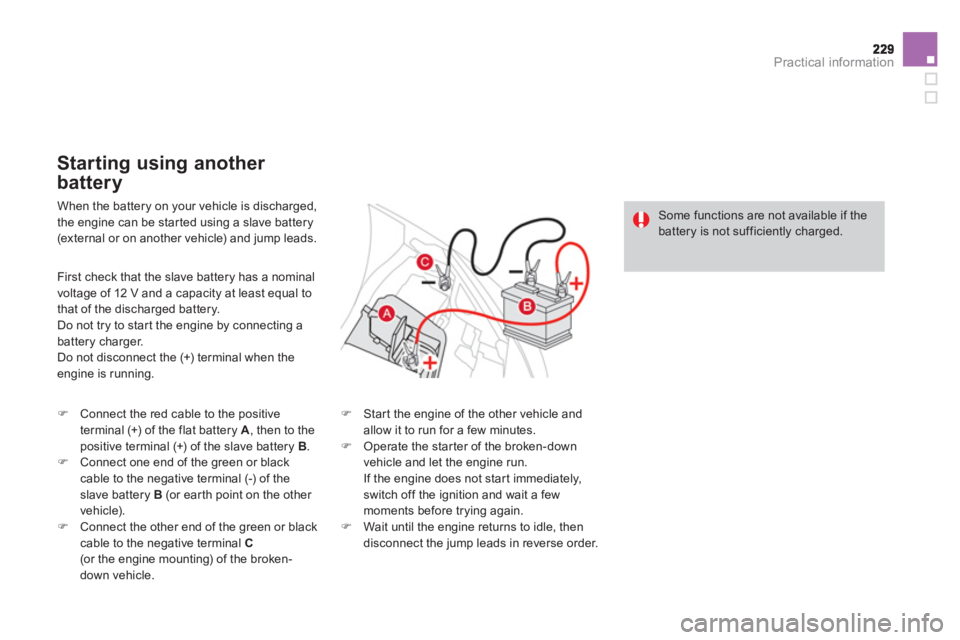
When the battery on your vehicle is discharged,
the engine can be star ted using a slave battery (external or on another vehicle) and jump leads.
Starting using another
batter
y
First check that the slave battery has a nominal
voltage of 12 V and a capacity at least equal to
that of the discharged battery.
Do not try to star t the engine by connecting a battery charger.
Do not disconnect the (+) terminal when theengine is running.
)Connect the red cable to the positive
terminal (+) of the flat battery A , then to the positive terminal (+) of the slave battery B.)Connect one end of the green or blackcable to the negative terminal (-) of the slave battery B
(or ear th point on the other
vehicle).)Connect the other end of the green or black
cable to the negative terminal C(or the engine mounting) of the broken-down vehicle.
) Start the engine of the other vehicle andallow it to run for a few minutes.)
Operate the star ter of the broken-down
vehicle and let the engine run.
If the engine does not star t immediately, switch off the ignition and wait a few
moments before trying again.) Wait until the engine returns to idle, then
disconnect the
jump leads in reverse order.
Some functions are not available if the battery is not sufficiently charged.
Page 232 of 384

Protect your eyes and face beforehandling the battery. All operations on the battery must be carried out in a well ventilated areaaway from naked flames and sources of sparks, so as to avoid the risk of explosion and fire.Do not try to charge a frozen battery;the battery must first be thawed out toavoid the risk of explosion. If the batteryhas been frozen, before charging haveit checked by a CITROËN dealer or a qualified workshop who will check thatthe internal components have not been damaged and the casing is not cracked,which could cause a leak of toxic andcorrosive acid.
Do not reverse the polarity and useonly a 12 V charger. Do not disconnect the terminals while the engine is running. Do not charge the batteries without disconnecting the terminals first. Wash your hands after wards.
Do not push the vehicle to star t the engine if you have an electronicgearbox or automatic gearbox.
Charging the battery using
a battery charger
Batteries contain harmful substances such as sulphuric acid and lead. They must bedisposed of in accordance with regulationsand must not, in any circumstances, be discarded with household waste. Ta k e used remote control batteries andvehicle batteries to a special collection point.
)Follow the instructions for use provided by
the manufacturer of the charger.
Do not disconnect the battery to charge it.
Page 233 of 384

231Practical information
Energy economy mode System which manages the period of use of cer tain functions to conser ve a sufficient level of charge in the battery.
After the engine has stopped, you can still use functions such as the audio equipment, windscreen wipers, dipped beam headlamps, cour tesy lamps,etc. for a maximum combined period of thir ty minutes.
This period may be greatly reduced if the battery is not fully charged.
A flat battery prevents the engine from starting (refer to the correspondingparagraph).
If the telephone is being used at thesame time on the eMyWay audionavigation system, it will be interrupted after 10 minutes.
Switching to economy mode
Once this period has elapsed, a message appears on the multifunction screen indicating
that the vehicle has switched to economy mode and the active functions are put on standby.
Exiting economy mode
These functions are reactivated automatically
the next time the vehicle is driven. ) In order to resume the use of thesefunctions immediately, star t the engine and
let it run for a few minutes.
The time available to you will then be double
the period for which the engine is left running. However, this period will always be between five and thir ty minutes.