ECU CITROEN DS4 2010 Owner's Manual
[x] Cancel search | Manufacturer: CITROEN, Model Year: 2010, Model line: DS4, Model: CITROEN DS4 2010Pages: 421, PDF Size: 8.05 MB
Page 250 of 421

248
To check the level or top up the
fluid on vehicle fitted with headlamp
washers, immobilise the vehicle and
switch of the engine.
Screenwash / headlamp wash fluid level
F Open the bonnet and secure it with the st ay.Specification of the fluid
To ensure optimum cleaning and to avoid
freezing, the fluid should never be topped up or
replaced by plain water.
In wintry conditions, the use of a fluid
with an ethyl alcohol or methanol base is
recommended.
F
O
pen the screenwash reservoir filler cap.
F
T
ake and pinch the level gauge to block its
breather.
F
R
emove the gauge completely from
the reservoir to read the level in the
transparent section.
F
T
op up if necessary.
F
R
efit the filler cap to the reservoir and
close the bonnet.
07
Practical information
Page 257 of 421

255
Never store bottles of AdBlue® in your
vehicle.
Recommendations on storage
AdBlue® freezes at about -11°C and
deteriorates above 25°C. It is recommended
that bottles be stored in a cool area and
protected from direct sunlight .
Under these conditions, the fluid can be kept
for at least a year .
If the additive has frozen, it can be used once it
has completely thawed out. Before starting the top-up procedure, ensure
that the vehicle is parked on a flat and level
sur face.
Procedure
F Switch off the ignition and remove the
key, or if your vehicle has one, press the
START/STOP button to switch off the
engine.
F
R
aise the boot floor for access to the
AdBlue
® tank. S
ecure the boot floor by attaching its cord
to the hook on the parcel shelf support.
F
U
nclip the black plastic blanking plug using
its tab.
F
I
nsert your fingers into the aperture and
turn the blue cap a 6
th of a turn anti-
clockwise.
F
C
arefully lift off the cap, without dropping it.
Do not dispose of AdBlue
® bottles or
containers in the household waste.
Place them in a container provided
for this purpose or take them to your
dealer.
07
Practical information
Page 269 of 421
267
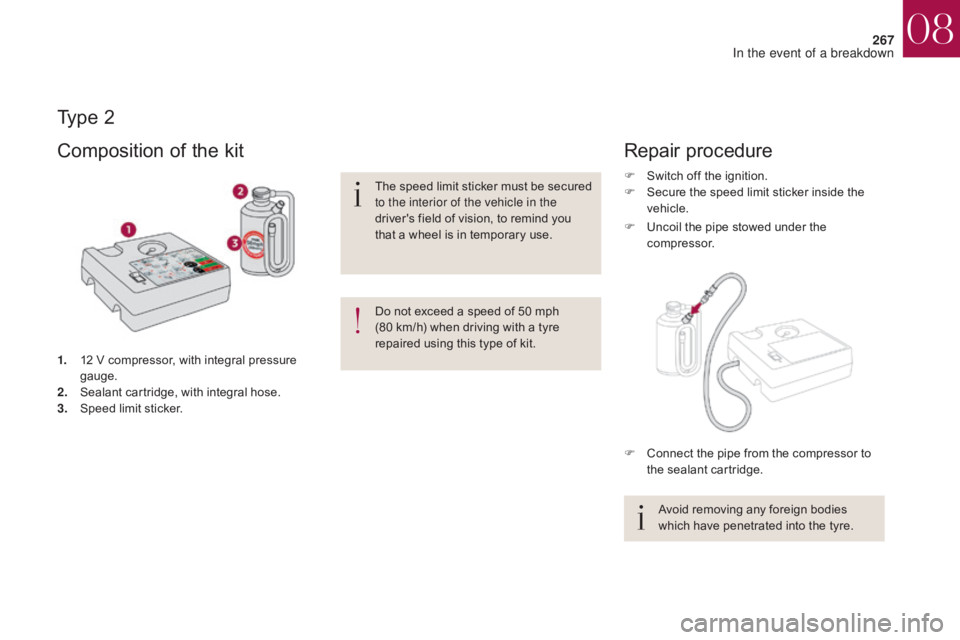
Ty p e 2
1. 12 V compressor, with integral pressure gauge.
2.
S
ealant cartridge, with integral hose.
3.
S
peed limit sticker.
Composition of the kit
The speed limit sticker must be secured
to the interior of the vehicle in the
driver's field of vision, to remind you
that a wheel is in temporary use.
Do not exceed a speed of 50 mph
(80
km/h) when driving with a tyre
repaired using this type of kit.
Repair procedure
F Switch off the ignition.
F S ecure the speed limit sticker inside the
vehicle.
Avoid removing any foreign bodies
which have penetrated into the tyre.
F
U
ncoil the pipe stowed under the
compressor.
F
C
onnect the pipe from the compressor to
the sealant cartridge.
08
In the event of a breakdown
Page 270 of 421

268
F Turn the sealant cartridge and secure it in the cut-out provided on the compressor. F
C
heck that the compressor switch is at
the "
O " position.
F
U
ncoil fully the electric cable, stowed under
the compressor.
F
R
emove the valve cap from the tyre to be
repaired, and place it in a clean area.
F
C
onnect the hose from the sealant
cartridge to the valve of the tyre to be
repaired and tighten firmly. F
C
onnect the compressor's plug to the
vehicle's 12 V socket.
F
S
witch on the ignition.
08
In the event of a breakdown
Page 273 of 421
271
Spare wheelProcedure for changing a wheel with a damaged or punctured tyre for the spare wheel, using the tools supplied with the vehicle.
The tools are installed in the boot under the
f l o o r.
To gain access to them:
F
o
pen the boot,
F
r
aise the floor,
F
s
ecure it by hooking its cord on the hook
on the rear shelf support,
F
w
ith a standard size spare wheel, unclip
and remove the box in the middle of the
wheel containing the tools,
or
F
w
ith a "space-saver" spare wheel; lift the
wheel at the rear towards you for access to
the storage box containing the tools.
Access to the tools
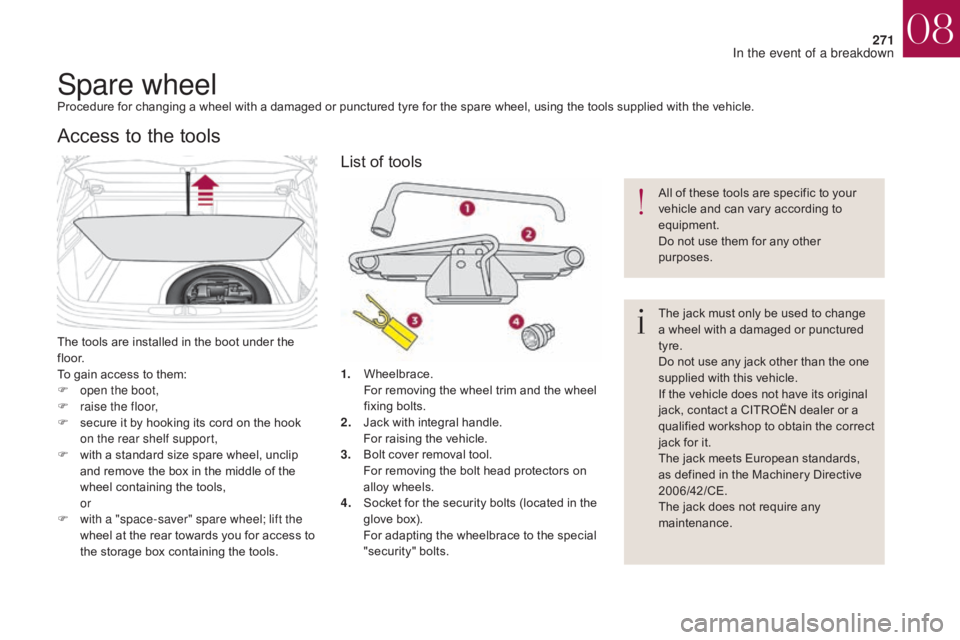
1. Wheelbrace. F or removing the wheel trim and the wheel
fixing bolts.
2.
J
ack with integral handle.
F
or raising the vehicle.
3.
B
olt cover removal tool.
F
or removing the bolt head protectors on
alloy wheels.
4.
S
ocket for the security bolts (located in the
glove box).
F
or adapting the wheelbrace to the special
"security" bolts. All of these tools are specific to your
vehicle and can vary according to
equipment.
Do not use them for any other
purposes.
The jack must only be used to change
a wheel with a damaged or punctured
tyre.
Do not use any jack other than the one
supplied with this vehicle.
If the vehicle does not have its original
jack, contact a CITROËN dealer or a
qualified workshop to obtain the correct
jack for it.
The jack meets European standards,
as defined in the Machinery Directive
2006/42/CE.
The jack does not require any
maintenance.
List of tools
08
In the event of a breakdown
Page 277 of 421
275
Removing a wheel
Parking the vehicle
Immobilise the vehicle where it does
not block traffic: the ground must be
level, stable and non-slippery ground.
Apply the parking brake unless it has
been programmed to automatic mode,
switch off the ignition and engage first
gear* to lock the wheels.
Check that the braking warning lamps
in the instrument panel are on (not
flashing).
The occupants must get out of the
vehicle and wait where they are safe.
If necessary, place a chock under the
wheel diagonally opposite the wheel to
be changed.
Never go underneath a vehicle raised
using a jack; use an axle stand.F
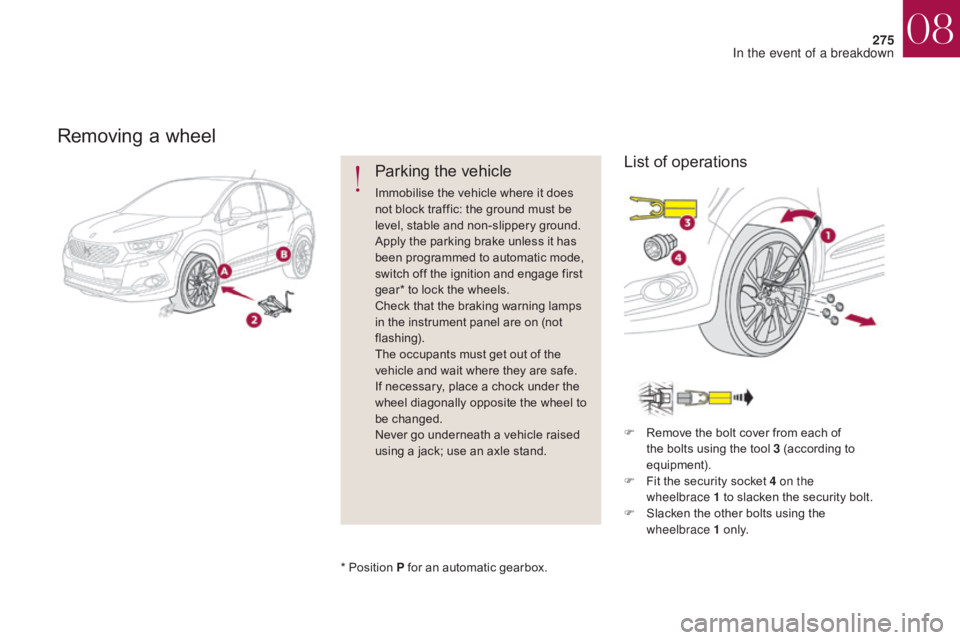
R
emove the bolt cover from each of
the bolts using the tool 3 (according to
equipment).
F
F
it the security socket 4 on the
wheelbrace
1 to slacken the security bolt.
F
S
lacken the other bolts using the
wheelbrace 1 o n l y.
*
Position P for an automatic gearbox.
List of operations
08
In the event of a breakdown
Page 279 of 421

277
Fitting a wheel
Fitting a steel or "space-
saver" spare wheel
If your vehicle is fitted with alloy
wheels, when tightening the bolts on
fitting it is normal to notice that the
washers do not come into contact with
the steel or "space-saver" spare wheel.
The wheel is secured by the conical
contact of each bolt.F
P
ut the wheel in place on the hub.
F
S
crew in the bolts by hand to the stop.
F P re-tighten the security bolt using the
wheelbrace 1 fitted with the security
socket
4 .
F
P
re-tighten the other bolts using the
wheelbrace 1 o n l y.
After changing a wheel
To store the punctured wheel in the
boot correctly, first remove the central
c ove r.
When using the "space-saver" type
spare wheel, do not exceed 50 mph
(80
km/h).
Have the tightening of the bolts and the
pressure of the spare wheel checked
by a CITROËN dealer or a qualified
workshop without delay.
Have the punctured wheel repaired and
replace it on the vehicle as soon as
possible.
List of operations
08
In the event of a breakdown
Page 280 of 421

278
F Lower the vehicle fully.
F F old the jack 2 and detach it. F
T ighten the security bolt using the
wheelbrace 1 fitted with the security
socket
4 .
F
T
ighten the other bolts using the
wheelbrace 1 o n l y.
F
R
efit the bolt covers to the bolts (according
to equipment).
F
S
tore the tools in the box.
08
In the event of a breakdown
Page 292 of 421

290
Fuse N°Rating Functions
F8 3 AAlarm siren, alarm ECU.
F13 10 ACigarette lighter / Front 12 V socket.
F14 10 A12 V socket in boot.
F16 3 ALighting for the large multifunctional storage unit, rear map
reading lamps, glove box illumination.
F17 3 ASun visor illumination, front map reading lamps.
F28 15 AAudio system, radio (after-market).
F30 20 ARear wiper.
F32 10 AHi-Fi amplifier.
Fusebox 2 Fuse N° Rating Functions
F36 15 ARear 12 V socket.
F37 -Not used.
F38 -Not used.
F39 -Not used.
F40 25 A230 V / 50 Hz socket.
Fuse tablesFusebox 1
08
In the event of a breakdown
Page 294 of 421

292
12 V battery
Access to the battery
Procedure for starting the engine using another battery or charging a discharged battery.If your vehicle has an automatic
gearbox, do not try to start the engine
by pushing the vehicle.
General points
Lead-acid starter batteries
Batteries contain harmful substances
such as sulphuric acid and lead.
They must be disposed of in
accordance with regulations and must
not, in any circumstances, be discarded
with household waste.
Take used remote control batteries and
vehicle batteries to a special collection
point.Protect your eyes and face before
handling the battery.
All operations on the battery must be
carried out in a well ventilated area and
away from naked flames and sources
of sparks, so as to avoid the risk of
explosion or fire.
Wash your hands after wards.The battery is located under the bonnet.
For access to the (+) terminal:
F
r elease the bonnet using the interior lever,
then the exterior safety catch,
F
r
aise the bonnet and secure it with its stay,
F
l
ift the plastic cover for access to
the
(+) terminal.
08
In the event of a breakdown