towing CITROEN RELAY 2019 Handbook (in English)
[x] Cancel search | Manufacturer: CITROEN, Model Year: 2019, Model line: RELAY, Model: CITROEN RELAY 2019Pages: 232, PDF Size: 8.21 MB
Page 140 of 232

138
A.Long socket.
B. B a r.
C. Jack.
D. Wheelbrace.
E. Screwdriver (handle and bits).
F. Removable towing eye.
2 - Remove the spare wheel
f
rom its compartment
To make the procedure easier, raise the
rear of the vehicle. The spare wheel is specific to your
vehicle, do not use it on other vehicles of
a
different model.
Likewise, do not use spare wheels that are
from a model different to your vehicle.
These instructions also apply to the bolts.
With steel wheels :
H. Handle.
I. Carrier. With alloy wheels
:
H. Handle.
I. Carrier.
J. Support.
K. Bolt.
In the event of a breakdown
Page 157 of 232

155
To w i n g
General recommendations
Obser ve the legislation in force in your
c o u nt r y.
Ensure that the weight of the towing
vehicle is higher than that of the towed
vehicle.
The driver must remain at the wheel of
the towed vehicle and must have a valid
driving licence.
When towing a
vehicle with all four wheels
on the ground, always use an approved
towbar; rope and straps are prohibited.
The towing vehicle must move off gently.
When the vehicle is towed with its engine
off, there is no longer braking and steering
assistance.
In the following cases, you must always
call on a
professional recovery ser vice:
-
v
ehicle broken down on a motor way or
main road,
-
f
our-wheel drive vehicle,
-
w
hen it is not possible to put the
gearbox into neutral, unlock the
steering, or release the parking brake,
-
t
owing with only two wheels on the
ground,
-
w
here there is no approved towbar
available.
The charging operation must be carried
out in a
ventilated area away from naked
flames or any possible sources of sparks
to eliminate the risk of explosion and fire.
Do not try to charge a
frozen battery: it
must first be thawed out to avoid the risk
of explosion. If the battery has frozen,
before charging it have it checked by
a
specialist who will verify that the internal
components have not been damaged and
that the case is not cracked, which could
mean that there is a
risk of a
leak of toxic
and corrosive acid.
Proceed with a
slow charge at low current
for a
maximum of about 24
hours to avoid
damaging the battery.
Charging the battery using
a battery charger
F Go to the battery located in the front left
f l o o r.
F
D
isconnect the battery.
F
F
ollow the instructions for use provided by
the manufacturer of the charger.
F
R
econnect starting with the negative (-)
terminal.
F
C
heck the condition of the terminals and
clamps. If they are covered with sulphate
(whitish or greenish deposits), disconnect
them and clean them all.
After refitting of the battery by a
CITROËN
dealer or a
qualified workshop, the Stop
& Start system will only be active after
a
continuous period of immobilisation
of the vehicle, a period which depends
on the climatic conditions and the state
of charge of the battery (up to about
8
h o u r s).
The presence of this label, in particular
with the Stop & Start system, indicates
the use of a
12 V lead-acid battery with
special technology and specification;
the involvement of a
CITROËN dealer or
a
qualified workshop is essential when
replacing or disconnecting the battery.
8
In the event of a breakdown
Page 158 of 232

156
Towing your vehicle
The removable towing eye is located in the tool
box under the front passenger seat.
F
U
nclip the cover using a flat tool.
The failure to follow this requirement may
lead to damage to components of the
braking system and the lack of braking
assistance on restarting the engine.
F
S
crew the removable towing eye in fully.
F
A
ttach the approved towbar to the
removable towing eye.
F
P
ut the gear lever into neutral.Towing another vehicle
The fixed towing eye is located on the right
below the bumper.
F
A
ttach the approved towbar to the fixed eye.
In the event of a breakdown
Page 159 of 232

157
Engine technical data and
towed loads
Engines
The engine characteristics are given in the
vehicle's registration document, as well as in
sales brochures.The maximum power corresponds to the
value type-approved on a
test bed, under
conditions defined in European legislation
(Directive 1999/99/EC).
For more information, contact a
CITROËN
dealer or a
qualified workshop.
Weights and towed loads
The maximum weights and towed loads for
your vehicle are given in the registration
document, as well as in sales brochures.
These values are also given on the
manufacturer's plate or label.
For more information, contact a CITROËN
dealer or a
qualified workshop. The GTW and towed load values indicated are
valid up to a
maximum altitude of 1,000 metres.
The towed load value must be reduced by 10%
for each additional 1,000 metres of altitude.
The maximum authorised nose weight
corresponds to the weight permitted on the
towbar (can be dismantled with or without
a
tool).
GT W: Gross train weight.
High ambient temperatures may result
in a reduction in the per formance of
the vehicle to protect the engine. If the
ambient temperature is above 37°C, limit
the towed load.
Towing with a towing vehicle which is only
slightly laden may negatively affect its
handling.
Towing a
trailer increases the braking
distance.
When towing, never exceed the speed
of 62
mph (100 km/h) (obser ve the local
legislation in force). If the exterior temperature is high, it is
recommended that the engine be allowed
to idle for 1
to 2 minutes after the vehicle
comes to a stop, to facilitate its cooling.
9
Technical data
Page 173 of 232
171
Crew cab
The crew cab is available on van
models and comprises a bench
seat, seat belts, a storage space
and side windows.
Rear bench seat Storage space
It is separated from the load space by a high-
s trength partition offering comfort and safety.
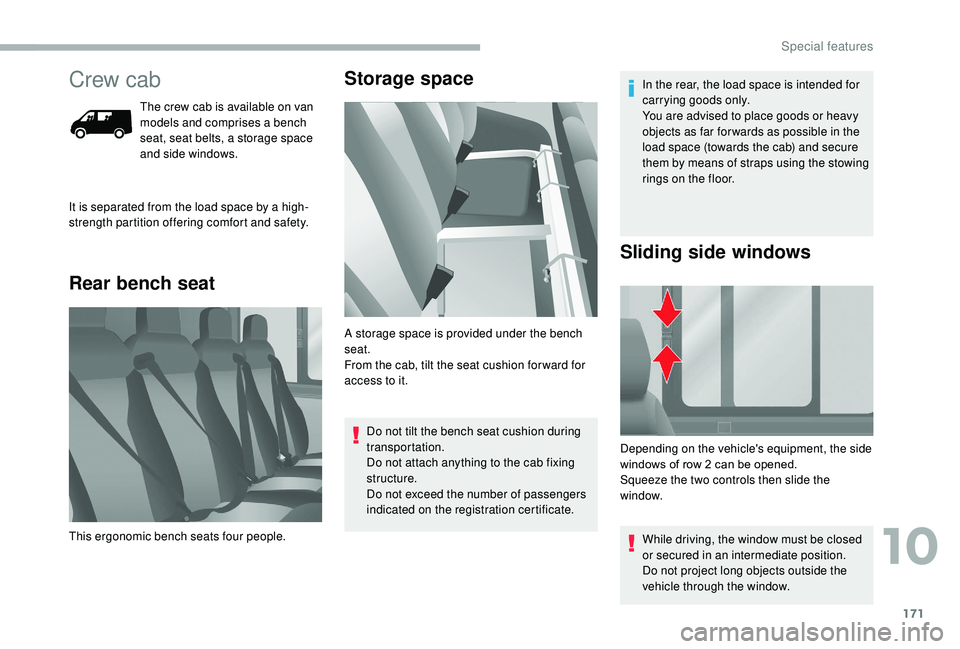
This ergonomic bench seats four people. A storage space is provided under the bench
seat.
From the cab, tilt the seat cushion for ward for
access to it.
Do not tilt the bench seat cushion during
transportation.
Do not attach anything to the cab fixing
structure.
Do not exceed the number of passengers
indicated on the registration certificate. In the rear, the load space is intended for
carrying goods only.
You are advised to place goods or heavy
objects as far for wards as possible in the
load space (towards the cab) and secure
them by means of straps using the stowing
rings on the floor.
Depending on the vehicle's equipment, the side
windows of row 2 can be opened.
Squeeze the two controls then slide the
window.
While driving, the window must be closed
or secured in an intermediate position.
Do not project long objects outside the
vehicle through the window.
Sliding side windows
10
Special features
Page 184 of 232

182
Weights and towed
loads (kg)
With load transfer, the braked trailer weight can
be increased, on condition that the equivalent
of this load is removed from the vehicle so that
the GTW is not exceeded. Warning: towing with
a lightly loaded towing vehicle may have an
adverse effect on its road holding.
The kerb weight is equal to the weight without
load + driver (75
kg) + fuel tank filled to 90%.
Hydraulic system
These precautions are mandator y for any
work on the hydraulic system. Before towing a trailer, check that:
-
t
he nose weight on the towbar ball does
not exceed the value (S) indicated on the
trailer's weight plate,
-
t
he maximum trailer weight is less than
the value indicated on the trailer's weight
plate and the Gross Vehicle Weight (GV W)
does not exceed the value indicated on the
vehicle's weight plate.
-
i
n the case of a self-supporting trailer,
the Gross Train Weight (GTW) must not
exceed the value indicated on the vehicle's
weight plate.
•
N
ever work under a tipper body that is not
supported,
• S witch off the power supply to the electro-
hydraulic unit using the circuit breaker,
•
V
ehicle stationary, engine off.
•
W
hen carrying out maintenance work
under the tipper body, place the tipper body
in the safety position secured with its stay
(position indicated by a red arrow under the
back of the tipper body),
Special features